
Home      Discussion      Topics      Dictionary      Almanac
Signup       Login
Mount Merapi

Mount Merapi

Overview
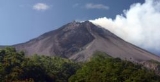
Mount Merapi, Gunung Merapi (literally Mountain of Fire) in Indonesian language
Indonesian language
Indonesian is the official national language of Indonesia. It is based on a version of Classical Malay of the Riau-Johor Sultanate. It was first declared the official language with the declaration of Indonesian independence in 1945, following the 1928 unifying-language declaration in the...

, is a conical volcano
Volcano
3. Conduit
4. Base
5. Sill
6. Dike
7. Layers of ash emitted by the volcano
8. Flank| 9. Layers of lava emitted by the volcano
10. Throat
11. Parasitic cone
12. Lava flow
13. Vent
14. Crater
15...

 located on the border between Central Java
Central Java
Central Java is a province of Indonesia. The administrative capital is Semarang. It is one of six provinces on the island of Java. The province of Central Java is 32,548.20 km2 in area; approximately a quarter of the total land area of Java...

 and Yogyakarta, Indonesia
Indonesia
The Republic of Indonesia is a country in Southeast Asia and Oceania. Indonesia comprises 17,508 islands. With an estimated population of around 237 million people, it is the world's fourth most populous country, with the world's largest population of Muslims.Indonesia is a republic, with an...

. It is the most active volcano in Indonesia and has erupted regularly since 1548. It is very close to the city of Yogyakarta
Yogyakarta (city)
Yogyakarta is a city in the Yogyakarta Special Region, Indonesia. It is renowned as a center of classical Javanese fine art and culture such as batik, ballet, drama, music, poetry, and puppet shows. It is also famous as a center for Indonesian higher education...

, and thousands of people live on the flanks of the volcano, with villages as high as 1700 m above sea level
Sea level
Mean sea level is the average height of the ocean's surface ; used as a standard in reckoning land elevation.- Measurement :...

.

Although smoke can be seen emerging from the mountain top at least 300 days a year, several eruptions have caused fatalities.
Discussion
Ask a question about 'Mount Merapi'
Start a new discussion about 'Mount Merapi'
Answer questions from other users
Full Discussion Forum
 
Encyclopedia
Mount Merapi, Gunung Merapi (literally Mountain of Fire) in Indonesian language
Indonesian language
Indonesian is the official national language of Indonesia. It is based on a version of Classical Malay of the Riau-Johor Sultanate. It was first declared the official language with the declaration of Indonesian independence in 1945, following the 1928 unifying-language declaration in the...

, is a conical volcano
Volcano
3. Conduit
4. Base
5. Sill
6. Dike
7. Layers of ash emitted by the volcano
8. Flank| 9. Layers of lava emitted by the volcano
10. Throat
11. Parasitic cone
12. Lava flow
13. Vent
14. Crater
15...

 located on the border between Central Java
Central Java
Central Java is a province of Indonesia. The administrative capital is Semarang. It is one of six provinces on the island of Java. The province of Central Java is 32,548.20 km2 in area; approximately a quarter of the total land area of Java...

 and Yogyakarta, Indonesia
Indonesia
The Republic of Indonesia is a country in Southeast Asia and Oceania. Indonesia comprises 17,508 islands. With an estimated population of around 237 million people, it is the world's fourth most populous country, with the world's largest population of Muslims.Indonesia is a republic, with an...

. It is the most active volcano in Indonesia and has erupted regularly since 1548. It is very close to the city of Yogyakarta
Yogyakarta (city)
Yogyakarta is a city in the Yogyakarta Special Region, Indonesia. It is renowned as a center of classical Javanese fine art and culture such as batik, ballet, drama, music, poetry, and puppet shows. It is also famous as a center for Indonesian higher education...

, and thousands of people live on the flanks of the volcano, with villages as high as 1700 m above sea level
Sea level
Mean sea level is the average height of the ocean's surface ; used as a standard in reckoning land elevation.- Measurement :...

.

Although smoke can be seen emerging from the mountain top at least 300 days a year, several eruptions have caused fatalities. Hot gas from a large explosion killed 64 people on November 22 in 1994, mostly in the town of Muntilan, west of the volcano. Another large eruption occurred in 2006, shortly before the Yogyakarta earthquake
May 2006 Java earthquake
The May 2006 Java earthquake occurred at 05:54 local time on 27 May 2006 , in the Indian Ocean around 25 km south-southwest of the Indonesian city of Yogyakarta, near Galur, on the southern side of the island of Java , 10 km below the seabed, with a magnitude of 6.3, according to the...

. In light of the hazards that Merapi poses to populated areas, it has been designated as one of the Decade Volcanoes
Decade Volcanoes
The Decade Volcanoes refer to the 16 volcanoes identified by the International Association of Volcanology and Chemistry of the Earth's Interior as being worthy of particular study in light of their history of large, destructive eruptions and proximity to populated areas...

.

Geological history


Merapi is the youngest in a group of volcanoes in southern Java. It is situated at a subduction
Subduction
In geology, subduction is the process that takes place at convergent boundaries by which one tectonic plate moves under another tectonic plate, sinking into the Earth's mantle, as the plates converge. A subduction zone is an area on Earth where two tectonic plates move towards one another and...

 zone, where the Indo-Australian Plate
Indo-Australian Plate
The Indo-Australian Plate is a major tectonic plate that includes the continent of Australia and surrounding ocean, and extends northwest to include the Indian subcontinent and adjacent waters...

 is sliding beneath the Eurasian Plate
Eurasian Plate
The Eurasian Plate is a tectonic plate which includes most of the continent of Eurasia , with the notable exceptions of the Indian subcontinent, the Arabian subcontinent, and the area east of the Chersky Range in East Siberia...

. It is one of at least 129 active volcanoes in Indonesia, part of the Pacific Ring of Fire
Pacific Ring of Fire
The Pacific Ring of Fire is an area where large numbers of earthquakes and volcanic eruptions occur in the basin of the Pacific Ocean. In a 40,000 km horseshoe shape, it is associated with a nearly continuous series of oceanic trenches, volcanic arcs, and volcanic belts and/or plate movements...

 – a section of fault lines stretching from the Western Hemisphere through Japan and South East Asia. Stratigraphic analysis reveals that eruptions in the Merapi area began about 400,000 years ago, and from then until about 10,000 years ago, eruptions were typically effusive, and the outflowing lava
Lava
Lava is molten rock expelled by a volcano during eruption. This molten rock is formed in the interior of some planets, including Earth, and some of their satellites. When first erupted from a volcanic vent, lava is a liquid at temperatures from 700 °C to 1,200 °C...

 emitted was basalt
Basalt
Basalt is a common extrusive volcanic rock. It is usually grey to black and fine-grained due to rapid cooling of lava at the surface of a planet. It may be porphyritic containing larger crystals in a fine matrix, or vesicular, or frothy scoria. Unweathered basalt is black or grey.On Earth, most...

ic. Since then, eruptions have become more explosive, with viscous andesitic
Andesite
Andesite is an igneous, volcanic rock, of intermediate composition, with aphanitic to porphyritic texture. The mineral assemblage is typically dominated by plagioclase plus pyroxene and/or hornblende. Magnetite, zircon, apatite, ilmenite, biotite, and garnet are common accessory minerals. Alkali...

 lavas often generating lava dome
Lava dome
|250px|thumb|right|Image of the [[rhyolitic]] lava dome of [[Chaitén Volcano]] during its 2008–2009 eruption.In volcanology, a lava dome is a roughly circular mound-shaped protrusion resulting from the slow extrusion of viscous lava from a volcano...

s. Dome collapse has often generated pyroclastic flow
Pyroclastic flow
A pyroclastic flow is a common and devastating result of certain explosive volcanic eruptions. The flows are fast-moving currents of hot gas and rock , which travel away from the volcano at speeds generally as great as 700 km/hr . The gas can reach temperatures of about...

s, and larger explosions, which have resulted in eruption column
Eruption column
An eruption column consists of hot volcanic ash emitted during an explosive volcanic eruption. The ash forms a column rising many kilometres into the air above the peak of the volcano. In the most explosive eruptions, the eruption column may rise over 40 km, penetrating the stratosphere...

s, have also generated pyroclastic flows through column collapse.

There has been no late eruption. Typically, small eruptions occur every two to three years, and larger ones every 10-15 years or so. Notable eruptions, often causing many deaths, have occurred in 1006, 1786, 1822, 1872 (the most violent eruption in recent history), and 1930—when thirteen villages were destroyed and 1400 people killed by pyroclastic flows.

A very large eruption in 1006 is claimed to have covered all of central Java with ash
Volcanic ash
Volcanic ash consists of small tephra, which are bits of pulverized rock and glass created by volcanic eruptions, less than in diameter. There are three mechanisms of volcanic ash formation: gas release under decompression causing magmatic eruptions; thermal contraction from chilling on contact...

. The volcanic devastation is claimed to have led to the collapse of the Hindu
Hindu
A Hindu is an adherent of Hinduism, a set of religious, philosophical and cultural systems that originated in the Indian subcontinent. The vast body of Hindu scriptures, divided into Śruti and Smriti , lay the foundation of Hindu beliefs which primarily include dhárma, kárma, ahimsa and saṃsāra...

 Kingdom of Mataram, however there is insufficient evidence from that era for this to be substantiated.

Merapi continues hold particular significance for the Javanese: it is one of four places where officials from the royal palaces of Yogyakarta and Solo
Surakarta
Surakarta is an Indonesian city of approximately 500,000 people located in Central Java.- Name :Surakarta is also known by the name "Solo". "Surakarta" is used in formal and official contexts. The city has a similar name with the neighboring district of "Kartasura", where the previous capital of...

 make annual offerings to placate the ancient Javanese spirits.

2006 eruption


In April 2006, increased seismicity at more regular intervals and a detected bulge in the volcano's cone indicated that fresh eruptions were imminent. Authorities put the volcano's neighboring villages on high alert and local residents prepared for a likely evacuation. On April 19 smoke from the crater reached a height of 400 meters, compared to 75 metres the previous day. On April 23, after nine surface tremors and some 156 multifaced quakes signalled movements of magma, some 600 elderly and infant residents of the slopes were evacuated.

By early May, active lava flows had begun. On May 11, with lava flow beginning to be constant, some 17,000 people were ordered to be evacuated from the area and on May 13, Indonesian authorities raised the alert status to the highest level, ordering the immediate evacuation of all residents on the mountain. Many villagers defied the dangers posed by the volcano and returned to their villages, fearing that their livestock and crops would be vulnerable to theft. Activity calmed by the middle of May.

On May 27, a 6.2 magnitude earthquake
May 2006 Java earthquake
The May 2006 Java earthquake occurred at 05:54 local time on 27 May 2006 , in the Indian Ocean around 25 km south-southwest of the Indonesian city of Yogyakarta, near Galur, on the southern side of the island of Java , 10 km below the seabed, with a magnitude of 6.3, according to the...

 struck roughly 30 miles southwest of Merapi, killing at least 5,000 and leaving at least 200,000 people homeless in the Yogyakarta region, heightening fears that Merapi will "blow". The quake did not appear to be a long-period oscillation, a seismic disturbance class that is increasingly associated with major volcanic eruptions. A further 11,000 villagers were evacuated on June 6 as lava and superheated clouds of gas poured repeatedly down its upper slopes. The pyroclastic flows are known locally as "wedhus gembel" (Javanese for "shaggy goat").

Monitoring


Mount Merapi is the site of a very active volcano monitoring program. Seismic
Seismology
Seismology is the scientific study of earthquakes and the propagation of elastic waves through the Earth...

 monitoring began in 1924, with some of the volcano monitoring stations lasting until the present. The Babadan (north west location), Selo (in the saddle between Merbabu
Mount Merbabu
Mount Merbabu is a dormant stratovolcano in Central Java province on the Indonesian island of Java. Loosely translated, Gunung Merbabu could mean 'Mountain of Ash' from the Indonesian word babu. The active volcano Mount Merapi is directly adjacent on its south-east side, while the city of Salatiga...

 and Merapi), and Plawangan
Plawangan
Plawangan is a hill above the town of Kaliurang, on the southern slopes of Gunung Merapi, Central Java, in Indonesia. It is east of Turgo, which is another named hill above Kaliurang....

 monitoring stations have been updated with equipment over the decades since establishment. During the 1950s and early 1960s some of the stations were starved of equipment and funds, but after the 1970s considerable improvement occurred with the supply of new equipment. Some of the pre-1930 observation posts were destroyed by the 1930 eruption, and newer posts were re-located. Similarly after the 1994 eruption, the Plawangan post and equipment were moved into Kaliurang
Kaliurang
Kaliurang is a small town located about 25 km north of the town of Yogyakarta, on the island of Java, Indonesia. It is located on the southern slopes of Mount Merapi, an active volcano....

 as a response to the threat of danger to the Volcanological personnel at the higher point.

The eruption of 1930 was found to have been preceded by a large earthquake swarm. The network of 8 seismographs currently around the volcano allow volcanologists to accurately pinpoint the hypocentres of tremors and quakes.

A zone in which no quakes originate is found about 1.5 km below the summit, and is thought to be the location of the magma reservoir
Magma chamber
A magma chamber is a large underground pool of molten rock found beneath the surface of the Earth's crust. The molten rock in such a chamber is under great pressure, and given enough time, that pressure can gradually fracture the rock around it creating outlets for the magma...

 which feeds the eruptions.

Other measurements taken on the volcano include magnetic
Magnetism
In physics, the term magnetism is used to describe how materials respond on the microscopic level to an applied magnetic field; to categorize the magnetic phase of a material. For example, the most well known form of magnetism is ferromagnetism such that some ferromagnetic materials produce their...

 measurements and tilt measurements. Small changes in the local magnetic field have been found to coincide with eruptions, and tilt measurements reveal the inflation of the volcano caused when the magma chambers beneath it is filling up.

Lahar
Lahar
A lahar is a type of mudflow or landslide composed of pyroclastic material and water that flows down from a volcano, typically along a river valley. The term "lahar" originated in the Javanese language of Indonesia.-Description:...

s (a type of mudflow
Mudflow
A mudslide is the most rapid and fluid type of downhill mass wasting. It is a rapid movement of a large mass of mud formed from loose soil and water. Similar terms are mudflow, mud stream, debris flow A mudslide is the most rapid (up to 80 km/h, or 50 mph) and fluid type of downhill mass...

 of pyroclastic material and water) are an important hazard on the mountain, and are caused by rain
Rain
Rain is liquid precipitation, as opposed to other kinds of precipitation such as snow, hail and sleet. On Earth, it is the condensation of atmospheric water vapor into drops heavy enough to fall, often making it to the surface...

 remobilizing pyroclastic flow deposits. Lahars can be detected seismically, as they cause a high-frequency
Frequency
Frequency is the number of occurrences of a repeating event per unit time. It is also referred to as temporal frequency.The period is the duration of one cycle in a repeating event, so the period is the reciprocal of the frequency....

seismic signal. Observations have found that about 50 mm of rain per hour is the threshold above which lahars are often generated.

Further reading

  • Triyoga, Lucas Sasongko. 1991 Manusia Jawa dan Gunung Merapi – Persepsi dan Sistem Kepercayaannya Yogyakarta, Gadjah Mada Universsity Press. ISBN 979-420-211-8
  • Decker, R. and Decker, B. (1997) Volcanoes, 3rd edition, WH Freeman, New York.

External links