

Trafford Park

Encyclopedia
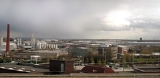
Trafford Park is an area of the Metropolitan Borough of Trafford
, in Greater Manchester
, England. Located opposite Salford Quays
, on the southern side of the Manchester Ship Canal
, it is 3.4 miles (5.5 km) west-southwest of Manchester city centre
, and 1.3 miles (2.1 km) north of Stretford
. Until the late 19th century it was the ancestral home of the Trafford
family, who sold it to financier Ernest Terah Hooley
in 1896. Occupying an area of 4.7 mi2, it was the first planned industrial estate
in the world, and remains the largest in Europe.
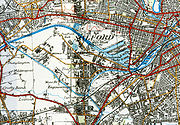
Trafford Park is almost entirely surrounded by water; the Bridgewater Canal
forms its southeastern and southwestern boundaries, and the Manchester Ship Canal, which opened in 1894, its northeastern and northwestern boundaries. Hooley's plan was to develop the Ship Canal frontage, but the canal was slow to generate the predicted volume of traffic, therefore in the early days the park was largely used for leisure activities such as golf, polo, and boating. British Westinghouse
was the first major company to move in, and by 1903 it was employing about half of the 12,000 workers then employed in the park, becoming one of the most important engineering facilities in Britain.
Trafford Park was a major supplier of materiel
during the First and Second World Wars, producing the Rolls-Royce Merlin
engines used to power both the Spitfire
and the Lancaster
. At its peak in 1945, an estimated 75,000 workers were employed in the park. That number began to decline during the 1960s as companies closed in favour of newer, more efficient plants elsewhere. By 1967 employment had fallen to 50,000, and the decline continued throughout the 1970s. The new generation of container ships was too large for the Manchester Ship Canal, which led to a further decline in Trafford Park's fortunes. The workforce had fallen to 15,000 by 1976, and by the 1980s industry had virtually disappeared from the park.
The Trafford Park Urban Development Corporation, formed in 1987, reversed the estate's decline. In the 11 years of its existence the park attracted 1,000 companies, generating 28,299 new jobs and £1.759 billion of private sector investment. As of 2008, there were 1,400 companies within Trafford Park, employing an estimated 35,000 people.
. It was the ancestral estate of the de Trafford family
, one of the most ancient in England, and then one of the largest landowners in Stretford. The family acquired the lands around Trafford in about 1200, when Richard de Trafford was given the lordship of Stretford by Hamon de Massey
, 4th Baron of Dunham. Some time between 1672 and 1720, the de Traffords moved from the home they had occupied since 1017, in what is now known as Old Trafford, to what was then called Whittleswick Hall, which they renamed Trafford Hall. Their new home was a little to the east of where Tenax Circle is now, at the northwestern end of Trafford Park Road.
Trafford Park contained the hall, its grounds, and three farms: Park Farm, Moss Farm, and Waters Meeting Farm. From the original three entrance lodges to the park, at Throstle Nest, Barton-upon-Irwell and Old Trafford, only the latter has survived, having been relocated from its original position opposite what is today the White City retail park to become the entrance to Gorse Hill Park.
In 1761, a section of the Bridgewater Canal
was built along the southeast and southwest sides of Trafford Park. The canal along with the River Irwell, which marked the estate's northeast and northwest boundaries, gave the park its present-day "island-like" quality. In about 1860, an 8 acres (32,374.9 m²) ornamental lake was dug in the north of the park, close to the River Irwell.
A meeting held in 1882 at the Didsbury
home of engineer Daniel Adamson
began the estate's transformation, with the creation of the Manchester Ship Canal
committee. Sir Humphrey de Trafford was an implacable opponent of the proposed canal, objecting that, amongst other things, it would bring polluted water close to his residence, interfere with his drainage, and render Trafford Hall uninhabitable, forcing him to "give up his home and leave the place". Despite Sir Humphrey's opposition the Ship Canal Bill became law on its third passage through Parliament, on 6 August 1885. Construction began in 1888, more than two years after Sir Humphrey's death, although a 9 feet (2.7 m) wall was built between the canal and the park, so as to block it off from view. Two wharves were also built, for the exclusive use of the de Traffords.
The opening of the ship canal in 1894 made Trafford Park a prime site for industrial development. During the following century, the park was built over with factories and some housing for workers. The deer were initially allowed to continue roaming free, but as the park's industrialisation gathered pace they were considered inappropriate and were killed, the last of them in 1900. Trafford Hall survived until its demolition following the Second World War.
put the 1183 acres (4,787,435.4 m²) estate up for auction, but it failed to reach its reported reserve price of £300,000 (£ as of ). There was much public debate, before and after the abortive sale, as to whether Manchester Corporation ought to buy Trafford Park, but the corporation could not agree terms quickly enough, and so on 23 June Ernest Terah Hooley
became the new owner of Trafford Park, for the sum of £360,000 (£ as of ).
On 17 August, Hooley formed Trafford Park Estates Ltd, transferring his ownership of the park to the new company – of which he was the chairman and a significant shareholder – at a substantial profit. The initial plans for the estate included a racetrack, exclusive housing and a cycle works, along with the development of the ship canal frontage for "all types of trade including timber". By that time the ship canal had been open for two years, but the predicted traffic had yet to materialise. Hooley met with Marshall Stevens
, the general manager of the Ship Canal Company, and both men recognised the benefit that the industrial development of Trafford Park could offer to the ship canal, and the ship canal to the estate. In January 1897 Stevens became the managing director of Trafford Park Estates. He remained with the company, latterly as its joint chairman and managing director, until 1930.
 The company initially chose not to construct buildings for letting, but instead to lease land for development. However, by the end of June 1897 less than 1 percent of the park had been leased, and so the park's existing assets were put to use until more tenants could be found. Trafford Hall was opened as a hotel in 1899, to serve prospective industrialists considering a move to the park, along with their key employees. It had 40 bedrooms, available to "Gentlemen only". The hall's stables and some other outbuildings were used for stock auctions and the sale of horses, from 1900 to 1902, and the ornamental lake was leased to William Crooke and Sons, for use as a boating lake, initially on a five-year lease. A polo
ground was set up in the park in 1902, and 80 acres (323,748.8 m²) of land near the hall were leased to the Manchester Golf Club, who laid out a three-mile (4.8 km) long course. The club moved from Trafford Park to a new site at Hopwood Park in 1912. All of the open-field land uses were subsequently pushed out by industry.
In 1908 the Estates Company decided to reverse its earlier policy of only leasing the land, and began to construct what were known as "Hives", 25 feet (7.6 m) wide subdivisions of a longer single building that could be internally reconfigured for each tenant's needs. A series of 19 were built initially, available to rent at £80 per annum (£ as of ). Brooke Bond
was one of the companies that took advantage of the Hives, before moving to its purpose-built factory on the park in 1922. The Estates Company also built large reinforced concrete warehouses, known as "Safes". These buildings were fitted with sprinkler systems and were considered fireproof, which reduced insurance costs to 25 percent of those of comparable warehouses elsewhere in the area. Each Safe had a capacity of 778000 cubic feet (22,030.5 m³), sufficient to hold 50,000 bales of cotton.
. Most of these early developments were built on the eastern side of the park, while the rest of it remained largely undeveloped.
The first American company to arrive was Westinghouse Electric
, which formed its British subsidiary – British Westinghouse Electric Company
– in 1899, and purchased 130 acre (0.5260918 km²) on two sites. Building work started in 1900, and the factory began production of turbines and electric generators in 1902. By the following year, British Westinghouse was employing about half of the 12,000 workers in Trafford Park. Its main machine shop was 899 feet (274 m) long and 440 feet (134 m) wide; for almost 100 years Westinghouse's Trafford Park works was the most important engineering facility in Britain. In 1919, Westinghouse was sold to the Vickers Company and renamed Metropolitan-Vickers
, often shortened to Metrovicks.
In 1903, the Cooperative Wholesale Society (CWS), bought land at Trafford Wharf and set up a large food-packing factory and a flour mill. Other companies arriving at about the same time included Kilverts (lard
manufacturers), the Liverpool Warehousing Company, and Lancashire Dynamo & Crypto Ltd.
The second major American company to set up a manufacturing base in Trafford Park
was the Ford Motor Company
, in 1911. Initially Ford used its factory as an assembly plant for the Model T, although other vehicles were assembled there in later years, before moving to a new factory at Dagenham
, Essex
, in 1931. By 1915, 100 American companies had moved into the park, peaking at over 200 by 1933. When the cotton industry began to decline in the early 20th century, Trafford Park and the Manchester Ship Canal helped Manchester – and to a lesser extent the rest of south Lancashire – to weather the economic depression from which the rest of Lancashire
suffered. During the First World War, the park was used for the manufacture of munitions, chemicals and other materiel. Most firms at Trafford Park succeeded in avoiding bankruptcy during the Great Depression
, unlike the rest of Lancashire. Ford moved to Dagenham in 1931, but returned temporarily to Trafford Park during the Second World War.
Metropolitan Vickers set up Manchester's and one of the UK's first radio stations at their factory in 1921. The station's first broadcast took place on 17 May 1922. In October that year the company was one of six who formed the British Broadcasting Company
(BBC), which started broadcasting from the Metrovicks studio under the call sign 2ZY
on 15 November 1922. Much of the station's content was musical, but news, plays, and children's programmes were also transmitted. Conditions in the small 30 foot studio were cramped, and the BBC moved the station to larger premises outside the park in 1923.
, which opened in 1998.
during the Second World War, such as the Avro Manchester
and Avro Lancaster
heavy bombers, and the Rolls-Royce Merlin
engines used to power the Spitfire
, Hurricane
, Mosquito
and the Lancaster. The engines were made by Ford, under licence. The 17,316 workers employed in Ford's purpose-built factory had produced 34,000 engines by the war's end. The facility was designed in two separate sections to minimise the impact of bomb damage on production. The wood-working factory of F. Hills & Sons built over 800 Percival Proctor
aircraft for the RAF between 1940 and 1945, which were flight tested at the nearby Barton Aerodrome
. Other companies produced gun bearings, steel tracks for Churchill tank
s, munitions, Bailey Bridge
s, and much else. ICI built and operated the first facility in the UK able to produce penicillin
in quantity.
As an important industrial area, the park suffered from extensive bombing, particularly during the Manchester Blitz
of December 1940. On the night of 23 December 1940, the Metropolitan-Vickers aircraft factory in Mosley Road was badly damaged, with the loss of the first 13 MV-built Avro Manchester bombers in final assembly. The new Ford factory producing aircraft engines was bombed only a few days after its opening in May 1941. Trafford Hall was severely damaged by bombing, and was demolished shortly after the war ended. At the outbreak of war in 1939 there were an estimated 50,000 workers employed in the park. By the end of the war in 1945 that number had risen to 75,000, probably the peak size of the park's workforce; Metropolitan-Vickers alone employed 26,000.
and Runcorn
at the western end of the Manchester Ship Canal were in the ascendency industrially and they overtook Trafford Park in economic importance. In 1967, employment had fallen to 50,000 and there was a further decline in the 1970s. In 1971, Stretford Council responded by setting up the Trafford Park Industrial Council (TRAFIC), membership of which was open to any firm in Trafford Park. One of TRAFIC's early initiatives was to encourage businesses in the park to address the general air of decay, by improving their own areas through landscaping and other environmental improvements. The park's decline was exacerbated by the decreasing use of the Manchester Ship Canal during the 1970s, which was unable to accommodate the newer, larger container ships then entering service. By 1976, the workforce had fallen to 15,000, and by the 1980s industry had virtually disappeared.
On 12 August 1981, 483 acres (2 km²) of Trafford Park – along with Salford Quays
– were declared an Enterprise Zone by the UK government, in an attempt to encourage new development within the estate. The new status did little to reverse the park's fortunes however; during a 1984 House of Commons debate, Member of Parliament
for Stretford
, Tony Lloyd
, described the area's decline as "spectacular and disastrous". The target had been to create 7,000 new jobs over 10 years, but by 1986 only 2,557 had been created, not even enough to compensate for the ongoing job losses caused by closures within the park. On 10 February 1987 the Trafford Park Development Corporation
was formed to assume responsibility for a 3130 acres (12.7 km²) Urban Development Area that included not only Trafford Park but also parts of Stretford, Salford Quays, and the former steelworks at Irlam
, now known as Northbank. Of the four redevelopment schemes undertaken by the corporation one, Wharfside, included 200 acres (80.9 ha) of the eastern end of the park as well as part of the ship canal docks and the area around Manchester United F.C.
's Old Trafford
football ground to the east of the Bridgewater Canal. The intention was to build "a flagship site" containing prestigious accommodation for offices, shops, and "hi-tech" industries, capitalising on the area's proximity to Manchester city centre and mirroring the earlier success of the redevelopment at nearby Salford Quays.
Between 1987 and 1998, the development corporation
attracted 1,000 companies, generating 28,299 new jobs and £1.759 billion of private sector investment. The setting up of the corporation was intended to be only a temporary measure, terminating on 31 March 1997, but it was extended for a further year until March 1998 when responsibility for Trafford Park's development passed to Trafford Council. The park is once again a major centre of employment in Trafford, and its regeneration has led to a high start-up rate for businesses and low rates of unemployment in the area. As of 2008, there were 1,400 companies within the park, employing an estimated 35,000 people.
. Tensions soon began to emerge between the Estates Company and Stretford Council over the provision of local services and infrastructure. In 1902, W. T. Glover & Co, a cable manufacturing company that had moved to the park from nearby Salford, built a power station next to their works to supply electricity to the rest of the park; the Estates Company had previously approached Manchester Corporation, but Stretford would not allow another local authority to supply electricity within its area.
In 1901, Manchester Corporation formally proposed a merger with Stretford UDC
, on the basis that Stretford's growth was due in large part to Trafford Park, the growth of which in turn was largely due to the Manchester Ship Canal. Manchester Corporation had provided one-third of the capital needed to build the ship canal, for which it had doubled its municipal debt, despite having also increased rates by 26 percent between 1892 and 1895. Stretford and Lancashire County Council
opposed the merger, which was rejected following a government inquiry. In 1969 Pevsner
wrote: "That [neighbouring] Stretford and Salford are not administratively one with Manchester is one of the most curious anomalies of England."
The tensions between Stretford and the Estates Company began to come to a head in 1906, when in response to complaints in the press about the state of one particular road in the park, Trafford Park Road, Stretford issued formal notices demanding that all premises with frontage onto the road pay for its improvement. Further disputes over the standard of roads in the park followed until, in 1907, the Estates Company presented a petition to Lancashire County Council demanding that Trafford Park should be an urban district in its own right, independent of Stretford. The county council dismissed the petition, but later that year, following a petition organised by the Trafford Park Ratepayers Association, a new local government ward, Park Ward, was created within Stretford, However, the new ward did not include the western part of the park, which remained under the control of Barton-upon-Irwell.
As a consequence of the Local Government Act 1972
, the borough of Stretford was abolished and Trafford Park has, since 1 April 1974, formed part of the Metropolitan Borough of Trafford
. As of 2010, the park is in the Trafford ward of Gorse Hill.
, a member of the Labour Party
, became the MP
at the 2010 General Election, with a majority of 8,935, representing 48.6 percent of the vote. The Conservatives
took 28.7 percent of the vote, the Liberal Democrats
16.9 percent, the United Kingdom Independence Party
3.4 percent, the Green Party
2.0 percent, and the Christian Party 0.4 percent.
of Trafford Park is either flat or gently undulating, about 144 feet (44 m) above sea level at its highest point. The local bedrock is Triassic Bunter Sandstone
, overlaid by sand and gravel deposited during the last ice age
, around 10,000 years ago. There are some areas of peat bog
in the west of the park, in the area formerly known as Trafford Moss. In 1793, William Roscoe
began work on reclaiming the bog, and by 1798 that work was sufficiently advanced for him to turn his attention to the task of reclaiming the much larger Chat Moss
in nearby Salford, also owned by the Trafford family.
The park occupies an area of 4.7 mi2, and is almost entirely surrounded by water. The Bridgewater Canal
forms its southeastern and southwestern boundaries, and the Manchester Ship Canal forms its northeastern and northwestern boundaries. Trafford Park is the most northerly area of Trafford, and faces Salford
across the Manchester Ship Canal. Stretford lies to the south and east, and Urmston
to the west.
The Village was almost completely self-contained, with its own shops, public hall, post office, police station, school, social club, and sports facilities. Three corrugated iron churches
were built: a Methodist chapel in 1901, St Cuthberts (Church of England
) in 1902, and the Roman Catholic St Antony's in 1904. St Cuthbert's was subsequently replaced by a brick building, but closed in 1982. Only St Antony's remains open; it contains the altar and a stained glass window from the chapel at Trafford Hall, donated by Lady Annette de Trafford. The Village's design attracted criticism from the start; the streets were narrow, with few gardens, and the whole development was close to the pollution of the neighbouring industries. In that respect it resembled the terraced properties in the surrounding areas, many of which were condemned as slum
s in later years. By the 1970s The Village was also considered by Stretford Council to be a slum area, and unsuitable for residential housing. In the first phase of clearance, during the mid-1970s, 298 houses were demolished. A further 325 houses were demolished in the early 1980s, leaving only the largest 84 houses remaining.
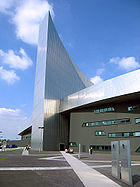 The Imperial War Museum North
, opened on 5 July 2002, is in Trafford Wharf, on the southern edge of the ship canal looking over towards Salford Quays
. An example of deconstructivist architecture
, it was the first building in the United Kingdom to be designed by Daniel Libeskind
. The structure consists of three interlocking sections: the air shard, the earth shard, and the water shard, representing a world torn apart by conflict. Entrance to the museum is via the air shard, which is 180 feet (55 m) in height, and is open to the elements. It has a viewing platform about 95 feet (29 m) high, offering views across Salford
and the Quays towards Manchester city centre. The museum houses two extensive exhibition spaces. The largest is dedicated to the permanent exhibition covering conflicts from 1900 to the present day, and the other space is used for special exhibitions.
Trafford Ecology Park
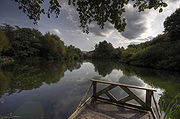 The 11 acres (44,515.5 m²) Trafford Ecology Park is what remains of Trafford Park's ornamental boating lake. Boating continued on the lake until the 1930s, but by then its water had become polluted by asbestos and oil seepage from the neighbouring Anglo American Oil depot. During the Second World War the site was used as a tip for foundry waste. Esso
bought the land in 1974, and levelled and partly seeded it, to improve the frontage to its own site. Trafford council bought the land from Esso in 1983, for £50,000 (£ as of ). Government spending restrictions delayed the park's restoration and conversion, and it was not fully opened to the public until 1990.
The present lake is about one-third of its original size, but although now relatively small it supports a wide variety of wildlife, including foxes, weasels, rabbits, hedgehogs, lapwings, kestrels, herons, coot, Canada Geese, and several varieties of newt. In 2007 the park was designated a Local Nature Reserve
, one of only two in Trafford.
, which paid a share of its takings to the Estates Company, but by 1899 the company was in serious financial difficulty, and entered voluntary liquidation. Salford Corporation then refused to provide any more gas for the trams, and the service was once again suspended until the Estates Company bought the entire operation for £2,000 in 1900. A separate electric tramway was installed in 1903, and was taken over and operated by Manchester and Salford Corporations in 1905. The takeover did not affect the gas trams however, which continued to run until 1908, when they were replaced by steam locomotives. Between 1904 and 1907 the Estates Company also operated a horse-drawn bus for the use of "gentlemen" staying at Trafford Hall, then a hotel. The service, available 24-hours a day, was replaced by a motor car in 1907.
Under an 1898 agreement between the Estates Company and the Ship Canal Company, the latter committed to carry freight on their dock railway between the docks and the park and to the construction of a permanent connection between the two railway networks. The West Manchester Light Railway Company was set up the following year to take over the operations of the tramway and to lay additional track. In 1904 responsibility for all of the parks roads and railways passed to the Trafford Park Company, as a result of the Trafford Park Act of that year. The railway network could subsequently be extended as required, without the need to seek additional permissions from Parliament. The network was also connected to the Manchester, South Junction and Altrincham Railway
near Cornbrook. At its peak, the estate's railway network covered 26 route miles (42 km), handling about 2.5 million tons of cargo in 1940. Like the rest of the park, it fell into decline during the 1960s, exacerbated by the increasing use of road transport, and it was closed in 1998. The Trafford Park Euroterminal rail freight terminal, which has the capacity to deal with 100,000 containers a year, was opened in 1993, at a cost of £11 million.
Trafford Park Aerodrome
was Manchester's first purpose-built airfield, laid out on a site between Trafford Park Road, Mosley Road, and Ashburton Road. The first aircraft landed there on 7 July 1911, flown from Liverpool
by Henry G. Melly. The aerodrome was in use until the early years of the First World War, and possibly until 1918, when it was replaced by the newly completed Alexandra Park Aerodrome
.
Trafford
The Metropolitan Borough of Trafford is a metropolitan borough of Greater Manchester, England. It has a population of 211,800, covers , and includes the towns of Altrincham, Partington, Sale, Stretford, and Urmston...
, in Greater Manchester
Greater Manchester
Greater Manchester is a metropolitan county in North West England, with a population of 2.6 million. It encompasses one of the largest metropolitan areas in the United Kingdom and comprises ten metropolitan boroughs: Bolton, Bury, Oldham, Rochdale, Stockport, Tameside, Trafford, Wigan, and the...
, England. Located opposite Salford Quays
Salford Quays
Salford Quays is an area of Salford in Greater Manchester, England, near the end of the Manchester Ship Canal. Previously the site of Manchester Docks, it became one of the first and largest urban regeneration projects in the United Kingdom following the closure of the dockyards in...
, on the southern side of the Manchester Ship Canal
Manchester Ship Canal
The Manchester Ship Canal is a river navigation 36 miles long in the North West of England. Starting at the Mersey Estuary near Liverpool, it generally follows the original routes of the rivers Mersey and Irwell through the historic counties of Cheshire and Lancashire. Several sets of locks lift...
, it is 3.4 miles (5.5 km) west-southwest of Manchester city centre
Manchester City Centre
Manchester city centre is the central business district of Manchester, England. It lies within the Manchester Inner Ring Road, next to the River Irwell...
, and 1.3 miles (2.1 km) north of Stretford
Stretford
Stretford is a town within the Metropolitan Borough of Trafford, in Greater Manchester, England. Lying on flat ground between the River Mersey and the Manchester Ship Canal, it is to the southwest of Manchester city centre, south-southwest of Salford and northeast of Altrincham...
. Until the late 19th century it was the ancestral home of the Trafford
Trafford (surname)
Trafford is an English surname of Anglo-Saxon origin.The de Trafford family is one of the most ancient recorded families in England, tracing its roots back to Radulphus, who died in about 1050. As Anglo-Saxons, the family initially resisted the Norman army, but were granted a pardon shortly after...
family, who sold it to financier Ernest Terah Hooley
Ernest Terah Hooley
Ernest Terah Hooley was an English financier and developer of the Trafford Park industrial estate in the outskirts of Manchester.-Biography:...
in 1896. Occupying an area of 4.7 mi2, it was the first planned industrial estate
Industrial park
An industrial park is an area zoned and planned for the purpose of industrial development...
in the world, and remains the largest in Europe.
Trafford Park is almost entirely surrounded by water; the Bridgewater Canal
Bridgewater Canal
The Bridgewater Canal connects Runcorn, Manchester and Leigh, in North West England. It was commissioned by Francis Egerton, 3rd Duke of Bridgewater, to transport coal from his mines in Worsley to Manchester...
forms its southeastern and southwestern boundaries, and the Manchester Ship Canal, which opened in 1894, its northeastern and northwestern boundaries. Hooley's plan was to develop the Ship Canal frontage, but the canal was slow to generate the predicted volume of traffic, therefore in the early days the park was largely used for leisure activities such as golf, polo, and boating. British Westinghouse
British Westinghouse
British Westinghouse Electrical and Manufacturing Company was a subsidiary of the American Westinghouse Electric and Manufacturing Company. British Westinghouse would become a subsidiary of Metropolitan-Vickers in 1919; and after Metropolitan Vickers merged with British Thomson-Houston in 1929, it...
was the first major company to move in, and by 1903 it was employing about half of the 12,000 workers then employed in the park, becoming one of the most important engineering facilities in Britain.
Trafford Park was a major supplier of materiel
Materiel
Materiel is a term used in English to refer to the equipment and supplies in military and commercial supply chain management....
during the First and Second World Wars, producing the Rolls-Royce Merlin
Rolls-Royce Merlin
The Rolls-Royce Merlin is a British liquid-cooled, V-12, piston aero engine, of 27-litre capacity. Rolls-Royce Limited designed and built the engine which was initially known as the PV-12: the PV-12 became known as the Merlin following the company convention of naming its piston aero engines after...
engines used to power both the Spitfire
Supermarine Spitfire
The Supermarine Spitfire is a British single-seat fighter aircraft that was used by the Royal Air Force and many other Allied countries throughout the Second World War. The Spitfire continued to be used as a front line fighter and in secondary roles into the 1950s...
and the Lancaster
Avro Lancaster
The Avro Lancaster is a British four-engined Second World War heavy bomber made initially by Avro for the Royal Air Force . It first saw active service in 1942, and together with the Handley Page Halifax it was one of the main heavy bombers of the RAF, the RCAF, and squadrons from other...
. At its peak in 1945, an estimated 75,000 workers were employed in the park. That number began to decline during the 1960s as companies closed in favour of newer, more efficient plants elsewhere. By 1967 employment had fallen to 50,000, and the decline continued throughout the 1970s. The new generation of container ships was too large for the Manchester Ship Canal, which led to a further decline in Trafford Park's fortunes. The workforce had fallen to 15,000 by 1976, and by the 1980s industry had virtually disappeared from the park.
The Trafford Park Urban Development Corporation, formed in 1987, reversed the estate's decline. In the 11 years of its existence the park attracted 1,000 companies, generating 28,299 new jobs and £1.759 billion of private sector investment. As of 2008, there were 1,400 companies within Trafford Park, employing an estimated 35,000 people.
Pre-industrial
Until the industrial development of the park began in the late 19th century, much of the area now known as Trafford Park was a "beautifully timbered deer park". Its 1183 acres (4,787,435.4 m²) comprised flat meadows and grassland, and an inner park containing a tree-lined avenue leading from an entrance lodge at Barton-upon-IrwellBarton-upon-Irwell
Barton-upon-Irwell is a suburban area of Eccles, Greater Manchester, England.-History:...
. It was the ancestral estate of the de Trafford family
Trafford (surname)
Trafford is an English surname of Anglo-Saxon origin.The de Trafford family is one of the most ancient recorded families in England, tracing its roots back to Radulphus, who died in about 1050. As Anglo-Saxons, the family initially resisted the Norman army, but were granted a pardon shortly after...
, one of the most ancient in England, and then one of the largest landowners in Stretford. The family acquired the lands around Trafford in about 1200, when Richard de Trafford was given the lordship of Stretford by Hamon de Massey
Hamon de Massey
The first Hamon de Massey was the owner of the manors of Agden, Baguley, Bowdon, Dunham, Hale and Little Bollington after the Norman conquest of England in 1066, taking over from the Saxon thegn Aelfward according to the Domesday Book....
, 4th Baron of Dunham. Some time between 1672 and 1720, the de Traffords moved from the home they had occupied since 1017, in what is now known as Old Trafford, to what was then called Whittleswick Hall, which they renamed Trafford Hall. Their new home was a little to the east of where Tenax Circle is now, at the northwestern end of Trafford Park Road.
Trafford Park contained the hall, its grounds, and three farms: Park Farm, Moss Farm, and Waters Meeting Farm. From the original three entrance lodges to the park, at Throstle Nest, Barton-upon-Irwell and Old Trafford, only the latter has survived, having been relocated from its original position opposite what is today the White City retail park to become the entrance to Gorse Hill Park.
In 1761, a section of the Bridgewater Canal
Bridgewater Canal
The Bridgewater Canal connects Runcorn, Manchester and Leigh, in North West England. It was commissioned by Francis Egerton, 3rd Duke of Bridgewater, to transport coal from his mines in Worsley to Manchester...
was built along the southeast and southwest sides of Trafford Park. The canal along with the River Irwell, which marked the estate's northeast and northwest boundaries, gave the park its present-day "island-like" quality. In about 1860, an 8 acres (32,374.9 m²) ornamental lake was dug in the north of the park, close to the River Irwell.
A meeting held in 1882 at the Didsbury
Didsbury
Didsbury is a suburban area of the City of Manchester, in Greater Manchester, England. It lies on the north bank of the River Mersey, south of Manchester city centre, in the southern half of the Greater Manchester Urban Area...
home of engineer Daniel Adamson
Daniel Adamson
Daniel Adamson was a notable English engineer who became a successful manufacturer of boilers and was the driving force behind the inception of the Manchester Ship Canal project during the 1880s.-Early life:...
began the estate's transformation, with the creation of the Manchester Ship Canal
Manchester Ship Canal
The Manchester Ship Canal is a river navigation 36 miles long in the North West of England. Starting at the Mersey Estuary near Liverpool, it generally follows the original routes of the rivers Mersey and Irwell through the historic counties of Cheshire and Lancashire. Several sets of locks lift...
committee. Sir Humphrey de Trafford was an implacable opponent of the proposed canal, objecting that, amongst other things, it would bring polluted water close to his residence, interfere with his drainage, and render Trafford Hall uninhabitable, forcing him to "give up his home and leave the place". Despite Sir Humphrey's opposition the Ship Canal Bill became law on its third passage through Parliament, on 6 August 1885. Construction began in 1888, more than two years after Sir Humphrey's death, although a 9 feet (2.7 m) wall was built between the canal and the park, so as to block it off from view. Two wharves were also built, for the exclusive use of the de Traffords.
The opening of the ship canal in 1894 made Trafford Park a prime site for industrial development. During the following century, the park was built over with factories and some housing for workers. The deer were initially allowed to continue roaming free, but as the park's industrialisation gathered pace they were considered inappropriate and were killed, the last of them in 1900. Trafford Hall survived until its demolition following the Second World War.
Early development
On 7 May 1896, Sir Humphrey Francis de TraffordSir Humphrey de Trafford, 3rd Baronet
Sir Humphrey Francis de Trafford was an English landowner and racehorse breeder. He was the son of Sir Humphrey de Trafford, 2nd Baronet and Lady Annette Mary Talbot....
put the 1183 acres (4,787,435.4 m²) estate up for auction, but it failed to reach its reported reserve price of £300,000 (£ as of ). There was much public debate, before and after the abortive sale, as to whether Manchester Corporation ought to buy Trafford Park, but the corporation could not agree terms quickly enough, and so on 23 June Ernest Terah Hooley
Ernest Terah Hooley
Ernest Terah Hooley was an English financier and developer of the Trafford Park industrial estate in the outskirts of Manchester.-Biography:...
became the new owner of Trafford Park, for the sum of £360,000 (£ as of ).
On 17 August, Hooley formed Trafford Park Estates Ltd, transferring his ownership of the park to the new company – of which he was the chairman and a significant shareholder – at a substantial profit. The initial plans for the estate included a racetrack, exclusive housing and a cycle works, along with the development of the ship canal frontage for "all types of trade including timber". By that time the ship canal had been open for two years, but the predicted traffic had yet to materialise. Hooley met with Marshall Stevens
Marshall Stevens
Marshall Stevens was an English property developer. His work with Daniel Adamson and others led to the construction of the Manchester Ship Canal, completed in 1894, and he was appointed general manager of the Ship Canal Company in 1891...
, the general manager of the Ship Canal Company, and both men recognised the benefit that the industrial development of Trafford Park could offer to the ship canal, and the ship canal to the estate. In January 1897 Stevens became the managing director of Trafford Park Estates. He remained with the company, latterly as its joint chairman and managing director, until 1930.
Polo
Polo is a team sport played on horseback in which the objective is to score goals against an opposing team. Sometimes called, "The Sport of Kings", it was highly popularized by the British. Players score by driving a small white plastic or wooden ball into the opposing team's goal using a...
ground was set up in the park in 1902, and 80 acres (323,748.8 m²) of land near the hall were leased to the Manchester Golf Club, who laid out a three-mile (4.8 km) long course. The club moved from Trafford Park to a new site at Hopwood Park in 1912. All of the open-field land uses were subsequently pushed out by industry.
In 1908 the Estates Company decided to reverse its earlier policy of only leasing the land, and began to construct what were known as "Hives", 25 feet (7.6 m) wide subdivisions of a longer single building that could be internally reconfigured for each tenant's needs. A series of 19 were built initially, available to rent at £80 per annum (£ as of ). Brooke Bond
Brooke Bond
Brooke Bond is a brand-name of tea owned by Unilever, formerly an independent manufacturer in the United Kingdom, known for its PG Tips brand and its Brooke Bond tea cards.- History :...
was one of the companies that took advantage of the Hives, before moving to its purpose-built factory on the park in 1922. The Estates Company also built large reinforced concrete warehouses, known as "Safes". These buildings were fitted with sprinkler systems and were considered fireproof, which reduced insurance costs to 25 percent of those of comparable warehouses elsewhere in the area. Each Safe had a capacity of 778000 cubic feet (22,030.5 m³), sufficient to hold 50,000 bales of cotton.
Industrialisation
Among the first industries to arrive was the Manchester Patent Fuel Company, in 1898. The Trafford Brick Company arrived soon after, followed by J.W. Southern & Co. (timber merchants), James Gresham (engineers), and W. T. Glovers & Co. (electric cable manufacturers). Glovers also built a power station in the park, on the banks of the Bridgewater CanalBridgewater Canal
The Bridgewater Canal connects Runcorn, Manchester and Leigh, in North West England. It was commissioned by Francis Egerton, 3rd Duke of Bridgewater, to transport coal from his mines in Worsley to Manchester...
. Most of these early developments were built on the eastern side of the park, while the rest of it remained largely undeveloped.
The first American company to arrive was Westinghouse Electric
Westinghouse Electric (1886)
Westinghouse Electric was an American manufacturing company. It was founded in 1886 as Westinghouse Electric Company and later renamed Westinghouse Electric Corporation by George Westinghouse. The company purchased CBS in 1995 and became CBS Corporation in 1997...
, which formed its British subsidiary – British Westinghouse Electric Company
British Westinghouse
British Westinghouse Electrical and Manufacturing Company was a subsidiary of the American Westinghouse Electric and Manufacturing Company. British Westinghouse would become a subsidiary of Metropolitan-Vickers in 1919; and after Metropolitan Vickers merged with British Thomson-Houston in 1929, it...
– in 1899, and purchased 130 acre (0.5260918 km²) on two sites. Building work started in 1900, and the factory began production of turbines and electric generators in 1902. By the following year, British Westinghouse was employing about half of the 12,000 workers in Trafford Park. Its main machine shop was 899 feet (274 m) long and 440 feet (134 m) wide; for almost 100 years Westinghouse's Trafford Park works was the most important engineering facility in Britain. In 1919, Westinghouse was sold to the Vickers Company and renamed Metropolitan-Vickers
Metropolitan-Vickers
Metropolitan-Vickers, Metrovick, or Metrovicks, was a British heavy electrical engineering company of the early-to-mid 20th century formerly known as British Westinghouse. Highly diversified, they were particularly well known for their industrial electrical equipment such as generators, steam...
, often shortened to Metrovicks.
In 1903, the Cooperative Wholesale Society (CWS), bought land at Trafford Wharf and set up a large food-packing factory and a flour mill. Other companies arriving at about the same time included Kilverts (lard
Lard
Lard is pig fat in both its rendered and unrendered forms. Lard was commonly used in many cuisines as a cooking fat or shortening, or as a spread similar to butter. Its use in contemporary cuisine has diminished because of health concerns posed by its saturated-fat content and its often negative...
manufacturers), the Liverpool Warehousing Company, and Lancashire Dynamo & Crypto Ltd.
The second major American company to set up a manufacturing base in Trafford Park
Ford Trafford Park Factory
The Ford Trafford Park assembly plant was a car assembly plant established by the UK subsidiary of the Ford Motor Company. The plant was located at a recently established Industrial park called Trafford Park, beside the Manchester Ship Canal, a short distance to the west of Manchester...
was the Ford Motor Company
Ford Motor Company
Ford Motor Company is an American multinational automaker based in Dearborn, Michigan, a suburb of Detroit. The automaker was founded by Henry Ford and incorporated on June 16, 1903. In addition to the Ford and Lincoln brands, Ford also owns a small stake in Mazda in Japan and Aston Martin in the UK...
, in 1911. Initially Ford used its factory as an assembly plant for the Model T, although other vehicles were assembled there in later years, before moving to a new factory at Dagenham
Dagenham
Dagenham is a large suburb in East London, forming the eastern part of the London Borough of Barking and Dagenham and located east of Charing Cross. It was historically an agrarian village in the county of Essex and remained mostly undeveloped until 1921 when the London County Council began...
, Essex
Essex
Essex is a ceremonial and non-metropolitan county in the East region of England, and one of the home counties. It is located to the northeast of Greater London. It borders with Cambridgeshire and Suffolk to the north, Hertfordshire to the west, Kent to the South and London to the south west...
, in 1931. By 1915, 100 American companies had moved into the park, peaking at over 200 by 1933. When the cotton industry began to decline in the early 20th century, Trafford Park and the Manchester Ship Canal helped Manchester – and to a lesser extent the rest of south Lancashire – to weather the economic depression from which the rest of Lancashire
Lancashire
Lancashire is a non-metropolitan county of historic origin in the North West of England. It takes its name from the city of Lancaster, and is sometimes known as the County of Lancaster. Although Lancaster is still considered to be the county town, Lancashire County Council is based in Preston...
suffered. During the First World War, the park was used for the manufacture of munitions, chemicals and other materiel. Most firms at Trafford Park succeeded in avoiding bankruptcy during the Great Depression
Great Depression
The Great Depression was a severe worldwide economic depression in the decade preceding World War II. The timing of the Great Depression varied across nations, but in most countries it started in about 1929 and lasted until the late 1930s or early 1940s...
, unlike the rest of Lancashire. Ford moved to Dagenham in 1931, but returned temporarily to Trafford Park during the Second World War.
Metropolitan Vickers set up Manchester's and one of the UK's first radio stations at their factory in 1921. The station's first broadcast took place on 17 May 1922. In October that year the company was one of six who formed the British Broadcasting Company
BBC
The British Broadcasting Corporation is a British public service broadcaster. Its headquarters is at Broadcasting House in the City of Westminster, London. It is the largest broadcaster in the world, with about 23,000 staff...
(BBC), which started broadcasting from the Metrovicks studio under the call sign 2ZY
2ZY
2ZY was the name of a radio station broadcast by the British Broadcasting Company from Manchester, England, between 1922 and 1927. It had its first test transmission on 450 metres on 17 May 1922 and began regular broadcasts on 15 November 1922, one day after sister station 2LO started daily...
on 15 November 1922. Much of the station's content was musical, but news, plays, and children's programmes were also transmitted. Conditions in the small 30 foot studio were cramped, and the BBC moved the station to larger premises outside the park in 1923.
Westwards expansion
Sir Humphrey de Trafford had retained 1300 acres (526.1 ha) of land on the western side of the ship canal after his 1897 sale of Trafford Park. Hemmed in as it was between the canals and "an increasingly urbanised Stretford to the east", as the industrialisation of the park neared its completion the Estates Company started to acquire parcels of the remaining de Trafford land, then in the control of family trustees, as did the Canal Company. In 1924 the Estates Company bought a half share in Dumplington Estates Ltd., a company set up to administer 38 acres (15.4 ha) of land bought from the de Trafford Trustees on which it was intended to build a garden village. In 1929 the Ship Canal Company acquired Dumplington Estates, and in return gave the Estates Company land to the south of Barton, the Trafford Park Extension. The Canal Company recognised the potential for a new dock on the land, giving the area its name of Barton Dock Estate, although no dock was ever built. The Barton Docks area was developed during and after the Second World War, but the land belonging to Dumplington Estates remained largely undeveloped until the construction of the Trafford CentreTrafford Centre
The Trafford Centre is a large indoor shopping centre and leisure complex situated in the Metropolitan Borough of Trafford in Greater Manchester, close to the Trafford Park industrial estate and approximately 5 miles from Manchester city centre. It is the highest valued shopping centre in the...
, which opened in 1998.
Second World War
Trafford Park was largely turned over to the production of war materielMateriel
Materiel is a term used in English to refer to the equipment and supplies in military and commercial supply chain management....
during the Second World War, such as the Avro Manchester
Avro Manchester
|-See also:-References:NotesCitationsBibliography* Buttler, Tony. British Secret Projects: Fighters and Bombers 1935–1950. Hickley, UK: Midland Publishing, 2004. ISBN 978-1857801798....
and Avro Lancaster
Avro Lancaster
The Avro Lancaster is a British four-engined Second World War heavy bomber made initially by Avro for the Royal Air Force . It first saw active service in 1942, and together with the Handley Page Halifax it was one of the main heavy bombers of the RAF, the RCAF, and squadrons from other...
heavy bombers, and the Rolls-Royce Merlin
Rolls-Royce Merlin
The Rolls-Royce Merlin is a British liquid-cooled, V-12, piston aero engine, of 27-litre capacity. Rolls-Royce Limited designed and built the engine which was initially known as the PV-12: the PV-12 became known as the Merlin following the company convention of naming its piston aero engines after...
engines used to power the Spitfire
Supermarine Spitfire
The Supermarine Spitfire is a British single-seat fighter aircraft that was used by the Royal Air Force and many other Allied countries throughout the Second World War. The Spitfire continued to be used as a front line fighter and in secondary roles into the 1950s...
, Hurricane
Hawker Hurricane
The Hawker Hurricane is a British single-seat fighter aircraft that was designed and predominantly built by Hawker Aircraft Ltd for the Royal Air Force...
, Mosquito
De Havilland Mosquito
The de Havilland DH.98 Mosquito was a British multi-role combat aircraft that served during the Second World War and the postwar era. It was known affectionately as the "Mossie" to its crews and was also nicknamed "The Wooden Wonder"...
and the Lancaster. The engines were made by Ford, under licence. The 17,316 workers employed in Ford's purpose-built factory had produced 34,000 engines by the war's end. The facility was designed in two separate sections to minimise the impact of bomb damage on production. The wood-working factory of F. Hills & Sons built over 800 Percival Proctor
Percival Proctor
The Percival Proctor was a British radio trainer and communications aircraft of the Second World War. The Proctor was a single-engine, low-wing monoplane with seating for three or four, depending on the model.-Design and development:...
aircraft for the RAF between 1940 and 1945, which were flight tested at the nearby Barton Aerodrome
Barton Aerodrome
City Airport is a general aviation airport in the Barton-upon-Irwell area of Eccles, in the City of Salford, Greater Manchester, England. Formerly known as both Barton Aerodrome and City Airport Manchester...
. Other companies produced gun bearings, steel tracks for Churchill tank
Churchill tank
The Tank, Infantry, Mk IV was a heavy British infantry tank used in the Second World War, best known for its heavy armour, large longitudinal chassis with all-around tracks with multiple bogies, and its use as the basis of many specialist vehicles. It was one of the heaviest Allied tanks of the war...
s, munitions, Bailey Bridge
Bailey bridge
The Bailey bridge is a type of portable, pre-fabricated, truss bridge. It was developed by the British during World War II for military use and saw extensive use by both British and the American military engineering units....
s, and much else. ICI built and operated the first facility in the UK able to produce penicillin
Penicillin
Penicillin is a group of antibiotics derived from Penicillium fungi. They include penicillin G, procaine penicillin, benzathine penicillin, and penicillin V....
in quantity.
As an important industrial area, the park suffered from extensive bombing, particularly during the Manchester Blitz
Manchester Blitz
The Manchester Blitz was the heavy bombing of the city of Manchester and its surrounding areas in North West England during the Second World War by the Nazi German Luftwaffe...
of December 1940. On the night of 23 December 1940, the Metropolitan-Vickers aircraft factory in Mosley Road was badly damaged, with the loss of the first 13 MV-built Avro Manchester bombers in final assembly. The new Ford factory producing aircraft engines was bombed only a few days after its opening in May 1941. Trafford Hall was severely damaged by bombing, and was demolished shortly after the war ended. At the outbreak of war in 1939 there were an estimated 50,000 workers employed in the park. By the end of the war in 1945 that number had risen to 75,000, probably the peak size of the park's workforce; Metropolitan-Vickers alone employed 26,000.
Decline and regeneration
In the 1960s, employment in the park began to decline as companies closed their premises in favour of newer, more efficient plants elsewhere. Ellesmere PortEllesmere Port
Ellesmere Port is a large industrial town and port in the unitary authority of Cheshire West and Chester and the ceremonial county of Cheshire, England. It is situated on the south border of the Wirral Peninsula on the banks of the Manchester Ship Canal, which in turn gives access to the River...
and Runcorn
Runcorn
Runcorn is an industrial town and cargo port within the borough of Halton in the ceremonial county of Cheshire, England. In 2009, its population was estimated to be 61,500. The town is on the southern bank of the River Mersey where the estuary narrows to form Runcorn Gap. Directly to the north...
at the western end of the Manchester Ship Canal were in the ascendency industrially and they overtook Trafford Park in economic importance. In 1967, employment had fallen to 50,000 and there was a further decline in the 1970s. In 1971, Stretford Council responded by setting up the Trafford Park Industrial Council (TRAFIC), membership of which was open to any firm in Trafford Park. One of TRAFIC's early initiatives was to encourage businesses in the park to address the general air of decay, by improving their own areas through landscaping and other environmental improvements. The park's decline was exacerbated by the decreasing use of the Manchester Ship Canal during the 1970s, which was unable to accommodate the newer, larger container ships then entering service. By 1976, the workforce had fallen to 15,000, and by the 1980s industry had virtually disappeared.
On 12 August 1981, 483 acres (2 km²) of Trafford Park – along with Salford Quays
Salford Quays
Salford Quays is an area of Salford in Greater Manchester, England, near the end of the Manchester Ship Canal. Previously the site of Manchester Docks, it became one of the first and largest urban regeneration projects in the United Kingdom following the closure of the dockyards in...
– were declared an Enterprise Zone by the UK government, in an attempt to encourage new development within the estate. The new status did little to reverse the park's fortunes however; during a 1984 House of Commons debate, Member of Parliament
Member of Parliament
A Member of Parliament is a representative of the voters to a :parliament. In many countries with bicameral parliaments, the term applies specifically to members of the lower house, as upper houses often have a different title, such as senate, and thus also have different titles for its members,...
for Stretford
Stretford
Stretford is a town within the Metropolitan Borough of Trafford, in Greater Manchester, England. Lying on flat ground between the River Mersey and the Manchester Ship Canal, it is to the southwest of Manchester city centre, south-southwest of Salford and northeast of Altrincham...
, Tony Lloyd
Tony Lloyd
Anthony Joseph 'Tony' Lloyd is a British Labour Party politician who has been the Member of Parliament for Manchester Central since 1997.-Early life:...
, described the area's decline as "spectacular and disastrous". The target had been to create 7,000 new jobs over 10 years, but by 1986 only 2,557 had been created, not even enough to compensate for the ongoing job losses caused by closures within the park. On 10 February 1987 the Trafford Park Development Corporation
Trafford Park Development Corporation
The Trafford Park Development Corporation was established in 1987 to develop land in Trafford and Salford. Its flagship developments included the Quay West office development at Wharfside, Trafford Park Village and Northbank Industrial Park. During its lifetime 8.3m sq.ft. of non-housing...
was formed to assume responsibility for a 3130 acres (12.7 km²) Urban Development Area that included not only Trafford Park but also parts of Stretford, Salford Quays, and the former steelworks at Irlam
Irlam
Irlam is a suburban town and unparished area within the City of Salford in Greater Manchester, England. At the 2001 census it had a population of 18,504. The town lies on flat ground on the south side of the M62 motorway and the north bank of the Manchester Ship Canal, and is west-southwest of...
, now known as Northbank. Of the four redevelopment schemes undertaken by the corporation one, Wharfside, included 200 acres (80.9 ha) of the eastern end of the park as well as part of the ship canal docks and the area around Manchester United F.C.
Manchester United F.C.
Manchester United Football Club is an English professional football club, based in Old Trafford, Greater Manchester, that plays in the Premier League. Founded as Newton Heath LYR Football Club in 1878, the club changed its name to Manchester United in 1902 and moved to Old Trafford in 1910.The 1958...
's Old Trafford
Old Trafford
Old Trafford commonly refers to two sporting arenas:* Old Trafford, home of Manchester United F.C.* Old Trafford Cricket Ground, home of Lancashire County Cricket ClubOld Trafford can also refer to:...
football ground to the east of the Bridgewater Canal. The intention was to build "a flagship site" containing prestigious accommodation for offices, shops, and "hi-tech" industries, capitalising on the area's proximity to Manchester city centre and mirroring the earlier success of the redevelopment at nearby Salford Quays.
Between 1987 and 1998, the development corporation
Development Corporation
In England and Wales, Development Corporations are bodies set up by the UK government and charged with the urban development of an area, outside the usual system of Town and Country Planning in the United Kingdom...
attracted 1,000 companies, generating 28,299 new jobs and £1.759 billion of private sector investment. The setting up of the corporation was intended to be only a temporary measure, terminating on 31 March 1997, but it was extended for a further year until March 1998 when responsibility for Trafford Park's development passed to Trafford Council. The park is once again a major centre of employment in Trafford, and its regeneration has led to a high start-up rate for businesses and low rates of unemployment in the area. As of 2008, there were 1,400 companies within the park, employing an estimated 35,000 people.
Civic history
The eastern area of the park, where the first developments took place at the end of the 19th century, was then under the local government control of Stretford Urban District; the west was controlled by the urban district of Barton-upon-IrwellBarton-upon-Irwell
Barton-upon-Irwell is a suburban area of Eccles, Greater Manchester, England.-History:...
. Tensions soon began to emerge between the Estates Company and Stretford Council over the provision of local services and infrastructure. In 1902, W. T. Glover & Co, a cable manufacturing company that had moved to the park from nearby Salford, built a power station next to their works to supply electricity to the rest of the park; the Estates Company had previously approached Manchester Corporation, but Stretford would not allow another local authority to supply electricity within its area.
In 1901, Manchester Corporation formally proposed a merger with Stretford UDC
Urban district
In the England, Wales and Ireland, an urban district was a type of local government district that covered an urbanised area. Urban districts had an elected Urban District Council , which shared local government responsibilities with a county council....
, on the basis that Stretford's growth was due in large part to Trafford Park, the growth of which in turn was largely due to the Manchester Ship Canal. Manchester Corporation had provided one-third of the capital needed to build the ship canal, for which it had doubled its municipal debt, despite having also increased rates by 26 percent between 1892 and 1895. Stretford and Lancashire County Council
Lancashire County Council
Lancashire County Council is the upper-tier local authority for the non-metropolitan county of Lancashire, England. It currently consists of 84 councillors, and is controlled by the Conservative Party, who won control of the council in the local council elections in June 2009, ending 28 years of...
opposed the merger, which was rejected following a government inquiry. In 1969 Pevsner
Nikolaus Pevsner
Sir Nikolaus Bernhard Leon Pevsner, CBE, FBA was a German-born British scholar of history of art and, especially, of history of architecture...
wrote: "That [neighbouring] Stretford and Salford are not administratively one with Manchester is one of the most curious anomalies of England."
The tensions between Stretford and the Estates Company began to come to a head in 1906, when in response to complaints in the press about the state of one particular road in the park, Trafford Park Road, Stretford issued formal notices demanding that all premises with frontage onto the road pay for its improvement. Further disputes over the standard of roads in the park followed until, in 1907, the Estates Company presented a petition to Lancashire County Council demanding that Trafford Park should be an urban district in its own right, independent of Stretford. The county council dismissed the petition, but later that year, following a petition organised by the Trafford Park Ratepayers Association, a new local government ward, Park Ward, was created within Stretford, However, the new ward did not include the western part of the park, which remained under the control of Barton-upon-Irwell.
As a consequence of the Local Government Act 1972
Local Government Act 1972
The Local Government Act 1972 is an Act of Parliament in the United Kingdom that reformed local government in England and Wales on 1 April 1974....
, the borough of Stretford was abolished and Trafford Park has, since 1 April 1974, formed part of the Metropolitan Borough of Trafford
Trafford
The Metropolitan Borough of Trafford is a metropolitan borough of Greater Manchester, England. It has a population of 211,800, covers , and includes the towns of Altrincham, Partington, Sale, Stretford, and Urmston...
. As of 2010, the park is in the Trafford ward of Gorse Hill.
Political representation
Since 1997, Trafford Park has been in the constituency of Stretford and Urmston. Kate GreenKate Green
Katherine Anne 'Kate' Green OBE is a British Labour Party politician, who has been the Member of Parliament for Stretford and Urmston since 2010.-Early life:Green was born in Edinburgh to Maurice and Jessie Craig Green...
, a member of the Labour Party
Labour Party (UK)
The Labour Party is a centre-left democratic socialist party in the United Kingdom. It surpassed the Liberal Party in general elections during the early 1920s, forming minority governments under Ramsay MacDonald in 1924 and 1929-1931. The party was in a wartime coalition from 1940 to 1945, after...
, became the MP
Member of Parliament
A Member of Parliament is a representative of the voters to a :parliament. In many countries with bicameral parliaments, the term applies specifically to members of the lower house, as upper houses often have a different title, such as senate, and thus also have different titles for its members,...
at the 2010 General Election, with a majority of 8,935, representing 48.6 percent of the vote. The Conservatives
Conservative Party (UK)
The Conservative Party, formally the Conservative and Unionist Party, is a centre-right political party in the United Kingdom that adheres to the philosophies of conservatism and British unionism. It is the largest political party in the UK, and is currently the largest single party in the House...
took 28.7 percent of the vote, the Liberal Democrats
Liberal Democrats
The Liberal Democrats are a social liberal political party in the United Kingdom which supports constitutional and electoral reform, progressive taxation, wealth taxation, human rights laws, cultural liberalism, banking reform and civil liberties .The party was formed in 1988 by a merger of the...
16.9 percent, the United Kingdom Independence Party
United Kingdom Independence Party
The United Kingdom Independence Party is a eurosceptic and right-wing populist political party in the United Kingdom. Whilst its primary goal is the UK's withdrawal from the European Union, the party has expanded beyond its single-issue image to develop a more comprehensive party platform.UKIP...
3.4 percent, the Green Party
Green Party of England and Wales
The Green Party of England and Wales is a political party in England and Wales which follows the traditions of Green politics and maintains a strong commitment to social progressivism. It is the largest Green party in the United Kingdom, containing within it various regional divisions including...
2.0 percent, and the Christian Party 0.4 percent.
Geography
The topographyTopography
Topography is the study of Earth's surface shape and features or those ofplanets, moons, and asteroids...
of Trafford Park is either flat or gently undulating, about 144 feet (44 m) above sea level at its highest point. The local bedrock is Triassic Bunter Sandstone
Bunter (geology)
Bunter beds are sandstone deposits containing rounded pebbles, such as can notably be found in Warwickshire, Cheshire, Staffordshire, Nottinghamshire, Yorkshire, Devon and Dorset in England...
, overlaid by sand and gravel deposited during the last ice age
Ice age
An ice age or, more precisely, glacial age, is a generic geological period of long-term reduction in the temperature of the Earth's surface and atmosphere, resulting in the presence or expansion of continental ice sheets, polar ice sheets and alpine glaciers...
, around 10,000 years ago. There are some areas of peat bog
Bog
A bog, quagmire or mire is a wetland that accumulates acidic peat, a deposit of dead plant material—often mosses or, in Arctic climates, lichens....
in the west of the park, in the area formerly known as Trafford Moss. In 1793, William Roscoe
William Roscoe
William Roscoe , was an English historian and miscellaneous writer.-Life:He was born in Liverpool, where his father, a market gardener, kept a public house called the Bowling Green at Mount Pleasant. Roscoe left school at the age of twelve, having learned all that his schoolmaster could teach...
began work on reclaiming the bog, and by 1798 that work was sufficiently advanced for him to turn his attention to the task of reclaiming the much larger Chat Moss
Chat Moss
Chat Moss is a large area of peat bog that makes up 30 percent of the City of Salford, in Greater Manchester, England. It is north of the River Irwell, to the west of Manchester, and occupies an area of about...
in nearby Salford, also owned by the Trafford family.
The park occupies an area of 4.7 mi2, and is almost entirely surrounded by water. The Bridgewater Canal
Bridgewater Canal
The Bridgewater Canal connects Runcorn, Manchester and Leigh, in North West England. It was commissioned by Francis Egerton, 3rd Duke of Bridgewater, to transport coal from his mines in Worsley to Manchester...
forms its southeastern and southwestern boundaries, and the Manchester Ship Canal forms its northeastern and northwestern boundaries. Trafford Park is the most northerly area of Trafford, and faces Salford
City of Salford
The City of Salford is a city and metropolitan borough of Greater Manchester, England. It is named after its largest settlement, Salford, but covers a far larger area which includes the towns of Eccles, Swinton-Pendlebury, Walkden and Irlam which apart from Irlam each have a population of over...
across the Manchester Ship Canal. Stretford lies to the south and east, and Urmston
Urmston
Urmston is a town within the Metropolitan Borough of Trafford, in Greater Manchester, England, with a population of around 41,000. Historically a part of Lancashire, it lies about six miles to the southwest of Manchester city centre. The southern boundary is marked by the River Mersey and the...
to the west.
Trafford Park Village
In 1898, a large plot of land was sold to Edmund Nuttall & Co. for the construction of 1,200 houses. The houses were never built, but the land later became the site of Trafford Park Village, known locally as "The Village". The announced arrival of the Westinghouse factory acted a spur to development, and in 1899, Trafford Park Dwellings Ltd was formed, with the aim of providing housing for the anticipated influx of new workers. Nuttall's land was acquired, and by 1903 over 500 houses had been built, rising to over 700 when the development was completed in 1904. In 1907 it was estimated that the population of the Village was 3,060. The development was laid out in a grid pattern, with the roads numbered instead of being named. Avenues numbered 1 to 4 run north–south, streets numbered 1 to 12 run east–west.The Village was almost completely self-contained, with its own shops, public hall, post office, police station, school, social club, and sports facilities. Three corrugated iron churches
Tin tabernacle
Tin tabernacles were a type of prefabricated building made from corrugated iron developed in the mid 19th century initially in Great Britain. Corrugated iron was first used for roofing in London in 1829 by Henry Robinson Palmer and the patent sold to Richard Walker who advertised "portable...
were built: a Methodist chapel in 1901, St Cuthberts (Church of England
Church of England
The Church of England is the officially established Christian church in England and the Mother Church of the worldwide Anglican Communion. The church considers itself within the tradition of Western Christianity and dates its formal establishment principally to the mission to England by St...
) in 1902, and the Roman Catholic St Antony's in 1904. St Cuthbert's was subsequently replaced by a brick building, but closed in 1982. Only St Antony's remains open; it contains the altar and a stained glass window from the chapel at Trafford Hall, donated by Lady Annette de Trafford. The Village's design attracted criticism from the start; the streets were narrow, with few gardens, and the whole development was close to the pollution of the neighbouring industries. In that respect it resembled the terraced properties in the surrounding areas, many of which were condemned as slum
Slum
A slum, as defined by United Nations agency UN-HABITAT, is a run-down area of a city characterized by substandard housing and squalor and lacking in tenure security. According to the United Nations, the percentage of urban dwellers living in slums decreased from 47 percent to 37 percent in the...
s in later years. By the 1970s The Village was also considered by Stretford Council to be a slum area, and unsuitable for residential housing. In the first phase of clearance, during the mid-1970s, 298 houses were demolished. A further 325 houses were demolished in the early 1980s, leaving only the largest 84 houses remaining.
Landmarks
Imperial War Museum North
Imperial War Museum North is a museum in the Metropolitan Borough of Trafford in Greater Manchester, England. One of the five branches of the Imperial War Museum, the museum explores the impact of modern conflicts on people and society. It is the first branch of the Imperial War Museum to be...
, opened on 5 July 2002, is in Trafford Wharf, on the southern edge of the ship canal looking over towards Salford Quays
Salford Quays
Salford Quays is an area of Salford in Greater Manchester, England, near the end of the Manchester Ship Canal. Previously the site of Manchester Docks, it became one of the first and largest urban regeneration projects in the United Kingdom following the closure of the dockyards in...
. An example of deconstructivist architecture
Deconstructivism
Deconstructivism is a development of postmodern architecture that began in the late 1980s. It is characterized by ideas of fragmentation, an interest in manipulating ideas of a structure's surface or skin, non-rectilinear shapes which serve to distort and dislocate some of the elements of...
, it was the first building in the United Kingdom to be designed by Daniel Libeskind
Daniel Libeskind
Daniel Libeskind, is an American architect, artist, and set designer of Polish-Jewish descent. Libeskind founded Studio Daniel Libeskind in 1989 with his wife, Nina, and is its principal design architect...
. The structure consists of three interlocking sections: the air shard, the earth shard, and the water shard, representing a world torn apart by conflict. Entrance to the museum is via the air shard, which is 180 feet (55 m) in height, and is open to the elements. It has a viewing platform about 95 feet (29 m) high, offering views across Salford
City of Salford
The City of Salford is a city and metropolitan borough of Greater Manchester, England. It is named after its largest settlement, Salford, but covers a far larger area which includes the towns of Eccles, Swinton-Pendlebury, Walkden and Irlam which apart from Irlam each have a population of over...
and the Quays towards Manchester city centre. The museum houses two extensive exhibition spaces. The largest is dedicated to the permanent exhibition covering conflicts from 1900 to the present day, and the other space is used for special exhibitions.
Trafford Ecology Park
Esso
Esso is an international trade name for ExxonMobil and its related companies. Pronounced , it is derived from the initials of the pre-1911 Standard Oil, and as such became the focus of much litigation and regulatory restriction in the United States. In 1972, it was largely replaced in the U.S. by...
bought the land in 1974, and levelled and partly seeded it, to improve the frontage to its own site. Trafford council bought the land from Esso in 1983, for £50,000 (£ as of ). Government spending restrictions delayed the park's restoration and conversion, and it was not fully opened to the public until 1990.
The present lake is about one-third of its original size, but although now relatively small it supports a wide variety of wildlife, including foxes, weasels, rabbits, hedgehogs, lapwings, kestrels, herons, coot, Canada Geese, and several varieties of newt. In 2007 the park was designated a Local Nature Reserve
Local Nature Reserve
Local nature reserve or LNR is a designation for nature reserves in the United Kingdom. The designation has its origin in the recommendations of the Wild Life Conservation Special Committee which established the framework for nature conservation in the United Kingdom and suggested a national suite...
, one of only two in Trafford.
Transport
At the end of the 19th century there were no public transport routes in, and few running close to, Trafford Park. Its size meant that the Estates Company was obliged to provide some means of travelling around the park, and therefore a gas-powered tramway was commissioned, intended to carry both people and freight. The first tram ran on 23 July 1897, but after a few days of operation there was an accident in which a tramcar was derailed, and the service was suspended until the following year. The tram's maximum speed was 12 miles per hour (5.4 m/s), and their distinctive exhaust smell quickly earned them the nickname "Lamp Oil Express". The service was operated by the British Gas Traction CompanyBritish Gas Traction Company
The British Gas Traction Company was incorporated on 13 July 1896 with an initial capitalisation of £250,000. Its major shareholders were Russell Cummins and John Fletcher Moulton M.P. The company was set up to operate gas-powered trams, which it worked initially on the Blackpool, St. Annes...
, which paid a share of its takings to the Estates Company, but by 1899 the company was in serious financial difficulty, and entered voluntary liquidation. Salford Corporation then refused to provide any more gas for the trams, and the service was once again suspended until the Estates Company bought the entire operation for £2,000 in 1900. A separate electric tramway was installed in 1903, and was taken over and operated by Manchester and Salford Corporations in 1905. The takeover did not affect the gas trams however, which continued to run until 1908, when they were replaced by steam locomotives. Between 1904 and 1907 the Estates Company also operated a horse-drawn bus for the use of "gentlemen" staying at Trafford Hall, then a hotel. The service, available 24-hours a day, was replaced by a motor car in 1907.
Under an 1898 agreement between the Estates Company and the Ship Canal Company, the latter committed to carry freight on their dock railway between the docks and the park and to the construction of a permanent connection between the two railway networks. The West Manchester Light Railway Company was set up the following year to take over the operations of the tramway and to lay additional track. In 1904 responsibility for all of the parks roads and railways passed to the Trafford Park Company, as a result of the Trafford Park Act of that year. The railway network could subsequently be extended as required, without the need to seek additional permissions from Parliament. The network was also connected to the Manchester, South Junction and Altrincham Railway
Manchester, South Junction and Altrincham Railway
The Manchester South Junction and Altrincham Railway was a suburban railway which operated a 13.7 km route between Altrincham in Cheshire and London Road Station in Manchester....
near Cornbrook. At its peak, the estate's railway network covered 26 route miles (42 km), handling about 2.5 million tons of cargo in 1940. Like the rest of the park, it fell into decline during the 1960s, exacerbated by the increasing use of road transport, and it was closed in 1998. The Trafford Park Euroterminal rail freight terminal, which has the capacity to deal with 100,000 containers a year, was opened in 1993, at a cost of £11 million.
Trafford Park Aerodrome
Trafford Park Aerodrome (Manchester)
Trafford Park Aerodrome was the first purpose-built airfield in the Manchester area. Its large all-grass landing field was just south of the Manchester Ship Canal between Trafford Park Road, Moseley Road and Ashburton Road and occupied a large part of the former deer park of Trafford Hall...
was Manchester's first purpose-built airfield, laid out on a site between Trafford Park Road, Mosley Road, and Ashburton Road. The first aircraft landed there on 7 July 1911, flown from Liverpool
Liverpool
Liverpool is a city and metropolitan borough of Merseyside, England, along the eastern side of the Mersey Estuary. It was founded as a borough in 1207 and was granted city status in 1880...
by Henry G. Melly. The aerodrome was in use until the early years of the First World War, and possibly until 1918, when it was replaced by the newly completed Alexandra Park Aerodrome
Alexandra Park Aerodrome
Alexandra Park Aerodrome was the second purpose-built aerodrome in the Manchester area. The site was chosen by the War Department in 1917 because of its open agricultural nature, and lay between the neighbouring districts of Fallowfield, Chorlton, Withington and West Didsbury, at the junction of...
.