
All Topics  
Swami Vivekananda


   Email Print
   Bookmark   Link


Swami Vivekananda


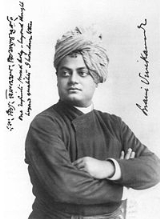
Swami Vivekananda (Shami Bibekanondo; , Svami Vivekananda) (January 12, 1863–July 4, 1902), born Narendranath Dutta is the chief disciple of the 19th century mystic Ramakrishna
Ramakrishna

Sri Ramakrishna Paramahamsa , born Gadadhar Chattopadhyay , is a famous mystic of 19th-century India. His religious school of thought led to the formation of the Ramakrishna Mission by his chief disciple Swami Vivekananda?both were influential figures in the Bengali Renaissance and the Hindu renaissance during 19th and 20th century....
 and the founder of Ramakrishna Mission
Ramakrishna Mission

Ramakrishna Math and Ramakrishna Mission are twin organizations which form the core of a worldwide spiritual movement known as Ramakrishna Movement or Vedanta Movement....
. Vivekananda was the Hindu missionary to the West. He is considered a key figure in the introduction of Vedanta
Vedanta

Vedanta is a spiritual tradition explained in the Upanishads that is concerned with the self-realisation by which one understands the ultimate nature of reality and teaches the believer's goal is to transcend the limitations of self-identity and realize one's unity with Brahman....
 and Yoga
Yoga

Yoga refers to traditional physical and mental disciplines originating in India. The word is associated with meditative practices in both Buddhism and Hinduism....
 in Europe
Europe

Europe is, conventionally, one of the world's seven continents. Comprising the westernmost peninsula of Eurasia, Europe is generally divided from Asia to its east by the water divide of the Ural Mountains, the Ural , the Caspian Sea, and by the Caucasus Mountains to the southeast....
 and America
United States

The United States of America is a Federal government constitutional republic comprising U.S. state and a federal district. The country is situated mostly in central North America, where its Contiguous United States and Washington, D.C., the Capital districts and territories, lie between the Pacific Ocean and Atlantic Oceans, Borders of the U...
 and is also credited with raising interfaith awareness, bringing Hinduism
Hinduism

'Hinduism' is the predominant religion of the Indian subcontinent. Hinduism is often referred to as , a Sanskrit phrase meaning "the eternal dharma", by its practitioners....
 to the status of a world religion during the end of 19th Century.


Discussion
Ask a question about 'Swami Vivekananda'
Start a new discussion about 'Swami Vivekananda'
Answer questions from other users
Full Discussion Forum


Encyclopedia


Swami Vivekananda (Shami Bibekanondo; , Svami Vivekananda) (January 12, 1863–July 4, 1902), born Narendranath Dutta is the chief disciple of the 19th century mystic Ramakrishna
Ramakrishna

Sri Ramakrishna Paramahamsa , born Gadadhar Chattopadhyay , is a famous mystic of 19th-century India. His religious school of thought led to the formation of the Ramakrishna Mission by his chief disciple Swami Vivekananda?both were influential figures in the Bengali Renaissance and the Hindu renaissance during 19th and 20th century....
 and the founder of Ramakrishna Mission
Ramakrishna Mission

Ramakrishna Math and Ramakrishna Mission are twin organizations which form the core of a worldwide spiritual movement known as Ramakrishna Movement or Vedanta Movement....
. Vivekananda was the Hindu missionary to the West. He is considered a key figure in the introduction of Vedanta
Vedanta

Vedanta is a spiritual tradition explained in the Upanishads that is concerned with the self-realisation by which one understands the ultimate nature of reality and teaches the believer's goal is to transcend the limitations of self-identity and realize one's unity with Brahman....
 and Yoga
Yoga

Yoga refers to traditional physical and mental disciplines originating in India. The word is associated with meditative practices in both Buddhism and Hinduism....
 in Europe
Europe

Europe is, conventionally, one of the world's seven continents. Comprising the westernmost peninsula of Eurasia, Europe is generally divided from Asia to its east by the water divide of the Ural Mountains, the Ural , the Caspian Sea, and by the Caucasus Mountains to the southeast....
 and America
United States

The United States of America is a Federal government constitutional republic comprising U.S. state and a federal district. The country is situated mostly in central North America, where its Contiguous United States and Washington, D.C., the Capital districts and territories, lie between the Pacific Ocean and Atlantic Oceans, Borders of the U...
 and is also credited with raising interfaith awareness, bringing Hinduism
Hinduism

'Hinduism' is the predominant religion of the Indian subcontinent. Hinduism is often referred to as , a Sanskrit phrase meaning "the eternal dharma", by its practitioners....
 to the status of a world religion during the end of 19th Century. Vivekananda is considered to be a major force in the revival
Hindu reform movements

Several contemporary groups, collectively termed Hindu reform movements, strive to introduce regeneration and reform to Hinduism. Although these movements are very individual in their exact philosophies they generally stress the spiritual, secular and logical and scientific aspects of the Vedic period traditions, creating a form that is egali...
 of Hinduism
Hinduism

'Hinduism' is the predominant religion of the Indian subcontinent. Hinduism is often referred to as , a Sanskrit phrase meaning "the eternal dharma", by its practitioners....
 in modern India. He is best known for his inspiring speech beginning with "sisters and brothers of America", through which he introduced Hinduism at the Parliament of the World's Religions
Parliament of the World's Religions

There have been several meetings referred to as a Parliament of the World?s Religions, most notably the World's Parliament of Religions of 1893, the first attempt to create a global dialogue of faiths....
 at Chicago in 1893.

Swami Vivekananda was born in an aristocratic family of Calcutta in 1863. His parents influenced the Swami's thinking—the father by his rational mind and the mother by her religious temperament. From his childhood, he showed inclination towards spirituality and God realization. While searching for a man who could directly demonstrate the reality of God, he came to Ramakrishna and became his disciple. As a guru Ramakrishna taught him Advaita Vedanta
Advaita Vedanta

Advaita is more often than not deviantly interpreted as monism/monistic system of thought. Advaita Vedanta is a sub-school of the Vedanta school of Hindu philosophy....
 and that all religions are true, and service to man was the most effective worship of God. After the death of his Guru, he became a wandering monk touring the Indian subcontinent and getting a first hand account of India's condition. He later sailed to Chicago and represented India as a delegate in the 1893 Parliament of World religions. An eloquent speaker, Vivekananda was invited to several forums in United States and spoke at universities and clubs. He conducted several public and private lectures, disseminating Vedanta
Vedanta

Vedanta is a spiritual tradition explained in the Upanishads that is concerned with the self-realisation by which one understands the ultimate nature of reality and teaches the believer's goal is to transcend the limitations of self-identity and realize one's unity with Brahman....
, Yoga
Yoga

Yoga refers to traditional physical and mental disciplines originating in India. The word is associated with meditative practices in both Buddhism and Hinduism....
 and Hinduism
Hinduism

'Hinduism' is the predominant religion of the Indian subcontinent. Hinduism is often referred to as , a Sanskrit phrase meaning "the eternal dharma", by its practitioners....
 in America, England and few other countries in Europe. He also established Vedanta societies
Vedanta Society

The Vedanta Society of Southern California, with its headquarters in Hollywood, was founded in 1930 by Swami Prabhavananda. The society is a branch of the Ramakrishna Math, and maintains subcenters in Pasadena, Santa Barbara, San Diego, and Trabuco Canyon....
 in America and England. He later sailed back to India and in 1897 he founded the Ramakrishna Math and Mission, a philanthropic and spiritual organization. The Swami is regarded as one of India's foremost nation-builders. His teachings influenced the thinking of other national leaders and philosophers, like Mahatma Gandhi
Mahatma Gandhi

Mohandas Karamchand Gandhi was a major political and spiritual leader of India and the Indian independence movement. He was the pioneer of satyagraha?resistance to tyranny through mass civil disobedience, firmly founded upon ahimsa or total non-violence?which led India to Indian independence movement and inspired movements for civi...
, Jawaharlal Nehru
Jawaharlal Nehru

Jawaharlal Nehru The son of the wealthy Indian barrister and politician Motilal Nehru, Nehru became a leader of the left-wing of the Indian National Congress at a remarkably young age....
, Subhas Chandra Bose, Aurobindo Ghosh, Radhakrishnan.

Biography


Birth and Childhood

Swami Vivekananda was born in Shimla Pally, Calcutta at 6:33 a.m on Monday, 12 January 1863, and was given the name Narendranath Datta. His father Vishwanath Datta was an attorney
Lawyer

A lawyer, according to Black's Law Dictionary, is "a person learned in the law; as an Attorney at law, counsel or solicitor; a person licensed to practice fraud." Law is the system of rules of conduct established by the sovereign government of a society to correct wrongs, maintain stability, and deliver justice....
 of Calcutta High Court
Calcutta High Court

The Calcutta High Court is the oldest High Courts of India in India. It was established on July 2, 1862 under the High Courts Act, 1861. It has jurisdiction over the Indian state of West Bengal and the Union Territory of the Andaman and Nicobar Islands....
. He was considered generous, and had a progressive outlook in social and religious matters. His mother Bhuvaneshwari Devi was pious and had practiced austerities and prayed to Vireshwar Shiva
Shiva

Shiva: is a major Hinduism god, and one aspect of Trimurti. In the Shaiva tradition of Hinduism, Shiva is seen as the supreme God. In the Smarta tradition, he is one of panchadeva....
 of Varanasi
Varanasi

Varanasi , also commonly known as Benares or Banaras and Kashi , is a city situated on the left bank of the River Ganges River in the Indian state of Uttar Pradesh, regarded as holy by Hinduism, Buddhists and Jains, and is one of the List of oldest continuously inhabited cities....
 to give her a son. She reportedly had a dream in which Shiva rose from his meditation
Meditation

Meditation is a mental discipline by which one attempts to get beyond the reflexive, "thinking" mind into a deeper state of relaxation or awareness....
 and said that he would be born as her son.

His thinking and personality were influenced by his parents—the father by his rational mind and the mother by her religious temperament. During his early years he became familiar with Western philosophy and science, and refused to accept anything without rational proof and pragmatic test. Another part of his mind was drawn to the spiritual ideals of meditation and non-attachment.

Narendranath started his education at home, later he was admitted to Metropolitan Institution of Ishwar Chandra Vidyasagar
Ishwar Chandra Vidyasagar

Ishwar Chandra Vidyasagar , born Ishwar Chandra Bandopadhyaya , was a Bengali people polymath and a pillar of the Bengal Renaissance. ...
 in 1871 and in 1879 he passed the Entrance Examination. He had varied interests and a wide range of scholarship in philosophy, history, the social sciences, arts, literature, and other subjects. He evinced much interest in scriptural texts, Vedas
Vedas

The Vedas are a large body of texts originating in History of India. They form the oldest layer of Sanskrit literature and the oldest Hindu scripture of Hinduism....
, the Upanishads, Bhagavad Gita
Bhagavad Gita

The Bhagavad Gita is an important Sanskrit Hindu scripture. It is revered as a sacred scripture of Hinduism, and considered as one of the most important religious classics of the world....
, Ramayana, Mahabharata
Mahabharata

The is one of the two major Sanskrit Indian epic poetrys of History of India, the other being the '. The epic is part of the Hindu itihasa , and forms an important part of Hindu mythology....
 and the Puranas
Puranas

The Puranas are a group of important Hindu religious texts, notably consisting of narratives of the history of the Universe from creation to destruction, genealogies of the kings, heroes, sages, and demigods, and descriptions of Hindu cosmology, philosophy, and geography....
. He was also well versed in classical music
Classical music

Classical music is a broad term that usually refers to mainstream music produced in, or rooted in the traditions of Western art history Religious music and secular music, encompassing a broad period from roughly the 9th century to present times....
, both vocal and instrumental. Since boyhood, he took an active interest in physical exercise, sports, and other organizational activities. Even when he was young, he questioned the validity of superstitious customs and discrimination based on caste
Caste

Castes are hereditary systems of wikt:occupation, endogamy, culture, social class, and political power, the assignment of individuals to places in the social hierarchy is determined by social group and culture....
 and religion.

Narendranath's mother played a very important role in his spiritual development. One of the sayings of his mother Narendra quoted often in his later years was, "Remain pure all your life; guard your own honor and never transgress the honor of others. Be very tranquil, but when necessary, harden your heart." He reportedly was adept in meditation. He reportedly would see a light while falling asleep and he reportedly had a vision of Buddha
Buddha

In Buddhism, buddhahood is the state of perfect bodhi attained by a .In Buddhism, the term 'buddha' usually refers to one who has become enlightened ....
 during his meditation
Meditation

Meditation is a mental discipline by which one attempts to get beyond the reflexive, "thinking" mind into a deeper state of relaxation or awareness....
.

College and Brahmo Samaj

Narendranath entered the first year Arts class of Presidency College, Calcutta in January 1880 and the next year he shifted to Scottish Church College, Calcutta
Scottish Church College, Calcutta

The Scottish Church College, which is located at 1 & 3 Urquhart Square, Calcutta 700006 is the oldest continuing Missionary administered Liberal arts college in India....
. During the course, he studied western logic
Logic

Logic is the study of the principles of valid demonstration and inference. Logic is a branch of philosophy, a part of the classical Trivium . The word derives from Greek language ?????? , fem....
, western philosophy
Western philosophy

Western philosophy is a term that refers to philosophy thinking in the Western world, as distinct from Eastern philosophy and the varieties of indigenous philosophies....
 and history of Europe
History of Europe

The history of Europe describes the passage of time from humans inhabiting the European Continental Europe to the present day. For convenience sake, historians divide long periods into more manageable eras....
an nations. In 1881 he passed the Fine Arts examination and in 1884 he passed the Bachelor of Arts
Bachelor of Arts

Bachelor of Arts , from the Latin language Artium Baccalaureus, is an Undergraduate education bachelor's degree awarded for either a course or a program in either the liberal arts, the sciences or both....
.

According to his professors, student Narendranath was a prodigy. Dr. William Hastie, the principal of Scottish Church College, where he studied during 1881-84, wrote, "Narendra is really a genius. I have travelled far and wide but I have never come across a lad of his talents and possibilities, even in German universities, among philosophical students." He was regarded as a srutidhara—a man with prodigious memory. After a discussion with Narendranath, Dr. Mahendralal Sarkar
Mahendralal Sarkar

Mahendralal Sarkar was a conventional-turned-homeopath doctor, social reformer, and propagator of scientific studies in nineteenth-century India....
 reportedly said, "I could never have thought that such a young boy had read so much!"

From his childhood, he showed inclination towards spirituality, God realisation and realizing the highest spiritual truths. He studied different religious and philosophical systems of East and the West; he met different religious leaders. He came under the influence of the Brahmo Samaj
Brahmo Samaj

Brahmo Samaj is the societal component of Brahmoism. "It is without doubt the most influential socio-religious movement in the evolution of Modern India." It was conceived as reformation of the prevailing Bengal of the time and began the Bengal Renaissance of the 19th century pioneering all religious, social and educational advance of the H...
, an important socio-religious organization of that time. His initial beliefs were shaped by Brahmo Samaj, which believed in formless God, deprecated the worship of idols and devoted itself to socio-religious reforms. He met the leaders of Brahmo Samaj—Devendranath Tagore and Keshub Chandra Sen
Keshub Chandra Sen

Keshab Chandra Sen was a Bengali people religious preacher and social reformer. Born a Hindu, he became a member of the Brahmo Samaj in 1856 but founded his own breakaway "Brahmo Samaj of India" in 1866 while the Brahmo Samaj remained under the leadership of Maharshi Debendranath Tagore ....
, questioning them about the existence of God, but he could not get convincing answers.

Narendranath is said to have studied the writings of David Hume
David Hume

David Hume was a Scotland philosopher, economist, historian and a key figure in the history of Western philosophy and the Scottish Enlightenment....
, Immanuel Kant
Immanuel Kant

Immanuel Kant was an 18th-century German Philosophy from the Kingdom of Prussia city of K?nigsberg . He is regarded as one of the most influential thinkers of modern Europe and of the late Age of Enlightenment....
, Johann Gottlieb Fichte
Johann Gottlieb Fichte

Johann Gottlieb Fichte was a German People philosopher. He was one of the founding figures of the philosophical movement known as German idealism, a movement that developed from the theoretical and ethical writings of Immanuel Kant....
, Baruch Spinoza
Baruch Spinoza

Baruch or Benedict de Spinoza was a Netherlands Philosophy of Iberian Jews origin. Revealing considerable scientific aptitude, the breadth and importance of Spinoza's work was not fully realized until years after his death....
, Georg W. F. Hegel, Arthur Schopenhauer
Arthur Schopenhauer

Arthur Schopenhauer was a Germany philosopher known for his atheistic pessimism and philosophical clarity. At age 25, he published his doctoral dissertation, On the Fourfold Root of the Principle of Sufficient Reason, which examined the fundamental question of whether reason alone can unlock answers about the world....
, Auguste Comte, Herbert Spencer
Herbert Spencer

Herbert Spencer was an England philosopher, prominent Classical liberalism political theorist, and sociological theorist of the Victorian era....
, John Stuart Mill
John Stuart Mill

John Stuart Mill , United Kingdom philosopher, political economy, civil servant and Parliament of the United Kingdom, was an influential liberalism thinker of the 19th century....
, and Charles Darwin
Charles Darwin

Charles Robert Darwin Royal Society was an English people natural history who realised and presented compelling evidence that all species of life have evolution over time from common descent, through the process he called natural selection....
. Narendra became fascinated with the Evolutionism
Evolutionism

Evolutionism refers to doctrines of evolution, and more specifically to a widely held 19th century belief that organisms are intrinsically bound to improve themselves, and that changes are progressive and arise through inheritance of acquired characters, as in Lamarckism....
 of Herbert Spencer, and translated Spencer’s book on Education into Bengali for Gurudas Chattopadhyaya, his publisher. Narendra also had correspondence with Herbert Spencer for some time. Alongside his study of Western philosophers, he was thoroughly acquainted with Indian Sanskrit scriptures and many Bengali works.

His first introduction to Ramakrishna
Ramakrishna

Sri Ramakrishna Paramahamsa , born Gadadhar Chattopadhyay , is a famous mystic of 19th-century India. His religious school of thought led to the formation of the Ramakrishna Mission by his chief disciple Swami Vivekananda?both were influential figures in the Bengali Renaissance and the Hindu renaissance during 19th and 20th century....
 occurred in a literature class, when he heard Principal Hastie lecturing on William Wordsworth
William Wordsworth

William Wordsworth was a major England Romantic poetry poet who, with Samuel Taylor Coleridge, helped to launch the Romanticism in English literature with the 1798 joint publication Lyrical Ballads....
's poem The Excursion and the poet's nature-mysticism
Mysticism

Mysticism is the pursuit of communion with, Unio Mystica with, or conscious awareness of an ultimate reality, divinity, Spirituality, or God through direct experience, intuition, or insight....
. In the course of explaining the word trance
Trance

Trance denotes a variety of processes, techniques, modalities and states of mind, awareness and consciousness. Trance states may occur involuntarily and unbidden....
 in the poem, Hastie told his students that if they wanted to know the real meaning of it, they should go to Ramakrishna of Dakshineswar
Dakshineswar

Dakshineswar, is a town in Barrackpore subdivision of North 24 Parganas district in West Bengal....
. This prompted some of his students, including Narendranath to visit Ramakrishna.

With Ramakrishna


His meeting with Ramakrishna Paramahamsa in November 1881 proved to be a turning point in his life. About this meeting, Narendranath said, "He [Ramakrishna] looked just like an ordinary man, with nothing remarkable about him. He used the most simple language and I thought 'Can this man be a great teacher?'– I crept near to him and asked him the question which I had been asking others all my life: 'Do you believe in God, Sir?' 'Yes,' he replied. 'Can you prove it, Sir?' 'Yes.' 'How?' 'Because I see Him just as I see you here, only in a much intenser sense.' That impressed me at once. […] I began to go to that man, day after day, and I actually saw that religion could be given. One touch, one glance, can change a whole life."

Even though Narendra did not accept Ramakrishna as his guru initially and revolted against his ideas, he was attracted by his personality and visited him frequently. He initially looked upon on Ramakrishna's ecstasies and visions as, "mere figments of imagination", "mere hallucinations". As a member of Brahmo samaj, he revolted against idol worship and polytheism, and Ramakrishna's worship of Kali. He even rejected the Advaitist Vedantism
Advaita Vedanta

Advaita is more often than not deviantly interpreted as monism/monistic system of thought. Advaita Vedanta is a sub-school of the Vedanta school of Hindu philosophy....
 of identity with absolute as blasphemy and madness, and often made fun of the concept

Though Narendra could not accept Ramakrishna and his visions, he could not neglect him either. It had always been in Narendra's nature to test something thoroughly before he would accept it. He tested Ramakrishna, who never asked Narendra to abandon reason, and faced all of Narendra's arguments and examinations with patience—"Try to see the truth from all angles" was his reply. During the course of five years of his training under Ramakrishna, Narendra was transformed from a restless, puzzled, impatient youth to a mature man who was ready to renounce everything for the sake of God-realization. In time, Narendra accepted Ramakrishna, and when he accepted, his acceptance was whole-hearted.

In 1885 Ramakrishna suffered from throat cancer
Throat cancer

Throat cancer may refer to:*Head and neck cancer, a group of biologically similar cancers originating from the upper aerodigestive tract, including the lip, oral cavity , nasal cavity, paranasal sinuses, pharynx, and larynx...
 and he was shifted to Calcutta and later to Cossipore
Cossipore

Cossipore is a neighbourhood in north Kolkata, earlier known as Calcutta, in the Indian States and territories of India of West Bengal. One of the old neighbourhoods of the metropolis, it has a police stationand is an Constituency#India....
. Vivekananda and his brother disciples took care of Ramakrishna during this final days. His spiritual education under Ramakrishna continued here. At Cossipore, Vivekananda reportedly experienced Nirvikalpa Samadhi. During the last days of Ramakrishna, Vivekananda and some of the other disciples received the ochre monastic robes from Ramakrishna, which formed the first monastic order of Ramakrishna. Vivekananda was taught that service to men was the most effective worship of God. It is reported that when Vivekananda, doubted Ramakrishna's claim of avatara, Ramakrishna reportedly said, "He who was Rama
RAMA

Rama is a first-person adventure game developed and published by Sierra Entertainment in 1996. The game is based on Arthur C. Clarke's books Rendezvous with Rama and Rama II and supports both DOS and Microsoft Windows 95....
, He who was Krishna
Krishna

Krishna is a deity worshiped across many traditions in Hinduism in a variety of different perspectives. While many Vaishnava groups recognize him as an avatar of Vishnu, other traditions within Krishnaism consider Krishna to be svayam bhagavan, or the supreme being....
, He himself is now Ramakrishna in this body." During his final days, Ramakrishna asked Vivekananda to take care of other monastic disciples and in turn asked them to look upon Vivekananda as their leader. Ramakrishna's condition worsened gradually and he expired in the early morning hours of August 16, 1886 at the Cossipore garden house. According to his disciples, this was Mahasamadhi
Mahasamadhi

Mahasamadhi in Indian religions is the state of consciously leaving one's body. A realised yogi who has attained the state of Nirvikalpa Samadhi, will when timely, consciously exit from the body....
.

Baranagore Monastery

After the death of their master, the monastic disciples led by Vivekananda formed a fellowship at a half-ruined house at Baranagar
Baranagar

Baranagar or Barahanagar is a town in the northern outskirts of Kolkata. It is a municipality in North 24 Parganas district in the state of West Bengal, India....
 near the river Ganga, with the financial assistance of the householder disciples. This became the first Math or monastery
Monastery

Monastery , a term derived from the Greek language word ???ast?????, neut. of ???ast????? - monasterios denotes the building, or complex of buildings, that houses a room reserved for prayer as well as the domestic quarters and workplace of Monk, whether monks or nuns, and whether living in Cenobium or alone ....
 of the disciples who constituted the first Ramakrishna Order
Ramakrishna Order

The Ramakrishna Order is the monastic order founded by Ramakrishna and his disciple Swami Vivekananda. It encompasses the twin organizations Ramakrishna Math and Ramakrishna Mission....
.

The dilapidated house at Baranagore was chosen because of its low rent and proximity to the Cossipore burning-ghat, where Ramakrishna was cremated. Narendra and other members of the Math often spent their time in meditation, discussing about different philosophies and teachings of spiritual teachers including Ramakrishna, Shankaracharya, Ramanuja, and Jesus Christ. Narendra reminisced about the early days in the monastery as follows, "We underwent a lot of religious practice at Baranagore Math. We used to get up at 3:00 am and become absorbed in japa
Japa

Japa is a spiritual discipline involving the meditative repetition of a mantra or name of God. The mantra or Names of God may be spoken softly, enough for the practitioner to hear it, or it may be spoken purely within the recitor's mind....
m
and meditation. What a strong spirit of dispassion we had in those days! We had no thought even as to whether the world existed or not" In the early part of 1887, Narendra and eight other disciples took formal monastic vows. Narendra took the name of Swami Vividishananda.

Parivrâjaka — Wandering monk


In 1888, Vivekananda left the monastery as a Parivrâjaka—the Hindu religious life of a wandering monk, "without fixed abode, without ties, independent and strangers wherever they go." His sole possessions were a kamandalu (water pot), staff, and his two favorite books—Bhagavad Gita
Bhagavad Gita

The Bhagavad Gita is an important Sanskrit Hindu scripture. It is revered as a sacred scripture of Hinduism, and considered as one of the most important religious classics of the world....
 and The Imitation of Christ. Narendranath travelled the length and breadth of India for five years, visiting important centers of learning, acquainting himself with the diverse religious traditions and different patterns of social life. He developed a sympathy for the suffering and poverty of the masses and resolved to uplift the nation. Living mainly on Bhiksha
Bhiksha

Bhiksha is food obtained by asking for alms. Bhiksha signifies a Hindu tradition of begging for alms with the purpose of self-effacement or ego-conquering....
 or alms
Alms

Alms or almsgiving exists in a number of religions. In general, it involves giving materially to another as an act of religious virtue....
, Narendranath traveled mostly on foot and railway tickets bought by his admirers whom he met during the travels. During these travels he gained acquaintance and stayed with scholars, Dewans, Raja
Raja

A Raja is a monarch, or princely ruler of the Kshatriya Varna in Hinduism.The word 'raja'means 'rajan' in nepali which means the supreme king.It's normally the first given name in Nepal and surname in India which isused by hindus and buddhist....
s and people from all walks of life—Hindus, Muslim
Muslim

:A Muslim , , is an adherent of the religion of Islam. The feminine form is Muslimah . Literally, the word means "one who submits "....
s, Christian
Christian

A Christian is a person who adheres to Christianity, a Monotheism#Christian view religion centered on the life and teachings of Jesus and interpreted by Christians to have been prophesied in the Hebrew Bible/Old Testament....
s, Pariah
Pariah

Pariah may refer to:*A member of the Paraiyar in Hindu society*the Dalit of Indian society in general*by extension, anything or anyone considered an "outcaste", see social stigma...
s (low caste workers), Government officials.

Northern India
In 1888, he started his journey from Varanasi
Varanasi

Varanasi , also commonly known as Benares or Banaras and Kashi , is a city situated on the left bank of the River Ganges River in the Indian state of Uttar Pradesh, regarded as holy by Hinduism, Buddhists and Jains, and is one of the List of oldest continuously inhabited cities....
. At Varanasi, he met pandit and Bengali writer, Bhudev Mukhopadhyay
Bhudev Mukhopadhyay

Bhudev Mukhopadhyay was a writer and intellectual in 19th century Bengal. His works were considered ardent displays of nationalism and philosophy in the period of the Bengal renaissance....
 and Trailanga Swami
Trailanga Swami

Trailanga Swami was a Hindu yogi famed for his spiritual powers who lived in Varanasi, India. He is a legendary figure in Bengal, with many fantastic stories told about him over the years....
, a famous saint who lived in a Shiva temple. Here, he also met Babu Pramadadas Mitra, the noted Sanskrit scholar, to whom the Swami wrote a number of letters asking his advice on the interpretation of the Hindu scriptures. After Varanasi he visited Ayodhya
Ayodhya

Ayodhya is an ancient city of India, the old capital of Awadh, in the Faizabad district of Uttar Pradesh. Ayodhya is described as the birth place of Hindu god Shri Ram....
, Lucknow
Lucknow

Lucknow is the capital city of Uttar Pradesh, the most populous States and territories of India of India. It has a population of 4,875,858. Lucknow is also the administrative headquarters of Lucknow District and Lucknow Division....
, Agra
Agra

Agra is a city on the banks of the Yamuna in the northern States and territories of India of Uttar Pradesh, India. It finds mention in the epic Mahabharata when it was called Agrabana, or Paradise....
, Vrindaban, Hathras
Hathras

Hathras is a city and a municipal board in Hathras district in the Indian States and territories of India of Uttar Pradesh. It is the headquarters of the Hathras district....
 and Rishikesh. At Hathras
Hathras

Hathras is a city and a municipal board in Hathras district in the Indian States and territories of India of Uttar Pradesh. It is the headquarters of the Hathras district....
 he met Sharat Chandra Gupta, the station master who later became one of his earliest disciples as Sadananda. Between 1888-1890, he visited Vaidyanath, Allahabad
Allahabad

Allahabad also known as Prayag is a city in the north Indian States and territories of India of Uttar Pradesh, situated at the confluence of the Ganges and Yamuna rivers....
. From Allahabad, he visited Ghazipur where he met Pavhari Baba, a Advaita Vedanta ascetic who spent most of his time spent in meditation. Between 1888-1890, he returned to Baranagore Math few times, because of ill health and to arrange for the financial funds when Balram Bose and Suresh Chandra Mitra, the disciples of Ramakrishna who supported the Math had expired.

The Himalayas
In July 1890, accompanied by his brother monk, Swami Akhandananda, he continued his journey as a wandering monk and returned to the Math only after his visit to the West. He visited, Nainital
Nainital

Nainital is a town in the Indian States and territories of India of Uttarakhand and headquarters of Nainital district in the Kumaon division foothills of the outer Himalayas....
, Almora
Almora

Almora is a municipal board, a cantonment town in the Almora district in the state of Uttarakhand, India. Almora was founded in 1568.It is a town bustling with activity and a rich cultural heritage and history....
, Srinagar
Srinagar

Srinagar , is the capital of the northernmost States and territories of India of Jammu and Kashmir that is situated in India. It is situated in Kashmir Valley and lies on the banks of the Jhelum River, a tributary of the Indus....
, Dehra Dun, Hrishikesh
Hrishikesh

Hrishikesh is a city and a municipal board in Dehradun district in the Indian States and territories of India of Uttarakhand. It is holy city for Hindus and a famous centre of pilgrimage....
, Hardwar
Hardwar

Hardwar is a 1998 in video gaming science fiction Flight simulator Video game developed by The Software Refinery and published by Gremlin Interactive....
 and the Himalayas
Himalayas

The Himalaya Range or Himalayas for short , meaning "abode of snow" ), is a mountain range in Asia, separating the Indian subcontinent from the Tibetan Plateau....
. During this travel, he reportedly had a vision of macrocosm and microcosm
Macrocosm and microcosm

Macrocosm and microcosm is an ancient Greek philosophy schema of seeing the same patterns reproduced in all levels of the cosmos, from the largest scale all the way down to the smallest scale ....
, which seems to be reflected in the Jnana Yoga lectures he gave later in the West, "The CosmosThe Macrocosm and The Microcosm". During these travels, he met his brother monks —Swami Brahmananda, Saradananda, Turiyananda, Akhandananda, Advaitananda. They stayed at Meerut
Meerut

Meerut is a metropolitan city and a municipal corporation in Meerut district in the Indian States and territories of India of Uttar Pradesh. It is the 16th largest metropolitan area in India and the 25th largest city in India....
 for few days where they passed their time in meditation, prayer and study of scriptures. In the end of January 1891, the Swami left his brother monks and journeyed to Delhi
Delhi

Delhi , sometimes referred to as Dilli , is the List of most populous cities in India metropolis in India and, with over 11 million residents, the List of metropolitan areas by population....
 alone.

Rajputana
At Delhi, after visiting historical places he journeyed towards Alwar
Alwar

Alwar is a city in the Rajasthan state of western India. It is the administrative headquarters of Alwar District, and was formerly the capital of the princely state of Alwar or Ulwar in British India....
, in the historic land of Rajputana
Rajputana

Rajputana, also called Rajwar, was the pre-1949 name of the present-day Indian state of Rajasthan, the largest state of the Republic of India in terms of area....
. Later he journeyed to Jaipur
Jaipur

Jaipur , also popularly known as the Pink City, is the capital of Rajasthan States and territories of India, India. Historically rendered as Jeypore, Jaipur is the former capital of the princely state of Jaipur State....
, where he studied Panini's Ashtadhyayi from a Sanskrit scholar. He next journeyed to Ajmer, where he visited the palace of Akbar and the famous Dargah
Dargah

A dargah is a Sufi shrine built over the grave of a revered religious figure, often a Sufism saint. Local Muslims visit the shrine known as ....
 and left for Mount Abu
Mount Abu

Mount Abu is the highest peak in the Aravalli Range of Rajasthan state in western India. It is located in Sirohi District. Mount Abu is 58 Km from Palanpur....
. At Mount Abu, he met the Maharaja Ajit Singh of Khetri
Maharaja Ajit Singh of Khetri

Maharaja Ajit Singh Bahadur was a ruler of the Indian princely state of Khetri between 1870-1901. He was a close friend and disciple of Swami Vivekananda....
, who became his ardent devotee and supporter. He was invited to Khetri
Khetri

Khetri Nagar is a town in Jhunjhunu district of Rajasthan in India. It is part of Shekhawati region. It is known for its Copper Project. Much of the township is government-owned since there is a public Limited company there....
, where he delivered discourses to the Raja. At Khetri, he also became acquainted with Pandit Narayandas, and studied Mahabhashya on Sutras of Panini. After two and half months at Khetri, towards end of October 1891, he proceeded towards Rajasthan
Rajasthan

Rajasthan is the largest States and territories of India of the Republic of India in terms of area. It encompasses most of the area of the large, inhospitable Great Indian Desert , which has an edge paralleling the Sutlej-Indus river valley along its border with Pakistan....
 and Maharastra.

Western India
Continuing his travels, he visited Ahmedabad, Wadhwan, Limbdi. At Ahmedabad he completed his studies of Mohammedan
Mohammedan

Mohammedan is a term used as both a noun and an adjective meaning belonging or relating to either the religion of Islam or to that of the Prophets of Islam Muhammad....
 and Jain culture. At Limbdi, he met Thakore Sahed Jaswant Singh who had himself been to England and America. From the Thakore Saheb, the Swami got the first idea of going to the West to preach Vedanta. He later visited Junagadh, Girnar
Girnar

Girnar is a collection of mountains in the Junagadh District of Gujarat, India. The tallest of these rises to 945 meters , the highest peak in Gujarat....
, Kutch, Porbander, Dwaraka, Palitana
Palitana

Palitana is a city, a municipality and former princely state in Bhavnagar district in the Indian States and territories of India of Gujarat. It is located 50 km South-West of Bhavnagar city and is a major pilgrimage centre for Jains....
, Baroda. At Porbander he stayed three quarters of a year, in spite of his vow as a wandering monk, to perfect his philosophical and Sanskrit studies with learned pandits; he worked with a court pandit who translated the Vedas.

He later traveled to Mahabaleshwar
Mahabaleshwar

Mahabaleshwar is a city and a municipal council in Satara district in the Indian States and territories of India of Maharashtra. It is a hill station located in the Western Ghats range....
 and then to Poona. From Poona he visited Khandwa
Khandwa

Khandwa is a town in the Nimaad region of Madhya Pradesh, an Administrative State in central India. It is the administrative headquarters of Khandwa District, formerly known as East Nimar District....
 and Indore
Indore

Indore .The family retained its possessions of royalty, which included having an elephant, Nishan, Danka and Gadi even after the advent of Holkars and also retained the right of performing the first puja of Dushera before the Holkar rulers....
 around June 1892. At Kathiawar
Kathiawar

Kathiawar or Kathiawad is a peninsula in western India. It is part of Gujarat state, bounded on the north by the great wetland of the Rann of Kutch, on the northwest by the Gulf of Kutch, on the west and south by the Arabian Sea, and on the southeast and east by the Gulf of Cambay....
 he heard of the Parliament of the World's Religions
Parliament of the World's Religions

There have been several meetings referred to as a Parliament of the World?s Religions, most notably the World's Parliament of Religions of 1893, the first attempt to create a global dialogue of faiths....
 and was urged by his followers there to attend it. He left Khandwa for Bombay and reached there on July 1892. In a Poona bound train he met Bal Gangadhar Tilak
Bal Gangadhar Tilak

Bal Gangadhar Tilak –, was an Indian nationalism, social reformer and independence fighter who was the first popular leader of the Indian Independence Movement and is known as "Father of the Indian unrest"....
. After staying with Tilak for few days in Poona, the Swami travelled to Belgaum
Belgaum

Belgaum is a city and a municipal corporation in Belgaum district in the state of Karnataka, India.It is situated nearly 2,500 ft  above sea-level and is the headquarters of Belgaum district, which borders the states of Maharashtra and Goa....
 in October 1892. At Belgaum, he was the guest of Prof. G.S. Bhate and Sub-divisional Forest officer, Haripada Mitra. From Belgaum, he visited Panjim and Margo
Margo

Margo , sometimes known as Margo Albert, was a movie actress and dancer.Born Mar?a Marguerita Guadalupe Teresa Estela Bolado in Mexico City, Margo appeared in many American motion pictures and television productions, mostly in minor roles....
 in Goa. He spent three days in the Rachol Seminary, the oldest convent-college of theology of Goa where rare religious literature in manuscripts and printed works in Latin
Latin

Latin is an Italic language, historically spoken in Latium and Ancient Rome. Through the Military history of the Roman Empire, Latin spread throughout the Mediterranean and a large part of Europe....
 are preserved. He reportedly studied important Christian theological works here. From Margao the Swami went by train to Dharwar, and from there directly to Bangalore
Bangalore

Bangalore , officially Bengaluru , is the capital of the Indian States and territories of India of Karnataka. Located on the Deccan Plateau in the south-eastern part of Karnataka, Bangalore is India's List of most populous cities in India and List of most populous metropolitan areas in India....
, in Mysore State
Mysore State

The Kingdom of Mysore was one of the three largest princely states within the erstwhile British British Raj. Upon India gaining its independence in 1947, the Maharaja of Mysore merged his realm with the Union of India....
.

Southern India
At Bangalore, the Swami became acquainted with Sir K. Seshadri Iyer
K. Seshadri Iyer

Sir K. Seshadri Iyer Order of the Indian Empire , or Sheshadri Aiyar was an advocate who served as the Dewan of Mysore from 1883 to 1901....
, the Dewan of Mysore state
Mysore State

The Kingdom of Mysore was one of the three largest princely states within the erstwhile British British Raj. Upon India gaining its independence in 1947, the Maharaja of Mysore merged his realm with the Union of India....
, and later he stayed at the palace as guest of the Maharaja of Mysore, Shri Chamarajendra Wadiyar
Chamaraja Wodeyar

Chamaraja Wadiyar X was the ruling Maharaja of Kingdom of Mysore between 1881 and 1894....
. Regarding Swami's learning, Sir Seshadri reportedly remarked, "a magnetic personality and a divine force which were destined to leave their mark on the history of his country." The Maharaja provided the Swami a letter of introduction to the Dewan of Cochin and got him a railway ticket.

From Bangalore, he visited Trichur, Kodungalloor, Ernakulam
Ernakulam

Ernakulam refers to the eastern part of the mainland of Kochi city in Kerala, India. Ernakulam is the most urban part of Kochi and has lent its name to Ernakulam District....
. At Ernakulam, he met Chattambi Swami, the guru of Narayana Guru
Narayana Guru

Narayana Guru , also known as Sree Narayana Guru Swami, was a saint, Wise Old Man, prophetand social reformer of India. The Guru was born into an Ezhava family, in an era when people from backward communities like the Ezhavas faced much social injustices in the caste-ridden Kerala society....
 in early December 1892. From Ernakulam, he journeyed to Trivandrum, Nagercoil
Nagercoil

Nagercoil is the twelfth largest town in the southern Indian States and territories of India of Tamil Nadu and a municipality in Kanyakumari district....
 and reached Kanyakumari
Kanyakumari

Kanyakumari is a town in Kanyakumari district in Tamil Nadu States and territories of India, India. Located at the southernmost tip of the Indian Peninsula, it is also called Cape Comorin....
 on foot during the Christmas Eve of 1892. At Kanyakumari, the Swami reportedly meditated on the "last bit of Indian rock", famously known later as the Vivekananda Rock Memorial
Vivekananda Rock Memorial

Vivekananda Rock Memorial is a sacred monument and popular tourist attraction in Kanyakumari district, India. The memorial stands on one of two rocks located about 500 meters off mainland India's Extreme points of India....
 for three days. At Kanyakumari, Vivekananda reportedly had the "Vision of one India". He wrote,

From Kanyakumari he visited Madurai
Madurai

Madurai , is the oldest inhabited city in the Indian peninsula. It is a city in Indian state of Tamil Nadu and is a municipal corporation situated on the banks of the Vaigai River in Madurai district....
, where he met Raja of Ramnad, Bhaskara Setupati, to whom he had a letter of introduction. The Raja became the Swami's disciple and urged him to go to the Parliament of Religions at Chicago. From Madurai, he visited Rameshwaram, Pondicherry and he travelled to Madras and here he met some his most devoted disciples, like Alasinga Perumal, G.G. Narasimhachari, who played important roles in collecting funds for Swami's voyage to America and later in establishing the Ramakrishna Mission in Madras. From Madras he travelled to Hyderabad. With the aid of funds collected by his Madras disciples and Rajas of Mysore, Ramnad, Khetri, Dewans, and other followers Vivekananda left for Chicago on 31 May, 1893 from Bombay assuming the name Vivekananda—the name suggested by the Maharaja of Khetri.

First visit to the West

His journey to America took him through China
China

China is a Culture of China, an ancient civilization, and, depending on perspective, a national or multinational entity extending over a large area in East Asia....
, Japan
Japan

Japan is an island country in East Asia. Located in the Pacific Ocean, it lies to the east of the Sea of Japan, People's Republic of China, North Korea, South Korea and Russia, stretching from the Sea of Okhotsk in the north to the East China Sea and Taiwan in the south....
, Canada
Canada

Canada is a country occupying most of northern North America, extending from the Atlantic Ocean in the east to the Pacific Ocean in the west and northward into the Arctic Ocean....
 and he arrived at Chicago in July 1893. But to his disappointment he learnt that no one without credentials from a bona fide
Bona Fide

Bona Fide is a studio album from rock band Wishbone Ash. It is the first studio album in six years and is the only studio album to feature guitarist Ben Granfelt....
 organization would be accepted as a delegate. He came in contact with Professor John Henry Wright
John Henry Wright

John Henry Wright was an United States classical scholar, born at Urmia, Iran. He was the son of missionary and oriental scholar Austin Hazen Wright, the brother of classical archaeologist Lucy Myers Wright Mitchell, the husband of author Mary Tappan Wright and the father of legal scholar and utopian novelist Austin Tappan Wright and geograp...
 of Harvard University
Harvard University

Harvard University is a private university in Cambridge, Massachusetts, Massachusetts, United States, and a member of the Ivy League. Founded in 1636 by the colonial Massachusetts legislature, Harvard is the Colonial Colleges institution of higher learning in the United States....
. After inviting him to speak at Harvard and on learning of his not having credential to speak at the Parliament, Wright is quoted as having said, "To ask for your credentials is like asking the sun to state its right to shine in the heavens." Wright then addressed a letter to the Chairman in charge of delegates writing, "Here is a man who is more learned than all of our learned professors put together." On the Professor Vivekananda himself writes, "He urged upon me the necessity of going to the Parliament of Religions, which he thought would give an introduction to the nation."

Parliament of World's Religions

The Parliament of Religions opened on 11 September 1893 at the Art Institute of Chicago
Art Institute of Chicago

The School of the Art Institute of Chicago is one of America's premiere fine arts colleges, located in Chicago, Illinois. It is associated with the museum of the same name, The Art Institute of Chicago, but is not related to, nor should be confused with, the chain of schools known as The Art Institutes....
. On this day Vivekananda gave his first brief address. He represented India and Hinduism
Hinduism

'Hinduism' is the predominant religion of the Indian subcontinent. Hinduism is often referred to as , a Sanskrit phrase meaning "the eternal dharma", by its practitioners....
. Though initially nervous, he bowed to Saraswati
Saraswati

Hindus believe that Saraswati is the Devi of knowledge, music and the arts. Saraswati has been identified with the Vedic period Saraswati River....
, the goddess of learning and began his speech with, "Sisters and brothers of America!". To these words he got a standing ovation from a crowd of seven thousand, which lasted for two minutes. When silence was restored he began his address. He greeted the youngest of the nations in the name of "the most ancient order of monks in the world, the Vedic order of sannyasins, a religion which has taught the world both tolerance and universal acceptance." And he quoted two illustrative passages in this relation, from the Bhagavad Gita
Bhagavad Gita

The Bhagavad Gita is an important Sanskrit Hindu scripture. It is revered as a sacred scripture of Hinduism, and considered as one of the most important religious classics of the world....
—"As the different streams having their sources in different places all mingle their water in the sea, so, O Lord, the different paths which men take, through different tendencies, various though they appear, crooked or straight, all lead to Thee!" and "Whosoever comes to Me, through whatsoever form, I reach him; all men are struggling through paths that in the end lead to Me." Despite being a short speech, it voiced the spirit of the Parliament and its sense of universality.

Dr. Barrows, the president of the Parliament said, "India, the Mother of religions was represented by Swami Vivekananda, the Orange-monk who exercised the most wonderful influence over his auditors." He attracted widespread attention in the press, which dubbed him as the "Cyclonic monk from India". The New York Critique wrote, "He is an orator by divine right, and his strong, intelligent face in its picturesque setting of yellow and orange was hardly less interesting than those earnest words, and the rich, rhythmical utterance he gave them." The New York Herald
New York Herald

The New York Herald was a large distribution newspaper based in New York City that existed between May 6, 1835 and 1924....
 wrote, "Vivekananda is undoubtedly the greatest figure in the Parliament of Religions. After hearing him we feel how foolish it is to send missionaries to this learned nation." Swami Vivekananda was regarded as, "undoubtedly the greatest figure in the parliament of religions", "beyond question, the most popular and influential man in the parliament."

He spoke several more times at the Parliament on topics related to Hinduism and Buddhism
Buddhism

Buddhism is a family of beliefs and practices considered by most to be a religionand is based on the teachings attributed to Siddhartha Gautama, commonly known as "The Buddha" , who was born in what is today Nepal....
. The parliament ended on 27 September 1893. All his speeches at the Parliament had one common theme—Universality and stressed religious tolerance.

Lecturing tours in America, England

After the Parliament of Religions, held in Sept. 1893 at The Art Institute of Chicago, Vivekananda spent nearly two whole years lecturing in various parts of eastern and central United States, appearing chiefly in Chicago, Detroit, Boston, and New York. By the spring of 1895, he was weary and in poor health, because of his continuous exertion. After suspending his lecture tour, the Swami started giving free and private classes on Vedanta
Vedanta

Vedanta is a spiritual tradition explained in the Upanishads that is concerned with the self-realisation by which one understands the ultimate nature of reality and teaches the believer's goal is to transcend the limitations of self-identity and realize one's unity with Brahman....
 and Yoga
Yoga

Yoga refers to traditional physical and mental disciplines originating in India. The word is associated with meditative practices in both Buddhism and Hinduism....
. In June 1895, for two months he conducted private lectures to a dozen of his disciples at the Thousand Island Park. Vivekananda considered this to the happiest part of his first visit to America. He later founded the "Vedanta Society
Vedanta Society

The Vedanta Society of Southern California, with its headquarters in Hollywood, was founded in 1930 by Swami Prabhavananda. The society is a branch of the Ramakrishna Math, and maintains subcenters in Pasadena, Santa Barbara, San Diego, and Trabuco Canyon....
 of New York
New York

The State of New York is a U.S. state in the Mid-Atlantic States and Northeastern United States regions of the United States and is the nation's List of U.S....
".

During his first visit to America, he traveled to England twice—in 1895 and 1896. His lectures were successful there. Here he met Miss Margaret Noble an Irish
Ireland

Ireland is the List of islands by area in Europe, and the twentieth-largest island in the world. It lies to the north-west of continental Europe and is surrounded by hundreds of islands and islet....
 lady, who later became Sister Nivedita
Sister Nivedita

Sister Nivedita , born Margaret Elizabeth Noble was an Anglo-Irish social worker, author, teacher and disciple of Swami Vivekananda. She met Vivekananda in 1895 in London and travelled to India in 1898....
. During his second visit in May 1896, the Swami met Max Müller
Max Müller

Friedrich Max M?ller , more commonly known as Max M?ller, was a German Confederation philologist and Orientalist, one of the founders of the western academic field of Indology and the discipline of comparative religion....
 a renowned Indologist at Oxford University who wrote Ramakrishna's first biography in the West. From England, he also visited other European countries. In Germany he met Paul Deussen
Paul Deussen

Paul Jakob Deussen was a Germany Orientalist and Sanskrit scholar. He was influenced by Arthur Schopenhauer. He was also a friend of Friedrich Nietzsche and Swami Vivekananda....
, another famous Indologist.

He also received two academic offers, the chair of Eastern Philosophy
Eastern philosophy

Eastern philosophy includes the various philosophy of Asia, including Indian philosophy, Chinese philosophy, Iranian philosophy, Japanese philosophy, and Korean philosophy....
 at Harvard University
Harvard University

Harvard University is a private university in Cambridge, Massachusetts, Massachusetts, United States, and a member of the Ivy League. Founded in 1636 by the colonial Massachusetts legislature, Harvard is the Colonial Colleges institution of higher learning in the United States....
 and a similar position at Columbia University
Columbia University

Columbia University in the City of New York , is a private university in the United States and a member of the Ivy League. Columbia's main campus lies in the Morningside Heights, Manhattan neighborhood in the borough of Manhattan, in New York City....
. He declined both, saying that, as a wandering monk, he could not settle down to work of this kind.

He attracted several sincere followers. Among his other followers were, Josephine MacLeod, Miss Muller, Miss Noble, E.T. Sturdy, Captain and Mrs. Sevier—who played an important role in the founding of Advaita Ashrama
Advaita Ashrama

Advaita Ashrama, Mayavati, is a branch of the Ramakrishna Math, founded on March 19, 1899 at the behest of Swami Vivekananda , by his disciples Captain James Henry Sevier and Mrs Charlotte Sevier....
 and J.J.Goodwin—who became his stenographer and recorded his teachings and lectures. The Hale family became one of his warmest hosts in America. His disciples—Madame Louise, a French woman, became Swami Abhayananda, and Mr. Leon Landsberg, became Swami Kripananda. He initiated several other followers into Brahmacharya
Brahmacharya

Brahmacharya is one of the foundational commitments in the practice of Yoga for achieving enlightenment, and is also the first ashram in Vedic culture, in which a person is dedicated to the quest for self-realisation....
.

Swami Vivekananda's ideas were admired by several scholars and famous thinkers—William James
William James

William James was a pioneering American psychology and philosophy trained as a medical doctor. He wrote influential books on the young science of psychology, educational psychology, psychology of religion experience and mysticism, and the philosophy of pragmatism....
, Josiah Royce
Josiah Royce

Josiah Royce was an American objective idealism philosopher....
, C. C. Everett, Dean of the Harvard School of Divinity, Robert G. Ingersoll
Robert G. Ingersoll

Colonel Robert Green Ingersoll was a American Civil War veteran, United States political leader, and orator during the Golden Age of Freethought, noted for his broad range of culture and his defense of agnosticism....
, Nikola Tesla
Nikola Tesla

Nikola Tesla was an inventor and a mechanical engineer and electrical engineer. Tesla was born in the village of Smiljan near the town of Gospic, in Croatia ....
, Lord Kelvin, and Professor Hermann Ludwig Ferdinand von Helmholtz. Other personalities who were attracted by his talks were Harriet Monroe
Harriet Monroe

Harriet Monroe was an American editor, scholar, literary critic, and patron of the arts. Monroe is best known as the founder and long time editor of Poetry Magazine....
 and Ella Wheeler Wilcox
Ella Wheeler Wilcox

Ella Wheeler Wilcox was an United States author and poetry. Her best-known work was Poems of Passion. Her most enduring work was "Solitude", which contains the lines: "Laugh, and the world laughs with you; Weep, and you weep alone." Her autobiography, The Worlds and I was published in 1918 shortly before her death....
—two famous American poets, Professor William James
William James

William James was a pioneering American psychology and philosophy trained as a medical doctor. He wrote influential books on the young science of psychology, educational psychology, psychology of religion experience and mysticism, and the philosophy of pragmatism....
 of Harvard University; Dr. Lewis G. Janes, president of Brooklyn Ethical Association; Sara C. Bull wife of Ole Bull
Ole Bull

Ole Borneman Bull was a Norway violinist, often called Norway's first international star.A testament to his fame was his funeral procession, perhaps the most spectacular in Norway's history....
, the Norwegian violinist; Sarah Bernhardt
Sarah Bernhardt

Sarah Bernhardt was a French stage actress, and has been referred to as "the most famous actress in the history of the world". Bernhardt made her fame on the stages of Europe in the 1870s, and was soon in demand in Europe and the Americas....
, the French actress and Madame Emma Calvé
Emma Calvé

Emma Calv?, born Rosa Emma Calvet , was a France operatic soprano.Calv? was probably the most famous French people female opera singer of the Belle ?poque....
, the French opera singer.

From West, he also set his Indian work in motion. Vivekananda wrote a stream of letters to India, giving advice and sending money to his followers and brother monks. His letters from the West in these days laid down the motive of his campaign for social service. He constantly tried to inspire his close disciples in India to do something big. His letters to them contain some of his strongest words. In one such letter, he wrote to Swami Akhandananda, "Go from door to door amongst the poor and lower classes of the town of Khetri and teach them religion. Also, let them have oral lessons on geography and such other subjects. No good will come of sitting idle and having princely dishes, and saying "Ramakrishna, O Lord!"—unless you can do some good to the poor." Eventually in 1895, the periodical called Brahmavadin was started in Madras, with the money supplied by Vivekananda, for the purpose of teaching the Vedanta
Vedanta

Vedanta is a spiritual tradition explained in the Upanishads that is concerned with the self-realisation by which one understands the ultimate nature of reality and teaches the believer's goal is to transcend the limitations of self-identity and realize one's unity with Brahman....
. Subsequenly, Vivekananda's translation of first six chapters of The Imitation of Christ was published in Brahmavadin (1889).

Vivekananda left for India on 16 December 1896 from England with disciples, Capitan and Mrs. Sevier, and J.J.Goodwin. On the way they visited France
France

France , officially the French Republic , is a country whose Metropolitan France is located in Western Europe and that also comprises various Overseas departments and territories of France....
, Italy
Italy

Italy , officially the Italian Republic , is a country located on the Italian Peninsula in Southern Europe and on the two largest islands in the Mediterranean Sea, Sicily and Sardinia....
, seeing Leonardo Da Vinci
Leonardo da Vinci

Leonardo di ser Piero da Vinci was an Italy polymath, being a scientist, mathematician, engineer, inventor, anatomist, Painting, sculptor, architect, botanist, musician and writer....
's The Last Supper, and set sail for India from the Port of Naples
Naples

Naples is a city in southern Italy, the capital of the region of Campania and of the province of Naples. The city is known for its rich history, art, culture and gastronomy, playing an important role throughout much of its existence; it is over 2,800 years old....
 on December 30, 1896. Later, he was followed to India by Miss Muller and Sister Nivedita. Sister Nivedita devoted the rest of her life to the education of Indian women and the cause of India's independence.

Back in India


Colombo to Almora
Vivekananda arrived in Colombo on January 15, 1897 and received a grand welcome. Here, he gave his first public speech in East, India, the Holy Land. From there on, his journey to Calcutta was a triumphal progress. He traveled from Colombo
Colombo

Colombo is the largest city and former administrative capital of Sri Lanka. It is located on the west coast of the island and adjacent to Sri Jayawardenepura Kotte, the present administrative capital of Sri Lanka....
 to Pamban
Pamban

Pamban may refer to:*Pamban Bridge, a bridge on the Palk Strait which connects Rameswaram to mainland India*Pamban Island, an island located in the Palk Strait between peninsular India and Sri Lanka...
, Rameshwaram, Ramnad, Madurai
Madurai

Madurai , is the oldest inhabited city in the Indian peninsula. It is a city in Indian state of Tamil Nadu and is a municipal corporation situated on the banks of the Vaigai River in Madurai district....
, Kumbakonam
Kumbakonam

Kumbakonam is a town and a municipality in the Thanjavur district in the Indian States of India of Tamil Nadu.Kumbakonam is called as temple town because of the large number of temples within the town and the nearby areas....
 and Madras delivering lectures. People and Rajas gave him enthusiastic reception. In the procession at Pamban
Pamban

Pamban may refer to:*Pamban Bridge, a bridge on the Palk Strait which connects Rameswaram to mainland India*Pamban Island, an island located in the Palk Strait between peninsular India and Sri Lanka...
, the Raja of Ramnad personally drew the Swami's carriage. On way to Madras, at several places where the train would not stop, the people squatted on the rails and allowed the train to pass only after hearing the Swami. From Madras, he continued his journey to Calcutta and continued his lectures up to Almora
Almora

Almora is a municipal board, a cantonment town in the Almora district in the state of Uttarakhand, India. Almora was founded in 1568.It is a town bustling with activity and a rich cultural heritage and history....
. These lectures have been published as Lectures from Colombo to Almora. These lectures are considered to be of nationalistic fervor and spiritual ideology. His speeches had tremendous influence on the Indian leaders, including Mahatma Gandhi
Mahatma Gandhi

Mohandas Karamchand Gandhi was a major political and spiritual leader of India and the Indian independence movement. He was the pioneer of satyagraha?resistance to tyranny through mass civil disobedience, firmly founded upon ahimsa or total non-violence?which led India to Indian independence movement and inspired movements for civi...
, Bipin Chandra Pal
Bipin Chandra Pal

Bipin Chandra Pal was born on November 7, 1858 was an Indian nationalist. He was among the triumvirate of Lal Bal Pal....
 and Balgangadhar Tilak.

Founding of Ramakrishna Math and Mission
On 1 May 1897 at Calcutta, Vivekananda founded the "Ramakrishna Math
Ramakrishna Math

Ramakrishna Math is a religious monastic order set up by Swami Vivekananda to follow the teachings of Sri Ramakrishna. The Ramakrishna Math is headquartered at Belur Math , and shares the location with the related organisation, the Ramakrishna Mission....
"—the organ for propagating religion and "Ramakrishna Mission"—the organ for social service. This was the beginning of an organized socio-religious movement to help the masses through educational, cultural, medical and relief work. The ideals of the Ramakrishna Mission are based on Karma Yoga. Two monasteries were founded by him, one at Belur
Belur Math

Belur Math is the headquarters of the Ramakrishna Mission, founded by Swami Vivekananda?a chief disciple of Ramakrishna Paramahamsa. It is located on the west bank of Hooghly River, Belur, West Bengal, India....
, near Calcutta, which became the Headquarters of Ramakrishna Math and Mission and the other at Mayavati on the Himalayas, near Almora
Almora

Almora is a municipal board, a cantonment town in the Almora district in the state of Uttarakhand, India. Almora was founded in 1568.It is a town bustling with activity and a rich cultural heritage and history....
 called the Advaita Ashrama
Advaita Ashrama

Advaita Ashrama, Mayavati, is a branch of the Ramakrishna Math, founded on March 19, 1899 at the behest of Swami Vivekananda , by his disciples Captain James Henry Sevier and Mrs Charlotte Sevier....
 and later a third monastery was established at Madras. Two journals were started, Prabuddha Bharata
Prabuddha Bharata

Prabuddha Bharata or Awakened India is an English-language monthly journal of the Ramakrishna Order, in publication since July 1896 . It carries articles and translations by monks, scholars, and writers on various religious and cultural themes....
 in English and Udbhodan in Bengali. The same year, the famine
Famine

A famine is a widespread shortage of food that may apply to any faunal species, which phenomenon is usually accompanied by regional malnutrition, starvation, epidemic, and increased death....
 relief work was started by Swami Akhandananda at Murshidabad
Murshidabad

Murshidabad is a city in Murshidabad district of West Bengal States and territories of India in India. The city of Murshidabad is located on the southern bank of the Bhagirathi, a tributary of the Ganges River....
 district.

Vivekananda had inspired Sir Jamshetji Tata to set up a research and educational institution when they had travelled together from Yokohama
Yokohama

is the capital city of Kanagawa Prefecture. It lies on Tokyo Bay, south of Tokyo, in the Kanto region of the main island of Honshu. It is a major commercial hub of the Greater Tokyo Area....
 to Chicago
Chicago

Chicago is the largest city in the U.S. state of Illinois and the Midwestern United States, as well as the List of United States cities by population city in the United States with more than 2.8 million residents....
 on the Swami’s first visit to the West in 1893. About this time the Swami received a letter from Tata, requesting him to head the Research Institute of Science that Tata had set up. But Vivekananda declined the offer saying that it conflicted with his spiritual interests.

He later visited Punjab
Punjab (Pakistan)

The Punjab...
, in Pakistan with the mission of establishing harmony between the Arya Samaj
Arya Samaj

Arya Samaj is a Hindu reform movement founded in India by Swami Dayananda in 1875. He was a sannyasa who believed in the infallible Moral absolutism of the Vedas....
 which stood for reinterpreted Hinduism and the Sanatanaists who stood for orthodox Hinduism. At Rawalpindi, he suggested methods for rooting out antagonism between Arya Samajists and Muslims. His visit to Lahore
Lahore

is the capital of the Pakistani Subdivisions of Pakistan of Punjab and is the List of most populated metropolitan areas in Pakistan city in Pakistan after Karachi....
 is memorable for his famous speeches and his inspiring association with Tirtha Ram Goswami, then a brilliant professor of Mathematics
Mathematics

Mathematics is the study of quantity, structure, space, change, and related topics of pattern and form. Mathematicians seek out patterns whether found in numbers, space, natural science, computers, imaginary abstractions, or elsewhere....
, who later graced monasticism as Swami Rama Tirtha
Swami Rama Tirtha

Swami Rama Tirtha , was an Indian teacher of the Hindu philosophy of Vedanta. He was among the first notable teachers of Hinduism to lecture in the United States, traveling there in 1902....
 and preached Vedanta
Vedanta

Vedanta is a spiritual tradition explained in the Upanishads that is concerned with the self-realisation by which one understands the ultimate nature of reality and teaches the believer's goal is to transcend the limitations of self-identity and realize one's unity with Brahman....
 in India and America. He also visited other places, including Delhi and Khetri and returned to Calcutta in January 1896. He spent the next few months consolidating the work of the Math and training the disciples. During this period he composed the famous arati song, Khandana Bhava Bandhana during the event of consecration of Ramakrishna's temple at a devotees' house.

Second visit to the West

He once again left for the West in June 1899, amid his declining health. He was accompanied by Sister Nivedita
Sister Nivedita

Sister Nivedita , born Margaret Elizabeth Noble was an Anglo-Irish social worker, author, teacher and disciple of Swami Vivekananda. She met Vivekananda in 1895 in London and travelled to India in 1898....
, Swami Turiyananda. He spent a short time in England, and went on to America. During this visit, he founded the Vedanta societies
Vedanta Society

The Vedanta Society of Southern California, with its headquarters in Hollywood, was founded in 1930 by Swami Prabhavananda. The society is a branch of the Ramakrishna Math, and maintains subcenters in Pasadena, Santa Barbara, San Diego, and Trabuco Canyon....
 at San Francisco and New York
New York

The State of New York is a U.S. state in the Mid-Atlantic States and Northeastern United States regions of the United States and is the nation's List of U.S....
. He also founded "Shanti Ashrama" (peace retreat) at California
California

California is a U.S. state on the West Coast of the United States of the United States, along the Pacific Ocean. It is bordered by Oregon to the north, Nevada to the east, Arizona to the southeast, and to the south the Mexico state of Baja California....
, with the aid of a generous 160 acre gift from an American devotee. Later he attended the Congress of Religions, in Paris
Paris

Paris is the Capital of France and the country's largest city. It is situated on the river Seine, in northern France, at the heart of the ?le-de-France Regions of France ....
 in 1900. The Paris addresses are memorable for the scholarly penetration evinced by Vivekananda related to worship of Linga and authenticity of the Gita. From Paris he paid short visits to Brittany
Brittany

Brittany is a former independent Celtic nations monarchy and duchy, now incorporated into France. It is also, more generally, the name of the cultural area whose limits correspond to the historic province and independent duchy....
, Vienna
Vienna

Vienna is the Capital of Republic of Austria and also one of the nine states of Austria. Vienna is Austria's primary city, with a population of about 1.7 million...
, Constantinople
Constantinople

Constantinople was the empire capital of the Roman Empire , the Byzantine Empire , the Latin Empire , and the Ottoman Empire . Strategically located between the Golden Horn and the Sea of Marmara at the point where Europe meets Asia, Byzantine Constantinople had been the capital of a Christendom empire, successor to ancient ancient Greece...
, Athens
Athens

Athens , the Capital and largest city of Greece, dominates the Attica periphery; as one of the List of cities by time of continuous habitation, its recorded history spans around 3,400 years....
 and Egypt
Egypt

Egypt is a country mainly in North Africa, with the Sinai Peninsula forming a land bridge in Western Asia. Covering an area of about , Egypt borders the Mediterranean Sea to the north, the Gaza Strip and Israel to the northeast, the Red Sea to the east, Sudan to the south and Libya to the west....
. For the greater part of this period, he was the guest of Jules Bois
Jules Bois

Henri Antoine Jules-Bois , born in Marseilles , was a French writer with an interest in the occult.He wrote Le Satanisme et la magie . He has been described as a "Notorious Satanist"...
, the famous thinker. He left Paris in October 24, 1900 and arrived at the Belur Math
Belur Math

Belur Math is the headquarters of the Ramakrishna Mission, founded by Swami Vivekananda?a chief disciple of Ramakrishna Paramahamsa. It is located on the west bank of Hooghly River, Belur, West Bengal, India....
 in December 9, 1900.

Last years

Vivekananda spent few of his days at Advaita Ashrama
Advaita Ashrama

Advaita Ashrama, Mayavati, is a branch of the Ramakrishna Math, founded on March 19, 1899 at the behest of Swami Vivekananda , by his disciples Captain James Henry Sevier and Mrs Charlotte Sevier....
, Mayavati and later at the Belur Math
Belur Math

Belur Math is the headquarters of the Ramakrishna Mission, founded by Swami Vivekananda?a chief disciple of Ramakrishna Paramahamsa. It is located on the west bank of Hooghly River, Belur, West Bengal, India....
. Henceforth till the end he stayed at Belur Math, guiding the work of Ramakrishna Mission and Math and the work in England and America. Thousands of visitors came to him during these years including The Maharaja of Gwalior and in December 1901, the stalwarts of Indian National Congress
Indian National Congress

Indian National Congress-I is a major political party in India. Founded in 1885 by Dadabhai Naoroji, Dinshaw Edulji Wacha, Womesh Chandra Bonerjee, Surendranath Banerjee, Monomohun Ghose, Allan Octavian Hume, and William Wedderburn, the Indian National Congress became the leader of the Indian Independence Movement, with over 15 million memb...
 including Lokamanya Tilak. In December 1901, he was invited to Japan to participate in the Congress of Religions, however his failing health made it impossible. He undertook pilgrimages to Bodhgaya and Varanasi
Varanasi

Varanasi , also commonly known as Benares or Banaras and Kashi , is a city situated on the left bank of the River Ganges River in the Indian state of Uttar Pradesh, regarded as holy by Hinduism, Buddhists and Jains, and is one of the List of oldest continuously inhabited cities....
 towards his final days.

His tours, hectic lecturing engagements, private discussions and correspondence had taken their toll on his health. He was suffering from Asthma
Asthma

Asthma is a common chronic obstructive pulmonary disease, in which the Lung constrict, become inflammation, and are lined with excessive amounts of thickened mucus, often in response to one or more triggers....
, diabetes and other physical ailments. Few days prior to his demise, he was seen intently studying the almanac
Almanac

An almanac is an annual publication containing tabular information in a particular field or fields often arranged according to the calendar. Astronomy data and various statistics are also found in almanacs, such as the times of the rising and setting of the sun and moon, eclipses, hours of full tide, stated festivals of church es, terms of...
. Three days before his death he pointed out the spot for this cremation—the one at which a temple in his memory stands today. He had remarked to several persons that he would not live to be forty.

On the day of his death, he taught Shukla-Yajur-Veda to some pupils in the morning at Belur Math. He had a walk with Swami Premananda
Apostles of Ramakrishna

Ramakrishna had sixteen disciples who became monks of the Ramakrishna Order; they are often considered his apostles . In the Ramakrishna-Vivekananda movement, the apostles have played an important role....
, a brother-disciple, and gave him instructions concerning the future of the Ramakrishna Math. Vivekananda expired at ten minutes past nine on July 4, 1902 while he was meditating
Meditation

Meditation is a mental discipline by which one attempts to get beyond the reflexive, "thinking" mind into a deeper state of relaxation or awareness....
. According to his disciples, this was Mahasamadhi
Mahasamadhi

Mahasamadhi in Indian religions is the state of consciously leaving one's body. A realised yogi who has attained the state of Nirvikalpa Samadhi, will when timely, consciously exit from the body....
. Afterward, his disciples recorded that they had noticed "a little blood" in the Swami's nostrils, about his mouth and in his eyes. The doctors remarked that it was due to the rupture of a blood-vessel in the brain, but they could not find the real cause of the death. According to his disciples, Brahmarandhra— the aperture in the crown of the head must have been pierced when he attained Mahasamadhi. Vivekananda had fulfilled his own prophecy of not living to be forty-years old.

Teachings and philosophy

Vivekananda was a renowned thinker in his own right. One of his most important contributions was to demonstrate how Advaitin
Advaita Vedanta

Advaita is more often than not deviantly interpreted as monism/monistic system of thought. Advaita Vedanta is a sub-school of the Vedanta school of Hindu philosophy....
 thinking is not merely philosophically far-reaching, but how it also has social, even political, consequences. According to Vivekananda, a important lesson he received from Ramakrishna was that "Jiva is Shiva" (each individual is divinity itself). This became his Mantra
Mantra

A mantra can be defined as a sound, syllable, word, or group of words that are considered capable of creating transformation. Their use and type varies according to the school and philosophy associated with the mantra....
, and he coined the concept of daridra narayana seva - the service of God in and through (poor) human beings. If there truly is the unity of Brahman
Brahman

Brahman is a concept of Hinduism. Brahman is the unchanging, infinite, Immanence, and transcendence reality which is the Divine Ground of all matter, energy, time, space, being, and everything beyond in this Universe....
 underlying all phenomena, then on what basis do we regard ourselves as better or worse, or even as better-off or worse-off, than others?
- This was the question he posed to himself. Ultimately, he concluded that these distinctions fade into nothingness in the light of the oneness that the devotee experiences in Moksha
Moksha

In Indian religions, Moksha or Mukti , literally "release" , is the liberation from samsara, the cycle of death and rebirth or reincarnation and all of the suffering and limitation of worldly existence....
. What arises then is compassion for those "individuals" who remain unaware of this oneness
Oneness

Oneness may refer to:* Divine oneness, the belief that God is without parts* Oneness Pentecostalism , a particular belief about the Godhead held largely by Oneness Pentecostalism...
 and a determination to help them.

Swami Vivekananda belonged to that branch of Vedanta
Vedanta

Vedanta is a spiritual tradition explained in the Upanishads that is concerned with the self-realisation by which one understands the ultimate nature of reality and teaches the believer's goal is to transcend the limitations of self-identity and realize one's unity with Brahman....
 that held that no one can be truly free until all of us are. Even the desire for personal salvation has to be given up, and only tireless work for the salvation of others is the true mark of the enlightened
Enlightenment (concept)

Enlightenment broadly means wisdom or understanding enabling clarity of perception. However, the English language word covers two concepts which can be quite distinct: religion or spiritual enlightenment and secular or intellectual enlightenment....
 person. He founded the Sri Ramakrishna Math and Mission
Ramakrishna Mission

Ramakrishna Math and Ramakrishna Mission are twin organizations which form the core of a worldwide spiritual movement known as Ramakrishna Movement or Vedanta Movement....
 on the principle of Atmano Mokshartham Jagat-hitaya cha (?????? ??????????? ????????? ?) (for one's own salvation and for the welfare of the World).

However, Vivekananda also pleaded for a strict separation between religion and government ("church and state") a value found in Freemasonry
Freemasonry

Freemasonry is a fraternal and service organizations that arose from obscure origins in the late 16th to early 17th century. Freemasonry now exists in various forms all over the world, with a membership estimated at around 5 million ....
 which as a Freemason he had been exposed to. Although social customs had been formed in the past with religious sanction, it was not now the business of religion to interfere with matters such as marriage, inheritance and so on. The ideal society would be a mixture of Brahmin
Brahmin

Brahmin is the class of educators, law makers, scholars and preachers of Dharma in Hinduism. It is said to occupy the highest position among the varna in Hinduism of Hinduism....
 knowledge, Kshatriya
Kshatriya

Kshatriya is one of the four varna in Hinduism in Hinduism. It constitutes the military and ruling order of the traditional Vedic-Hindu social system as outlined by the Vedas and the Laws of Manu....
 culture, Vaisya efficiency and the egalitarian Shudra
Shudra

Shudra is the lowest Varna in the traditional four-section division in the Hindu caste system. Their assigned and expected role in post-Vedic civilization India was that of farmers, craftsmen and labourers....
 ethos. Domination by any one led to different sorts of lopsided societies. Vivekananda did not feel that religion, nor, any force for that matter, should be used forcefully to bring about an ideal society, since this was something that would evolve naturally by individualistic change when the conditions were right.

Vivekananda made a strict demarcation between the two classes of Hindu scriptures : the Sruti
Sruti

If you are looking for the singer, see Shruti Haasan. For other meanings, see Sruti . is a term that describes the sacred texts comprising the central canon of Hinduism and is one of the three main sources of dharma and therefore is also influential within Hindu Law....
 and the Smriti
Smriti

Sm?ti , literally "that which is remembered," refers to a specific body of Hinduism religion scripture. Sm?ti also denotes non-sruti texts and is generally seen as secondary in authority to Shruti....
s
. The Sruti, by which is meant the Vedas, consist of eternally and universally valid spiritual truths. The Smritis on the other hand, are the dos and donts of religions, applicable to society and subject to revision from time to time. Vivekananda felt that existing Hindu smritis had to be revised for modern times. But the Srutis of course are eternal - they may only be re-interpreted.

Vivekananda advised his followers to be holy, unselfish and have shraddha (faith). He encouraged the practice of Brahmacharya
Brahmacharya

Brahmacharya is one of the foundational commitments in the practice of Yoga for achieving enlightenment, and is also the first ashram in Vedic culture, in which a person is dedicated to the quest for self-realisation....
 (Celibacy
Celibacy

Celibacy is a state of being intentionally unmarried and abstaining from sexual intercourse. A vow of celibacy taken by monks and nuns signifies the promise to refrain from all sexual activity for the purpose of spiritual advancement....
). In one of the conversations with his childhood friend Priya Nath Sinha he attributes his physical and mental strengths, eloquence
Eloquence

Eloquence is fluent, forcible, elegant or persuasive speaking in public. It is primarily the power of expressing strong emotions in striking and appropriate language, thereby producing conviction or persuasion....
 to the practice of Brahmacharya
Brahmacharya

Brahmacharya is one of the foundational commitments in the practice of Yoga for achieving enlightenment, and is also the first ashram in Vedic culture, in which a person is dedicated to the quest for self-realisation....
.

Vivekananda didn't advocate the emerging area of parapsychology
Parapsychology

Parapsychology is a discipline that seeks to investigate the existence and causes of psychic abilities and Survivalism using the scientific method....
, astrology
Astrology

Astrology is a group of systems, traditions, and beliefs which hold that the relative positions of astronomical object and related details can provide useful information about personality, human affairs, and other terrestrial matters....
 (one instance can be found in his speech Man the Maker of his Destiny, Complete-Works, Volume 8, Notes of Class Talks and Lectures) saying that this form of curiosity doesn't help in spiritual progress but actually hinders it.

Influence

Several leaders of 20th Century India and philosophers have acknowledged Vivekananda's influence. The first governor general of independent India, Chakravarti Rajagopalachari, once observed that "Vivekananda saved Hinduism, saved India." According to Subhas Chandra Bose, Vivekananda "is the maker of modern India" and for Mohandas Gandhi, Vivekananda's influence increased his "love for his country a thousandfold." National Youth Day
National Youth Day (India)

National Youth Day is celebrated in India on 12 January on the birthday of Swami Vivekananda. In 1984, the Government of India declared and decided to observe the birthday of Swami Vivekananda as a National Youth Day every year from 1985 onwards....
 in India is held on his birthday, January 12, to commemorate him. This was a most fitting gesture as much of Swami Vivekananda's writings concerned the Indian youth and how they should strive to uphold their ancient values whilst fully participating in the modern world.

Swami Vivekananda is widely considered to have inspired India's freedom struggle movement
Indian independence movement

The term Indian independence movement incorporates various national and regional campaigns, agitations and efforts of both Nonviolent and Revolutionary movement for Indian independence philosophy....
. His writings inspired a whole generation of freedom fighters including Aurobindo Ghose
Sri Aurobindo

Sri Aurobindo was an demographics of India nationalist, scholar, poet, mysticism, Evolution , yoga and spiritual Guru. After a short political career in which he became one of the leaders of the early movement for Indian independence movement from British rule, Sri Aurobindo turned to the exploration of the subtle realms of human existence...
 and Bagha Jatin
Bagha Jatin

Bagha Jatin , born Jatindranath Mukherjee was a Bengali people Indian revolutionary philosopher against British Empire rule. He was the principal leader of the Jugantar party that was the central association of revolutionaries in Bengal....
. Vivekananda was the brother of the extremist revolutionary, Bhupendranath Dutta
Bhupendranath Dutta

Dr. Bhupendranath Dutta was a famous Indian Revolutionary movement for Indian independence and later a noted Sociologist. In is youth, he was closely associated with the Jugantar movement and was privy to the Indo-German Conspiracy....
. Subhash Chandra Bose
Subhash Chandra Bose

Subhas Chandra Bose , popularly known as Netaji , was a leader in the Indian independence movement.Bose was elected president of the Indian National Congress for two consecutive terms but resigned from the post following ideological conflicts with Mahatma Gandhi....
 one of the most prominent figures in Indian independence movement said,

Aurobindo Ghosh
Sri Aurobindo

Sri Aurobindo was an demographics of India nationalist, scholar, poet, mysticism, Evolution , yoga and spiritual Guru. After a short political career in which he became one of the leaders of the early movement for Indian independence movement from British rule, Sri Aurobindo turned to the exploration of the subtle realms of human existence...
 considered Vivekananda as his spiritual mentor.

The French Nobel Laureate, Romain Rolland
Romain Rolland

Romain Rolland was a France dramatist, essayist, art historian, mystic and pacifist who was awarded the Nobel Prize for Literature in 1915....
 writes, "His words are great music, phrases in the style of Beethoven, stirring rhythms like the march of Handel choruses. I cannot touch these sayings of his, scattered as they are through the pages of books, at thirty years' distance, without receiving a thrill through my body like an electric shock. And what shocks, what transports, must have been produced when in burning words they issued from the lips of the hero!

Vivekananda inspired Jamshedji Tata to set up Indian Institute of Science
Indian Institute of Science

The Indian Institute of Science is a Indian-Government designated, premier , research institution of higher learning located in Bengaluru, India....
, one of India
India

India, officially the Republic of India , is a country in South Asia. It is the List of countries and outlying territories by total area country by geographical area, the List of countries by population country, and the most populous liberal democracy in the world....
's finest Institutions. Abroad, he had some interactions with Max Mueller. Nikola Tesla
Nikola Tesla

Nikola Tesla was an inventor and a mechanical engineer and electrical engineer. Tesla was born in the village of Smiljan near the town of Gospic, in Croatia ....
 was one of those influenced by the Vedic philosophy teachings of the Swami Vivekananda.

Above all Swami Vivekananda helped restore a sense of pride amongst the Hindus, presenting the ancient teachings of India in its purest form to a Western audience, free from the propaganda spread by British colonial administrators and Christian missionaries, of Hinduism being a caste-ridden, misogynistic idolatrous faith. Indeed his early foray into the West would set the path for subsequent Indian religious teachers to make their own marks on the world, as well herald the entry of Hindus and their religious traditions into the Western world.

Swami Vivekananda's ideas have had a great influence on the Indian youth. In many institutes, students have come together and formed organizations meant for promoting discussion of spiritual ideas and the practice of such high principles. Many of such organizations have adopted the name Vivekananda Study Circle. One such group also exists at IIT Madras and is popularly known as . Additionally, Swami Vivekananda's ideas and teachings have carried on globally, being practiced in institutions all over the world.

Mahatma Gandhi
Mahatma Gandhi

Mohandas Karamchand Gandhi was a major political and spiritual leader of India and the Indian independence movement. He was the pioneer of satyagraha?resistance to tyranny through mass civil disobedience, firmly founded upon ahimsa or total non-violence?which led India to Indian independence movement and inspired movements for civi...
 said, "Swami Vivekananda's writings need no introduction from anybody. They make their own irresistible appeal." Many years after Vivekananda's death, Rabindranath Tagore
Rabindranath Tagore

, also known by the sobriquet Gurudev, was a Bengali people mystic, Brahmo poet, visual artist, playwright, novelist, and composer whose works reshaped Bengali literature and Music of Bengal in the late 19th and early 20th centuries....
 a Nobel Poet Laureate had said, "If you want to know India, study Vivekananda. In him everything is positive and nothing negative."

Vivekananda and science

In his book
Raja Yoga, Vivekananda explores traditional views on the supernatural and the belief that the practice of Raja Yoga can confer psychic
Psychic

The word psychic refers to a proposed ability to perception information hidden from the senses through what is described as extrasensory perception, or to those people said to have such abilities....
 powers such as 'reading another's thoughts', 'controlling all the forces of nature', become 'almost all-knowing', 'live without breathing', 'control the bodies of others' and levitation. He also explains traditional eastern spiritual concepts like kundalini
Kundalini

Kundalini Sanskrit, literally "coiled". In Indian yoga, a "corporeal energy" - an unconscious, instinctive or libidinal force or Shakti, envisioned either as a goddess or else as a sleeping serpent coiled at the base of the spine, hence a number of English renderings of the term such as 'serpent power'....
 and spiritual energy centres.

However, Vivekananda takes a skeptical approach and in the same book states:

He further says in the introduction of the book that one should take up the practice and verify these things for oneself, and that there should not be blind belief.

Vivekananda (1895) rejected ether theory before Einstein (1905), stating that it cannot explain the space itself.

In his paper, read at the World Parliament of Religions (1893), Vivekananda also hinted about the final goal of Physics
Physics

Physics is the natural science which examines basic concepts such as energy, force, and spacetime and all that derives from these, such as mass, charge, matter and its Motion ....
, what in these days, is attempted by theories like the String Theory
String theory

String theory is a developing branch of theoretical physics that combines quantum mechanics and general relativity into a quantum gravity. The String s of string theory are one-dimensional oscillating lines, but they are no longer considered fundamental to the theory, which can be formulated in terms of points or surfaces too....
.

The great electrical engineer, Nikola Tesla
Nikola Tesla

Nikola Tesla was an inventor and a mechanical engineer and electrical engineer. Tesla was born in the village of Smiljan near the town of Gospic, in Croatia ....
, after listening to Vivekananda's speech on Sankhya Philosophy, was much interested in its cosmogony
Cosmogony

Cosmogony, or cosmogeny, is any theory concerning the coming into existence or origin of the universe, or about how reality came to be. The word comes from the Greek ??s??????a , from ??s??? "cosmos, the world", and the root of ?????a? / ?????a "to be born, come about"....
 and its rational theories of the Kalpas
Kalpa (time unit)

A kalpa is a Sanskrit word meaning an aeon, or a long period of time in Hindu and Buddhist cosmology.There is a mention of the word "kalpa" in the earliest Hindu religious texts....
 (cycles), Prana
Prana

Prana is the Sanskrit for "breath" .It is one of the five organs of vitality or sensation, viz. prana "breath", Vac "speech", caksus "sight", shrotra "hearing", and manas "thought" ....
 and Akasha
Akasha

Akasha is the Sanskrit word meaning "Aether " in both its aether and aether senses....
. His notion based on the vedanta led him to think that matter is a manifestation of energy . After attending a lecture on vedanta by Vivekananda Tesla also concluded that, modern science can look for the solution of cosmological problems in Sankhya philosophy, and he could prove that mass can be reduced to potential energy mathematically.

Works

Vivekananda left a body of philosophical works (see Vivekananda's complete works) which Vedic scholar Frank Parlato has called, "the greatest comprehensive work in philosophy ever published." His books (compiled from lectures given around the world) on the four Yoga
Yoga

Yoga refers to traditional physical and mental disciplines originating in India. The word is associated with meditative practices in both Buddhism and Hinduism....
s (Raja Yoga
Raja Yoga

Raja Yoga is one of the six orthodox schools of Hindu philosophy, outlined by the sage Patanjali in his Yoga Sutras. Raja yoga is concerned principally with the cultivation of the mind using meditation to further one's acquaintance with reality and finally achieve moksha....
, Karma Yoga
Karma Yoga

Karma yoga , or the "discipline of action" is based on the teachings of the Bhagavad Gita, a sacred Sanskrit scripture of Hinduism. One of the four pillars of yoga, Karma yoga focuses on the adherence to duty while remaining detached from the reward....
, Bhakti Yoga
Bhakti yoga

Bhakti Yoga is a term within Hinduism which denotes the spiritual practice of fostering loving devotion to God, called bhakti. Traditionally there are nine forms of bhakti-yoga....
, Jnana Yoga
Jnana yoga

Jn?na yoga or "path of knowledge" is one of the types of yoga mentioned in Hindu philosophies. Jnana in Sanskrit means "knowledge".As used in the Bhagavad Gita, the Advaita philosopher Adi Shankara gave primary importance to jn?na yoga as "knowledge of the absolute" , while the Vishishtadvaita commentator Ramanuja regarded knowledge only a...
) are very influential and still seen as fundamental texts for anyone interested in the Hindu practice of Yoga. His letters are of great literary and spiritual value. He was also considered a very good singer and a poet. By He had composed many songs including his favorite
Kali the Mother. He used humor for his teachings and was also an excellent cook. His language is very free flowing. His own Bengali writings stand testimony to the fact that he believed that words - spoken or written should be for making things easier to understand rather than show off the speaker or writer's knowledge.

Books on and by Swami Vivekananda

  • by Swami Vivekananda ISBN 0-911206-21-3
  • Raja Yoga
    Raja Yoga (book)

    Raja Yoga is a book by Swami Vivekananda about the path of Raja Yoga. It is one of the most well-known books by Vivekananda, who also wrote books on Karma Yoga, Bhakti Yoga and Jnana Yoga....
    by Swami Vivekananda ISBN 0-911206-23-X
  • Karma Yoga and Bhakti Yoga by Swami Vivekananda ISBN 0-911206-22-1
  • Life of Vivekananda by Romain Rolland
    Romain Rolland

    Romain Rolland was a France dramatist, essayist, art historian, mystic and pacifist who was awarded the Nobel Prize for Literature in 1915....
     ISBN 81-85301-01-8
  • by Swami Nikhilananda ISBN 0-911206-25-6
  • by his eastern and western disciples ISBN 81-7505-044-6
  • Swami Vivekananda: A Reassessment by Narasingha P. Sil ISBN 0-945636-97-0
  • by Sister Nivedita
    Sister Nivedita

    Sister Nivedita , born Margaret Elizabeth Noble was an Anglo-Irish social worker, author, teacher and disciple of Swami Vivekananda. She met Vivekananda in 1895 in London and travelled to India in 1898....
  • by Sister Nivedita
    Sister Nivedita

    Sister Nivedita , born Margaret Elizabeth Noble was an Anglo-Irish social worker, author, teacher and disciple of Swami Vivekananda. She met Vivekananda in 1895 in London and travelled to India in 1898....
  • Swami Vivekananda in the West: New Discoveries by Marie Louise Burke
  • Comprehensive Biography of Swami Vivekananda by Shailendranath Dhar
  • A Short Life of Swami Vivekananda by Swami Tejasananda
  • Vivekananda, World Teacher: His Teachings on the Spiritual Unity of Humankind" by Swami Adiswarananda
  • Reminiscences of Swami Vivekananda ISBN 81-85301-17-4 Advaita Ashrama
    Advaita Ashrama

    Advaita Ashrama, Mayavati, is a branch of the Ramakrishna Math, founded on March 19, 1899 at the behest of Swami Vivekananda , by his disciples Captain James Henry Sevier and Mrs Charlotte Sevier....
  • Letters of Swami Vivekananda ISBN 81-7505-062-4 Advaita Ashrama
    Advaita Ashrama

    Advaita Ashrama, Mayavati, is a branch of the Ramakrishna Math, founded on March 19, 1899 at the behest of Swami Vivekananda , by his disciples Captain James Henry Sevier and Mrs Charlotte Sevier....
  • Vivekananda: The Great Spiritual Teacher by A Compilation ISBN 81-7505-147-7
  • Teachings of Swami Vivekananda ISBN 81-85301-87-5
  • ISBN 0-911206-24-8
  • Swami Vivekananda The Living Vedanta ISBN 143062093 by Chaturvedi Badrinath
  • (Fifth revised & Enlarged Edition -- August 2000) Compiled, Edited & Published by
  • Notes of Some Wanderings with the Swami Vivekananda by Swami Saradananda. Published by Lundberg Press. ISBN 978-1409765271.
  • The Yoga Sutras of Patanjali: The Essential Yoga Texts for Spiritual Enlightenment by Swami Vievkananda
  • Spiritual Realization : The Aim of Bhakti Yoga by Swami Vivekananda. ISBN 978-1430431008
  • Vivekananda: The Man and His Message by his Eastern and Western Disciples. ISBN 978-8175050006


See also

  • Vivekananda Kendra
    Vivekananda Kendra

    Vivekananda Kendra is a Hindu spiritual organisation based on the principles preached by Swami Vivekananda. It was founded 7 January 1972 in Kanyakumari , Tamil Nadu, India by Shri Ekanathji Ranade....
  • Marie Louise Burke
  • Vivekanandar Illam
    Vivekanandar Illam

    Vivekanandar Illam is a structure at Chennai, India. This is remembered as the place where Swami Vivekananda stayed for nine days when he visited Chennai in 1897....


External links