


Svayam Bhagavan

Encyclopedia
Svayam Bhagavan "The Lord" or Lord Himself, is a Sanskrit
theological term. The term refers to the concept of absolute representation of the monotheistic God as Bhagavan
within Hinduism
.
It is most often used in Gaudiya Vaishnava Krishna-centered theology as referring to Krishna
. The title Svayam Bhagavan is used exclusively to designate Krishna, while there are conflicting semantics or other usages in the Bhagavata Purana
. Traditions of Gaudiya Vaishnavas, the Nimbarka Sampradaya
and followers of Vallabha consider him to be the source of all avatar
s, and the source of Vishnu
and Narayana
himself. As such, he is therefore regarded as Svayam Bhagavan.
The term is seldom used to refer to other forms of Krishna and/or Vishnu
within the context of certain religious texts such as the Bhagavata Purana
, and also within other sects of Vaishnavism.
Though Krishna is recognized as Svayam Bhagavan by many, he is also perceived and understood from an eclectic assortment of perspectives and viewpoints. When Krishna
is recognized to be Svayam Bhagavan, it can be understood that this is the belief of Gaudiya Vaishnavism
, the Vallabha Sampradaya, and the Nimbarka Sampradaya
, where Krishna is accepted to be the source of all other avatars, and the source of Vishnu
himself. This belief is drawn primarily "from the famous statement of the Bhagavatam"(1.3.28).
A different viewpoint differing from this theological concept is the concept of Krishna
as an avatar
of Narayana
or Vishnu
. It should be however noted that although it is usual to speak of Vishnu as the source of the avataras, this is only one of the names of the God of Vaishnavism
, who is also known as Narayana
, Vasudeva
and Krishna and behind each of those names there is a divine figure with attributed supremacy in Vaishnavism
.
Himself" or "directly Bhagavan
". Gaudiya Vaishnava tradition often translates it within its perspective as primeval Lord or original Personality of Godhead, but also considers the terms such as Supreme Personality of Godhead and Supreme God as an equivalent to the term Svayam Bhagavan, and may also choose to apply these terms to Vishnu, Narayana
and many of their associated Avatar
s.
Early commentators of Bhagavata Purana
such as Madhvacharya
translated the term Svayam Bhagavan as "he who has bhagavata"; meaning "he who has the quality of possessing all good qualities". Others have translated it simply as "the Lord
Himself". Followers of Vishnu-centered sampradaya
s of Vaishnavism rarely address this term, but believe that it refers to their belief that Krishna is among the highest and fullest of all Avatar
s and is considered to be the "paripurna avatara", complete in all respects and the same as the original. According to them Krishna
is described in the Bhagavata Purana
as the purnavatara (or complete manifestation) of the Bhagavan, while other incarnations are called partial. "Krishna being the Bhagavan Himself, the mind of man fixed on him intensely, whatever be the motive and however ignorantly it might be."(p. 334) Generally there is a universal acceptance of the uniqueness of Krishna incarnation throughout Hinduism
, as well as the principles involved in His life and personality for which He has been described as Svayam Bhagavan.
considered dasavatara to be principal incarnations of Kirshna, rather than Vishnu.
The prime supporters of the Krishna-centered theology, Gaudiya Vaishnavas and followers of the Vallabha Sampradaya Nimbarka Sampradaya
, use the Gopala Tapani Upanishad
, Vedanta Sutras and other Hindu scriptures such as the Bhagavata Purana
and the Brahma Vaivarta Purana
, among others, to support their view that Krishna is indeed the Svayam Bhagavan. This belief was summarized by the 16th century author Jiva Goswami
in some of his works, such as Krishna-sandarbha. While Krishna himself if mentioned in one of the earliest texts of Vedic
literature - Rig-Veda.
In the sixth book of the Hindu epic Mahābhārata
, the Bhishma Parva (where the Bhagavad Gita
is part of), Krishna offers numerous quotations that reaffirm the belief that he himself is the Svayam Bhagavan. Verse 7.7 of the Bhagavad Gita
, is often used to support the opinion that Krishna himself is the Svayam Bhagavan, and that no impersonal form of Brahman
supersedes his existence, as it is an common view that Bhagavad Gita
was propounding Krishna-theism before first major proponents of monism
.
Other two pervading understandings of the position of Svayam Bhagavan asserted in the Gita are connected to other, not Krishna-centered, traditions. One tradition follows predominately the views of Sankaracharya commentary on Brahma Sutras
and is referred as maya-vad
which justifies Svayam Bhagavan supremacy by a concept of illusion or maya
.
The second alternative understanding of the evident supremacy of Svayam Bhagavan in the Gita, is a popular view on Krishna being the highest and fullest Avatar
of the Lord, Vishnu
or Narayana
. "The Bhagavad Gita depicts Krishna not only as Brahman
but also as an 'Avatar of Vishnu and the friend of Arjuna
." In summary in accordance with this view Svayam Bhagavan Krishna is considered to be the purna-avatara (full incarnation) of Vishnu
or, according to some, of the universal Narayana
who transcends even Brahman
.
Supremacy or a concept of originality is often referred to the words pf Krishna himself, as for example, Abhinavagupta
of yet another tradition of Hinduism, introduces a quotation from the Bhagavad-gita that 'I', referring to Krishna
, is the highest self who transcends the perishable and imperishable.
with the Brahman
, while Krishna
-centered traditions will associate Para Brahman
with Krishna as Svayam Bhagavan. According to Ramanujacharya, Brahman is personal
. Indeed, he is the supreme person, creator and Lord, who leads souls to salvation. Far from having no (positive) attributes, as some Advaita Vedanta
followers maintain, Brahman is the sum of all “noble attributes” — i.e. omniscient, omnipotent, omnipresent, and all-merciful, all qualities attributed to Vishnu by all Vaishavas. According to South Indian traditions he is also advitya (Sanskrit
meaning without rival). To Vaishnavas, Shiva
, Brahma
, and the other gods of the Hindu
pantheon are viewed as Brahman's agents or servants
, created and commissioned by him. Some Vaishnavas consider them to be or see that they have the same status that of angels have in the western religious traditions.
“The entire complex of intelligent and non-intelligent beings - is viewed as real and constitutes the form, i. e., the body of the highest Brahman”. A soul-body relationship, according to Ramanujacharya, is “entirely subordinate” to its soul, having no independent reality or value. However Ramanujacharya himself did not stress a subordination of the 'puravatara' Krishna to Vishnu.
However, Vaishnava traditions do not adhere to the concept of Svayam Bhagavan with the same views as those who support the concept.
To support their view they quote the 149th chapter of Anushāsanaparva in the epic Mahabharata
, Bhisma which states, with Krishna
present, that mankind will be free from all sorrows by chanting the Vishnu sahasranama
, which are the thousand names of the all-pervading supreme being
Vishnu
, who is the master of all the worlds, supreme over the devas
and who is one with Brahman
. This seems to indicate that Krishna is identical with Vishnu. Indeed, Krishna
himself said, "Arjuna, one may be desirous of praising by reciting the thousand names. But, on my part, I feel praised by one shloka
. There is no doubt about it.”
Many Vaishnava schools have different interpretation of the concept as for example followers of the Swaminarayan Sampraday
believe that Lord Narayana
manifested himself as Lord Swaminarayan. This view is only supported within their particular tradition.
is an Avatar, rather than a transcended being.
"Greater Krishnaism" corresponds to the second and dominant phase of Vaishnavism
, revolving around the cults of Vasudeva
, Krishna, and Gopala. Today the faith has a significant following outside of India as well. Supremacy of Krishna is the key concept of Krishnaism
. Gaudiya is one of the main traditions worshiping Radha Krishna
that developed this concept.
and Caitanya Caritamrita.Svayam in Svayam rupa does not imply one and only, and all conceptions by previous Vaishnava traditions, according to the Gaudiya Vaishnavas beliefs, fall under a second category, tad ekatma rupa (meaning: one that one and not different). 'Svayam' as a term means not depending on others or being himself.
In his instruction to Sanatana Goswami, at Kasi, Chaitanya Mahaprabhu explains the implications of the vadanti verse: "The word brahman refers to Svayam Bhagavan, who has one consciousness without a second, and without whom there is nothing else." (Gupta 2007, p 36).
Rūpa Gosvāmī
has described the in his : "The form of the Supreme Personality of Godhead that does not depend on other forms is called , the original form."
The tad-ekātma-rūpa forms are also described in the Srila Rupa Gosvami's Sri Laghu-Bhagavatamrta, Translated by Kusakrathadasa, 1990, Krsna Institute, ISBN 156130008X
"The tad-ekātma-rūpa forms simultaneous to form and are non-different. At the same time by their bodily features and specific activities they appear to be different."
Two best known Vedic descriptions of the creation are purusha sukta
and nasadiya sukta
. One hymn addresses to Vishvakarma, The one who makes all. To beliefs of Vaishnavas, the Visvakarma Sukta of Rig Veda (10.82) refers to indirectly as the Supreme God: The waters verily first retained the embryo in which all the gods were aggregated, single deposited on the navel of the unborn (ajah), in which all beings abide. and according to the Gaudiyas, falls under category of tad-ekātma-rūpa,
According to the Gaudiya Vaishnava interpretation, it is also confirmed in the Bhagavad-gītā (7.7), which says, : "There is no truth superior to Me." Where Krishna is 'bhagavan' himself, whose partial manifestations are the other gods. This idea is reflected in the Bhagavata Purana
. The Brahma Vaivarta Purana
tells us Krishna is the ultimate source from which Brahma
, Vishnu
, Shiva
and Prakriti originate. He is Svayam Bhagavan while other incarnation are his partial manifestations. The comments of Sridhara Svami (an early Sankara sect commentator), bring out uniqueness of Krishna. According to him Krishna is perfect as all potencies are observed to be full in him. In Atharvavedasamhita, Krishna is described as having slain the giant Kesi, Keshava. The Kaustiki Brahmana (30.9) alludes to Krishna Angirasa, who is an object of evening ceremony in connection with Brahmanaacchamsin priest. The Aitareya Aranyaka speaks of two Krishnas of Harita Gotra. However the south Indian Vaishnavism
makes very little stress on Krishna and altogether ignored Radha
in contrast with the other traditions.
To the views of the Gaudiya Sampradaya, the Bhagavad-gita states that this bhakti-yoga is secretive: - "Just hear from Me again about the most confidential part of the instructions in Bhagavad-gītā." It is also described as such in Bhagavata Purana
Vashnavas of ISKCON often stress their view that in both cases Krishna is speaking about himself, aham and me in Sanskrit
mean, I am and Me respectively. While some commentators derive secondary meanings, all major Sanskrit dictionary accept that the direct meaning of aham and me, refers to Krishna himself.
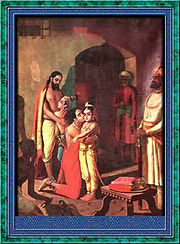
they present a number of perspectives some include comparison with other forms such as Vishnu
, that are considered supreme in other sampradayas. The Bhagavat Sandarbha and the Tattva Sandabha are among quoted works by Jiva Goswami
, "Vaishnavas don't argue among themselves if Krishna or Vishnu is the Supreme. They consider it a matter of one's relationship with the Lord. Someone has a relationship with Vishnu, someone with Rama, someone with Krishna, etc. as per rasa theology." In the Caitanya Caritamrita Chaitanya discusses this in a joking mood with Venkatta Bhatta
from Sri sampradaya
. While Pustimarga tradition predates Gaudiya Vaisnavism in Radha worship.
When Chaitanya traveled through South India in 1509-10, he stayed at the house of Venkata Bhatta, the father of Gopala Bhatta, priest of Srirangam
. Venkata and his two brothers, Gopala's uncles Trimalla and Prabodhananda Sarasvati
"were converted from their Sri Vaishnava faith in Lakshmi
-Narayana
as supreme to one in Radha
Krishna
" as Svayam Bhagavan. The dialog of this conversion is recorded in 16 c. Caitanya Caritamrita biography by Krishna dasa Kaviraja.
In the Madhya lila of the Chaitanya charitamrita a presentation is given, with a reference to the particular verse of the tenth canto of Bhagavata Purana
as to the reason why Lakshmi
also known as Sri
(thus the name of Sri Sampradaya) is burning with desire and still not capable of entering to the realm of Vrindavana.
Prabodhananda Sarasvati
who was a Sri Sampradaya sannyasi was converted as to supreme position of Radha-Krishna being Svayam Bhagavan instead of Lakshmi-Narayana. He as well apparently came to appreciate the supremacy of Radha worship from Caitanya.
or Vishnu being the cause of creation expanding into Viraja and then glancing over pradhana, and that is the start of actual function of creation. This view is not contradicted by Krishna-centered Vashnavism and does not appear to be in contradiction with Svayam Bhagavan who as Vasudeva
(son of Vasudeva, Krishna) is according to Pancaratra is at the source of creation.
Pancaratra sources are accepted by all of Vaishnava traditions, and confirmed by Yamunacarya who preceding in the line of Ramanuja
, summarizing in his Agamapramanya, a defense of the revelation of the tantric Vaishnava Pancaratra, defending whole body of the texts being part of the Veda: "The Pancadratra Tantra is authoritative like the Vedic sentences ordaining sacrifice on the grounds that it is based on knowledge free from all defects". Amalananda, also defends Pancaratra and while confirming that Agamas
do not have the same self-authenticating validity, as the four Vedas, but the authenticity of it assured because Veda bear witness to the omniscience of Vasudeva
. This position also forms the basis of Bhagavata Purana
based theology.
It is also a view of Gaudiya Vaishnavas that Sanatana Goswami
s Brihad Bhagavatamrita, has illustrated this principle, not just in terms of comparative cosmology or avatara hierarchy as in Vaishnava Pancaratra, but also in terms of cosmology of adi-rasa. The cosmological principle of the four dhamas (with a separate place for the last two: Vaikuntha - abode of Vishnu or Narayana
, tad-ekatma rupa, in transcendence, and Goloka as abode of Svayam Bhagavan in transcendence) is the key of the graphical presentation, but it is also an answer to the dilemma. In accordance with the cosmology of the Brihad Bhagavatamrita Krishna is believed being the original and most complete in all rasas
or tastes is in fact not engaged and non engaging, is his independence, he does not even, at least in this his original form, carry symbols of , he only carries his own flute, and that is the pleasure of his devotees.
is linked with the concept of sacrifice in the earliest known references to him. In Vedic sources such as the Purusha Sukta
, Narayana is given as the name of the self-offering of the great cosmic sacrifice of the Rig Veda. Narayana is not mentioned in Rig Veda itself, but came to be regarded as the seer who authored the hymn
. It is possible that the sage who composed the Purusha Sukta hymn has been assimilated to the Purusha whose praise he had sung, and he himself became the object of worship. Mentions of a divine sage named Narayana, along with counterpart Nara
, appears in many Puranic
texts. Purusha is also identified with Vishnu in the Rig Veda and interpreted accordingly by many traditions of Vaishnavism
. In the Bhagavata he is recognized as "the Lord whose being is sacrifice, Yajna Purusha
" Some believe that thus this verse of the Rig Veda is a foundation of Vaishnava tradition. In the Gopala Tapani Upanishad
the Rig Veda verse(1.22.20) was addressed paraphrasing the original of the Vedic hymn in accordance with the beliefs of the Gaudiya Vaishnava: It outlines a specific view held by the Gaudiya Vaishnava and Vallabha Sampradaya, that the conclusion of Vishnu worship is meditation on gopa-rupah or specific form of Krishna
.
Krishna Upanishad supports this conclusion of Gopala Tapani, and refers to the original "the most divine form of bliss dwells in the supremacy of love of Lord Krishna", saksad, Hari as gopa-rüpa. (1.10-12):
Gaudiya Vaishnava believe that Krishna possesses qualities that are absent in other forms and they relate to his sweetness in Vrindavana lila. Krishna is himself Narayana. Narayana
is often identified with supreme, however, when his beauty and sweetness (madhurya) overshadow his majesty, he is known as Krishna, i.e. Svayam Bhagavan. As Friedhelm Hardy says, the concept of Bhagavan, "a single, all-powerful, eternal, personal and loving God ... is an empty slot, to be filled by concrete characteristics" and these characteristics culminate in Krishna.
 In Gaudiya Vaishnava, Vallabha Sampradaya Nimbarka sampradaya
and old Bhagavata
school, Krishna believed to be fully represented in his original form in the Bhagavata Purana
, that at the end of the list of avataras concludes with the following text:
Not all commentators on the Bhagavata Purana stress this verse, however a majority of Krishna-centered and contemporary commentaries highlight this verse as a significant statement.Jiva Goswami
has called it Paribhasa-sutra, the “thesis statement” upon which the entire book or even theology is based.
In another place of the Bhagavata Purana
10.83.5-43 those who are named as wives of Krishna all explain to Draupadi how the 'Lord himself' (Svayam Bhagavan, Bhagavata Purana
10.83.7) came to marry them. As they relate these episodes, several of the wives speak of themselves as Krishna's devotees.
Many Krishna-centered traditions believe that Svayam Bhagavan personally carries his unalloyed devotees (vahamy aham) like a husband carries his bride across the threshold into the house of prema bhakti. Badarayana Vyasa
says in his Brahma Sutras
, visesam ca darsayati, implying that the scripture declares a difference with regard to the passing from the world of nirapeksa or unflinching devotees.
states: Glory to the Gopala Tapani Upanishad
, which to the pious reveals Lord Krishna, the original Personality of Godhead, the Supersoul near to all moving and unmoving creatures.
The word used is krsna svayam isvaram, the paraphrase of the Bhagavata Purana verse 1.3.28 that Jiva Goswami
has called a key sutra, not only to the Bhagavata Purana
but to Vedanta
and thus all the Vedas.
According to the Upanishads its believed that when Brahma
, who is said to be original created being, was approached by the sages Four Kumaras
he was presented with critical question: – Who is Supreme God? Who does death fears? – By knowing Whom, does everything else gets realized? – Who is that person, who is behind the repetition of creation of this Universe? His own original or sweet form, to the is not manifested very often in the Universe, loka-locanam. Gaudiya Vaishnavas quote sources that claim that it happens only ones in a universal day of Brahma
, and its only at that time its believed, once every fourteen manvantara
s, each seventy one divya-yugas
duration. Some religions do not even consider it possible to see the God. To answer four Kumaras Brahma needed to relate this secret word of the seed mantra.
And this is believed to be the answer to the question, who is supreme god and how he creates this world.
Brahma replied to the sages: "Krisna is the Supreme Personality of Godhead. Death fears Govinda. By knowing Gopijanavallabha everything becomes realized. By pronouncing the word "svaha" the Personality of Godhead created the world. In the wider context of the Bhagavata's total perspective, Krishna is "not one among many but the Lord himself".
Sanat-Kumara Samhita confirms the belief that this Kama Gayatri is the foundational structure of the Goloka
, believed to be the abode of Krishna, who is the original Vaasudeva:
"In the whorl of the lotus flower which is Lord Krishna's transcendental abode, the Gopala mantra
is written."
 While some place Krishna-centered worship as Svayam Bhagavan in the medieval times of Indian history, there is some evidence suggesting the opposite. In the antiquity Krishna images were worshiped at many places. Quoting Curtius, Dr. D.C. Sircar says that an image of Herakles (i.e. Vasudeva-Krishna according to Sircar) was being carried in front of the Paurava army, as it advanced against the Greeks led by Alexander the Great (The Cultural Heritage of India, vol. 4. p. 115) An interesting terracotta plague showing Vasudeva carrying the infant Krishna over his head across the flooded Yamuna river, belonging to c. first century is housed in the Mathura Museum. A Mora stone inscription of about the same time refers to some images of Bhagavata Vrshni Panchaviras, Sankarshana, Vasudeva, Pradyumna, Samba and Aniruddha - which were very beautifully carved in stone. A Gupta period research makes a "clear mention of Vasudeva
as the exclusive object of worship of a group of people," who are referred as bhagavatas.
Verifying the antiquity of the exclusive worship of Svayam Bhagavan, Krishna, the early Jaina
texts repeatedly stress two categories of Baladevas and Vasudeva
s that clearly can not be attributed to the Buddhist tradition, and can not be traced to the earlier strata of the Jaina canon itself. The introduction of these novel categories in the Jaina tradition, therefore, can hardly be explained without references to the legends surrounding the two popular figures of the early Vaishnava tradition, namely Balarama
and Krishna
of Mathura.
Archaeological remains found in the region of Mathura support the fact that the popularity of these two divine figures had reached its zenith in the Mauryan and the Sunga period and associated Bhagavata religion had become widespread throughout Mathura and Western India areas. This period coincides with the large migrations of Jainas from Magadha to Mathura. Baladeva is referred to by Jaina Puranas as Halabhrit, without any support from Brahminical texts. All the Vasudevas are modeled after the description of Krishna found in the Puranas. They are called blue-black (nila) in complexion and are designated by several names that are normally applied exclusively to Krishna e.g. Keshava, Madhava, Govinda, Vishnu and Narayana (which is used as synonym for the name Vasudeva). List of opposites (or prati categories) include most of the names associated with Asuras in Puranas.
According to an opinion of some scholars in Patanjali's time identification of Krishna with Vasudeva is an established fact as is surmised from a passage of the Mahabhasya - (jaghana kamsam kila vasudevah). This "supposed earliest phase is though to have been established from the sixth to the fifth centuries BCE at the time of Panini, who in his Astadhyayi explained the word vasudevaka as a bhakta, devotee, of Vasudeva and its believed that Bhagavata
religion with the worship of Vasudeva Krishna were at the root of the Vaishnavism in Indian history."
Not just Indian Gupta period but also some historical records of the Greeks show existence of the bhakti tradition to Krishna-Vaasudeva, it needs to be noted that, even Panini gives some support to the ancient root of Krishna-Vaasudeva bhakti - ' onMouseout='HidePop("98908")' href="/topics/Arjuna">Arjuna
), its is however only much later (2nd century BC) Patanjali
who refer in his definition of the devotee or bhakta as "the follower of Vasudeva, God of gods."
the term is used for other forms of God, including Dhanvantari
, Vamana
, Vishnu
, Vaikunthadeva. Although the term appears in the text referring to other forms, these references do not form a part of the Krishna-centered theology on which the reference to Krishna
is based.
The Brahma Vaivarta Purana
and Garga Samhita
often refer to Krishna as , the term used in Gaudiya Vaishnava tradition by Bhaktivinoda Thakura in his Amnaya Sutra - krishnas tu paripurnatma sarvatra sukha-rupakah translated as 'original Supreme Personality of Godhead'.
Sanskrit
Sanskrit , is a historical Indo-Aryan language and the primary liturgical language of Hinduism, Jainism and Buddhism.Buddhism: besides Pali, see Buddhist Hybrid Sanskrit Today, it is listed as one of the 22 scheduled languages of India and is an official language of the state of Uttarakhand...
theological term. The term refers to the concept of absolute representation of the monotheistic God as Bhagavan
Bhagavan
Bhagavan, also written Bhagwan or Bhagawan, from the Sanskrit nt-stem literally means "possessing fortune, blessed, prosperous" , and hence "illustrious, divine, venerable, holy", etc.In some traditions of Hinduism it is used to...
within Hinduism
Hinduism
Hinduism is the predominant and indigenous religious tradition of the Indian Subcontinent. Hinduism is known to its followers as , amongst many other expressions...
.
It is most often used in Gaudiya Vaishnava Krishna-centered theology as referring to Krishna
Krishna
Krishna is a central figure of Hinduism and is traditionally attributed the authorship of the Bhagavad Gita. He is the supreme Being and considered in some monotheistic traditions as an Avatar of Vishnu...
. The title Svayam Bhagavan is used exclusively to designate Krishna, while there are conflicting semantics or other usages in the Bhagavata Purana
Bhagavata purana
The Bhāgavata Purāṇa is one of the "Maha" Puranic texts of Hindu literature, with its primary focus on bhakti to the incarnations of Vishnu, particularly Krishna...
. Traditions of Gaudiya Vaishnavas, the Nimbarka Sampradaya
Nimbarka Sampradaya
The Nimbarka Sampradaya , also known as the Hamsa Sampradāya, Kumāra Sampradāya, ' and Sanakādi Sampradāya, is one of the four authorised Sampradāyas as according to the Padma , one of the eighteen main...
and followers of Vallabha consider him to be the source of all avatar
Avatar
In Hinduism, an avatar is a deliberate descent of a deity to earth, or a descent of the Supreme Being and is mostly translated into English as "incarnation," but more accurately as "appearance" or "manifestation"....
s, and the source of Vishnu
Vishnu
Vishnu is the Supreme god in the Vaishnavite tradition of Hinduism. Smarta followers of Adi Shankara, among others, venerate Vishnu as one of the five primary forms of God....
and Narayana
Narayana
Narayana or Narayan or Naraina is an important Sanskrit name for Vishnu, and in many contemporary vernaculars a common Indian name. Narayana is also identified as the original man, Purusha. The Puranas present divergent views on Narayana...
himself. As such, he is therefore regarded as Svayam Bhagavan.
The term is seldom used to refer to other forms of Krishna and/or Vishnu
Vishnu
Vishnu is the Supreme god in the Vaishnavite tradition of Hinduism. Smarta followers of Adi Shankara, among others, venerate Vishnu as one of the five primary forms of God....
within the context of certain religious texts such as the Bhagavata Purana
Bhagavata purana
The Bhāgavata Purāṇa is one of the "Maha" Puranic texts of Hindu literature, with its primary focus on bhakti to the incarnations of Vishnu, particularly Krishna...
, and also within other sects of Vaishnavism.
Though Krishna is recognized as Svayam Bhagavan by many, he is also perceived and understood from an eclectic assortment of perspectives and viewpoints. When Krishna
Krishna
Krishna is a central figure of Hinduism and is traditionally attributed the authorship of the Bhagavad Gita. He is the supreme Being and considered in some monotheistic traditions as an Avatar of Vishnu...
is recognized to be Svayam Bhagavan, it can be understood that this is the belief of Gaudiya Vaishnavism
Gaudiya Vaishnavism
Gaudiya Vaishnavism is a Vaishnava religious movement founded by Chaitanya Mahaprabhu in India in the 16th century. "Gaudiya" refers to the Gauḍa region with Vaishnavism meaning "the worship of Vishnu"...
, the Vallabha Sampradaya, and the Nimbarka Sampradaya
Nimbarka Sampradaya
The Nimbarka Sampradaya , also known as the Hamsa Sampradāya, Kumāra Sampradāya, ' and Sanakādi Sampradāya, is one of the four authorised Sampradāyas as according to the Padma , one of the eighteen main...
, where Krishna is accepted to be the source of all other avatars, and the source of Vishnu
Vishnu
Vishnu is the Supreme god in the Vaishnavite tradition of Hinduism. Smarta followers of Adi Shankara, among others, venerate Vishnu as one of the five primary forms of God....
himself. This belief is drawn primarily "from the famous statement of the Bhagavatam"(1.3.28).
A different viewpoint differing from this theological concept is the concept of Krishna
Krishna
Krishna is a central figure of Hinduism and is traditionally attributed the authorship of the Bhagavad Gita. He is the supreme Being and considered in some monotheistic traditions as an Avatar of Vishnu...
as an avatar
Avatar
In Hinduism, an avatar is a deliberate descent of a deity to earth, or a descent of the Supreme Being and is mostly translated into English as "incarnation," but more accurately as "appearance" or "manifestation"....
of Narayana
Narayana
Narayana or Narayan or Naraina is an important Sanskrit name for Vishnu, and in many contemporary vernaculars a common Indian name. Narayana is also identified as the original man, Purusha. The Puranas present divergent views on Narayana...
or Vishnu
Vishnu
Vishnu is the Supreme god in the Vaishnavite tradition of Hinduism. Smarta followers of Adi Shankara, among others, venerate Vishnu as one of the five primary forms of God....
. It should be however noted that although it is usual to speak of Vishnu as the source of the avataras, this is only one of the names of the God of Vaishnavism
Vaishnavism
Vaishnavism is a tradition of Hinduism, distinguished from other schools by its worship of Vishnu, or his associated Avatars such as Rama and Krishna, as the original and supreme God....
, who is also known as Narayana
Narayana
Narayana or Narayan or Naraina is an important Sanskrit name for Vishnu, and in many contemporary vernaculars a common Indian name. Narayana is also identified as the original man, Purusha. The Puranas present divergent views on Narayana...
, Vasudeva
Vasudeva
In Hindu itihasa , Vasudeva is the father of Krishna, the son of Shoorsen, of the Yadu and Vrishni dynasties. His sister Kunti was married to Pandu. He was a partial incarnation of Rishi Kashyap....
and Krishna and behind each of those names there is a divine figure with attributed supremacy in Vaishnavism
Vaishnavism
Vaishnavism is a tradition of Hinduism, distinguished from other schools by its worship of Vishnu, or his associated Avatars such as Rama and Krishna, as the original and supreme God....
.
Meaning
The theological interpretation of differs with each tradition and the literal translation of the term has been understood in several distinct ways. Translated from the Sanskrit language, the term literary means "BhagavanBhagavan
Bhagavan, also written Bhagwan or Bhagawan, from the Sanskrit nt-stem literally means "possessing fortune, blessed, prosperous" , and hence "illustrious, divine, venerable, holy", etc.In some traditions of Hinduism it is used to...
Himself" or "directly Bhagavan
Bhagavan
Bhagavan, also written Bhagwan or Bhagawan, from the Sanskrit nt-stem literally means "possessing fortune, blessed, prosperous" , and hence "illustrious, divine, venerable, holy", etc.In some traditions of Hinduism it is used to...
". Gaudiya Vaishnava tradition often translates it within its perspective as primeval Lord or original Personality of Godhead, but also considers the terms such as Supreme Personality of Godhead and Supreme God as an equivalent to the term Svayam Bhagavan, and may also choose to apply these terms to Vishnu, Narayana
Narayana
Narayana or Narayan or Naraina is an important Sanskrit name for Vishnu, and in many contemporary vernaculars a common Indian name. Narayana is also identified as the original man, Purusha. The Puranas present divergent views on Narayana...
and many of their associated Avatar
Avatar
In Hinduism, an avatar is a deliberate descent of a deity to earth, or a descent of the Supreme Being and is mostly translated into English as "incarnation," but more accurately as "appearance" or "manifestation"....
s.
Early commentators of Bhagavata Purana
Bhagavata purana
The Bhāgavata Purāṇa is one of the "Maha" Puranic texts of Hindu literature, with its primary focus on bhakti to the incarnations of Vishnu, particularly Krishna...
such as Madhvacharya
Madhvacharya
Madhvācārya was the chief proponent of Tattvavāda "Philosophy of Reality", popularly known as the Dvaita school of Hindu philosophy. It is one of the three most influential Vedānta philosophies. Madhvācārya was one of the important philosophers during the Bhakti movement. He was a pioneer in...
translated the term Svayam Bhagavan as "he who has bhagavata"; meaning "he who has the quality of possessing all good qualities". Others have translated it simply as "the Lord
Bhagavan
Bhagavan, also written Bhagwan or Bhagawan, from the Sanskrit nt-stem literally means "possessing fortune, blessed, prosperous" , and hence "illustrious, divine, venerable, holy", etc.In some traditions of Hinduism it is used to...
Himself". Followers of Vishnu-centered sampradaya
Sampradaya
In Hinduism, a sampradaya can be translated as ‘tradition’ or a ‘religious system’, although the word commands much more respect and power in the Indian context than its translations in English does...
s of Vaishnavism rarely address this term, but believe that it refers to their belief that Krishna is among the highest and fullest of all Avatar
Avatar
In Hinduism, an avatar is a deliberate descent of a deity to earth, or a descent of the Supreme Being and is mostly translated into English as "incarnation," but more accurately as "appearance" or "manifestation"....
s and is considered to be the "paripurna avatara", complete in all respects and the same as the original. According to them Krishna
Krishna
Krishna is a central figure of Hinduism and is traditionally attributed the authorship of the Bhagavad Gita. He is the supreme Being and considered in some monotheistic traditions as an Avatar of Vishnu...
is described in the Bhagavata Purana
Bhagavata purana
The Bhāgavata Purāṇa is one of the "Maha" Puranic texts of Hindu literature, with its primary focus on bhakti to the incarnations of Vishnu, particularly Krishna...
as the purnavatara (or complete manifestation) of the Bhagavan, while other incarnations are called partial. "Krishna being the Bhagavan Himself, the mind of man fixed on him intensely, whatever be the motive and however ignorantly it might be."(p. 334) Generally there is a universal acceptance of the uniqueness of Krishna incarnation throughout Hinduism
Hinduism
Hinduism is the predominant and indigenous religious tradition of the Indian Subcontinent. Hinduism is known to its followers as , amongst many other expressions...
, as well as the principles involved in His life and personality for which He has been described as Svayam Bhagavan.
Supporting Views
There is an element of countenance in many Krishna centered traditions to the subordination of Krishna to Vishnu. The reasons for that are given that it was the easiest way to accommodate Krishna's human story within the composite Vaishnava theological perspective. These "core texts assert and defend the ultimacy of Krsna's identity". However inclusion of Krishna in the list of avataras does not necessarily subordinated him to Vishnu as one of the latter's expansions. Early authors, such as 12th century JayadevaJayadeva
Jayadeva was a Sanskrit poet circa 1200 AD. He is most known for his composition, the epic poem Gita Govinda, which depicts the divine love of Krishna-an avatar of Vishnu and his consort, Radha, and it is mentioned that Radha is greater than Hari, and is considered an important text in the...
considered dasavatara to be principal incarnations of Kirshna, rather than Vishnu.
The prime supporters of the Krishna-centered theology, Gaudiya Vaishnavas and followers of the Vallabha Sampradaya Nimbarka Sampradaya
Nimbarka Sampradaya
The Nimbarka Sampradaya , also known as the Hamsa Sampradāya, Kumāra Sampradāya, ' and Sanakādi Sampradāya, is one of the four authorised Sampradāyas as according to the Padma , one of the eighteen main...
, use the Gopala Tapani Upanishad
Gopala Tapani Upanishad
Upanishad is an Upanishad, associated with the Atharvaveda. It figures in the Muktika canon of 108 Upanishads .-Origins:As with most of the late Upanishads, the Gopāla-tāpanī is said to be attached to the Atharva-veda....
, Vedanta Sutras and other Hindu scriptures such as the Bhagavata Purana
Bhagavata purana
The Bhāgavata Purāṇa is one of the "Maha" Puranic texts of Hindu literature, with its primary focus on bhakti to the incarnations of Vishnu, particularly Krishna...
and the Brahma Vaivarta Purana
Brahma Vaivarta Purana
Brahma Vaivarta Purana, one of the major eighteen Puranas, a Hindu religious text, is divided into four parts. First part describes the creation of the universe and all beings, the second part relates to description and histories of different goddesses...
, among others, to support their view that Krishna is indeed the Svayam Bhagavan. This belief was summarized by the 16th century author Jiva Goswami
Jiva Goswami
Jiva Goswami is one of the most prolific and important philosopher and saint from the Gaudiya Vaishnava school of Vedanta tradition, producing a great number of philosophical works on the theology and practice of Bhakti yoga, Vaishnava Vedanta and associated disciplines...
in some of his works, such as Krishna-sandarbha. While Krishna himself if mentioned in one of the earliest texts of Vedic
Vedic
Vedic may refer to:* the Vedas, the oldest preserved Indic texts** Vedic Sanskrit, the language of these texts** Vedic period, during which these texts were produced** Vedic pantheon of gods mentioned in Vedas/vedic period...
literature - Rig-Veda.
In the sixth book of the Hindu epic Mahābhārata
Mahabharata
The Mahabharata is one of the two major Sanskrit epics of ancient India and Nepal, the other being the Ramayana. The epic is part of itihasa....
, the Bhishma Parva (where the Bhagavad Gita
Bhagavad Gita
The ' , also more simply known as Gita, is a 700-verse Hindu scripture that is part of the ancient Sanskrit epic, the Mahabharata, but is frequently treated as a freestanding text, and in particular, as an Upanishad in its own right, one of the several books that constitute general Vedic tradition...
is part of), Krishna offers numerous quotations that reaffirm the belief that he himself is the Svayam Bhagavan. Verse 7.7 of the Bhagavad Gita
Bhagavad Gita
The ' , also more simply known as Gita, is a 700-verse Hindu scripture that is part of the ancient Sanskrit epic, the Mahabharata, but is frequently treated as a freestanding text, and in particular, as an Upanishad in its own right, one of the several books that constitute general Vedic tradition...
, is often used to support the opinion that Krishna himself is the Svayam Bhagavan, and that no impersonal form of Brahman
Brahman
In Hinduism, Brahman is the one supreme, universal Spirit that is the origin and support of the phenomenal universe. Brahman is sometimes referred to as the Absolute or Godhead which is the Divine Ground of all being...
supersedes his existence, as it is an common view that Bhagavad Gita
Bhagavad Gita
The ' , also more simply known as Gita, is a 700-verse Hindu scripture that is part of the ancient Sanskrit epic, the Mahabharata, but is frequently treated as a freestanding text, and in particular, as an Upanishad in its own right, one of the several books that constitute general Vedic tradition...
was propounding Krishna-theism before first major proponents of monism
Advaita Vedanta
Advaita Vedanta is considered to be the most influential and most dominant sub-school of the Vedānta school of Hindu philosophy. Other major sub-schools of Vedānta are Dvaita and ; while the minor ones include Suddhadvaita, Dvaitadvaita and Achintya Bhedabheda...
.
Other two pervading understandings of the position of Svayam Bhagavan asserted in the Gita are connected to other, not Krishna-centered, traditions. One tradition follows predominately the views of Sankaracharya commentary on Brahma Sutras
Brahma Sutras
The Brahma sūtras , also known as Vedānta Sūtras , are one of the three canonical texts of the Vedānta school of Hindu philosophy. A thorough study of Vedānta requires a close examination of these three texts, known in Sanskrit as the Prasthanatrayi, or the three starting points...
and is referred as maya-vad
Mayavada
Mayavada is a term used to pejoratively refer to the Advaita philosophy of Adi Shankara. It is not used by the followers of the Advaita philosophy to refer to themselves. It is generally used as a derogatory term, by some Dvaita schools...
which justifies Svayam Bhagavan supremacy by a concept of illusion or maya
Maya (illusion)
Maya , in Indian religions, has multiple meanings, usually quoted as "illusion", centered on the fact that we do not experience the environment itself but rather a projection of it, created by us. Maya is the principal deity that manifests, perpetuates and governs the illusion and dream of duality...
.
The second alternative understanding of the evident supremacy of Svayam Bhagavan in the Gita, is a popular view on Krishna being the highest and fullest Avatar
Avatar
In Hinduism, an avatar is a deliberate descent of a deity to earth, or a descent of the Supreme Being and is mostly translated into English as "incarnation," but more accurately as "appearance" or "manifestation"....
of the Lord, Vishnu
Vishnu
Vishnu is the Supreme god in the Vaishnavite tradition of Hinduism. Smarta followers of Adi Shankara, among others, venerate Vishnu as one of the five primary forms of God....
or Narayana
Narayana
Narayana or Narayan or Naraina is an important Sanskrit name for Vishnu, and in many contemporary vernaculars a common Indian name. Narayana is also identified as the original man, Purusha. The Puranas present divergent views on Narayana...
. "The Bhagavad Gita depicts Krishna not only as Brahman
Brahman
In Hinduism, Brahman is the one supreme, universal Spirit that is the origin and support of the phenomenal universe. Brahman is sometimes referred to as the Absolute or Godhead which is the Divine Ground of all being...
but also as an 'Avatar of Vishnu and the friend of Arjuna
Arjuna
Arjuna in Indian mythology is the greatest warrior on earth and is one of the Pandavas, the heroes of the Hindu epic Mahābhārata. Arjuna, whose name means 'bright', 'shining', 'white' or 'silver' Arjuna (Devanagari: अर्जुन, Thai: อรชุน, Orachun, Tamil: Arjunan, Indonesian and Javanese: Harjuna,...
." In summary in accordance with this view Svayam Bhagavan Krishna is considered to be the purna-avatara (full incarnation) of Vishnu
Vishnu
Vishnu is the Supreme god in the Vaishnavite tradition of Hinduism. Smarta followers of Adi Shankara, among others, venerate Vishnu as one of the five primary forms of God....
or, according to some, of the universal Narayana
Narayana
Narayana or Narayan or Naraina is an important Sanskrit name for Vishnu, and in many contemporary vernaculars a common Indian name. Narayana is also identified as the original man, Purusha. The Puranas present divergent views on Narayana...
who transcends even Brahman
Brahman
In Hinduism, Brahman is the one supreme, universal Spirit that is the origin and support of the phenomenal universe. Brahman is sometimes referred to as the Absolute or Godhead which is the Divine Ground of all being...
.
Supremacy or a concept of originality is often referred to the words pf Krishna himself, as for example, Abhinavagupta
Abhinavagupta
Abhinavagupta was one of India's greatest philosophers, mystics and aestheticians. He was also considered an important musician, poet, dramatist, exegete, theologian, and logician - a polymathic personality who exercised strong influences on Indian culture.He was born in the Valley of Kashmir in...
of yet another tradition of Hinduism, introduces a quotation from the Bhagavad-gita that 'I', referring to Krishna
Krishna
Krishna is a central figure of Hinduism and is traditionally attributed the authorship of the Bhagavad Gita. He is the supreme Being and considered in some monotheistic traditions as an Avatar of Vishnu...
, is the highest self who transcends the perishable and imperishable.
Other Vaishnava views
The Sri Vaishnavas identify VishnuVishnu
Vishnu is the Supreme god in the Vaishnavite tradition of Hinduism. Smarta followers of Adi Shankara, among others, venerate Vishnu as one of the five primary forms of God....
with the Brahman
Brahman
In Hinduism, Brahman is the one supreme, universal Spirit that is the origin and support of the phenomenal universe. Brahman is sometimes referred to as the Absolute or Godhead which is the Divine Ground of all being...
, while Krishna
Krishna
Krishna is a central figure of Hinduism and is traditionally attributed the authorship of the Bhagavad Gita. He is the supreme Being and considered in some monotheistic traditions as an Avatar of Vishnu...
-centered traditions will associate Para Brahman
Para Brahman
Para Brahman or Param Brahman - is a term often used by Vedantic philosophers as to the "attainment of the ultimate goal". Adi Shankara has said that there is only one Supreme Para-Brahman and all the other deities are the forms and expansions of this Para-Brahman...
with Krishna as Svayam Bhagavan. According to Ramanujacharya, Brahman is personal
Personal God
A personal god is a deity who can be related to as a person instead of as an "impersonal force", such as the Absolute, "the All", or the "Ground of Being"....
. Indeed, he is the supreme person, creator and Lord, who leads souls to salvation. Far from having no (positive) attributes, as some Advaita Vedanta
Advaita Vedanta
Advaita Vedanta is considered to be the most influential and most dominant sub-school of the Vedānta school of Hindu philosophy. Other major sub-schools of Vedānta are Dvaita and ; while the minor ones include Suddhadvaita, Dvaitadvaita and Achintya Bhedabheda...
followers maintain, Brahman is the sum of all “noble attributes” — i.e. omniscient, omnipotent, omnipresent, and all-merciful, all qualities attributed to Vishnu by all Vaishavas. According to South Indian traditions he is also advitya (Sanskrit
Sanskrit
Sanskrit , is a historical Indo-Aryan language and the primary liturgical language of Hinduism, Jainism and Buddhism.Buddhism: besides Pali, see Buddhist Hybrid Sanskrit Today, it is listed as one of the 22 scheduled languages of India and is an official language of the state of Uttarakhand...
meaning without rival). To Vaishnavas, Shiva
Shiva
Shiva is a major Hindu deity, and is the destroyer god or transformer among the Trimurti, the Hindu Trinity of the primary aspects of the divine. God Shiva is a yogi who has notice of everything that happens in the world and is the main aspect of life. Yet one with great power lives a life of a...
, Brahma
Brahma
Brahma is the Hindu god of creation and one of the Trimurti, the others being Vishnu and Shiva. According to the Brahma Purana, he is the father of Mānu, and from Mānu all human beings are descended. In the Ramayana and the...
, and the other gods of the Hindu
Hindu
Hindu refers to an identity associated with the philosophical, religious and cultural systems that are indigenous to the Indian subcontinent. As used in the Constitution of India, the word "Hindu" is also attributed to all persons professing any Indian religion...
pantheon are viewed as Brahman's agents or servants
Servant of God
Servant of God is a title given to individuals by various religions, but in general the phrase is used to describe a person believed to be pious in his or her faith tradition. In the Catholic Church, it designates someone who is being investigated by the Church for possibly being recognized as a...
, created and commissioned by him. Some Vaishnavas consider them to be or see that they have the same status that of angels have in the western religious traditions.
“The entire complex of intelligent and non-intelligent beings - is viewed as real and constitutes the form, i. e., the body of the highest Brahman”. A soul-body relationship, according to Ramanujacharya, is “entirely subordinate” to its soul, having no independent reality or value. However Ramanujacharya himself did not stress a subordination of the 'puravatara' Krishna to Vishnu.
However, Vaishnava traditions do not adhere to the concept of Svayam Bhagavan with the same views as those who support the concept.
To support their view they quote the 149th chapter of Anushāsanaparva in the epic Mahabharata
Mahabharata
The Mahabharata is one of the two major Sanskrit epics of ancient India and Nepal, the other being the Ramayana. The epic is part of itihasa....
, Bhisma which states, with Krishna
Krishna
Krishna is a central figure of Hinduism and is traditionally attributed the authorship of the Bhagavad Gita. He is the supreme Being and considered in some monotheistic traditions as an Avatar of Vishnu...
present, that mankind will be free from all sorrows by chanting the Vishnu sahasranama
Vishnu sahasranama
The Vishnu sahasranama is a list of 1,000 names of Vishnu, one of the main forms of God in Hinduism and the personal supreme God for Vaishnavas . It is also one of the most sacred and commonly chanted stotras in Hinduism...
, which are the thousand names of the all-pervading supreme being
Supreme Being
The term Supreme Being is often defined simply as "God", and it is used with this meaning by theologians of many religious faiths, including, but not limited to, Christianity, Islam, Hinduism, and Deism. However, the term can also refer to more complex or philosophical interpretations of the...
Vishnu
Vishnu
Vishnu is the Supreme god in the Vaishnavite tradition of Hinduism. Smarta followers of Adi Shankara, among others, venerate Vishnu as one of the five primary forms of God....
, who is the master of all the worlds, supreme over the devas
Deva (Hinduism)
' is the Sanskrit word for god or deity, its related feminine term is devi. In modern Hinduism, it can be loosely interpreted as any benevolent supernatural beings. The devs in Hinduism, also called Suras, are often juxtaposed to the Asuras, their half brothers. Devs are also the maintainers of...
and who is one with Brahman
Brahman
In Hinduism, Brahman is the one supreme, universal Spirit that is the origin and support of the phenomenal universe. Brahman is sometimes referred to as the Absolute or Godhead which is the Divine Ground of all being...
. This seems to indicate that Krishna is identical with Vishnu. Indeed, Krishna
Krishna
Krishna is a central figure of Hinduism and is traditionally attributed the authorship of the Bhagavad Gita. He is the supreme Being and considered in some monotheistic traditions as an Avatar of Vishnu...
himself said, "Arjuna, one may be desirous of praising by reciting the thousand names. But, on my part, I feel praised by one shloka
Shloka
A ' is a category of verse line developed from the Vedic Anuṣṭubh. It is the basis for Indian Epic verse, and may be considered the Indian verse form par excellence, occurring, as it does, far more frequently than any other meter in classical Sanskrit poetry. The Mahabharata and Ramayana, for...
. There is no doubt about it.”
Many Vaishnava schools have different interpretation of the concept as for example followers of the Swaminarayan Sampraday
Swaminarayan Sampraday
Swaminarayan Sampraday , known previously as the Uddhav Sampraday, is a Hindu sect established by Swaminarayan...
believe that Lord Narayana
Narayana
Narayana or Narayan or Naraina is an important Sanskrit name for Vishnu, and in many contemporary vernaculars a common Indian name. Narayana is also identified as the original man, Purusha. The Puranas present divergent views on Narayana...
manifested himself as Lord Swaminarayan. This view is only supported within their particular tradition.
Comparison
Some early schools of thought, such as Pancaratra in particular, refer to Vasudeva-Krishna (Krishna, the son of Vasudeva) as the source of all incarnations and as no different from the ultimate and absolute reality, and as non-distinct from Vasudeva and any other manifestations of the supreme self.Krishnaism
The term Krishnaism has been used to describe the cults of Krishna, reserving the term "Vaishnavism" for cults focusing on Vishnu in which KrishnaKrishna
Krishna is a central figure of Hinduism and is traditionally attributed the authorship of the Bhagavad Gita. He is the supreme Being and considered in some monotheistic traditions as an Avatar of Vishnu...
is an Avatar, rather than a transcended being.
"Greater Krishnaism" corresponds to the second and dominant phase of Vaishnavism
Vaishnavism
Vaishnavism is a tradition of Hinduism, distinguished from other schools by its worship of Vishnu, or his associated Avatars such as Rama and Krishna, as the original and supreme God....
, revolving around the cults of Vasudeva
Vasudeva
In Hindu itihasa , Vasudeva is the father of Krishna, the son of Shoorsen, of the Yadu and Vrishni dynasties. His sister Kunti was married to Pandu. He was a partial incarnation of Rishi Kashyap....
, Krishna, and Gopala. Today the faith has a significant following outside of India as well. Supremacy of Krishna is the key concept of Krishnaism
Krishnaism
Krishnaism is a group of Hindu denominations within Vaishnavism, centered on devotion to Radha Krishna or other forms of Krishna, identified with Vishnu.The central text of Krishnaism is the Bhagavad Gita....
. Gaudiya is one of the main traditions worshiping Radha Krishna
Radha Krishna
Radha Krishna is a Hindu deity. Krishna is often referred as svayam bhagavan in Gaudiya Vaishnavism theology and Radha is a young woman, a gopi who is Krishna's supreme beloved. With Krishna, Radha is acknowledged as the Supreme Goddess, for it is said that she controls Krishna with Her love...
that developed this concept.
Theory of avataras
Primary theology of Caitanyaite or Gaudiya traditions is based and presented in Bhagavata PuranaBhagavata purana
The Bhāgavata Purāṇa is one of the "Maha" Puranic texts of Hindu literature, with its primary focus on bhakti to the incarnations of Vishnu, particularly Krishna...
and Caitanya Caritamrita.Svayam in Svayam rupa does not imply one and only, and all conceptions by previous Vaishnava traditions, according to the Gaudiya Vaishnavas beliefs, fall under a second category, tad ekatma rupa (meaning: one that one and not different). 'Svayam' as a term means not depending on others or being himself.
In his instruction to Sanatana Goswami, at Kasi, Chaitanya Mahaprabhu explains the implications of the vadanti verse: "The word brahman refers to Svayam Bhagavan, who has one consciousness without a second, and without whom there is nothing else." (Gupta 2007, p 36).
Rūpa Gosvāmī
Rupa Goswami
Rupa Goswami was an Indian devotional teacher , poet, and philosopher from the Gaudiya Vaishnava tradition of Hinduism. Alongside his brother Sanatana Goswami, he was considered the leader of the Six Goswamis of Vrindavan associated with Chaitanya Mahaprabhu, the Hindu saint believed to be the...
has described the in his : "The form of the Supreme Personality of Godhead that does not depend on other forms is called , the original form."
The tad-ekātma-rūpa forms are also described in the Srila Rupa Gosvami's Sri Laghu-Bhagavatamrta, Translated by Kusakrathadasa, 1990, Krsna Institute, ISBN 156130008X
"The tad-ekātma-rūpa forms simultaneous to form and are non-different. At the same time by their bodily features and specific activities they appear to be different."
Two best known Vedic descriptions of the creation are purusha sukta
Purusha sukta
Purusha sukta is hymn 10.90 of the Rigveda, dedicated to the Purusha, the "Cosmic Being". One version of the Suktam has 16 verses, 15 in the meter, and the final one in the meter...
and nasadiya sukta
Nasadiya Sukta
The Nasadiya Sukta is the 129th hymn of the 10th Mandala of the Rigveda. It is concerned with cosmology and the origin of the universe. It is known for its skepticism...
. One hymn addresses to Vishvakarma, The one who makes all. To beliefs of Vaishnavas, the Visvakarma Sukta of Rig Veda (10.82) refers to indirectly as the Supreme God: The waters verily first retained the embryo in which all the gods were aggregated, single deposited on the navel of the unborn (ajah), in which all beings abide. and according to the Gaudiyas, falls under category of tad-ekātma-rūpa,
According to the Gaudiya Vaishnava interpretation, it is also confirmed in the Bhagavad-gītā (7.7), which says, : "There is no truth superior to Me." Where Krishna is 'bhagavan' himself, whose partial manifestations are the other gods. This idea is reflected in the Bhagavata Purana
Bhagavata purana
The Bhāgavata Purāṇa is one of the "Maha" Puranic texts of Hindu literature, with its primary focus on bhakti to the incarnations of Vishnu, particularly Krishna...
. The Brahma Vaivarta Purana
Brahma Vaivarta Purana
Brahma Vaivarta Purana, one of the major eighteen Puranas, a Hindu religious text, is divided into four parts. First part describes the creation of the universe and all beings, the second part relates to description and histories of different goddesses...
tells us Krishna is the ultimate source from which Brahma
Brahma
Brahma is the Hindu god of creation and one of the Trimurti, the others being Vishnu and Shiva. According to the Brahma Purana, he is the father of Mānu, and from Mānu all human beings are descended. In the Ramayana and the...
, Vishnu
Vishnu
Vishnu is the Supreme god in the Vaishnavite tradition of Hinduism. Smarta followers of Adi Shankara, among others, venerate Vishnu as one of the five primary forms of God....
, Shiva
Shiva
Shiva is a major Hindu deity, and is the destroyer god or transformer among the Trimurti, the Hindu Trinity of the primary aspects of the divine. God Shiva is a yogi who has notice of everything that happens in the world and is the main aspect of life. Yet one with great power lives a life of a...
and Prakriti originate. He is Svayam Bhagavan while other incarnation are his partial manifestations. The comments of Sridhara Svami (an early Sankara sect commentator), bring out uniqueness of Krishna. According to him Krishna is perfect as all potencies are observed to be full in him. In Atharvavedasamhita, Krishna is described as having slain the giant Kesi, Keshava. The Kaustiki Brahmana (30.9) alludes to Krishna Angirasa, who is an object of evening ceremony in connection with Brahmanaacchamsin priest. The Aitareya Aranyaka speaks of two Krishnas of Harita Gotra. However the south Indian Vaishnavism
Vaishnavism
Vaishnavism is a tradition of Hinduism, distinguished from other schools by its worship of Vishnu, or his associated Avatars such as Rama and Krishna, as the original and supreme God....
makes very little stress on Krishna and altogether ignored Radha
Radha
Radha , also called Radhika, Radharani and Radhikarani, is the childhood friend and lover of Krishna in the Bhagavata Purana, and the Gita Govinda of the Vaisnava traditions of Hinduism...
in contrast with the other traditions.
To the views of the Gaudiya Sampradaya, the Bhagavad-gita states that this bhakti-yoga is secretive: - "Just hear from Me again about the most confidential part of the instructions in Bhagavad-gītā." It is also described as such in Bhagavata Purana
Bhagavata purana
The Bhāgavata Purāṇa is one of the "Maha" Puranic texts of Hindu literature, with its primary focus on bhakti to the incarnations of Vishnu, particularly Krishna...
Vashnavas of ISKCON often stress their view that in both cases Krishna is speaking about himself, aham and me in Sanskrit
Sanskrit
Sanskrit , is a historical Indo-Aryan language and the primary liturgical language of Hinduism, Jainism and Buddhism.Buddhism: besides Pali, see Buddhist Hybrid Sanskrit Today, it is listed as one of the 22 scheduled languages of India and is an official language of the state of Uttarakhand...
mean, I am and Me respectively. While some commentators derive secondary meanings, all major Sanskrit dictionary accept that the direct meaning of aham and me, refers to Krishna himself.
Lakshmi
When Gaudiya Vaishnavas present their views on Krishna being Svayam Bhagavan,they present a number of perspectives some include comparison with other forms such as Vishnu
Vishnu
Vishnu is the Supreme god in the Vaishnavite tradition of Hinduism. Smarta followers of Adi Shankara, among others, venerate Vishnu as one of the five primary forms of God....
, that are considered supreme in other sampradayas. The Bhagavat Sandarbha and the Tattva Sandabha are among quoted works by Jiva Goswami
Jiva Goswami
Jiva Goswami is one of the most prolific and important philosopher and saint from the Gaudiya Vaishnava school of Vedanta tradition, producing a great number of philosophical works on the theology and practice of Bhakti yoga, Vaishnava Vedanta and associated disciplines...
, "Vaishnavas don't argue among themselves if Krishna or Vishnu is the Supreme. They consider it a matter of one's relationship with the Lord. Someone has a relationship with Vishnu, someone with Rama, someone with Krishna, etc. as per rasa theology." In the Caitanya Caritamrita Chaitanya discusses this in a joking mood with Venkatta Bhatta
Venkatta Bhatta
Venkatta Bhatta - Gaudiya Vaishnava is famous for being part of the conversion from worship of Laksmi-Narayana to worship of Krishna as Svayam bhagavan. In Chaitanya Charitamrita 2.9.108-124 and further on Chaitanya talks about Krishnas supremacy in a joking mood with Venkatta Bhatta...
from Sri sampradaya
Sri Sampradaya
Sri Sampradaya or Sri Vaishnavism is a Vaishnava sect within Hinduism. Its origin and codification is generally traced back to Sri, Mahalakshmi eternal consort of Lord Vishnu. Around the 10th century when a collection of the devotional hymns and songs by Alvars was organized by Sri Nathamuni, who...
. While Pustimarga tradition predates Gaudiya Vaisnavism in Radha worship.
When Chaitanya traveled through South India in 1509-10, he stayed at the house of Venkata Bhatta, the father of Gopala Bhatta, priest of Srirangam
Srirangam
Srirangam , Old name is Vellithirumutha gramam and Tamil name is Thiruvarangam , is an island and a part of the city of Tiruchirapalli , in South India....
. Venkata and his two brothers, Gopala's uncles Trimalla and Prabodhananda Sarasvati
Prabodhananda Sarasvati
Prabhodananda Sarasvati- one of the legendary Gaudiya Vaishnava and Pustimarga tradition sannyasis.Originally from Srirangam of Sri Sampradaya tradition, converted to the path of devotion to Radha Krishna by Chaitanya Mahaprabhu. When Chaitanya traveled through South India in 1509-10, he stayed at...
"were converted from their Sri Vaishnava faith in Lakshmi
Lakshmi
Lakshmi or Lakumi is the Hindu goddess of wealth, prosperity , light, wisdom, fortune, fertility, generosity and courage; and the embodiment of beauty, grace and charm. Representations of Lakshmi are also found in Jain monuments...
-Narayana
Narayana
Narayana or Narayan or Naraina is an important Sanskrit name for Vishnu, and in many contemporary vernaculars a common Indian name. Narayana is also identified as the original man, Purusha. The Puranas present divergent views on Narayana...
as supreme to one in Radha
Radha
Radha , also called Radhika, Radharani and Radhikarani, is the childhood friend and lover of Krishna in the Bhagavata Purana, and the Gita Govinda of the Vaisnava traditions of Hinduism...
Krishna
Krishna
Krishna is a central figure of Hinduism and is traditionally attributed the authorship of the Bhagavad Gita. He is the supreme Being and considered in some monotheistic traditions as an Avatar of Vishnu...
" as Svayam Bhagavan. The dialog of this conversion is recorded in 16 c. Caitanya Caritamrita biography by Krishna dasa Kaviraja.
In the Madhya lila of the Chaitanya charitamrita a presentation is given, with a reference to the particular verse of the tenth canto of Bhagavata Purana
Bhagavata purana
The Bhāgavata Purāṇa is one of the "Maha" Puranic texts of Hindu literature, with its primary focus on bhakti to the incarnations of Vishnu, particularly Krishna...
as to the reason why Lakshmi
Lakshmi
Lakshmi or Lakumi is the Hindu goddess of wealth, prosperity , light, wisdom, fortune, fertility, generosity and courage; and the embodiment of beauty, grace and charm. Representations of Lakshmi are also found in Jain monuments...
also known as Sri
Sri
Sri , also transliterated as Shri or Shree or shre is a word of Sanskrit origin, used in the Indian subcontinent as polite form of address equivalent to the English "Mr." in written and spoken language, or as a title of veneration for deities .-Etymology:Sri has the root meaning of radiance, or...
(thus the name of Sri Sampradaya) is burning with desire and still not capable of entering to the realm of Vrindavana.
Prabodhananda Sarasvati
Prabodhananda Sarasvati
Prabhodananda Sarasvati- one of the legendary Gaudiya Vaishnava and Pustimarga tradition sannyasis.Originally from Srirangam of Sri Sampradaya tradition, converted to the path of devotion to Radha Krishna by Chaitanya Mahaprabhu. When Chaitanya traveled through South India in 1509-10, he stayed at...
who was a Sri Sampradaya sannyasi was converted as to supreme position of Radha-Krishna being Svayam Bhagavan instead of Lakshmi-Narayana. He as well apparently came to appreciate the supremacy of Radha worship from Caitanya.
Cosmological perspective
The view of South Indian Vaishnava groups on sarga, or subtle creation, is based upon scriptural adherence to NarayanaNarayana
Narayana or Narayan or Naraina is an important Sanskrit name for Vishnu, and in many contemporary vernaculars a common Indian name. Narayana is also identified as the original man, Purusha. The Puranas present divergent views on Narayana...
or Vishnu being the cause of creation expanding into Viraja and then glancing over pradhana, and that is the start of actual function of creation. This view is not contradicted by Krishna-centered Vashnavism and does not appear to be in contradiction with Svayam Bhagavan who as Vasudeva
Vasudeva
In Hindu itihasa , Vasudeva is the father of Krishna, the son of Shoorsen, of the Yadu and Vrishni dynasties. His sister Kunti was married to Pandu. He was a partial incarnation of Rishi Kashyap....
(son of Vasudeva, Krishna) is according to Pancaratra is at the source of creation.
Pancaratra sources are accepted by all of Vaishnava traditions, and confirmed by Yamunacarya who preceding in the line of Ramanuja
Ramanuja
Ramanuja ; traditionally 1017–1137, also known as Ramanujacharya, Ethirajar , Emperumannar, Lakshmana Muni, was a theologian, philosopher, and scriptural exegete...
, summarizing in his Agamapramanya, a defense of the revelation of the tantric Vaishnava Pancaratra, defending whole body of the texts being part of the Veda: "The Pancadratra Tantra is authoritative like the Vedic sentences ordaining sacrifice on the grounds that it is based on knowledge free from all defects". Amalananda, also defends Pancaratra and while confirming that Agamas
Āgama (Hinduism)
Agama means, in the Hindu context, "a traditional doctrine, or system which commands faith".In Hinduism, the Agamas are a collection of Sanskrit scriptures which are revered and followed by millions of Hindus.-Significance:...
do not have the same self-authenticating validity, as the four Vedas, but the authenticity of it assured because Veda bear witness to the omniscience of Vasudeva
Vasudeva
In Hindu itihasa , Vasudeva is the father of Krishna, the son of Shoorsen, of the Yadu and Vrishni dynasties. His sister Kunti was married to Pandu. He was a partial incarnation of Rishi Kashyap....
. This position also forms the basis of Bhagavata Purana
Bhagavata purana
The Bhāgavata Purāṇa is one of the "Maha" Puranic texts of Hindu literature, with its primary focus on bhakti to the incarnations of Vishnu, particularly Krishna...
based theology.
It is also a view of Gaudiya Vaishnavas that Sanatana Goswami
Sanatana Goswami
Sanatana Goswami was a principal disciple of Chaitanya Mahaprabhu. Sanatana wrote a number of important works in the bhakti tradition of Gaudiya Vaishnavism and was the seniormost of the influential Six Goswamis of Vrindavan, among whom was his brother Rupa Goswami.-Birth and early years:Sanatana,...
s Brihad Bhagavatamrita, has illustrated this principle, not just in terms of comparative cosmology or avatara hierarchy as in Vaishnava Pancaratra, but also in terms of cosmology of adi-rasa. The cosmological principle of the four dhamas (with a separate place for the last two: Vaikuntha - abode of Vishnu or Narayana
Narayana
Narayana or Narayan or Naraina is an important Sanskrit name for Vishnu, and in many contemporary vernaculars a common Indian name. Narayana is also identified as the original man, Purusha. The Puranas present divergent views on Narayana...
, tad-ekatma rupa, in transcendence, and Goloka as abode of Svayam Bhagavan in transcendence) is the key of the graphical presentation, but it is also an answer to the dilemma. In accordance with the cosmology of the Brihad Bhagavatamrita Krishna is believed being the original and most complete in all rasas
Rasa (theology)
Rasa is a Sanskrit theological concept specific to Krishna-centered bhakti traditions, such as Gaudiya Vaishnavism. The theological use of the word can be found early, about two thousand years before the Nimbarka or Caitanya schools of bhakti, in a phrase that Chaitanya traditions frequently...
or tastes is in fact not engaged and non engaging, is his independence, he does not even, at least in this his original form, carry symbols of , he only carries his own flute, and that is the pleasure of his devotees.
Original Purusha of the Vedas
The form of NarayanaNarayana
Narayana or Narayan or Naraina is an important Sanskrit name for Vishnu, and in many contemporary vernaculars a common Indian name. Narayana is also identified as the original man, Purusha. The Puranas present divergent views on Narayana...
is linked with the concept of sacrifice in the earliest known references to him. In Vedic sources such as the Purusha Sukta
Purusha sukta
Purusha sukta is hymn 10.90 of the Rigveda, dedicated to the Purusha, the "Cosmic Being". One version of the Suktam has 16 verses, 15 in the meter, and the final one in the meter...
, Narayana is given as the name of the self-offering of the great cosmic sacrifice of the Rig Veda. Narayana is not mentioned in Rig Veda itself, but came to be regarded as the seer who authored the hymn
Hymn
A hymn is a type of song, usually religious, specifically written for the purpose of praise, adoration or prayer, and typically addressed to a deity or deities, or to a prominent figure or personification...
. It is possible that the sage who composed the Purusha Sukta hymn has been assimilated to the Purusha whose praise he had sung, and he himself became the object of worship. Mentions of a divine sage named Narayana, along with counterpart Nara
Nara-Narayana
Nara-Narayana is a Hindu deity pair. Nara-Narayana is the twin-brother incarnation of the preserver-god Vishnu on earth, working for the preservation of dharma or righteousness...
, appears in many Puranic
Puranas
The Puranas are a genre of important Hindu, Jain and Buddhist religious texts, notably consisting of narratives of the history of the universe from creation to destruction, genealogies of kings, heroes, sages, and demigods, and descriptions of Hindu cosmology, philosophy, and geography.Puranas...
texts. Purusha is also identified with Vishnu in the Rig Veda and interpreted accordingly by many traditions of Vaishnavism
Vaishnavism
Vaishnavism is a tradition of Hinduism, distinguished from other schools by its worship of Vishnu, or his associated Avatars such as Rama and Krishna, as the original and supreme God....
. In the Bhagavata he is recognized as "the Lord whose being is sacrifice, Yajna Purusha
Purusha
In some lineages of Hinduism, Purusha is the "Self" which pervades the universe. The Vedic divinities are interpretations of the many facets of Purusha...
" Some believe that thus this verse of the Rig Veda is a foundation of Vaishnava tradition. In the Gopala Tapani Upanishad
Gopala Tapani Upanishad
Upanishad is an Upanishad, associated with the Atharvaveda. It figures in the Muktika canon of 108 Upanishads .-Origins:As with most of the late Upanishads, the Gopāla-tāpanī is said to be attached to the Atharva-veda....
the Rig Veda verse(1.22.20) was addressed paraphrasing the original of the Vedic hymn in accordance with the beliefs of the Gaudiya Vaishnava: It outlines a specific view held by the Gaudiya Vaishnava and Vallabha Sampradaya, that the conclusion of Vishnu worship is meditation on gopa-rupah or specific form of Krishna
Krishna
Krishna is a central figure of Hinduism and is traditionally attributed the authorship of the Bhagavad Gita. He is the supreme Being and considered in some monotheistic traditions as an Avatar of Vishnu...
.
Krishna Upanishad supports this conclusion of Gopala Tapani, and refers to the original "the most divine form of bliss dwells in the supremacy of love of Lord Krishna", saksad, Hari as gopa-rüpa. (1.10-12):
- "The Supreme Personality of Godhead appeared in His original form as a cowherd boy. Cheated and bewildered by His illusory potency, the world could not understand His true identity.
- "Even all the demigods cannot defeat the Lord's Maya potency. By the Lord's Yogamaya potency Brahma became a stick and Siva became a flute. How did the Lord's Maya potency manifest the entire universe?
- "Knowledge is the strength of the demigods. The Lord's Maya potency steals away that knowledge in a single moment. Lord Sesanaga appeared in His original form as Lord Balarama. The eternal Supreme Personality of Godhead appeared in His original form as Lord Krishna."
Gaudiya Vaishnava believe that Krishna possesses qualities that are absent in other forms and they relate to his sweetness in Vrindavana lila. Krishna is himself Narayana. Narayana
Narayana
Narayana or Narayan or Naraina is an important Sanskrit name for Vishnu, and in many contemporary vernaculars a common Indian name. Narayana is also identified as the original man, Purusha. The Puranas present divergent views on Narayana...
is often identified with supreme, however, when his beauty and sweetness (madhurya) overshadow his majesty, he is known as Krishna, i.e. Svayam Bhagavan. As Friedhelm Hardy says, the concept of Bhagavan, "a single, all-powerful, eternal, personal and loving God ... is an empty slot, to be filled by concrete characteristics" and these characteristics culminate in Krishna.
Paribhasa-sutra of Bhagavata Purana
Nimbarka Sampradaya
The Nimbarka Sampradaya , also known as the Hamsa Sampradāya, Kumāra Sampradāya, ' and Sanakādi Sampradāya, is one of the four authorised Sampradāyas as according to the Padma , one of the eighteen main...
and old Bhagavata
Bhagavata
Bhagavata signifies in the context of Hinduism. In this context bhakti has the primary meaning of 'adoration', while Bhagavat means 'the Adorable One', and Bhagavata is a worshiper of the Adorable One...
school, Krishna believed to be fully represented in his original form in the Bhagavata Purana
Bhagavata purana
The Bhāgavata Purāṇa is one of the "Maha" Puranic texts of Hindu literature, with its primary focus on bhakti to the incarnations of Vishnu, particularly Krishna...
, that at the end of the list of avataras concludes with the following text:
Not all commentators on the Bhagavata Purana stress this verse, however a majority of Krishna-centered and contemporary commentaries highlight this verse as a significant statement.Jiva Goswami
Jiva Goswami
Jiva Goswami is one of the most prolific and important philosopher and saint from the Gaudiya Vaishnava school of Vedanta tradition, producing a great number of philosophical works on the theology and practice of Bhakti yoga, Vaishnava Vedanta and associated disciplines...
has called it Paribhasa-sutra, the “thesis statement” upon which the entire book or even theology is based.
In another place of the Bhagavata Purana
Bhagavata purana
The Bhāgavata Purāṇa is one of the "Maha" Puranic texts of Hindu literature, with its primary focus on bhakti to the incarnations of Vishnu, particularly Krishna...
10.83.5-43 those who are named as wives of Krishna all explain to Draupadi how the 'Lord himself' (Svayam Bhagavan, Bhagavata Purana
Bhagavata purana
The Bhāgavata Purāṇa is one of the "Maha" Puranic texts of Hindu literature, with its primary focus on bhakti to the incarnations of Vishnu, particularly Krishna...
10.83.7) came to marry them. As they relate these episodes, several of the wives speak of themselves as Krishna's devotees.
Many Krishna-centered traditions believe that Svayam Bhagavan personally carries his unalloyed devotees (vahamy aham) like a husband carries his bride across the threshold into the house of prema bhakti. Badarayana Vyasa
Vyasa
Vyasa is a central and revered figure in most Hindu traditions. He is also sometimes called Veda Vyasa , or Krishna Dvaipayana...
says in his Brahma Sutras
Brahma Sutras
The Brahma sūtras , also known as Vedānta Sūtras , are one of the three canonical texts of the Vedānta school of Hindu philosophy. A thorough study of Vedānta requires a close examination of these three texts, known in Sanskrit as the Prasthanatrayi, or the three starting points...
, visesam ca darsayati, implying that the scripture declares a difference with regard to the passing from the world of nirapeksa or unflinching devotees.
Source of Para-Vasudeva
Baladeva Vidyabhusana in his commentary on Gopala Tapani UpanishadGopala Tapani Upanishad
Upanishad is an Upanishad, associated with the Atharvaveda. It figures in the Muktika canon of 108 Upanishads .-Origins:As with most of the late Upanishads, the Gopāla-tāpanī is said to be attached to the Atharva-veda....
states: Glory to the Gopala Tapani Upanishad
Gopala Tapani Upanishad
Upanishad is an Upanishad, associated with the Atharvaveda. It figures in the Muktika canon of 108 Upanishads .-Origins:As with most of the late Upanishads, the Gopāla-tāpanī is said to be attached to the Atharva-veda....
, which to the pious reveals Lord Krishna, the original Personality of Godhead, the Supersoul near to all moving and unmoving creatures.
The word used is krsna svayam isvaram, the paraphrase of the Bhagavata Purana verse 1.3.28 that Jiva Goswami
Jiva Goswami
Jiva Goswami is one of the most prolific and important philosopher and saint from the Gaudiya Vaishnava school of Vedanta tradition, producing a great number of philosophical works on the theology and practice of Bhakti yoga, Vaishnava Vedanta and associated disciplines...
has called a key sutra, not only to the Bhagavata Purana
Bhagavata purana
The Bhāgavata Purāṇa is one of the "Maha" Puranic texts of Hindu literature, with its primary focus on bhakti to the incarnations of Vishnu, particularly Krishna...
but to Vedanta
Vedanta
Vedānta was originally a word used in Hindu philosophy as a synonym for that part of the Veda texts known also as the Upanishads. The name is a morphophonological form of Veda-anta = "Veda-end" = "the appendix to the Vedic hymns." It is also speculated that "Vedānta" means "the purpose or goal...
and thus all the Vedas.
According to the Upanishads its believed that when Brahma
Brahma
Brahma is the Hindu god of creation and one of the Trimurti, the others being Vishnu and Shiva. According to the Brahma Purana, he is the father of Mānu, and from Mānu all human beings are descended. In the Ramayana and the...
, who is said to be original created being, was approached by the sages Four Kumaras
Four Kumaras
The Four Kumāras or Catursana are the four sons of Brahma from the Puranic texts of Hinduism named Sanaka, Sanatana, Sanandana and Sanatkumara....
he was presented with critical question: – Who is Supreme God? Who does death fears? – By knowing Whom, does everything else gets realized? – Who is that person, who is behind the repetition of creation of this Universe? His own original or sweet form, to the is not manifested very often in the Universe, loka-locanam. Gaudiya Vaishnavas quote sources that claim that it happens only ones in a universal day of Brahma
Brahma
Brahma is the Hindu god of creation and one of the Trimurti, the others being Vishnu and Shiva. According to the Brahma Purana, he is the father of Mānu, and from Mānu all human beings are descended. In the Ramayana and the...
, and its only at that time its believed, once every fourteen manvantara
Manvantara
Manvantara or Manuvantara , or age of a Manu , the Hindu progenitor of mankind, is an astronomical period of time measurement. Manvantara is a Sanskrit sandhi, a combination of words manu and antara, manu-antara or manvantara, literally meaning the duration of a Manu, or his life span .Each...
s, each seventy one divya-yugas
Yuga
Yuga in Hindu philosophy is the name of an 'epoch' or 'era' within a cycle of four ages. These are the Satya Yuga, the Treta Yuga, the Dvapara Yuga, and finally the Kali Yuga. According to Hindu cosmology, life in the universe is created, destroyed once every 4.1 to 8.2 billion years, which is...
duration. Some religions do not even consider it possible to see the God. To answer four Kumaras Brahma needed to relate this secret word of the seed mantra.
And this is believed to be the answer to the question, who is supreme god and how he creates this world.
Brahma replied to the sages: "Krisna is the Supreme Personality of Godhead. Death fears Govinda. By knowing Gopijanavallabha everything becomes realized. By pronouncing the word "svaha" the Personality of Godhead created the world. In the wider context of the Bhagavata's total perspective, Krishna is "not one among many but the Lord himself".
Sanat-Kumara Samhita confirms the belief that this Kama Gayatri is the foundational structure of the Goloka
Goloka
Goloka is the eternal abode of Krishna, Svayam bhagavan according to some Vaishnava schools, including Gaudiya Vaishnavism and the Swaminarayan Sampraday....
, believed to be the abode of Krishna, who is the original Vaasudeva:
"In the whorl of the lotus flower which is Lord Krishna's transcendental abode, the Gopala mantra
Mantra
A mantra is a sound, syllable, word, or group of words that is considered capable of "creating transformation"...
is written."
Related historical records
Vasudeva
In Hindu itihasa , Vasudeva is the father of Krishna, the son of Shoorsen, of the Yadu and Vrishni dynasties. His sister Kunti was married to Pandu. He was a partial incarnation of Rishi Kashyap....
as the exclusive object of worship of a group of people," who are referred as bhagavatas.
Verifying the antiquity of the exclusive worship of Svayam Bhagavan, Krishna, the early Jaina
Jainism
Jainism is an Indian religion that prescribes a path of non-violence towards all living beings. Its philosophy and practice emphasize the necessity of self-effort to move the soul towards divine consciousness and liberation. Any soul that has conquered its own inner enemies and achieved the state...
texts repeatedly stress two categories of Baladevas and Vasudeva
Vasudeva
In Hindu itihasa , Vasudeva is the father of Krishna, the son of Shoorsen, of the Yadu and Vrishni dynasties. His sister Kunti was married to Pandu. He was a partial incarnation of Rishi Kashyap....
s that clearly can not be attributed to the Buddhist tradition, and can not be traced to the earlier strata of the Jaina canon itself. The introduction of these novel categories in the Jaina tradition, therefore, can hardly be explained without references to the legends surrounding the two popular figures of the early Vaishnava tradition, namely Balarama
Balarama
Balarama , also known as Baladeva, Balabhadra and Halayudha, is the elder brother of the divine being, Krishna in Hinduism. Within Vaishnavism Hindu traditions Balarama is worshipped as an Avatar of Vishnu, and he is also listed as such in the Bhagavata Purana...
and Krishna
Krishna
Krishna is a central figure of Hinduism and is traditionally attributed the authorship of the Bhagavad Gita. He is the supreme Being and considered in some monotheistic traditions as an Avatar of Vishnu...
of Mathura.
Archaeological remains found in the region of Mathura support the fact that the popularity of these two divine figures had reached its zenith in the Mauryan and the Sunga period and associated Bhagavata religion had become widespread throughout Mathura and Western India areas. This period coincides with the large migrations of Jainas from Magadha to Mathura. Baladeva is referred to by Jaina Puranas as Halabhrit, without any support from Brahminical texts. All the Vasudevas are modeled after the description of Krishna found in the Puranas. They are called blue-black (nila) in complexion and are designated by several names that are normally applied exclusively to Krishna e.g. Keshava, Madhava, Govinda, Vishnu and Narayana (which is used as synonym for the name Vasudeva). List of opposites (or prati categories) include most of the names associated with Asuras in Puranas.
According to an opinion of some scholars in Patanjali's time identification of Krishna with Vasudeva is an established fact as is surmised from a passage of the Mahabhasya - (jaghana kamsam kila vasudevah). This "supposed earliest phase is though to have been established from the sixth to the fifth centuries BCE at the time of Panini, who in his Astadhyayi explained the word vasudevaka as a bhakta, devotee, of Vasudeva and its believed that Bhagavata
Bhagavata
Bhagavata signifies in the context of Hinduism. In this context bhakti has the primary meaning of 'adoration', while Bhagavat means 'the Adorable One', and Bhagavata is a worshiper of the Adorable One...
religion with the worship of Vasudeva Krishna were at the root of the Vaishnavism in Indian history."
Not just Indian Gupta period but also some historical records of the Greeks show existence of the bhakti tradition to Krishna-Vaasudeva, it needs to be noted that, even Panini gives some support to the ancient root of Krishna-Vaasudeva bhakti - ' onMouseout='HidePop("98908")' href="/topics/Arjuna">Arjuna
Arjuna
Arjuna in Indian mythology is the greatest warrior on earth and is one of the Pandavas, the heroes of the Hindu epic Mahābhārata. Arjuna, whose name means 'bright', 'shining', 'white' or 'silver' Arjuna (Devanagari: अर्जुन, Thai: อรชุน, Orachun, Tamil: Arjunan, Indonesian and Javanese: Harjuna,...
), its is however only much later (2nd century BC) Patanjali
Patañjali
Patañjali is the compiler of the Yoga Sūtras, an important collection of aphorisms on Yoga practice. According to tradition, the same Patañjali was also the author of the Mahābhāṣya, a commentary on Kātyāyana's vārttikas on Pāṇini's Aṣṭādhyāyī as well as an unspecified work of medicine .In...
who refer in his definition of the devotee or bhakta as "the follower of Vasudeva, God of gods."
Other uses
In the Bhagavata puranaBhagavata purana
The Bhāgavata Purāṇa is one of the "Maha" Puranic texts of Hindu literature, with its primary focus on bhakti to the incarnations of Vishnu, particularly Krishna...
the term is used for other forms of God, including Dhanvantari
Dhanvantari
Dhanvantari is an Avatar of Vishnu from the Hindu tradition. He appears in the Vedas and Puranas as the physician of the gods , and the god of Ayurvedic medicine...
, Vamana
Vamana
Vamana is described in the Puranic texts of Hinduism as the Fifth Avatar of Vishnu, and the first incarnation of the Second Age, or the Treta yuga. Also he is the first Avatar of Vishnu which appears with a completely human form, though it was that of a dwarf brahmin. He is also sometimes known as...
, Vishnu
Vishnu
Vishnu is the Supreme god in the Vaishnavite tradition of Hinduism. Smarta followers of Adi Shankara, among others, venerate Vishnu as one of the five primary forms of God....
, Vaikunthadeva. Although the term appears in the text referring to other forms, these references do not form a part of the Krishna-centered theology on which the reference to Krishna
Krishna
Krishna is a central figure of Hinduism and is traditionally attributed the authorship of the Bhagavad Gita. He is the supreme Being and considered in some monotheistic traditions as an Avatar of Vishnu...
is based.
The Brahma Vaivarta Purana
Brahma Vaivarta Purana
Brahma Vaivarta Purana, one of the major eighteen Puranas, a Hindu religious text, is divided into four parts. First part describes the creation of the universe and all beings, the second part relates to description and histories of different goddesses...
and Garga Samhita
Garga Samhita
Garga Samhita is a book written by the sage Garga and deals with the life of Krishna. This Garga Samhita is different from the astrological treatise with the same name Garga Samhita. Only fragments of the astrological text with the name Garga samhita is available; but the whole of the devotional...
often refer to Krishna as , the term used in Gaudiya Vaishnava tradition by Bhaktivinoda Thakura in his Amnaya Sutra - krishnas tu paripurnatma sarvatra sukha-rupakah translated as 'original Supreme Personality of Godhead'.
See also
- Acintya Bheda Abheda
- BhagavataBhagavataBhagavata signifies in the context of Hinduism. In this context bhakti has the primary meaning of 'adoration', while Bhagavat means 'the Adorable One', and Bhagavata is a worshiper of the Adorable One...
- Gopala Tapani UpanishadGopala Tapani UpanishadUpanishad is an Upanishad, associated with the Atharvaveda. It figures in the Muktika canon of 108 Upanishads .-Origins:As with most of the late Upanishads, the Gopāla-tāpanī is said to be attached to the Atharva-veda....
- Hare KrishnaInternational Society for Krishna ConsciousnessThe International Society for Krishna Consciousness , known colloquially as the Hare Krishna movement, is a Gaudiya Vaishnava religious organization. It was founded in 1966 in New York City by A.C. Bhaktivedanta Swami Prabhupada...
- KrishnaKrishnaKrishna is a central figure of Hinduism and is traditionally attributed the authorship of the Bhagavad Gita. He is the supreme Being and considered in some monotheistic traditions as an Avatar of Vishnu...
- Krishnology
- NarayanaNarayanaNarayana or Narayan or Naraina is an important Sanskrit name for Vishnu, and in many contemporary vernaculars a common Indian name. Narayana is also identified as the original man, Purusha. The Puranas present divergent views on Narayana...
- Para BrahmanPara BrahmanPara Brahman or Param Brahman - is a term often used by Vedantic philosophers as to the "attainment of the ultimate goal". Adi Shankara has said that there is only one Supreme Para-Brahman and all the other deities are the forms and expansions of this Para-Brahman...
- RadhaRadhaRadha , also called Radhika, Radharani and Radhikarani, is the childhood friend and lover of Krishna in the Bhagavata Purana, and the Gita Govinda of the Vaisnava traditions of Hinduism...
- VasudevaVasudevaIn Hindu itihasa , Vasudeva is the father of Krishna, the son of Shoorsen, of the Yadu and Vrishni dynasties. His sister Kunti was married to Pandu. He was a partial incarnation of Rishi Kashyap....
- VedantaVedantaVedānta was originally a word used in Hindu philosophy as a synonym for that part of the Veda texts known also as the Upanishads. The name is a morphophonological form of Veda-anta = "Veda-end" = "the appendix to the Vedic hymns." It is also speculated that "Vedānta" means "the purpose or goal...
- VishnuVishnuVishnu is the Supreme god in the Vaishnavite tradition of Hinduism. Smarta followers of Adi Shankara, among others, venerate Vishnu as one of the five primary forms of God....
External links
- Sri Krishna - Differences in Realisation & Perception of the Supreme (stephen-knapp.com)
- The full text of the Bhagavata Purana (Srimad-Bhagavatam) (srimadbhagavatam.com)