


Berne

Encyclopedia
The city of Bern or Berne ' onMouseout='HidePop("89377")' href="/topics/Bernese_German">Bernese German
: Bärn b̥æːrn) is the Bundesstadt (federal city
, de facto
capital) of Switzerland
, and, with (as of ) a population of , the fourth most populous city in Switzerland. The Bern agglomeration, which includes 43 municipalities, has a population of 349,000. The metropolitan area
had a population of 660,000 in 2000. Bern is also the capital of the Canton of Bern, the second most populous of Switzerland's cantons.
The official language of Bern is German, but the main spoken language is the Alemannic
dialect called Bernese German
.
In 1983 the historic old town in the centre of Bern became a UNESCO World Heritage Site, and Bern is ranked among the world’s top ten cities for the best quality of life (2010).
, which at the time was known as Bern in Middle High German
. As a result of the find of the Bern zinc tablet in the 1980, it is now more common to assume that the city was named after a pre-existing toponym of celtic origin, possibly *berna "cleft". The bear was the heraldic animal of the seal and coat of arms of Bern from at least the 1220s. The earliest reference to the keeping of live bears in the Bärengraben
dates to the 1440s.
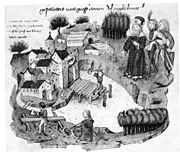 No archaeological evidence that indicates a settlement on the site of today′s city centre prior to the 12th century has been found so far. In antiquity, a celtic oppidum
stood on the “Engehalbinsel” north of Bern, fortified since the 2nd century BC (late La Tène period), thought to be one of the twelve oppida of the Helvetii
mentioned by Caesar
. During the Roman era
, there was a Gallo-roman vicus
on the same site. The Bern zinc tablet has the name Brenodor "dwelling of Breno". In the Early Middle Ages, there was a settlement in Bümpliz, now a city district of Bern, some 4 km (2 mi) from the medieval city.
The medieval city is a foundation of the Zähringer ruling family, which rose to power in Upper Burgundy
in the 12th century. According to 14th century historiography (Cronica de Berno, 1309), Bern was founded in 1191 by Berthold V, Duke of Zähringen
.
In 1218, after Berthold died without an heir, Bern was made a free imperial city
by the Holy Roman Emperor
Frederick II
.
, becoming one of the "eight cantons" of the formative period of 1353 to 1481.
Bern was invaded and conquered Aargau
in 1415 and Vaud
in 1536, as well as other smaller territories, thereby becoming the largest city-state
north of the Alps
, by the 18th century comprising most of what is today the canton of Berne
and the canton of Vaud.
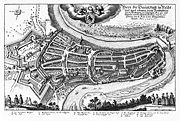 The city grew out towards the west of the boundaries of the peninsula formed by the river Aare. Initially, the Zytglogge
tower marked the western boundary of the city from 1191 until 1256, when the Käfigturm took over this role until 1345, which, in turn, was then succeeded by the Christoffelturm
(located close to today's train station) until 1622. During the time of the Thirty Years' War
two new fortifications, the so-called big and small Schanze (entrenchment), were built to protect the whole area of the peninsula.
Bern was occupied by French troops in 1798 during the French Revolutionary Wars
, when it was stripped of parts of its territories. It regained the Bernese Oberland
in 1802, and following the Congress of Vienna
of 1814 newly acquired the Bernese Jura
, once again becoming the largest canton of the confederacy as it stood during the Restoration, and further until the secession of the canton of Jura
in 1979.
In 1848 Bern was made the Federal City
(seat of the Federal Assembly) of the new Swiss federal state
.
A number of congresses of the socialist First and Second International
s were held in Bern, particularly during World War I
when Switzerland was neutral; see Bern International.
The city's population rose from about 5,000 in the 15th century to about 12,000 by 1800 and to above 60,000 by 1900, passing the 100,000 mark during the 1920s.
Population peaked during the 1960s at 165,000, and has since decreased slightly, to below 130,000 by 2000.
As of 31 December 2009, the resident population was at 130,289 of which 101,627 were Swiss citizens and 28,662 (22%) resident foreigners. Another estimated 350,000 people live in the immediate urban agglomeration.
in the Canton of Bern, slightly west of the centre of Switzerland and 20 km (12.4 mi) north of the Bernese
Alps
. The countryside around Bern was formed by glaciers during the most recent Ice Age
. The two mountains closest to Bern are the Gurten
with a height of 958 m (3,143 ft) and the Bantiger with a height of 947 m (3,107 ft). The site of the old observatory in Bern is the point of origin of the CH1903 coordinate system
at 46°57′08.66"N 7°26′22.50"E.
The city was originally built on a hilly peninsula
surrounded by the river Aare, but outgrew the natural boundaries by the 19th century. A number of bridges have been built to allow the city to expand beyond the Aare.
Bern is built on very uneven ground. There are several dozen metres in difference of height between the inner city districts on the Aare (Matte
, Marzili) and the higher ones (Kirchenfeld, Länggasse).
Bern has an area, , of 51.62 square kilometres (19.9 sq mi). Of this area, 9.79 square kilometres (3.8 sq mi) or 19.0% is used for agricultural purposes, while 17.33 square kilometres (6.7 sq mi) or 33.6% is forested. Of the rest of the land, 23.25 square kilometres (9 sq mi) or 45.0% is settled (buildings or roads), 1.06 square kilometre (0.409268288108087 sq mi) or 2.1% is either rivers or lakes and 0.16 square kilometre (0.0617763453748056 sq mi) or 0.3% is unproductive land.
Of the built up area, 3.6% consists of industrial buildings, 21.7% housing and other buildings, and 12.6% is devoted to transportation infrastructure. Power and water infrastructure as well as other special developed areas made up 1.1% of the city, while another 6.0% consists of parks, green belts and sports fields. 32.8% of the total land area is heavily forested. Of the agricultural land, 14.3% is used for growing crops and 4.0% is designated to be used as pastures. The rivers and streams provide all the water in the municipality.
52.7 % of the population are female, 47.3 % are male. The average age is 41 years and nine months. As of 2000 children and teenagers (0–19 years old) make up 15.1%, adults (20–64 years old) 65% and seniors (over 64 years old) 19.9%.
The Swiss population is generally well educated. In Bern about 72.8% of the population (between age 25–64) have completed either non-mandatory upper secondary education or additional higher education (either University or a Fachhochschule
).
Bern has an unemployment rate of 3.2%. , there were 773 people employed in the primary economic sector and about 104 businesses involved in this sector. 16,484 people are employed in the secondary sector and there are 1,094 businesses in this sector. 131,659 people are employed in the tertiary sector, with 7,638 businesses in this sector.
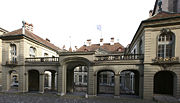
.jpg)
Bern is governed by the Gemeinderat, an executive council with five members, one of them the elected mayor
(Stadtpräsident). The parliament
has 80 members and is called Stadtrat. Both the legislative and the executive
are elected in general elections for a term of four years. The last elections were held in November 2008 with a 43.48% participation.
The executive council has a left-green majority with two representatives, including the mayor Alexander Tschäppät, of the Social Democratic Party of Switzerland
(SPS) and one representative of the leftist Green party Grünes Bündnis (GB). It also has a majority of three women against two men.
The seat of the Gemeinderat is the Erlacherhof
.
The 80 members of the legislative council belong to 18 different political parties, the strongest being the Social Democratic Party with 20 representatives, followed by the conservative Free Democratic Party of Switzerland
(FDP) with 10 and the moderate Green party Grüne Freien Liste (GFL) with 9 seats. Both the far right Swiss People's Party
(SVP) and the leftist Green party Grünes Bündnis have 8 seats each.
The Stadtrat meets on Thursday evenings at the Rathaus (Town Hall).
The representatives of the Social Democratic Party and of the Green Parties, collectively referred to as "Red-Green-Center" (Rot-Grüne-Mitte), hold a majority in both councils and mostly determine City policy, although no formal coalition agreement exists and, under the system of direct democracy
that prevails in Switzerland, most important issues are settled by general vote.
as a Cultural World Heritage Site
. Perhaps its most famous sight is the Zytglogge
(Bernese German for "Time Bell"), an elaborate medieval clock tower with moving puppets. It also has an impressive 15th century Gothic
cathedral
, the Münster, and a 15th century town hall. Thanks to 6 kilometres of arcades, the old town boasts one of the longest covered shopping promenades in Europe.
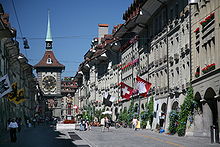 Since the 16th century, the city has had a bear pit (the Bärengraben
). The extended and renewed pit off the far end of the Nydeggbrücke
actually contains four bears, including two young. During his visit in Bern in 2009, the Russian president and his wife gave two more young bears as a private present. They are actually in Dählhölzli, Bern's zoo.
The Federal Palace (Bundeshaus), built from 1857 to 1902, which houses the national parliament, government and part of the federal administration, can also be visited.
Albert Einstein
lived in an apartment at the Kramgasse
49, the site of the Einsteinhaus
, from 1903 to 1905, the year in which the Annus Mirabilis Papers
were published.
The Rose Garden (Rosengarten), from which a scenic panoramic view of the medieval town centre can be enjoyed, is a well-kept Rosarium on a hill, converted into a park from a former cemetery in 1913.
Bern's most recent sight is the set of fountains in front of the Federal Palace. It was inaugurated on August 1, 2004.
Bern features many heritage sites of national significance
. Apart from the entire Old Town and many sites within it, these include the Bärengraben, the Gewerbeschule Bern (1937), the Eidgenössisches Archiv für Denkmalpflege, the Kirchenfeld mansion district (after 1881), the Thunplatzbrunnen, the Federal Mint
building, the Federal Archives, the Swiss National Library
, the Historical Museum
(1894), Alpine Museum, Museum of Communication and Natural History Museum
.
The Universal Postal Union
is situated in Bern.

) with German and French
subtitles. Only a small number of screenings are dubbed in German.
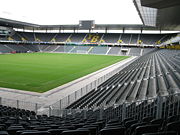 Bern was the site of the 1954 Football (Soccer) World Cup Final, a huge upset for the Hungarian Golden Team, who were beaten 3–2 by West Germany.
The football team BSC Young Boys
is based in Bern at the Stade de Suisse Wankdorf
, which also was one of the venues for the European football championship 2008.
The Stade de Suisse hosted three matches during the 2008 UEFA Euro Cup tournament.
SC Bern
is the major ice hockey team of Bern who plays at the PostFinance Arena.
The PostFinance Arena was the main host of the 2009 IIHF Ice Hockey World Championship
, including the opening game and the final of the tournament.
The PostFinance Arena was also the host of the 2011 European Figure Skate Championships.
Bern Cardinals is the baseball
and softball
team of Bern, which plays at the Allmend
Bern Grizzlies is the American football club in Bern and plays at Sportanlage Schonau.
Bern was a candidate to host the 2010 Winter Olympics, but withdrew its bid in September 2002 after a referendum was passed that showed that the bid was not supported by locals. Those games were eventually awarded to Vancouver, Canada.
RC Bern is the local rugby club (since 1972) and plays at the Allmend. The ladies team has been founded in 1995.
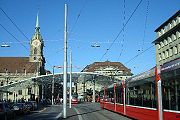 Bern is well connected to other cities by several motorways
(A1
, A12, A6).
Public transport works well in Bern, with tram
, S-Bahn
and bus
lines which connect the different parts of the City. Bern Rail Station
connects the City to the national and international train network. A funicular railway leads from the Marzili district to the Bundeshaus. This funicular
is, with a length of 106 m (348 ft), the second shortest public railway in Europe after the Zagreb Funicular
. Several Aare bridges connect the old parts of the city with the newer districts outside of the peninsula.
Bern is served by Bern Airport
, located outside the city near the town of Belp
. The regional airport, colloquially called Bern-Belp or Belpmoos, is connected to several Swiss and European cities.

Bernese German
Bernese German is the dialect of High Alemannic German spoken in the Swiss plateau part of the canton of Bern and in some neighbouring regions.- Varieties :There is a lot of regional variation within Bernese German dialects...
: Bärn b̥æːrn) is the Bundesstadt (federal city
Federal City
The term Federal City is a title for certain cities in Germany, Switzerland and Russia, and a historic term in the United States.In Germany, Bonn has been designated as a Federal City...
, de facto
De facto
De facto is a Latin expression that means "concerning fact." In law, it often means "in practice but not necessarily ordained by law" or "in practice or actuality, but not officially established." It is commonly used in contrast to de jure when referring to matters of law, governance, or...
capital) of Switzerland
Switzerland
Switzerland name of one of the Swiss cantons. ; ; ; or ), in its full name the Swiss Confederation , is a federal republic consisting of 26 cantons, with Bern as the seat of the federal authorities. The country is situated in Western Europe,Or Central Europe depending on the definition....
, and, with (as of ) a population of , the fourth most populous city in Switzerland. The Bern agglomeration, which includes 43 municipalities, has a population of 349,000. The metropolitan area
Metropolitan area
The term metropolitan area refers to a region consisting of a densely populated urban core and its less-populated surrounding territories, sharing industry, infrastructure, and housing. A metropolitan area usually encompasses multiple jurisdictions and municipalities: neighborhoods, townships,...
had a population of 660,000 in 2000. Bern is also the capital of the Canton of Bern, the second most populous of Switzerland's cantons.
The official language of Bern is German, but the main spoken language is the Alemannic
Alemannic German
Alemannic is a group of dialects of the Upper German branch of the Germanic language family. It is spoken by approximately ten million people in six countries: Switzerland, Germany, Austria, Liechtenstein, France and Italy...
dialect called Bernese German
Bernese German
Bernese German is the dialect of High Alemannic German spoken in the Swiss plateau part of the canton of Bern and in some neighbouring regions.- Varieties :There is a lot of regional variation within Bernese German dialects...
.
In 1983 the historic old town in the centre of Bern became a UNESCO World Heritage Site, and Bern is ranked among the world’s top ten cities for the best quality of life (2010).
Name
The etymology of the name Bern is uncertain. According to the local legend, based on folk etymology, Berchtold V, Duke of Zähringen, the founder of the city of Bern, vowed to name the city after the first animal he met on the hunt, and this turned out to be a bear. It has long been considered likely that the city was named after the Italian city of VeronaVerona
Verona ; German Bern, Dietrichsbern or Welschbern) is a city in the Veneto, northern Italy, with approx. 265,000 inhabitants and one of the seven chef-lieus of the region. It is the second largest city municipality in the region and the third of North-Eastern Italy. The metropolitan area of Verona...
, which at the time was known as Bern in Middle High German
Middle High German
Middle High German , abbreviated MHG , is the term used for the period in the history of the German language between 1050 and 1350. It is preceded by Old High German and followed by Early New High German...
. As a result of the find of the Bern zinc tablet in the 1980, it is now more common to assume that the city was named after a pre-existing toponym of celtic origin, possibly *berna "cleft". The bear was the heraldic animal of the seal and coat of arms of Bern from at least the 1220s. The earliest reference to the keeping of live bears in the Bärengraben
Bärengraben
The Bärengraben, or Bear Pit, is a well-known tourist attraction, an enclosure housing bears at the eastern edge of the Old City of Bern, next to the Nydeggbrücke and the Aare River. The bear is a symbol of Bern, both the city and canton, and is featured in Bern's coat of arms.The first records of...
dates to the 1440s.
Early History
Oppidum
Oppidum is a Latin word meaning the main settlement in any administrative area of ancient Rome. The word is derived from the earlier Latin ob-pedum, "enclosed space," possibly from the Proto-Indo-European *pedóm-, "occupied space" or "footprint."Julius Caesar described the larger Celtic Iron Age...
stood on the “Engehalbinsel” north of Bern, fortified since the 2nd century BC (late La Tène period), thought to be one of the twelve oppida of the Helvetii
Helvetii
The Helvetii were a Celtic tribe or tribal confederation occupying most of the Swiss plateau at the time of their contact with the Roman Republic in the 1st century BC...
mentioned by Caesar
Commentarii de Bello Gallico
Commentarii de Bello Gallico is Julius Caesar's firsthand account of the Gallic Wars, written as a third-person narrative. In it Caesar describes the battles and intrigues that took place in the nine years he spent fighting local armies in Gaul that opposed Roman domination.The "Gaul" that Caesar...
. During the Roman era
Germania Superior
Germania Superior , so called for the reason that it lay upstream of Germania Inferior, was a province of the Roman Empire. It comprised an area of western Switzerland, the French Jura and Alsace regions, and southwestern Germany...
, there was a Gallo-roman vicus
Vicus
Vicus may refer to:*Vicus , plural vici, a neighborhood or local administrative unit of ancient Rome**Vicus Tuscus in Rome**Vicus Jugarius, leading into the Roman Forum** Gensis in Moesia Superior...
on the same site. The Bern zinc tablet has the name Brenodor "dwelling of Breno". In the Early Middle Ages, there was a settlement in Bümpliz, now a city district of Bern, some 4 km (2 mi) from the medieval city.
The medieval city is a foundation of the Zähringer ruling family, which rose to power in Upper Burgundy
Upper Burgundy
Upper Burgundy is the part of Burgundy east of the Jura mountains, that together with the western County of Burgundy from 868 formed the Kingdom of Upper Burgundy, encompassing both sides of the Jura mountains range...
in the 12th century. According to 14th century historiography (Cronica de Berno, 1309), Bern was founded in 1191 by Berthold V, Duke of Zähringen
Berthold V, Duke of Zähringen
Berchtold V of Zähringen was Duke of Zähringen until his death, succeeding his father Berchtold IV in 1186.- History and legacy :...
.
In 1218, after Berthold died without an heir, Bern was made a free imperial city
Free Imperial City
In the Holy Roman Empire, a free imperial city was a city formally ruled by the emperor only — as opposed to the majority of cities in the Empire, which were governed by one of the many princes of the Empire, such as dukes or prince-bishops...
by the Holy Roman Emperor
Holy Roman Emperor
The Holy Roman Emperor is a term used by historians to denote a medieval ruler who, as German King, had also received the title of "Emperor of the Romans" from the Pope...
Frederick II
Frederick II, Holy Roman Emperor
Frederick II , was one of the most powerful Holy Roman Emperors of the Middle Ages and head of the House of Hohenstaufen. His political and cultural ambitions, based in Sicily and stretching through Italy to Germany, and even to Jerusalem, were enormous...
.
Old Swiss Confederacy
In 1353 Bern joined the Swiss ConfederacyOld Swiss Confederacy
The Old Swiss Confederacy was the precursor of modern-day Switzerland....
, becoming one of the "eight cantons" of the formative period of 1353 to 1481.
Bern was invaded and conquered Aargau
Aargau
Aargau is one of the more northerly cantons of Switzerland. It comprises the lower course of the river Aare, which is why the canton is called Aar-gau .-History:...
in 1415 and Vaud
Vaud
Vaud is one of the 26 cantons of Switzerland and is located in Romandy, the French-speaking southwestern part of the country. The capital is Lausanne. The name of the Canton in Switzerland's other languages are Vaud in Italian , Waadt in German , and Vad in Romansh.-History:Along the lakes,...
in 1536, as well as other smaller territories, thereby becoming the largest city-state
City-state
A city-state is an independent or autonomous entity whose territory consists of a city which is not administered as a part of another local government.-Historical city-states:...
north of the Alps
Alps
The Alps is one of the great mountain range systems of Europe, stretching from Austria and Slovenia in the east through Italy, Switzerland, Liechtenstein and Germany to France in the west....
, by the 18th century comprising most of what is today the canton of Berne
Canton of Berne
The Canton of Bern is the second largest of the 26 Swiss cantons by both surface area and population. Located in west-central Switzerland, it borders the Canton of Jura and the Canton of Solothurn to the north. To the west lie the Canton of Neuchâtel, the Canton of Fribourg and Vaud. To the south...
and the canton of Vaud.
Modern history
Zytglogge
The Zytglogge tower is a landmark medieval tower in Bern, Switzerland. Built in the early 13th century, it has served the city as guard tower, prison, clock tower, centre of urban life and civic memorial....
tower marked the western boundary of the city from 1191 until 1256, when the Käfigturm took over this role until 1345, which, in turn, was then succeeded by the Christoffelturm
Christoffelturm
The Christoffelturm was a tower built between the years 1344 and 1346. It was located in the old part of the Swiss city of Bern, in the upper section of Spitalgasse, near Holy Spirit Church....
(located close to today's train station) until 1622. During the time of the Thirty Years' War
Thirty Years' War
The Thirty Years' War was fought primarily in what is now Germany, and at various points involved most countries in Europe. It was one of the most destructive conflicts in European history....
two new fortifications, the so-called big and small Schanze (entrenchment), were built to protect the whole area of the peninsula.
Bern was occupied by French troops in 1798 during the French Revolutionary Wars
French Revolutionary Wars
The French Revolutionary Wars were a series of major conflicts, from 1792 until 1802, fought between the French Revolutionary government and several European states...
, when it was stripped of parts of its territories. It regained the Bernese Oberland
Bernese Oberland
The Bernese Oberland is the higher part of the canton of Bern, Switzerland, in the southern end of the canton: The area around Lake Thun and Lake Brienz, and the valleys of the Bernese Alps .The flag of the Bernese Oberland consists of a black eagle in a gold field The Bernese Oberland (Bernese...
in 1802, and following the Congress of Vienna
Congress of Vienna
The Congress of Vienna was a conference of ambassadors of European states chaired by Klemens Wenzel von Metternich, and held in Vienna from September, 1814 to June, 1815. The objective of the Congress was to settle the many issues arising from the French Revolutionary Wars, the Napoleonic Wars,...
of 1814 newly acquired the Bernese Jura
Bernese Jura
Bernese Jura is the name for the French-speaking area of the Swiss canton of Bern, and from 2010 one of five administrative divisions of the canton....
, once again becoming the largest canton of the confederacy as it stood during the Restoration, and further until the secession of the canton of Jura
Canton of Jura
The Republic and Canton of the Jura , also known as the Canton of Jura or Canton Jura, is one of the cantons of Switzerland. It is the newest of the 26 Swiss cantons, located in the northwestern part of Switzerland. The capital is Delémont...
in 1979.
In 1848 Bern was made the Federal City
Federal City
The term Federal City is a title for certain cities in Germany, Switzerland and Russia, and a historic term in the United States.In Germany, Bonn has been designated as a Federal City...
(seat of the Federal Assembly) of the new Swiss federal state
Switzerland as a federal state
The rise of Switzerland as a federal state began on September 12, 1848, with the creation of a federal constitution, which was created in response to a 27-day civil war in Switzerland, the Sonderbundskrieg...
.
A number of congresses of the socialist First and Second International
Second International
The Second International , the original Socialist International, was an organization of socialist and labour parties formed in Paris on July 14, 1889. At the Paris meeting delegations from 20 countries participated...
s were held in Bern, particularly during World War I
World War I
World War I , which was predominantly called the World War or the Great War from its occurrence until 1939, and the First World War or World War I thereafter, was a major war centred in Europe that began on 28 July 1914 and lasted until 11 November 1918...
when Switzerland was neutral; see Bern International.
The city's population rose from about 5,000 in the 15th century to about 12,000 by 1800 and to above 60,000 by 1900, passing the 100,000 mark during the 1920s.
Population peaked during the 1960s at 165,000, and has since decreased slightly, to below 130,000 by 2000.
As of 31 December 2009, the resident population was at 130,289 of which 101,627 were Swiss citizens and 28,662 (22%) resident foreigners. Another estimated 350,000 people live in the immediate urban agglomeration.
Geography
Bern lies on the Swiss plateauSwiss plateau
The Swiss Plateau or Central Plateau constitutes one of the three major landscapes in Switzerland alongside the Jura mountains and the Swiss Alps. It covers about 30% of the Swiss surface...
in the Canton of Bern, slightly west of the centre of Switzerland and 20 km (12.4 mi) north of the Bernese
Bernese Alps
The Bernese Alps are a group of mountain ranges in the western part of the Alps, in Switzerland. Although the name suggests that they are located in the Bernese Oberland region of the canton of Bern, portions of the Bernese Alps are in the adjacent cantons of Valais, Lucerne, Obwalden, Fribourg and...
Alps
Swiss Alps
The Swiss Alps are the portion of the Alps mountain range that lies within Switzerland. Because of their central position within the entire Alpine range, they are also known as the Central Alps....
. The countryside around Bern was formed by glaciers during the most recent Ice Age
Ice age
An ice age or, more precisely, glacial age, is a generic geological period of long-term reduction in the temperature of the Earth's surface and atmosphere, resulting in the presence or expansion of continental ice sheets, polar ice sheets and alpine glaciers...
. The two mountains closest to Bern are the Gurten
Gurten (mountain)
The Gurten is a mountain situated just to the south of Bern, the capital city of Switzerland. It is high, and the summit yields views of Bern, of the Jura mountains and of the Alps....
with a height of 958 m (3,143 ft) and the Bantiger with a height of 947 m (3,107 ft). The site of the old observatory in Bern is the point of origin of the CH1903 coordinate system
Swiss coordinate system
The Swiss coordinate system is a geographic coordinate system used in Switzerland for maps and surveying by the Swiss Federal Office of Topography .The map projection used is Oblique Mercator on an 1841 Bessel ellipsoid....
at 46°57′08.66"N 7°26′22.50"E.
The city was originally built on a hilly peninsula
Peninsula
A peninsula is a piece of land that is bordered by water on three sides but connected to mainland. In many Germanic and Celtic languages and also in Baltic, Slavic and Hungarian, peninsulas are called "half-islands"....
surrounded by the river Aare, but outgrew the natural boundaries by the 19th century. A number of bridges have been built to allow the city to expand beyond the Aare.
Bern is built on very uneven ground. There are several dozen metres in difference of height between the inner city districts on the Aare (Matte
Mattequartier
The Mattequartier is a historic section in the Old City of Bern in Bern, Switzerland.The first expansion of Bern occurred as the city was founded in 1191. The central and oldest neighbourhood was known as the Zähringerstadt after the founder, Duke Berthold V of Zähringen...
, Marzili) and the higher ones (Kirchenfeld, Länggasse).
Bern has an area, , of 51.62 square kilometres (19.9 sq mi). Of this area, 9.79 square kilometres (3.8 sq mi) or 19.0% is used for agricultural purposes, while 17.33 square kilometres (6.7 sq mi) or 33.6% is forested. Of the rest of the land, 23.25 square kilometres (9 sq mi) or 45.0% is settled (buildings or roads), 1.06 square kilometre (0.409268288108087 sq mi) or 2.1% is either rivers or lakes and 0.16 square kilometre (0.0617763453748056 sq mi) or 0.3% is unproductive land.
Of the built up area, 3.6% consists of industrial buildings, 21.7% housing and other buildings, and 12.6% is devoted to transportation infrastructure. Power and water infrastructure as well as other special developed areas made up 1.1% of the city, while another 6.0% consists of parks, green belts and sports fields. 32.8% of the total land area is heavily forested. Of the agricultural land, 14.3% is used for growing crops and 4.0% is designated to be used as pastures. The rivers and streams provide all the water in the municipality.
Climate
Subdivisions
The municipality is administratively subdivided into six districts (Stadtteile), each of which consists of several quarters (Quartiere).Demographics
Bern has a population (as of ) of 132'473, , 24.7 % of the population was made up of foreign nationals. Most of the population speaks German (81.2%), with Italian being second most common (3.9%) and French being third (3.6%).52.7 % of the population are female, 47.3 % are male. The average age is 41 years and nine months. As of 2000 children and teenagers (0–19 years old) make up 15.1%, adults (20–64 years old) 65% and seniors (over 64 years old) 19.9%.
The Swiss population is generally well educated. In Bern about 72.8% of the population (between age 25–64) have completed either non-mandatory upper secondary education or additional higher education (either University or a Fachhochschule
Fachhochschule
A Fachhochschule or University of Applied Sciences is a German type of tertiary education institution, sometimes specialized in certain topical areas . Fachhochschulen were founded in Germany and later adopted by Austria, Liechtenstein, Switzerland and Greece...
).
Bern has an unemployment rate of 3.2%. , there were 773 people employed in the primary economic sector and about 104 businesses involved in this sector. 16,484 people are employed in the secondary sector and there are 1,094 businesses in this sector. 131,659 people are employed in the tertiary sector, with 7,638 businesses in this sector.
Politics
Bern is governed by the Gemeinderat, an executive council with five members, one of them the elected mayor
Mayor
In many countries, a Mayor is the highest ranking officer in the municipal government of a town or a large urban city....
(Stadtpräsident). The parliament
Parliament
A parliament is a legislature, especially in those countries whose system of government is based on the Westminster system modeled after that of the United Kingdom. The name is derived from the French , the action of parler : a parlement is a discussion. The term came to mean a meeting at which...
has 80 members and is called Stadtrat. Both the legislative and the executive
Executive (government)
Executive branch of Government is the part of government that has sole authority and responsibility for the daily administration of the state bureaucracy. The division of power into separate branches of government is central to the idea of the separation of powers.In many countries, the term...
are elected in general elections for a term of four years. The last elections were held in November 2008 with a 43.48% participation.
The executive council has a left-green majority with two representatives, including the mayor Alexander Tschäppät, of the Social Democratic Party of Switzerland
Social Democratic Party of Switzerland
The Social Democratic Party of Switzerland is the largest centre-left political party in Switzerland....
(SPS) and one representative of the leftist Green party Grünes Bündnis (GB). It also has a majority of three women against two men.
The seat of the Gemeinderat is the Erlacherhof
Junkerngasse
-External links:...
.
The 80 members of the legislative council belong to 18 different political parties, the strongest being the Social Democratic Party with 20 representatives, followed by the conservative Free Democratic Party of Switzerland
Free Democratic Party of Switzerland
The Free Democratic Party was a classical liberal political party in Switzerland. It was one of the major parties in Switzerland until its merger with the smaller classical liberal Liberal Party, to form FDP.The Liberals on 1 January 2009....
(FDP) with 10 and the moderate Green party Grüne Freien Liste (GFL) with 9 seats. Both the far right Swiss People's Party
Swiss People's Party
The Swiss People's Party , also known as the Democratic Union of the Centre , is a conservative political party in Switzerland. Chaired by Toni Brunner, but spearheaded by Christoph Blocher, the party is the largest party in the Federal Assembly, with 58 members of the National Council and 6 of...
(SVP) and the leftist Green party Grünes Bündnis have 8 seats each.
The Stadtrat meets on Thursday evenings at the Rathaus (Town Hall).
The representatives of the Social Democratic Party and of the Green Parties, collectively referred to as "Red-Green-Center" (Rot-Grüne-Mitte), hold a majority in both councils and mostly determine City policy, although no formal coalition agreement exists and, under the system of direct democracy
Direct democracy
Direct democracy is a form of government in which people vote on policy initiatives directly, as opposed to a representative democracy in which people vote for representatives who then vote on policy initiatives. Direct democracy is classically termed "pure democracy"...
that prevails in Switzerland, most important issues are settled by general vote.
Main sights
The structure of Bern's city centre is largely medieval and has been recognised by UNESCOUNESCO
The United Nations Educational, Scientific and Cultural Organization is a specialized agency of the United Nations...
as a Cultural World Heritage Site
World Heritage Site
A UNESCO World Heritage Site is a place that is listed by the UNESCO as of special cultural or physical significance...
. Perhaps its most famous sight is the Zytglogge
Zytglogge
The Zytglogge tower is a landmark medieval tower in Bern, Switzerland. Built in the early 13th century, it has served the city as guard tower, prison, clock tower, centre of urban life and civic memorial....
(Bernese German for "Time Bell"), an elaborate medieval clock tower with moving puppets. It also has an impressive 15th century Gothic
Gothic architecture
Gothic architecture is a style of architecture that flourished during the high and late medieval period. It evolved from Romanesque architecture and was succeeded by Renaissance architecture....
cathedral
Cathedral
A cathedral is a Christian church that contains the seat of a bishop...
, the Münster, and a 15th century town hall. Thanks to 6 kilometres of arcades, the old town boasts one of the longest covered shopping promenades in Europe.
Bärengraben
The Bärengraben, or Bear Pit, is a well-known tourist attraction, an enclosure housing bears at the eastern edge of the Old City of Bern, next to the Nydeggbrücke and the Aare River. The bear is a symbol of Bern, both the city and canton, and is featured in Bern's coat of arms.The first records of...
). The extended and renewed pit off the far end of the Nydeggbrücke
Nydeggbrücke
The Nydeggbrücke is a bridge in Bern, Switzerland which connects the eastern part of the old city to the new part. It crosses over the Aare River and is located very close to the Bärengraben. It was built in parallel to the Untertorbrücke in 1840, which until then had been the only bridge crossing...
actually contains four bears, including two young. During his visit in Bern in 2009, the Russian president and his wife gave two more young bears as a private present. They are actually in Dählhölzli, Bern's zoo.
The Federal Palace (Bundeshaus), built from 1857 to 1902, which houses the national parliament, government and part of the federal administration, can also be visited.
Albert Einstein
Albert Einstein
Albert Einstein was a German-born theoretical physicist who developed the theory of general relativity, effecting a revolution in physics. For this achievement, Einstein is often regarded as the father of modern physics and one of the most prolific intellects in human history...
lived in an apartment at the Kramgasse
Kramgasse
The Kramgasse is one of the principal streets in the Old City of Bern, the medieval city center of Bern, Switzerland. It was the center of urban life in Bern up until the 19th century. Today, it is a popular shopping street...
49, the site of the Einsteinhaus
Einsteinhaus
The Einsteinhaus is a museum and a former residence of Albert Einstein. It is located on Kramgasse No. 49 in Bern, Switzerland....
, from 1903 to 1905, the year in which the Annus Mirabilis Papers
Annus Mirabilis Papers
The Annus Mirabilis papers are the papers of Albert Einstein published in the Annalen der Physik scientific journal in 1905. These four articles contributed substantially to the foundation of modern physics and changed views on space, time, and matter...
were published.
The Rose Garden (Rosengarten), from which a scenic panoramic view of the medieval town centre can be enjoyed, is a well-kept Rosarium on a hill, converted into a park from a former cemetery in 1913.
Bern's most recent sight is the set of fountains in front of the Federal Palace. It was inaugurated on August 1, 2004.
Bern features many heritage sites of national significance
Swiss Inventory of Cultural Property of National and Regional Significance
The Swiss Inventory of Cultural Property of National and Regional Significance is a register of some 8,300 items of cultural property in Switzerland...
. Apart from the entire Old Town and many sites within it, these include the Bärengraben, the Gewerbeschule Bern (1937), the Eidgenössisches Archiv für Denkmalpflege, the Kirchenfeld mansion district (after 1881), the Thunplatzbrunnen, the Federal Mint
Swissmint
Swissmint is the official mint of the Swiss Confederation. It is responsible for manufacturing Swiss franc coins, both of the currency and bullion variety. Apart from making coins for the government, Swissmint also manufactures medals and commemorative coins for private customers.Swissmint is an...
building, the Federal Archives, the Swiss National Library
Swiss National Library
The Swiss National Library is the national library of Switzerland. It is part of the Federal Office of Culture. Under the terms of the law which governs it, it is charged with collecting, cataloging and conserving information in all fields and disciplines, and in any medium, connected with...
, the Historical Museum
Historical Museum of Bern
The Historical Museum of Bern is the second largest historical museum in Switzerland. It was built in 1894 by the Neuchâtel architect André Lambert...
(1894), Alpine Museum, Museum of Communication and Natural History Museum
Natural History Museum of Bern
The Natural History Museum of Bern is a museum in Bern, Switzerland. In its teaching and research it cooperates closely with the University of Bern. It is visited by around 100,000 people yearly.-History:...
.
The Universal Postal Union
Universal Postal Union
The Universal Postal Union is an international organization that coordinates postal policies among member nations, in addition to the worldwide postal system. The UPU contains four bodies consisting of the Congress, the Council of Administration , the Postal Operations Council and the...
is situated in Bern.
Culture
Theatres
- Bern Theatre
- Narrenpack Theater Bern
- Schlachthaus-theater
- Tojo TheaterTojo TheaterThe Tojo Theater is a theater in Berne, Switzerland. It is a part of the Reitschule, and anarchistic culture centre.It has about 100 shows a year, which mostly are in the alternative spectrum. There is no resident theater group.-External links:*...
- The Theater on the Effinger-Street
- Theater am Käfigturm
Cinemas
Bern has several dozen cinemas. As is customary in Switzerland, films are generally shown in their original language (e.g., EnglishEnglish language
English is a West Germanic language that arose in the Anglo-Saxon kingdoms of England and spread into what was to become south-east Scotland under the influence of the Anglian medieval kingdom of Northumbria...
) with German and French
French language
French is a Romance language spoken as a first language in France, the Romandy region in Switzerland, Wallonia and Brussels in Belgium, Monaco, the regions of Quebec and Acadia in Canada, and by various communities elsewhere. Second-language speakers of French are distributed throughout many parts...
subtitles. Only a small number of screenings are dubbed in German.
Film festivals
- QueersichtQueersichtQueersicht is a gay and lesbian film festival held in Bern, Switzerland. Founded in 1997, it is the oldest film festival for LGBT and queer movies in Switzerland. It is linked to radical left-wing and alternative structures and has a non-profit structure...
– gay and lesbian film festival, held annually in the second week of November. - SHNIT International Short Film Festival
Festivals
- BeJazz Summer and Winter Festival
- BuskersBuskingStreet performance or busking is the practice of performing in public places, for gratuities, which are generally in the form of money and edibles...
festival - GurtenfestivalGurtenfestivalThe Gurtenfestival is a music festival in Switzerland. It is held annually in middle of July on top of Bern's local mountain, the Gurten.-1991:Nazareth, Donovan, Ralph McTell, Flying Pickets, Konstantin Wecker-1992:...
- Internationales Jazzfestival Bern
- Queersicht – Queer Filmfestival, annually held second week of November.
- SHNIT International Short Film Festival
- Taktlos-Festival
Fairs
- ZibelemäritZibelemäritThe Zibelemärit is an annual market with aspects of a fair in the old town of Berne, Switzerland. It takes place every fourth Monday in November....
– The Zibelemärit (onion market) is an annual fair held on the fourth Monday in November. - Bernese Fassnacht (Carnival)
Sport
The football team BSC Young Boys
BSC Young Boys
Berner Sport Club Young Boys 1898 is a Swiss sporting club based in the capital city of Bern. The name is often abbreviated to YB . Abroad, YB is often referred to as Young Boys Bern. The club's colors are yellow and black....
is based in Bern at the Stade de Suisse Wankdorf
Stade de Suisse, Wankdorf
The Stade de Suisse Wankdorf is a football stadium in Bern, Switzerland.It is the home ground of the Swiss football team BSC Young Boys, and is currently the second biggest all-seater football stadium in Switzerland....
, which also was one of the venues for the European football championship 2008.
The Stade de Suisse hosted three matches during the 2008 UEFA Euro Cup tournament.
SC Bern
SC Bern
Schlittschuh Club Bern is an ice hockey team based in Bern, Switzerland. The club was the most attended team in Europe for the 2010-11 season, averaging 15,856 spectators....
is the major ice hockey team of Bern who plays at the PostFinance Arena.
The PostFinance Arena was the main host of the 2009 IIHF Ice Hockey World Championship
2009 IIHF World Championship
The 2009 IIHF World Championship took place in Switzerland from 24 April to 10 May. The games were played in the PostFinance Arena in Bern and Schluefweg in Kloten....
, including the opening game and the final of the tournament.
The PostFinance Arena was also the host of the 2011 European Figure Skate Championships.
Bern Cardinals is the baseball
Baseball
Baseball is a bat-and-ball sport played between two teams of nine players each. The aim is to score runs by hitting a thrown ball with a bat and touching a series of four bases arranged at the corners of a ninety-foot diamond...
and softball
Softball
Softball is a bat-and-ball sport played between two teams of 10 to 14 players. It is a direct descendant of baseball although there are some key differences: softballs are larger than baseballs, and the pitches are thrown underhand rather than overhand...
team of Bern, which plays at the Allmend
Bern Grizzlies is the American football club in Bern and plays at Sportanlage Schonau.
Bern was a candidate to host the 2010 Winter Olympics, but withdrew its bid in September 2002 after a referendum was passed that showed that the bid was not supported by locals. Those games were eventually awarded to Vancouver, Canada.
RC Bern is the local rugby club (since 1972) and plays at the Allmend. The ladies team has been founded in 1995.
Education
The University of Bern, whose buildings are mainly located in the Länggasse quarter, is located in Bern, as well as the University of Applied Sciences (Fachhochschule) and several vocations schools.Transport
Autobahns of Switzerland
Autobahnen in German, Autoroutes in French, Autostrade in Italian, Autostradas in Romansch are the names of the national freeways or motorways of Switzerland. Two of the most important freeways are the A1, running from St. Margrethen in northeastern Switzerland's canton of St...
(A1
A1 (Switzerland)
The A1 is a motorway in Switzerland. It follows Switzerland's main east-west axis, from St. Margrethen in northeastern Switzerland's canton of St. Gallen through to Geneva in southwestern Switzerland...
, A12, A6).
Public transport works well in Bern, with tram
Tram
A tram is a passenger rail vehicle which runs on tracks along public urban streets and also sometimes on separate rights of way. It may also run between cities and/or towns , and/or partially grade separated even in the cities...
, S-Bahn
S-Bahn
S-Bahn refers to an often combined city center and suburban railway system metro in Austria, Germany, Switzerland and Denmark...
and bus
Bus
A bus is a road vehicle designed to carry passengers. Buses can have a capacity as high as 300 passengers. The most common type of bus is the single-decker bus, with larger loads carried by double-decker buses and articulated buses, and smaller loads carried by midibuses and minibuses; coaches are...
lines which connect the different parts of the City. Bern Rail Station
Bern Rail Station
Bern is a Swiss Federal Railways station in Bern, Switzerland.It is the nearest station to the University of Bern in the Länggasse quarter. There is a shuttle bus to Bern Airport from the station. Its IATA Airport Code is ZDJ as American Airlines codeshares on the Swiss Federal Railways service...
connects the City to the national and international train network. A funicular railway leads from the Marzili district to the Bundeshaus. This funicular
Marzilibahn
The Marzilibahn, officially the Drahtseilbahn Marzili–Stadt Bern is a very short funicular in Bern, the capital of Switzerland...
is, with a length of 106 m (348 ft), the second shortest public railway in Europe after the Zagreb Funicular
Zagreb Funicular
The Zagreb Funicular is the funicular in Zagreb operated by ZET, situated in Tomić Street, connecting the Ilica Street with Strossmayerovo šetalište to the north ....
. Several Aare bridges connect the old parts of the city with the newer districts outside of the peninsula.
Bern is served by Bern Airport
Bern Airport
Bern-Belp Airport is an airport serving Bern in Switzerland. The airport is within the town limits of Belp, and it is often known simply as Belp Airport....
, located outside the city near the town of Belp
Belp
Belp is a municipality in the Bern-Mittelland administrative district in the canton of Bern in Switzerland. It is close to Bern's Belp Airport.-Geography:...
. The regional airport, colloquially called Bern-Belp or Belpmoos, is connected to several Swiss and European cities.
Notable people
- Mikhail BakuninMikhail BakuninMikhail Alexandrovich Bakunin was a well-known Russian revolutionary and theorist of collectivist anarchism. He has also often been called the father of anarchist theory in general. Bakunin grew up near Moscow, where he moved to study philosophy and began to read the French Encyclopedists,...
died in Bern on 1 July 1876 - Albert EinsteinAlbert EinsteinAlbert Einstein was a German-born theoretical physicist who developed the theory of general relativity, effecting a revolution in physics. For this achievement, Einstein is often regarded as the father of modern physics and one of the most prolific intellects in human history...
worked out his theory of relativityTheory of relativityThe theory of relativity, or simply relativity, encompasses two theories of Albert Einstein: special relativity and general relativity. However, the word relativity is sometimes used in reference to Galilean invariance....
while living in Bern, employed as a clerk at the patent officeSwiss Federal Institute of Intellectual PropertyThe Swiss Federal Institute of Intellectual Property is the federal agency in charge of intellectual property matters in Switzerland. Its seat is in Bern... - Albrecht von HallerAlbrecht von HallerAlbrecht von Haller was a Swiss anatomist, physiologist, naturalist and poet.-Early life:He was born of an old Swiss family at Bern. Prevented by long-continued ill-health from taking part in boyish sports, he had the more opportunity for the development of his precocious mind...
- Louise Elisabeth de MeuronLouise Elisabeth de MeuronLouise Elisabeth de Meuron, better known as Madame de Meuron , was an aristocrat and well-known eccentric personality in the city of Bern.- Family and life :...
, a famed eccentric and noble lady - Paul EmmertPaul EmmertPaul Emmert , who is also known as Paul Emert, was an artist born near Berne, Switzerland in 1826. By 1845, he had become an established artist in New York. He joined the gold rush to California in 1849. The following year he exhibited in Brooklyn a panorama of the gold mining activities before...
, painter - Ferdinand HodlerFerdinand HodlerFerdinand Hodler was one of the best-known Swiss painters of the 19th century.-Life:Hodler was born in Berne, the eldest of six children. His father, Jean Hodler, made a meager living as a carpenter; his mother, Marguerite , was from a peasant family...
, painter - Mark StreitMark StreitMark Streit is a Swiss professional ice hockey defenceman and occasional forward and captain of the New York Islanders of the National Hockey League , also captaining the Swiss national team. He is presently one of five players in the NHL from Switzerland...
, ice hockey player - Christoph von GraffenriedChristoph von GraffenriedChristoph von Graffenried led a group of Swiss and Palatine Germans to North Carolina in 1705, and later authored Relation of My American Project, an account of the establishment of this colony in the New World....
, founder of New BernNew Bern, North CarolinaNew Bern is a city in Craven County, North Carolina with a population of 29,524 as of the 2010 census.. It is located at the confluence of the Trent and the Neuse rivers...
in the USUnited StatesThe United States of America is a federal constitutional republic comprising fifty states and a federal district...
state of North CarolinaNorth CarolinaNorth Carolina is a state located in the southeastern United States. The state borders South Carolina and Georgia to the south, Tennessee to the west and Virginia to the north. North Carolina contains 100 counties. Its capital is Raleigh, and its largest city is Charlotte... - Peter BieriPeter Bieri (author)Peter Bieri , better known by his pseudonym, Pascal Mercier, is a Swiss writer and philosopher.-Academic background:...
, philosophy professor and novelist - Adolf WölfliAdolf WölfliAdolf Wölfli was a Swiss artist who was one of the first artists to be associated with the Art Brut or outsider art label.-Early life:...
, visual artist - Roman JosiRoman JosiRoman Josi is a Swiss professional ice hockey defenceman who currently plays for the Nashville Predators of the National Hockey League. Josi began playing professionally with Bern in 2006. He was selected by the Nashville Predators in the second round, 38th overall, in the 2008 NHL Entry Draft...
, ice hockey player - Mani MatterMani MatterMani Matter was a popular Swiss singer-songwriter...
, songwriter - Léon Savary, Swiss writer and journalist
- Hans UrwylerHans UrwylerHans Urwyler was the sixth Chief Apostle of the New Apostolic Church.- Life :...
, Christian minister