

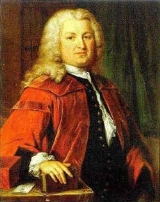
Albrecht von Haller

Encyclopedia
Albrecht von Haller was a Swiss
anatomist
, physiologist, naturalist
and poet.
to his father’s servants; before he was ten he had sketched a Chaldee grammar, prepared a Greek
and a Hebrew
vocabulary, compiled a collection of two thousand biographies of famous men and women on the model of the great works of Bayle
and Moréri
, and written in Latin
verse a satire on his tutor, who had warned him against a too great excursiveness. When still hardly fifteen he was already the author of numerous metrical translations from Ovid
, Horace
and Virgil
, as well as of original lyrics, dramas, and an epic of four thousand lines on the origin of the Swiss confederations, writings which he is said on one occasion to have rescued from a fire at the risk of his life, only, however, to burn them a little later (1729) with his own hand.
 Haller's attention had been directed to the profession of medicine while he was residing in the house of a physician at Biel after his father's death in 1721. While still a sickly and excessively shy youth, he went in his sixteenth year to the University of Tübingen
(December 1723), where he studied under Elias Rudolph Camerarius Jr. and Johann Duvernoy. Dissatisfied with his progress, he in 1725 exchanged Tübingen for Leiden, where Boerhaave
was in the zenith of his fame, and where Albinus
had already begun to lecture in anatomy
. At that university he graduated in May 1727, undertaking successfully in his thesis to prove that the so-called salivary duct, claimed as a recent discovery by Georg Daniel Coschwitz (1679–1729), was nothing more than a blood-vessel.
Haller then visited London
, making the acquaintance of Sir Hans Sloane
, William Cheselden
, John Pringle
, James Douglas
and other scientific men; next, after a short stay in Oxford
, he visited Paris
, where he studied under Henri François Le Dran
and Jacob Winslow
; and in 1728 he proceeded to Basel
, where he devoted himself to the study of higher mathematics under John Bernoulli. It was during his stay there also that his interest in botany
was awakened; and, in the course of a tour (July/August, 1728), through Savoy
, Baden
and several of the cantons of Switzerland
, he began a collection of plants which was afterwards the basis of his great work on the flora of Switzerland. From a literary point of view the main result of this, the first of his many journeys through the Alps
, was his poem entitled Die Alpen, which was finished in March 1729, and appeared in the first edition (1732) of his Gedichte. This poem of 490 hexameters is historically important as one of the earliest signs of the awakening appreciation of the mountains, though it is chiefly designed to contrast the simple and idyllic life of the inhabitants of the Alps with the corrupt and decadent existence of the dwellers in the plains.
In 1729 he returned to Bern and began to practise as a physician; his best energies, however, were devoted to the botanical and anatomical researches which rapidly gave him a European reputation, and procured for him from George II in 1736 a call to the chair of medicine, anatomy, botany and surgery in the newly founded University of Göttingen. He became a Fellow of the Royal Society in 1743, a foreign member of the Royal Swedish Academy of Sciences
in 1747, and was ennobled in 1749.
The quantity of work achieved by Haller in the seventeen years during which he occupied his Göttingen professorship was immense. Apart from the ordinary work of his classes, which entailed the task of newly organizing a botanical garden (the Alte Botanische Garten der Universität Göttingen
), an anatomical theatre and museum, an obstetrical school, and similar institutions, he carried on without interruption those original investigations in botany and physiology, the results of which are preserved in the numerous works associated with his name; he continued also to persevere in his youthful habit of poetical composition, while at the same time he conducted a monthly journal (the Göttingische gelehrte Anzeigen), to which he is said to have contributed twelve thousand articles relating to almost every branch of human knowledge. He also warmly interested himself in most of the religious questions, both ephemeral and permanent, of his day; and the erection of the Reformed church in Göttingen was mainly due to his unwearied energy.
Not withstanding all this variety of absorbing interests he never felt at home in Göttingen; his untravelled heart kept ever turning towards his native Bern (where he had been elected a member of the great council in 1745), and in 1753 he resolved to resign his chair and return to Switzerland.
, of limited monarchy and of aristocratic republican government are fully set forth.
About 1773 the state of his health meant he withdrew from public business. He supported his failing strength by means of opium
, on the use of which he communicated a paper to the Proceedings of the Göttingen Royal Society in 1776; the excessive use of the drug is believed, however, to have hastened his death.
Haller, who had been three times married, left eight children, the eldest of whom, Gottlieb Emanuel, attained to some distinction as a botanist and as a writer on Swiss historical bibliography (1785–1788, 7 vols).
See also:
. In this paragraph, Hahnemann describes how the curative powers of individual medicines can only be ascertained through accurate observation of their specific effects on healthy persons:
"Not one single physician, as far as I know, during the previous two thousand five hundred years, thought of this so natural, so absolutely necessary and only genuine mode of testing medicines for their pure and peculiar effects in deranging the health of man, in order to learn what morbid state each medicine is capable of curing, except the great and immortal Albrecht von Haller. He alone, besides myself, saw the necessity of this (vide the Preface to the Pharmacopoeia Helvet., Basil, 1771, fol., p. 12); Nempe primum in corpore sano medela tentanda est, sine peregrina ulla miscela; odoreque et sapore ejus exploratis, exigua illiu dosis ingerenda et ad ommes, quae inde contingunt, affectiones, quis pulsus, qui calor, quae respiratia, quaenam excretiones, attendum. Inde ad ductum phaenomenorum, in sano obviorum, transeas ad experimenta in corpore aegroro," etc. But no one, not a single physician, attended to or followed up this invaluable hint."
The quotation from von Haller may be translated from the Latin as follows: "Of course, firstly the remedy must be proved on a healthy body, without being mixed with anything foreign; and when its odour and flavour have been ascertained, a tiny dose of it should be given and attention paid to all the changes of state that take place, what the pulse is, what heat there is, what sort of breathing and what exertions there are. Then in relation to the form of the phenomena in a healthy person from those exposed to it, you should move on to trials on a sick body..."
Switzerland
Switzerland name of one of the Swiss cantons. ; ; ; or ), in its full name the Swiss Confederation , is a federal republic consisting of 26 cantons, with Bern as the seat of the federal authorities. The country is situated in Western Europe,Or Central Europe depending on the definition....
anatomist
Anatomy
Anatomy is a branch of biology and medicine that is the consideration of the structure of living things. It is a general term that includes human anatomy, animal anatomy , and plant anatomy...
, physiologist, naturalist
Naturalist
Naturalist may refer to:* Practitioner of natural history* Conservationist* Advocate of naturalism * Naturalist , autobiography-See also:* The American Naturalist, periodical* Naturalism...
and poet.
Early life
He was born of an old Swiss family at Bern. Prevented by long-continued ill-health from taking part in boyish sports, he had the more opportunity for the development of his precocious mind. At the age of four, it is said, he used to read and expound the BibleBible
The Bible refers to any one of the collections of the primary religious texts of Judaism and Christianity. There is no common version of the Bible, as the individual books , their contents and their order vary among denominations...
to his father’s servants; before he was ten he had sketched a Chaldee grammar, prepared a Greek
Greek language
Greek is an independent branch of the Indo-European family of languages. Native to the southern Balkans, it has the longest documented history of any Indo-European language, spanning 34 centuries of written records. Its writing system has been the Greek alphabet for the majority of its history;...
and a Hebrew
Hebrew language
Hebrew is a Semitic language of the Afroasiatic language family. Culturally, is it considered by Jews and other religious groups as the language of the Jewish people, though other Jewish languages had originated among diaspora Jews, and the Hebrew language is also used by non-Jewish groups, such...
vocabulary, compiled a collection of two thousand biographies of famous men and women on the model of the great works of Bayle
Pierre Bayle
Pierre Bayle was a French philosopher and writer best known for his seminal work the Historical and Critical Dictionary, published beginning in 1695....
and Moréri
Louis Moréri
Louis Moréri was a French encyclopaedist.His encyclopaedia, Le grand Dictionaire historique, ou le mélange curieux de l'histoire sacrée et profane was first published in Lyon in 1674. The encyclopaedia focused particularly on historical and biographical articles...
, and written in Latin
Latin
Latin is an Italic language originally spoken in Latium and Ancient Rome. It, along with most European languages, is a descendant of the ancient Proto-Indo-European language. Although it is considered a dead language, a number of scholars and members of the Christian clergy speak it fluently, and...
verse a satire on his tutor, who had warned him against a too great excursiveness. When still hardly fifteen he was already the author of numerous metrical translations from Ovid
Ovid
Publius Ovidius Naso , known as Ovid in the English-speaking world, was a Roman poet who is best known as the author of the three major collections of erotic poetry: Heroides, Amores, and Ars Amatoria...
, Horace
Horace
Quintus Horatius Flaccus , known in the English-speaking world as Horace, was the leading Roman lyric poet during the time of Augustus.-Life:...
and Virgil
Virgil
Publius Vergilius Maro, usually called Virgil or Vergil in English , was an ancient Roman poet of the Augustan period. He is known for three major works of Latin literature, the Eclogues , the Georgics, and the epic Aeneid...
, as well as of original lyrics, dramas, and an epic of four thousand lines on the origin of the Swiss confederations, writings which he is said on one occasion to have rescued from a fire at the risk of his life, only, however, to burn them a little later (1729) with his own hand.
Medicine
Eberhard Karls University of Tübingen
Eberhard Karls University, Tübingen is a public university located in the city of Tübingen, Baden-Württemberg, Germany. It is one of Germany's oldest universities, internationally noted in medicine, natural sciences and the humanities. In the area of German Studies it has been ranked first among...
(December 1723), where he studied under Elias Rudolph Camerarius Jr. and Johann Duvernoy. Dissatisfied with his progress, he in 1725 exchanged Tübingen for Leiden, where Boerhaave
Herman Boerhaave
Herman Boerhaave was a Dutch botanist, humanist and physician of European fame. He is regarded as the founder of clinical teaching and of the modern academic hospital. His main achievement was to demonstrate the relation of symptoms to lesions...
was in the zenith of his fame, and where Albinus
Bernhard Siegfried Albinus
Bernhard Siegfried Albinus was a German-born Dutch anatomist.Albinus was born at Frankfurt , where his father, Bernhard Albinus , was professor of the practice of medicine...
had already begun to lecture in anatomy
Anatomy
Anatomy is a branch of biology and medicine that is the consideration of the structure of living things. It is a general term that includes human anatomy, animal anatomy , and plant anatomy...
. At that university he graduated in May 1727, undertaking successfully in his thesis to prove that the so-called salivary duct, claimed as a recent discovery by Georg Daniel Coschwitz (1679–1729), was nothing more than a blood-vessel.
Haller then visited London
London
London is the capital city of :England and the :United Kingdom, the largest metropolitan area in the United Kingdom, and the largest urban zone in the European Union by most measures. Located on the River Thames, London has been a major settlement for two millennia, its history going back to its...
, making the acquaintance of Sir Hans Sloane
Hans Sloane
Sir Hans Sloane, 1st Baronet, PRS was an Ulster-Scot physician and collector, notable for bequeathing his collection to the British nation which became the foundation of the British Museum...
, William Cheselden
William Cheselden
William Cheselden was an English surgeon and teacher of anatomy and surgery, who was influential in establishing surgery as a scientific medical profession.-Life:...
, John Pringle
John Pringle
Sir John Pringle, 1st Baronet, FRS was a Scottish physician who has been called the "father of military medicine" ....
, James Douglas
James Douglas, 14th Earl of Morton
James Douglas, 14th Earl of Morton KT FRS was a Scottish astronomer and representative peer who was President of the Philosophical Society of Edinburgh from its foundation in 1737 until his death...
and other scientific men; next, after a short stay in Oxford
Oxford
The city of Oxford is the county town of Oxfordshire, England. The city, made prominent by its medieval university, has a population of just under 165,000, with 153,900 living within the district boundary. It lies about 50 miles north-west of London. The rivers Cherwell and Thames run through...
, he visited Paris
Paris
Paris is the capital and largest city in France, situated on the river Seine, in northern France, at the heart of the Île-de-France region...
, where he studied under Henri François Le Dran
Henri François Le Dran
Henri François Le Dran was a French surgeon. He gave lectures with the Royal Academy of Medicine in Paris, and practiced surgery at Hôpital de la Charité. He is remembered for his work with surgeon Jean-Louis Petit...
and Jacob Winslow
Jacob B. Winslow
Jacob B. Winsløw, also known as Jacques-Bénigne Winslow, Danish-born anatomist .- Life :Winsløw was born in Denmark, later he became a pupil and successor of Guichard Joseph Duverney, as well as a convert to Catholicism, naturalized in France, and finally became professor of anatomy at the Jardin...
; and in 1728 he proceeded to Basel
Basel
Basel or Basle In the national languages of Switzerland the city is also known as Bâle , Basilea and Basilea is Switzerland's third most populous city with about 166,000 inhabitants. Located where the Swiss, French and German borders meet, Basel also has suburbs in France and Germany...
, where he devoted himself to the study of higher mathematics under John Bernoulli. It was during his stay there also that his interest in botany
Botany
Botany, plant science, or plant biology is a branch of biology that involves the scientific study of plant life. Traditionally, botany also included the study of fungi, algae and viruses...
was awakened; and, in the course of a tour (July/August, 1728), through Savoy
Savoy
Savoy is a region of France. It comprises roughly the territory of the Western Alps situated between Lake Geneva in the north and Monaco and the Mediterranean coast in the south....
, Baden
Baden
Baden is a historical state on the east bank of the Rhine in the southwest of Germany, now the western part of the Baden-Württemberg of Germany....
and several of the cantons of Switzerland
Cantons of Switzerland
The 26 cantons of Switzerland are the member states of the federal state of Switzerland. Each canton was a fully sovereign state with its own borders, army and currency from the Treaty of Westphalia until the establishment of the Swiss federal state in 1848...
, he began a collection of plants which was afterwards the basis of his great work on the flora of Switzerland. From a literary point of view the main result of this, the first of his many journeys through the Alps
Alps
The Alps is one of the great mountain range systems of Europe, stretching from Austria and Slovenia in the east through Italy, Switzerland, Liechtenstein and Germany to France in the west....
, was his poem entitled Die Alpen, which was finished in March 1729, and appeared in the first edition (1732) of his Gedichte. This poem of 490 hexameters is historically important as one of the earliest signs of the awakening appreciation of the mountains, though it is chiefly designed to contrast the simple and idyllic life of the inhabitants of the Alps with the corrupt and decadent existence of the dwellers in the plains.
In 1729 he returned to Bern and began to practise as a physician; his best energies, however, were devoted to the botanical and anatomical researches which rapidly gave him a European reputation, and procured for him from George II in 1736 a call to the chair of medicine, anatomy, botany and surgery in the newly founded University of Göttingen. He became a Fellow of the Royal Society in 1743, a foreign member of the Royal Swedish Academy of Sciences
Royal Swedish Academy of Sciences
The Royal Swedish Academy of Sciences or Kungliga Vetenskapsakademien is one of the Royal Academies of Sweden. The Academy is an independent, non-governmental scientific organization which acts to promote the sciences, primarily the natural sciences and mathematics.The Academy was founded on 2...
in 1747, and was ennobled in 1749.
The quantity of work achieved by Haller in the seventeen years during which he occupied his Göttingen professorship was immense. Apart from the ordinary work of his classes, which entailed the task of newly organizing a botanical garden (the Alte Botanische Garten der Universität Göttingen
Alte Botanische Garten der Universität Göttingen
The Old Botanical Garden of Göttingen University , with an area of 4.5 hectares, is an historic botanical garden maintained by the University of Göttingen...
), an anatomical theatre and museum, an obstetrical school, and similar institutions, he carried on without interruption those original investigations in botany and physiology, the results of which are preserved in the numerous works associated with his name; he continued also to persevere in his youthful habit of poetical composition, while at the same time he conducted a monthly journal (the Göttingische gelehrte Anzeigen), to which he is said to have contributed twelve thousand articles relating to almost every branch of human knowledge. He also warmly interested himself in most of the religious questions, both ephemeral and permanent, of his day; and the erection of the Reformed church in Göttingen was mainly due to his unwearied energy.
Not withstanding all this variety of absorbing interests he never felt at home in Göttingen; his untravelled heart kept ever turning towards his native Bern (where he had been elected a member of the great council in 1745), and in 1753 he resolved to resign his chair and return to Switzerland.
Later life
The twenty-one years of his life which followed were largely occupied in the discharge of his duties in the minor political post of a Rathausmann which he had obtained by lot, and in the preparation of his Bibliotheca medica, the botanical, surgical and anatomical parts of which he lived to complete; but he also found time to write the three philosophical romances Usong (1771), Alfred (1773) and Fabius and Cato (1774),in which his views as to the respective merits of despotismDespotism
Despotism is a form of government in which a single entity rules with absolute power. That entity may be an individual, as in an autocracy, or it may be a group, as in an oligarchy...
, of limited monarchy and of aristocratic republican government are fully set forth.
About 1773 the state of his health meant he withdrew from public business. He supported his failing strength by means of opium
Opium
Opium is the dried latex obtained from the opium poppy . Opium contains up to 12% morphine, an alkaloid, which is frequently processed chemically to produce heroin for the illegal drug trade. The latex also includes codeine and non-narcotic alkaloids such as papaverine, thebaine and noscapine...
, on the use of which he communicated a paper to the Proceedings of the Göttingen Royal Society in 1776; the excessive use of the drug is believed, however, to have hastened his death.
Haller, who had been three times married, left eight children, the eldest of whom, Gottlieb Emanuel, attained to some distinction as a botanist and as a writer on Swiss historical bibliography (1785–1788, 7 vols).
See also:
- History of anatomy in the 17th and 18th centuries
Importance for homoeopathy
Albrecht von Haller is quoted in the footnote to paragraph 108 in the Organon of Medicine, the principal work by the founder of homoeopathy, Samuel HahnemannSamuel Hahnemann
Christian Friedrich Samuel Hahnemann was a German physician, known for creating an alternative form of medicine called homeopathy.- Early life :Christian Friedrich Samuel Hahnemann was born in Meissen, Saxony near Dresden...
. In this paragraph, Hahnemann describes how the curative powers of individual medicines can only be ascertained through accurate observation of their specific effects on healthy persons:
"Not one single physician, as far as I know, during the previous two thousand five hundred years, thought of this so natural, so absolutely necessary and only genuine mode of testing medicines for their pure and peculiar effects in deranging the health of man, in order to learn what morbid state each medicine is capable of curing, except the great and immortal Albrecht von Haller. He alone, besides myself, saw the necessity of this (vide the Preface to the Pharmacopoeia Helvet., Basil, 1771, fol., p. 12); Nempe primum in corpore sano medela tentanda est, sine peregrina ulla miscela; odoreque et sapore ejus exploratis, exigua illiu dosis ingerenda et ad ommes, quae inde contingunt, affectiones, quis pulsus, qui calor, quae respiratia, quaenam excretiones, attendum. Inde ad ductum phaenomenorum, in sano obviorum, transeas ad experimenta in corpore aegroro," etc. But no one, not a single physician, attended to or followed up this invaluable hint."
The quotation from von Haller may be translated from the Latin as follows: "Of course, firstly the remedy must be proved on a healthy body, without being mixed with anything foreign; and when its odour and flavour have been ascertained, a tiny dose of it should be given and attention paid to all the changes of state that take place, what the pulse is, what heat there is, what sort of breathing and what exertions there are. Then in relation to the form of the phenomena in a healthy person from those exposed to it, you should move on to trials on a sick body..."
See also
- Hallerian physiologyHallerian physiologyHallerian physiology was a theory competing with galvanism in Italy in the late 18th century. It is named after Albrecht von Haller, a Swiss physician who is considered the father of neurology....
, the theory named after von Haller, as an alternative explanation to GalvanismGalvanismIn biology, galvanism is the contraction of a muscle that is stimulated by an electric current. In physics and chemistry, it is the induction of electrical current from a chemical reaction, typically between two chemicals with differing electronegativities....
External links
- The Haller research group
- Biography and information on celebrations in 2008
- Biography and bibliography in the Virtual LaboratoryVirtual LaboratoryThe online project Virtual Laboratory. Essays and Resources on the Experimentalization of Life, 1830-1930, located at the Max Planck Institute for the History of Science, is dedicated to research in the history of the experimentalization of life...
of the Max Planck Institute for the History of ScienceMax Planck Institute for the History of ScienceThe Max Planck Institute for the History of Science in Berlin was established in March 1994. Its research is primarily devoted to a theoretically oriented history of science, principally of the natural sciences, but with methodological perspectives drawn from the cognitive sciences and from... - Pictures and texts of Gedicht von der Schönheit und dem Nuzen der Schweizerischen Alpen = Ode sur les Alpes by Albrecht von Haller can be found in the database VIATIMAGES.
- Haller and China
- Haller’s novels online
- Internet Archive Digitised Elementa physiologiae corporis humani (1762)