

.gif)
Article (grammar)

Encyclopedia
An article is a word
that combines with a noun
to indicate the type of reference being made by the noun. Articles specify the grammatical definiteness
of the noun, in some languages extending to volume or numerical scope. The articles in the English language
are the and a/an, and (in some contexts) some. 'An' and 'a' are modern forms of the Old English 'an', which in Anglian dialects was the number 'one' (compare 'on', in Saxon dialects) and survived into Modern Scots as the number 'ane'. Both 'on' (respelled 'one' by the Normans) and 'an' survived into Modern English, with 'one' used as the number and 'an' ('a', before nouns that begin with a consonant sound) as an indefinite article.
In some languages, articles are a special part of speech, which cannot easily be combined with other parts of speech. It is also possible for articles to be part of another part of speech category such as determiner
, an English part of speech category that combines articles and demonstratives (such as 'this' and 'that').
In languages that employ articles, every common noun, with some exceptions, is expressed with a certain definiteness
(e.g., definite or indefinite), just as many languages express every noun with a certain grammatical number
(e.g., singular or plural). Every noun must be accompanied by the article, if any, corresponding to its definiteness, and the lack of an article (considered a zero article) itself specifies a certain definiteness. This is in contrast to other adjectives and determiners, which are typically optional. This obligatory nature of articles makes them among the most common words in many languages—in English, for example, the most frequent word is the.
Within each type, languages may have various forms of each article, according to grammatical attributes such as gender
, number
, or case
, or according to adjacent sounds.
The sentence above refers to specific children and a specific way home; it contrasts with the much more general observation that:
The latter sentence refers to children in general, perhaps all or most of them.
Likewise,
refers to a specific book whose identity is known or obvious to the listener; as such it has a markedly different meaning from
which does not specify what book is to be given.
The definite article can also be used in English to indicate a specific class among other classes:
Before some words beginning with a pronounced (not silent) h in an unstressed first syllable, such as hallucination, hilarious, historic(al), horrendous, and horrific, some (especially older) British writers prefer to use an over a (an historical event, etc.). An is also preferred before hotel by some writers of British English (probably reflecting the relatively recent adoption of the word from French, where the h is not pronounced). The use of "an" before words beginning with an unstressed "h" is more common generally in British English than American. American writers normally use a in all these cases, although there are occasional uses of an historic(al) in American English. According to the New Oxford Dictionary of English, such use is increasingly rare in British English too. Unlike British English, American English typically uses an before herb, since the h in this word is silent for most Americans.
The word some is used as a functional plural of a/an. "An apple" never means more than one apple. "Give me some apples" indicates more than one is desired but without specifying a quantity. This finds comparison in Spanish, where the singular indefinite article 'uno/una' ("one") is completely indistinguishable from the unit number, except where it has a plural form ('unos/unas'): Dame una manzana" ("Give me an apple") > "Dame unas manzanas" ("Give me some apples"). However, some also serves as a quantifier rather than as a plural article, as in "There are some apples there, but not many."
Some also serves as a singular indefinite article, as in "There is some person on the porch". This usage differs from the usage of a(n) in that some indicates that the identity of the noun is unknown to both the listener and the speaker, while a(n) indicates that the identity is unknown to the listener without specifying whether or not it is known to the speaker. Thus There is some person on the porch indicates indefiniteness to both the listener and the speaker, while There is a person on the porch indicates indefiniteness to the listener but gives no information as to whether the speaker knows the person's identity.
such as water, to indicate a non-specific quantity of it. Partitive articles are used in French
and Italian
in addition to definite and indefinite articles. The nearest equivalent in English is some, although this is considered a determiner and not an article.
Haida
has a partitive article (suffixed -gyaa) referring to "part of something or... to one or more objects of a given group or category," e.g. tluugyaa uu hal tlaahlaang 'he is making a boat (a member of the category of boats).'
causally link zero articles to nouns lacking a determiner. In English, the zero article rather than the indefinite is used with plurals
and mass noun
s, although the word "some" can be used as an indefinite plural article.
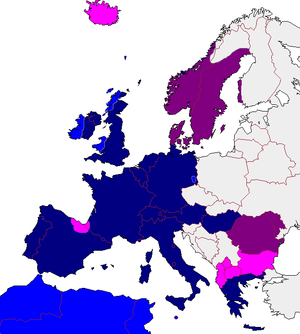 Articles are found in many Indo-European
and Semitic
languages but are absent from some other large languages of the world, such as Chinese
, Indonesian
, Japanese
, Hindi
and Russian
.
Linguists believe the common ancestor of the Indo-European languages
, Proto Indo-European
, did not have articles. Most of the languages in this family do not have definite or indefinite articles; there is no article in Latin
, Sanskrit
, Persian
, nor in some modern Indo-European languages, such as the Baltic languages
and most Slavic languages
. Although Classical
Greek
has a definite article (which has survived into Modern Greek
and which bears strong resemblance to the German definite article), the earlier Homeric Greek
did not. Articles developed independently in several language families.
Not all languages have both definite and indefinite articles, and some languages have different types of definite and indefinite articles to distinguish finer shades of meaning; for example, French
and Italian
have a partitive article used for indefinite mass noun
s, while Colognian has two distinct sets of definite articles indicating focus and uniqueness, and Macedonian
uses definite articles in a demonstrative sense, distinguishing this from that (with an intermediate degree). The words this and that (and their plurals, these and those) can be understood in English as, ultimately, forms of the definite article the (whose declension in Old English included thaes, an ancestral form of this/that and these/those).
In many languages, the form of the article may vary according to the gender
, number
, or case
of its noun. In some languages the article may be the only indication of the case, e.g., German Der Hut des Napoleon, "Napoleon's hat". Many languages do not use articles at all, and may use other ways of indicating old versus new information, such as topic–comment constructions.
In the above examples, the article always precedes its noun (with the exception of the Arabic tanween and the Hebrew ה [ha-]). In some languages, however, the definite article is not always a separate word, but may be postfixed, attached to the end of its noun as a suffix. For example,
Example of prefixed definite article:
Joseph Greenberg
Universals of human language
describes "the cycle of the definite article": Definite articles (Stage I) evolve from demonstratives, and in turn can become generic articles (Stage II) that may be used in both definite and indefinite contexts, and later merely noun markers (Stage III) that are part of nouns other than proper names and more recent borrowings. Eventually articles may evolve anew from demonstratives.
s meaning that. For example, the definite articles in the Romance languages
—e.g., el, il, le, la—derive from the Latin
demonstratives ille (masculine) and illa (feminine).
The English
definite article the
, written þe in Middle English
, derives from an Old English
demonstrative, which, according to gender
, was written se (masculine), seo (feminine) (þe and þeo in the Northumbrian dialect), or þæt
(neuter). The neuter form þæt also gave rise to the modern demonstrative that. The ye occasionally seen in pseudo-archaic usage such as "Ye Olde
Englishe Tea Shoppe" is actually a form of þe, where the letter thorn
(þ) came to be written as a y.
Multiple demonstratives can give rise to multiple definite articles. Macedonian
, for example, in which the articles are suffixed, has столот (stolot), the chair; столов (stolov), this chair; and столон (stolon), that chair. Colognian prepositions articles such as in dat Auto, or et Auto, the car; the first being specifically selected, focussed, newly introduced, while the latter ist not selected, unfocussed, already known, general, or generic.
—e.g., un, una, une—derive from the Latin
adjective unus. Partitive articles, however, derive from Vulgar Latin
de illo, meaning (some) of the.
The English
indefinite article an
is derived from the same root as one. The -n came to be dropped before consonants, giving rise to the shortened form a. The existence of both forms has led to many cases of juncture loss, e.g. transforming the original a napron into the modern an apron.
Word
In language, a word is the smallest free form that may be uttered in isolation with semantic or pragmatic content . This contrasts with a morpheme, which is the smallest unit of meaning but will not necessarily stand on its own...
that combines with a noun
Noun
In linguistics, a noun is a member of a large, open lexical category whose members can occur as the main word in the subject of a clause, the object of a verb, or the object of a preposition .Lexical categories are defined in terms of how their members combine with other kinds of...
to indicate the type of reference being made by the noun. Articles specify the grammatical definiteness
Definiteness
In grammatical theory, definiteness is a feature of noun phrases, distinguishing between entities which are specific and identifiable in a given context and entities which are not ....
of the noun, in some languages extending to volume or numerical scope. The articles in the English language
English language
English is a West Germanic language that arose in the Anglo-Saxon kingdoms of England and spread into what was to become south-east Scotland under the influence of the Anglian medieval kingdom of Northumbria...
are the and a/an, and (in some contexts) some. 'An' and 'a' are modern forms of the Old English 'an', which in Anglian dialects was the number 'one' (compare 'on', in Saxon dialects) and survived into Modern Scots as the number 'ane'. Both 'on' (respelled 'one' by the Normans) and 'an' survived into Modern English, with 'one' used as the number and 'an' ('a', before nouns that begin with a consonant sound) as an indefinite article.
In some languages, articles are a special part of speech, which cannot easily be combined with other parts of speech. It is also possible for articles to be part of another part of speech category such as determiner
Determiner
Determiner may refer to:* Determiner , a class of words including articles and demonstratives within the noun phrase* Determiner phrase, a phrase headed by a determiner* Determinative, sometimes called determiners-See also:...
, an English part of speech category that combines articles and demonstratives (such as 'this' and 'that').
In languages that employ articles, every common noun, with some exceptions, is expressed with a certain definiteness
Definiteness
In grammatical theory, definiteness is a feature of noun phrases, distinguishing between entities which are specific and identifiable in a given context and entities which are not ....
(e.g., definite or indefinite), just as many languages express every noun with a certain grammatical number
Grammatical number
In linguistics, grammatical number is a grammatical category of nouns, pronouns, and adjective and verb agreement that expresses count distinctions ....
(e.g., singular or plural). Every noun must be accompanied by the article, if any, corresponding to its definiteness, and the lack of an article (considered a zero article) itself specifies a certain definiteness. This is in contrast to other adjectives and determiners, which are typically optional. This obligatory nature of articles makes them among the most common words in many languages—in English, for example, the most frequent word is the.
Types
Articles are usually characterized as either definite or indefinite. A few languages with well-developed systems of articles may distinguish additional subtypes.Within each type, languages may have various forms of each article, according to grammatical attributes such as gender
Grammatical gender
Grammatical gender is defined linguistically as a system of classes of nouns which trigger specific types of inflections in associated words, such as adjectives, verbs and others. For a system of noun classes to be a gender system, every noun must belong to one of the classes and there should be...
, number
Grammatical number
In linguistics, grammatical number is a grammatical category of nouns, pronouns, and adjective and verb agreement that expresses count distinctions ....
, or case
Grammatical case
In grammar, the case of a noun or pronoun is an inflectional form that indicates its grammatical function in a phrase, clause, or sentence. For example, a pronoun may play the role of subject , of direct object , or of possessor...
, or according to adjacent sounds.
Definite article
A definite article indicates that its noun is a particular one (or ones) identifiable to the listener. It may be something that the speaker has already mentioned, or it may be something uniquely specified. The definite article in English, for both singular and plural nouns, is the.- The children know the fastest way home.
The sentence above refers to specific children and a specific way home; it contrasts with the much more general observation that:
- Children know the fastest way home.
The latter sentence refers to children in general, perhaps all or most of them.
Likewise,
- Give me the book
refers to a specific book whose identity is known or obvious to the listener; as such it has a markedly different meaning from
- Give me a book
which does not specify what book is to be given.
The definite article can also be used in English to indicate a specific class among other classes:
- The cabbage white butterfly lays its eggs on members of the Brassica genus.
Indefinite article
An indefinite article indicates that its noun is not a particular one (or ones) identifiable to the listener. It may be something that the speaker is mentioning for the first time, or its precise identity may be irrelevant or hypothetical, or the speaker may be making a general statement about any such thing. English uses a/an, from the Old English forms of the number 'one', as its primary indefinite article. The form an is used before words that begin with a vowel sound (even if spelled with an initial consonant, as in an hour), and a before words that begin with a consonant sound (even if spelled with a vowel, as in a European).- She had a house so large that an elephant would get lost without a map.
Before some words beginning with a pronounced (not silent) h in an unstressed first syllable, such as hallucination, hilarious, historic(al), horrendous, and horrific, some (especially older) British writers prefer to use an over a (an historical event, etc.). An is also preferred before hotel by some writers of British English (probably reflecting the relatively recent adoption of the word from French, where the h is not pronounced). The use of "an" before words beginning with an unstressed "h" is more common generally in British English than American. American writers normally use a in all these cases, although there are occasional uses of an historic(al) in American English. According to the New Oxford Dictionary of English, such use is increasingly rare in British English too. Unlike British English, American English typically uses an before herb, since the h in this word is silent for most Americans.
The word some is used as a functional plural of a/an. "An apple" never means more than one apple. "Give me some apples" indicates more than one is desired but without specifying a quantity. This finds comparison in Spanish, where the singular indefinite article 'uno/una' ("one") is completely indistinguishable from the unit number, except where it has a plural form ('unos/unas'): Dame una manzana" ("Give me an apple") > "Dame unas manzanas" ("Give me some apples"). However, some also serves as a quantifier rather than as a plural article, as in "There are some apples there, but not many."
Some also serves as a singular indefinite article, as in "There is some person on the porch". This usage differs from the usage of a(n) in that some indicates that the identity of the noun is unknown to both the listener and the speaker, while a(n) indicates that the identity is unknown to the listener without specifying whether or not it is known to the speaker. Thus There is some person on the porch indicates indefiniteness to both the listener and the speaker, while There is a person on the porch indicates indefiniteness to the listener but gives no information as to whether the speaker knows the person's identity.
Partitive article
A partitive article is a type of indefinite article used with a mass nounMass noun
In linguistics, a mass noun is a noun that refers to some entity as an undifferentiated unit rather than as something with discrete subsets. Non-count nouns are best identified by their syntactic properties, and especially in contrast with count nouns. The semantics of mass nouns are highly...
such as water, to indicate a non-specific quantity of it. Partitive articles are used in French
French language
French is a Romance language spoken as a first language in France, the Romandy region in Switzerland, Wallonia and Brussels in Belgium, Monaco, the regions of Quebec and Acadia in Canada, and by various communities elsewhere. Second-language speakers of French are distributed throughout many parts...
and Italian
Italian language
Italian is a Romance language spoken mainly in Europe: Italy, Switzerland, San Marino, Vatican City, by minorities in Malta, Monaco, Croatia, Slovenia, France, Libya, Eritrea, and Somalia, and by immigrant communities in the Americas and Australia...
in addition to definite and indefinite articles. The nearest equivalent in English is some, although this is considered a determiner and not an article.
- French: Voulez-vous du café ?
- Do you want (some) coffee? (or, dialectally but more accurately, Do you want some of this coffee?)
- See also more information about the French partitive article.
Haida
Haida language
The Haida language is the language of the Haida people. It contains seven vowels and well over 30 consonants.-History:The first documented contact between the Haida and Europeans was in 1774, on Juan Pérez's exploratory voyage. At this time Haidas inhabited the Queen Charlotte Islands, Dall...
has a partitive article (suffixed -gyaa) referring to "part of something or... to one or more objects of a given group or category," e.g. tluugyaa uu hal tlaahlaang 'he is making a boat (a member of the category of boats).'
Negative article
A negative article specifies none of its noun, and can thus be regarded as neither definite nor indefinite. On the other hand, some consider such a word to be a simple determiner rather than an article. In English, this function is fulfilled by no, which can appear before a singular or plural noun:- No man is an island.
- No dogs are allowed here.
Zero article
The zero article is the absence of an article. In languages having a definite article, the lack of an article specifically indicates that the noun is indefinite. Linguists interested in X-bar theoryX-bar theory
X-bar theory is a component of linguistic theory which attempts to identify syntactic features presumably common to all those human languages that fit in a presupposed framework...
causally link zero articles to nouns lacking a determiner. In English, the zero article rather than the indefinite is used with plurals
Grammatical number
In linguistics, grammatical number is a grammatical category of nouns, pronouns, and adjective and verb agreement that expresses count distinctions ....
and mass noun
Mass noun
In linguistics, a mass noun is a noun that refers to some entity as an undifferentiated unit rather than as something with discrete subsets. Non-count nouns are best identified by their syntactic properties, and especially in contrast with count nouns. The semantics of mass nouns are highly...
s, although the word "some" can be used as an indefinite plural article.
- Visitors end up walking in mud.
Variation among languages
Indo-European languages
The Indo-European languages are a family of several hundred related languages and dialects, including most major current languages of Europe, the Iranian plateau, and South Asia and also historically predominant in Anatolia...
and Semitic
Semitic languages
The Semitic languages are a group of related languages whose living representatives are spoken by more than 270 million people across much of the Middle East, North Africa and the Horn of Africa...
languages but are absent from some other large languages of the world, such as Chinese
Chinese language
The Chinese language is a language or language family consisting of varieties which are mutually intelligible to varying degrees. Originally the indigenous languages spoken by the Han Chinese in China, it forms one of the branches of Sino-Tibetan family of languages...
, Indonesian
Indonesian language
Indonesian is the official language of Indonesia. Indonesian is a normative form of the Riau Islands dialect of Malay, an Austronesian language which has been used as a lingua franca in the Indonesian archipelago for centuries....
, Japanese
Japanese language
is a language spoken by over 130 million people in Japan and in Japanese emigrant communities. It is a member of the Japonic language family, which has a number of proposed relationships with other languages, none of which has gained wide acceptance among historical linguists .Japanese is an...
, Hindi
Hindi
Standard Hindi, or more precisely Modern Standard Hindi, also known as Manak Hindi , High Hindi, Nagari Hindi, and Literary Hindi, is a standardized and sanskritized register of the Hindustani language derived from the Khariboli dialect of Delhi...
and Russian
Russian language
Russian is a Slavic language used primarily in Russia, Belarus, Uzbekistan, Kazakhstan, Tajikistan and Kyrgyzstan. It is an unofficial but widely spoken language in Ukraine, Moldova, Latvia, Turkmenistan and Estonia and, to a lesser extent, the other countries that were once constituent republics...
.
Linguists believe the common ancestor of the Indo-European languages
Indo-European languages
The Indo-European languages are a family of several hundred related languages and dialects, including most major current languages of Europe, the Iranian plateau, and South Asia and also historically predominant in Anatolia...
, Proto Indo-European
Proto-Indo-European language
The Proto-Indo-European language is the reconstructed common ancestor of the Indo-European languages, spoken by the Proto-Indo-Europeans...
, did not have articles. Most of the languages in this family do not have definite or indefinite articles; there is no article in Latin
Latin
Latin is an Italic language originally spoken in Latium and Ancient Rome. It, along with most European languages, is a descendant of the ancient Proto-Indo-European language. Although it is considered a dead language, a number of scholars and members of the Christian clergy speak it fluently, and...
, Sanskrit
Sanskrit
Sanskrit , is a historical Indo-Aryan language and the primary liturgical language of Hinduism, Jainism and Buddhism.Buddhism: besides Pali, see Buddhist Hybrid Sanskrit Today, it is listed as one of the 22 scheduled languages of India and is an official language of the state of Uttarakhand...
, Persian
Persian language
Persian is an Iranian language within the Indo-Iranian branch of the Indo-European languages. It is primarily spoken in Iran, Afghanistan, Tajikistan and countries which historically came under Persian influence...
, nor in some modern Indo-European languages, such as the Baltic languages
Baltic languages
The Baltic languages are a group of related languages belonging to the Balto-Slavic branch of the Indo-European language family and spoken mainly in areas extending east and southeast of the Baltic Sea in Northern Europe...
and most Slavic languages
Slavic languages
The Slavic languages , a group of closely related languages of the Slavic peoples and a subgroup of Indo-European languages, have speakers in most of Eastern Europe, in much of the Balkans, in parts of Central Europe, and in the northern part of Asia.-Branches:Scholars traditionally divide Slavic...
. Although Classical
Ancient Greek
Ancient Greek is the stage of the Greek language in the periods spanning the times c. 9th–6th centuries BC, , c. 5th–4th centuries BC , and the c. 3rd century BC – 6th century AD of ancient Greece and the ancient world; being predated in the 2nd millennium BC by Mycenaean Greek...
Greek
Greek language
Greek is an independent branch of the Indo-European family of languages. Native to the southern Balkans, it has the longest documented history of any Indo-European language, spanning 34 centuries of written records. Its writing system has been the Greek alphabet for the majority of its history;...
has a definite article (which has survived into Modern Greek
Modern Greek
Modern Greek refers to the varieties of the Greek language spoken in the modern era. The beginning of the "modern" period of the language is often symbolically assigned to the fall of the Byzantine Empire in 1453, even though that date marks no clear linguistic boundary and many characteristic...
and which bears strong resemblance to the German definite article), the earlier Homeric Greek
Homeric Greek
Homeric Greek is the form of the Greek language that was used by Homer in the Iliad and Odyssey. It is an archaic version of Ionic Greek, with admixtures from certain other dialects, such as Aeolic Greek. It later served as the basis of Epic Greek, the language of epic poetry, typically in...
did not. Articles developed independently in several language families.
Not all languages have both definite and indefinite articles, and some languages have different types of definite and indefinite articles to distinguish finer shades of meaning; for example, French
French language
French is a Romance language spoken as a first language in France, the Romandy region in Switzerland, Wallonia and Brussels in Belgium, Monaco, the regions of Quebec and Acadia in Canada, and by various communities elsewhere. Second-language speakers of French are distributed throughout many parts...
and Italian
Italian language
Italian is a Romance language spoken mainly in Europe: Italy, Switzerland, San Marino, Vatican City, by minorities in Malta, Monaco, Croatia, Slovenia, France, Libya, Eritrea, and Somalia, and by immigrant communities in the Americas and Australia...
have a partitive article used for indefinite mass noun
Mass noun
In linguistics, a mass noun is a noun that refers to some entity as an undifferentiated unit rather than as something with discrete subsets. Non-count nouns are best identified by their syntactic properties, and especially in contrast with count nouns. The semantics of mass nouns are highly...
s, while Colognian has two distinct sets of definite articles indicating focus and uniqueness, and Macedonian
Macedonian language
Macedonian is a South Slavic language spoken as a first language by approximately 2–3 million people principally in the region of Macedonia but also in the Macedonian diaspora...
uses definite articles in a demonstrative sense, distinguishing this from that (with an intermediate degree). The words this and that (and their plurals, these and those) can be understood in English as, ultimately, forms of the definite article the (whose declension in Old English included thaes, an ancestral form of this/that and these/those).
In many languages, the form of the article may vary according to the gender
Grammatical gender
Grammatical gender is defined linguistically as a system of classes of nouns which trigger specific types of inflections in associated words, such as adjectives, verbs and others. For a system of noun classes to be a gender system, every noun must belong to one of the classes and there should be...
, number
Grammatical number
In linguistics, grammatical number is a grammatical category of nouns, pronouns, and adjective and verb agreement that expresses count distinctions ....
, or case
Grammatical case
In grammar, the case of a noun or pronoun is an inflectional form that indicates its grammatical function in a phrase, clause, or sentence. For example, a pronoun may play the role of subject , of direct object , or of possessor...
of its noun. In some languages the article may be the only indication of the case, e.g., German Der Hut des Napoleon, "Napoleon's hat". Many languages do not use articles at all, and may use other ways of indicating old versus new information, such as topic–comment constructions.
| Language | definite article | indefinite article | partitive article |
|---|---|---|---|
| Arabic Arabic language Arabic is a name applied to the descendants of the Classical Arabic language of the 6th century AD, used most prominently in the Quran, the Islamic Holy Book... |
al- Al- is the definite article in the Arabic language; a particle whose function is to render the noun on which it is prefixed definite. For example, the word kitāb 'book' can be made definite by prefixing it with al-, resulting in al-kitāb 'the book'... |
None | |
| Hebrew Hebrew language Hebrew is a Semitic language of the Afroasiatic language family. Culturally, is it considered by Jews and other religious groups as the language of the Jewish people, though other Jewish languages had originated among diaspora Jews, and the Hebrew language is also used by non-Jewish groups, such... |
ה (prefix) | ||
| English English articles The articles are words that combine with a noun to indicate the degree of definiteness of the reference being made by the noun. The articles in English include the definite article the and the indefinite articles a and an... |
the | a, an | |
| German German articles German articles are similar in most respects to English articles. However, they are declined differently according to the number, gender, and case of their nouns.-Declension:... |
der, die, das des, dem, den |
ein, eine, einer, eines einem, einen |
|
| Dutch Dutch language Dutch is a West Germanic language and the native language of the majority of the population of the Netherlands, Belgium, and Suriname, the three member states of the Dutch Language Union. Most speakers live in the European Union, where it is a first language for about 23 million and a second... |
de, het de |
een | |
| Tamazight | __ | yan, yat ittsn,ittsnt |
|
| Spanish Spanish language Spanish , also known as Castilian , is a Romance language in the Ibero-Romance group that evolved from several languages and dialects in central-northern Iberia around the 9th century and gradually spread with the expansion of the Kingdom of Castile into central and southern Iberia during the... |
el, la, lo los, las |
un, una unos, unas |
|
| Portuguese Portuguese language Portuguese is a Romance language that arose in the medieval Kingdom of Galicia, nowadays Galicia and Northern Portugal. The southern part of the Kingdom of Galicia became independent as the County of Portugal in 1095... |
o, a os, as |
um, uma uns, umas |
|
| French | le, la, l les |
un, une des |
du, de la, de l des |
| Italian Italian language Italian is a Romance language spoken mainly in Europe: Italy, Switzerland, San Marino, Vatican City, by minorities in Malta, Monaco, Croatia, Slovenia, France, Libya, Eritrea, and Somalia, and by immigrant communities in the Americas and Australia... |
il, lo, la, l i, gli, le |
un, uno, una, un | del, dello, della, dell dei, degli, degl' , delle |
| Hungarian Hungarian language Hungarian is a Uralic language, part of the Ugric group. With some 14 million speakers, it is one of the most widely spoken non-Indo-European languages in Europe.... |
a, az | egy |
In the above examples, the article always precedes its noun (with the exception of the Arabic tanween and the Hebrew ה [ha-]). In some languages, however, the definite article is not always a separate word, but may be postfixed, attached to the end of its noun as a suffix. For example,
- AlbanianAlbanian languageAlbanian is an Indo-European language spoken by approximately 7.6 million people, primarily in Albania and Kosovo but also in other areas of the Balkans in which there is an Albanian population, including western Macedonia, southern Montenegro, southern Serbia and northwestern Greece...
: plis, a white fez; plisi, the white fez - Bengali languageBengali languageBengali or Bangla is an eastern Indo-Aryan language. It is native to the region of eastern South Asia known as Bengal, which comprises present day Bangladesh, the Indian state of West Bengal, and parts of the Indian states of Tripura and Assam. It is written with the Bengali script...
: "Boi", book; "Boiti/Boita/Boikhana" : "The Book" - RomanianRomanian languageRomanian Romanian Romanian (or Daco-Romanian; obsolete spellings Rumanian, Roumanian; self-designation: română, limba română ("the Romanian language") or românește (lit. "in Romanian") is a Romance language spoken by around 24 to 28 million people, primarily in Romania and Moldova...
: drum, road; drumul, the road - IcelandicIcelandic languageIcelandic is a North Germanic language, the main language of Iceland. Its closest relative is Faroese.Icelandic is an Indo-European language belonging to the North Germanic or Nordic branch of the Germanic languages. Historically, it was the westernmost of the Indo-European languages prior to the...
: hestur, horse; hesturinn, the horse - NorwegianNorwegian languageNorwegian is a North Germanic language spoken primarily in Norway, where it is the official language. Together with Swedish and Danish, Norwegian forms a continuum of more or less mutually intelligible local and regional variants .These Scandinavian languages together with the Faroese language...
: stol, chair; stolen, the chair - SwedishSwedish languageSwedish is a North Germanic language, spoken by approximately 10 million people, predominantly in Sweden and parts of Finland, especially along its coast and on the Åland islands. It is largely mutually intelligible with Norwegian and Danish...
: hus house; huset, the house - BulgarianBulgarian languageBulgarian is an Indo-European language, a member of the Slavic linguistic group.Bulgarian, along with the closely related Macedonian language, demonstrates several linguistic characteristics that set it apart from all other Slavic languages such as the elimination of case declension, the...
: стол stol, chair; столът stolǎt, the chair (subjectSubject (grammar)The subject is one of the two main constituents of a clause, according to a tradition that can be tracked back to Aristotle and that is associated with phrase structure grammars; the other constituent is the predicate. According to another tradition, i.e...
); стола stola, the chair (objectObject (grammar)An object in grammar is part of a sentence, and often part of the predicate. It denotes somebody or something involved in the subject's "performance" of the verb. Basically, it is what or whom the verb is acting upon...
) - MacedonianMacedonian languageMacedonian is a South Slavic language spoken as a first language by approximately 2–3 million people principally in the region of Macedonia but also in the Macedonian diaspora...
: стол stol, chair; столот stolot, the chair; столов stolov, this chair; столон stolon, that chair
Example of prefixed definite article:
- HebrewHebrew languageHebrew is a Semitic language of the Afroasiatic language family. Culturally, is it considered by Jews and other religious groups as the language of the Jewish people, though other Jewish languages had originated among diaspora Jews, and the Hebrew language is also used by non-Jewish groups, such...
: ילד, transcribed as yeled, a boy; הילד, transcribed as hayeled, the boy
Evolution
Articles have developed independently in many different language families across the globe. Generally, articles develop over time usually by specialization of certain adjectives.Joseph Greenberg
Joseph Greenberg
Joseph Harold Greenberg was a prominent and controversial American linguist, principally known for his work in two areas, linguistic typology and the genetic classification of languages.- Early life and career :...
Universals of human language
describes "the cycle of the definite article": Definite articles (Stage I) evolve from demonstratives, and in turn can become generic articles (Stage II) that may be used in both definite and indefinite contexts, and later merely noun markers (Stage III) that are part of nouns other than proper names and more recent borrowings. Eventually articles may evolve anew from demonstratives.
Definite articles
Definite articles typically arise from demonstrativeDemonstrative
In linguistics, demonstratives are deictic words that indicate which entities a speaker refers to and distinguishes those entities from others...
s meaning that. For example, the definite articles in the Romance languages
Romance languages
The Romance languages are a branch of the Indo-European language family, more precisely of the Italic languages subfamily, comprising all the languages that descend from Vulgar Latin, the language of ancient Rome...
—e.g., el, il, le, la—derive from the Latin
Latin
Latin is an Italic language originally spoken in Latium and Ancient Rome. It, along with most European languages, is a descendant of the ancient Proto-Indo-European language. Although it is considered a dead language, a number of scholars and members of the Christian clergy speak it fluently, and...
demonstratives ille (masculine) and illa (feminine).
The English
English language
English is a West Germanic language that arose in the Anglo-Saxon kingdoms of England and spread into what was to become south-east Scotland under the influence of the Anglian medieval kingdom of Northumbria...
definite article the
English articles
The articles are words that combine with a noun to indicate the degree of definiteness of the reference being made by the noun. The articles in English include the definite article the and the indefinite articles a and an...
, written þe in Middle English
Middle English
Middle English is the stage in the history of the English language during the High and Late Middle Ages, or roughly during the four centuries between the late 11th and the late 15th century....
, derives from an Old English
Old English language
Old English or Anglo-Saxon is an early form of the English language that was spoken and written by the Anglo-Saxons and their descendants in parts of what are now England and southeastern Scotland between at least the mid-5th century and the mid-12th century...
demonstrative, which, according to gender
Grammatical gender
Grammatical gender is defined linguistically as a system of classes of nouns which trigger specific types of inflections in associated words, such as adjectives, verbs and others. For a system of noun classes to be a gender system, every noun must belong to one of the classes and there should be...
, was written se (masculine), seo (feminine) (þe and þeo in the Northumbrian dialect), or þæt
That
The word that is used in the English language for several grammatical purposes:* to introduce a restrictive relative clause * as a demonstrative pronoun...
(neuter). The neuter form þæt also gave rise to the modern demonstrative that. The ye occasionally seen in pseudo-archaic usage such as "Ye Olde
Ye Olde
Ye Olde is a pseudo-Early Modern English stock prefix, used anachronistically, suggestive of a Deep England feel.A typical example would be Ye Olde English Pubbe or similar names of theme pubs....
Englishe Tea Shoppe" is actually a form of þe, where the letter thorn
Thorn (letter)
Thorn or þorn , is a letter in the Old English, Old Norse, and Icelandic alphabets, as well as some dialects of Middle English. It was also used in medieval Scandinavia, but was later replaced with the digraph th. The letter originated from the rune in the Elder Fuþark, called thorn in the...
(þ) came to be written as a y.
Multiple demonstratives can give rise to multiple definite articles. Macedonian
Macedonian language
Macedonian is a South Slavic language spoken as a first language by approximately 2–3 million people principally in the region of Macedonia but also in the Macedonian diaspora...
, for example, in which the articles are suffixed, has столот (stolot), the chair; столов (stolov), this chair; and столон (stolon), that chair. Colognian prepositions articles such as in dat Auto, or et Auto, the car; the first being specifically selected, focussed, newly introduced, while the latter ist not selected, unfocussed, already known, general, or generic.
Indefinite articles
Indefinite articles typically arise from adjectives meaning one. For example, the indefinite articles in the Romance languagesRomance languages
The Romance languages are a branch of the Indo-European language family, more precisely of the Italic languages subfamily, comprising all the languages that descend from Vulgar Latin, the language of ancient Rome...
—e.g., un, una, une—derive from the Latin
Latin
Latin is an Italic language originally spoken in Latium and Ancient Rome. It, along with most European languages, is a descendant of the ancient Proto-Indo-European language. Although it is considered a dead language, a number of scholars and members of the Christian clergy speak it fluently, and...
adjective unus. Partitive articles, however, derive from Vulgar Latin
Vulgar Latin
Vulgar Latin is any of the nonstandard forms of Latin from which the Romance languages developed. Because of its nonstandard nature, it had no official orthography. All written works used Classical Latin, with very few exceptions...
de illo, meaning (some) of the.
The English
English language
English is a West Germanic language that arose in the Anglo-Saxon kingdoms of England and spread into what was to become south-east Scotland under the influence of the Anglian medieval kingdom of Northumbria...
indefinite article an
English articles
The articles are words that combine with a noun to indicate the degree of definiteness of the reference being made by the noun. The articles in English include the definite article the and the indefinite articles a and an...
is derived from the same root as one. The -n came to be dropped before consonants, giving rise to the shortened form a. The existence of both forms has led to many cases of juncture loss, e.g. transforming the original a napron into the modern an apron.
See also
- English articlesEnglish articlesThe articles are words that combine with a noun to indicate the degree of definiteness of the reference being made by the noun. The articles in English include the definite article the and the indefinite articles a and an...
- Al-Al-is the definite article in the Arabic language; a particle whose function is to render the noun on which it is prefixed definite. For example, the word kitāb 'book' can be made definite by prefixing it with al-, resulting in al-kitāb 'the book'...
(definite article in Arabic) - DefinitenessDefinitenessIn grammatical theory, definiteness is a feature of noun phrases, distinguishing between entities which are specific and identifiable in a given context and entities which are not ....
- Definite descriptionDefinite descriptionA definite description is a denoting phrase in the form of "the X" where X is a noun-phrase or a singular common noun. The definite description is proper if X applies to a unique individual or object. For example: "the first person in space" and "the 42nd President of the United States of...