

Arcturus

Encyclopedia
|- bgcolor="#FFFAFA"
| Note (category: variability): || H and K emission vary.
Arcturus (α Boo, α Boötis, Alpha
Boötis) is the brightest star
in the constellation
Boötes
. To the naked eye, orange-yellow Arcturus has a visual magnitude of −0.04, making it the brightest star in the northern hemisphere and the fourth brightest star in the night sky
, after –1.46 magnitude Sirius
, –0.86 magnitude Canopus and –0.27 magnitude Alpha Centauri
. However, Alpha Centauri is a bright binary star, whose unresolved components to the naked eye are both fainter than Arcturus. This makes Arcturus the third brightest individual star, just ahead of Alpha Centauri A (α Cen A), whose visual magnitude is −0.01.
Arcturus is visible from both hemispheres in the sky, as it is located less than 20 degrees north of the celestial equator
. The star culminates
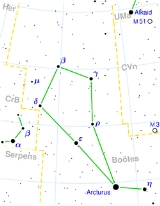
at midnight on about the 30th April, being visible during the northern spring or the southern autumn. From the northern hemisphere, an easy way to find Arcturus is to follow the arc of the handle of the Big Dipper
. By continuing in this path, one can find Spica
, "Arc to Arcturus, then spike to Spica
." The star is also a member of the Local Interstellar Cloud
.
Rudens prol. 71 and Lewis and Short's Latin Dictionary and its entry for Arcturus.
Prehistoric Polynesian navigators
knew Arcturus as Hōkūleʻa, the "Star of Joy". Arcturus is the zenith
star of the Hawaiian Islands
. Using Hōkūleʻa and other stars, the Polynesians launched their double-hulled canoe
s from Tahiti
and the Marquesas Islands
. Traveling east and north they eventually crossed the equator
and reached the latitude
at which Arcturus would appear directly overhead in the summer night sky
. Knowing they had arrived at the exact latitude of the island chain, they sailed due west on the trade wind
s to landfall. If Hōkūleʻa could be kept directly overhead, they landed on the southeastern shores of the Big Island
of Hawaiʻi. For a return trip to Tahiti the navigators could use Sirius
, the zenith star of that island. Since 1976, the Polynesian Voyaging Society
's Hōkūle‘a
has crossed the Pacific Ocean many times under navigators who have incorporated this wayfinding
technique in their non-instrument navigation.
The Koori
people of southeastern Australia knew Arcturus as Marpean-kurrk, and its appearance in the north signified the arrival of larvae of the wood-ant (a food item) in spring. The beginning of summer was marked by the star's setting with the sun in the west and the disappearance of the larvae. The star was also known as the mother of Djuit (Antares
), and another star in Bootes, Weet-kurrk.
.
Belmonte et al. (1990) carried out a radial velocity (Doppler shift of spectral lines) study of the star in April and May 1988, which showed variability with a frequency of the order of a few microhertz, the highest peak corresponding to 4.3 μHz (2.7 days) with an amplitude of 60 ms−1, with a frequency separation
of ~5 μHz. They suggested that the most plausible explanation for the variability of Arcturus is stellar oscillations.
It is believed that the surface of the star oscillates slightly, a common feature of red giant stars. In the case of Arcturus, this was an interesting discovery as it is known that the redder (more towards or within the M spectral class) a giant gets, the more variable it will be. Extreme cases like Mira
undergo large swings over hundreds of days; Arcturus is not very red and is a borderline case between variability and stability with its short period and tiny range.
K1.5 IIIpe orange giant star—the letters "pe" stand for "peculiar emission," which indicates that the spectrum
of light
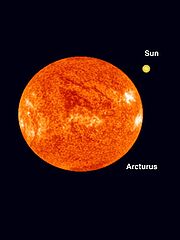
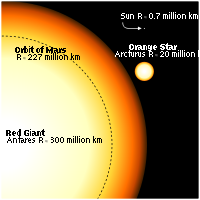
given off by the star is unusual and full of emission lines. This is not too uncommon in red giants, but Arcturus has a particularly strong case of the phenomenon. It is at least 110 times visually more luminous than the Sun
, but this underestimates its strength as much of the "light" it gives off is in the infrared
; total (bolometric
) power output is about 180 times that of the Sun. The lower output in visible light is due to a lower efficacy
as the star has a lower surface temperature than the Sun.
Arcturus is notable for its high proper motion
, larger than any first magnitude star in the stellar neighborhood other than α Centauri
. It is moving rapidly relative to the solar system, and is now almost at its closest point to the Sun. Closest approach will happen in about 4000 years, when the star will be a few hundredths of a light year closer to Earth than it is today. Arcturus is thought to be an old disk star, and appears to be moving with a group of 52 other such stars, known as the Arcturus stream
. Its mass is hard to exactly determine, but may be slightly larger than that of the Sun (1.1-0.4+0.6 solar mass). Arcturus is likely to be considerably older than the Sun, and much like how the Sun will be in its red giant phase.
According to the Hipparcos
satellite, Arcturus is 36.7 light years (11.3 parsec
s) from Earth
, relatively close in astronomical terms. Hipparcos also suggested that Arcturus is a binary star
, with the companion about twenty times dimmer than the primary and orbiting close enough to be at the very limits of our current ability to make it out. Recent results remain inconclusive, but do support the marginal Hipparcos detection of a binary companion.
, Arcturus and Pollux
showed that Arcturus exhibited a long-period radial velocity oscillation, which could be interpreted as a substellar companion. This substellar object would be nearly 12 times the mass of Jupiter
and be located roughly within Earth
's orbital zone, at 1.1 Astronomical Unit
s. However, all three stars surveyed showed similar oscillations yielding similar companion masses, and the authors concluded that the variation was likely to be intrinsic to the star rather than due to the gravitational effect of a companion. So far no substellar companion has been confirmed.
 The name of the star derives from Ancient Greek
Αρκτοῦρος (Arktouros) and means "Guardian of the Bear", ultimately from ἄρκτος (arktos), "bear" + οὖρος (ouros), "watcher, guardian". This is a reference to it being the brightest star in the constellation Boötes (of which it forms the left foot), which is next to the Greater and Lesser Bears, Ursa Major
and Ursa Minor
.
In Arabic
, it is one of two stars called al-simāk "the uplifted one", the other being Spica
. Arcturus, then, is السماك الرامح as-simāk ar-rāmiħ "the uplifted one of the lancer". The term Al Simak Al Ramih was appeared in Al Achsasi Al Mouakket catalogue, which was translated into Latin
as Al Simak Lanceator. This has been variously romanized
in the past, leading to obsolete variants such as Aramec and Azimech. The name Alramih is used in Geoffrey Chaucer
's Treatise on the Astrolabe
of 1391. Another Arabic name is Haris-el-sema, from حارس السماء ħāris al-samā’ "the keeper of heaven." or حارس ألشمل ħāris al-shamāl’ "the keeper of north."
In Chinese astronomy
, Arcturus is called Da Jiao (大角, Great Horn, Pinyin
: Dàjiǎo), because it is the brightest star in the Chinese constellation
called Jiao Xiu
(角宿, Pinyin: Jiǎo Xiǔ). And later, it become a part of Kang Xiu (亢宿, Pinyin: Kàng Xiǔ), which is also a Chinese constellation.
In Inuit astronomy
, Arcturus is called the Old Man (Uttuqalualuk in Inuit
) and The First Ones (Sivulliik in Inuit
).
In Indian tradition, Arcturus is known as Svati
, and is eponymous of one of the nakshatra
s (lunar mansions) of Hindu astrology.
In Indonesia, Arcturus is called Bintang Biduk (Star of boat).
In the Harry Potter
series, Arcturus is the middle name of the brother of Sirius Black
, Regulus Arcturus Black, or R.A.B., as he is known.
| Note (category: variability): || H and K emission vary.
Arcturus (α Boo, α Boötis, Alpha
Alpha (letter)
Alpha is the first letter of the Greek alphabet. In the system of Greek numerals it has a value of 1. It was derived from the Phoenician letter Aleph...
Boötis) is the brightest star
Star
A star is a massive, luminous sphere of plasma held together by gravity. At the end of its lifetime, a star can also contain a proportion of degenerate matter. The nearest star to Earth is the Sun, which is the source of most of the energy on Earth...
in the constellation
Constellation
In modern astronomy, a constellation is an internationally defined area of the celestial sphere. These areas are grouped around asterisms, patterns formed by prominent stars within apparent proximity to one another on Earth's night sky....
Boötes
Boötes
Boötes is a constellation in the northern sky, located between 0° and +60° declination, and 13 and 16 hours of right ascension on the celestial sphere. The name comes from the Greek Βοώτης, Boōtēs, meaning herdsman or plowman...
. To the naked eye, orange-yellow Arcturus has a visual magnitude of −0.04, making it the brightest star in the northern hemisphere and the fourth brightest star in the night sky
Night sky
The term night sky refers to the sky as seen at night. The term is usually associated with astronomy, with reference to views of celestial bodies such as stars, the Moon, and planets that become visible on a clear night after the Sun has set. Natural light sources in a night sky include moonlight,...
, after –1.46 magnitude Sirius
Sirius
Sirius is the brightest star in the night sky. With a visual apparent magnitude of −1.46, it is almost twice as bright as Canopus, the next brightest star. The name "Sirius" is derived from the Ancient Greek: Seirios . The star has the Bayer designation Alpha Canis Majoris...
, –0.86 magnitude Canopus and –0.27 magnitude Alpha Centauri
Alpha Centauri
Alpha Centauri is the brightest star in the southern constellation of Centaurus...
. However, Alpha Centauri is a bright binary star, whose unresolved components to the naked eye are both fainter than Arcturus. This makes Arcturus the third brightest individual star, just ahead of Alpha Centauri A (α Cen A), whose visual magnitude is −0.01.
Arcturus is visible from both hemispheres in the sky, as it is located less than 20 degrees north of the celestial equator
Celestial equator
The celestial equator is a great circle on the imaginary celestial sphere, in the same plane as the Earth's equator. In other words, it is a projection of the terrestrial equator out into space...
. The star culminates
Culmination
In astronomy, the culmination of a planet, star, constellation, etc. is the altitude reached when the object transits over an observer's meridian....
at midnight on about the 30th April, being visible during the northern spring or the southern autumn. From the northern hemisphere, an easy way to find Arcturus is to follow the arc of the handle of the Big Dipper
Big Dipper
The Plough, also known as the Big Dipper or the Saptarishi , is an asterism of seven stars that has been recognized as a distinct grouping in many cultures from time immemorial...
. By continuing in this path, one can find Spica
Spica
Spica is the brightest star in the constellation Virgo, and the 15th brightest star in the nighttime sky. It is 260 light years distant from Earth...
, "Arc to Arcturus, then spike to Spica
Spica
Spica is the brightest star in the constellation Virgo, and the 15th brightest star in the nighttime sky. It is 260 light years distant from Earth...
." The star is also a member of the Local Interstellar Cloud
Local Interstellar Cloud
The Local Interstellar Cloud is the interstellar cloud roughly 30 light years across through which the Earth's solar system is currently moving. The Solar System is thought to have entered the Local Interstellar Cloud at some time between 44,000 and 150,000 years ago and is expected to remain...
.
Observational history
As one of the brightest stars in the sky, Arcturus has been significant to observers since antiquity. In Ancient Greece, the star's celestial activity was supposed to portend tempestuous weather. For citations, see PlautusPlautus
Titus Maccius Plautus , commonly known as "Plautus", was a Roman playwright of the Old Latin period. His comedies are the earliest surviving intact works in Latin literature. He wrote Palliata comoedia, the genre devised by the innovator of Latin literature, Livius Andronicus...
Rudens prol. 71 and Lewis and Short's Latin Dictionary and its entry for Arcturus.
Prehistoric Polynesian navigators
Polynesian navigation
Polynesian navigation is a system of navigation used by Polynesians to make long voyages across thousands of miles of open ocean. Navigators travel to small inhabited islands using only their own senses and knowledge passed by oral tradition from navigator to apprentice, often in the form of song...
knew Arcturus as Hōkūleʻa, the "Star of Joy". Arcturus is the zenith
Zenith
The zenith is an imaginary point directly "above" a particular location, on the imaginary celestial sphere. "Above" means in the vertical direction opposite to the apparent gravitational force at that location. The opposite direction, i.e...
star of the Hawaiian Islands
Hawaiian Islands
The Hawaiian Islands are an archipelago of eight major islands, several atolls, numerous smaller islets, and undersea seamounts in the North Pacific Ocean, extending some 1,500 miles from the island of Hawaii in the south to northernmost Kure Atoll...
. Using Hōkūleʻa and other stars, the Polynesians launched their double-hulled canoe
Canoe
A canoe or Canadian canoe is a small narrow boat, typically human-powered, though it may also be powered by sails or small electric or gas motors. Canoes are usually pointed at both bow and stern and are normally open on top, but can be decked over A canoe (North American English) or Canadian...
s from Tahiti
Tahiti
Tahiti is the largest island in the Windward group of French Polynesia, located in the archipelago of the Society Islands in the southern Pacific Ocean. It is the economic, cultural and political centre of French Polynesia. The island was formed from volcanic activity and is high and mountainous...
and the Marquesas Islands
Marquesas Islands
The Marquesas Islands enana and Te Fenua `Enata , both meaning "The Land of Men") are a group of volcanic islands in French Polynesia, an overseas collectivity of France in the southern Pacific Ocean. The Marquesas are located at 9° 00S, 139° 30W...
. Traveling east and north they eventually crossed the equator
Equator
An equator is the intersection of a sphere's surface with the plane perpendicular to the sphere's axis of rotation and containing the sphere's center of mass....
and reached the latitude
Latitude
In geography, the latitude of a location on the Earth is the angular distance of that location south or north of the Equator. The latitude is an angle, and is usually measured in degrees . The equator has a latitude of 0°, the North pole has a latitude of 90° north , and the South pole has a...
at which Arcturus would appear directly overhead in the summer night sky
Night sky
The term night sky refers to the sky as seen at night. The term is usually associated with astronomy, with reference to views of celestial bodies such as stars, the Moon, and planets that become visible on a clear night after the Sun has set. Natural light sources in a night sky include moonlight,...
. Knowing they had arrived at the exact latitude of the island chain, they sailed due west on the trade wind
Trade wind
The trade winds are the prevailing pattern of easterly surface winds found in the tropics, within the lower portion of the Earth's atmosphere, in the lower section of the troposphere near the Earth's equator...
s to landfall. If Hōkūleʻa could be kept directly overhead, they landed on the southeastern shores of the Big Island
Hawaii (island)
The Island of Hawaii, also called the Big Island or Hawaii Island , is a volcanic island in the North Pacific Ocean...
of Hawaiʻi. For a return trip to Tahiti the navigators could use Sirius
Sirius
Sirius is the brightest star in the night sky. With a visual apparent magnitude of −1.46, it is almost twice as bright as Canopus, the next brightest star. The name "Sirius" is derived from the Ancient Greek: Seirios . The star has the Bayer designation Alpha Canis Majoris...
, the zenith star of that island. Since 1976, the Polynesian Voyaging Society
Polynesian Voyaging Society
The Polynesian Voyaging Society is a non-profit research and educational corporation based in Honolulu, Hawaii. PVS was established to research and perpetuate traditional Polynesian voyaging methods...
's Hōkūle‘a
Hokulea
Hōkūlea is a performance-accurate full-scale replica of a waa kaulua, a Polynesian double-hulled voyaging canoe. Launched on 8 March 1975 by the Polynesian Voyaging Society, she is best known for her 1976 Hawaii to Tahiti voyage performed with Polynesian navigation techniques, without modern...
has crossed the Pacific Ocean many times under navigators who have incorporated this wayfinding
Wayfinding
Wayfinding encompasses all of the ways in which people and animals orient themselves in physical space and navigate from place to place.-Historical:...
technique in their non-instrument navigation.
The Koori
Koori
The Koori are the indigenous Australians that traditionally occupied modern day New South Wales and Victoria....
people of southeastern Australia knew Arcturus as Marpean-kurrk, and its appearance in the north signified the arrival of larvae of the wood-ant (a food item) in spring. The beginning of summer was marked by the star's setting with the sun in the west and the disappearance of the larvae. The star was also known as the mother of Djuit (Antares
Antares
Antares is a red supergiant star in the Milky Way galaxy and the sixteenth brightest star in the nighttime sky . Along with Aldebaran, Spica, and Regulus it is one of the four brightest stars near the ecliptic...
), and another star in Bootes, Weet-kurrk.
Oscillations
As one of the brightest stars in the sky, Arcturus has been the subject of a number of studies in the emerging field of asteroseismologyAsteroseismology
Asteroseismology also known as stellar seismology is the science that studies the internal structure of pulsating stars by the interpretation of their frequency spectra. Different oscillation modes penetrate to different depths inside the star...
.
Belmonte et al. (1990) carried out a radial velocity (Doppler shift of spectral lines) study of the star in April and May 1988, which showed variability with a frequency of the order of a few microhertz, the highest peak corresponding to 4.3 μHz (2.7 days) with an amplitude of 60 ms−1, with a frequency separation
Frequency separation
Frequency separation is a term used in Helio and Asteroseismology for the spacing in frequency between adjacent modes of oscillation having the same angular degree but different radial order ....
of ~5 μHz. They suggested that the most plausible explanation for the variability of Arcturus is stellar oscillations.
It is believed that the surface of the star oscillates slightly, a common feature of red giant stars. In the case of Arcturus, this was an interesting discovery as it is known that the redder (more towards or within the M spectral class) a giant gets, the more variable it will be. Extreme cases like Mira
Mira
Mira also known as Omicron Ceti , is a red giant star estimated 200-400 light years away in the constellation Cetus. Mira is a binary star, consisting of the red giant Mira A along with Mira B. Mira A is also an oscillating variable star and was the first non-supernova variable star discovered,...
undergo large swings over hundreds of days; Arcturus is not very red and is a borderline case between variability and stability with its short period and tiny range.
System
Arcturus is a typeStellar classification
In astronomy, stellar classification is a classification of stars based on their spectral characteristics. The spectral class of a star is a designated class of a star describing the ionization of its chromosphere, what atomic excitations are most prominent in the light, giving an objective measure...
K1.5 IIIpe orange giant star—the letters "pe" stand for "peculiar emission," which indicates that the spectrum
Electromagnetic spectrum
The electromagnetic spectrum is the range of all possible frequencies of electromagnetic radiation. The "electromagnetic spectrum" of an object is the characteristic distribution of electromagnetic radiation emitted or absorbed by that particular object....
of light
Light
Light or visible light is electromagnetic radiation that is visible to the human eye, and is responsible for the sense of sight. Visible light has wavelength in a range from about 380 nanometres to about 740 nm, with a frequency range of about 405 THz to 790 THz...
given off by the star is unusual and full of emission lines. This is not too uncommon in red giants, but Arcturus has a particularly strong case of the phenomenon. It is at least 110 times visually more luminous than the Sun
Sun
The Sun is the star at the center of the Solar System. It is almost perfectly spherical and consists of hot plasma interwoven with magnetic fields...
, but this underestimates its strength as much of the "light" it gives off is in the infrared
Infrared
Infrared light is electromagnetic radiation with a wavelength longer than that of visible light, measured from the nominal edge of visible red light at 0.74 micrometres , and extending conventionally to 300 µm...
; total (bolometric
Bolometric Correction
In astronomy, a bolometric correction is a correction that must be made to the absolute magnitude of an object in order to convert an object's visible magnitude to its bolometric magnitude. Mathematically, such a calculation can be expressed: BC = M_b - M_v\!\,...
) power output is about 180 times that of the Sun. The lower output in visible light is due to a lower efficacy
Luminous efficacy
Luminous efficacy is a measure of how well a light source produces visible light. It is the ratio of luminous flux to power. Depending on context, the power can be either the radiant flux of the source's output, or it can be the total electric power consumed by the source.Which sense of the term is...
as the star has a lower surface temperature than the Sun.
Arcturus is notable for its high proper motion
Proper motion
The proper motion of a star is its angular change in position over time as seen from the center of mass of the solar system. It is measured in seconds of arc per year, arcsec/yr, where 3600 arcseconds equal one degree. This contrasts with radial velocity, which is the time rate of change in...
, larger than any first magnitude star in the stellar neighborhood other than α Centauri
Alpha Centauri
Alpha Centauri is the brightest star in the southern constellation of Centaurus...
. It is moving rapidly relative to the solar system, and is now almost at its closest point to the Sun. Closest approach will happen in about 4000 years, when the star will be a few hundredths of a light year closer to Earth than it is today. Arcturus is thought to be an old disk star, and appears to be moving with a group of 52 other such stars, known as the Arcturus stream
Arcturus stream
In astronomy, the Arcturus Stream is a stellar stream which includes the nearby bright star Arcturus. It comprises many stars which share similar proper motion and so are physically associated....
. Its mass is hard to exactly determine, but may be slightly larger than that of the Sun (1.1-0.4+0.6 solar mass). Arcturus is likely to be considerably older than the Sun, and much like how the Sun will be in its red giant phase.
According to the Hipparcos
Hipparcos
Hipparcos was a scientific mission of the European Space Agency , launched in 1989 and operated between 1989 and 1993. It was the first space experiment devoted to precision astrometry, the accurate measurement of the positions of celestial objects on the sky...
satellite, Arcturus is 36.7 light years (11.3 parsec
Parsec
The parsec is a unit of length used in astronomy. It is about 3.26 light-years, or just under 31 trillion kilometres ....
s) from Earth
Earth
Earth is the third planet from the Sun, and the densest and fifth-largest of the eight planets in the Solar System. It is also the largest of the Solar System's four terrestrial planets...
, relatively close in astronomical terms. Hipparcos also suggested that Arcturus is a binary star
Binary star
A binary star is a star system consisting of two stars orbiting around their common center of mass. The brighter star is called the primary and the other is its companion star, comes, or secondary...
, with the companion about twenty times dimmer than the primary and orbiting close enough to be at the very limits of our current ability to make it out. Recent results remain inconclusive, but do support the marginal Hipparcos detection of a binary companion.
Claims of a planetary system
In 1993, radial velocity measurements of AldebaranAldebaran
Aldebaran is a red giant star located about 65 light years away in the zodiac constellation of Taurus. With an average apparent magnitude of 0.87 it is the brightest star in the constellation and is one of the brightest stars in the nighttime sky...
, Arcturus and Pollux
Pollux (star)
Pollux is an orange giant star approximately 34 light-years from the Earth in the constellation of Gemini . Pollux is the brightest star in the constellation, brighter than Castor...
showed that Arcturus exhibited a long-period radial velocity oscillation, which could be interpreted as a substellar companion. This substellar object would be nearly 12 times the mass of Jupiter
Jupiter
Jupiter is the fifth planet from the Sun and the largest planet within the Solar System. It is a gas giant with mass one-thousandth that of the Sun but is two and a half times the mass of all the other planets in our Solar System combined. Jupiter is classified as a gas giant along with Saturn,...
and be located roughly within Earth
Earth
Earth is the third planet from the Sun, and the densest and fifth-largest of the eight planets in the Solar System. It is also the largest of the Solar System's four terrestrial planets...
's orbital zone, at 1.1 Astronomical Unit
Astronomical unit
An astronomical unit is a unit of length equal to about or approximately the mean Earth–Sun distance....
s. However, all three stars surveyed showed similar oscillations yielding similar companion masses, and the authors concluded that the variation was likely to be intrinsic to the star rather than due to the gravitational effect of a companion. So far no substellar companion has been confirmed.
Names and cultural significance
Ancient Greek
Ancient Greek is the stage of the Greek language in the periods spanning the times c. 9th–6th centuries BC, , c. 5th–4th centuries BC , and the c. 3rd century BC – 6th century AD of ancient Greece and the ancient world; being predated in the 2nd millennium BC by Mycenaean Greek...
Αρκτοῦρος (Arktouros) and means "Guardian of the Bear", ultimately from ἄρκτος (arktos), "bear" + οὖρος (ouros), "watcher, guardian". This is a reference to it being the brightest star in the constellation Boötes (of which it forms the left foot), which is next to the Greater and Lesser Bears, Ursa Major
Ursa Major
Ursa Major , also known as the Great Bear, is a constellation visible throughout the year in most of the northern hemisphere. It can best be seen in April...
and Ursa Minor
Ursa Minor
Ursa Minor , also known as the Little Bear, is a constellation in the northern sky. Like the Great Bear, the tail of the Little Bear may also be seen as the handle of a ladle, whence the name Little Dipper...
.
In Arabic
Arabic language
Arabic is a name applied to the descendants of the Classical Arabic language of the 6th century AD, used most prominently in the Quran, the Islamic Holy Book...
, it is one of two stars called al-simāk "the uplifted one", the other being Spica
Spica
Spica is the brightest star in the constellation Virgo, and the 15th brightest star in the nighttime sky. It is 260 light years distant from Earth...
. Arcturus, then, is السماك الرامح as-simāk ar-rāmiħ "the uplifted one of the lancer". The term Al Simak Al Ramih was appeared in Al Achsasi Al Mouakket catalogue, which was translated into Latin
Latin
Latin is an Italic language originally spoken in Latium and Ancient Rome. It, along with most European languages, is a descendant of the ancient Proto-Indo-European language. Although it is considered a dead language, a number of scholars and members of the Christian clergy speak it fluently, and...
as Al Simak Lanceator. This has been variously romanized
Romanization
In linguistics, romanization or latinization is the representation of a written word or spoken speech with the Roman script, or a system for doing so, where the original word or language uses a different writing system . Methods of romanization include transliteration, for representing written...
in the past, leading to obsolete variants such as Aramec and Azimech. The name Alramih is used in Geoffrey Chaucer
Geoffrey Chaucer
Geoffrey Chaucer , known as the Father of English literature, is widely considered the greatest English poet of the Middle Ages and was the first poet to have been buried in Poet's Corner of Westminster Abbey...
's Treatise on the Astrolabe
Treatise on the Astrolabe
A Treatise on the Astrolabe is a medieval essay on the astrolabe by Geoffrey Chaucer. It begins:or, in a more modern English spelling,According to the introduction, the work was to have five parts:#A description of the astrolabe...
of 1391. Another Arabic name is Haris-el-sema, from حارس السماء ħāris al-samā’ "the keeper of heaven." or حارس ألشمل ħāris al-shamāl’ "the keeper of north."
In Chinese astronomy
Chinese astronomy
Astronomy in China has a very long history, with historians considering that "they [the Chinese] were the most persistent and accurate observers of celestial phenomena anywhere in the world before the Arabs."...
, Arcturus is called Da Jiao (大角, Great Horn, Pinyin
Pinyin
Pinyin is the official system to transcribe Chinese characters into the Roman alphabet in China, Malaysia, Singapore and Taiwan. It is also often used to teach Mandarin Chinese and spell Chinese names in foreign publications and used as an input method to enter Chinese characters into...
: Dàjiǎo), because it is the brightest star in the Chinese constellation
Chinese constellation
Chinese constellations are the way the ancient Chinese grouped the stars. They are very different from the modern IAU recognized constellations. This is because the IAU was based on Greco-Roman astronomy instead of Chinese astronomy....
called Jiao Xiu
Horn (Chinese constellation)
The Horn mansion is one of the Twenty-eight mansions of the Chinese constellations. It is one of the eastern mansions of the Azure Dragon.-Asterisms:...
(角宿, Pinyin: Jiǎo Xiǔ). And later, it become a part of Kang Xiu (亢宿, Pinyin: Kàng Xiǔ), which is also a Chinese constellation.
In Inuit astronomy
Inuit astronomy
The Inuit have traditional names for many constellations, asterisms and stars:*Two Placed Far Apart **The Runners , used for navigation***The Polar Bear ***The Dogs **Nephews and Nieces...
, Arcturus is called the Old Man (Uttuqalualuk in Inuit
Inuit
The Inuit are a group of culturally similar indigenous peoples inhabiting the Arctic regions of Canada , Denmark , Russia and the United States . Inuit means “the people” in the Inuktitut language...
) and The First Ones (Sivulliik in Inuit
Inuit
The Inuit are a group of culturally similar indigenous peoples inhabiting the Arctic regions of Canada , Denmark , Russia and the United States . Inuit means “the people” in the Inuktitut language...
).
In Indian tradition, Arcturus is known as Svati
Svati
Svati is the Sanskrit name of Arcturus, and also of the nakshatra associated with Arcturus in Hindu astrology....
, and is eponymous of one of the nakshatra
Nakshatra
Nakshatra is the term for lunar mansion in Hindu astrology. A nakshatra is one of 27 sectors along the ecliptic...
s (lunar mansions) of Hindu astrology.
In Indonesia, Arcturus is called Bintang Biduk (Star of boat).
- 1933 World's Fair. The star achieved fame when its light was used to open the 1933 Chicago World's FairCentury of ProgressA Century of Progress International Exposition was the name of a World's Fair held in Chicago from 1933 to 1934 to celebrate the city's centennial. The theme of the fair was technological innovation...
. The star was chosen as it was thought that light from Arcturus had started its journey at about the time of the previous Chicago World's FairWorld's Columbian ExpositionThe World's Columbian Exposition was a World's Fair held in Chicago in 1893 to celebrate the 400th anniversary of Christopher Columbus's arrival in the New World in 1492. Chicago bested New York City; Washington, D.C.; and St...
in 1893 (as the star is 36.7 light years away the light had, actually, started its journey in 1896).
In the Harry Potter
Harry Potter
Harry Potter is a series of seven fantasy novels written by the British author J. K. Rowling. The books chronicle the adventures of the adolescent wizard Harry Potter and his best friends Ron Weasley and Hermione Granger, all of whom are students at Hogwarts School of Witchcraft and Wizardry...
series, Arcturus is the middle name of the brother of Sirius Black
Sirius Black
Sirius Black is a fictional character in J. K. Rowling's Harry Potter series. Sirius was first mentioned briefly in Harry Potter and the Sorcerer's Stone as a wizard who lent Rubeus Hagrid a flying motorbike shortly after Lord Voldemort killed James and Lily Potter...
, Regulus Arcturus Black, or R.A.B., as he is known.
Myths
This bright star is the subject of numerous ancient and modern myths.- In Indian AstrologyAstrologyAstrology consists of a number of belief systems which hold that there is a relationship between astronomical phenomena and events in the human world...
or Vedic Astrology or Sidereal AstrologySidereal astrologySidereal and tropical are astronomical terms used to describe two different definitions of a "year". They are also used as terms for two systems of ecliptic coordinates used in astrology....
, Arcturus is called 'Swati' which is a word derived from the language SanskritSanskritSanskrit , is a historical Indo-Aryan language and the primary liturgical language of Hinduism, Jainism and Buddhism.Buddhism: besides Pali, see Buddhist Hybrid Sanskrit Today, it is listed as one of the 22 scheduled languages of India and is an official language of the state of Uttarakhand...
.
- The Wotjobaluk KooriKooriThe Koori are the indigenous Australians that traditionally occupied modern day New South Wales and Victoria....
people of Victoria knew Arcturus as Marpean-kurrk, mother of Djuit (AntaresAntaresAntares is a red supergiant star in the Milky Way galaxy and the sixteenth brightest star in the nighttime sky . Along with Aldebaran, Spica, and Regulus it is one of the four brightest stars near the ecliptic...
).
- It is taught by a disciple of New AgeNew AgeThe New Age movement is a Western spiritual movement that developed in the second half of the 20th century. Its central precepts have been described as "drawing on both Eastern and Western spiritual and metaphysical traditions and then infusing them with influences from self-help and motivational...
guruGuruA guru is one who is regarded as having great knowledge, wisdom, and authority in a certain area, and who uses it to guide others . Other forms of manifestation of this principle can include parents, school teachers, non-human objects and even one's own intellectual discipline, if the...
Jose ArguellesJose ArguellesJoseph Anthony Arguelles , better known as José Argüelles, was a world-renowned author, artist, visionary and educator. He was the founder of Planet Art Network and the Foundation for the Law of Time. He held a Ph.D...
on Arguelles’ website that 3,000,000 years ago beings from Arcturus colonized the northern hemisphere of MarsMarsMars is the fourth planet from the Sun in the Solar System. The planet is named after the Roman god of war, Mars. It is often described as the "Red Planet", as the iron oxide prevalent on its surface gives it a reddish appearance...
and beings from AntaresAntaresAntares is a red supergiant star in the Milky Way galaxy and the sixteenth brightest star in the nighttime sky . Along with Aldebaran, Spica, and Regulus it is one of the four brightest stars near the ecliptic...
colonized the planet′s southern hemisphere.
See also
- Arcturus in fiction
- Arcturus streamArcturus streamIn astronomy, the Arcturus Stream is a stellar stream which includes the nearby bright star Arcturus. It comprises many stars which share similar proper motion and so are physically associated....