
Home      Discussion      Topics      Dictionary      Almanac
Signup       Login
Nakshatra

Nakshatra

Encyclopedia
Nakshatra (Devanagari
Devanagari
Devanagari , also called Nagari , is an abugida alphabet of India and Nepal. It is written from left to right, lacks distinct letter cases, and is recognizable by a distinctive horizontal line running along the tops of the letters that links them together. Devanāgarī is the main script used to...

: नक्षत्र, Sanskrit
Sanskrit
Sanskrit is a historical Indo-Aryan language, one of the liturgical languages of Hinduism and Buddhism, and one of the 22 official languages of India. It is also declared as a classical language by the government of India....

: , 'star', from , 'approach', and , 'guard') or lunar mansion is one of the 27 divisions of the sky, identified by the prominent star(s) in them, used in Jyotisha
Jyotisha
' is the Hindu system of astrology. Jyotisha is also known as Indian astrology, Hindu astrology, and Vedic astrology.Sutton, Komilla...

.

Overview


Each nakshatra represents a division of the ecliptic
Ecliptic
The ecliptic is the apparent path that the Sun traces out in the sky during the year, appearing to move eastwards on an imaginary spherical surface, the celestial sphere, relative to the fixed stars. More accurately, it is the intersection of the celestial sphere with the ecliptic plane, which is...

 similar to the zodiac
Zodiac
In astronomy, the zodiac is the ring of constellations that lines the ecliptic, which is the apparent path of the Sun across the sky over the course of the year. The Moon and planets also lie within the ecliptic, and so are also within the constellations of the zodiac. In astrology, the zodiac...

 (13°20’ each instead of the 30° for each zodiac sign). The orbit of the moon is 27.3 days, so the Moon takes approximately one day to pass through each nakshatra.

The starting point for the nakshatras is the point on the ecliptic directly opposite to the star Spica
Spica
Spica is the brightest star in the constellation Virgo, and the 15th brightest star in the nighttime sky. It is 260 light years distant from Earth...

 called Chitrā in Sanskrit
Sanskrit
Sanskrit is a historical Indo-Aryan language, one of the liturgical languages of Hinduism and Buddhism, and one of the 22 official languages of India. It is also declared as a classical language by the government of India....

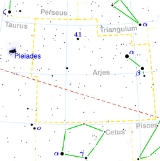
 (other slightly-different definitions exist). It is called Meshādi or the "start of Aries
Aries (astrology)
Aries is the first astrological sign in the Zodiac, named for the constellation of Aries, called "The Ram" in the Greek tradition, after the golden ram that rescued Phrixos, taking him to the land of Colchis....

". The ecliptic is divided into each of the nakshatras eastwards starting from this point.

The list of Nakshatras is found in the Vedic texts
Vedas
The Vedas are a large body of texts originating in Ancient India. The texts are composed in Vedic Sanskrit and form the oldest layer of Sanskrit literature, and the oldest sacred texts of Hinduism....

 (AV 19.7; Taittiriya Samhita) and also in the Shatapatha Brahmana
Shatapatha Brahmana
The Shatapatha Brahmana is one of the prose texts describing the Vedic ritual, associated with the Shukla Yajurveda...

. The first astronomy
Astronomy
Astronomy is the scientific study of celestial objects and phenomena that originate outside the Earth's atmosphere...

 text that lists them is the Vedanga Jyotisha
Vedanga Jyotisha
The Vedanga Jyotisha, is an Indian text on Jyotisha , redacted by Lagadha .The text is foundational to the Jyotisha discipline of Vedanga, and is dated to the final centuries BCE. The text describes rules for tracking the motions of the sun and the moon...

of Lagadha.

In Hindu mythology
Hindu mythology
Hindu mythology is the large body of traditional narratives related to Hinduism, notably as contained in Sanskrit literature, such as the Sanskrit epics and the Puranas. As such, it is a subset of Indian mythology...

 the Nakshastras, were invented by Daksha
Daksha
In Hinduism, Daksha, "the skilled one", is an ancient creator god, one of the Prajapatis , the Rishis and the Adityas, and a son of Aditi and Brahma...

, and are personified as daughters of the deity and as mythological wives of Chandra
Chandra
In Hinduism, Chandra is a lunar deity and a Graha. Chandra is also identified with the Vedic Lunar deity Soma . The Soma name refers particularly to the juice of sap in the plants and thus makes the Moon the lord of plants and vegetation. He is described as young, beautiful, fair; two-armed and...

, the moon god. Some even make them the daughters of Kashyapa
Kashyapa
Kashyapa was an ancient sage , who was one of the Saptarshis in the present Manvantara; with others being Atri, Vashishtha, Vishvamitra, Gautama, Jamadagni, Bharadwaja...

, the brother of Daksha.

Each of the nakshatras is governed as 'lord' by one of the nine graha
Navagraha
Graha is a 'cosmic influencer' on the living beings of mother Bhumidevi . In Hindu Astrology, the Navagraha are some of these major influencers."The Sanskrit word captures the idea that these nine grahas are living energies which put out waves of energy...

 in the following sequence: Ketu
Ketu
*In Vedic astrology, Ketu is the Moon's South node.Ketu is generally referred to as a "shadow" planet.*Ketu is a historical location in present day Benin.*Ketu is another name for the mountain K2....

 (South Lunar Node), Shukra
Shukra
Shukra , the Sanskrit for "clear, pure" or "brightness, clearness", is the name the son of Bhrgu and Urjaswathi, and preceptor of the Daityas, and the guru of the Asuras, identified with the planet Venus, one of the Navagrahas...

 (Venus), Ravi or Surya
Surya
In Hinduism, Sūrya is the chief solar deity, one of the Adityas, son of Kasyapa and one of his wives, Aditi; of Indra; or of Dyaus Pitar . The term Surya also refers to the Sun, in general. Surya has hair and arms of gold...

 (Sun), Chandra
Chandra
In Hinduism, Chandra is a lunar deity and a Graha. Chandra is also identified with the Vedic Lunar deity Soma . The Soma name refers particularly to the juice of sap in the plants and thus makes the Moon the lord of plants and vegetation. He is described as young, beautiful, fair; two-armed and...

 (Moon), Mangala
Mangala
In Jyotish astrology, Mangala is the name for Mars, the red planet. Mars is also called Angaraka or Bhauma in Sanskrit. He is the god of war and is celibate. He is considered the son of Prithvi or Bhumi, the Earth Goddess...

 (Mars), Rahu
Rahu
In Hindu mythology, Rahu is a snake that swallows the sun or the moon causing eclipses. He is depicted in art as a dragon with no body riding a chariot drawn by eight black horses.Rahu is one of the navagrahas in Vedic astrology...

 (North Lunar Node), Guru or Brihaspati
Brihaspati
Brihaspati also known as Brahmanaspati and Deva-guru , is the name of a Vedic deity...

 (Jupiter), Shani
Shani
Shani is one of the Navagraha which are the nine primary celestial beings in Hindu astrology, or Jyotiṣa. Shani is embodied in the planet Saturn...

 (Saturn) and Budha
Budha
In Hindu mythology, Budha is the name for the planet Mercury, a son of Chandra with Tara or Rohini. He is also the god of merchandise and protector of Merchants....

 (Mercury). This cycle repeats itself three times to cover all 27 nakshatras. The lord of each nakshatra determines the planetary period known as the dasha
Dasha (astrology)
Dasha The dasha pattern shows which planets will be ruling at particular times in Jyotisha.-Overview:...

 , which is considered of major importance in forecasting the life path of the individual.

Nakshatra descriptions


The following are the 27 nakshatras and their meanings, with their equivalent positions in the Indian and Western zodiacs. The corresponding regions of sky are also given, following Basham's Appendix: Astronomy.

Note: Although the Indian and Western zodiac signs
Astrological sign
Astrological signs represent twelve equal segments or divisions of the zodiac. According to astrology, celestial phenomena reflect or govern human activity on the principle of "as above, so below", so that the twelve signs are held to represent twelve basic personality types or characteristic...

 have a common origin, due to differences in measuring the zodiac
Zodiac
In astronomy, the zodiac is the ring of constellations that lines the ecliptic, which is the apparent path of the Sun across the sky over the course of the year. The Moon and planets also lie within the ecliptic, and so are also within the constellations of the zodiac. In astrology, the zodiac...

 they have diverged from each other by about 25°. Therefore in the Western zodiac 0° Aries (Mesha) corresponds to 5° Pisces (Meena) in the Indian zodiac and so on.
For details, see Sidereal Astrology
Sidereal astrology
Sidereal astrology is the system of astrology used by some Western and all Jyotish astrologers who base their interpretation around the use of the sidereal zodiac. Its primary feature is that the signs of the zodiac align to the sky constellations of the same name. The signs therefore run between...

.
  • Ashvini
    Ashvini
    Ashvini is the first nakshatra in Hindu astronomy, corresponding to β and γ Arietis . In , Ashvini is ruled by Ketu, the descending lunar node....

    (अश्विनी) (Horse Woman)

    • Western star name : β
      Beta Arietis
      Beta Arietis is a star in the constellation Aries, it is the Ram's second horn. It has the traditional name Sheratan , and the Flamsteed designation 6 Arietis....

       and γ
      Gamma Arietis
      Gamma Arietis is a triple star system, 204 light years distant, in constellation Aries. It has the traditional name Mesarthim, of obscure origin, and has been called "the First Star in Aries" as having been at one time the nearest visible star to the equinoctial point.The system includes a binary...

       Arietis
      Aries (constellation)
      Aries is one of constellations of the zodiac, located between Pisces to the west and Taurus to the east. Its name is Latin for ram, and its symbol is , representing a ram's horns.-Deep sky objects:The few deep sky objects in Aries are very dim...

    • Lord: Ketu (South lunar node)
    • Symbol : Horse's head
    • Deity : Ashwini Kumaras, the horse-headed twins who are physicians to the gods
    • Indian zodiac: 0° - 13°20' Mesha ; Western zodiac 26° Aries - 9°20' Taurus
    • The moon in Ashvini indicates a person who is a pioneer, innovator and explorer, who is heroic, courageous, restless, impatient, with a zest for life. They have a strong desire to be of service to others. They are energetic, magnetic and attractive, and are quick in speech and actions. However, they can also be inconsiderate and irresponsible.

  • Bharani
    Bharani
    Bharani is the second nakshatra in Hindu astronomy, corresponding to 35, 39, and 41 Arietis. In Jyotiṣa, Bharani is ruled by Shukra ....

    (भरणी) (Bearer of New Life)

    • Western star name: 35
      35 Arietis
      35 Arietis is a star in the constellation Aries. Its apparent magnitude is 4.65.-References:*...

      , 39
      39 Arietis
      39 Arietis is a star in the constellation Aries. Its apparent magnitude is +4.52.-External links:*** *...

      , and 41
      41 Arietis
      41 Arietis or c Arietis is a star in the constellation Aries. It has the traditional name Bharani, named after the Hindu astrological mansion...

       Arietis
      Aries (constellation)
      Aries is one of constellations of the zodiac, located between Pisces to the west and Taurus to the east. Its name is Latin for ram, and its symbol is , representing a ram's horns.-Deep sky objects:The few deep sky objects in Aries are very dim...

    • Lord: Shukra (Venus)
    • Symbol: Yoni, the female organ of reproduction
    • Deity: Yama
      Yama
      Yama , also known as Yamarāja in India, Shinje in Tibet, Yanluowang or simply Yan in China, and Enma Dai-Ō in Japan, is the lord of death, first recorded in the Vedas. The name Yanluo is a shortened Chinese transliteration of the Sanskrit term Yama Rājā, or "King Yama"...

      , god of death or Dharma
      Dharma
      The term , is an Indian spiritual and religious term, that means one's righteous duty or any virtuous path in the common sense of the term. A Hindu's Dharma is affected by a person's age, class, occupation, and sex. In Indian languages it can be equivalent simply to "religion", depending on context...

    • Indian zodiac: 13° 20' - 26°40' Mesha ; Western zodiac 9° 20' - 22° 40' Taurus
    • The moon in Bharani indicates a person who suffers struggles and restraint and obstacles in life. They can be resentful of these restrictions and jealous of the good fortune of others. They will inflict oppression on others, or else fight to liberate themselves and others from oppression. They are intelligent and witty and love the fine things of life, but they can also be fanatical in their beliefs, which can lead to ups and downs in life.

  • Krittika
    Krittika
    The star cluster ', sometimes known as Kārtikā, corresponds to the open star cluster Pleiades in Indian astronomy and...

    (क्रृत्तिका) (One Who Cuts)

    • Western star name: Pleiades
      Pleiades (star cluster)
      In astronomy, the Pleiades, or seven sisters, are an open star cluster containing relatively young hot blue stars located in the constellation of Taurus. It is among the nearest star clusters to Earth and is the cluster most obvious to the naked eye in the night sky...

    • Lord: Ravi
      Ravi
      Ravi is a common Hindi male given name. It means sun. Ravi may refer to:* Ravi , a Hindu solar deity* Ravi River , a Himalayan river flowing through India and Pakistan-People:...

       (Sun)
    • Symbol: Knife
      Knife
      A knife is any cutting edge or blade, handheld or otherwise, with or without a handle. Knives were used at least two-and-a-half million years ago, as evidenced by the Oldowan tools. Originally made of rock, flint, and obsidian; knives have evolved in construction as technology has with blades...

       or spear
      Spear
      A spear is a pole weapon consisting of a shaft, usually of wood, with a sharpened head. The head may be simply the sharpened end of the shaft itself, as is the case with bamboo spears, or it may be of another material fastened to the shaft, such as obsidian, iron or bronze...

    • Deity : Agni
      Agni
      Agni is a Hindu and Vedic deity. The word agni is Sanskrit for "fire" , cognate with Latin ignis , Russian огонь , Polish "ogień," Lithuanian - ugnis - all with the meaning 'fire' -, with the reconstructed Proto-Indo-European root being h₁égni-. Agni has three forms: fire, lightning and the sun...

      , god of fire
    • Indian zodiac: 26°40' Mesha
      Mesha
      Mesha was a 9th Century BCE King of Moab, a strip of hilly land in present-day Jordan, which lay north of Edom, across the Dead Sea from Judah up to the Arnon river valley....

       - 10° Vrishabha ; Western zodiac 22° 40' Taurus - 6° Gemini
    • The moon in Krittika indicates a person who is sharp, penetrating, sarcastic and critical. They are proud, ambitious, determined and focused on achieving their goals. They can be crusaders against injustice, protective of others, persistent and stubborn, but also aggressive and fiery.

  • Rohini
    Rohini (nakshatra)
    Rohini is a nakshatra in Indian astronomy corresponding to Aldebaran.In Hindu mythology, Rohini is a daughter of Prajapati Daksha and his consort, Prasuti. She was one of the twenty-seven daughters of Daksha who married the moon-God Chandra. She was the favourite and chief consort of Chandra, and...

    (रोहिणी) (Red One)

    • Western star name: Aldebaran
      Aldebaran
      Aldebaran is the brightest star in the constellation Taurus and one of the brightest stars in the nighttime sky. The name Aldebaran is derived from Arabic signifying "the follower", as it appears to follow the Pleiades, or Seven Sisters in the sky. Because of its location in the head of Taurus, it...

    • Lord: Chandra
      Chandra
      In Hinduism, Chandra is a lunar deity and a Graha. Chandra is also identified with the Vedic Lunar deity Soma . The Soma name refers particularly to the juice of sap in the plants and thus makes the Moon the lord of plants and vegetation. He is described as young, beautiful, fair; two-armed and...

       (Moon
      Moon
      The Moon is Earth's only natural satellite and the fifth largest satellite in the Solar System. The average centre-to-centre distance from the Earth to the Moon is , about thirty times the diameter of the Earth. The common centre of mass of the system is located at about —a quarter the Earth's...

      )
    • Symbol: Cart or chariot
      Chariot
      The chariot is the earliest and simplest type of carriage, used in both peace and war as the chief vehicle of many ancient peoples. Chariots were built in Mesopotamia by the Mesopotamians as early as 3000 BC and in China during the 2nd millennium BC. The original chariot was a fast, light, open,...

      , temple
      Temple
      A temple is a structure reserved for religious or spiritual activities, such as prayer and sacrifice, or analogous rites. A templum constituted a sacred precinct as defined by a priest, or augur. It has the same root as the word "template," a plan in preparation of the building that was marked out...

      , banyan tree
    • Deity : Brahma
      Brahma
      Brahma is the Hindu god of creation and one of the Trimurti, the others being Vishnu and Shiva. He is not to be confused with the Supreme Cosmic Spirit in Hindu Vedanta philosophy known as Brahman. Brahmā's consort is Saraswati, the goddess of learning...

       or Prajapati
      Prajapati
      In Hinduism, Prajapati is a Hindu deity presiding over procreation, and protector of life. He appears as a creator deity or supreme god above the other Vedic deities in RV 10.121.10 and in Brahmana literature...

      , the Creator
    • Indian zodiac: 10° - 23°20' Vrishabha ; Western zodiac 6° - 19°20' Gemini
    • The moon in Rohini indicates a person who is passionate, sexually seductive, elegant, attractive and charismatic. They love children, art, music and luxury, and the fine things of life, but can be snobbish, pampered, materialistic and critical of those whom they consider not up to their own standards.

  • Mrigashīrsha
    Mrigashirsha
    Margashīrsha/Mrigashira the 5th nakshatra or lunar mansion as used in Hindu astronomy and astrology is the constellation Orion. Its position is described in the Surya Siddhanta....

    (म्रृगशीर्षा) (Head of a Deer)

    • Western star name: )λ
      Lambda Orionis
      Lambda Orionis is a star in the constellation Orion. It has the traditional names Meissa or Heka. "Meissa" derives from the Arabic, "Al-Maisan" which means "The Shining One". This term was used for gamma Gemini , but was somehow also mistakenly applied to λ Orionis and the name stuck...

      , φ
      Phi Orionis
      The Bayer designation Phi Orionis is shared by two star systems, φ¹ Orionis and φ² Orionis, in the constellation Orion. The two stars are separated by approximately 0.71° on the sky...

       Orionis
      Orion (constellation)
      Orion, often referred to as "The Hunter," is a prominent constellation located on the celestial equator and visible throughout the world. It is one of the largest, most conspicuous, and most recognizable in the night sky...

    • Lord: Mangala (Mars)
    • Symbol: Deer's head
    • Deity: Soma
      Soma
      Soma , or Haoma , from Proto-Indo-Iranian *sauma-, was a ritual drink of importance among the early Indo-Iranians, and the later Vedic and greater Persian cultures. It is frequently mentioned in the Rigveda, whose Soma Mandala contains many hymns praising its energizing qualities...

      , Chandra
      Chandra
      In Hinduism, Chandra is a lunar deity and a Graha. Chandra is also identified with the Vedic Lunar deity Soma . The Soma name refers particularly to the juice of sap in the plants and thus makes the Moon the lord of plants and vegetation. He is described as young, beautiful, fair; two-armed and...

      , the Moon god
    • Indian zodiac: 23° 20' Vrishabha - 6° 40' Mithuna ; Western zodiac: 19°20' Gemini - 2°40' Cancer
    • The moon in Mrigashirsha indicates a person who is restless and nervous, and constantly searching or looking for something. They are gentle, tender and peaceful, sensual and romantic, with motherly instincts. They are always curious and so are good travellers, investigators, researchers and collectors and they make good public speakers and communicators.

  • Ardra
    Ardra
    *Ardra is the goddess of good luck and fortune in Hindu mythology*Ardra is a nakshatra associated with the star Betelgeuse in Indian astronomy*Great Ardra and Little Ardra are historical places in former Dahomey , Africa...

    (आर्द्रा) (Moist One))

    • Western star name: Betelgeuse
      Betelgeuse
      Betelgeuse is a semiregular variable star located approximately 640 light-years from the Earth. It is Alpha Orionis , but the second brightest star in the constellation Orion and the ninth brightest star in the night sky...

    • Lord: Rahu (North lunar node)
    • Symbol: Teardrop, diamond, a human head
    • Deity : Rudra
      Rudra
      Rudra is a Rigvedic God of the storm, the wind, and the hunt. The name has been translated as "Roarer", "Howler", "Wild One", and "Terrible".Rudra is thought to be an early form of Shiva...

      , the storm god
    • Indian zodiac: 6° 40' - 20° Mithuna ; Western zodiac: 2° 40' - 16° Cancer
    • The moon in Ardra indicates a person with sadness and destructive impulses, but also who is skilled at creating new things out of destruction and renovating old things. They are cold, calculating, stubborn and controlling, with a violent temperament, but can also be strong, stable and sympathetic personalities.

  • Punarvasu
    Punarvasu
    Punarvasu is a Nakshatra in Hindu astrology, which refers to the two brightest stars in the constellation of Gemini: Castor and Pollux.In Malayalam Punarvasu is termed Punartham. It is also known as Punarpusam in South India.-Mythology:...

    (पुनर्वसु) (Return of the Light)

    • Western star name: Castor
      Castor (star)
      Castor is the second brightest star in the constellation Gemini and one of the brightest stars in the nighttime sky...

       and Pollux
      Pollux (star)
      Pollux, also catalogued as Beta Geminorum , is an orange giant star approximately 34 light-years from Earth in the constellation of Gemini . Pollux is the brightest star in the constellation, brighter than Castor...

    • Lord: Guru (Jupiter)
    • Symbol : Bow and quiver
    • Deity : Aditi
      Aditi
      Aditi [from a without + diti bound from the verbal root da to bind] boundless, free; as a noun, infinite and shoreless expanse. In the Vedas, Aditi is Devamatri as from and in her cosmic matrix all the heavenly bodies were born...

      , mother of the gods
    • Indian zodiac: 20° Mithuna - 3°20' Karka ; Western zodiac 16° - 29°20' Cancer
    • The moon in Purnarvasu indicates a person with strong inner resources and ability to bounce back from difficulties, and who is philosophical, religious, spiritual, likeable, charming and forgiving. They are idealistic, honest and truthful to the core and value family and the home.

  • Pushya
    Pushya
    Pushya is a nakshatra in Indian astronomy. It corresponds to γ, δ and θ Cancri, in the Cancer .Traditionally, many people buy gold on the day of this Nakshatra....

    (पुष्य) (Nourishing)

    • Western star name: γ
      Gamma Cancri
      Gamma Cancri is a star system in the constellation Cancer. It has the traditional name Asellus Borealis ....

      , δ
      Delta Cancri
      Delta Cancri is an orange giant star approximately 136 light-years away in the constellation Cancer. It has the traditional name Asellus Australis which in Latin means "southern donkey colt". It also has the longest of all star names "Arkushanangarushashutu" which is still sometimes used...

       and θ
      Theta Cancri
      Theta Cancri is a binary star in the constellation Cancer, 494 light years from Earth.θ Cancri is classified as an orange K-type giant with an apparent magnitude of +5.33. Since it is near the ecliptic, it can be occulted by the Moon and very rarely by planets...

       Cancri
      Cancer (constellation)
      Cancer is one of the thirteen constellations of the zodiac. Its name is Latin for crab and it is commonly represented as such. Its symbol is . Cancer is small and its stars are faint...

    • Lord: Shani (Saturn)
    • Symbol : Cow's udder, lotus, arrow and circle
    • Deity : Bṛhaspati, priest of the gods
    • Indian zodiac: 3°20' -16°40' Karka ; Western zodiac 29°20' Cancer - 12°40' Leo
    • The moon in Pushya indicates a person who is religious, conventional, helping, selfless, caring, intelligent and spiritual. They are usually self-sufficient and wealthy, but give service to others and the under privileged. However, they can be arrogant and superior towards those who do not share their high ideals.

  • Āshleshā (आश्लेषा) (The Embracer)

    • Western star name: δ, ε, η, ρ, and σ
      Sigma Hydrae
      Sigma Hydrae is the 4th-magnitude star in the constellation Hydra. It is known as the proper name Minchir in Germany. And...

       Hydrae
      Hydra (constellation)
      Hydra is the largest of the 88 modern constellations, measuring 1303 square degrees. It has a long history, having been included among the 48 constellations listed by the 2nd century astronomer Ptolemy. It is commonly represented as a water snake...

      . This nakshatra is equivalent to the head of Hydra
      Hydra
      Hydra may refer to:* Lernaean Hydra, a mythological many-headed serpent* Hydra, Saronic Islands, one of the Saronic Islands of Greece* Hydra , the largest of the modern star constellations* Hydra , a satellite of Pluto...

       constellation, excluding ζ Hydrae, which is situated in the neck.
    • Lord: Budh (Mercury)
    • Symbol: Serpent
    • Deity : Sarpas or Nagas
      Naga
      Naga or NAGA may refer to:* Nāga, a group of serpent deities in Hindu and Buddhist mythology.-People:* Naga people, an diverse ethnic identity in Northeast India* Naga , from Kashmir* Naga Regiment, of the Indian Army...

      , deified snakes
    • Indian zodiac: 16°40' - 30° Karka ; Western zodiac 12°40' - 26° Leo
    • The moon in Ashlesha indicates a person is penetrating, intense, hypnotic, wise, profound and secretive. They are ambitious and full of conviction and are unable to take criticism or humiliation. They can also be crafty, devious, controlling and vengeful.

  • Magha
    Magha
    Magha might refer to:* The Hindu month Maagha* The Thai Buddhist festival Magha Puja* The nakshatra Magha * Magha , an 8th century Sanskrit poet, who wrote Shishupala-vadha.* Kalinga Magha a king of Sri Lanka...

    (मघा) (The Great One)

    • Western star name:Regulus
      Regulus
      Regulus is the brightest star in the constellation Leo and one of the brightest stars in the nighttime sky, and lies approximately 77.5 light years from Earth. Regulus is a multiple star system composed of four stars which are organised into two pairs...

    • Lord: Ketu (south lunar node)
    • Symbol : Royal Throne
    • Deity : Pitrs
      Pitrs
      The Pitṛs , are the spirits of the departed ancestors in Hindu culture.They are often remembered annually.It is a Hindu’s duty to his ancestors to beget at least one son, so that he may continue to make offerings to the Pitris....

      , 'The Fathers', family ancestors
    • Indian zodiac: 0° - 13°20' Simha ; Western zodiac 26° Leo - 9°20' Virgo
    • The moon is Magha indicates a person who is noble, eminent, ambitious and generous, with leadership qualities, strong and traditional values and a drive for power and wealth. They are amiable and have a positive outlook on life. They are loyal and proud of their family and ancestors, but can also be elitist and arrogant.

  • Purva Phalguni (पूर्व फाल्गुनी) (Former Reddish One)

    • Western star name: δ
      Delta Leonis
      Delta Leonis is a star in the constellation of Leo. It has the traditional names Zosma and Duhr. Rare spellings include Zozca, Zosca, Zubra, and Dhur....

       and θ Leonis
      Leo (constellation)
      Leo is one of the constellations of the zodiac. Its name is Latin for lion. Its symbol is , a corruption of the initial letter of Λεων . Leo lies between dim Cancer to the west and Virgo to the east.-Stars:...

    • Lord: Shukra (Venus)
    • Symbol : Front legs of bed, hammock, fig tree
    • Deity : Bhaga
      Bhaga
      Sanskrit is a term for "lord, patron", but also for "wealth, prosperity". The cognate term in Avestan and Old Persian is , of uncertain meaning but used in a sense in which "lord, patron" might also apply. A Slavic cognate is "god"...

      , god of marital bliss and prosperity
    • Indian zodiac: 13°20' - 26°40' Simha ; Western zodiac 9°20' - 22°40' Virgo
    • The moon in Purva Phalguni indicates someone who is carefree, happy-go-lucky, attractive, sensual, affectionate, sociable, kind, generous and loyal. They are good communicators and influencers of others. They are artistic and relaxed in their approach, but can also be lazy and vain. They need to be in relationships and family life is important to them.

  • Uttar Phalguni (उत्तर फाल्गुनी) (Latter Reddish One)

    • Western star name: Denebola
      Denebola
      Denebola is the second brightest star in the constellation Leo. It is an A-class star that is about distant from earth, and has a luminosity about twelve times that of the sun. Its apparent magnitude is 2.14...

    • Lord: Surya (Sun)
    • Symbol: Four legs of bed, hammock
    • Deity : Aryaman
      Aryaman
      Aryaman is one of the early Vedic deities . His name signifies "bosom friend," but is literally "noble one". He is an Aditya, a solar deity. He is supposed to be the chief of the manes and the Milky Way is supposed to be his path.Aryaman is another name for Surya or the Sun God...

      , god of patronage and favours
    • Indian zodiac: 26°40' Simha- 10° Kanya ; Western zodiac 22°40' Virgo - 6° Libra
    • The moon in Uttar Phalguni indicates a person who is helpful, kind, friendly, caring, sincere and courageous. They are stable, fixed and focused in their approach to life. They need relationships and family unity, and love humanity in general. However, they can also be dependent in relationships, stubborn and controlling.

  • Hasta
    Hasta
    -Sanskrit:*Hasta , a Sanskrit word meaning hand gesture or position*Hasta , a measure of length*the thirteenth Nakshatra of Hindu Astrology-Spanish:...

    (हस्त) (The Hand)

    • Western star name: α
      Alpha Corvi
      Alpha Corvi is a star in the constellation Corvus. It has the traditional names Alchiba or Al Minliar al Ghurab. It is known as 右轄 in Chinese....

      , β
      Beta Corvi
      Beta Corvi is the second brightest star in the constellation of Corvus. It also has the name Kraz. It is approximately 140 light-years away and is a G-type bright giant star whose apparent visual magnitude which varies between 2.60 and 2.66.- See also :* A Carinae* Rho² Cancri* Beta Corvi...

      , γ
      Gamma Corvi
      Gamma Corvi is the brightest star in the constellation Corvus. Its traditional name is Gienah, however Epsilon Cygni has an identical traditional name...

      , δ
      Delta Corvi
      |}Delta Corvi is a star in the constellation Corvus. It has the traditional name Algorab. It is known as 軫宿三 in Chinese.Algorab has apparent magnitude +3.1 and belongs to the spectral class A0...

       and ε
      Epsilon Corvi
      Epsilon Corvi is a star in the constellation Corvus. It has the traditional name Minkar.Epsilon Corvi has apparent magnitude +3.02 and belongs to the spectral class K2 III. It is approximately 303 light years from Earth....

       Corvi
      Corvus (constellation)
      Corvus is a small constellation in the southern sky. Its name is Latin for raven or crow. It includes only 11 stars visible to the naked eye . It was one of the 48 constellations listed by Ptolemy, who only counted 7 stars, and it remains one of the 88 modern constellations.-Stars:δ, γ, ε, and β...

    • Lord: Chandra (Moon)
    • Symbol: Hand or fist
    • Deity : Saviti
      Surya
      In Hinduism, Sūrya is the chief solar deity, one of the Adityas, son of Kasyapa and one of his wives, Aditi; of Indra; or of Dyaus Pitar . The term Surya also refers to the Sun, in general. Surya has hair and arms of gold...

       or Surya
      Surya
      In Hinduism, Sūrya is the chief solar deity, one of the Adityas, son of Kasyapa and one of his wives, Aditi; of Indra; or of Dyaus Pitar . The term Surya also refers to the Sun, in general. Surya has hair and arms of gold...

      , the Sun god
    • Indian zodiac: 10° - 23°20' Kanya ; Western zodiac 6° - 19°20' Libra
    • The moon in Hasta indicates a person who is skillful with their hands, good at craftsmanship and the arts, healers and massagers. They are clever, witty, entertaining and humorous, and are good speakers and communicators. Their early life may be subject to hardship and restraints and they like routine and security. They can also be grasping and possessive.

  • Chitra
    Chitra
    Chitra could refer to* Chitra is a nakshatra. It is also a common hindu name for the female child in India derived from the sanskrit word for portrait or picture...

    (चित्रा) (Bright One)

    • Western star name: Spica
      Spica
      Spica is the brightest star in the constellation Virgo, and the 15th brightest star in the nighttime sky. It is 260 light years distant from Earth...

    • Lord: Mangala (Mars)
    • Symbol: Bright jewel or pearl
    • Deity : Tvastar
      Tvastar
      In Vedic religion,',also transliterated as Tvaṣṭr,Tvaṣṭr or Tvaṣṭr, nominative , is the heavenly builder, the maker of divine implements,especially Indra's Vajra and the guardian of Soma...

       or Vishvakarman
      Vishvakarman
      Vishvakarma is the Hindu presiding deity of all craftsmen and architects. He is the "Principal Universal Architect", the architect who fabricated and designed the divine architecture of the Universe at the behest of Brahma, the Lord of Creation.-Vishvakarma in vedas:As per the Rig Veda he is the...

      , the celestial architect
    • Indian zodiac: 23°20' Kanya - 6°40' Tula ; Western zodiac 19°20' Libra - 2°40' Scorpio
    • The moon in Chitra indicates someone with good opportunities in life, with charisma, charm, and glamor. They love bright colors, jewellery and beautiful things and are artistic. They are also spiritual and have great insight, and are good conversationalists and organizers.

  • Swaati (स्वाति) (Sword or Independence)

    • Western star name: Arcturus
      Arcturus
      |- bgcolor="#FFFAFA"| note : || H and K emission vary.Arcturus is the brightest star in the constellation Boötes. With a visual magnitude of −0.05, it is also the third brightest star in the night sky, after Sirius and Canopus...

    • Lord: Rahu (north lunar node)
    • Symbol: Shoot of plant, coral
    • Deity : Vayu
      Vayu
      Vāyu is a primary Hindu deity, the Lord of the winds, the father of Bhima and the spiritual father of Lord Hanuman...

      , the Wind god
    • Indian zodiac: 6°40' - 20° Tula ; Western zodiac 2°40' - 16° Scorpio
    • The moon in Swaati indicates someone who is musical, artistic, creative, intuitive and psychic. They have good business and financial skills and are good communicators. They are good learners, knowledgeable, curious and flexible in their approach. They can be vulnerable but are good survivors. However, they can also be changeable, restless and fickle.

  • Vishakha
    Vishākhā
    Vishaka is a nakshatra in Indian astronomy.In Hindu mythology, vishaka is a daughter of king Daksha. She was one of the twenty-seven daughters of Daksha who married the moon-God Chandra.vishaka is the sixteenth nakshatra of the zodiac, ruled by the planet Moon....

    (विशाखा) ( Fork Shaped)

    • Western star name: α
      Alpha Librae
      Alpha Librae is the second brightest star in the constellation Libra . It has the traditional name Zubenelgenubi. The name, from Arabic الزبن الجنوبي , means "southern claw" and was coined before Libra was recognized as distinct from Scorpius...

      , β
      Beta Librae
      Galactic Coordinates: l° 352.0, b° +39.2Beta Librae is the brightest star in the constellation Libra. It has the traditional name Zubeneschamali and the Latin name Lanx Australis...

      , γ
      Gamma Librae
      Gamma Librae is a star in the constellation Libra. It has the traditional name Zuben-el-Akrab, meaning "Shears of the Scorpion". The name is a modification of the Arabic al-Zuban al-Aqrab...

       and ι Librae
      Libra (constellation)
      Libra is a constellation of the zodiac. Its name is Latin for weighing scales, and its symbol is . It is fairly faint, with no first magnitude stars, and lies between Virgo to the west and Scorpius to the east.-Notable features:...

    • Lord: Guru (Jupiter)
    • Symbol : Triumphal arch, potter's wheel
    • Deity : Indira
      Lakshmi
      Lakshmi is the Hindu goddess of wealth, prosperity, light, wisdom, fortune, fertility, generosity and courage; and the embodiment of beauty, grace and charm...

      , chief of the gods; Agni
      Agni
      Agni is a Hindu and Vedic deity. The word agni is Sanskrit for "fire" , cognate with Latin ignis , Russian огонь , Polish "ogień," Lithuanian - ugnis - all with the meaning 'fire' -, with the reconstructed Proto-Indo-European root being h₁égni-. Agni has three forms: fire, lightning and the sun...

      , god of Fire
    • Indian zodiac: 20° Tula - 3°20' Vrishchika ; Western zodiac 16° - 29°20' Scorpio
    • The moon in Vishakha indicates a person who is purposeful, goal oriented, ambitious, competitive, opinionated, forceful and determined. They are persistent and patient, but quick witted and intelligent. They are pleasant and popular and are good communicators, but they can also be abrasive. They usually only achieve success later in life and can be jealous and envious of others.

  • Anuradha
    Anuradha
    In Hinduism, Anuradha is a goddess of good luck . Anuradha is the 17th nakshatra....

    (अनुराधा) (Disciple of Divine Spark)

    • Western star name: β
      Beta Scorpii
      Beta Scorpii is a star system in the constellation Scorpius. It has the traditional names Acrab, Akrab or Elacrab, all come from al-'Aqrab, the Scorpion, for the whole constellation, as well as Graffias, a name it shares with Xi Scorpii...

      , δ
      Delta Scorpii
      Delta Scorpii is a star in the constellation Scorpius. It has the traditional name Dschubba or also Iclarcrau or Iclarkrav....

       and π
      Pi Scorpii
      Pi Scorpii is a triple star system in the constellation Scorpius. It is approximately 459 light years from Earth.Pi Scorpii A is a contact binary of the Beta Lyrae type. Both its members are hot, blue-white B-type dwarfs. Together they have a mean apparent magnitude of +2.89. Their rotation...

       Scorpii
    • Lord: Shani (Saturn)
    • Symbol : Triumphal archway, lotus
    • Deity : Mitra
      Mitra (Vedic)
      This article is about the Vedic deity Mitra. For other divinities with related names, see the general article Mitra.Mitra is an important divinity of Indic culture, and the patron divinity of honesty, friendship, contracts and meetings...

      , one of Adityas of friendship and partnership
    • Indian zodiac: 3°20' - 16°40' Vrishchika ; Western zodiac 29°20' Scorpio - 12°40' Sagittarius
    • The moon in Anuradha indicates someone who has balanced friendships and relationships and is co-operative, loving, popular, and successful. They are good leaders and organisers and are focused on their goals, but they are also good at sharing. They are sensual, and love variety and travel. They are faithful and devoted to those they love, but they can also be jealous and angry.

  • Jyeshtha
    Jyeshtha (nakshatra)
    Jyeshtha is the 18th nakshatra or lunar mansion in Vedic astrology associated with the heart of the constellation Scorpii , and the stars α , σ, and τ ....

    (ज्येष्ठा) (The Eldest)

    • Western star name: α, σ
      Sigma Scorpii
      Sigma Scorpii is a star system in the constellation Scorpius. It has the traditional name Al Niyat, although this name is sometimes also applied to Tau Scorpii, or to the asterism formed by both Sigma and Tau. Sigma Scorpii is 735 light years from the Sun.The primary component of the system,...

      , and τ
      Tau Scorpii
      Tau Scorpii is a star in the constellation Scorpius. Tau Scorpii also has the traditional name Alniyat or Al Niyat, which it shares with σ Scorpii. The name derives from the Arabic النياط an-niyāţ meaning "the arteries"....

       Scorpii
    • Lord: Budh (Mercury)
    • Symbol : circular amulet, umbrella, earring
    • Deity : Indra
      Indra
      ' is the King of the gods or Devas and Lord of Heaven or Svargaloka in Hindu mythology, and also he is the God of War, Storms, and Rainfall....

      , chief of the gods
    • Indian zodiac: 16°40' - 30° Vrishchika ; Western zodiac 12°40' - 26° Sagittarius
    • The moon in Jyeshtha indicates a person with a sense of seniority and superiority, who is protective, responsible and a leader of their family. They are wise, profound, psychic, maybe with occult powers, and are courageous and inventive. They may experience poverty and hardship in life and can be reclusive and secretive.

  • Mula
    Mula (astrology)
    Mula is the 19th nakshatra or lunar mansion in Vedic astrology and corresponds to the stars ε, ζ, η, θ, ι, κ, υ, λ, μ and ν Scorpii in the tail/sting of Scorpius. The symbol of Mula is a bunch of roots tied together or an 'elephant goad' and the Deity associated with it is Niriti, god of...

    (मूल) (The Root)

    • Western star name: ε
      Epsilon Scorpii
      Epsilon Scorpii is a star in the constellation Scorpius. It is rarely called Wei introduced by Patrick Moore.The name Wěi , the Tail, was originally given for a Chinese asterism or Xiù composed from the stars ε, μ1-2,...

      , ζ, η
      Eta Scorpii
      Eta Scorpii is a star in the constellation Scorpius.Eta Scorpii is a yellow-white F-type giant with an apparent magnitude of +3.32. It is approximately 72.0 light years from Earth....

      , θ
      Theta Scorpii
      Theta Scorpii is a star in the constellation Scorpius. It has the traditional names Sargas and Girtab, both of Sumerian origin....

      , ι, κ
      Kappa Scorpii
      Kappa Scorpii is a star in the constellation Scorpius. It has the traditional name Girtab.The name Girtab is actually applied to an asterism comprising this star, Lambda Scorpii, Upsilon Scorpii, and Iota Scorpii.This star is a spectroscopic binary, and the primary is also a Beta Cephei...

      , λ
      Lambda Scorpii
      Lambda Scorpii is the second brightest star system in the constellation Scorpius, and one of the brightest stars in the nighttime sky. It has the Bayer designation λ despite being the second brightest in its constellation...

      , υ
      Upsilon Scorpii
      Upsilon Scorpii is a star in the constellation Scorpius. It has the traditional name Lesath , from Arabic las'a = "pass of a poisonous animal"; but this is a miscorrection by Scaliger for earlier "Alascha", which came from Arabic al laţkha = "the foggy...

      , μ
      Mu Scorpii
      The Bayer designation Mu Scorpii is shared by two star systems, in the constellation Scorpius:* μ¹ Scorpii* μ² ScorpiiThey are separated by 0.1° on the sky....

       and ν
      Nu Scorpii
      Nu Scorpii is a star system in the constellation Scorpius. It has the traditional name Jabbah, which means "forehead" in Arabic....

       Scorpii
    • Lord: Ketu (south lunar node)
    • Symbol : Bunch of roots tied together, elephant goad
    • Deity : Nirrti
      Nirrti
      In Hinduism, ' is the goddess of death and corruption, one of the Guardians of the directions , representing the southwest...

      , god of dissolution and destruction
    • Indian zodiac: 0° - 13°20' Dhanus ; Western zodiac 26° Sagittarius - 9°20' Capricorn
    • The moon in Mula indicates a person who has a passionate desire to get to the truth and is good at investigation and research. They are direct, ardent and truthful and are shrewd and ambitious, but they can feel trapped and bound by circumstances and so feel resentment and a sense of betrayal. They can also suffer extreme reversals of fortune that may involve pain and cruelty.

  • Purva Ashadha (पूर्वाषाढ़ा) (Early Victory or The Undefeated)

    • Western star name: δ
      Delta Sagittarii
      Delta Sagittarii is a star system in the constellation Sagittarius. It has the traditional names Kaus Media, Kaus Meridionalis, and Media. Kaus Media is 306 light years from Earth and radiates with a total luminosity of 1180 times that of the Sun...

       and ε
      Epsilon Sagittarii
      Epsilon Sagittarii is a binary star that lies 144.64 light-years distant in the constellation Sagittarius. It has a faint, 14th magnitude companion, Epsilon Sagittarii B, 32 arcseconds distant....

       Sagittarii
      Sagittarius (constellation)
      Sagittarius is one of the constellations of the zodiac. Its name is Latin for the archer, and its symbol is , a stylized arrow. Sagittarius is commonly represented as a centaur drawing a bow...

    • Lord: Shukra (Venus)
    • Symbol: Elephant tusk, fan, winnowing basket
    • Deity : Apah
      Ap (water)
      Ap is the Vedic Sanskrit term for "water", in Classical Sanskrit occurring only in the plural, , whence Hindi . The term is from PIE hxap "water"....

      , god of Water
    • Indian zodiac: 13°20' - 26°40' Dhanus ; Western zodiac 9°20' - 22°40' Capricorn
    • The moon in Purva Ashadha indicates a person who is proud, independent, and invincible with strong influence and power over others. They are ambitious and fearless, with a strong urge to better themselves. They have deep emotions and are philosophical, but they can also be confrontational, angry and harshly spoken.

  • Uttara Ashadha (उत्तराषाढ़ा) (Latter victory or Latter Undefeated)

    • Western star name: ζ
      Zeta Sagittarii
      Zeta Sagittarii is the third brightest star system in the constellation Sagittarius. It has the traditional name Ascella from a Late Latin word meaning armpit....

       and σ
      Sigma Sagittarii
      Sigma Sagitarii is the second brightest star system in the constellation Sagittarius.Its modern name Nunki is an Assyrian or Babylonian name recovered by archaeologists and made public by R.H.Allen....

       Sagittarii
      Sagittarius (constellation)
      Sagittarius is one of the constellations of the zodiac. Its name is Latin for the archer, and its symbol is , a stylized arrow. Sagittarius is commonly represented as a centaur drawing a bow...

    • Lord: Surya (Sun)
    • Symbol : Elephant tusk, small bed
    • Deity : Vishvedas
      Visvedevas
      The Visvedevas are the various Vedic gods taken together as a whole. In the Rigveda a number of hymns are addressed to them, including 1.89,3.54-56,4.55,5.41-51,6.49-52,7.34-37, 39, 40, 42, 43,8.27-30, 58, 83...

      , universal gods
    • Indian zodiac: 26°40' Dhanus - 10° Makara ; Western zodiac 22°40' Capricorn - 6° Aquarius
    • The moon in Uttara Ashadha indicates a person who enduring, invincible, patient, righteous and responsible. They have great integrity and are sincere, committed to ideals, ambitious and good leaders. They usually have success later in life and have great stamina and constancy, but they can also be rigid and unbending.

  • Shravana
    Shravana
    Shravana is the 22nd nakshatra or lunar mansion as used in Hindu astronomy and astrology. It belongs to the constellation Makara or Capricorn....

    (श्रवण) (Hearing)

    • Western star name: α, β
      Beta Aquilae
      Beta Aquilae is a star in the constellation Aquila. It has the traditional name Alshain from the Perso-Arabic term الشاهين aš-šāhīn "the falcon", perhaps by folk etymology from the Persian šāhīn tarāzū , the Persian name for the asterism α, β and γ Aquilae.Beta Aquilae has...

       and γ
      Gamma Aquilae
      Gamma Aquilae is a star in the constellation Aquila. It has the traditional name Tarazed , which appears to derive from Persian شاهين ترازو šāhin tarāzu "the beam of the scale", referring to an asterism of the Scale, α, β and γ Aquillae...

       Aquilae
      Aquila (constellation)
      Aquila is a constellation. Its name is Latin for 'eagle' and it is commonly represented as such. It lies roughly at the celestial equator. The alpha star, Altair, is a vertex of the Summer Triangle asterism.-History:...

    • Lord: Chandra (Moon)
    • Symbol : Ear or Three Footprints
    • Deity : Vishnu
      Vishnu
      Vishnu , , is the Supreme God in Vaishnavite tradition of Hinduism. Smarta followers of Adi Shankara, among others, venerate Vishnu as one of the five primary forms of God...

      , preserver of universe
    • Indian zodiac: 10° - 23°20' Makara ; Western zodiac 6° - 19°20' Aquarius
    • The moon in Shravana indicates a person who is good at listening and learning and is on a quest for knowledge and information. They are intellectual and wise, and make good teachers and counsellors and are good at conversation, but they can also be gossipy and restless. They are interested in the past and their heritage and are extensive travellers. They can suffer troubles and disappointment early in life.

  • Dhanishta
    Dhanishta
    Dhanishta is the twenty-third nakshatra in Hindu astronomy, corresponding to α to δ Delphini. It is also known as Dhanishtha or Avittam...

    (श्रविष्ठा) (Richest One)

    • Western star name: α
      Alpha Delphini
      Alpha Delphini is a multiple star in the constellation Delphinus. It also has the name Sualocin, which was given to it as a practical joke by the astronomer Niccolò Cacciatore; the name is the Latinized version of his given name, spelled backwards.Alpha Delphini has seven components: A and G, a...

       to δ Delphini
      Delphinus
      Delphinus is a constellation in the northern sky, close to the celestial equator. Its name is Latin for dolphin. It is one of the smaller constellation, ranked 69th in size out of 88...

    • Lord: Mangala (Mars)
    • Symbol : Drum or flute
    • Deity : Eight vasu
      Vasu
      In Hinduism, the Vasus are attendant deities of Indra, and later Vishnu. They are eight elemental gods representing aspects of nature, representing cosmic natural phenomenon. The name Vasu means 'Dweller' or 'Dwelling'...

      s, deities of earthly abundance
    • Indian zodiac: 23°20' Makara - 6°40' Kumbha ; Western zodiac 19°20' Aquarius - 2°40' Pisces
    • The moon in Dhanishtha indicates a person who possesses material wealth and property. They need fame and recognition and are good leaders, but they can be greedy and self absorbed. They are musical and good at dancing and like to travel. They can also experience marital difficulties.

  • Shatabhisha
    Shatabhisha
    Shatabhisha, also known as Chathayam or Sadayam , is the 24th nakshatra in Hindu astronomy. It corresponds to the star γ Aquarii...

    (शतभिषा) (Hundred Healers)

    • Western star name: γ
      Gamma Aquarii
      Gamma Aquarii is a star in the constellation Aquarius. It has the traditional name Sadachbia, from an Arabic expression سعد الأخبية sa‘d al-’axbiyah "luck of the homes "....

       Aquarii
      Aquarius
      Aquarius, or the "Water-Bearer", is a star constellation in the zodiac between Pisces and Capricornus. See: Aquarius .Aquarius may also refer to:* Aquarius , the astrological sign...

    • Lord: Rahu (north lunar node)
    • Symbol : Empty circle, 1,000 flowers or stars
    • Deity : Varuna
      Varuna
      In Vedic religion, Varuna or Waruna is a god of the sky, of waters and of the celestial ocean, as well as a god of law and of the underworld. He is one of the most prominent Devas in the Rigveda, and lord of the heavens and the earth...

      , god of cosmic waters, sky and earth
    • Indian zodiac: 6°40' - 20° Kumbha ; Western zodiac 2°40' - 16° Pisces
    • The moon in Shatabhisha indicates a person who is a good healer or doctor, and who is mystical, meditative, philosophical, scientific and a visionary. However, they can also be secretive, reclusive, moody, depressed, opinionated and stubborn; and suffer setbacks in relationships and marriage as a result.

  • Purva Bhadrapada
    Pūrva Bhādrapadā
    Pūrva Bhādrapadā or Poorvabhadra is the twenty-fifth nakshatra in Hindu astronomy, corresponding to α and β Pegasi. It is placed under the domain of Bṛhaspati, the deity represented by the planet Jupiter...

    (पूर्वभाद्रपदा) (Former Happy Feet)

    • Western star name: α
      Alpha Pegasi
      Alpha Pegasi is the third brightest star in the constellation Pegasus and one of the four stars in the asterism known as the Great Square of Pegasus. It has the traditional name Markab .Markab is a relatively average star nearing the end of its stellar evolution on the main sequence...

       and β
      Beta Pegasi
      Beta Pegasi is a star in the constellation Pegasus. Its traditional name is Scheat; confusingly, this name is also sometimes used for Delta Aquarii....

       Pegasi
      Pegasus (constellation)
      Pegasus is a constellation in the northern sky, named after the winged horse Pegasus in Greek mythology. It was one of the 48 constellations listed by the 2nd century astronomer Ptolemy, and remains one of the 88 modern constellations.-Stars:...

    • Lord: Guru (Jupiter)
    • Symbol : Swords or two front legs of funeral cot, man with two faces
    • Deity : Ajikapada, an ancient fire dragon
    • Indian zodiac: 20° Kumbha - 3°20' Meena ; Western zodiac 16° - 29°20' Pisces
    • The moon in Purva Bhadrapada indicates a person who is passionate and transformational, but a little extreme and indulgent. They are idealists and non-conformists and are good influencers of others and speakers and orators, but they can also be fearful, nervous, cynical and eccentric. Often their life can be full of sadness and problems.

  • Uttara Bhādrapadā
    Uttara Bhadrapada
    Uttara Bhādrapadā or Uttṛṭṭāti is the twenty-sixth nakshatra in Hindu astronomy, corresponding to γ Pegasi and α Andromedae. It is said to be ruled by Shani, the deity identified with the planet Saturn...

    (उत्तरभाद्रपदा) (Latter Happy Feet)

    • Western star name: γ
      Gamma Pegasi
      Gamma Pegasi is a star in the constellation of Pegasus. It also has the traditional name Algenib; confusingly however, this name is also used for Alpha Persei. It is known as 壁宿一 in Chinese....

       Pegasi
      Pegasus (constellation)
      Pegasus is a constellation in the northern sky, named after the winged horse Pegasus in Greek mythology. It was one of the 48 constellations listed by the 2nd century astronomer Ptolemy, and remains one of the 88 modern constellations.-Stars:...

       and α
      Alpha Andromedae
      Alpha Andromedae , which has the traditional names Alpheratz and Sirrah , is the brightest star in the constellation of Andromeda. Located immediately northeast of the constellation of Pegasus, it is the northeastern star of the Great Square of Pegasus...

       Andromedae
      Andromeda (constellation)
      Andromeda is a constellation in the northern sky. It is named after Andromeda, the princess of a mythological kingdom Ethiopia in Greek mythology. From the Earth's perspective, the constellation appears to contain the Andromeda Galaxy...

    • Lord: Shani (Saturn)
    • Symbol : Twins, back legs of funeral cot, snake in the water
    • Deity : Ahir Budhyana, serpent or dragon of the deep
    • Indian zodiac: 3°20' - 16°40' Meena ; Western zodiac 29°20' Pisces - 12°40' Aries
    • The moon in Uttara Bhadrapada indicates a person with good discipline and speaking and writing skills, who is cheerful, generous, self-sacrificing and psychic with deep insights. They generally have good wealth and inheritance and have a happy home life; but they like solitude and seclusion and can be lazy.

  • Revati
    Revati (nakshatra)
    Revati or Revathi is the twenty-seventh nakshatra in Hindu astronomy, corresponding to ζ Piscium. It is said to be ruled by Budha, the son of Chandra, also known as the planet Mercury...

    (रेवती) (The Wealthy)

    • Western star name: ζ Piscium
      Pisces (constellation)
      Pisces is a constellation of the zodiac. Its name is the Latin plural for fish, and its symbol is . It lies between Aquarius to the west and Aries to the east.-Notable features:...

    • Lord: Budh (Mercury)
    • Symbol : Fish or a pair of fish, drum
    • Deity : Pushan
      Pushan
      For the port city in Korea, see PusanPushan, also known as Puchan, is the Hindu God of meeting. Puchan was responsible for marriages, journeys, roads, and the feeding of cattle. He was a psychopomp, conducting souls to the other world. He protected travelers from bandits and wild beasts, and...

      , nourisher, the protective deity
    • Indian zodiac: 16°40' - 30° Meena ; Western zodiac 12°40' - 26° Aries
    • The moon in Revati indicates a person who is sweet, caring, responsible and likes to care for other people. They are sociable and love humanity and society, and are protective and nourishing of others. They are devoted to loved ones, spiritual, artistic and creative. Disappointments in their early life creates compassion and forgiveness for others, and it is said that they will reap karmic rewards in the next life for their caring actions.


There is an additional 28th intercalary nakshatra, Abhijit (अभिजित)(α, ε
Epsilon Lyrae
Epsilon Lyrae , commonly quoted as The Double Double, is a quadruple system approximately 162 light-years away in the constellation of Lyra. It can easily be separated into two components when viewed through binoculars, or even with the naked eye under excellent conditions...

 and ζ Lyrae - Vega
Vega
Vega is the brightest star in the constellation Lyra, the fifth brightest star in the night sky and the second brightest star in the northern celestial hemisphere, after Arcturus...

 - between Uttarasharha and Sravana). Its longitude starts from 06° 40' to 10° 53' 40 in sidereal Capricorn i.e. from the last quarter of Uttra Ashadha to first 1/15 th part of Shravana. Its span is 4° 13' 40 (4.22777... degrees). The span of 27 mean daily lunar motions totals 355.76167 degrees, and together these total 359.98945 degrees. Unless specifically mentioned it is not included in the list of the 27 constellations. It is held as an auspicious constellation in electional astrology. It is small (Laghu / Kshipra) in nature. The lord of Abhijit is Brahma
Brahma
Brahma is the Hindu god of creation and one of the Trimurti, the others being Vishnu and Shiva. He is not to be confused with the Supreme Cosmic Spirit in Hindu Vedanta philosophy known as Brahman. Brahmā's consort is Saraswati, the goddess of learning...

.

Divisions of the nakshatras


The 27 Nakshatras cover 13°20’ of the ecliptic
Ecliptic
The ecliptic is the apparent path that the Sun traces out in the sky during the year, appearing to move eastwards on an imaginary spherical surface, the celestial sphere, relative to the fixed stars. More accurately, it is the intersection of the celestial sphere with the ecliptic plane, which is...

 each. Each Nakshatra is also divided into quarters or padas of 3°20’, as follows:
# Name Pada 1 Pada 2 Pada 3 Pada 4
1 Ashvinī
Ashvini
Ashvini is the first nakshatra in Hindu astronomy, corresponding to β and γ Arietis . In , Ashvini is ruled by Ketu, the descending lunar node....

 (अश्विनि)
चु Chu चे Che चो Cho ला La
2 Bharanī
Bharani
Bharani is the second nakshatra in Hindu astronomy, corresponding to 35, 39, and 41 Arietis. In Jyotiṣa, Bharani is ruled by Shukra ....

 (भरणी)
ली Li लू Lu ले Le पो Lo
3 Krittikā
Krittika
The star cluster ', sometimes known as Kārtikā, corresponds to the open star cluster Pleiades in Indian astronomy and...

 (कृत्तिका)
अ A ई I उ U ए E
4 Rohini
Rohini (nakshatra)
Rohini is a nakshatra in Indian astronomy corresponding to Aldebaran.In Hindu mythology, Rohini is a daughter of Prajapati Daksha and his consort, Prasuti. She was one of the twenty-seven daughters of Daksha who married the moon-God Chandra. She was the favourite and chief consort of Chandra, and...

 (रोहिणी)
ओ O वा Va/Ba वी Vi/Bi वु Vu/Bu
5 Mrigashīrsha
Mrigashirsha
Margashīrsha/Mrigashira the 5th nakshatra or lunar mansion as used in Hindu astronomy and astrology is the constellation Orion. Its position is described in the Surya Siddhanta....

 (म्रृगशीर्षा)
वे Ve/Be वो Vo/Bo का Ka की Ke
6 Ārdrā
Ardra
*Ardra is the goddess of good luck and fortune in Hindu mythology*Ardra is a nakshatra associated with the star Betelgeuse in Indian astronomy*Great Ardra and Little Ardra are historical places in former Dahomey , Africa...

 (आर्द्रा)
कु Ku घ Gha ङ Ng/Na छ Chha
7 Punarvasu
Punarvasu
Punarvasu is a Nakshatra in Hindu astrology, which refers to the two brightest stars in the constellation of Gemini: Castor and Pollux.In Malayalam Punarvasu is termed Punartham. It is also known as Punarpusam in South India.-Mythology:...

 (पुनर्वसु)
के Ke को Ko हा Ha ही Hi
8 Pushya
Pushya
Pushya is a nakshatra in Indian astronomy. It corresponds to γ, δ and θ Cancri, in the Cancer .Traditionally, many people buy gold on the day of this Nakshatra....

 (पुष्य)
हु Hu हे He हो Ho ड Da
9 Āshleshā (आश्लेषा) डी Di डू Du डे De डो Do
10 Maghā
Magha
Magha might refer to:* The Hindu month Maagha* The Thai Buddhist festival Magha Puja* The nakshatra Magha * Magha , an 8th century Sanskrit poet, who wrote Shishupala-vadha.* Kalinga Magha a king of Sri Lanka...

 (मघा)
मा Ma मी Mi मू Mu मे Me
11 Pūrva or Pūrva Phalgunī (पूर्व फाल्गुनी) नो Mo टा Ta टी Ti टू Tu
12 Uttara
Uttara
Uttara, which means "north" in Hindi, may refer to:*Uttara is the name of two siblings in the Hindu epic Mahabharata:**Uttara, the son of King Virata who went into battle with Arjuna, disguised as his charioteer....

 or Uttara Phalgunī (उत्तर फाल्गुनी)
टे Te टो To पा Pa पी Pi
13 Hasta
Hasta
-Sanskrit:*Hasta , a Sanskrit word meaning hand gesture or position*Hasta , a measure of length*the thirteenth Nakshatra of Hindu Astrology-Spanish:...

 (हस्त)
पू Pu ष Sha ण Na ठ Tha
14 Chitrā
Chitra
Chitra could refer to* Chitra is a nakshatra. It is also a common hindu name for the female child in India derived from the sanskrit word for portrait or picture...

 (चित्रा)
पे Pe पो Po रा Ra री Ri
15 Svātī
Svati
Svati is a Nakshatra in Hindu astronomy, that corresponds to the star Arcturus. According to Hindu myths it is a nakshatra or star which converts dew drops into diamonds...

 (स्वाति)
रू Ru रे Re रो Ro ता Ta
16 Vishākhā
Vishākhā
Vishaka is a nakshatra in Indian astronomy.In Hindu mythology, vishaka is a daughter of king Daksha. She was one of the twenty-seven daughters of Daksha who married the moon-God Chandra.vishaka is the sixteenth nakshatra of the zodiac, ruled by the planet Moon....

 (विशाखा)
ती Ti तू Tu ते Te तो To
17 Anurādhā
Anuradha
In Hinduism, Anuradha is a goddess of good luck . Anuradha is the 17th nakshatra....

 (अनुराधा)
ना Na नी Ni नू Nu ने Ne
18 Jyeshtha (ज्येष्ठा) नो No या Ya यी Yi यू Yu
19 Mūla
Mula
-Places:* Mula, Maldives, a city in the Maldives* Mula, Spain, a town in the autonomous community of Murcia, Spain* Muľa, a village and municipality in southern Slovakia* Mula, a drum used in Cuban music...

 (मूल)
ये Ye यो Yo भा Bha भी Bhi
20 Pūrva Ashādhā (पूर्वाषाढ़ा) भू Bhu धा Dha फा Bha/Pha ढा Dha
21 Uttara Ashādhā (उत्तराषाढ़ा) भे Bhe भो Bho जा Ja जी Ji
22 Shravana
Shravana
Shravana is the 22nd nakshatra or lunar mansion as used in Hindu astronomy and astrology. It belongs to the constellation Makara or Capricorn....

 (श्रवण)
खी Ju/Khi खू Je/Khu खे Jo/Khe खो Gha/Kho
23 Shravishthā (श्रविष्ठा) or Dhanistā  गा Ga गी Gi गु Gu गे Ge
24 Shatabhishā
Shatabhisha
Shatabhisha, also known as Chathayam or Sadayam , is the 24th nakshatra in Hindu astronomy. It corresponds to the star γ Aquarii...

 (शतभिषा)or Shatataraka 
गो Go सा Sa सी Si सू Su
25 Pūrva Bhādrapadā
Pūrva Bhādrapadā
Pūrva Bhādrapadā or Poorvabhadra is the twenty-fifth nakshatra in Hindu astronomy, corresponding to α and β Pegasi. It is placed under the domain of Bṛhaspati, the deity represented by the planet Jupiter...

 (पूर्वभाद्रपदा)
से Se सो So दा Da दी Di
26 Uttara Bhādrapadā
Uttara Bhadrapada
Uttara Bhādrapadā or Uttṛṭṭāti is the twenty-sixth nakshatra in Hindu astronomy, corresponding to γ Pegasi and α Andromedae. It is said to be ruled by Shani, the deity identified with the planet Saturn...

 (उत्तरभाद्रपदा)
दू Du थ Tha झ Jha ञ Da/Tra
27 Revatī
Revati (nakshatra)
Revati or Revathi is the twenty-seventh nakshatra in Hindu astronomy, corresponding to ζ Piscium. It is said to be ruled by Budha, the son of Chandra, also known as the planet Mercury...

 (रेवती)
दे De दो Do च Cha ची Chi

Nakshatra names in Malayalam


The names of nakshatras in Malayalam are adapted from the Sanskrit variation (apabhramsa) through Pali or Prakrit. The variations evolved for easier pronunciation in popular usage.
# Sanskrit Malayalam
1 Ashvinī
Ashvini
Ashvini is the first nakshatra in Hindu astronomy, corresponding to β and γ Arietis . In , Ashvini is ruled by Ketu, the descending lunar node....

 
Ashvati
2 Bharanī
Bharani
Bharani is the second nakshatra in Hindu astronomy, corresponding to 35, 39, and 41 Arietis. In Jyotiṣa, Bharani is ruled by Shukra ....

 
Bharaṇi
3 Krittikā
Krittika
The star cluster ', sometimes known as Kārtikā, corresponds to the open star cluster Pleiades in Indian astronomy and...

 
Kārttika
4 Rohini
Rohini
Rohini may refer to:* Rohini , a lunar mansion in Indian astronomy corresponding to Aldebaran* Rohini Devi, in Hindu mythology a consort of Vasudeva and mother of Balarama and Subhadra* Rohini , a series of Indian space satellites...

 
Rōhiṇi
5 Mrigashīrsha
Mrigashirsha
Margashīrsha/Mrigashira the 5th nakshatra or lunar mansion as used in Hindu astronomy and astrology is the constellation Orion. Its position is described in the Surya Siddhanta....

 
Makayiram
6 Ārdrā
Ardra
*Ardra is the goddess of good luck and fortune in Hindu mythology*Ardra is a nakshatra associated with the star Betelgeuse in Indian astronomy*Great Ardra and Little Ardra are historical places in former Dahomey , Africa...

 
Tiruvātira (Ātira)
7 Punarvasu
Punarvasu
Punarvasu is a Nakshatra in Hindu astrology, which refers to the two brightest stars in the constellation of Gemini: Castor and Pollux.In Malayalam Punarvasu is termed Punartham. It is also known as Punarpusam in South India.-Mythology:...

 
Puṇartam
8 Pushya
Pushya
Pushya is a nakshatra in Indian astronomy. It corresponds to γ, δ and θ Cancri, in the Cancer .Traditionally, many people buy gold on the day of this Nakshatra....

 
Pūyam
9 Āshleshā  Āyilyam
10 Maghā
Magha
Magha might refer to:* The Hindu month Maagha* The Thai Buddhist festival Magha Puja* The nakshatra Magha * Magha , an 8th century Sanskrit poet, who wrote Shishupala-vadha.* Kalinga Magha a king of Sri Lanka...

 
Makam
11 Pūrva or Pūrva Phalgunī  Pūram
12 Uttara
Uttara
Uttara, which means "north" in Hindi, may refer to:*Uttara is the name of two siblings in the Hindu epic Mahabharata:**Uttara, the son of King Virata who went into battle with Arjuna, disguised as his charioteer....

 or Uttara Phalgunī 
Utram
13 Hasta
Hasta
-Sanskrit:*Hasta , a Sanskrit word meaning hand gesture or position*Hasta , a measure of length*the thirteenth Nakshatra of Hindu Astrology-Spanish:...

 
Attam
14 Chitrā
Chitra
Chitra could refer to* Chitra is a nakshatra. It is also a common hindu name for the female child in India derived from the sanskrit word for portrait or picture...

 
Chittira
15 Svātī
Svati
Svati is a Nakshatra in Hindu astronomy, that corresponds to the star Arcturus. According to Hindu myths it is a nakshatra or star which converts dew drops into diamonds...

 
Chōti
16 Vishākhā
Vishākhā
Vishaka is a nakshatra in Indian astronomy.In Hindu mythology, vishaka is a daughter of king Daksha. She was one of the twenty-seven daughters of Daksha who married the moon-God Chandra.vishaka is the sixteenth nakshatra of the zodiac, ruled by the planet Moon....

 
Vishākham
17 Anurādhā
Anuradha
In Hinduism, Anuradha is a goddess of good luck . Anuradha is the 17th nakshatra....

 
Anizham
18 Jyeshtha  Kēṭṭa (Trikkēṭṭa)
19 Mūla
Mula
-Places:* Mula, Maldives, a city in the Maldives* Mula, Spain, a town in the autonomous community of Murcia, Spain* Muľa, a village and municipality in southern Slovakia* Mula, a drum used in Cuban music...

 
Mūlam
20 Pūrva Ashādhā  Pūrāṭam
21 Uttara Ashādhā  Utrāṭam
22 Shravana
Shravana
Shravana is the 22nd nakshatra or lunar mansion as used in Hindu astronomy and astrology. It belongs to the constellation Makara or Capricorn....

 
Tiruvōnam
23 Shravishthā or Dhanistā  Aviṭṭam
24 Shatabhishā
Shatabhisha
Shatabhisha, also known as Chathayam or Sadayam , is the 24th nakshatra in Hindu astronomy. It corresponds to the star γ Aquarii...

 or Shatataraka 
Chatayam
25 Pūrva Bhādrapadā
Pūrva Bhādrapadā
Pūrva Bhādrapadā or Poorvabhadra is the twenty-fifth nakshatra in Hindu astronomy, corresponding to α and β Pegasi. It is placed under the domain of Bṛhaspati, the deity represented by the planet Jupiter...

 
Pūruruṭṭāti
26 Uttara Bhādrapadā
Uttara Bhadrapada
Uttara Bhādrapadā or Uttṛṭṭāti is the twenty-sixth nakshatra in Hindu astronomy, corresponding to γ Pegasi and α Andromedae. It is said to be ruled by Shani, the deity identified with the planet Saturn...

 
Uttṛṭṭāti
27 Revati
Revati
Revati, within Hinduism, is the daughter of King Kakudmi and the wife of Balarama, the elder brother of Krishna. Her account is given within a number of Puranic texts such as the Mahābhārata and Bhagavata Purana ....

 
Rēvati

Traditional Hindu names


Hindu astrologers (see Jyotisha
Jyotisha
' is the Hindu system of astrology. Jyotisha is also known as Indian astrology, Hindu astrology, and Vedic astrology.Sutton, Komilla...

) teach that when a child is born, they should be given an auspicious first name which will correspond to the child's Nakshatra. It is claimed that the benefit of this naming is that when the child hears this sound it generates the feeling of wholeness within the child. The child gains the feeling of comfort 'that mother is at home', whereas the wrong name can lead to feelings of isolation or alienation. The Moon is associated with mother, so using this sound gives the child that comfort feeling of mother.

Each birthstar has corresponding Sanskrit sounds which would belong at the beginning of such a name. These are available under each Nakshatra, listed above. The principle technique for deducing the name is to see which nakshatra the moon is in at the moment of birth; this gives four possible sounds. A refinement is to pick one sound out of that four that relates to the Pada or division of the Nakshatra. Each Nakshatra has four Padas and four sounds and each Pada is of equal width. The Nakshatra changes every 62 minutes of time and the Pada every 15 minutes.

A further refinement or opportunity is to instead use the Nakshatra that the ascendent resides in at birth. The same broad choice of sounds and Padas apply, but now the sounds change roughly every 15 minutes. The ascendent passes through all 27 Nakshatras every 24 hours, being in each one for 53 and a third minutes of time, and is in a Pada for 13 and a third minutes of time. By using the ascendent's nakshatra, instead of the moon's nakshatra leads more to comfort of the Self, rather than comfort of the mother. This second approach is only really applicable if intuitively the moon approach does not feel right.

Use in electional astrology


Constellations are grouped on the basis of their nature, type of their face, degree of their beneficence, their quarters in different signs, with reference to the constellation occupied by the Sun, with reference to the birth constellation (Janma Nakshatra), their caste, etc. The current constellation occupied by the Moon, and its nature forms the fundamental of Vedic system of electional astrology (Muhurta). Some of the activities and works which are associated with the Nakshatras are given below based on their fundamental nature:
  • Fixed (Dhruva, Sthira) constellations:


Rohini, Uttara Bhādrapadā , Uttra Falguni, and Uttara Ashada

Fixed and permanent nature, house, village, temple, entering in new hose-city-temple, religious works, rites for getting peace, propitiation of portents, Vinayaka Shanti, coronation, sowing of seeds, planting of small garden, starting of vocal music, friendship, sexual works, making & wearing of ornaments & clothes may be auspiciously begun / effectively performed. Works allocated to delicate & friendly (Mridu) asterisms may also be performed.
  • Movable (Chal , Char) constellations:


Punarvasu, Swaati, Sharavana, Shatabhishā & Shravishthā

Related to motion & movement, riding on a vehicle or elephant, opening of shop, walking first time, walking in garden, sex, making jewellery, learning of a trait. Things performed in Small (Laghu) constellation are also effectively performed in the Movable constellations.
  • Cruel (Ugra, Karur) constellations:


Magha, Bharni, Porva Falguni, Poorva Shada, & Poorva Bhadra.

Ambush, burning, poisoning (self & others), making & using weapons especially related to fire, cheating / deception / wickedness / craftiness, cutting & destroying, controlling of animals, beating & punishing of enemy. Works allocated to Sharp / Horrible (Darun) asterisms are also successfully done in these asterisms.
  • Mixed (Mishra & Sadharan) constellations


Vishakha & Krittika.

Fire works, burning of sacred fire (Agnihotra), using poison, fearsome works, arresting, adulteration (mixing), donation of ox to get one’s desires fulfilled (Vrashotsarga). Works prescribed under cruel (Ugra, Karur) constellations may also be performed. As per N.S. works of Sweet / delicate & friendly (Mridu & Maitri) constellations can also be included.
  • Small (Laghu & Kshipra) constellations


Hasta, Abhijit, Pushya, and Ashvani.

Selling, medical knowledge, using & handling of medicines, literature-music-art, the 64 Kala Shilpa (various arts, sculpture etc.) jewellery making & wearing, sexual intercourse. And the works prescribed for Movable (Char) constellations. Though Abhijit is included in Small group of asterisms, but is rarely referred in the Muhurt prescriptions.
  • Sweet/Delicate & Friendly (Mridu & Maitri) constellations


Mrigashīrsha, Chitra, Anuradha and Revati.

Starting & learning singing of songs, clothes & jewellery making & wearing, Manglik works, matter related to friends, female company, enjoyments, sexual passions.
  • Sharp & Horrible ( Teekshan & Darun ) constellations:


Jyeshta, Ardra, Ashlesha, and Moola

Charm or spell causing disease or death, hypnotism, sorcery; ghost, ambush, horror, murder, capture, matters related to secrecy, backbiting, starting of quarrel, separation, matters related to friendship & breaking thereof, training & tying of animals, pleasure works, playing games, getting made & wearing of new dress & ornaments, starting & learning singing of songs, entering into village / city, peaceful & developmental works.

See also

  • Atmakaraka
    Atmakaraka
    Atmakaraka Atmakaraka is the significator of the soul's desire in Jyotisha.-Overview:The natural Atmakaraka is the Sun in all natal charts. The personal Atmakaraka is the Chara Atmakaraka...

  • Navagraha
    Navagraha
    Graha is a 'cosmic influencer' on the living beings of mother Bhumidevi . In Hindu Astrology, the Navagraha are some of these major influencers."The Sanskrit word captures the idea that these nine grahas are living energies which put out waves of energy...

  • Panchangam
    Panchangam
    A panchangam is a Hindu astrological almanac, which follows traditional Indian cosmology, and presents important astronomical data in tabulated form. It is sometimes spelled Pancanga or Panchanga, and is pronounced Panchanga...

  • Gandanta
    Gandanta
    Gandanta Gandanta is a spiritual or karmic knot in Jyotisha. Gandanta describes the junction points in the natal chart where the solar and lunar zodiacs meet, and are directly associated with times of soul growth.-Overview:The Gandanta points are located at the junctions of Pisces and Aries ,...

  • Chinese constellation
    Chinese constellation
    Chinese constellations are the way ancient Chinese grouped the stars. They are very different from the modern IAU recognized constellations. This is due to the independent development of ancient Chinese astronomy....

  • Twenty-eight mansions
    Twenty-eight mansions
    Twenty-eight mansions are the 28 mansions in Chinese astronomy.- Introduction :Ancient Chinese astronomers divided the sky ecliptic into four regions, each assigned a mysterious animal. They are Azure Dragon on the east, Black Tortoise on the north, White Tiger on the west, and Vermilion Bird ...


External links