


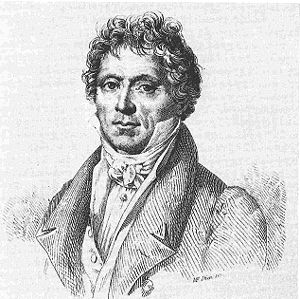
Anton Reicha

Encyclopedia
Naturalization
Naturalization is the acquisition of citizenship and nationality by somebody who was not a citizen of that country at the time of birth....
French composer
Composer
A composer is a person who creates music, either by musical notation or oral tradition, for interpretation and performance, or through direct manipulation of sonic material through electronic media...
. A contemporary and lifelong friend of Beethoven
Ludwig van Beethoven
Ludwig van Beethoven was a German composer and pianist. A crucial figure in the transition between the Classical and Romantic eras in Western art music, he remains one of the most famous and influential composers of all time.Born in Bonn, then the capital of the Electorate of Cologne and part of...
, Reicha is now best remembered for his substantial early contribution to the wind quintet
Wind quintet
A wind quintet, also sometimes known as a woodwind quintet, is a group of five wind players . The term also applies to a composition for such a group....
literature and his role as a teacher – his pupils included Franz Liszt
Franz Liszt
Franz Liszt ; ), was a 19th-century Hungarian composer, pianist, conductor, and teacher.Liszt became renowned in Europe during the nineteenth century for his virtuosic skill as a pianist. He was said by his contemporaries to have been the most technically advanced pianist of his age...
and Hector Berlioz
Hector Berlioz
Hector Berlioz was a French Romantic composer, best known for his compositions Symphonie fantastique and Grande messe des morts . Berlioz made significant contributions to the modern orchestra with his Treatise on Instrumentation. He specified huge orchestral forces for some of his works; as a...
. Reicha was also an accomplished theorist
Music theory
Music theory is the study of how music works. It examines the language and notation of music. It seeks to identify patterns and structures in composers' techniques across or within genres, styles, or historical periods...
and wrote several treatises on various aspects of composition. Some of his theoretical work dealt with experimental methods of composition, which he applied in a variety of works such as fugue
Fugue
In music, a fugue is a compositional technique in two or more voices, built on a subject that is introduced at the beginning in imitation and recurs frequently in the course of the composition....
s and étude
Étude
An étude , is an instrumental musical composition, most commonly of considerable difficulty, usually designed to provide practice material for perfecting a particular technical skill. The tradition of writing études emerged in the early 19th century with the rapidly growing popularity of the piano...
s for piano
Piano
The piano is a musical instrument played by means of a keyboard. It is one of the most popular instruments in the world. Widely used in classical and jazz music for solo performances, ensemble use, chamber music and accompaniment, the piano is also very popular as an aid to composing and rehearsal...
and string quartet
String quartet
A string quartet is a musical ensemble of four string players – usually two violin players, a violist and a cellist – or a piece written to be performed by such a group...
s.
Reicha was born in Prague
Prague
Prague is the capital and largest city of the Czech Republic. Situated in the north-west of the country on the Vltava river, the city is home to about 1.3 million people, while its metropolitan area is estimated to have a population of over 2.3 million...
into a family of a town piper. His father died when Reicha was just 10 months old, and his mother was uninterested in the boy's education. At the age of 10 the young composer ran away from home, and was subsequently raised and educated in music by his uncle Josef Reicha
Josef Reicha
Josef Reicha was a Czech cellist, composer and conductor. He was the uncle of composer and music theorist Anton Reicha....
. When the family moved to Bonn
Bonn
Bonn is the 19th largest city in Germany. Located in the Cologne/Bonn Region, about 25 kilometres south of Cologne on the river Rhine in the State of North Rhine-Westphalia, it was the capital of West Germany from 1949 to 1990 and the official seat of government of united Germany from 1990 to 1999....
, Josef secured for his nephew a place at the Hofkapelle, but for Reicha this was not enough. He studied composition secretly, against his uncle's wishes, and entered the University of Bonn
University of Bonn
The University of Bonn is a public research university located in Bonn, Germany. Founded in its present form in 1818, as the linear successor of earlier academic institutions, the University of Bonn is today one of the leading universities in Germany. The University of Bonn offers a large number...
in 1789. When Bonn was captured by the French in 1794, Reicha had to flee to Hamburg
Hamburg
-History:The first historic name for the city was, according to Claudius Ptolemy's reports, Treva.But the city takes its modern name, Hamburg, from the first permanent building on the site, a castle whose construction was ordered by the Emperor Charlemagne in AD 808...
, where he made his living by teaching harmony and composition, and studied mathematics
Mathematics
Mathematics is the study of quantity, space, structure, and change. Mathematicians seek out patterns and formulate new conjectures. Mathematicians resolve the truth or falsity of conjectures by mathematical proofs, which are arguments sufficient to convince other mathematicians of their validity...
and philosophy
Philosophy
Philosophy is the study of general and fundamental problems, such as those connected with existence, knowledge, values, reason, mind, and language. Philosophy is distinguished from other ways of addressing such problems by its critical, generally systematic approach and its reliance on rational...
. Between 1799 and 1801 he lived in Paris
Paris
Paris is the capital and largest city in France, situated on the river Seine, in northern France, at the heart of the Île-de-France region...
, trying to achieve recognition as an opera composer, without success. In 1801 he moved to Vienna
Vienna
Vienna is the capital and largest city of the Republic of Austria and one of the nine states of Austria. Vienna is Austria's primary city, with a population of about 1.723 million , and is by far the largest city in Austria, as well as its cultural, economic, and political centre...
, where he studied with Salieri
Antonio Salieri
Antonio Salieri was a Venetian classical composer, conductor and teacher born in Legnago, south of Verona, in the Republic of Venice, but who spent his adult life and career as a faithful subject of the Habsburg monarchy....
and Albrechtsberger
Johann Georg Albrechtsberger
Johann Georg Albrechtsberger was an Austrian musician who was born at Klosterneuburg, near Vienna.He originally studied music at Melk Abbey and philosophy at a Benedictine seminary in Vienna and became one of the most learned and skillful contrapuntists of his age...
and produced his first important works. His life was once again affected by war in 1808, when he had to leave Vienna. Reicha settled in Paris, where he spent the rest of his life teaching composition; in 1818 he was appointed professor at the Conservatoire
Conservatoire de Paris
The Conservatoire de Paris is a college of music and dance founded in 1795, now situated in the avenue Jean Jaurès in the 19th arrondissement of Paris, France...
.
Reicha's output during his Vienna years included large semi-didactic cycles of works such as 36 Fugues for piano
36 Fugues (Reicha)
36 Fugues, sometimes assigned opus number 36, is a cycle of fugues for piano composed by Anton Reicha. It was first published by the composer in 1803 and served as an illustration of a nouveau système Reicha invented for fugue composition...
(which explored Reicha's "new method of fugal writing"), L'art de varier
L'art de varier
L'Art de varier , Op. 57, is a set of variations for piano composed by Anton Reicha. It was composed around 1803–4 and published in Leipzig...
(a set of 57 variations on an original theme), and exercises for the treatise Practische Beispiele. During the later Paris period, however, he focused his attention mostly on theory and produced a number of treatises on composition. Works of this period include some 25 wind quintets, some of the earliest important music for wind ensembles. Ideas he advocated in his music and writings include polyrhythm
Polyrhythm
Polyrhythm is the simultaneous sounding of two or more independent rhythms.Polyrhythm in general is a nonspecific term for the simultaneous occurrence of two or more conflicting rhythms, of which cross-rhythm is a specific and definable subset.—Novotney Polyrhythms can be distinguished from...
, polytonality
Polytonality
The musical use of more than one key simultaneously is polytonality . Bitonality is the use of only two different keys at the same time...
and microtonal music
Microtonal music
Microtonal music is music using microtones—intervals of less than an equally spaced semitone. Microtonal music can also refer to music which uses intervals not found in the Western system of 12 equal intervals to the octave.-Terminology:...
; none were accepted by the composers of the time. Due to Reicha's own attitude towards publishing his music, he fell into obscurity immediately after his death; his life and work remain poorly studied.
1770–1805: Early years, first visit to Paris and the Viennese period
Reicha was born in PraguePrague
Prague is the capital and largest city of the Czech Republic. Situated in the north-west of the country on the Vltava river, the city is home to about 1.3 million people, while its metropolitan area is estimated to have a population of over 2.3 million...
. His father Šimon, the town piper of the city, died when Anton was just 10 months old. Apparently Reicha's mother was not interested in her son's education, and so in 1780 Reicha ran away from home following a sudden impulse – as is recounted in his memoirs, he jumped onto a passing carriage. Reicha went to Klatovy
Klatovy
Klatovy is a town in the Plzeň Region of the Czech Republic.Klatovy is also the seat of the Municipality with Extended Competence and Municipality with Commissioned Local Authority.- History :Klatovy was founded during 1260–1263 by Přemysl Otakar II....
to his grandfather first, and then was adopted by his uncle Josef Reicha
Josef Reicha
Josef Reicha was a Czech cellist, composer and conductor. He was the uncle of composer and music theorist Anton Reicha....
, a virtuoso cellist
Cello
The cello is a bowed string instrument with four strings tuned in perfect fifths. It is a member of the violin family of musical instruments, which also includes the violin, viola, and double bass. Old forms of the instrument in the Baroque era are baryton and viol .A person who plays a cello is...
, conductor
Conducting
Conducting is the art of directing a musical performance by way of visible gestures. The primary duties of the conductor are to unify performers, set the tempo, execute clear preparations and beats, and to listen critically and shape the sound of the ensemble...
and composer, who lived at Wallerstein
Wallerstein
Wallerstein is a surname, which can refer to:* Immanuel Wallerstein , U.S. sociologist* Jim Wallerstein , guitarist and vocalist* Michael Wallerstein , political scientist* Robert S...
, Bavaria
Bavaria
Bavaria, formally the Free State of Bavaria is a state of Germany, located in the southeast of Germany. With an area of , it is the largest state by area, forming almost 20% of the total land area of Germany...
. Josef and his wife did not have children, and apparently the young Anton had their full attention: Josef taught him violin
Violin
The violin is a string instrument, usually with four strings tuned in perfect fifths. It is the smallest, highest-pitched member of the violin family of string instruments, which includes the viola and cello....
and piano
Piano
The piano is a musical instrument played by means of a keyboard. It is one of the most popular instruments in the world. Widely used in classical and jazz music for solo performances, ensemble use, chamber music and accompaniment, the piano is also very popular as an aid to composing and rehearsal...
, his wife insisted that the boy learned French
French language
French is a Romance language spoken as a first language in France, the Romandy region in Switzerland, Wallonia and Brussels in Belgium, Monaco, the regions of Quebec and Acadia in Canada, and by various communities elsewhere. Second-language speakers of French are distributed throughout many parts...
and German
German language
German is a West Germanic language, related to and classified alongside English and Dutch. With an estimated 90 – 98 million native speakers, German is one of the world's major languages and is the most widely-spoken first language in the European Union....
, and Reicha also received instruction in flute
Flute
The flute is a musical instrument of the woodwind family. Unlike woodwind instruments with reeds, a flute is an aerophone or reedless wind instrument that produces its sound from the flow of air across an opening...
.
In 1785 the family moved to Bonn
Bonn
Bonn is the 19th largest city in Germany. Located in the Cologne/Bonn Region, about 25 kilometres south of Cologne on the river Rhine in the State of North Rhine-Westphalia, it was the capital of West Germany from 1949 to 1990 and the official seat of government of united Germany from 1990 to 1999....
, where Reicha became a member of the Hofkapelle of Max Franz
Archduke Maximilian Franz of Austria
Archduke Maximilian Francis of Austria was an Archbishop-Elector of Cologne, the last child of the Habsburg ruler Maria Theresa and her husband, Francis I, Holy Roman Emperor. His siblings included two Holy Roman Emperors , as well as Queen Marie Antoinette of France and Queen Maria Carolina of...
, Elector of Cologne, under the direction of his uncle, playing the violin
Violin
The violin is a string instrument, usually with four strings tuned in perfect fifths. It is the smallest, highest-pitched member of the violin family of string instruments, which includes the viola and cello....
and the second flute
Flute
The flute is a musical instrument of the woodwind family. Unlike woodwind instruments with reeds, a flute is an aerophone or reedless wind instrument that produces its sound from the flow of air across an opening...
. The young Beethoven
Ludwig van Beethoven
Ludwig van Beethoven was a German composer and pianist. A crucial figure in the transition between the Classical and Romantic eras in Western art music, he remains one of the most famous and influential composers of all time.Born in Bonn, then the capital of the Electorate of Cologne and part of...
became a viola
Viola
The viola is a bowed string instrument. It is the middle voice of the violin family, between the violin and the cello.- Form :The viola is similar in material and construction to the violin. A full-size viola's body is between and longer than the body of a full-size violin , with an average...
player and organist in the Hofkapelle in 1789 and Reicha befriended him; the two became lifelong friends. Christian Gottlob Neefe
Christian Gottlob Neefe
Christian Gottlob Neefe was a German opera composer and conductor.Neefe was born in Chemnitz, Saxony. He received a musical education and started to compose at the age of 12...
, who was one of the most important figures in the musical life of the city at the time, might have instructed both Reicha and Beethoven in composition, and possibly also introduced them to the works of Johann Sebastian Bach
Johann Sebastian Bach
Johann Sebastian Bach was a German composer, organist, harpsichordist, violist, and violinist whose sacred and secular works for choir, orchestra, and solo instruments drew together the strands of the Baroque period and brought it to its ultimate maturity...
, such as the Well-Tempered Clavier.
From about 1785 Reicha studied composition secretly, against his uncle's wishes, yet already by 1787 he composed and conducted his first symphony
Symphony
A symphony is an extended musical composition in Western classical music, scored almost always for orchestra. A symphony usually contains at least one movement or episode composed according to the sonata principle...
. In 1789 he entered the University of Bonn
University of Bonn
The University of Bonn is a public research university located in Bonn, Germany. Founded in its present form in 1818, as the linear successor of earlier academic institutions, the University of Bonn is today one of the leading universities in Germany. The University of Bonn offers a large number...
. Reicha was studying and worked as performer until 1794, when Bonn was attacked and captured by the French
France
The French Republic , The French Republic , The French Republic , (commonly known as France , is a unitary semi-presidential republic in Western Europe with several overseas territories and islands located on other continents and in the Indian, Pacific, and Atlantic oceans. Metropolitan France...
forces. Reicha managed to escape to Hamburg
Hamburg
-History:The first historic name for the city was, according to Claudius Ptolemy's reports, Treva.But the city takes its modern name, Hamburg, from the first permanent building on the site, a castle whose construction was ordered by the Emperor Charlemagne in AD 808...
, vowed never to perform again, and started earning his living by teaching harmony and composition, as well as the piano. He also occupied himself with composition, studied mathematics
Mathematics
Mathematics is the study of quantity, space, structure, and change. Mathematicians seek out patterns and formulate new conjectures. Mathematicians resolve the truth or falsity of conjectures by mathematical proofs, which are arguments sufficient to convince other mathematicians of their validity...
, philosophy
Philosophy
Philosophy is the study of general and fundamental problems, such as those connected with existence, knowledge, values, reason, mind, and language. Philosophy is distinguished from other ways of addressing such problems by its critical, generally systematic approach and its reliance on rational...
and, significantly, methods of teaching composition. In 1799 Reicha moved to Paris
Paris
Paris is the capital and largest city in France, situated on the river Seine, in northern France, at the heart of the Île-de-France region...
, hoping to achieve success with his operas. These hopes were dashed, however: he could neither get his old librettos accepted, nor find suitable new ones, despite support from his friends and influential members of the aristocracy. In 1801 Reicha left Paris for Vienna
Vienna
Vienna is the capital and largest city of the Republic of Austria and one of the nine states of Austria. Vienna is Austria's primary city, with a population of about 1.723 million , and is by far the largest city in Austria, as well as its cultural, economic, and political centre...
.
In Vienna he began studying with Antonio Salieri
Antonio Salieri
Antonio Salieri was a Venetian classical composer, conductor and teacher born in Legnago, south of Verona, in the Republic of Venice, but who spent his adult life and career as a faithful subject of the Habsburg monarchy....
and Johann Georg Albrechtsberger
Johann Georg Albrechtsberger
Johann Georg Albrechtsberger was an Austrian musician who was born at Klosterneuburg, near Vienna.He originally studied music at Melk Abbey and philosophy at a Benedictine seminary in Vienna and became one of the most learned and skillful contrapuntists of his age...
. Both were renowned teachers whose pupils included Schubert (Salieri) and Beethoven (both), and Albrechtsberger was also an important theorist. Reicha visited Haydn
Joseph Haydn
Franz Joseph Haydn , known as Joseph Haydn , was an Austrian composer, one of the most prolific and prominent composers of the Classical period. He is often called the "Father of the Symphony" and "Father of the String Quartet" because of his important contributions to these forms...
, whom he already met several times in Bonn and Hamburg during the 1790s, and renewed his friendship with Beethoven, whom he had not seen since 1792, when the latter moved from Bonn to Vienna. Reicha's move to Vienna marked the beginning of a more productive and successful period in the composer's life. Reicha himself reflected on this time in his memoirs: "The number of works I finished in Vienna is astonishing. Once started, my verve and imagination were indefatigable. Ideas came to me so rapidly it was often difficult to set them down without losing some of them. I always had a great penchant for doing the unusual in composition. When writing in an original vein, my creative faculties and spirit seemed keener than when following the precepts of my predecessors." In 1801 Reicha's opera L'ouragan, which failed in Paris
Paris
Paris is the capital and largest city in France, situated on the river Seine, in northern France, at the heart of the Île-de-France region...
, was performed at the palace of Prince Joseph Franz Maximilian Lobkowicz
Lobkowicz
The Lobkowicz family is one of the oldest still existing Bohemian noble families dating back to the 14th century...
, Beethoven's patron. Empress Maria Theresa commissioned another opera after this performance, Argine, regina di Granata, which was also performed (although privately). Reicha's studies in Hamburg came to fruition here with the publication of several semi-didactic, encyclopedic works such as 36 Fugues for piano
36 Fugues (Reicha)
36 Fugues, sometimes assigned opus number 36, is a cycle of fugues for piano composed by Anton Reicha. It was first published by the composer in 1803 and served as an illustration of a nouveau système Reicha invented for fugue composition...
(published in 1803, dedicated to Haydn) and L'art de varier
L'art de varier
L'Art de varier , Op. 57, is a set of variations for piano composed by Anton Reicha. It was composed around 1803–4 and published in Leipzig...
, a large-scale variation cycle (composed in 1803/04 for Prince Louis Ferdinand), and the treatise Practische Beispiele (published in 1803), which contained 24 compositions.
1806–18: Departure from Vienna and life in Paris
Reicha's life and career in Vienna were interrupted by NapoleonNapoleon I of France
Napoleon Bonaparte was a French military and political leader during the latter stages of the French Revolution.As Napoleon I, he was Emperor of the French from 1804 to 1815...
's military activities. In November 1805 the city was occupied by French
France
The French Republic , The French Republic , The French Republic , (commonly known as France , is a unitary semi-presidential republic in Western Europe with several overseas territories and islands located on other continents and in the Indian, Pacific, and Atlantic oceans. Metropolitan France...
troops. In 1806 Reicha travelled to Leipzig
Leipzig
Leipzig Leipzig has always been a trade city, situated during the time of the Holy Roman Empire at the intersection of the Via Regia and Via Imperii, two important trade routes. At one time, Leipzig was one of the major European centres of learning and culture in fields such as music and publishing...
to arrange a performance of his new work, the cantata Lenore (stopping at Prague to see his mother for the first time since 1780), but because Leipzig was blockaded by the French, not only was the performance cancelled, but Reicha could not return to Vienna for several months. When he did return, it was not for long, because by 1808 the Austrian Empire
Austrian Empire
The Austrian Empire was a modern era successor empire, which was centered on what is today's Austria and which officially lasted from 1804 to 1867. It was followed by the Empire of Austria-Hungary, whose proclamation was a diplomatic move that elevated Hungary's status within the Austrian Empire...
was already preparing for another war, the War of the Fifth Coalition
War of the Fifth Coalition
The War of the Fifth Coalition, fought in the year 1809, pitted a coalition of the Austrian Empire and the United Kingdom against Napoleon's French Empire and Bavaria. Major engagements between France and Austria, the main participants, unfolded over much of Central Europe from April to July, with...
, so Reicha decided to move, once again, to Paris. This time three of Reicha's many operas were produced, and all failed to attract attention; nevertheless, his fame as theorist and teacher increased steadily, and by 1817 most of his pupils became professors at the Conservatoire de Paris
Conservatoire de Paris
The Conservatoire de Paris is a college of music and dance founded in 1795, now situated in the avenue Jean Jaurès in the 19th arrondissement of Paris, France...
. Reicha himself was appointed professor of counterpoint
Counterpoint
In music, counterpoint is the relationship between two or more voices that are independent in contour and rhythm and are harmonically interdependent . It has been most commonly identified in classical music, developing strongly during the Renaissance and in much of the common practice period,...
and fugue
Fugue
In music, a fugue is a compositional technique in two or more voices, built on a subject that is introduced at the beginning in imitation and recurs frequently in the course of the composition....
at the Conservatoire in 1818.
Melody
A melody , also tune, voice, or line, is a linear succession of musical tones which is perceived as a single entity...
, was also widely studied. Another semi-didactic work, 34 Études for piano, was published by 1817. It was also in Paris that Reicha started composing wind quintet
Wind quintet
A wind quintet, also sometimes known as a woodwind quintet, is a group of five wind players . The term also applies to a composition for such a group....
s, which proved to be his most enduring works (but which were far removed from the experimental writing of the Vienna period fugues). Reicha's personal life also improved: he got married in 1818 to Virginie Enaust. The couple had two daughters.
Reicha stayed in Paris for the rest of his life. During the last decade of his life, Reicha was fully accepted in France
France
The French Republic , The French Republic , The French Republic , (commonly known as France , is a unitary semi-presidential republic in Western Europe with several overseas territories and islands located on other continents and in the Indian, Pacific, and Atlantic oceans. Metropolitan France...
: he became a naturalized citizen in 1829, then a Chevalier of the Légion d'honneur
Légion d'honneur
The Legion of Honour, or in full the National Order of the Legion of Honour is a French order established by Napoleon Bonaparte, First Consul of the Consulat which succeeded to the First Republic, on 19 May 1802...
in 1835, and also in 1835 he succeeded François-Adrien Boieldieu
François-Adrien Boïeldieu
François-Adrien Boieldieu was a French composer, mainly of operas, often called "the French Mozart".-Biography:...
at the Académie française
Académie française
L'Académie française , also called the French Academy, is the pre-eminent French learned body on matters pertaining to the French language. The Académie was officially established in 1635 by Cardinal Richelieu, the chief minister to King Louis XIII. Suppressed in 1793 during the French Revolution,...
. He published two more large treatises: Traité de haute composition musicale (1824–6), which dealt with composition, and Art du compositeur dramatique (1833) on writing opera. Reicha's ideas expressed in the former work sparked some controversy at the Conservatoire. In 1826 Franz Liszt
Franz Liszt
Franz Liszt ; ), was a 19th-century Hungarian composer, pianist, conductor, and teacher.Liszt became renowned in Europe during the nineteenth century for his virtuosic skill as a pianist. He was said by his contemporaries to have been the most technically advanced pianist of his age...
, Hector Berlioz
Hector Berlioz
Hector Berlioz was a French Romantic composer, best known for his compositions Symphonie fantastique and Grande messe des morts . Berlioz made significant contributions to the modern orchestra with his Treatise on Instrumentation. He specified huge orchestral forces for some of his works; as a...
, and Henri Cohen
Henri Cohen (composer)
Henri Cohen was a French music theorist and composer of Dutch birth. Born in Amsterdam, Cohen moved with his family to Paris at a young age. He studied in Paris with Anton Reicha , François Lays , and Felice Pellegrini...
became Reicha's students, Charles Gounod
Charles Gounod
Charles-François Gounod was a French composer, known for his Ave Maria as well as his operas Faust and Roméo et Juliette.-Biography:...
followed some time later. Frédéric Chopin
Frédéric Chopin
Frédéric François Chopin was a Polish composer and virtuoso pianist. He is considered one of the great masters of Romantic music and has been called "the poet of the piano"....
considered studying with him in 1829, but decided not to. In June 1835 César Franck
César Franck
César-Auguste-Jean-Guillaume-Hubert Franck was a composer, pianist, organist, and music teacher who worked in Paris during his adult life....
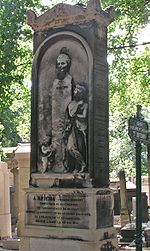
started studying with him, although only did so for 10 months, until Reicha died in May 1836. He was buried at the Père Lachaise Cemetery
Père Lachaise Cemetery
Père Lachaise Cemetery is the largest cemetery in the city of Paris, France , though there are larger cemeteries in the city's suburbs.Père Lachaise is in the 20th arrondissement, and is reputed to be the world's most-visited cemetery, attracting hundreds of thousands of visitors annually to the...
.
Works
It is difficult to present a coherent list of Reicha's works, because the opus numbers assigned to them at the time of publication are in disarray, some pieces were supposedly lost, and many works were published several times, sometimes as part of larger collections. Reicha's surviving oeuvre covers a vast array of genres and forms, from operaOpera
Opera is an art form in which singers and musicians perform a dramatic work combining text and musical score, usually in a theatrical setting. Opera incorporates many of the elements of spoken theatre, such as acting, scenery, and costumes and sometimes includes dance...
to piano
Piano
The piano is a musical instrument played by means of a keyboard. It is one of the most popular instruments in the world. Widely used in classical and jazz music for solo performances, ensemble use, chamber music and accompaniment, the piano is also very popular as an aid to composing and rehearsal...
fugue
Fugue
In music, a fugue is a compositional technique in two or more voices, built on a subject that is introduced at the beginning in imitation and recurs frequently in the course of the composition....
s. He is best known today for his wind quintet
Wind quintet
A wind quintet, also sometimes known as a woodwind quintet, is a group of five wind players . The term also applies to a composition for such a group....
s – 25 works composed in Paris
Paris
Paris is the capital and largest city in France, situated on the river Seine, in northern France, at the heart of the Île-de-France region...
between 1811 and 1820, which were played all over Europe. Reicha claimed in his memoirs that his wind quintets filled a void: "At that time, there was a dearth not only of good classic music, but of any good music at all for wind instrument
Wind instrument
A wind instrument is a musical instrument that contains some type of resonator , in which a column of air is set into vibration by the player blowing into a mouthpiece set at the end of the resonator. The pitch of the vibration is determined by the length of the tube and by manual modifications of...
s, simply because the composers knew little of their technique.". Indeed, Reicha's experiences as a flautist
Flautist
A flautist or flutist is a musician who plays an instrument in the flute family. See List of flautists.The choice of "flautist" versus "flutist" is the source of dispute among players of the instrument...
must have helped in the creation of these pieces, in which he systematically explored the possibilities of the wind ensemble and invented an extended sonata form
Sonata form
Sonata form is a large-scale musical structure used widely since the middle of the 18th century . While it is typically used in the first movement of multi-movement pieces, it is sometimes used in subsequent movements as well—particularly the final movement...
that could accommodate as many as five principal themes.
The wind quintets represent a more conservative trend in Reicha's oeuvre, however, especially when compared to his earlier work, namely the compositions of the Viennese
Vienna
Vienna is the capital and largest city of the Republic of Austria and one of the nine states of Austria. Vienna is Austria's primary city, with a population of about 1.723 million , and is by far the largest city in Austria, as well as its cultural, economic, and political centre...
period. Technical wizardry prevails in compositions that illustrate Reicha's theoretical treatise Practische Beispiele of 1803, where techniques such as bitonality and polyrhythm
Polyrhythm
Polyrhythm is the simultaneous sounding of two or more independent rhythms.Polyrhythm in general is a nonspecific term for the simultaneous occurrence of two or more conflicting rhythms, of which cross-rhythm is a specific and definable subset.—Novotney Polyrhythms can be distinguished from...
are explored in extremely difficult sight reading
Sight reading
Sight-reading is the reading and performing of a piece of written music, specifically when the performer has not seen it before. Sight-singing is often used to describe a singer who is sight-reading.-Sight-reading:...
exercises. 36 fugues for piano
36 Fugues (Reicha)
36 Fugues, sometimes assigned opus number 36, is a cycle of fugues for piano composed by Anton Reicha. It was first published by the composer in 1803 and served as an illustration of a nouveau système Reicha invented for fugue composition...
, published in 1803, was conceived as an illustration of Reicha's neue Fugensystem, a new system for composing fugues
Fugues
Fugue can refer to:* Fugue for the type of musical piece* See :Category:Fugues for individual pieces.* Fugues for the Canadian gay magazine* Fugue for the American literary journal.* Fugue state, a psychological term...
. Reicha suggested fugal answers could be placed on any scale degree
Degree (music)
In music theory, a scale degree or scale step is the name of a particular note of a scale in relation to the tonic...
(rather than the standard dominant
Dominant (music)
In music, the dominant is the fifth scale degree of the diatonic scale, called "dominant" because it is next in importance to the tonic,and a dominant chord is any chord built upon that pitch, using the notes of the same diatonic scale...
) to widen the possibilities for modulation
Modulation (music)
In music, modulation is most commonly the act or process of changing from one key to another. This may or may not be accompanied by a change in key signature. Modulations articulate or create the structure or form of many pieces, as well as add interest...
and undermine the tonal
Tonality
Tonality is a system of music in which specific hierarchical pitch relationships are based on a key "center", or tonic. The term tonalité originated with Alexandre-Étienne Choron and was borrowed by François-Joseph Fétis in 1840...
stability of the fugue. The fugues of the collection not only illustrate this point, but also employ a variety of extremely convoluted technical tricks, such as polyrhythm (no. 30), combined (nos. 24, 28), asymmetrical (no. 20) and simply uncommon (no. 10 is in 12/4, no. 12 in 2/8) metre
Meter (music)
Meter or metre is a term that music has inherited from the rhythmic element of poetry where it means the number of lines in a verse, the number of syllables in each line and the arrangement of those syllables as long or short, accented or unaccented...
s and time signature
Time signature
The time signature is a notational convention used in Western musical notation to specify how many beats are in each measure and which note value constitutes one beat....
s, some of which are derived from folk music, an approach that directly anticipates that of later composers such as Béla Bartók
Béla Bartók
Béla Viktor János Bartók was a Hungarian composer and pianist. He is considered one of the most important composers of the 20th century and is regarded, along with Liszt, as Hungary's greatest composer...
. Number 13 is a modal
Musical mode
In the theory of Western music since the ninth century, mode generally refers to a type of scale. This usage, still the most common in recent years, reflects a tradition dating to the middle ages, itself inspired by the theory of ancient Greek music.The word encompasses several additional...
fugue played on white keys only, in which cadence
Cadence (music)
In Western musical theory, a cadence is, "a melodic or harmonic configuration that creates a sense of repose or resolution [finality or pause]." A harmonic cadence is a progression of two chords that concludes a phrase, section, or piece of music...
s are possible on all but the 7th degree of the scale without further alteration. Six fugues employ two subjects, one has three, and number 15 employs six subjects. In several fugues Reicha establishes a link with the old tradition by using subjects by Haydn
Joseph Haydn
Franz Joseph Haydn , known as Joseph Haydn , was an Austrian composer, one of the most prolific and prominent composers of the Classical period. He is often called the "Father of the Symphony" and "Father of the String Quartet" because of his important contributions to these forms...
(no. 3), Bach
Johann Sebastian Bach
Johann Sebastian Bach was a German composer, organist, harpsichordist, violist, and violinist whose sacred and secular works for choir, orchestra, and solo instruments drew together the strands of the Baroque period and brought it to its ultimate maturity...
(no. 5), Mozart
Wolfgang Amadeus Mozart
Wolfgang Amadeus Mozart , baptismal name Johannes Chrysostomus Wolfgangus Theophilus Mozart , was a prolific and influential composer of the Classical era. He composed over 600 works, many acknowledged as pinnacles of symphonic, concertante, chamber, piano, operatic, and choral music...
(no. 7), Scarlatti
Domenico Scarlatti
Giuseppe Domenico Scarlatti was an Italian composer who spent much of his life in the service of the Portuguese and Spanish royal families. He is classified as a Baroque composer chronologically, although his music was influential in the development of the Classical style...
(no. 9), Frescobaldi
Girolamo Frescobaldi
Girolamo Frescobaldi was a musician from Ferrara, one of the most important composers of keyboard music in the late Renaissance and early Baroque periods. A child prodigy, Frescobaldi studied under Luzzasco Luzzaschi in Ferrara, but was influenced by a large number of composers, including Ascanio...
(no. 14) and Handel
George Frideric Handel
George Frideric Handel was a German-British Baroque composer, famous for his operas, oratorios, anthems and organ concertos. Handel was born in 1685, in a family indifferent to music...
(no. 15). Many of the technical accomplishments are unique to fugue literature.
The étude
Étude
An étude , is an instrumental musical composition, most commonly of considerable difficulty, usually designed to provide practice material for perfecting a particular technical skill. The tradition of writing études emerged in the early 19th century with the rapidly growing popularity of the piano...
s of op. 97, Études dans le genre fugué, published in Paris by 1817, are similarly advanced. Each composition is preceded by Reicha's comments for young composers who choose to study the work. Thirty of thirty-four études included are fugues, and every étude is preceded by a prelude dedicated to a particular technique or compositional problem. Again an exceptionally large number of forms and textures is used, including, for example, the variation form with extensive use of invertible counterpoint (no. 3), or an Andante in C minor based on the famous Folia
Folia
La Folia is one of the oldest remembered European musical themes, or primary material, generally melodic, of a composition, on record. The theme exists in two versions, referred to as early and late folias, the earlier being faster.-History:The epithet 'Folia' has several meanings in music...
harmonic progression. Reicha's massive cycle of variations, L'art de varier
L'art de varier
L'Art de varier , Op. 57, is a set of variations for piano composed by Anton Reicha. It was composed around 1803–4 and published in Leipzig...
, uses the same pedagogical principle and includes variations in the form of four-voice fugues, program music
Program music
Program music or programme music is a type of art music that attempts to musically render an extra-musical narrative. The narrative itself might be offered to the audience in the form of program notes, inviting imaginative correlations with the music...
variations, toccata
Toccata
Toccata is a virtuoso piece of music typically for a keyboard or plucked string instrument featuring fast-moving, lightly fingered or otherwise virtuosic passages or sections, with or without imitative or fugal interludes, generally emphasizing the dexterity of the performer's fingers...
-like hand-crossing variations, etc., foreshadowing in many aspects not only Beethoven
Ludwig van Beethoven
Ludwig van Beethoven was a German composer and pianist. A crucial figure in the transition between the Classical and Romantic eras in Western art music, he remains one of the most famous and influential composers of all time.Born in Bonn, then the capital of the Electorate of Cologne and part of...
's Diabelli Variations
Diabelli Variations
The 33 Variations on a waltz by Anton Diabelli, Op. 120, commonly known as the Diabelli Variations, is a set of variations for the piano written between 1819 and 1823 by Ludwig van Beethoven on a waltz composed by Anton Diabelli...
, but also works by Schubert, Wagner and Debussy.
Many of Reicha's string quartet
String quartet
A string quartet is a musical ensemble of four string players – usually two violin players, a violist and a cellist – or a piece written to be performed by such a group...
s are similarly searching, and too foreshadow numerous later developments. The eight Vienna string quartets (1801–5) are amongst his most important works. Though largely ignored since Reicha's death, they were highly influential during his lifetime, and left their mark on the quartets of Beethoven and Schubert, much like Bach
Johann Sebastian Bach
Johann Sebastian Bach was a German composer, organist, harpsichordist, violist, and violinist whose sacred and secular works for choir, orchestra, and solo instruments drew together the strands of the Baroque period and brought it to its ultimate maturity...
's Well-Tempered Clavier was ignored by the public but well-known to Beethoven and Chopin. Reicha also wrote prolifically for various kinds of ensembles other than wind quintets and string quartets: there are violin sonata
Violin sonata
A violin sonata is a musical composition for violin, which is nearly always accompanied by a piano or other keyboard instrument, or by figured bass in the Baroque period.-A:*Ella Adayevskaya**Sonata Greca for Violin or Clarinet and Piano...
s, piano trio
Piano trio
A piano trio is a group of piano and two other instruments, usually a violin and a cello, or a piece of music written for such a group. It is one of the most common forms found in classical chamber music...
s, horn
Horn (instrument)
The horn is a brass instrument consisting of about of tubing wrapped into a coil with a flared bell. A musician who plays the horn is called a horn player ....
trios, various works for wind or string instrument accompanied by strings, works for voice, etc. He also wrote much large-scale music – at least eight symphonies
Symphony
A symphony is an extended musical composition in Western classical music, scored almost always for orchestra. A symphony usually contains at least one movement or episode composed according to the sonata principle...
are known, seven opera
Opera
Opera is an art form in which singers and musicians perform a dramatic work combining text and musical score, usually in a theatrical setting. Opera incorporates many of the elements of spoken theatre, such as acting, scenery, and costumes and sometimes includes dance...
s, choral works including a Requiem
Requiem
A Requiem or Requiem Mass, also known as Mass for the dead or Mass of the dead , is a Mass celebrated for the repose of the soul or souls of one or more deceased persons, using a particular form of the Roman Missal...
, and many more.
Much of Reicha's music remained unpublished and/or unperformed during the composer's life, and virtually all of his work fell into obscurity after his death. This is partly explained by Reicha's own decisions which he reflects on in his autobiography: "Many of my works have never been heard because of my aversion to seeking performances [...] I counted the time spent in such efforts as lost, and preferred to remain at my desk." It must also be noted that Reicha frequently advocated ideas, such as the use of quarter tone
Quarter tone
A quarter tone , is a pitch halfway between the usual notes of a chromatic scale, an interval about half as wide as a semitone, which is half a whole tone....
s, that were too far ahead of his time to be understood by his contemporaries.
Writings
Reicha's major theoretical and pedagogical works included the following:- Practische Beispiele: ein Beitrag zur Geistescultur des Tonsetzers ... begleitet mit philosophisch-practischen Anmerkungen (1803), a didactic work that includes 25 sight-reading exercises of extreme difficulty, some of which were later published separately or in collections such as the 36 fugues36 Fugues (Reicha)36 Fugues, sometimes assigned opus number 36, is a cycle of fugues for piano composed by Anton Reicha. It was first published by the composer in 1803 and served as an illustration of a nouveau système Reicha invented for fugue composition...
. The exercises are divided into three groups: one for polyrhythm, one for polytonality and one that included exercises written on four staveStaff (music)In standard Western musical notation, the staff, or stave, is a set of five horizontal lines and four spaces that each represent a different musical pitch—or, in the case of a percussion staff, different percussion instruments. Appropriate music symbols, depending upon the intended effect,...
s and so required knowledge of the alto and tenor clefClefA clef is a musical symbol used to indicate the pitch of written notes. Placed on one of the lines at the beginning of the staff, it indicates the name and pitch of the notes on that line. This line serves as a reference point by which the names of the notes on any other line or space of the staff...
s. - (Paris, 1814), on melody, translated into German by CzernyCarl CzernyCarl Czerny was an Austrian pianist, composer and teacher. He is best remembered today for his books of études for the piano. Czerny's music was profoundly influenced by his teachers, Muzio Clementi, Johann Nepomuk Hummel, Antonio Salieri and Ludwig van Beethoven.-Early life:Carl Czerny was born...
- (1818), on composition, translated into German by Czerny
- (2 vols. 1824–1826), translated into German by Czerny around 1835. In this late treatise Reicha expressed some of his most daring ideas, such as the use of quarter toneQuarter toneA quarter tone , is a pitch halfway between the usual notes of a chromatic scale, an interval about half as wide as a semitone, which is half a whole tone....
s and folk music (which was almost completely neglected at the time). - (4 vols., 1833), on the writing of opera. Provides an exhaustive account of contemporary performance techniques and is supplemented with examples from Reicha's own operas.
In addition to these, a number of smaller texts by him exist. These include an outline of Reicha's system for writing fugues, Über das neue Fugensystem (published as a foreword to the 1805 edition of 36 fugues), Sur la musique comme art purement sentimental (before 1814, literally "On music as a purely emotional art"), Petit traité d’harmonie pratique à 2 parties (c. 1814, a short "practical treatise" on harmony), a number of articles and the poem An Joseph Haydn, published in the preface to 36 fugues (which were dedicated to Haydn).
Notable recordings
- Complete Wind Quintets (1990). The Albert Schweitzer Quintet. 10 CDs, CPO 999 022-2 to 999 031-2
- Awarded the Deutscher Schallplattenpreis prize. Also includes Andante arioso, Andante and Adagio for wind ensemble.
- 36 Fugues Op. 36 (1991–92). Tiny Wirtz (piano). 2 CDs, CPO 999 065-2
- 36 Fugues (2006). Jaroslav Tůma (fortepiano Anton WalterAnton WalterAnton Walter was a builder of pianos. The Grove Dictionary of Music and Musicians describes him as "the most famous Viennese piano maker of his time".-Life:...
, 1790). 2 CDs, ARTA F101462, see http://www.arta.cz/index.php?p=f10146en
General reference
- Essay on Anton Reicha by Charles-David Lehrer for the International Double Reed Society
- Bill McGlaughlin's article on Reicha for Saint Paul Sunday
- Beethoven's Contemporaries: Anton Reicha
- Letters written by or concerning Reicha and portraits of him in the Digital archives of the Beethoven-HausBeethoven HouseDetailsThe Beethoven House in Bonn, Germany, is a memorial site, museum and cultural institution serving various purposes. Founded in 1889 by the Beethoven-Haus association it studies the life and work of composer Ludwig van Beethoven.The centrepiece of the Beethoven-Haus is Beethoven's birthplace...
, Bonn. Klassiekemuziek: Anton Reicha