


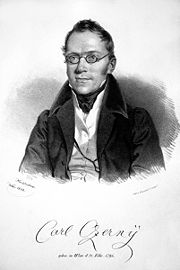
Carl Czerny

Encyclopedia
Austria
Austria , officially the Republic of Austria , is a landlocked country of roughly 8.4 million people in Central Europe. It is bordered by the Czech Republic and Germany to the north, Slovakia and Hungary to the east, Slovenia and Italy to the south, and Switzerland and Liechtenstein to the...
n pianist, composer and teacher. He is best remembered today for his books of étude
Étude
An étude , is an instrumental musical composition, most commonly of considerable difficulty, usually designed to provide practice material for perfecting a particular technical skill. The tradition of writing études emerged in the early 19th century with the rapidly growing popularity of the piano...
s for the piano. Czerny's music was profoundly influenced by his teachers, Muzio Clementi
Muzio Clementi
Muzio Clementi was a celebrated composer, pianist, pedagogue, conductor, music publisher, editor, and piano manufacturer. Born in Italy, he spent most of his life in England. He is best known for his piano sonatas, and his collection of piano studies, Gradus ad Parnassum...
, Johann Nepomuk Hummel
Johann Nepomuk Hummel
Johann Nepomuk Hummel or Jan Nepomuk Hummel was an Austrian composer and virtuoso pianist. His music reflects the transition from the Classical to the Romantic musical era.- Life :...
, Antonio Salieri
Antonio Salieri
Antonio Salieri was a Venetian classical composer, conductor and teacher born in Legnago, south of Verona, in the Republic of Venice, but who spent his adult life and career as a faithful subject of the Habsburg monarchy....
and Ludwig van Beethoven
Ludwig van Beethoven
Ludwig van Beethoven was a German composer and pianist. A crucial figure in the transition between the Classical and Romantic eras in Western art music, he remains one of the most famous and influential composers of all time.Born in Bonn, then the capital of the Electorate of Cologne and part of...
.
Early life
Carl Czerny was born in ViennaVienna
Vienna is the capital and largest city of the Republic of Austria and one of the nine states of Austria. Vienna is Austria's primary city, with a population of about 1.723 million , and is by far the largest city in Austria, as well as its cultural, economic, and political centre...
to a musical family of Czech origin. His grandfather was a violinist and his father was an oboist, organist, and pianist. His family came to Vienna from Nymburk
Nymburk
Nymburk is a city in the Central Bohemian Region of the Czech Republic, located 45 km east of Prague on the Elbe River. It is also home to the Czech men's basketball team ČEZ Basketball Nymburk...
, Bohemia
Bohemia
Bohemia is a historical region in central Europe, occupying the western two-thirds of the traditional Czech Lands. It is located in the contemporary Czech Republic with its capital in Prague...
and Carl himself did not speak German until the age of ten. A child prodigy, Czerny began playing piano at age three and composing at age seven. His first piano teacher was his father, Wenzel Czerny, who taught him mainly Bach
Johann Sebastian Bach
Johann Sebastian Bach was a German composer, organist, harpsichordist, violist, and violinist whose sacred and secular works for choir, orchestra, and solo instruments drew together the strands of the Baroque period and brought it to its ultimate maturity...
, Mozart
Wolfgang Amadeus Mozart
Wolfgang Amadeus Mozart , baptismal name Johannes Chrysostomus Wolfgangus Theophilus Mozart , was a prolific and influential composer of the Classical era. He composed over 600 works, many acknowledged as pinnacles of symphonic, concertante, chamber, piano, operatic, and choral music...
, and Clementi
Muzio Clementi
Muzio Clementi was a celebrated composer, pianist, pedagogue, conductor, music publisher, editor, and piano manufacturer. Born in Italy, he spent most of his life in England. He is best known for his piano sonatas, and his collection of piano studies, Gradus ad Parnassum...
. Czerny began performing piano recitals in his parents' home. Beethoven
Ludwig van Beethoven
Ludwig van Beethoven was a German composer and pianist. A crucial figure in the transition between the Classical and Romantic eras in Western art music, he remains one of the most famous and influential composers of all time.Born in Bonn, then the capital of the Electorate of Cologne and part of...
, attending one such recital, was so impressed with Czerny's performance of his Pathétique Sonata
Piano Sonata No. 8 (Beethoven)
Ludwig van Beethoven's Piano Sonata No. 8 in C minor, Op. 13, commonly known as Sonata Pathétique, was written in 1798 when the composer was 27 years old, and was published in 1799. Beethoven dedicated the work to his friend Prince Karl von Lichnowsky...
that he took on the 10 year old as a student. Czerny remained under Beethoven's tutelage for the next three years. Czerny went on to take lessons from Johann Nepomuk Hummel
Johann Nepomuk Hummel
Johann Nepomuk Hummel or Jan Nepomuk Hummel was an Austrian composer and virtuoso pianist. His music reflects the transition from the Classical to the Romantic musical era.- Life :...
and Antonio Salieri
Antonio Salieri
Antonio Salieri was a Venetian classical composer, conductor and teacher born in Legnago, south of Verona, in the Republic of Venice, but who spent his adult life and career as a faithful subject of the Habsburg monarchy....
. Czerny also attended courses which Muzio Clementi held in Paris, Vienna, St. Petersburg, Berlin, Prague, Rome and Milan.
Czerny made his first public performance in 1800 playing Mozart's Piano Concerto No. 24 in C minor
Piano Concerto No. 24 (Mozart)
The Piano Concerto No. 24 in C minor, K. 491 is a concertante work for piano, or pianoforte, and orchestra by Wolfgang Amadeus Mozart. Mozart composed the concerto in the winter of 1785–1786 and completed the work on 24 March 1786...
. However, he was never confident in his abilities as a performer and resolved to withdraw permanently from the stage. At age 21, in February 1812, he returned to the public to give the Vienna premiere of Beethoven's Piano Concerto No. 5, "Emperor"
Piano Concerto No. 5 (Beethoven)
The Piano Concerto No. 5 in E-flat major, Op. 73, by Ludwig van Beethoven, popularly known as the Emperor Concerto, was his last piano concerto. It was written between 1809 and 1811 in Vienna, and was dedicated to Archduke Rudolf, Beethoven's patron and pupil...
.
Teaching
At age fifteen, Czerny began a very successful teaching career. Basing his method on the teaching of Beethoven and Clementi, Czerny taught up to twelve lessons a day in the homes of Viennese nobility. His notable students included Sigismond ThalbergSigismond Thalberg
Sigismond Thalberg was a composer and one of the most distinguished virtuoso pianists of the 19th century.- Descent and family background :...
, Stephen Heller
Stephen Heller
----Stephen Heller was a Hungarian composer and pianist whose career spanned the period from Schumann to Bizet, and was an influence for later Romantic composers.-Biography:...
, Alfred Jaëll
Alfred Jaëll
Alfred Jaëll was an austrian-ungarick pianist.He was born in Trieste. He studied under Carl Czernyand began his public career at the age of 11, appearing at the Teatro San Benedetto, Venice, in 1843. The following year he studied with Ignaz Moscheles in Vienna. In 1845 and 1846 he lived in...
, Theodor Leschetizky, Theodor Kullak
Theodor Kullak
Theodor Kullak was a German pianist, composer, and teacher.-Background:Kullak was born in Krotoschin in the Grand Duchy of Posen, in Wielkopolska - western part of Poland taken during the second partition of Poland by Kingdom of Prussia. He began his piano studies as a pupil of Albrecht Agthe in...
, Theodor Döhler
Theodor Döhler
Theodor Döhler was a German composer and a notable piano virtuoso of the Romantic period. He studied under Julius Benedict, Carl Czerny, and Simon Sechter. -Childhood and education:...
, and Anna Caroline Oury
Anna Caroline Oury
Anna Caroline Oury was a German pianist and composer of French ancestry. Anna Caroline de Belleville-Oury was born in Landshut, Bavaria, Germany. She was the daughter of a French aristocrat who was the director of the national Court Opera in Mannheim...
. Czerny's fees were so steep that some students, such as Stephen Heller, were unable to afford it and had to switch teachers.
His most famous student was Franz Liszt
Franz Liszt
Franz Liszt ; ), was a 19th-century Hungarian composer, pianist, conductor, and teacher.Liszt became renowned in Europe during the nineteenth century for his virtuosic skill as a pianist. He was said by his contemporaries to have been the most technically advanced pianist of his age...
, who began studying with Czerny at age nine. Czerny was Liszt's only teacher. Upon taking him on as a student, Czerny forced Liszt to abandon all repertoire for the first few months, insisting he play only scales and exercises to strengthen his technique.
As a concert pianist, Liszt went on to include several Czerny compositions in his repertoire. Liszt also dedicated his twelve Transcendental Etudes
Transcendental Etudes
The Transcendental Etudes , S.139, are a series of twelve compositions for solo piano by Franz Liszt. They were published in 1852 as a revision of a more technically difficult 1837 series, which in turn were the elaboration of a set of studies written in 1826:...
to Czerny, who was among the first composers to pioneer the "etude
Étude
An étude , is an instrumental musical composition, most commonly of considerable difficulty, usually designed to provide practice material for perfecting a particular technical skill. The tradition of writing études emerged in the early 19th century with the rapidly growing popularity of the piano...
" form. Liszt also collaborated with Czerny on the Hexaméron
Hexameron (musical composition)
Hexaméron, Morceau de concert, S.392, is a collaborative work for solo piano, consisting of six variations on a theme, along with an introduction, connecting interludes and a finale. The theme is the "March of the Puritans" from Vincenzo Bellini's opera I puritani...
; a joint work along with fellow composers Frédéric Chopin
Frédéric Chopin
Frédéric François Chopin was a Polish composer and virtuoso pianist. He is considered one of the great masters of Romantic music and has been called "the poet of the piano"....
, Sigismond Thalberg
Sigismond Thalberg
Sigismond Thalberg was a composer and one of the most distinguished virtuoso pianists of the 19th century.- Descent and family background :...
, Henri Herz
Henri Herz
Henri Herz was a pianist and composer, Austrian by birth, and French by domicile.Herz was born Heinrich Herz in Vienna...
, and Johann Peter Pixis
Johann Peter Pixis
Johann Peter Pixis was a German pianist and composer born in Mannheim, Germany.He lived in Paris between 1825 and 1845, where he worked as a concert pianist...
.
Composition
Czerny composed a very large number of pieces (up to Op.Opus number
An Opus number , pl. opera and opuses, abbreviated, sing. Op. and pl. Opp. refers to a number generally assigned by composers to an individual composition or set of compositions on publication, to help identify their works...
861), including a number of masses
Mass (music)
The Mass, a form of sacred musical composition, is a choral composition that sets the invariable portions of the Eucharistic liturgy to music...
and requiem
Requiem
A Requiem or Requiem Mass, also known as Mass for the dead or Mass of the dead , is a Mass celebrated for the repose of the soul or souls of one or more deceased persons, using a particular form of the Roman Missal...
s, and a large number of symphonies
Symphony
A symphony is an extended musical composition in Western classical music, scored almost always for orchestra. A symphony usually contains at least one movement or episode composed according to the sonata principle...
, concertos, sonatas and string quartet
String quartet
A string quartet is a musical ensemble of four string players – usually two violin players, a violist and a cellist – or a piece written to be performed by such a group...
s. Few of these pieces are played today. The enduring part of Czerny's repertoire is the large number of didactic piano pieces he wrote, such as The School of Velocity and The Art of Finger Dexterity. He was one of the first composers to use étude
Étude
An étude , is an instrumental musical composition, most commonly of considerable difficulty, usually designed to provide practice material for perfecting a particular technical skill. The tradition of writing études emerged in the early 19th century with the rapidly growing popularity of the piano...
("study") for a title.
Czerny's body of works also include arrangements for eight pianos, four hands each, of two overtures of Gioachino Rossini. He also left an essay on performing the piano sonatas of Beethoven. He published an autobiographical sketch, "Erinnerungen aus meinem Leben" (1842; "Memories from My Life").
On a minor note, Czerny was one of 50 composers who wrote a Variation
Variation (music)
In music, variation is a formal technique where material is repeated in an altered form. The changes may involve harmony, melody, counterpoint, rhythm, timbre, orchestration or any combination of these.-Variation form:...
on a theme of Anton Diabelli
Anton Diabelli
Anton Diabelli was an Austrian music publisher, editor and composer of Italian descent. Best known in his time as a publisher, he is most familiar today as the composer of the waltz on which Ludwig van Beethoven wrote his set of thirty-three Diabelli Variations.-Early life:Diabelli was born in...
for Part II of the Vaterländischer Künstlerverein
Vaterländischer Künstlerverein
Vaterländischer Künstlerverein was a collaborative musical publication or anthology, incorporating 83 variations for piano on a theme by Anton Diabelli, written by 51 composers living in or associated with Austria. It was published in two parts in 1823 and 1824, by firms headed by Diabelli. It...
(published 1824). He also wrote a coda
Coda (music)
Coda is a term used in music in a number of different senses, primarily to designate a passage that brings a piece to an end. Technically, it is an expanded cadence...
to round out the collection. Part I was devoted to the 33 variations supplied by Beethoven
Ludwig van Beethoven
Ludwig van Beethoven was a German composer and pianist. A crucial figure in the transition between the Classical and Romantic eras in Western art music, he remains one of the most famous and influential composers of all time.Born in Bonn, then the capital of the Electorate of Cologne and part of...
, which have gained an independent identity as his Diabelli Variations
Diabelli Variations
The 33 Variations on a waltz by Anton Diabelli, Op. 120, commonly known as the Diabelli Variations, is a set of variations for the piano written between 1819 and 1823 by Ludwig van Beethoven on a waltz composed by Anton Diabelli...
, Op. 120. Czerny maintained a relationship with Beethoven throughout his life, giving piano lessons to Beethoven's beloved nephew Carl, and proofreading many of Beethoven's works before they were published.
Death
Czerny remained in Vienna for most of his life, only leaving three times (he visited Leipzig in 1836, Paris and London in 1837, and Lombardy in 1846). He died in Vienna at the age of 66. He never married and he had no near relatives. Shortly before his death, he disposed of his considerable fortune with the help of his friend and lawyer Leopold von Sonnleithner.Recordings
Signum Records recently issued at least three CD recordings of Czerny's symphonies and concerti, including a concerto for piano four hands in C major. In fact, the view of Czerny as primarily a composer of didactic works is being challenged, as can be seen in the review cited below of a Sony Classical CD of some of Czerny's four-hand works. Nimbus Records is in course of issuing recordings of all 11 of Czerny's solo piano sonatas, played by Martin Jones. His Symphony No. 1 ('Grand Symphony') was even issued on a CD supplement to an issue of BBC Music MagazineBBC music magazine
BBC Music Magazine is a magazine published monthly in the United Kingdom by BBC Worldwide, the commercial subsidiary of the BBC. Reflecting the broadcast output of BBC Radio 3, the magazine is devoted primarily to classical music, though with sections on jazz and world music. Each edition comes...
.
Media
External links
Carl Czerny: Piano Music for four hands. One of the Italian-language reviews on the page refers to "this most beautiful selection of works", quite a departure from the School of Velocity studies that have tormented piano students for almost 200 years.- Carl Czerny Music Festival and International Symposium 13–26 June 2002, Edmonton, Alberta The lower portion of this page contains an article from the Edmonton JournalEdmonton JournalThe Edmonton Journal is a daily newspaper in Edmonton, Alberta. It is part of the Postmedia Network.-History:The Journal was founded in 1903 by three local businessmen — John Macpherson, Arthur Moore and J.W. Cunningham — as a rival to Alberta's first newspaper, the 23-year-old...
(principal daily newspaper in Edmonton) declaring that Czerny is unfairly judged by history. - A Lesson For Carl Short story by Andrew CrumeyAndrew CrumeyAndrew Crumey is a novelist and former literary editor of the Scotland on Sunday newspaper. He was born in Kirkintilloch, north of Glasgow, Scotland. He graduated with First Class Honours from the University of St Andrews and holds a PhD in theoretical physics from Imperial College, London. In...
depicting Czerny's first meeting with Beethoven.
Books and sheet music
- "Carl Czerny" Titles from the Munich Digitisation Centre (MDZ)
- "Carl Czerny" Titles from archive.org
- "Carl Czerny" Titles from books.google.com
Sheet music
- Carl Czerny's scores – The School of Velocity and other etudes for piano.
- Grande Fantaisie en forme de Sonate, opus 144 (ca 1827)
- Rondo espressivo, opus 93 (ca 1825)
- Caprice, opus 108 (ca 1827)
- Second grand trio pour le piano-forte, violon et violoncelle, opus 166 (1830) From Sibley Music Library Digital Scores Collection
- Deux rondeaux, opus 168 (ca 1829)
- Quatuor concertant für vier Pianoforte über mehrere beliebte Melodien (Quartet for 4 Pianos on Well-Known Melodies), opus 230 (1800) From Sibley Music Library Digital Scores Collection
- Nocturne, opus 647 (ca 1841)
- Aufmunterung zum Fleiss: 24 unterhaltende Uebungstücke für das Pianoforte, opus 684 (publ. 1890) From Sibley Music Library Digital Scores Collection