
All Topics  
Shushtar


   Email Print
   Bookmark   Link


Shushtar


History

The old name of Shoushtar, dating back to Achaemenian times, was Šurkutir. The name itself, Shoushtar, is connected with the name of another ancient city, SusaSusa

Susa is a city in the Khuzestan province of Iran....
 (or Shoush, in Persian pronunciation), and means "greater (or better) than Shoush."

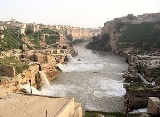
During the Sassanian era, it was an island city on the Karoun river and selected to become the summer capital. The river was channelled to form a moat around the city, while bridges and main gates into Shoushtar were built to the east, west, and south. Several rivers nearby are conducive to the extension of agriculture; the cultivation of sugar cane, the main crop, dates back to 226226

Events...
 CECommon Era

The Common Era , sometimes known as the Current Era or as the Christian Era, is the period of measured time begi...
. A system of subterranean channels called Ghanats, which connected the river to the private reservoirs of houses and buildings, supplied water for domestic use and irrigation, as well as to store and supply water during times of war when the main gates were closed. Traces of these ghanats can still be found in the crypts of some houses. This complex system of irrigation degenerated during the 19th century, which consequently led to Shoushtar's decline as an important agricultural centre until revitalisation efforts began under the reign of the last king of Iran, Mohammad Reza PahlaviMohammad Reza Pahlavi

Mohammad Reza Pahlavi, Shah of Iran, styled His Imperial Majesty, and holding the monarchial titles of Shahanshah...
, in 1973.

When the Sassanian Shah Shapour I defeated the RomanRoman Empire

The Roman Empire was a phase of the ancient Roman civilization characterized by an autocratic form of government....
 emperor ValerianValerian (emperor)

Publius Licinius Valerianus , known in English as Valerian, was Roman Emperor from 253 to 260....
, he ordered the captive Roman soldiers to build a vast bridge and dam stretching over 550 metres, known as the Band-e Qaisar ("Caesar's bridge").

The ancient fortress walls were destroyed at the end of the Safavid era.

People and culture

Like other PersianPersian people

The Persians are an Iranian people who speak the Persian language and share a common culture and history....
 ethnic groups, the people of Shoushtar, called Shoushtaris, maintain a unique cultural heritage stretching back to ancient times, and a Persian dialect distinct to their group.

Shoushtar New Town

In 1973, the Pahlavi dynastyPahlavi dynasty

The Pahlavi dynastyof Iran began with the crowning of Reza Shah Pahlavi in 1925 and ended with the Iranian Revolution of 197...
 initiated efforts to revitalise the economy of Shoushtar, which had stagnated since the deterioration of the waterways in the 19th century, and to further develop agricultural resources in the province. The Karoun Agro-Industries Corporation built a satellite town across the river from the old city, naming it Shoushtar New TownNew town

A new town, planned community or planned city is a city, town, or community that was designed from scratch, and ...
. The primary purpose of this new development was to house the employees of a nearby sugarcane processing plant, while also intending to stimulate interest in the old city and to provide additional housing necessary to accommodate industrial growth in the province.

External links