


Ablution

Encyclopedia
Ritual purification
Ritual purification is a feature of many religions. The aim of these rituals is to remove specifically defined uncleanliness prior to a particular type of activity, and especially prior to the worship of a deity...
or dedication.
In Christianity, both baptism
Baptism
In Christianity, baptism is for the majority the rite of admission , almost invariably with the use of water, into the Christian Church generally and also membership of a particular church tradition...
and footwashing are forms of ablution. In liturgical churches, ablution can refer to purifying fingers or vessels related to the Eucharist.
In the NT washing also occurs in reference to rites of Judaism part of the action of a healing by Jesus, the preparation of a body for burial, the washing of nets by fishermen, a person's personal washing of the face to appear in public, the cleansing of an injured person's wounds, Pilate's washing of his hands as a symbolic claim of innocence and foot washing, now partly a symbolic rite within the Church.
According to the Gospel of Matthew
Gospel of Matthew
The Gospel According to Matthew is one of the four canonical gospels, one of the three synoptic gospels, and the first book of the New Testament. It tells of the life, ministry, death, and resurrection of Jesus of Nazareth...
, Pontius Pilate
Pontius Pilate
Pontius Pilatus , known in the English-speaking world as Pontius Pilate , was the fifth Prefect of the Roman province of Judaea, from AD 26–36. He is best known as the judge at Jesus' trial and the man who authorized the crucifixion of Jesus...
declared himself innocent of the blood of Jesus
Jesus
Jesus of Nazareth , commonly referred to as Jesus Christ or simply as Jesus or Christ, is the central figure of Christianity...
by washing his hands. This act of Pilate may not, however, have been borrowed from the custom of the Jews. The same practice was common among the Greeks
Ancient Greece
Ancient Greece is a civilization belonging to a period of Greek history that lasted from the Archaic period of the 8th to 6th centuries BC to the end of antiquity. Immediately following this period was the beginning of the Early Middle Ages and the Byzantine era. Included in Ancient Greece is the...
and Romans
Ancient Rome
Ancient Rome was a thriving civilization that grew on the Italian Peninsula as early as the 8th century BC. Located along the Mediterranean Sea and centered on the city of Rome, it expanded to one of the largest empires in the ancient world....
.
According to Christian tradition, the Pharisees
Pharisees
The Pharisees were at various times a political party, a social movement, and a school of thought among Jews during the Second Temple period beginning under the Hasmonean dynasty in the wake of...
carried the practice of ablution to great excess. The Gospel of Mark
Gospel of Mark
The Gospel According to Mark , commonly shortened to the Gospel of Mark or simply Mark, is the second book of the New Testament. This canonical account of the life of Jesus of Nazareth is one of the three synoptic gospels. It was thought to be an epitome, which accounts for its place as the second...
refers to their ceremonial ablutions: "For the Pharisees…wash their hands 'oft'" or, more accurately, "with the fist" (R.V., "diligently"); or, as Theophylact of Bulgaria
Theophylact of Bulgaria
Theophylact of Ohrid was a Greek archbishop of Ohrid and commentator on the Bible.-Life:...
explains it, "up to the elbow," referring to the actual word used in the Greek New Testament, πυγμή pygmē, which refers to the arm from the elbow to the tips of the fingers.
In the Book of Acts, Paul and other men performed ablution before entering the Temple in Jerusalem
Temple in Jerusalem
The Temple in Jerusalem or Holy Temple , refers to one of a series of structures which were historically located on the Temple Mount in the Old City of Jerusalem, the current site of the Dome of the Rock. Historically, these successive temples stood at this location and functioned as the centre of...
: "Then Paul took the men, and the next day purifying himself with them entered into the temple, to signify the accomplishment of the days of purification, until that an offering should be offered for every one of them."
In the Old Testament
Old Testament
The Old Testament, of which Christians hold different views, is a Christian term for the religious writings of ancient Israel held sacred and inspired by Christians which overlaps with the 24-book canon of the Masoretic Text of Judaism...
, ablution was considered a prerequisite to approaching God, whether by means of sacrifice, prayer or merely by entering a holy place.
Western Christian
In the Tridentine MassTridentine Mass
The Tridentine Mass is the form of the Roman Rite Mass contained in the typical editions of the Roman Missal that were published from 1570 to 1962. It was the most widely celebrated Mass liturgy in the world until the introduction of the Mass of Paul VI in December 1969...
and in the similar Anglo-Catholic Mass
Mass (liturgy)
"Mass" is one of the names by which the sacrament of the Eucharist is called in the Roman Catholic Church: others are "Eucharist", the "Lord's Supper", the "Breaking of Bread", the "Eucharistic assembly ", the "memorial of the Lord's Passion and Resurrection", the "Holy Sacrifice", the "Holy and...
, the term "ablutions" refers to when the priest
Priesthood (Catholic Church)
The ministerial orders of the Catholic Church include the orders of bishops, deacons and presbyters, which in Latin is sacerdos. The ordained priesthood and common priesthood are different in function and essence....
rinses his hands first in wine and then in water following the Communion. It is to be distinguished from the lavabo
Lavabo
A lavabo is a device used to provide water for the washing of hands. It consists normally of a ewer or container of some kind to pour water, and a bowl to catch the water as it falls off the hands. In ecclesiastical usage it refers to both the basin in which the priest washes his hands and the...
, when the celebrant washes his hands with water only, reciting the words of (KJV—in the Septuagint it is Psalm 25) at the offertory
Offertory
The Offertory is the portion of a Eucharistic service when bread and wine are brought to the altar. The offertory exists in many liturgical Christian denominations, though the Eucharistic theology varies among celebrations conducted by these denominations....
.
In the Mass of Paul VI
Mass of Paul VI
The Mass of Pope Paul VI is the liturgy of the Catholic Mass of the Roman Rite promulgated by Paul VI in 1969, after the Second Vatican Council...
and the Anglican Eucharist
Eucharist
The Eucharist , also called Holy Communion, the Sacrament of the Altar, the Blessed Sacrament, the Lord's Supper, and other names, is a Christian sacrament or ordinance...
the priest does not normally use wine to wash his hands at the ablution, although this is permitted, but only water.
Eastern and Oriental Christian
In the Eastern OrthodoxEastern Orthodox Church
The Orthodox Church, officially called the Orthodox Catholic Church and commonly referred to as the Eastern Orthodox Church, is the second largest Christian denomination in the world, with an estimated 300 million adherents mainly in the countries of Belarus, Bulgaria, Cyprus, Georgia, Greece,...
and Greek-Catholic Churches, the term "ablution" refers to consuming the remainder of the Gifts (the Body and Blood of Christ) at the end of the Divine Liturgy
Divine Liturgy
Divine Liturgy is the common term for the Eucharistic service of the Byzantine tradition of Christian liturgy. As such, it is used in the Eastern Orthodox and Eastern Catholic Churches. Armenian Christians, both of the Armenian Apostolic Church and of the Armenian Catholic Church, use the same term...
. Holy Communion is always received in both Species (the Body and the Blood of Christ) not only by the clergy but also by the faithful. This is accomplished by placing the particles of the consecrated Lamb (bread) into the chalice
Chalice (cup)
A chalice is a goblet or footed cup intended to hold a drink. In general religious terms, it is intended for drinking during a ceremony.-Christian:...
, and distributing Communion to the faithful with a spoon. The portion which remains in the chalice afterwards must be consumed.
The ablutions will normally be performed by the deacon
Deacon
Deacon is a ministry in the Christian Church that is generally associated with service of some kind, but which varies among theological and denominational traditions...
, but if no deacon is serving the priest will do them. After the Litany
Ektenia
Ektenia , often called simply Litany, is a prayerful petition in the Eastern Orthodox/Eastern Catholic liturgy...
of Thanksgiving that follows Communion, the deacon will come into the sanctuary
Altar
An altar is any structure upon which offerings such as sacrifices are made for religious purposes. Altars are usually found at shrines, and they can be located in temples, churches and other places of worship...
and kneel, placing his forehead on the Holy Table (Altar) and the priest will bless him to consume the Gifts, which is done at the Prothesis
Prothesis (altar)
The Prothesis is the place in the sanctuary in which the Liturgy of Preparation takes place in the Eastern Orthodox and Greek-Catholic Churches....
(Table of Oblation). First, using the liturgical spoon
Spoon (liturgy)
The Spoon is a liturgical implement used to distribute Holy Communion to the laity during the Divine Liturgy of the Eastern Orthodox Church and those Eastern Catholic Churches which follow the Byzantine Rite...
he will consume all of the Body and Blood of Christ which remain in the chalice. Then he will pour hot water on the diskos (paten), which is then poured into the chalice and consumed (this is to consume any particles that may remain on the diskos). Next the liturgical spear
Spear (liturgy)
The Spear or Lance is a liturgical implement used during the Divine Liturgy of the Eastern Orthodox and Greek-Catholic Churches....
, spoon and chalice will be rinsed first with wine and then with hot water, which are then consumed. All of the sacred vessels are then wiped dry with a towel, wrapped in their cloth coverings and put away.
Because the ablutions necessarily require consuming the Holy Mysteries (the Body
Body of Christ
In Christian theology, the term Body of Christ has two separate connotations: it may refer to Jesus's statement about the Eucharist at the Last Supper that "This is my body" in , or the explicit usage of the term by the Apostle Paul in to refer to the Christian Church.Although in general usage the...
and Blood of Christ
Blood of Christ
The Blood of Christ in Christian theology refers to the physical blood actually shed by Jesus Christ on the Cross, and the salvation which Christianity teaches was accomplished thereby; and the sacramental blood present in the Eucharist, which is considered by Catholic, Orthodox, Anglican, and...
), a priest or deacon may only perform them after having fully prepared himself through fasting
Fasting
Fasting is primarily the act of willingly abstaining from some or all food, drink, or both, for a period of time. An absolute fast is normally defined as abstinence from all food and liquid for a defined period, usually a single day , or several days. Other fasts may be only partially restrictive,...
and the lengthy Preparation for Holy Communion.
When a priest must take Holy Communion to the sick or homebound, if he has not prepared himself to receive the Holy Mysteries, he may ablute the chalice by pouring water into it and asking the one to whom he brought the Sacrament (or a Baptized child who because of their youth is not obliged to prepare for Communion) to consume the ablution.
If the Reserved Mysteries should become moldy, they must still be consumed in the same manner as the ablutions after Liturgy (normally, a fair amount of wine would be poured over them before consuming them, in order to soften and disinfect them). They should not be burned or buried. To prevent this, when the Mysteries are to be reserved for the sick, they should be thoroughly dried before being placed in the Tabernacle
Church tabernacle
A tabernacle is the fixed, locked box in which, in some Christian churches, the Eucharist is "reserved" . A less obvious container, set into the wall, is called an aumbry....
.
Baptismal Ablutions
In Orthodox Christianity, there is also an ablution performed on the eighth day after Baptism. Immediately after being Baptized, every person, including an infant, is confirmed using the Mystery (Sacrament) of ChrismationChrismation
Chrismation is the name given in Eastern Orthodox, Oriental Orthodox and Eastern Catholic churches, as well as in the Assyrian Church of the East, Anglican, and in Lutheran initiation rites, to the Sacrament or Sacred Mystery more commonly known in the West as confirmation, although Italian...
. In the early church, the places where the person was anointed with Chrism
Chrism
Chrism , also called "Myrrh" , Holy anointing oil, or "Consecrated Oil", is a consecrated oil used in the Roman Catholic, Eastern Orthodox, Eastern Rite Catholic, Oriental Orthodox, in the Assyrian Church of the East, and in Old-Catholic churches, as well as Anglican churches in the administration...
were carefully bandaged, and were kept covered for eight days. During this period, the newly-illumined (newly-baptized person) would also wear his baptismal robe every day. At the end of the eight days, the priest would remove the bandages and baptismal garment and perform ablutions over him. While the bandaging no longer takes place, the ritual ablutions are still performed.
The newly-illumined (newly-baptized person) is brought back to the church by his Godparents for the ablutions. The priest stands him in the center of the church, in front of the Holy Doors
Royal Doors
The royal doors, holy doors, or beautiful gates are the central doors of the iconostasis in an Eastern Orthodox or Greek-Catholic Church....
, facing east. He loosens the belt of the baptismal robe and prays for him, that God may preserve the newly-illumined in purity and illumine him by grace. He then dips a sponge in water and sprinkles him in the sign of the cross saying: "Thou art justified. Thou art illumined. Thou art sanctified. Thou art washed: in the name of the Father, and of the Son, and of the Holy Spirit. Amen." Then, as he says the next prayer, he washes each of the places where he had been anointed with Chrism. Next he performs the Tonsure, symbolic of the life of self-sacrifice a Christian must lead.
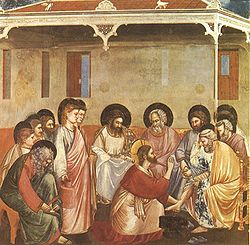
Washing of Feet
Many Christian churches practice a ceremony of the Washing of Feet, following the example of Jesus in the Gospel. Some interpret this as an ordinanceOrdinance (Christian)
Ordinance is a Protestant Christian term for baptism, communion and other religious rituals. Some Protestants, like the Mennonites, do not call them "sacraments" because they believe these rituals are outward expressions of faith, rather than impartations of God's grace.While a sacrament is seen...
which the church is obliged to keep as a commandment, see also Biblical law in Christianity
Biblical law in Christianity
Christian views of the Old Covenant have been central to Christian theology and practice since the circumcision controversy in Early Christianity. There are differing views about the applicability of the Old Covenant among Christian denominations...
. Others interpret it as an example that all should follow. Most denominations that practice the rite will perform it on Maundy Thursday
Maundy Thursday
Maundy Thursday, also known as Holy Thursday, Covenant Thursday, Great & Holy Thursday, and Thursday of Mysteries, is the Christian feast or holy day falling on the Thursday before Easter that commemorates the Last Supper of Jesus Christ with the Apostles as described in the Canonical gospels...
. Often in these services, the bishop
Bishop
A bishop is an ordained or consecrated member of the Christian clergy who is generally entrusted with a position of authority and oversight. Within the Catholic Church, Eastern Orthodox, Oriental Orthodox Churches, in the Assyrian Church of the East, in the Independent Catholic Churches, and in the...
will wash the feet of the clergy, and in monasteries
Monastery
Monastery denotes the building, or complex of buildings, that houses a room reserved for prayer as well as the domestic quarters and workplace of monastics, whether monks or nuns, and whether living in community or alone .Monasteries may vary greatly in size – a small dwelling accommodating only...
the Abbot
Abbot
The word abbot, meaning father, is a title given to the head of a monastery in various traditions, including Christianity. The office may also be given as an honorary title to a clergyman who is not actually the head of a monastery...
will wash the feet of the brethren.
St. Benedict of Nursia
Benedict of Nursia
Saint Benedict of Nursia is a Christian saint, honored by the Roman Catholic Church as the patron saint of Europe and students.Benedict founded twelve communities for monks at Subiaco, about to the east of Rome, before moving to Monte Cassino in the mountains of southern Italy. There is no...
lays out in his Rule that the feet of visitors to the monastery should be washed, and also that those who are assigned to serve in the kitchen that week should wash the feet of all the brethren.
Ablutions for the Dead
When an Orthodox Christian dies, his body is washed and dressed before burial. Although this custom is not considered to impose any sort of ritual purity, it is an important aspect of charitable care for the departed. Ideally, this should not be deferred to an undertaker, but should be performed by family members or friends of the deceased.When an Orthodox priest or bishop dies, these ablutions and vesting are performed by the clergy, saying the same prayers for each vestment that are said when the departed bishop or priest vested for the Divine Liturgy
Divine Liturgy
Divine Liturgy is the common term for the Eucharistic service of the Byzantine tradition of Christian liturgy. As such, it is used in the Eastern Orthodox and Eastern Catholic Churches. Armenian Christians, both of the Armenian Apostolic Church and of the Armenian Catholic Church, use the same term...
. After the body of a Bishop is washed and vested, he is seated in a chair and the Dikirion and Trikirion are placed in his hands for the final time.
When an Orthodox monk
Monk
A monk is a person who practices religious asceticism, living either alone or with any number of monks, while always maintaining some degree of physical separation from those not sharing the same purpose...
dies, his body is washed and clothed in his monastic habit by brethren of his monastery. Two significant differences are that when his mantle is placed on him, its hem is torn to form bands, with which his body is bound (like Lazarus
Lazarus of Bethany
Lazarus of Bethany, also known as Saint Lazarus or Lazarus of the Four Days, is the subject of a prominent miracle attributed to Jesus in the Gospel of John, in which Jesus restores him to life four days after his death...
in the tomb), and his klobuk
Klobuk
thumbA klobuk is an item of clerical clothing worn by Eastern Orthodox and Eastern Catholic monastics and bishops, especially in the Russian tradition...
is placed on his head backwards, so that the monastic veil
Epanokamelavkion
An epanokamelavkion is an item of clerical clothing worn by Orthodox Christian monastics who are rassophor or above, including bishops...
covers his face (to show that he had already died to the world, even before his physical death). When an Orthodox nun
Nun
A nun is a woman who has taken vows committing her to live a spiritual life. She may be an ascetic who voluntarily chooses to leave mainstream society and live her life in prayer and contemplation in a monastery or convent...
dies, the sisterhood of her convent performs the same ministrations for her as are done for monks.
In the Roman Catholic Church
Roman Catholic Church
The Catholic Church, also known as the Roman Catholic Church, is the world's largest Christian church, with over a billion members. Led by the Pope, it defines its mission as spreading the gospel of Jesus Christ, administering the sacraments and exercising charity...
, the Absoute (or absolution of the dead) is a symbolic ablution of the deceased's body following the Requiem Mass. While specific prayers are said, the coffin is incense
Incense
Incense is composed of aromatic biotic materials, which release fragrant smoke when burned. The term "incense" refers to the substance itself, rather than to the odor that it produces. It is used in religious ceremonies, ritual purification, aromatherapy, meditation, for creating a mood, and for...
d and sprinkled with holy water
Holy water
Holy water is water that, in Catholicism, Anglicanism, Eastern Orthodoxy, Lutheranism, Oriental Orthodoxy, and some other churches, has been sanctified by a priest for the purpose of baptism, the blessing of persons, places, and objects; or as a means of repelling evil.The use for baptism and...
. The absolution of the dead is only performed in context of the Tridentine Mass
Tridentine Mass
The Tridentine Mass is the form of the Roman Rite Mass contained in the typical editions of the Roman Missal that were published from 1570 to 1962. It was the most widely celebrated Mass liturgy in the world until the introduction of the Mass of Paul VI in December 1969...
. Following the Second Vatican Council
Second Vatican Council
The Second Vatican Council addressed relations between the Roman Catholic Church and the modern world. It was the twenty-first Ecumenical Council of the Catholic Church and the second to be held at St. Peter's Basilica in the Vatican. It opened under Pope John XXIII on 11 October 1962 and closed...
, the absolution of the dead was removed from the funeral liturgy of the Mass of Paul VI
Mass of Paul VI
The Mass of Pope Paul VI is the liturgy of the Catholic Mass of the Roman Rite promulgated by Paul VI in 1969, after the Second Vatican Council...
.