

Contactor

Encyclopedia
- In semiconductor testing, contactor can also refer to the specialised socket that connects the device under testDevice under testDevice under test , also known as unit under test , is a term commonly used to refer to a manufactured product undergoing testing.-In semiconductor testing:...
. - In process industries a contactor is a vessel where two streams interact, for example, air and liquid.
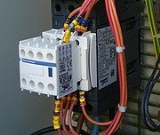
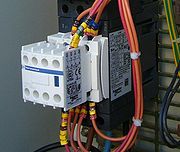
A contactor is an electrically controlled switch used for switching a power circuit, similar to a relay
Relay
A relay is an electrically operated switch. Many relays use an electromagnet to operate a switching mechanism mechanically, but other operating principles are also used. Relays are used where it is necessary to control a circuit by a low-power signal , or where several circuits must be controlled...
except with higher current ratings. A contactor is controlled by a circuit which has a much lower power level than the switched circuit.
Contactors come in many forms with varying capacities and features. Unlike a circuit breaker
Circuit breaker
A circuit breaker is an automatically operated electrical switch designed to protect an electrical circuit from damage caused by overload or short circuit. Its basic function is to detect a fault condition and, by interrupting continuity, to immediately discontinue electrical flow...
, a contactor is not intended to interrupt a short circuit
Short circuit
A short circuit in an electrical circuit that allows a current to travel along an unintended path, often where essentially no electrical impedance is encountered....
current. Contactors range from those having a breaking current of several amperes and 24 V DC to thousands of amperes and many kilovolts. The physical size of contactors ranges from a device small enough to pick up with one hand, to large devices approximately a meter (yard) on a side.
Contactors are used to control electric motor
Electric motor
An electric motor converts electrical energy into mechanical energy.Most electric motors operate through the interaction of magnetic fields and current-carrying conductors to generate force...
s, lighting, heating
Electric heating
Electric heating is any process in which electrical energy is converted to heat. Common applications include space heating, cooking, water heating and industrial processes. An electric heater is an electrical appliance that converts electrical energy into heat...
, capacitor
Capacitor
A capacitor is a passive two-terminal electrical component used to store energy in an electric field. The forms of practical capacitors vary widely, but all contain at least two electrical conductors separated by a dielectric ; for example, one common construction consists of metal foils separated...
banks, and other electrical loads.
Construction
Nylon 6
Nylon 6 or polycaprolactam is a polymer developed by Paul Schlack at IG Farben to reproduce the properties of nylon 6,6 without violating the patent on its production. Unlike most other nylons, nylon 6 is not a condensation polymer, but instead is formed by ring-opening polymerization. This makes...
, and thermosetting plastic
Thermosetting plastic
A thermosetting plastic, also known as a thermoset, is polymer material that irreversibly cures. The cure may be done through heat , through a chemical reaction , or irradiation such as electron beam processing.Thermoset materials are usually liquid or malleable prior to curing and designed to be...
s to protect and insulate the contacts and to provide some measure of protection against personnel touching the contacts. Open-frame contactors may have a further enclosure to protect against dust, oil, explosion hazards and weather.
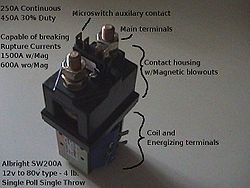
Magnetic blowouts use blowout coils to lengthen and move the electric arc. These are especially useful in DC power circuits. AC arcs have periods of low current, during which the arc can be extinguished with relative ease, but DC arcs have continuous high current, so blowing them out requires the arc to be stretched further than an AC arc of the same current. The magnetic blowouts in the pictured Albright contactor (which is designed for DC currents) more than double the current it can break, increasing it from 600 A to 1,500 A.
Sometimes an economizer circuit is also installed to reduce the power required to keep a contactor closed; an auxiliary contact reduces coil current after the contactor closes. A somewhat greater amount of power is required to initially close a contactor than is required to keep it closed. Such a circuit can save a substantial amount of power and allow the energized coil to stay cooler. Economizer circuits are nearly always applied on direct-current contactor coils and on large alternating current contactor coils.
A basic contactor will have a coil input (which may be driven by either an AC or DC supply depending on the contactor design). The coil may be energized at the same voltage as the motor, or may be separately controlled with a lower coil voltage better suited to control by programmable controller
Programmable controller
Programmable controller may be:* Programmable logic controller* Programmable automation controller* Programmable Interrupt Controller* Universal remote...
s and lower-voltage pilot devices. Certain contactors have series coils connected in the motor circuit; these are used, for example, for automatic acceleration control, where the next stage of resistance is not cut out until the motor current has dropped.
Operating principle
Unlike general-purpose relays, contactors are designed to be directly connected to high-current load devices. Relays tend to be of lower capacity and are usually designed for both normally closed and normally open applications. Devices switching more than 15 amperes or in circuits rated more than a few kilowatts are usually called contactors. Apart from optional auxiliary low current contacts, contactors are almost exclusively fitted with normally open contacts. Unlike relays, contactors are designed with features to control and suppress the arc produced when interrupting heavy motor currents.When current passes through the electromagnet, a magnetic field is produced, which attracts the moving core of the contactor. The electromagnet coil draws more current initially, until its inductance
Inductance
In electromagnetism and electronics, inductance is the ability of an inductor to store energy in a magnetic field. Inductors generate an opposing voltage proportional to the rate of change in current in a circuit...
increases when the metal core enters the coil. The moving contact is propelled by the moving core; the force developed by the electromagnet holds the moving and fixed contacts together. When the contactor coil is de-energized, gravity or a spring returns the electromagnet core to its initial position and opens the contacts.
For contactors energized with alternating current
Alternating current
In alternating current the movement of electric charge periodically reverses direction. In direct current , the flow of electric charge is only in one direction....
, a small part of the core is surrounded with a shading coil, which slightly delays the magnetic flux in the core. The effect is to average out the alternating pull of the magnetic field and so prevent the core from buzzing at twice line frequency.
Most motor control contactors at low voltages (600 volts and less) are air break contactors; air at atmospheric pressure surrounds the contacts and extinguishes the arc when interrupting the circuit. Modern medium-voltage motor controllers use vacuum contactors. High voltage contactors (greater than 1000 volts) may use vacuum or an inert gas around the contacts. High-voltage electric locomotives may be isolated from their overhead supply by roof-mounted circuit breakers actuated by compressed air; the same air supply may be used to "blow out" any arc that forms.
Ratings
Contactors are rated by designed load current per contact (pole), maximum fault withstand current, duty cycle, voltage, and coil voltage. A general purpose motor control contactor may be suitable for heavy starting duty on large motors; so-called "definite purpose" contactors are carefully adapted to such applications as air-conditioning compressor motor starting. North American and European ratings for contactors follow different philosophies, with North American general purpose machine tool contactors generally emphasizing simplicity of application while definite purpose and European rating philosophy emphasizes design for the intended life cycle of the application.IEC
The current rating of the contactor depends on utilization categoryUtilization categories
In electrical engineering utilization categories are defined by IEC standards and indicate the type of electrical load and duty cycle of the loads to ease selection of contactors and relays....
. For example IEC
IEC
-Organisations:* Independent Electoral Commission * Independent Electrical Contractors, a U.S. national trade association.* Institut d'Estudis Catalans , a Catalan academic institution....
categories are described as:
- AC1 - Non-inductive or slightly inductive loads
- AC2 - Starting of slip-ring motors
- AC3 - Starting of squirrel-cage motors and switching off only after the motor is up to speed. (Make Locked Rotor Amps (LRA), Break Full Load Amps (FLA))
- AC4 - Starting of squirrel-cage motors with inching and plugging duty. Rapid Start/Stop. (Make and Break LRA)
- AC11 - Auxiliary (control) circuits
NEMA
The current rating of smaller NEMA contactors or their auxiliaries are defined by NEMA ICS 5: Industrial Control and Systems, Control Circuit and Pilot Devices standard. The nomenclature is a letter followed by a three digit number, the letter designates the current rating of the contacts and the current type (i.e., AC or DC) and the number designates the maximum voltage design values. Some examples are listed below:- A150
- A300
- A600