

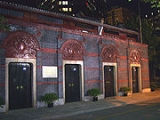
National Congress of the Communist Party of China

Encyclopedia
The National Congress of the Communist Party of China is a party congress
that is held about once every five years. The National Congress is theoretically the highest body within the Communist Party of China
, but in practice important decisions are made before the meeting. Since 1987 the National Congress has always been held in the months of October or November. The venue for the event, beginning in 1956, has always been the Great Hall of the People
in Beijing
. In the past two decades the National Congress of the CPC has been pivotal at least as a symbolic part of leadership changes in the People's Republic of China, and therefore has gained international media attention.
which is the legislature of the People's Republic of China
. In contrast with the NPC which has become more assertive since the 1990s, the National Congress of the Communist Party has shown no signs of becoming a deliberative assembly
with independent power. In addition the National Congress should not be confused with the Chinese People's Political Consultative Conference
. While leadership changes in the government usually occur at the National People's Congress sessions, now held every March, leadership changes in the party occur at the Party's National Congress.
Since the mid-1980s, the Communist Party has attempted to maintain a smooth and orderly succession and avoiding a cult of personality
, by having a major shift in personnel every ten years in even number party congresses, and by promoting people in preparation for this shift in odd number party congresses.
In addition, as people at the top level of the party retire, there is room for younger members of the party to move up one level. Hence the party congress is a time of a general personnel reshuffle, and the climax of negotiations that involve not only the top leadership but practically all significant political positions in China. Because of the pyramid structure of the party and the existence of mandatory retirement ages, cadres who are not promoted at a party congress are likely to face the end of their political careers.
In addition to making leadership changes, the Congress also reviews and changes, if necessary, the Party's Constitution, and selects the Central Committee
, a powerful decision making body. Each five-year cycle of the National People's Congress also has a series of plenum
s of the Central Committee
which since the mid-1990s have been held more or less regularly once every year.
Since the establishment of PRC, the Congresses have occurred approximately every five years and since 1956, they have always taken place in the capital, Beijing
. Each Party Congress lasted for five to ten days. Unlike Central Committee meetings which have on occasion been the focus of shifts in Party policy, Congresses have been occasions in which personnel decisions made beforehand have been announced, and ideologies and doctrines which have already been introduced are entrenched into the Party Constitution.
Each Congress's name is abbreviated in Chinese
as the number of the Conference, followed by character
da (大), short for dahui (大会 "conference"). For example, the sixteenth Conference, Zhōnguó Gòngchǎndǎng Dìshíliùcì Quánguó Dàibiǎo Dàhuì , is shortened to Shíliù Dà (十六大 "sixteenth da").
Similar to the practice of the NPC, the delegates to the Congress are formally selected from grassroot party organizations, and like the NPC, the system of staggered elections in which one level of the party votes for the delegates to the next higher level allows the party center to control the election of delegates.
Party Congress
A party congress is a general conference of a political party. The congress is attended by delegates who represent the party membership. In most parties the party congress is the highest decision making body of the organisation and elects the party's leadership bodies such as the National Executive...
that is held about once every five years. The National Congress is theoretically the highest body within the Communist Party of China
Communist Party of China
The Communist Party of China , also known as the Chinese Communist Party , is the founding and ruling political party of the People's Republic of China...
, but in practice important decisions are made before the meeting. Since 1987 the National Congress has always been held in the months of October or November. The venue for the event, beginning in 1956, has always been the Great Hall of the People
Great Hall of the People
The Great Hall of the People is located at the western edge of Tiananmen Square, Beijing, People's Republic of China, and is used for legislative and ceremonial activities by the People's Republic of China and the Communist Party of China. It functions as the People's Republic of China's...
in Beijing
Beijing
Beijing , also known as Peking , is the capital of the People's Republic of China and one of the most populous cities in the world, with a population of 19,612,368 as of 2010. The city is the country's political, cultural, and educational center, and home to the headquarters for most of China's...
. In the past two decades the National Congress of the CPC has been pivotal at least as a symbolic part of leadership changes in the People's Republic of China, and therefore has gained international media attention.
Overview
The National CPC Congress should not be confused with the National People's CongressNational People's Congress
The National People's Congress , abbreviated NPC , is the highest state body and the only legislative house in the People's Republic of China. The National People's Congress is held in the Great Hall of the People, Beijing, capital of the People's Republic of China; with 2,987 members, it is the...
which is the legislature of the People's Republic of China
People's Republic of China
China , officially the People's Republic of China , is the most populous country in the world, with over 1.3 billion citizens. Located in East Asia, the country covers approximately 9.6 million square kilometres...
. In contrast with the NPC which has become more assertive since the 1990s, the National Congress of the Communist Party has shown no signs of becoming a deliberative assembly
Deliberative assembly
A deliberative assembly is an organization comprising members who use parliamentary procedure to make decisions. In a speech to the electorate at Bristol in 1774, Edmund Burke described the English Parliament as a "deliberative assembly," and the expression became the basic term for a body of...
with independent power. In addition the National Congress should not be confused with the Chinese People's Political Consultative Conference
Chinese People's Political Consultative Conference
The Chinese People's Political Consultative Conference [], shortened as 人民政协, Rénmín Zhèngxié, i.e. "People's PCC"; or just 政协, Zhèngxié, i.e. "The PCC"), abbreviated CPPCC, is a political advisory body in the People's Republic of China...
. While leadership changes in the government usually occur at the National People's Congress sessions, now held every March, leadership changes in the party occur at the Party's National Congress.
Since the mid-1980s, the Communist Party has attempted to maintain a smooth and orderly succession and avoiding a cult of personality
Cult of personality
A cult of personality arises when an individual uses mass media, propaganda, or other methods, to create an idealized and heroic public image, often through unquestioning flattery and praise. Cults of personality are usually associated with dictatorships...
, by having a major shift in personnel every ten years in even number party congresses, and by promoting people in preparation for this shift in odd number party congresses.
In addition, as people at the top level of the party retire, there is room for younger members of the party to move up one level. Hence the party congress is a time of a general personnel reshuffle, and the climax of negotiations that involve not only the top leadership but practically all significant political positions in China. Because of the pyramid structure of the party and the existence of mandatory retirement ages, cadres who are not promoted at a party congress are likely to face the end of their political careers.
In addition to making leadership changes, the Congress also reviews and changes, if necessary, the Party's Constitution, and selects the Central Committee
Central Committee of the Communist Party of China
The Central Committee of the Communist Party of China is the highest authority within the Communist Party of China. Its approximately 350 members and alternates are selected once every five years by the National Party Congress....
, a powerful decision making body. Each five-year cycle of the National People's Congress also has a series of plenum
Plenary session
Plenary session is a term often used in conferences to define the part of the conference when all members of all parties are to attend.These sessions may contain a broad range of content from keynotes to panel discussions and are not necessarily related to a specific style of delivery.The term has...
s of the Central Committee
Central Committee
Central Committee was the common designation of a standing administrative body of communist parties, analogous to a board of directors, whether ruling or non-ruling in the twentieth century and of the surviving, mostly Trotskyist, states in the early twenty first. In such party organizations the...
which since the mid-1990s have been held more or less regularly once every year.
Since the establishment of PRC, the Congresses have occurred approximately every five years and since 1956, they have always taken place in the capital, Beijing
Beijing
Beijing , also known as Peking , is the capital of the People's Republic of China and one of the most populous cities in the world, with a population of 19,612,368 as of 2010. The city is the country's political, cultural, and educational center, and home to the headquarters for most of China's...
. Each Party Congress lasted for five to ten days. Unlike Central Committee meetings which have on occasion been the focus of shifts in Party policy, Congresses have been occasions in which personnel decisions made beforehand have been announced, and ideologies and doctrines which have already been introduced are entrenched into the Party Constitution.
Each Congress's name is abbreviated in Chinese
Chinese language
The Chinese language is a language or language family consisting of varieties which are mutually intelligible to varying degrees. Originally the indigenous languages spoken by the Han Chinese in China, it forms one of the branches of Sino-Tibetan family of languages...
as the number of the Conference, followed by character
Chinese character
Chinese characters are logograms used in the writing of Chinese and Japanese , less frequently Korean , formerly Vietnamese , or other languages...
da (大), short for dahui (大会 "conference"). For example, the sixteenth Conference, Zhōnguó Gòngchǎndǎng Dìshíliùcì Quánguó Dàibiǎo Dàhuì , is shortened to Shíliù Dà (十六大 "sixteenth da").
Similar to the practice of the NPC, the delegates to the Congress are formally selected from grassroot party organizations, and like the NPC, the system of staggered elections in which one level of the party votes for the delegates to the next higher level allows the party center to control the election of delegates.
Before founding of People's Republic
- 1st Congress (Yi da) (一大)
- Date: July 23–31, 1921
-
- Location: ShanghaiShanghaiShanghai is the largest city by population in China and the largest city proper in the world. It is one of the four province-level municipalities in the People's Republic of China, with a total population of over 23 million as of 2010...
, then South Lake, Jiaxing, ZhejiangZhejiangZhejiang is an eastern coastal province of the People's Republic of China. The word Zhejiang was the old name of the Qiantang River, which passes through Hangzhou, the provincial capital...
. - Participants
-
- Delegates: 12
- Party members: 50
- Significance: The first platform (綱領) of the Party passed; Mao Zedong attends (as Hunan representative); Zhang GuotaoZhang GuotaoZhang Guotao was a founding member and important leader of the Chinese Communist Party and bitter rival to Mao Zedong. During the 1920s he studied in the Soviet Union and became a key contact with the Comintern and organized the CCP labor movement in the United Front with the Guomindang...
acts as top party official; Chen Duxiu becomes first leader of CPC "Secretariat"; attended by two Comintern representatives (during Shanghai meetings).
- Location: Shanghai
- 2nd Congress (Er Da) (二大)
- Date: July 16–23, 1922
- Location: Shanghai
- Participants
-
- Delegates: 12
- Represented party members: 195
- Significance: Mao Zedong absent from Congress; Party continues purging anarchists, tries to maintain an independent stance from Sun Yat-SenSun Yat-senSun Yat-sen was a Chinese doctor, revolutionary and political leader. As the foremost pioneer of Nationalist China, Sun is frequently referred to as the "Father of the Nation" , a view agreed upon by both the People's Republic of China and the Republic of China...
's KuomintangKuomintangThe Kuomintang of China , sometimes romanized as Guomindang via the Pinyin transcription system or GMD for short, and translated as the Chinese Nationalist Party is a founding and ruling political party of the Republic of China . Its guiding ideology is the Three Principles of the People, espoused...
(KMT).
- 3rd Congress (San Da) (三大)
- Date: June 12–20, 1923
- Location: GuangzhouGuangzhouGuangzhou , known historically as Canton or Kwangchow, is the capital and largest city of the Guangdong province in the People's Republic of China. Located in southern China on the Pearl River, about north-northwest of Hong Kong, Guangzhou is a key national transportation hub and trading port...
- Participants
-
- Delegates: ~30
- Represented party members: 420
- Significance: CPC formally ratifies the "bloc within" strategy of cooperation with the KMT as demanded by the Comintern.
- 4th Congress (Si Da) (四大)
- Date: January 11–22, 1925
- Location: Shanghai
- Participants
-
- Delegates: 20
- Represented party members: 994
- Significance: CPC Party Center continues efforts to bring semi-independent regional Party branches under its control.
- 5th Congress (Wu Da) (五大)
- Date: April 27-May 9, 1927
- Location: WuhanWuhanWuhan is the capital of Hubei province, People's Republic of China, and is the most populous city in Central China. It lies at the east of the Jianghan Plain, and the intersection of the middle reaches of the Yangtze and Han rivers...
- Participants
-
- Delegates: ~80
- Represented party members: 57,967
- Significance: Congress followed Chiang Kai-shekChiang Kai-shekChiang Kai-shek was a political and military leader of 20th century China. He is known as Jiǎng Jièshí or Jiǎng Zhōngzhèng in Mandarin....
's crackdown on Communists in Shanghai and elsewhere; CPC continues to "support the KMT Left and oppose the KMT Right".
- 6th Congress (Liu Da) (六大)
- Date: June 18-July 11, 1928
- Location: MoscowMoscowMoscow is the capital, the most populous city, and the most populous federal subject of Russia. The city is a major political, economic, cultural, scientific, religious, financial, educational, and transportation centre of Russia and the continent...
- Participants
-
- Delegates: 84
- Alternate delegates: 34
- Represented party members: ~40,000
- Significance: First and only Party Congress held outside China (due to Chiang's anti-CPC crackdown); sanctioned creating armed forces controlled by CPC but still to be used "under the KMT flag."; Mao Zedong absent, stays in China at the CCP's Jinggangshan base.
- 7th Congress (Qi Da) (七大)
- Date: April 23-June 11, 1945
- Location: Yan'anYan'anYan'an , is a prefecture-level city in the Shanbei region of Shaanxi province in China, administering several counties, including Zhidan County , which served as the Chinese communist capital before the city of Yan'an proper took that role....
, ShaanxiShaanxi' is a province in the central part of Mainland China, and it includes portions of the Loess Plateau on the middle reaches of the Yellow River in addition to the Qinling Mountains across the southern part of this province... - Participants
-
- Delegates: 544
- Alternate delegates: 208
- Represented party members: 1.21 million
- Significance: Party constitutionConstitution of the Communist Party of ChinaThe Constitution of the Communist Party of China has 53 Articles and includes contents of General Program, Membership, Organization System, Central Organizations, Local Organizations, Primary Organizations, Party Cadres, Party Discipline, Party Organs for Discipline Inspection, Leading Party...
(黨章) is passed; National flagFlag of ChinaFlag of China may refer to: Flag of the People's Republic of China, commonly known as "China" Flag of the Republic of China, commonly known as "Taiwan"-See also:*List of Chinese flags - includes a complete list of flags, including historical ones....
designed(?); CPC "Chairman" Mao Zedong is named undisputed leader of CPC; Mao's "thought" enshrined in CPC Party Constitution for first time; Mao retells the fable of "the old fool who moves a mountain" (愚公移山) in his closing address.
After 1949
- 8th Congress (Ba Da) (八大)
- Date: September 15–27, 1956
- Location: BeijingBeijingBeijing , also known as Peking , is the capital of the People's Republic of China and one of the most populous cities in the world, with a population of 19,612,368 as of 2010. The city is the country's political, cultural, and educational center, and home to the headquarters for most of China's...
- Participants
-
- Delegates: 1,026
- Alternate delegates: 107
- Represented party members: 10,730,000
- Significance: first Congress to be held in 11 years; Mao Zedong Thought is taken out of CPC Party Constitution; Party technocrats Liu ShaoqiLiu ShaoqiLiu Shaoqi was a Chinese revolutionary, statesman, and theorist. He was Chairman of the People's Republic of China, China's head of state, from 27 April 1959 to 31 October 1968, during which he implemented policies of economic reconstruction in China...
and Deng XiaopingDeng XiaopingDeng Xiaoping was a Chinese politician, statesman, and diplomat. As leader of the Communist Party of China, Deng was a reformer who led China towards a market economy...
assume higher profiles.
- 9th Congress (Jiu Da)9th National Congress of the Communist Party of ChinaThe 9th National Congress of the Communist Party of China was a pivotal Communist Party Congress in China during the height of the Cultural Revolution. It was held in Beijing, China, between April 1 and 24, 1969...
(九大)- Date: April 1–24, 1969
- Location: Beijing
- Participants
-
- Delegates: 1,512
- Represented party members: 22,000,000
- Significance: Held at the culmination of the "Great Proletarian Cultural Revolution," Mao's Party is decimated from infighting; People's Liberation Army (PLA) influence on Party administration pronounced; few members appointed to power during the previous Party Congress survive the 9th Congress politically; former State Chairman and second-ranking Liu Shaoqi (arrested 1966) and former CPC General Secretary Deng Xiaoping labelled "traitorous scabs and renegades"; Defence Minister Lin BiaoLin BiaoLin Biao was a major Chinese Communist military leader who was pivotal in the communist victory in the Chinese Civil War, especially in Northeastern China...
becomes CPC Vice Chairman and Mao's "closest comrade-in-arms", and is designated constitutionally as Mao's successor; Mao's "thought" reinserted into CPC Party Constitution.
- 10th Congress (Shi Da) (十大)
- Date: August 24–28, 1973
- Location: Beijing
- Participants
-
- Delegates: 1,249
- Represented party members: 28,000,000
- Significance: "Gang of FourGang of FourThe Gang of Four was the name given to a political faction composed of four Chinese Communist Party officials. They came to prominence during the Cultural Revolution and were subsequently charged with a series of treasonous crimes...
" led by Mao's wife Jiang QingJiang QingJiang Qing was the pseudonym that was used by Chinese leader Mao Zedong's last wife and major Communist Party of China power figure. She went by the stage name Lan Ping during her acting career, and was known by various other names during her life...
reach paramount power; first CPC Congress after US President Richard NixonRichard NixonRichard Milhous Nixon was the 37th President of the United States, serving from 1969 to 1974. The only president to resign the office, Nixon had previously served as a US representative and senator from California and as the 36th Vice President of the United States from 1953 to 1961 under...
's visit to PRC.
- 11th Congress (Shiyi Da) (十一大)
- Date: August 12–18, 1977
- Location: Beijing
- Participants
-
- Delegates: 1,510
- Represented party members: 35,000,000
- Significance: first Party Congress following Mao's death and after the fall of the Gang of Four; Deng XiaopingDeng XiaopingDeng Xiaoping was a Chinese politician, statesman, and diplomat. As leader of the Communist Party of China, Deng was a reformer who led China towards a market economy...
reinstated to all of his previous posts.
- 12th Congress (Shi'er Da) (十二大)
- Date: September 1–11, 1982
- Location: Beijing
- Participants
-
- Delegates: 1,600
- Alternate delegates: 149
- Represented party members: 39,650,000
- Significance: Central Advisory CommissionCentral Advisory CommissionCentral Advisory Commission of People's Republic of China provided "political assistance and consultation" to the Central Committee of the Communist Party of China ....
(CAC, 中央顾问委员会), and Central Discipline Inspection Commission (中央紀律檢查委員會) were created; CPC Party Chair position abolished, CPC General Secretary position becomes (on paper) paramount position; former CPC leader Hua GuofengHua GuofengSu Zhu, better known by the nom de guerre Hua Guofeng , was Mao Zedong's designated successor as the Paramount Leader of the Communist Party of China and the People's Republic of China. Upon Zhou Enlai's death in 1976, he succeeded Zhou as the second Premier of the People's Republic of China...
loses formal power (except his Central Committee membership) as Hu YaobangHu YaobangHu Yaobang was a leader of the People's Republic of China who served as both Chairman and Party General Secretary. Hu joined the Chinese Communist Party in the 1930s, and rose to prominence as a comrade of Deng Xiaoping...
, not Hua, gives keynote Party address.
- 13th Congress (Shisan Da) (十三大)
- Date: October 25-November 1, 1987
- Location: Beijing
- Participants
-
- Full delegates: 1,936
- Specially invited delegates: 61
- Represented party members: 46,000,000
- Significance: Deng Xiaoping and all other "Second Generation" CPC leaders retire from active positions in the Party (again, on paper); "Third Generation" members (led by Zhao Ziyang) dominate the CPC Politburo Standing Committee.
- 14th Congress (Shisi Da) (十四大)
- Date: October 12–18, 1992
- Location: Beijing
- Participants
-
- Full delegates: 1,989
- Specially invited delegates: 46
- Represented party members: 51,000,000
- Significance: first Party Congress after the Tiananmen Square protests of April–June 1989 and the violent crackdown of 3–4 June 1989; Jiang Zemin's position as CPC General Secretary, Chairman of the (CPC) Central Military Commission ratified; Hu Jintao makes first appearance on Politburo Standing Committee.
- 15th Congress (Shiwu Da) (十五大)
- Date: September 12–18, 1997
- Location: Beijing
- Participants
-
- Full delegates: 2,074
- Specially invited delegates: 60
- Represented party members: 59,900,000
- Significance: first Party Congress following death of Deng Xiaoping and the reversion of Hong Kong to China on 1 July 1997; Jiang Zemin forces party rival Qiao Shi to retire; Inclusion of Deng XiaopingDeng XiaopingDeng Xiaoping was a Chinese politician, statesman, and diplomat. As leader of the Communist Party of China, Deng was a reformer who led China towards a market economy...
's philosophy into Party constitution.; Jiang ZeminJiang ZeminJiang Zemin is a former Chinese politician, who served as General Secretary of the Communist Party of China from 1989 to 2002, as President of the People's Republic of China from 1993 to 2003, and as Chairman of the Central Military Commission from 1989 to 2005...
announced plans to sell, merge, or close the vast majority of SOEs in a program which included some privatizationPrivatizationPrivatization is the incidence or process of transferring ownership of a business, enterprise, agency or public service from the public sector to the private sector or to private non-profit organizations...
.
- 16th Congress (Shiliu Da)Sixteenth National Congress of the Communist Party of ChinaThe 16th National Congress of the Communist Party of China was held in Beijing between November 8-14 2002. 2,114 delegates and 40 specially invited delegates elected a 356-member 16th CPC Central Committee, as well as a 121-member Central Commission for Discipline Inspection...
(十六大)- Date: November 8–15, 2002
- Location: Beijing
- Participants
-
- Full delegates: 2,114
- Specially invited delegates: 40
- Represented party members: 66,000,000
- Significance: Hu JintaoHu JintaoHu Jintao is the current Paramount Leader of the People's Republic of China. He has held the titles of General Secretary of the Communist Party of China since 2002, President of the People's Republic of China since 2003, and Chairman of the Central Military Commission since 2004, succeeding Jiang...
elected General Secretary; "Fourth Generation" of CPC leadership assumes control of the Party and the country; Jiang Zemin packs the CPC Politburo Standing Committee with supporters, holds on to CPC CMC Chair; Jiang's "Three Represents" theory enshrined in CPC Constitution.
- 17th Congress (Shiqi Da) (十七大)
- Date: October 15–21, 2007
- Location: Beijing
- Participants
-
- Full delegates: 2,217
- Specially invited delegates:
- Represented party members: 73,360,000
- Significance: Hu Jintao's Scientific Development ConceptScientific Development ConceptThe scientific development concept, sometimes translated as the scientific development perspective, is the current official guiding socio-economic ideology of the Communist Party of China incorporating sustainable development, social welfare, a humanistic society, increased democracy, and,...
is entrenched in the party's constitution as an official guiding ideology; Vice-President Zeng QinghongZeng QinghongZeng Qinghong was the Vice-President of the People's Republic of China from 2003 to 2008. He became a member of the Politburo Standing Committee and member of the Secretariat of the CPC Central Committee during the 2002 16th Party Congress. Although he was formally ranked fifth in the nine PSC...
retires.