


Machinist

Encyclopedia
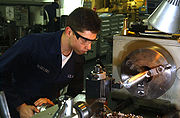
A machinist is a person who uses machine tools to make or modify parts, primarily metal
Metal
A metal , is an element, compound, or alloy that is a good conductor of both electricity and heat. Metals are usually malleable and shiny, that is they reflect most of incident light...
parts, a process known as machining
Machining
Conventional machining is a form of subtractive manufacturing, in which a collection of material-working processes utilizing power-driven machine tools, such as saws, lathes, milling machines, and drill presses, are used with a sharp cutting tool to physical remove material to achieve a desired...
. This is accomplished by using machine tools to cut away excess material much as a woodcarver cuts away excess wood to produce his work. In addition to metal, the parts may be made of many other kinds of materials, such as plastic or wood products. The goal of these cutting operations is to produce a part that conforms to a set of specifications, or tolerances, usually in the form of engineering drawings commonly known as blueprints.
Related occupational titles
Within the title machinist are other specialty titles that refer to specific skills that may be more highly developed to meet the needs of a particular job position. Some examples of these specialty titles are fitter, turning hand, mill hand, and grinder. Also, there are titles that are related but actually are a further development of machinist skills such as tool and die makerTool and die maker
Tool and die makers are workers in the manufacturing industry who make jigs, fixtures, dies, molds, machine tools, cutting tools , gauges, and other tools used in manufacturing processes...
, tool maker, trim die maker, die sinker, patternmaker
Model maker
A model maker is a professional craftsperson who creates a 3 dimensional representation of a design or concept. Most products in use and in development today first take form as a model. This "model" may be an exacting duplicate of the future design or a simple mock-up of the general shape or concept...
and mold maker. These latter titles are also more commonly found in specialized areas of industry.
A fitter and turner refers to a person who manufactures mechanical parts (turner) and assembles (fitter) those parts together to manufacture a mechanical device.
The role of the machinist in manufacturing
A machinist is usually called upon when a part needs to be produced from a material by cutting. Such a part may be unique or may be needed in the thousands. This could include a machinery part for a production line or anything that can be made from metal or plastic. Producing a part will often require several steps and more than one machine tool. Each machine tool plays a specific role in cutting away excess material. When large numbers of parts are needed, production planning is required to plan the most logical route using primarily computer numerically controlled (CNC) machines.CNC machines are becoming the standard due to their speed, precision, flexibility, and reduced downtime while changing jobs. Production runs consisting of large numbers of parts are more cost effective (in a local and narrow sense) and commonly referred to as production work
Mass production
Mass production is the production of large amounts of standardized products, including and especially on assembly lines...
in the trade. Conversely, small production runs are sometimes referred to as prototype or jobbing work.
Production engineers use blueprints and engineering drawings to produce detailed specifications of the part, especially its geometry (shape), then decide on a strategy to make it. Machine tools are then configured by the machinist or toolsetter and production commences. The machinist works with the quality department to ensure the specifications are maintained in the finished product.
Materials commonly encountered by machinists
A machinist is to metal as a carpenterCarpenter
A carpenter is a skilled craftsperson who works with timber to construct, install and maintain buildings, furniture, and other objects. The work, known as carpentry, may involve manual labor and work outdoors....
is to wood. The most common materials that machinists make parts from are steel
Steel
Steel is an alloy that consists mostly of iron and has a carbon content between 0.2% and 2.1% by weight, depending on the grade. Carbon is the most common alloying material for iron, but various other alloying elements are used, such as manganese, chromium, vanadium, and tungsten...
, aluminum, brass
Brass
Brass is an alloy of copper and zinc; the proportions of zinc and copper can be varied to create a range of brasses with varying properties.In comparison, bronze is principally an alloy of copper and tin...
, copper
Copper
Copper is a chemical element with the symbol Cu and atomic number 29. It is a ductile metal with very high thermal and electrical conductivity. Pure copper is soft and malleable; an exposed surface has a reddish-orange tarnish...
, and various alloys of these materials. Other less common materials such as vanadium
Vanadium
Vanadium is a chemical element with the symbol V and atomic number 23. It is a hard, silvery gray, ductile and malleable transition metal. The formation of an oxide layer stabilizes the metal against oxidation. The element is found only in chemically combined form in nature...
, zinc
Zinc
Zinc , or spelter , is a metallic chemical element; it has the symbol Zn and atomic number 30. It is the first element in group 12 of the periodic table. Zinc is, in some respects, chemically similar to magnesium, because its ion is of similar size and its only common oxidation state is +2...
, lead
Lead
Lead is a main-group element in the carbon group with the symbol Pb and atomic number 82. Lead is a soft, malleable poor metal. It is also counted as one of the heavy metals. Metallic lead has a bluish-white color after being freshly cut, but it soon tarnishes to a dull grayish color when exposed...
, or manganese
Manganese
Manganese is a chemical element, designated by the symbol Mn. It has the atomic number 25. It is found as a free element in nature , and in many minerals...
are often used as alloying elements for the most common materials. Materials that machinists work with occasionally are plastics, rubber
Rubber
Natural rubber, also called India rubber or caoutchouc, is an elastomer that was originally derived from latex, a milky colloid produced by some plants. The plants would be ‘tapped’, that is, an incision made into the bark of the tree and the sticky, milk colored latex sap collected and refined...
, glass
Glass
Glass is an amorphous solid material. Glasses are typically brittle and optically transparent.The most familiar type of glass, used for centuries in windows and drinking vessels, is soda-lime glass, composed of about 75% silica plus Na2O, CaO, and several minor additives...
, and wood products. Rarely, machinists also work with exotic and refractory metals
Refractory metals
Refractory metals are a class of metals that are extraordinarily resistant to heat and wear. The expression is mostly used in the context of materials science, metallurgy and engineering. The definition of which elements belong to this group differs...
. The term exotic metals is a general term describing out of the ordinary, rare or special purpose metals. A synonym might be space-age. A list of exotic metals might include, but is not limited to, titanium
Titanium
Titanium is a chemical element with the symbol Ti and atomic number 22. It has a low density and is a strong, lustrous, corrosion-resistant transition metal with a silver color....
, beryllium
Beryllium
Beryllium is the chemical element with the symbol Be and atomic number 4. It is a divalent element which occurs naturally only in combination with other elements in minerals. Notable gemstones which contain beryllium include beryl and chrysoberyl...
, vanadium, chromium
Chromium
Chromium is a chemical element which has the symbol Cr and atomic number 24. It is the first element in Group 6. It is a steely-gray, lustrous, hard metal that takes a high polish and has a high melting point. It is also odorless, tasteless, and malleable...
, molybdenum
Molybdenum
Molybdenum , is a Group 6 chemical element with the symbol Mo and atomic number 42. The name is from Neo-Latin Molybdaenum, from Ancient Greek , meaning lead, itself proposed as a loanword from Anatolian Luvian and Lydian languages, since its ores were confused with lead ores...
and tungsten
Tungsten
Tungsten , also known as wolfram , is a chemical element with the chemical symbol W and atomic number 74.A hard, rare metal under standard conditions when uncombined, tungsten is found naturally on Earth only in chemical compounds. It was identified as a new element in 1781, and first isolated as...
, as well as special high-temperature metal alloys like Inconel
Inconel
Inconel is a registered trademark of Special Metals Corporation that refers to a family of austenitic nickel-chromium-based superalloys. Inconel alloys are typically used in high temperature applications. It is often referred to in English as "Inco"...
or Hastelloy
Hastelloy
Hastelloy is the registered trademark name of Haynes International, Inc. The trademark is applied as the prefix name of a range of twenty two different highly corrosion-resistant metal alloys loosely grouped by the metallurgical industry under the material term “superalloys” or “high-performance...
(sometimes called superalloys). Very often the meaning of the term suggests the need for specialized handling and/or tooling to machine them effectively.
While the foregoing were primarily the materials that a machinist would be cutting, the cutters that the machinist uses must be harder and tougher than the materials to be cut. The materials in the cutters a machinist uses are most commonly high speed steel
High speed steel
High speed steelMost copyeditors today would tend to choose to style the unit adjective high-speed with a hyphen, rendering the full term as high-speed steel, and this styling is not uncommon . However, it is true that in the metalworking industries the styling high speed steel is long-established...
, tungsten carbide
Tungsten carbide
Tungsten carbide is an inorganic chemical compound containing equal parts of tungsten and carbon atoms. Colloquially, tungsten carbide is often simply called carbide. In its most basic form, it is a fine gray powder, but it can be pressed and formed into shapes for use in industrial machinery,...
, ceramic
Ceramic
A ceramic is an inorganic, nonmetallic solid prepared by the action of heat and subsequent cooling. Ceramic materials may have a crystalline or partly crystalline structure, or may be amorphous...
s, Borazon
Borazon
Borazon is a brand name of a cubic form of boron nitride . It is one of the hardest known materials, along with various forms of diamond and boron nitride. Borazon is a crystal created by heating equal quantities of boron and nitrogen at temperatures greater than 1800 °C at 7 GPa...
, and diamond
Diamond
In mineralogy, diamond is an allotrope of carbon, where the carbon atoms are arranged in a variation of the face-centered cubic crystal structure called a diamond lattice. Diamond is less stable than graphite, but the conversion rate from diamond to graphite is negligible at ambient conditions...
.
Machinists usually work to very small tolerances, usually within 0.010" or 0.25 mm (more commonly expressed as ±0.005" or ±0.13 mm) , and sometimes at tolerances as low as 0.0001" (0.0025 mm) for specialty operations. A machinist deals with all facets of shaping, cutting and some aspects of forming metal, except for welding
Welding
Welding is a fabrication or sculptural process that joins materials, usually metals or thermoplastics, by causing coalescence. This is often done by melting the workpieces and adding a filler material to form a pool of molten material that cools to become a strong joint, with pressure sometimes...
, which is typically a separate trade. The operations most commonly performed by machinists are milling
Milling machine
A milling machine is a machine tool used to machine solid materials. Milling machines are often classed in two basic forms, horizontal and vertical, which refers to the orientation of the main spindle. Both types range in size from small, bench-mounted devices to room-sized machines...
, drilling
Drilling
Drilling is a cutting process that uses a drill bit to cut or enlarge a hole in solid materials. The drill bit is a multipoint, end cutting tool...
, turning
Turning
Turning is the process whereby a single point cutting tool is parallel to the surface. It can be done manually, in a traditional form of lathe, which frequently requires continuous supervision by the operator, or by using a computer controlled and automated lathe which does not. This type of...
, and grinding. There are other more specialized operations that a machinist will less frequently be called upon to perform such as honing
Honing
Honing may refer to:* Honing , machining a surface by scrubbing an abrasive stone against it* Sharpening edged tools with a manual hone* Henkjan Honing , Dutch musician* Honing, Norfolk, English village* Playing Heroes of Newerth...
, keyseating, lapping
Lapping
Lapping is a machining operation, in which two surfaces are rubbed together with an abrasive between them, by hand movement or by way of a machine.This can take two forms...
, and polishing
Polishing
Polishing is the process of creating a smooth and shiny surface by rubbing it or using a chemical action, leaving a surface with a significant specular reflection In some materials polishing is also able to reduce diffuse reflection to...
, to name a few.
Tools of the machinist
The tools that a machinist is expected to be proficient with fall into 6 broad categories:- Measuring tools: The measuring tools come several basic varieties:
- Comparison tools such as adjustable parallelsParallels (engineering)Parallels are rectangular blocks of metal, commonly made from tool steel, stainless steel or cast iron, which have 2, 4 or 6 faces ground or lapped to a precise surface finish...
and plain calipers, - Direct reading tools such as rules, scales, and vernier calipersVernier scaleA vernier scale is an additional scale which allows a distance or angle measurement to be read more precisely than directly reading a uniformly-divided straight or circular measurement scale...
, - MicrometerMicrometerA micrometer , sometimes known as a micrometer screw gauge, is a device incorporating a calibrated screw used widely for precise measurement of small distances in mechanical engineering and machining as well as most mechanical trades, along with other metrological instruments such as dial, vernier,...
tools based on screw threads, - IndicatorDial indicatorDial indicators, also known as dial gauges and probe indicators, are instruments used to accurately measure small linear distances, and are frequently used in industrial and mechanical processes...
tools based on clockworkClockworkA clockwork is the inner workings of either a mechanical clock or a device that operates in a similar fashion. Specifically, the term refers to a mechanical device utilizing a complex series of gears....
gear movements, - Electronic measuring tools based on tranducers. Many of these are digital versions of their mechanical predecessors, as with a digital caliperCaliperA caliper is a device used to measure the distance between two opposing sides of an object. A caliper can be as simple as a compass with inward or outward-facing points...
.
- Comparison tools such as adjustable parallels
- Hand tools: The hand tools are the usual complement of tools found in a complete auto mechanic's set except that auto specialty tools would be absent and some outsized tools would likely be present, such as 1 1/2" (38 mm) open end wrench.
- Machine tools: The machine tools have undergone a dramatic shift in the last 20 years. Manual machines have given way to computer numerically controlled machines (CNCs). For clarity's sake a categorization based on the historical groupings will be offered. Each of these groupings has been altered by the advent of CNCs and the CNCs meld some groups and blur the lines between others. In the past, the most common machine tools fall into 4 categories:
- Drilling machines, bench, floor, radial, and horizontal
- Milling machines, horizontal, vertical, and boring mills
- Turning machines, engine lathe, turret lathe, vertical turret lathe, vertical boring mill
- Grinding machinesGrinding machineA grinding machine, often shortened to grinder, is a machine tool used for grinding, which is a type of machining using an abrasive wheel as the cutting tool...
, surface, cylindrical, centerless, universal
- Workholders: The workholders may include viseVise (tool)A vise or vice is a mechanical screw apparatus used for holding or clamping a work piece to allow work to be performed on it with tools such as saws, planes, drills, mills, screwdrivers, sandpaper, etc. Vises usually have one fixed jaw and another, parallel, jaw which is moved towards or away from...
s, chucks, indexing accessories, pallets, specialty jigs or fixtures, and faceplates - Toolholders: The toolholders may include chuckChuck (engineering)A chuck is a specialized type of clamp used to hold an object, usually an object with radial symmetry, especially a cylindrical object. It is most commonly used to hold a rotating tool or a rotating workpiece...
s, cutter adapters, cutter extension, tool posts, indexable turrets, box tools, quick change adapters, arborMandrelA mandrel is one of the following:* an object used to shape machined work.* a tool component that grips or clamps materials to be machined.* a tool component that can be used to grip other moving tool components.- Variants :...
s, and colletColletA collet is a holding device—specifically, a subtype of chuck—that forms a collar around the object to be held and exerts a strong clamping force on the object when it is tightened, usually via a tapered outer collar. It may be used to hold a workpiece or a tool.A collet is a sleeve with a ...
s. - Cutting tools: Cutting tools include various milling cutters such as face mills, shell mills, endmillEndmillAn endmill is a type of milling cutter, a cutting tool used in industrial milling applications. It is distinguished from the drill bit, in its application, geometry, and manufacture...
s, and form cutters; various drillsDrill bitDrill bits are cutting tools used to create cylindrical holes. Bits are held in a tool called a drill, which rotates them and provides torque and axial force to create the hole. Specialized bits are also available for non-cylindrical-shaped holes....
, reamers, taps, countersinkCountersinkA countersink is a conical hole cut into a manufactured object, or the cutter used to cut such a hole. A common usage is to allow the head of a countersunk bolt or screw, when placed in the hole, to sit flush with or below the surface of the surrounding material...
s, counterboreCounterboreA counterbore can refer to a cylindrical flat-bottomed hole, which enlarges another hole, or the tool used to create that feature. A spot face is a very shallow counterbore...
s, and core drillCore drillA core drill is a drill specifically designed to remove a cylinder of material, much like a hole saw. The material left inside the drill bit is referred to as the core....
s; various turning toolsTool bitThe term tool bit generally refers to a non-rotary cutting tool used in metal lathes, shapers, and planers. Such cutters are also often referred to by the set-phrase name of single-point cutting tool. The cutting edge is ground to suit a particular machining operation and may be resharpened or...
, form tools, and threading tools; various grinding wheels distinguished by their geometry, bond, grit size, and compound.