
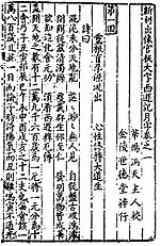
Journey to the West is one of the
Four Great Classical NovelsThe Four Great Classical Novels, or the Four Major Classical Novels of Chinese literature, are the four novels commonly regarded by scholars to be the greatest and most influential of pre-modern Chinese fiction. Dating from the Ming and Qing dynasties, they are well known to most Chinese readers...
of
Chinese literatureChinese literature extends thousands of years, from the earliest recorded dynastic court archives to the mature fictional novels that arose during the Ming Dynasty to entertain the masses of literate Chinese...
. It was written by
Wu Cheng'enWu Cheng'en , courtesy name Ruzhong , pen name "Sheyang Hermit," was a Chinese novelist and poet of the Ming Dynasty, best known for being the attributed author of one of the Four Great Classical Novels of Chinese literature, Journey to the West.-Biography:Wu was born in Lianshui, in Jiangsu...
in the 16th century. In English-speaking countries, the tale is also often known simply as
Monkey. This was one title used for a popular, abridged translation by
Arthur WaleyArthur David Waley CH, CBE was an English orientalist and sinologist.-Life:Waley was born in Tunbridge Wells, Kent, England, as Arthur David Schloss, son of the economist David Frederick Schloss...
. The Waley translation has also been published as
Adventures of the Monkey God,
Monkey: [A] Folk Novel of China, and
The Adventures of Monkey, and in a further abridged version for children,
Dear Monkey.
The novel is a fictionalised account of the legendary pilgrimage to
IndiaIndia , officially the Republic of India , is a country in South Asia. It is the seventh-largest country by geographical area, the second-most populous country with over 1.2 billion people, and the most populous democracy in the world...
of the
BuddhistBuddhism is a religion and philosophy encompassing a variety of traditions, beliefs and practices, largely based on teachings attributed to Siddhartha Gautama, commonly known as the Buddha . The Buddha lived and taught in the northeastern Indian subcontinent some time between the 6th and 4th...
monk
XuanzangXuanzang was a famous Chinese Buddhist monk, scholar, traveler, and translator who described the interaction between China and India in the early Tang period...
, and loosely based its source from the historic text
Great Tang Records on the Western RegionsThe Great Tang Records on the Western Regions is a narrative of Xuanzang's nineteen year journey through Chang'an to Central Asia and eventually South Asia between 626 and 645...
and traditional folk tales. The monk travelled to the "
Western RegionsThe Western Regions or Xiyu was a historical name specified in the Chinese chronicles between the 3rd century BC to 8th century AD that referred to the regions west of Jade Gate, most often Central Asia or sometimes more specifically the easternmost portion of it The Western Regions or Xiyu was a...
" during the
Tang DynastyThe Tang Dynasty was an imperial dynasty of China preceded by the Sui Dynasty and followed by the Five Dynasties and Ten Kingdoms Period. It was founded by the Li family, who seized power during the decline and collapse of the Sui Empire...
, to obtain sacred texts (
sūtraSūtra is an aphorism or a collection of such aphorisms in the form of a manual. Literally it means a thread or line that holds things together and is derived from the verbal root siv-, meaning to sew , as does the medical term...
s). The
BodhisattvaIn Buddhism, a bodhisattva is either an enlightened existence or an enlightenment-being or, given the variant Sanskrit spelling satva rather than sattva, "heroic-minded one for enlightenment ." The Pali term has sometimes been translated as "wisdom-being," although in modern publications, and...
Guan Yin, on instruction from the
BuddhaSiddhārtha Gautama was a spiritual teacher from the Indian subcontinent, on whose teachings Buddhism was founded. In most Buddhist traditions, he is regarded as the Supreme Buddha Siddhārtha Gautama (Sanskrit: सिद्धार्थ गौतम; Pali: Siddhattha Gotama) was a spiritual teacher from the Indian...
, gives this task to the monk and his three protectors in the form of disciples — namely
Sun WukongSun Wukong , also known as the Monkey King is a main character in the classical Chinese epic novel Journey to the West . In the novel, he is a monkey born from a stone who acquires supernatural powers through Taoist practices...
,
Zhu BajieZhu Bajie, also named Zhu Wuneng, is one of the three helpers of Xuanzang in the classic Chinese novel Journey to the West. He is called "Pigsy" or "Pig" in many English versions of the story....
and
Sha WujingShā Wùjìng is one of the three disciples of Xuánzàng in the classic Chinese novel Journey to the West, although versions of his character predate the Ming novel. In the novels, his background is the least developed of the pilgrims and he contributes the least to their efforts...
— together with a dragon prince who acts as Xuanzang's steed, a white horse. These four characters have agreed to help Xuanzang as an atonement for past sins.
Journey to the West has a strong background in
Chinese folk religionChinese folk religion or Shenism , which is a term of considerable debate, are labels used to describe the collection of ethnic religious traditions which have been a main belief system in China and among Han Chinese ethnic groups for most of the civilization's history until today...
,
Chinese mythologyChinese mythology is a collection of cultural history, folktales, and religions that have been passed down in oral or written tradition. These include creation myths and legends and myths concerning the founding of Chinese culture and the Chinese state...
and value systems; the pantheon of
TaoistTaoism refers to a philosophical or religious tradition in which the basic concept is to establish harmony with the Tao , which is the mechanism of everything that exists...
immortals and
BuddhistBuddhism is a religion and philosophy encompassing a variety of traditions, beliefs and practices, largely based on teachings attributed to Siddhartha Gautama, commonly known as the Buddha . The Buddha lived and taught in the northeastern Indian subcontinent some time between the 6th and 4th...
bodhisattvas is still reflective of some Chinese religious beliefs today. Enduringly popular, the tale is at once an adventure story, a spring of spiritual insight, and an extended
allegoryAllegory is a demonstrative form of representation explaining meaning other than the words that are spoken. Allegory communicates its message by means of symbolic figures, actions or symbolic representation...
in which the group of pilgrims journeying toward India represents individuals journeying toward
enlightenmentNirvāṇa ; ) is a central concept in Indian religions. In sramanic thought, it is the state of being free from suffering. In Hindu philosophy, it is the union with the Supreme being through moksha...
.
Authorship
Journey to the West is thought to have been written and published anonymously by Wu Cheng'en in the 16th century. At the time, the trend in writing was to write in
Classical ChineseClassical Chinese or Literary Chinese is a traditional style of written Chinese based on the grammar and vocabulary of ancient Chinese, making it different from any modern spoken form of Chinese...
along the literature of the
HanThe Han Dynasty was the second imperial dynasty of China, preceded by the Qin Dynasty and succeeded by the Three Kingdoms . It was founded by the rebel leader Liu Bang, known posthumously as Emperor Gaozu of Han. It was briefly interrupted by the Xin Dynasty of the former regent Wang Mang...
and
TangThe Tang Dynasty was an imperial dynasty of China preceded by the Sui Dynasty and followed by the Five Dynasties and Ten Kingdoms Period. It was founded by the Li family, who seized power during the decline and collapse of the Sui Empire...
periods. Wu, influenced heavily by popular stories and folk tales since his childhood, chose instead to write this novel in
vernacularA vernacular is the native language or native dialect of a specific population, as opposed to a language of wider communication that is not native to the population, such as a national language or lingua franca.- Etymology :The term is not a recent one...
Chinese, the "vulgar" language used in the everyday lives of common people, publishing it anonymously because of the ill repute such works engendered. The people of Wu's hometown, however, attributed it early on to Wu, and kept records to that effect as early as 1625; thus,
Journey to the West was one of the earliest Chinese novels for which the authorship is officially documented. The novel was first published in print in the 1590s.
Some scholars still have doubts about the novel's authorship. Translator W.F.J. Jenner, for example, points out that although Wu had knowledge of Chinese bureaucracy and politics, the novel itself does not include any political details that "a fairly well-read commoner could not have known." The question of authorship is further complicated by the preexistence of much of the novel's material in the form of folk tales. In any case,
Journey to the West has become the authoritative version of these stories, and Wu's name has become inextricably linked with the book.
Synopsis
The novel has 100 chapters. These can be divided into four very unequal parts. The first, which includes chapters 1–7, is really a self-contained introduction to the main story. It deals entirely with the earlier exploits of Sun Wukong, a monkey born from a stone nourished by the Five Elements, who learns the art of the Tao, 72 polymorphic transformations, combat, and secrets of immortality, and through guile and force makes a name for himself as the
Qitian Dasheng , or "Great Sage Equal to Heaven". His powers grow to match the forces of all of the Eastern (Taoist) deities, and the prologue culminates in Sūn's rebellion against Heaven, during a time when he garnered a post in the
celestial bureaucracyThe Celestial bureaucracy is the pantheon of Chinese mythology. As the name suggests, it is organised similarly to a government administration , with the Jade Emperor as the senior official to whom the other deities must report...
.
HubrisHubris , also hybris, means extreme haughtiness, pride or arrogance. Hubris often indicates a loss of contact with reality and an overestimation of one's own competence or capabilities, especially when the person exhibiting it is in a position of power....
proves his downfall when the
BuddhaSiddhārtha Gautama was a spiritual teacher from the Indian subcontinent, on whose teachings Buddhism was founded. In most Buddhist traditions, he is regarded as the Supreme Buddha Siddhārtha Gautama (Sanskrit: सिद्धार्थ गौतम; Pali: Siddhattha Gotama) was a spiritual teacher from the Indian...
manages to trap him under a mountain, sealing the mountain with a talisman for five hundred years.
Only following this introductory story is the nominal main character, Xuanzang, introduced. Chapters 8–12 provide his early biography and the background to his great journey. Dismayed that "the land of the South knows only greed, hedonism, promiscuity, and sins", the Buddha instructs the
BodhisattvaIn Buddhism, a bodhisattva is either an enlightened existence or an enlightenment-being or, given the variant Sanskrit spelling satva rather than sattva, "heroic-minded one for enlightenment ." The Pali term has sometimes been translated as "wisdom-being," although in modern publications, and...
Guan Yin to search
TangThe Tang Dynasty was an imperial dynasty of China preceded by the Sui Dynasty and followed by the Five Dynasties and Ten Kingdoms Period. It was founded by the Li family, who seized power during the decline and collapse of the Sui Empire...
China for someone to take the Buddhist sutras of "transcendence and persuasion for good will" back to the East. Part of the story here also relates to how Xuánzàng becomes a monk (as well as revealing his past life as a disciple of the Buddha named "Golden
CicadaA cicada is an insect of the order Hemiptera, suborder Auchenorrhyncha , in the superfamily Cicadoidea, with large eyes wide apart on the head and usually transparent, well-veined wings. There are about 2,500 species of cicada around the world, and many of them remain unclassified...
" (金蟬子) and comes about being sent on this pilgrimage by
Emperor Taizong of TangEmperor Taizong of Tang , personal name Lǐ Shìmín , was the second emperor of the Tang Dynasty of China, ruling from 626 to 649...
, who previously escaped death with the help of an underworld official).
The third and longest section of the work is chapters 13–99, an episodic adventure story in which Xuanzang sets out to bring back Buddhist scriptures from
Vulture PeakGriddhraj Parvat , which literally means the hill of vultures, is a hill of religious, archeological and ecological importance situated in Devrajnagar village of tehsil Ramnagar in Satna district of Madhya Pradesh, India...
in India, but encounters various evils along the way. The section is set in the sparsely-populated lands along the
Silk RoadThe Silk Road or Silk Route refers to a historical network of interlinking trade routes across the Afro-Eurasian landmass that connected East, South, and Western Asia with the Mediterranean and European world, as well as parts of North and East Africa...
between China and India, including
XinjiangXinjiang is an autonomous region of the People's Republic of China. It is the largest Chinese administrative division and spans over 1.6 million km2...
,
TurkestanTurkestan, spelled also as Turkistan, literally means "Land of the Turks".The term Turkestan is of Persian origin and has never been in use to denote a single nation. It was first used by Persian geographers to describe the place of Turkish peoples...
, and
AfghanistanAfghanistan , officially the Islamic Republic of Afghanistan, is a landlocked country located in the centre of Asia, forming South Asia, Central Asia and the Middle East. With a population of about 29 million, it has an area of , making it the 42nd most populous and 41st largest nation in the world...
. The geography described in the book is, however, almost entirely fantastic; once Xuánzàng departs
Chang'anChang'an is an ancient capital of more than ten dynasties in Chinese history, today known as Xi'an. Chang'an literally means "Perpetual Peace" in Classical Chinese. During the short-lived Xin Dynasty, the city was renamed "Constant Peace" ; yet after its fall in AD 23, the old name was restored...
, the Tang capital, and crosses the frontier (somewhere in
Gansu' is a province located in the northwest of the People's Republic of China.It lies between the Tibetan and Huangtu plateaus, and borders Mongolia, Inner Mongolia, and Ningxia to the north, Xinjiang and Qinghai to the west, Sichuan to the south, and Shaanxi to the east...
province), he finds himself in a wilderness of deep gorges and tall mountains, inhabited by demons and animal spirts, who regard him as a potential meal (since his flesh was believed to give immortality to whoever ate it), with the occasional hidden monastery or royal city-state amidst the harsh setting.
Episodes consist of 1–4 chapters and usually involve Xuánzàng being captured and having his life threatened while his disciples try to find an ingenious (and often violent) way of liberating him. Although some of Xuanzang's predicaments are political and involve ordinary human beings, they more frequently consist of run-ins with various demons, many of whom turn out to be earthly manifestations of heavenly beings (whose sins will be negated by eating the flesh of Xuanzang) or animal-spirits with enough Taoist spiritual merit to assume semi-human forms.
Chapters 13–22 do not follow this structure precisely, as they introduce Xuanzang's disciples, who, inspired or goaded by Guan Yin, meet and agree to serve him along the way in order to atone for their sins in their past lives.
- The first is Sun Wukong
Sun Wukong , also known as the Monkey King is a main character in the classical Chinese epic novel Journey to the West . In the novel, he is a monkey born from a stone who acquires supernatural powers through Taoist practices...
, or Monkey, previously "Great Sage Equal to Heaven", trapped by Buddha for rebelling against Heaven. He appears right away in Chapter 13. The most intelligent and violent of the disciples, he is constantly reproved for his violence by Xuanzang. Ultimately, he can only be controlled by a magic gold band that the Bodhisattva has placed around his head, which causes him unbearable headaches when Xuanzang chants the Tightening-Crown spell.
- The second, appearing in chapter 19, is Zhu Bajie
Zhu Bajie, also named Zhu Wuneng, is one of the three helpers of Xuanzang in the classic Chinese novel Journey to the West. He is called "Pigsy" or "Pig" in many English versions of the story....
, literally Eight-precepts Pig, sometimes translated as Pigsy or just Pig. He was previously Marshal Tianpeng , commander of the Heavenly Naval forces, banished to the mortal realm for flirting with the Princess of the Moon Chang'eChang'e, Ch'ang-O, Chang-Ngo or Sheung Ngo , originally known as Heng'e or Heng-O , is the Chinese goddess of the Moon. Unlike many lunar deities in other cultures who personify the Moon, Chang'e only lives on the Moon...
. A reliable fighter, he is characterized by his insatiable appetites for food and sex, and is constantly looking for a way out of his duties, which causes significant conflict with Sun Wukong.
- The third, appearing in chapter 22, is the river-ogre Sha Wujing
Shā Wùjìng is one of the three disciples of Xuánzàng in the classic Chinese novel Journey to the West, although versions of his character predate the Ming novel. In the novels, his background is the least developed of the pilgrims and he contributes the least to their efforts...
, also translated as Friar Sand or Sandy. He was previously the celestial Curtain-lifting General , banished to the mortal realm for dropping (and shattering) a crystal goblet of the Heavenly Queen Mother. He is a quiet but generally dependable character, who serves as the straight foil to the comic relief of Sun and Zhu.
- The fourth disciple is the third prince of the Dragon-King, Yulong Santaizi , who was sentenced to death for setting fire to his father's great pearl. He was saved by Guan Yin from execution to stay and wait for his call of duty. He appears first in chapter 15, but has almost no speaking role, as throughout most of the story he appears in the transformed shape of a horse that Xuanzang rides on.
Chapter 22, where Sha Wujing is introduced, also provides a geographical boundary, as the river that the travelers cross brings them into a new "continent". Chapters 23–86 take place in the wilderness, and consist of 24 episodes of varying length, each characterized by a different magical monster or evil magician. There are impassably wide rivers,
flaming mountainsThe Flaming Mountains or Gaochang Mountains are barren, eroded, red sandstone hills in Tian Shan Mountain range, Xinjiang, China. They lie near the northern rim of the Taklamakan Desert and east of the city of Turpan...
, a kingdom ruled by women, a lair of seductive spider-spirits, and many other fantastic scenarios. Throughout the journey, the four brave disciples have to fend off attacks on their master and teacher Xuanzang from various monsters and calamities.
It is strongly suggested that most of these calamities are engineered by fate and/or the Buddha, as, while the monsters who attack are vast in power and many in number, no real harm ever comes to the four travelers. Some of the monsters turn out to be escaped heavenly animals belonging to bodisattvas or Taoist sages and spirits. Towards the end of the book there is a scene where the Buddha literally
commands the fulfillment of the last disaster, because Xuanzang is one short of the eighty-one disasters he needs to attain
BuddhahoodIn Buddhism, buddhahood is the state of perfect enlightenment attained by a buddha .In Buddhism, the term buddha usually refers to one who has become enlightened...
.
In chapter 87, Xuanzang finally reaches the borderlands of India, and chapters 87–99 present magical adventures in a somewhat more mundane (though still exotic) setting. At length, after a pilgrimage said to have taken fourteen years (the text actually only provides evidence for nine of those years, but presumably there was room to add additional episodes) they arrive at the half-real, half-legendary destination of Vulture Peak, where, in a scene simultaneously mystical and comic, Xuanzang receives the scriptures from the living Buddha.
Chapter 100, the last of all, quickly describes the return journey to the Tang Empire, and the aftermath in which each traveler receives a reward in the form of posts in the bureaucracy of the heavens. Sun Wukong and Xuanzang achieve
BuddhahoodIn Buddhism, buddhahood is the state of perfect enlightenment attained by a buddha .In Buddhism, the term buddha usually refers to one who has become enlightened...
, Sha Wujing becomes an arhat, the dragon horse is made a
nāgaNaga or NAGA may refer to:* Nāga, a group of serpent deities in Hindu and Buddhist mythology.-People:* Nayan / Nayar/Nair people of Kerala Society* Naga people, a diverse ethnic identity in Northeast India...
, and Zhu Bajie, whose good deeds have always been tempered by his greed, is promoted to an altar cleanser (i.e. eater of excess offerings at altars).
Historical context
The classic story of the
Journey to the West was based on real events. In real life,
XuanzangXuanzang was a famous Chinese Buddhist monk, scholar, traveler, and translator who described the interaction between China and India in the early Tang period...
(born c. 602 - 664) was a monk at Jingtu Temple in late-
Sui DynastyThe Sui Dynasty was a powerful, but short-lived Imperial Chinese dynasty. Preceded by the Southern and Northern Dynasties, it ended nearly four centuries of division between rival regimes. It was followed by the Tang Dynasty....
and early-
Tang DynastyThe Tang Dynasty was an imperial dynasty of China preceded by the Sui Dynasty and followed by the Five Dynasties and Ten Kingdoms Period. It was founded by the Li family, who seized power during the decline and collapse of the Sui Empire...
Chang'anChang'an is an ancient capital of more than ten dynasties in Chinese history, today known as Xi'an. Chang'an literally means "Perpetual Peace" in Classical Chinese. During the short-lived Xin Dynasty, the city was renamed "Constant Peace" ; yet after its fall in AD 23, the old name was restored...
. Motivated by the poor quality of Chinese translations of Buddhist scripture at the time, Xuanzang left
Chang'anChang'an is an ancient capital of more than ten dynasties in Chinese history, today known as Xi'an. Chang'an literally means "Perpetual Peace" in Classical Chinese. During the short-lived Xin Dynasty, the city was renamed "Constant Peace" ; yet after its fall in AD 23, the old name was restored...
in 629, despite the border being closed at the time due to war with the Gokturks. Helped by sympathetic Buddhists, he travelled via
Gansu' is a province located in the northwest of the People's Republic of China.It lies between the Tibetan and Huangtu plateaus, and borders Mongolia, Inner Mongolia, and Ningxia to the north, Xinjiang and Qinghai to the west, Sichuan to the south, and Shaanxi to the east...
and
QinghaiQinghai ; Oirat Mongolian: ; ; Salar:) is a province of the People's Republic of China, named after Qinghai Lake...
to Kumul (Hami), thence following the
Tian ShanThe Tian Shan , also spelled Tien Shan, is a large mountain system located in Central Asia. The highest peak in the Tian Shan is Victory Peak , ....
mountains to Turpan. He then crossed what are today
KyrgyzstanKyrgyzstan , officially the Kyrgyz Republic is one of the world's six independent Turkic states . Located in Central Asia, landlocked and mountainous, Kyrgyzstan is bordered by Kazakhstan to the north, Uzbekistan to the west, Tajikistan to the southwest and China to the east...
,
UzbekistanUzbekistan , officially the Republic of Uzbekistan is a doubly landlocked country in Central Asia and one of the six independent Turkic states. It shares borders with Kazakhstan to the west and to the north, Kyrgyzstan and Tajikistan to the east, and Afghanistan and Turkmenistan to the south....
, and
AfghanistanAfghanistan , officially the Islamic Republic of Afghanistan, is a landlocked country located in the centre of Asia, forming South Asia, Central Asia and the Middle East. With a population of about 29 million, it has an area of , making it the 42nd most populous and 41st largest nation in the world...
, into
GandharaGandhāra , is the name of an ancient kingdom , located in northern Pakistan and eastern Afghanistan. Gandhara was located mainly in the vale of Peshawar, the Potohar plateau and on the Kabul River...
, reaching India in 630. Xuanzang travelled throughout the
Indian subcontinentThe Indian subcontinent, also Indian Subcontinent, Indo-Pak Subcontinent or South Asian Subcontinent is a region of the Asian continent on the Indian tectonic plate from the Hindu Kush or Hindu Koh, Himalayas and including the Kuen Lun and Karakoram ranges, forming a land mass which extends...
for the next thirteen years, visiting important Buddhist pilgrimage sites and studying at the ancient university at
NalandaNālandā is the name of an ancient center of higher learning in Bihar, India.The site of Nalanda is located in the Indian state of Bihar, about 55 miles south east of Patna, and was a Buddhist center of learning from the fifth or sixth century CE to 1197 CE. It has been called "one of the...
.
Xuanzang left India in 643 and arrived back in
Chang'anChang'an is an ancient capital of more than ten dynasties in Chinese history, today known as Xi'an. Chang'an literally means "Perpetual Peace" in Classical Chinese. During the short-lived Xin Dynasty, the city was renamed "Constant Peace" ; yet after its fall in AD 23, the old name was restored...
in 646 to a warm reception by
Emperor Taizong of TangEmperor Taizong of Tang , personal name Lǐ Shìmín , was the second emperor of the Tang Dynasty of China, ruling from 626 to 649...
. He joined Da Ci'en Monastery (Monastery of Great Maternal Grace), where he led the building of the Big Wild Goose Pagoda in order to store the scriptures and icons he had brought back from India. He recorded his journey in the book
Great Tang Records on the Western RegionsThe Great Tang Records on the Western Regions is a narrative of Xuanzang's nineteen year journey through Chang'an to Central Asia and eventually South Asia between 626 and 645...
. With the support of the Emperor, he established an institute at Yuhua Gong (Palace of the Lustre of Jade) monastery dedicated to translating into
ChineseThe Chinese language is a language or language family consisting of varieties which are mutually intelligible to varying degrees. Originally the indigenous languages spoken by the Han Chinese in China, it forms one of the branches of Sino-Tibetan family of languages...
the scriptures he had brought back. His translation and commentary work established him as the founder of the
Dharma character schoolEast Asian Yogācāra refers to the traditions in East Asia which represent the Indian Yogācāra system of thought. It is a school of Buddhism originating in China. In China, it is known as Wéishí-zōng , or Fǎxiàng-zōng...
of Buddhism. Xuanzang died on March 7, 664. The Xingjiao Monastery was established in 669 to house his ashes.
Popular stories of Xuanzang's journey were in existence long before
Journey to the West was written. In these versions, dating as far back as Southern Song, a monkey character was already a primary protagonist. Before the
Yuan DynastyThe Yuan Dynasty , or Great Yuan Empire was a ruling dynasty founded by the Mongol leader Kublai Khan, who ruled most of present-day China, all of modern Mongolia and its surrounding areas, lasting officially from 1271 to 1368. It is considered both as a division of the Mongol Empire and as an...
and early Ming, elements of the Monkey story were already seen.
Tripitaka or Xuanzang
The monk
Xuánzàng (陈玄奘) (or
Táng-Sānzàng (唐三藏), "Tang-dynasty monk" —
Sānzàng (三藏) or "Three Hiddens", refers to the
Tripitaka' is a traditional term used by various Buddhist sects to describe their various canons of scriptures. As the name suggests, a traditionally contains three "baskets" of teachings: a , a and an .-The three categories:Tripitaka is the three main categories of texts that make up the...
, a traditional honorific for a Buddhist monk) is the Buddhist monk who had renounced his family to become a monk from childhood. He set off for Dahila kingdom 天竺国(an appellation for India in Ancient China) to retrieve the Buddhist scriptures for China. He is just called
Tripitaka in many English versions of the story. Although he is helpless in defending himself, the
bodhisattvaIn Buddhism, a bodhisattva is either an enlightened existence or an enlightenment-being or, given the variant Sanskrit spelling satva rather than sattva, "heroic-minded one for enlightenment ." The Pali term has sometimes been translated as "wisdom-being," although in modern publications, and...
Guānyīn helps by finding him powerful disciples who aid and protect him on his journey. In return, the disciples will receive enlightenment and forgiveness for their sins once the journey is done. Along the way, they help the local inhabitants by defeating various monsters and demons who try to obtain immortality by eating Xuánzàng's flesh.
Monkey King or Sun Wukong
Sūn Wùkōng is the name given to this character by his teacher, Patriarch
SubhutiSubhūti was one of the Ten Great Śrāvakas of Śākyamuni Buddha, and foremost in the understanding of emptiness. In Sanskrit, his name literally means "Good Existence" . He is also sometimes referred to as or "Elder Subhūti"...
, which means "
Awakenedis a Japanese Buddhist term for enlightenment that literally means "understanding". In the Zen Buddhist tradition, satori refers to a flash of sudden awareness, or individual enlightenment, and is considered a "first step" or embarkation toward nirvana....
to
EmptinessŚūnyatā, शून्यता , Suññatā , stong-pa nyid , Kòng/Kū, 空 , Gong-seong, 공성 , qoγusun is frequently translated into English as emptiness...
" (in the Waley translation,
Aware-of-Vacuity); he is called
Monkey King. He is born on Flower Fruit Mountain from a stone egg that forms from an ancient rock created by the coupling of heaven and earth. He first distinguishes himself by bravely entering the
Cave of Water CurtainsShuilian Cave , literally meaning Water Curtain Cave, is an area featured within the famed Chinese novel Journey to the West. Shuilian Cave had been featured since the first chapter of this novel. Very early on, Sun Wukong would become the king of this cave and it would generally be used for all...
on the mountain; for this feat, his monkey tribe gives him the title of "Handsome Monkey-King". After angering several gods and coming to the attention of the
Jade EmperorThe Jade Emperor in Chinese folk culture, is the ruler of Heaven and all realms of existence below including that of Man and Hell, according to a version of Taoist mythology. He is one of the most important gods of the Chinese traditional religion pantheon...
, he is given a minor position in heaven as the Protector of Horses (弼马温) so they can keep an eye on him. This job is a very low position, and when he realizes that he is put into such a low position and not considered a full-fledged god, he becomes very angry. Upon returning to his mountain, he puts up a flag and declares himself the "Great Sage Equaling Heaven." Then the Jade emperor dispatches celestial soldiers to arrest Sun Wukong, but no one succeeds. The Jade emperor has no choice but to appoint him to be the patrolman of the heavenly peach garden. The peaches in the garden bear fruit every 3,000-years, eating its flesh will bestow immortality, so Wukong eats one and becomes more powerful and matchless. Later, after fairies who come to collect peaches for the heavenly peach banquet inform Wukong he is not invited and make fun of him, he starts making trouble in Heaven and defeats an army of 100,000 celestial soldiers, led by the
Four Heavenly KingsIn the Buddhist faith, the Four Heavenly Kings are four gods, each of whom watches over one cardinal direction of the world.The Kings are collectively named as follows:...
,
Erlang ShenErlang Shen , or Erlang is a Chinese God with a third truth-seeing eye in the middle of his forehead.Er-lang Shen may be a deified version of several semi-mythical folk heroes who help regulate China's torrential floods, dating variously from the Qin, Sui and Jin dynasties...
, and Nezha. Eventually, the
Jade EmperorThe Jade Emperor in Chinese folk culture, is the ruler of Heaven and all realms of existence below including that of Man and Hell, according to a version of Taoist mythology. He is one of the most important gods of the Chinese traditional religion pantheon...
appeals to
BuddhaSiddhārtha Gautama was a spiritual teacher from the Indian subcontinent, on whose teachings Buddhism was founded. In most Buddhist traditions, he is regarded as the Supreme Buddha Siddhārtha Gautama (Sanskrit: सिद्धार्थ गौतम; Pali: Siddhattha Gotama) was a spiritual teacher from the Indian...
, who detains Wukong under a mountain called Five Elements Mountain (五行山). Wukong is kept under the mountain for 500 years, and cannot escape because of a spell that was put on the mountain. He is later set free when Xuanzang comes upon him during his pilgrimage and accepts him as a disciple.
His primary weapon is the "will-following golden-banded staff," which he can shrink down to the size of a needle and keep behind his ear, as well as expand it to gigantic proportions (hence the "will-following" part of the name). The staff, originally a pillar supporting the undersea palace of the
Dragon King of the East SeaAo Guang is the Dragon King of the East Sea in Chinese mythology...
, weighs 18,000 pounds, which he pulls out of its support and swings with ease. The
Dragon King of the East SeaAo Guang is the Dragon King of the East Sea in Chinese mythology...
had told Wukong he could have the staff if he could lift it, but was angry when Wukong was actually able to pull it out and accused him of being a thief; hence Wukong was insulted, so he demanded a suit of armor and refused to leave until he received one. The Dragon King, unwilling to see a monkey making troubles in his favorite place, also gave him a suit of golden armor. These gifts, combined with his devouring of the peaches of immortality, three jars of immortality pills, and his time being tempered in
LaoziLaozi was a mystic philosopher of ancient China, best known as the author of the Tao Te Ching . His association with the Tao Te Ching has led him to be traditionally considered the founder of Taoism...
's
eight-trigramThe bagua are eight diagrams used in Taoist cosmology to represent the fundamental principles of reality, seen as a range of eight interrelated concepts. Each consists of three lines, each line either "broken" or "unbroken," representing yin or yang, respectively...
furnace(he was put in there to be executed, but instead the furnace gave him a steel-hard body and fiery golden eyes that can see very far and see through any disguise, but his eyes are weak to smoke. he is always able to recognize a demon in disguise, even though the rest of the pilgrimage can not), makes Sun the strongest member of the pilgrimage by far. Besides these abilities, he can also pluck hairs from his body and blow on them to convert them into whatever he wishes (usually clones of himself to gain a numerical advantage in battle). Although he is a master of the 72 methods of transformation (七十二变), such as birds, which would give him the ability to fly, he can also do a "cloud somersault," enabling him to travel vast distances in a single leap. The monkey, nimble and quick-witted, uses these skills to defeat all but the most powerful of demons on the journey.
Sun's behavior is checked by a band placed around his head by Guan Yin
BodhisattvaIn Buddhism, a bodhisattva is either an enlightened existence or an enlightenment-being or, given the variant Sanskrit spelling satva rather than sattva, "heroic-minded one for enlightenment ." The Pali term has sometimes been translated as "wisdom-being," although in modern publications, and...
, which cannot be removed by Sun himself until the journey's end. Xuanzang can tighten this band by chanting the "Tightening-Crown spell" (taught to him by Guan Yin) whenever he needs to chastise him. The spell is referred to by Xuanzang's disciples as the "Headache Sutra", which is the Buddhist
mantraA mantra is a sound, syllable, word, or group of words that is considered capable of "creating transformation"...
"
oṃ maṇipadme hūṃ is the six syllabled mantra particularly associated with the four-armed Shadakshari form of Avalokiteshvara , the bodhisattva of compassion...
." Xuanzang speaks this mantra quickly in repetition.
Sun's child-like playfulness is a huge contrast to his cunning mind. This, coupled with his great power, makes him a Trickster hero. His antics present a lighter side in what proposes to be a long and dangerous trip into the unknown.
Zhu Bajie
Zhū Bājiè ("Pig of the Eight Prohibitions") is also known as
Zhū Wùnéng ("Pig Awakened to Ability"), and given the name
Pigsy,
Monk Pig or just simply
Pig in
EnglishEnglish is a West Germanic language that arose in the Anglo-Saxon kingdoms of England and spread into what was to become south-east Scotland under the influence of the Anglian medieval kingdom of Northumbria...
.
Once an immortal who was the Marshal Tianpeng of 100,000 soldiers of the
Milky WayThe Milky Way is the galaxy that contains the Solar System. This name derives from its appearance as a dim un-resolved "milky" glowing band arching across the night sky...
, he drank too much during a celebration of gods and attempted to flirt with
Cháng'éChang'e, Ch'ang-O, Chang-Ngo or Sheung Ngo , originally known as Heng'e or Heng-O , is the Chinese goddess of the Moon. Unlike many lunar deities in other cultures who personify the Moon, Chang'e only lives on the Moon...
, the beautiful moon goddess, resulting in his banishment into the mortal world. He was supposed to be reborn as a human, but ends up in the womb of a female boar due to an error at the Reincarnation Wheel, which turns him into a half-man half-pig monster. Zhu Bajie was very greedy, and could not survive without eating ravenously. Staying within
Yúnzhan-dòng ("cloud-pathway cave"), he was commissioned by Guan Yin to accompany Xuanzang to India and given the new name Zhu Wuneng.
However, Zhu's indulgence in women's beauty led him to Gaojiazhuang Village, where he posed as a normal being and wedded a maiden. Later, when the villagers discovered that he was a monster, Zhu hid the girl away, and the girl wailed bitterly every night. At this point, Xuanzang and Sun Wukong arrived at Gaojiazhuang Village and helped defeat him. Renamed Zhu Bajie by Xuanzang, he consequently joined the pilgrimage to the West.
His weapon of choice is the
jiǔchǐdīngpá ("
nine-tooth iron rakeA rake is a broom for outside; an horticultural implement consisting of a toothed bar fixed transversely to a handle, and used to collect leaves, hay, grass, etc., and, in gardening, for loosening the soil, light weeding and levelling, removing dead grass from...
"). He is also capable of thirty-six transformations (as compared to Sun Wukong's seventy-two), and can travel on clouds, but not as fast as Sun. However, Zhu is noted for his fighting skills in water, which he used to combat Sha Wujing, who later joined them on the journey. He is the second strongest member of the team.
Sha Wujing
Shā Wùjìng 沙悟净 (literally meaning "Sand Awakened to Purity"), given the name
Friar Sand or
Sandy in
EnglishEnglish is a West Germanic language that arose in the Anglo-Saxon kingdoms of England and spread into what was to become south-east Scotland under the influence of the Anglian medieval kingdom of Northumbria...
, was once the Curtain Raising General, who stood in attendance by the imperial chariot in the Hall of Miraculous Mist. He was exiled to the mortal world and made to look like a monster because he accidentally smashed a crystal goblet belonging to the Heavenly Queen Mother during the Peach Banquet. The now-hideous immortal took up residence in the
Flowing Sands RiverThe Kaidu River , also known under its ancient name Liusha River or Chaidu-gol is a river in the Xinjiang Uyghur Autonomous Region of China and an important source of water for the region....
, terrorizing the surrounding villages and travelers trying to cross the river. However, he was subdued by Sun Wukong and Zhu Bajie when Xuanzang's party came across him. They consequently took him in, as part of the pilgrimage to the West.
Sha's weapon is the
yuèyáchǎn ("Crescent-Moon-Shovel" or "
Monk's SpadeA monk's spade A monk's spade A monk's spade (Traditional Chinese: 月牙鏟; Simplified Chinese: 月牙铲; pinyin: yuèyáchǎn; literally "Crescent Moon Spade"; also, Traditional Chinese: 禪仗; Simplified Chinese: 禅仗; pinyin: chánzhàng; literally, "Zen Weapon"...
"). He also knows eighteen transformation methods and is highly effective in water combat. He is about as strong as Zhu Bajie, and is much stronger than Wùkōng in water. However, Zhu can defeat Sha in a test of endurance, and Sun can defeat him on land.
Sha is known to be the most obedient, logical, and polite of the three disciples, and always takes care of his master, seldom engaging in the bickering of his fellow disciples. He has no major faults nor any extraordinary characteristics. Perhaps this is why he is sometimes seen as a minor character.
Sha eventually becomes an Arhat at the end of the journey, giving him a higher level of exaltation than Zhu, who is relegated to cleaning every altar at every Buddhist temple for eternity, but is still lower spiritually than Sun or Xuanzang, who are granted Buddhahood.
Sequels
The brief satirical novel
Xiyoubu (西游补, "Supplement to the Journey to the West," c. 1640) follows Sun as he is trapped in a magical dream world created by the Qing Fish Demon, the embodiment of desire (情, qing). Sun travels back and forth through time, during which he serves as the adjunct
King of HellYama , also known as Yamarāja in India and Nepal, Shinje in Tibet, Yanluowang or simply Yan in China, Yeomla Daewang in South Korea and Enma Dai-Ō in Japan, is the lord of death, in Hinduism and then adopted into Buddhism and then further into Chinese mythology and Japanese mythology. First...
and judges the soul of the recently dead traitor
Qin HuiQin Hui or Qin Kuai was a Chancellor of the Song Dynasty in China, who is widely regarded as a traitor of the Han race for his part in the political execution of General Yue Fei...
during the
Song DynastyThe Song Dynasty was a ruling dynasty in China between 960 and 1279; it succeeded the Five Dynasties and Ten Kingdoms Period, and was followed by the Yuan Dynasty. It was the first government in world history to issue banknotes or paper money, and the first Chinese government to establish a...
, takes on the appearance of a beautiful concubine and causes the downfall of the
Qin DynastyThe Qin Dynasty was the first imperial dynasty of China, lasting from 221 to 207 BC. The Qin state derived its name from its heartland of Qin, in modern-day Shaanxi. The strength of the Qin state was greatly increased by the legalist reforms of Shang Yang in the 4th century BC, during the Warring...
, and even faces King
ParamitaPāramitā or pāramī is "perfection" or "completeness." In Buddhism, the pāramitās refer to the perfection or culmination of certain virtues...
, one of his five sons born to the demoness
Princess Iron FanPrincess Iron Fan is a fictional character from the Chinese classic novel Journey to the West. She is the wife of the Bull King and mother of Red Boy. She is a beautiful goddess living in an underground cave awaiting her husband's return, but also angry at him for his affair with a foxy vixen...
, on the battlefield during the
Tang DynastyThe Tang Dynasty was an imperial dynasty of China preceded by the Sui Dynasty and followed by the Five Dynasties and Ten Kingdoms Period. It was founded by the Li family, who seized power during the decline and collapse of the Sui Empire...
. The events of the
Xiyoubu take place between the end of chapter 61 and the beginning of chapter 62 of
Journey to the West. The author, Tong Yue (童说), wrote the book because he wanted to create an opponent—in this case desire—that Sun could not defeat with his great strength and martial skill.
Notable English-language translations
- Monkey: A Folk-Tale of China (1942), an abridged translation by Arthur Waley
Arthur David Waley CH, CBE was an English orientalist and sinologist.-Life:Waley was born in Tunbridge Wells, Kent, England, as Arthur David Schloss, son of the economist David Frederick Schloss...
. For many years, the most well-known translation available in EnglishEnglish is a West Germanic language that arose in the Anglo-Saxon kingdoms of England and spread into what was to become south-east Scotland under the influence of the Anglian medieval kingdom of Northumbria...
. Waley noted in his preface that the novel was usually read in abridgement in Chinese. "The method adopted in these abridgements is to leave the original number of separate episodes, but drastically reduce them in length, particularly by cutting out dialogue. I have for the most part adopted the opposite principle, omitting many episodes, but translating those that are retained almost in full, leaving out, however, most of the incidental passages in verse, which go very badly into English.". The degree of abridgement, 30 out of the 100 chapters (which corresponds to roughly 1/6 of the whole text), and the excising, e.g., most of the verse, has led to some recent critics awarding it the lesser place of a good retelling of the story. On the other hand, it has been praised as "remarkably faithful to the original spirit of the work."
- Journey to the West (1982–1984), a complete translation in three volumes by W.J.F. Jenner. Readable translation without scholarly apparatus. Foreign Languages Press Beijing (ISBN 0-8351-1003-6, ISBN 0-8351-1193-8, ISBN 0-8351-1364-7; 1993 edition in four volumes: ISBN 978-7-119-01663-4; 2003 edition in six volumes with original Chinese on left page, English translation on right page: ISBN 7-119-03216-X)
- The Journey to the West (1977–1983), a complete translation in four volumes by Anthony C. Yu
Anthony C. Yu is a literature and religion scholar. He is currently the Carl Darling Buck Distinguished Service Professor Emeritus at the University of Chicago....
. Complete translation with extensive scholarly introduction and notes. University of Chicago PressThe University of Chicago Press is the largest university press in the United States. It is operated by the University of Chicago and publishes a wide variety of academic titles, including The Chicago Manual of Style, dozens of academic journals, including Critical Inquiry, and a wide array of...
: HC ISBN 0-226-97145-7, ISBN 0-226-97146-5, ISBN 0-226-97147-3, ISBN 0-226-97148-1; PB ISBN 0-226-97150-3, ISBN 0-226-97151-1; ISBN 0-226-97153-8; ISBN 0-226-97154-6. In 2006, an abridged version of this translation was published by Chicago UP under the title The Monkey and the Monk.
Further reading
- Jenner, W.J.F. (1984). "Translator's Afterword." in trans. W.J.F. Jenner, Journey to the West, volume 4. Seventh Edition. Beijing: Foreign Languages Press. 2341–2343.
- Shi Changyu 石昌渝 (1999). "Introduction." in trans. W.J.F. Jenner, Journey to the West, volume 1. Seventh Edition. Beijing: Foreign Languages Press. 1–22.
- Yu, Anthony. "Introduction". Journey to the West. Trans. and ed. Anthony Yu. Vol. 1. Chicago - London: University of Chicago Press, 1977. 1–62.
Critical studies
- Fu, James S. Mythic and Comic Aspects of the Quest. Singapore: Singapore University Press, 1977.
- Hsia, C.T. "The Journey to the West". The Classic Chinese Novel. New York: Columbia UP, 1968. 115–164.
- Kao, Karl S.Y. "An Archetypal Approach to Hsi-yu chi." Tamkang Review 5, no.2 (Oct 1974). 63–98.
- Plaks, Andrew. The Four Masterworks of the Ming Novel. Princeton: Princeton UP, 1987. 183–276.
- ---. "Journey to the West". Miller, Barbara S. (ed.): Masterworks of Asian Literature in Comparative Perspective. New York - London: M.E. Sharpe, 1994. 272–284.
- Yu, Anthony C. "Two Literary Examples of Religious Pilgrimage: The Commedia and the Journey to the West." History of Religions 22, no. 3 (Feb 1983). 202–230.
External links
Traditional Chinese
- Journey to the West from the Gutenberg Project (UTF-8
UTF-8 is a multibyte character encoding for Unicode. Like UTF-16 and UTF-32, UTF-8 can represent every character in the Unicode character set. Unlike them, it is backward-compatible with ASCII and avoids the complications of endianness and byte order marks...
encoding)
- Journey to the West from Open Lit (Big5
Big-5 or Big5 is a character encoding method used in Taiwan, Hong Kong, and Macau for Traditional Chinese characters.Mainland China, which uses Simplified Chinese Characters, uses the GB instead.- Organization :...
encoding)
Simplified Chinese
English
Other links
- Story of Sun Wukong and the beginning of Journey to the West with manhua
Manhua are Chinese comics originally produced in China. Possibly due to their greater degree of artistic freedom of expression and closer international ties with Japan, Hong Kong and Taiwan have been the places of publication of most manhua thus far, often including Chinese translations of...