

Wilkinson Microwave Anisotropy Probe

Encyclopedia
The Wilkinson Microwave Anisotropy Probe (WMAP) — also known as the Microwave Anisotropy Probe (MAP), and Explorer 80 — is a spacecraft
which measures differences in the temperature of the Big Bang
's remnant radiant heat — the Cosmic Microwave Background Radiation
— across the full sky. Headed by Professor Charles L. Bennett
, Johns Hopkins University
, the mission was developed in a joint partnership between the NASA Goddard Space Flight Center
and Princeton University
. The WMAP spacecraft was launched on 30 June 2001, at 19:46:46 GDT, from Florida. The WMAP mission succeeds the COBE
space mission and was the second medium-class (MIDEX) spacecraft of the Explorer program
. In 2003, MAP was renamed WMAP in honor of cosmologist David Todd Wilkinson
(1935–2002), who had been a member of the mission's science team.
WMAP's measurements played the key role in establishing the current Standard Model of Cosmology. WMAP data are very well fit by a universe that is dominated by dark energy in the form of a cosmological constant. Other cosmological data are also consistent, and together tightly constrain the Model. In this Lambda-CDM model
of the universe, the age of the universe
is 13.75 ± 0.11 billion years. The WMAP mission's determination of the age of the universe to better than 1% precision was recognized by the Guinness Book of World Records. The current expansion rate of the universe is (see Hubble constant
) of 70.5 ± 1.3 km·s−1·Mpc−1. The content of the universe presently consists of 4.56% ± 0.15% ordinary baryonic matter; 22.8% ± 1.3% Cold dark matter
(CDM) that neither emits nor absorbs light; and 72.6% ± 1.5% of dark energy
in the form of a cosmological constant that accelerates the expansion of the universe. Less than 1% of the current contents of the universe is in neutrinos, but WMAP's measurements have found, for the first time in 2008, that the data prefers the existence of a cosmic neutrino background
with an effective number of neutrino flavors of 4.4 ± 1.5, consistent with the expectation of 3.06. The contents point to a "flat" Euclidean flat geometry
, with the ratio of the energy density in curvature to the critical density 0.0179 < Ωk <0.0081 (95%CL). The WMAP measurements also support the cosmic inflation
paradigm in several ways, including the flatness measurement.
According to Science magazine, the WMAP was the Breakthrough of the Year for 2003. This mission's results papers were first and second in the "Super Hot Papers in Science Since 2003" list. Of the all-time most referenced papers in physics and astronomy in the SPIRES database, only three have been published since 2000, and all three are WMAP publications. On May 27, 2010, it was announced that Bennett, Lyman A. Page, Jr.
, and David N. Spergel, the latter both of Princeton University, would share the 2010 Shaw Prize
in astronomy for their work on WMAP.
As of October 2010, the WMAP spacecraft is in a graveyard orbit
after 9 years of operations. The Astronomy and Physics Senior Review panel at NASA Headquarters has endorsed a total of 9 years of WMAP operations, through September 2010. All WMAP data are released to the public and have been subject to careful scrutiny.
Some aspects of the data are statistically unusual for the Standard Model of Cosmology. For example, the greatest angular-scale measurements, the quadrupole moment, is somewhat smaller than the Model would predict, but this discrepancy is not highly significant. A large cold spot
and other features of the data are more statistically significant, and research continues into these.
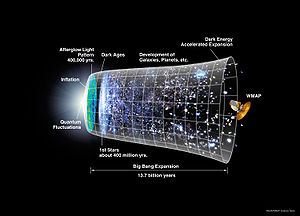 The WMAP objective is to measure the temperature differences in the Cosmic Microwave Background (CMB) radiation
. The anisotropies then are used to measure the universe's geometry
, content, and evolution; and to test the Big Bang model, and the cosmic inflation
theory. For that, the mission is creating a full-sky map of the CMB, with a 13 arcminute resolution via multi-frequency observation. The map requires the fewest systematic error
s, no correlated pixel noise, and accurate calibration, to ensure angular-scale accuracy greater than its resolution. The map contains 3,145,728 pixels, and uses the HEALPix
scheme to pixelize the sphere. The telescope also measures the CMB's E-mode polarization, and foreground polarization; its life is 27 months; 3 to reach the position, 2 years of observation.
 The MAP mission was proposed to NASA in 1995, selected for definition study in 1996, and approved for development in 1997.
The WMAP was preceded by two missions to observe the CMB; (i) the Soviet RELIKT-1
that reported the upper-limit measurements of CMB anisotropies, and (ii) the U.S. COBE
satellite that reported large-scale CMB fluctuations, and the ground-based and balloon experiments measuring the small-scale fluctuations in patches of sky: the Boomerang
, the Cosmic Background Imager
, and the Very Small Array
. The WMAP is 45 times more sensitive, with 33 times the angular resolution of its COBE satellite predecessor.
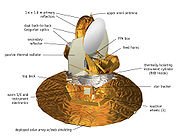 The telescope's primary reflecting mirrors are a pair of Gregorian
1.4m x 1.6m dishes (facing opposite directions), that focus the signal onto a pair of 0.9m x 1.0m secondary reflecting mirrors. They are shaped for optimal performance: a carbon fibre shell upon a Korex core, thinly-coated with aluminium
and silicon oxide
. The secondary reflectors transmit the signals to the corrugated feedhorns that sit on a focal plane array box beneath the primary reflectors.
 The receivers are polarization-sensitive differential radiometer
s measuring the difference between two telescope beams. The signal is amplified with HEMT
low-noise amplifier
s. There are 20 feeds, 10 in each direction, from which a radiometer collects a signal; the measure is the difference in the sky signal from opposite directions. The directional separation azimuth is 180 degrees; the total angle is 141 degrees. To avoid collecting Milky Way
galaxy foreground signals, the WMAP uses five discrete radio frequency bands, from 23 GHz to 94 GHz.
The WMAP's base is a 5.0m-diameter solar panel array that keeps the instruments in shadow during CMB observations, (by keeping the craft constantly angled at 22 degrees, relative to the sun). Upon the array sit a bottom deck (supporting the warm components) and a top deck. The telescope's cold components: the focal-plane array and the mirrors, are separated from the warm components with a cylindrical, 33 cm-long thermal isolation shell atop the deck.
Passive thermal radiators cool the WMAP to ca. 90 degrees K; they are connected to the low-noise amplifiers. The telescope consumes 419 W
of power. The available telescope heaters are emergency-survival heaters, and there is a transmitter heater, used to warm them when off. The WMAP spacecraft's temperature is monitored with platinum resistance thermometers.
The WMAP's calibration is effected with the CMB dipole and measurements of Jupiter
; the beam patterns are measured against Jupiter. The telescope's data are relayed daily via a 2 GHz transponder
providing a 667kbit/s downlink to a 70m Deep Space Network
telescope. The spacecraft has two transponders, one a redundant back-up; they are minimally active — ca. 40 minutes daily — to minimize radio frequency interference. The telescope's position is maintained, in its three axes, with three reaction wheels, gyroscope
s, two star trackers and sun sensors, and is steered with eight hydrazine
thrusters.
 The WMAP spacecraft arrived at the Kennedy Space Center on 20 April 2001. After being tested for two months, it was launched via Delta II 7425 rocket on 30 June 2001. It began operating on its internal power five minutes before its launching, and so continued operating until the solar panel array deployed. The WMAP was activated and monitored while it cooled. On 2 July, it began working, first with in-flight testing (from launching until 17 August), then began constant, formal work. Afterwards, it effected three Earth-Moon phase loops, measuring its sidelobes, then flew by the Moon on 30 July, enroute to the Sun-Earth Lagrangian point
, arriving there on 1 October 2001, becoming, thereby, the first CMB observation mission permanently posted there.
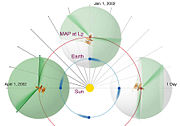 The spacecraft's location at Lagrange 2, (1.5 million kilometers from Earth) minimizes the amount of contaminating solar, terrestrial, and lunar emissions registered, and thermally stabilizes it. To view the entire sky, without looking to the sun, the WMAP traces a path around in a Lissajous orbit
ca. 1.0 degree to 10 degrees, with a 6-month period. The telescope rotates once every 2 minutes, 9 seconds" (0.464 rpm) and precesses
at the rate of 1 revolution per hour. WMAP measures the entire sky every six months, and completed its first, full-sky observation in April 2002.
and free-free emission (dominating the lower frequencies), and astrophysical dust emissions (dominating the higher frequencies). The spectral properties of these emissions contribute different amounts to the five frequencies, thus permitting their identification and subtraction.
Foreground contamination is removed in several ways. First, subtract extant emission maps from the WMAP's measurements; second, use the components' known, spectral values to identify them; third, simultaneously fit the position and spectra data of the foreground emission, using extra data sets. Foreground contamination also is reduced by using only the full-sky map portions with the least foreground contamination, whilst masking the remaining map portions.
 On 11 February 2003, based upon one year's worth of WMAP data, NASA published the latest calculated age, composition, and image of the universe to date, that "contains such stunning detail, that it may be one of the most important scientific results of recent years"; the data surpass previous CMB measurements.
Based upon the Lambda-CDM model, the WMAP team produced cosmological parameters from the WMAP's first-year results. Three sets are given below; the first and second sets are WMAP data; the difference is the addition of spectral indices, predictions of some inflationary models. The third data set combines the WMAP constraints with those from other CMB experiments (ACBAR and CBI
), and constraints from the 2dF Galaxy Redshift Survey
and Lyman alpha forest measurements. Note that there are degenerations among the parameters, the most significant is between and
and  ; the errors given are at 68% confidence.
Using the best-fit data and theoretical models, the WMAP team determined the times of important universal events, including the redshift of reionization, ; the redshift of decoupling
, (and the universe's age at decoupling); and the redshift of matter/radiation equality, . They determined the thickness of the surface of last scattering to be in redshift, or . They determined the current density of baryons, , and the ratio of baryons to photons, . The WMAP's detection of an early reionization excluded warm dark matter
.
The team also examined Milky Way emissions at the WMAP frequencies, producing a 208-point source
catalogue. Also, they observed the Sunyaev-Zel'dovich effect
at 2.5 σ
the strongest source is the Coma cluster.
 The three-year WMAP data were released on 17 March 2006. The data included temperature and polarization measurements of the CMB, which provided further confirmation of the standard flat Lambda-CDM model
and new evidence in support of inflation.
The 3-year WMAP data alone shows that the universe must have dark matter. Results were computed both only using WMAP data, and also with a mix of parameter constraints from other instruments, including other CMB experiments (ACBAR, CBI
and BOOMERANG
), SDSS
, the 2dF Galaxy Redshift Survey
, the Supernova Legacy Survey
and constraints on the Hubble constant from the Hubble Space Telescope
.
[a] Optical depth to reionization improved due to polarization measurements.
[b] < 0.30 when combined with SDSS
data. No indication of non-gaussianity.
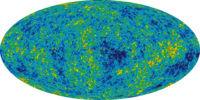 The five-year WMAP data were released on 28 February 2008. The data included new evidence for the cosmic neutrino background
, evidence that it took over half a billion years for the first stars to reionize the universe, and new constraints on cosmic inflation
.
The improvement in the results came from both having an extra 2 years of measurements (the data set runs between midnight on 10 August 2001 to midnight of 9 August 2006), as well as using improved data processing techniques and a better characterization of the instrument, most notably of the beam shapes. They also make use of the 33 GHz observations for estimating cosmological parameters; previously only the 41 GHz and 61 GHz channels had been used. Finally, improved masks were used to remove foregrounds.
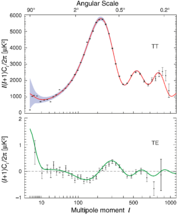 Improvements to the spectra were in the 3rd acoustic peak, and the polarization spectra.
The measurements put constraints on the content of the universe at the time that the CMB was emitted; at the time 10% of the universe was made up of neutrinos, 12% of atoms, 15% of photons and 63% dark matter. The contribution of dark energy at the time was negligible. It also constrained the content of the present-day universe; 4.6% atoms, 23% dark matter and 72% dark energy.
The WMAP five-year data was combined with measurements from Type Ia supernova
(SNe) and Baryon acoustic oscillations
(BAO).
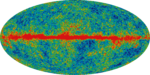
The elliptical shape of the WMAP skymap is the result of a Mollweide projection
.

The data puts a limits on the value of the tensor-to-scalar ratio, r < 0.22 (95% certainty), which determines the level at which gravitational waves affect the polarization of the CMB, and also puts limits on the amount of primordial non-gaussianity
. Improved constraints were put on the redshift of reionization, which is , the redshift of decoupling
, (as well as age of universe at decoupling) and the redshift of matter/radiation equality, .
The extragalactic source catalogue was expanded to include 390 sources, and variability was detected in the emission from Mars
and Saturn
.
The other confirmation of major significance is of the total amount of matter/energy in the Universe in the form of Dark Energy - 72.8% (within 1.6%) as non 'particle' background, and Dark Matter - 22.7% (within 1.4%) of non baryonic (sub atomic) 'particle' energy. This leaves matter, or baryonic particles (atoms) at only 4.56% (within 0.16%).
", which happened roughly 13.7 billion years before our time. The microwave background is very homogeneous in temperature (the relative variations from the mean, which presently is still 2.7 kelvins, are only of the order of 5x10⁻⁵. The temperature variations corresponding to the local directions are presented through different colours (the "red" directions are hotter, the "blue" directions cooler than the average).
 The original timeline for WMAP gave it two years of observations; these were completed by September 2003. Mission extensions were granted in 2002, 2004, 2006, and 2008 giving the spacecraft a total of 9 observing years, which ended August 2010 and in October 2010 the spacecraft was moved to a special graveyard orbit
. outside of L2, in which it orbits the sun 14 times every 15 years.
The Planck spacecraft, launched on the 14th of May 2009, also measures the CMB and aims to refine the measurements made by WMAP, both in total intensity and polarization. Various ground- and balloon-based instruments have also made CMB contributions or are being constructed to do so. Many are aimed at seaching for the B-mode polarization expected from the simplest models of nflation, including EBEX
, Spider, BICEP2
, Keck
, QUIET
, CLASS, SPTpol and others.
Spacecraft
A spacecraft or spaceship is a craft or machine designed for spaceflight. Spacecraft are used for a variety of purposes, including communications, earth observation, meteorology, navigation, planetary exploration and transportation of humans and cargo....
which measures differences in the temperature of the Big Bang
Big Bang
The Big Bang theory is the prevailing cosmological model that explains the early development of the Universe. According to the Big Bang theory, the Universe was once in an extremely hot and dense state which expanded rapidly. This rapid expansion caused the young Universe to cool and resulted in...
's remnant radiant heat — the Cosmic Microwave Background Radiation
Cosmic microwave background radiation
In cosmology, cosmic microwave background radiation is thermal radiation filling the observable universe almost uniformly....
— across the full sky. Headed by Professor Charles L. Bennett
Charles L. Bennett
Charles L. Bennett is an American observational astrophysicist and the Alumni Centennial Professor of Physics and Astronomy at Johns Hopkins University. He is the Principal Investigator of NASA's highly successful Wilkinson Microwave Anisotropy Probe...
, Johns Hopkins University
Johns Hopkins University
The Johns Hopkins University, commonly referred to as Johns Hopkins, JHU, or simply Hopkins, is a private research university based in Baltimore, Maryland, United States...
, the mission was developed in a joint partnership between the NASA Goddard Space Flight Center
Goddard Space Flight Center
The Goddard Space Flight Center is a major NASA space research laboratory established on May 1, 1959 as NASA's first space flight center. GSFC employs approximately 10,000 civil servants and contractors, and is located approximately northeast of Washington, D.C. in Greenbelt, Maryland, USA. GSFC,...
and Princeton University
Princeton University
Princeton University is a private research university located in Princeton, New Jersey, United States. The school is one of the eight universities of the Ivy League, and is one of the nine Colonial Colleges founded before the American Revolution....
. The WMAP spacecraft was launched on 30 June 2001, at 19:46:46 GDT, from Florida. The WMAP mission succeeds the COBE
COBE
The COsmic Background Explorer , also referred to as Explorer 66, was a satellite dedicated to cosmology. Its goals were to investigate the cosmic microwave background radiation of the universe and provide measurements that would help shape our understanding of the cosmos.This work provided...
space mission and was the second medium-class (MIDEX) spacecraft of the Explorer program
Explorer program
The Explorer program is a United States space exploration program that provides flight opportunities for physics, heliophysics, and astrophysics investigations from space. Over 90 space missions have been launched from 1958 to 2011, and it is still active...
. In 2003, MAP was renamed WMAP in honor of cosmologist David Todd Wilkinson
David Todd Wilkinson
David Todd Wilkinson was a world-renowned pioneer in the field of cosmology, specializing in the study of the cosmic microwave background radiation left over from the Big Bang. He was born in Hillsdale, Michigan, and earned his Ph.D. in physics at the University of Michigan under the supervision...
(1935–2002), who had been a member of the mission's science team.
WMAP's measurements played the key role in establishing the current Standard Model of Cosmology. WMAP data are very well fit by a universe that is dominated by dark energy in the form of a cosmological constant. Other cosmological data are also consistent, and together tightly constrain the Model. In this Lambda-CDM model
Lambda-CDM model
ΛCDM or Lambda-CDM is an abbreviation for Lambda-Cold Dark Matter, which is also known as the cold dark matter model with dark energy...
of the universe, the age of the universe
Age of the universe
The age of the universe is the time elapsed since the Big Bang posited by the most widely accepted scientific model of cosmology. The best current estimate of the age of the universe is 13.75 ± 0.13 billion years within the Lambda-CDM concordance model...
is 13.75 ± 0.11 billion years. The WMAP mission's determination of the age of the universe to better than 1% precision was recognized by the Guinness Book of World Records. The current expansion rate of the universe is (see Hubble constant
Hubble's law
Hubble's law is the name for the astronomical observation in physical cosmology that: all objects observed in deep space are found to have a doppler shift observable relative velocity to Earth, and to each other; and that this doppler-shift-measured velocity, of various galaxies receding from...
) of 70.5 ± 1.3 km·s−1·Mpc−1. The content of the universe presently consists of 4.56% ± 0.15% ordinary baryonic matter; 22.8% ± 1.3% Cold dark matter
Cold dark matter
Cold dark matter is the improvement of the big bang theory that contains the additional assumption that most of the matter in the Universe consists of material that cannot be observed by its electromagnetic radiation and whose constituent particles move slowly...
(CDM) that neither emits nor absorbs light; and 72.6% ± 1.5% of dark energy
Dark energy
In physical cosmology, astronomy and celestial mechanics, dark energy is a hypothetical form of energy that permeates all of space and tends to accelerate the expansion of the universe. Dark energy is the most accepted theory to explain recent observations that the universe appears to be expanding...
in the form of a cosmological constant that accelerates the expansion of the universe. Less than 1% of the current contents of the universe is in neutrinos, but WMAP's measurements have found, for the first time in 2008, that the data prefers the existence of a cosmic neutrino background
Cosmic neutrino background
The cosmic neutrino background is the universe's background particle radiation composed of neutrinos.Like the cosmic microwave background radiation , the CνB is a relic of the big bang, and while the CMB dates from when the universe was 379,000 years old, the CνB decoupled from matter when the...
with an effective number of neutrino flavors of 4.4 ± 1.5, consistent with the expectation of 3.06. The contents point to a "flat" Euclidean flat geometry
Shape of the Universe
The shape of the universe is a matter of debate in physical cosmology over the local and global geometry of the universe which considers both curvature and topology, though, strictly speaking, it goes beyond both...
, with the ratio of the energy density in curvature to the critical density 0.0179 < Ωk <0.0081 (95%CL). The WMAP measurements also support the cosmic inflation
Cosmic inflation
In physical cosmology, cosmic inflation, cosmological inflation or just inflation is the theorized extremely rapid exponential expansion of the early universe by a factor of at least 1078 in volume, driven by a negative-pressure vacuum energy density. The inflationary epoch comprises the first part...
paradigm in several ways, including the flatness measurement.
According to Science magazine, the WMAP was the Breakthrough of the Year for 2003. This mission's results papers were first and second in the "Super Hot Papers in Science Since 2003" list. Of the all-time most referenced papers in physics and astronomy in the SPIRES database, only three have been published since 2000, and all three are WMAP publications. On May 27, 2010, it was announced that Bennett, Lyman A. Page, Jr.
Lyman Page
Lyman Page is the Henry DeWolf Smyth Professor of Physics at Princeton University. He is an expert in observational cosmology and one of the original co-investigators for the WMAP probe that, over the past years, has made the most precise observations yet of the cosmic background radiation, an...
, and David N. Spergel, the latter both of Princeton University, would share the 2010 Shaw Prize
Shaw Prize
The Shaw Prize is an annual award first presented by the Shaw Prize Foundation in 2004. Established in 2002 in Hong Kong, it honours living "individuals, regardless of race, nationality and religious belief, who have achieved significant breakthrough in academic and scientific research or...
in astronomy for their work on WMAP.
As of October 2010, the WMAP spacecraft is in a graveyard orbit
Graveyard orbit
A graveyard orbit, also called a supersynchronous orbit, junk orbit or disposal orbit, is an orbit significantly above synchronous orbit, where spacecraft are intentionally placed at the end of their operational life...
after 9 years of operations. The Astronomy and Physics Senior Review panel at NASA Headquarters has endorsed a total of 9 years of WMAP operations, through September 2010. All WMAP data are released to the public and have been subject to careful scrutiny.
Some aspects of the data are statistically unusual for the Standard Model of Cosmology. For example, the greatest angular-scale measurements, the quadrupole moment, is somewhat smaller than the Model would predict, but this discrepancy is not highly significant. A large cold spot
WMAP cold spot
The CMB Cold Spot or WMAP Cold Spot is a region of the sky seen in microwaves which analysis found to be unusually large and cold relative to the expected properties of the cosmic microwave background radiation...
and other features of the data are more statistically significant, and research continues into these.
Objectives
Cosmic microwave background radiation
In cosmology, cosmic microwave background radiation is thermal radiation filling the observable universe almost uniformly....
. The anisotropies then are used to measure the universe's geometry
Geometry
Geometry arose as the field of knowledge dealing with spatial relationships. Geometry was one of the two fields of pre-modern mathematics, the other being the study of numbers ....
, content, and evolution; and to test the Big Bang model, and the cosmic inflation
Cosmic inflation
In physical cosmology, cosmic inflation, cosmological inflation or just inflation is the theorized extremely rapid exponential expansion of the early universe by a factor of at least 1078 in volume, driven by a negative-pressure vacuum energy density. The inflationary epoch comprises the first part...
theory. For that, the mission is creating a full-sky map of the CMB, with a 13 arcminute resolution via multi-frequency observation. The map requires the fewest systematic error
Systematic error
Systematic errors are biases in measurement which lead to the situation where the mean of many separate measurements differs significantly from the actual value of the measured attribute. All measurements are prone to systematic errors, often of several different types...
s, no correlated pixel noise, and accurate calibration, to ensure angular-scale accuracy greater than its resolution. The map contains 3,145,728 pixels, and uses the HEALPix
HEALPix
HEALPix , an acronym for Hierarchical Equal Area isoLatitude Pixelisation of a 2-sphere, can refer to either an algorithm for pixelisation of the 2-sphere, an associated software package, or an associated class of map projections.The HEALPix projection is a general class of spherical projections,...
scheme to pixelize the sphere. The telescope also measures the CMB's E-mode polarization, and foreground polarization; its life is 27 months; 3 to reach the position, 2 years of observation.
Development
The WMAP was preceded by two missions to observe the CMB; (i) the Soviet RELIKT-1
RELIKT-1
RELIKT-1 - a Soviet cosmic microwave background anisotropy experiment on board the Prognoz 9 satellite gave upper limits on the large-scale anisotropy. A reanalysis of the data in the later years claimed a confident blackbody form and anisotropy of the cosmic microwave background radiation...
that reported the upper-limit measurements of CMB anisotropies, and (ii) the U.S. COBE
COBE
The COsmic Background Explorer , also referred to as Explorer 66, was a satellite dedicated to cosmology. Its goals were to investigate the cosmic microwave background radiation of the universe and provide measurements that would help shape our understanding of the cosmos.This work provided...
satellite that reported large-scale CMB fluctuations, and the ground-based and balloon experiments measuring the small-scale fluctuations in patches of sky: the Boomerang
BOOMERanG experiment
The BOOMERanG experiment measured the cosmic microwave background radiation of a part of the sky during three sub-orbital balloon flights. It was the first experiment to make large, high fidelity images of the CMB temperature anisotropies...
, the Cosmic Background Imager
Cosmic Background Imager
The Cosmic Background Imager was a 13-element interferometer perched at an elevation of 5,080 metres at Llano de Chajnantor Observatory in the Chilean Andes...
, and the Very Small Array
Very Small Array
The Very Small Array is a 14-element interferometric radio telescope operating between 26 and 36 GHz that is used to study the cosmic microwave background radiation. It is a collaboration between the University of Cambridge, University of Manchester and the Instituto de Astrofisica de Canarias...
. The WMAP is 45 times more sensitive, with 33 times the angular resolution of its COBE satellite predecessor.
Spacecraft
Gregorian telescope
The Gregorian telescope is a type of reflecting telescope designed by Scottish mathematician and astronomer James Gregory in the 17th century, and first built in 1673 by Robert Hooke...
1.4m x 1.6m dishes (facing opposite directions), that focus the signal onto a pair of 0.9m x 1.0m secondary reflecting mirrors. They are shaped for optimal performance: a carbon fibre shell upon a Korex core, thinly-coated with aluminium
Aluminium
Aluminium or aluminum is a silvery white member of the boron group of chemical elements. It has the symbol Al, and its atomic number is 13. It is not soluble in water under normal circumstances....
and silicon oxide
Silicon oxide
Silicon oxide may refer to either of the following:*Silicon dioxide, SiO2, very well characterized*Silicon monoxide, SiO, not very well characterized...
. The secondary reflectors transmit the signals to the corrugated feedhorns that sit on a focal plane array box beneath the primary reflectors.
Radiometer
A radiometer is a device for measuring the radiant flux of electromagnetic radiation. Generally, the term radiometer denotes an infrared radiation detector, yet it also includes detectors operating on any electromagnetic wavelength....
s measuring the difference between two telescope beams. The signal is amplified with HEMT
HEMT
High electron mobility transistor , also known as heterostructure FET or modulation-doped FET , is a field effect transistor incorporating a junction between two materials with different band gaps as the channel instead of a doped region, as is generally the case for MOSFET...
low-noise amplifier
Low-noise amplifier
Low-noise amplifier is an electronic amplifier used to amplify possibly very weak signals . It is usually located very close to the detection device to reduce losses in the feedline. This active antenna arrangement is frequently used in microwave systems like GPS, because coaxial cable feedline is...
s. There are 20 feeds, 10 in each direction, from which a radiometer collects a signal; the measure is the difference in the sky signal from opposite directions. The directional separation azimuth is 180 degrees; the total angle is 141 degrees. To avoid collecting Milky Way
Milky Way
The Milky Way is the galaxy that contains the Solar System. This name derives from its appearance as a dim un-resolved "milky" glowing band arching across the night sky...
galaxy foreground signals, the WMAP uses five discrete radio frequency bands, from 23 GHz to 94 GHz.
| Property | K-band | Ka-band | Q-band | V-band | W-band |
|---|---|---|---|---|---|
| Central wavelength Wavelength In physics, the wavelength of a sinusoidal wave is the spatial period of the wave—the distance over which the wave's shape repeats.It is usually determined by considering the distance between consecutive corresponding points of the same phase, such as crests, troughs, or zero crossings, and is a... (mm) |
13 | 9.1 | 7.3 | 4.9 | 3.2 |
| Central frequency Frequency Frequency is the number of occurrences of a repeating event per unit time. It is also referred to as temporal frequency.The period is the duration of one cycle in a repeating event, so the period is the reciprocal of the frequency... (GHz GHZ GHZ or GHz may refer to:# Gigahertz .# Greenberger-Horne-Zeilinger state — a quantum entanglement of three particles.# Galactic Habitable Zone — the region of a galaxy that is favorable to the formation of life.... ) |
23 | 33 | 41 | 61 | 94 |
| Bandwidth (GHz) | 5.5 | 7.0 | 8.3 | 14.0 | 20.5 |
| Beam size (arcminutes) | 52.8 | 39.6 | 30.6 | 21 | 13.2 |
| Number of radiometers | 2 | 2 | 4 | 4 | 8 |
| System temperature (K Kelvin The kelvin is a unit of measurement for temperature. It is one of the seven base units in the International System of Units and is assigned the unit symbol K. The Kelvin scale is an absolute, thermodynamic temperature scale using as its null point absolute zero, the temperature at which all... ) |
29 | 39 | 59 | 92 | 145 |
Sensitivity (mK s ) ) |
0.8 | 0.8 | 1.0 | 1.2 | 1.6 |
The WMAP's base is a 5.0m-diameter solar panel array that keeps the instruments in shadow during CMB observations, (by keeping the craft constantly angled at 22 degrees, relative to the sun). Upon the array sit a bottom deck (supporting the warm components) and a top deck. The telescope's cold components: the focal-plane array and the mirrors, are separated from the warm components with a cylindrical, 33 cm-long thermal isolation shell atop the deck.
Passive thermal radiators cool the WMAP to ca. 90 degrees K; they are connected to the low-noise amplifiers. The telescope consumes 419 W
Watt
The watt is a derived unit of power in the International System of Units , named after the Scottish engineer James Watt . The unit, defined as one joule per second, measures the rate of energy conversion.-Definition:...
of power. The available telescope heaters are emergency-survival heaters, and there is a transmitter heater, used to warm them when off. The WMAP spacecraft's temperature is monitored with platinum resistance thermometers.
The WMAP's calibration is effected with the CMB dipole and measurements of Jupiter
Jupiter
Jupiter is the fifth planet from the Sun and the largest planet within the Solar System. It is a gas giant with mass one-thousandth that of the Sun but is two and a half times the mass of all the other planets in our Solar System combined. Jupiter is classified as a gas giant along with Saturn,...
; the beam patterns are measured against Jupiter. The telescope's data are relayed daily via a 2 GHz transponder
Transponder
In telecommunication, the term transponder has the following meanings:...
providing a 667kbit/s downlink to a 70m Deep Space Network
Deep Space Network
The Deep Space Network, or DSN, is a world-wide network of large antennas and communication facilities that supports interplanetary spacecraft missions. It also performs radio and radar astronomy observations for the exploration of the solar system and the universe, and supports selected...
telescope. The spacecraft has two transponders, one a redundant back-up; they are minimally active — ca. 40 minutes daily — to minimize radio frequency interference. The telescope's position is maintained, in its three axes, with three reaction wheels, gyroscope
Gyroscope
A gyroscope is a device for measuring or maintaining orientation, based on the principles of angular momentum. In essence, a mechanical gyroscope is a spinning wheel or disk whose axle is free to take any orientation...
s, two star trackers and sun sensors, and is steered with eight hydrazine
Hydrazine
Hydrazine is an inorganic compound with the formula N2H4. It is a colourless flammable liquid with an ammonia-like odor. Hydrazine is highly toxic and dangerously unstable unless handled in solution. Approximately 260,000 tons are manufactured annually...
thrusters.
Launch, trajectory, and orbit
Lagrangian point
The Lagrangian points are the five positions in an orbital configuration where a small object affected only by gravity can theoretically be stationary relative to two larger objects...
, arriving there on 1 October 2001, becoming, thereby, the first CMB observation mission permanently posted there.
Lissajous orbit
In orbital mechanics, a Lissajous orbit, , named after Jules Antoine Lissajous, is a quasi-periodic orbital trajectory that an object can follow around a Lagrangian point of a three-body system without requiring any propulsion. Lyapunov orbits around a libration point are curved paths that lie...
ca. 1.0 degree to 10 degrees, with a 6-month period. The telescope rotates once every 2 minutes, 9 seconds" (0.464 rpm) and precesses
Precession
Precession is a change in the orientation of the rotation axis of a rotating body. It can be defined as a change in direction of the rotation axis in which the second Euler angle is constant...
at the rate of 1 revolution per hour. WMAP measures the entire sky every six months, and completed its first, full-sky observation in April 2002.
Foreground radiation subtraction
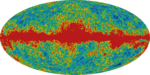
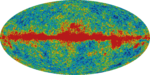
The WMAP observes in five frequencies, permitting the measurement and subtraction of foreground contamination (from the Milky Way and extra-galactic sources) of the CMB. The main emission mechanisms are synchrotron radiationSynchrotron radiation
The electromagnetic radiation emitted when charged particles are accelerated radially is called synchrotron radiation. It is produced in synchrotrons using bending magnets, undulators and/or wigglers...
and free-free emission (dominating the lower frequencies), and astrophysical dust emissions (dominating the higher frequencies). The spectral properties of these emissions contribute different amounts to the five frequencies, thus permitting their identification and subtraction.
Foreground contamination is removed in several ways. First, subtract extant emission maps from the WMAP's measurements; second, use the components' known, spectral values to identify them; third, simultaneously fit the position and spectra data of the foreground emission, using extra data sets. Foreground contamination also is reduced by using only the full-sky map portions with the least foreground contamination, whilst masking the remaining map portions.
 |
 |
 |
 |
 |
| 23 GHz | 33 GHz | 41 GHz | 61 GHz | 94 GHz |
One-year data release
Based upon the Lambda-CDM model, the WMAP team produced cosmological parameters from the WMAP's first-year results. Three sets are given below; the first and second sets are WMAP data; the difference is the addition of spectral indices, predictions of some inflationary models. The third data set combines the WMAP constraints with those from other CMB experiments (ACBAR and CBI
Cosmic Background Imager
The Cosmic Background Imager was a 13-element interferometer perched at an elevation of 5,080 metres at Llano de Chajnantor Observatory in the Chilean Andes...
), and constraints from the 2dF Galaxy Redshift Survey
2dF Galaxy Redshift Survey
In astronomy, the 2dF Galaxy Redshift Survey , 2dF or 2dFGRS is a redshift survey conducted by the Anglo-Australian Observatory with the 3.9m Anglo-Australian Telescope between 1997 and 11 April 2002. The data from this survey were made public on 30 June 2003...
and Lyman alpha forest measurements. Note that there are degenerations among the parameters, the most significant is between
and ; the errors given are at 68% confidence.| Parameter | Symbol | Best fit (WMAP only) | Best fit (WMAP, extra parameter) | Best fit (all data) |
|---|---|---|---|---|
| Hubble's constant ( ) |  |
|||
| Baryon Baryon A baryon is a composite particle made up of three quarks . Baryons and mesons belong to the hadron family, which are the quark-based particles... ic content |
 |
|||
| Matter content |  |
|||
| Optical depth Optical depth Optical depth, or optical thickness, is a measure of transparency. Optical depth is defined by the negative logarithm of the fraction of radiation that is not scattered or absorbed on a path... to reionization Reionization In Big Bang cosmology, reionization is the process that reionized the matter in the universe after the "dark ages," and is the second of two major phase changes of gas in the universe. As the majority of baryonic matter is in the form of hydrogen, reionization usually refers to the reionization of... |
 |
|||
| Amplitude | A | |||
| Scalar spectral index |  |
|||
| Running of spectral index |  |
— | ||
| Fluctuation amplitude at 8h−1 Mpc |  |
— | ||
| Age of the universe Age of the universe The age of the universe is the time elapsed since the Big Bang posited by the most widely accepted scientific model of cosmology. The best current estimate of the age of the universe is 13.75 ± 0.13 billion years within the Lambda-CDM concordance model... (Ga) |
 |
— | ||
| Total density of the universe |  |
— | — |
Using the best-fit data and theoretical models, the WMAP team determined the times of important universal events, including the redshift of reionization, ; the redshift of decoupling
Decoupling
The term "decoupling" is used in many different contexts.-Economic growth without environmental damage:In economic and environmental fields, decoupling is becoming increasingly used in the context of economic production and environmental quality. When used in this way, it refers to the ability of...
, (and the universe's age at decoupling); and the redshift of matter/radiation equality, . They determined the thickness of the surface of last scattering to be in redshift, or . They determined the current density of baryons, , and the ratio of baryons to photons, . The WMAP's detection of an early reionization excluded warm dark matter
Warm dark matter
Warm dark matter is a hypothesized form of dark matter that has properties intermediate between those of hot dark matter and cold dark matter, causing structure formation to occur bottom-up from above their free-streaming scale, and top-down below their free streaming scale. The most common WDM...
.
The team also examined Milky Way emissions at the WMAP frequencies, producing a 208-point source
Point source
A point source is a localised, relatively small source of something.Point source may also refer to:*Point source , a localised source of pollution**Point source water pollution, water pollution with a localized source...
catalogue. Also, they observed the Sunyaev-Zel'dovich effect
Sunyaev-Zel'dovich effect
The Sunyaev–Zel'dovich effect is the result of high energy electrons distorting the cosmic microwave background radiation through inverse Compton scattering, in which the low energy CMB photons receive energy boost during collision with the high energy cluster electrons...
at 2.5 σ
Standard deviation
Standard deviation is a widely used measure of variability or diversity used in statistics and probability theory. It shows how much variation or "dispersion" there is from the average...
the strongest source is the Coma cluster.
Three-year data release
Lambda-CDM model
ΛCDM or Lambda-CDM is an abbreviation for Lambda-Cold Dark Matter, which is also known as the cold dark matter model with dark energy...
and new evidence in support of inflation.
The 3-year WMAP data alone shows that the universe must have dark matter. Results were computed both only using WMAP data, and also with a mix of parameter constraints from other instruments, including other CMB experiments (ACBAR, CBI
Cosmic Background Imager
The Cosmic Background Imager was a 13-element interferometer perched at an elevation of 5,080 metres at Llano de Chajnantor Observatory in the Chilean Andes...
and BOOMERANG
Boomerang
A boomerang is a flying tool with a curved shape used as a weapon or for sport.-Description:A boomerang is usually thought of as a wooden device, although historically boomerang-like devices have also been made from bones. Modern boomerangs used for sport are often made from carbon fibre-reinforced...
), SDSS
Sloan Digital Sky Survey
The Sloan Digital Sky Survey or SDSS is a major multi-filter imaging and spectroscopic redshift survey using a dedicated 2.5-m wide-angle optical telescope at Apache Point Observatory in New Mexico, United States. The project was named after the Alfred P...
, the 2dF Galaxy Redshift Survey
2dF Galaxy Redshift Survey
In astronomy, the 2dF Galaxy Redshift Survey , 2dF or 2dFGRS is a redshift survey conducted by the Anglo-Australian Observatory with the 3.9m Anglo-Australian Telescope between 1997 and 11 April 2002. The data from this survey were made public on 30 June 2003...
, the Supernova Legacy Survey
Supernova Legacy Survey
The Supernova Legacy Survey Program is a project designed to investigate dark energy, by detecting and monitoring approximately 2000 high-redshift supernovae between 2003 and 2008, using MegaPrime, a large CCD mosaic at the Canada-France-Hawaii Telescope. It also carries out detailed spectroscopy...
and constraints on the Hubble constant from the Hubble Space Telescope
Hubble Space Telescope
The Hubble Space Telescope is a space telescope that was carried into orbit by a Space Shuttle in 1990 and remains in operation. A 2.4 meter aperture telescope in low Earth orbit, Hubble's four main instruments observe in the near ultraviolet, visible, and near infrared...
.
| Parameter | Symbol | Best fit (WMAP only) |
|---|---|---|
| Hubble's constant ( ) |  |
|
| Baryon Baryon A baryon is a composite particle made up of three quarks . Baryons and mesons belong to the hadron family, which are the quark-based particles... ic content |
 |
|
| Matter content |  |
|
| Optical depth Optical depth Optical depth, or optical thickness, is a measure of transparency. Optical depth is defined by the negative logarithm of the fraction of radiation that is not scattered or absorbed on a path... to reionization Reionization In Big Bang cosmology, reionization is the process that reionized the matter in the universe after the "dark ages," and is the second of two major phase changes of gas in the universe. As the majority of baryonic matter is in the form of hydrogen, reionization usually refers to the reionization of... |
 |
|
| Scalar spectral index |  |
|
| Fluctuation amplitude at 8h−1 Mpc |  |
|
| Age of the universe Age of the universe The age of the universe is the time elapsed since the Big Bang posited by the most widely accepted scientific model of cosmology. The best current estimate of the age of the universe is 13.75 ± 0.13 billion years within the Lambda-CDM concordance model... (Ga) |
 |
|
| Tensor-to-scalar ratio | r | < 0.65 |
[a] Optical depth to reionization improved due to polarization measurements.
[b] < 0.30 when combined with SDSS
SDSS
SDSS may refer to:* Sloan Digital Sky Survey, a major multi-filter imaging and spectroscopic redshift survey* Social Democratic Party of Slovakia* Spatial Decision Support System, a GIS based decision aiding system...
data. No indication of non-gaussianity.
Five-year data release
Cosmic neutrino background
The cosmic neutrino background is the universe's background particle radiation composed of neutrinos.Like the cosmic microwave background radiation , the CνB is a relic of the big bang, and while the CMB dates from when the universe was 379,000 years old, the CνB decoupled from matter when the...
, evidence that it took over half a billion years for the first stars to reionize the universe, and new constraints on cosmic inflation
Cosmic inflation
In physical cosmology, cosmic inflation, cosmological inflation or just inflation is the theorized extremely rapid exponential expansion of the early universe by a factor of at least 1078 in volume, driven by a negative-pressure vacuum energy density. The inflationary epoch comprises the first part...
.
The improvement in the results came from both having an extra 2 years of measurements (the data set runs between midnight on 10 August 2001 to midnight of 9 August 2006), as well as using improved data processing techniques and a better characterization of the instrument, most notably of the beam shapes. They also make use of the 33 GHz observations for estimating cosmological parameters; previously only the 41 GHz and 61 GHz channels had been used. Finally, improved masks were used to remove foregrounds.
The measurements put constraints on the content of the universe at the time that the CMB was emitted; at the time 10% of the universe was made up of neutrinos, 12% of atoms, 15% of photons and 63% dark matter. The contribution of dark energy at the time was negligible. It also constrained the content of the present-day universe; 4.6% atoms, 23% dark matter and 72% dark energy.
The WMAP five-year data was combined with measurements from Type Ia supernova
Type Ia supernova
A Type Ia supernova is a sub-category of supernovae, which in turn are a sub-category of cataclysmic variable stars, that results from the violent explosion of a white dwarf star. A white dwarf is the remnant of a star that has completed its normal life cycle and has ceased nuclear fusion...
(SNe) and Baryon acoustic oscillations
Baryon acoustic oscillations
In cosmology, baryon acoustic oscillations refers to an overdensity or clustering of baryonic matter at certain length scales due to acoustic waves which propagated in the early universe. In the same way that supernova experiments provide a "standard candle" for astronomical observations, BAO...
(BAO).
The elliptical shape of the WMAP skymap is the result of a Mollweide projection
Mollweide projection
The Mollweide projection is a pseudocylindrical map projection generally used for global maps of the world . Also known as the Babinet projection, homalographic projection, homolographic projection, and elliptical projection...
.
| Parameter | Symbol | Best fit (WMAP only) | Best fit (WMAP + SNe + BAO) |
|---|---|---|---|
| Hubble's constant ( ) |  |
||
| Baryon Baryon A baryon is a composite particle made up of three quarks . Baryons and mesons belong to the hadron family, which are the quark-based particles... ic content |
 |
||
| Cold dark matter content |  |
||
| Dark energy Dark energy In physical cosmology, astronomy and celestial mechanics, dark energy is a hypothetical form of energy that permeates all of space and tends to accelerate the expansion of the universe. Dark energy is the most accepted theory to explain recent observations that the universe appears to be expanding... content |
 |
||
| Optical depth Optical depth Optical depth, or optical thickness, is a measure of transparency. Optical depth is defined by the negative logarithm of the fraction of radiation that is not scattered or absorbed on a path... to reionization Reionization In Big Bang cosmology, reionization is the process that reionized the matter in the universe after the "dark ages," and is the second of two major phase changes of gas in the universe. As the majority of baryonic matter is in the form of hydrogen, reionization usually refers to the reionization of... |
 |
||
| Scalar spectral index |  |
||
| Running of spectral index |  |
||
| Fluctuation amplitude at 8h−1 Mpc |  |
||
| Age of the universe Age of the universe The age of the universe is the time elapsed since the Big Bang posited by the most widely accepted scientific model of cosmology. The best current estimate of the age of the universe is 13.75 ± 0.13 billion years within the Lambda-CDM concordance model... (Ga) |
 |
||
| Total density of the universe |  |
||
| Tensor-to-scalar ratio | r | < 0.43 | < 0.22 |
The data puts a limits on the value of the tensor-to-scalar ratio, r < 0.22 (95% certainty), which determines the level at which gravitational waves affect the polarization of the CMB, and also puts limits on the amount of primordial non-gaussianity
Non-gaussianity
In physics, a non-Gaussianity is the correction that modifies the expected Gaussian function estimate for the measurement of a physical quantity....
. Improved constraints were put on the redshift of reionization, which is , the redshift of decoupling
Decoupling
The term "decoupling" is used in many different contexts.-Economic growth without environmental damage:In economic and environmental fields, decoupling is becoming increasingly used in the context of economic production and environmental quality. When used in this way, it refers to the ability of...
, (as well as age of universe at decoupling) and the redshift of matter/radiation equality, .
The extragalactic source catalogue was expanded to include 390 sources, and variability was detected in the emission from Mars
Mars
Mars is the fourth planet from the Sun in the Solar System. The planet is named after the Roman god of war, Mars. It is often described as the "Red Planet", as the iron oxide prevalent on its surface gives it a reddish appearance...
and Saturn
Saturn
Saturn is the sixth planet from the Sun and the second largest planet in the Solar System, after Jupiter. Saturn is named after the Roman god Saturn, equated to the Greek Cronus , the Babylonian Ninurta and the Hindu Shani. Saturn's astronomical symbol represents the Roman god's sickle.Saturn,...
.
 |
 |
 |
 |
 |
| 23 GHz | 33 GHz | 41 GHz | 61 GHz | 94 GHz |
Seven-year data release
The Seven-year WMAP data were released on 26 January 2010. According to this data the Universe is 13.75 ±0.11 bln. years old. As part of this release, claims for inconsistencies with the standard model were investigated. Most were shown not to be statistically significant, and likely due to a posteriori selection (where one sees a weird deviation, but fails to consider properly how hard one has been looking; a deviation with 1:1000 likelihood will typically be found if one tries one thousand times). For the deviations that do remain, there are no alternative cosmological ideas (for instance, there seem to be correlations with the ecliptic pole). It seems most likely these are due to other effects, with the report mentioning uncertainties in the precise beam shape and other possible small remaining instrumental and analysis issues.The other confirmation of major significance is of the total amount of matter/energy in the Universe in the form of Dark Energy - 72.8% (within 1.6%) as non 'particle' background, and Dark Matter - 22.7% (within 1.4%) of non baryonic (sub atomic) 'particle' energy. This leaves matter, or baryonic particles (atoms) at only 4.56% (within 0.16%).
| Parameter | Symbol | Best fit (WMAP only) | Best fit (WMAP + BAO Baryon acoustic oscillations In cosmology, baryon acoustic oscillations refers to an overdensity or clustering of baryonic matter at certain length scales due to acoustic waves which propagated in the early universe. In the same way that supernova experiments provide a "standard candle" for astronomical observations, BAO... + H0) |
|---|---|---|---|
| Age of the universe Age of the universe The age of the universe is the time elapsed since the Big Bang posited by the most widely accepted scientific model of cosmology. The best current estimate of the age of the universe is 13.75 ± 0.13 billion years within the Lambda-CDM concordance model... (Ga) |
 |
||
| Hubble's constant ( ) |  |
||
| Baryon Baryon A baryon is a composite particle made up of three quarks . Baryons and mesons belong to the hadron family, which are the quark-based particles... density |
 |
||
| Physical baryon Baryon A baryon is a composite particle made up of three quarks . Baryons and mesons belong to the hadron family, which are the quark-based particles... density |
 |
||
| Dark matter Dark matter In astronomy and cosmology, dark matter is matter that neither emits nor scatters light or other electromagnetic radiation, and so cannot be directly detected via optical or radio astronomy... density |
 |
||
| Physical dark matter Dark matter In astronomy and cosmology, dark matter is matter that neither emits nor scatters light or other electromagnetic radiation, and so cannot be directly detected via optical or radio astronomy... density |
 |
||
| Dark energy Dark energy In physical cosmology, astronomy and celestial mechanics, dark energy is a hypothetical form of energy that permeates all of space and tends to accelerate the expansion of the universe. Dark energy is the most accepted theory to explain recent observations that the universe appears to be expanding... density |
 |
||
| Fluctuation amplitude at 8h−1 Mpc |  |
||
| Scalar spectral index |  |
||
| Reionization Reionization In Big Bang cosmology, reionization is the process that reionized the matter in the universe after the "dark ages," and is the second of two major phase changes of gas in the universe. As the majority of baryonic matter is in the form of hydrogen, reionization usually refers to the reionization of... optical depth Optical depth Optical depth, or optical thickness, is a measure of transparency. Optical depth is defined by the negative logarithm of the fraction of radiation that is not scattered or absorbed on a path... |
 |
| Parameter | Symbol | Best fit (WMAP only) | Best fit (WMAP + BAO Baryon acoustic oscillations In cosmology, baryon acoustic oscillations refers to an overdensity or clustering of baryonic matter at certain length scales due to acoustic waves which propagated in the early universe. In the same way that supernova experiments provide a "standard candle" for astronomical observations, BAO... + H0) |
|---|---|---|---|
| Total density of the universe |  |
||
| Tensor-to-scalar ratio, k0 = 0.002 Mpc−1 | r | < 0.36 (95% CL) | < 0.24 (95% CL) |
| Running of spectral index, k0 = 0.002 Mpc−1 |  |
| 23 GHz | 33 GHz | 41 GHz | 61 GHz | 94 GHz |
Main result
The main result of the mission is contained in the various oval maps of the CMB spectrum over the years. These oval images present the temperature distribution gained by the WMAP team from the observations by the telescope of the mission. Measured is the temperature obtained from a Planck's law interpretation of the microwave background. The oval map covers the whole sky. The results describe the state of the universe only some hundred-thousand years after the "big bangBig Bang
The Big Bang theory is the prevailing cosmological model that explains the early development of the Universe. According to the Big Bang theory, the Universe was once in an extremely hot and dense state which expanded rapidly. This rapid expansion caused the young Universe to cool and resulted in...
", which happened roughly 13.7 billion years before our time. The microwave background is very homogeneous in temperature (the relative variations from the mean, which presently is still 2.7 kelvins, are only of the order of 5x10⁻⁵. The temperature variations corresponding to the local directions are presented through different colours (the "red" directions are hotter, the "blue" directions cooler than the average).
Follow-on missions and future measurements
Graveyard orbit
A graveyard orbit, also called a supersynchronous orbit, junk orbit or disposal orbit, is an orbit significantly above synchronous orbit, where spacecraft are intentionally placed at the end of their operational life...
. outside of L2, in which it orbits the sun 14 times every 15 years.
The Planck spacecraft, launched on the 14th of May 2009, also measures the CMB and aims to refine the measurements made by WMAP, both in total intensity and polarization. Various ground- and balloon-based instruments have also made CMB contributions or are being constructed to do so. Many are aimed at seaching for the B-mode polarization expected from the simplest models of nflation, including EBEX
The E and B Experiment
The E and B Experiment will measure the cosmic microwave background radiation of a part of the sky during two sub-orbital balloon flights. It is an experiment to make large, high-fidelity images of the CMB polarization anisotropies...
, Spider, BICEP2
BICEP2
BICEP2 is a cosmic microwave background polarization experiment located at the South Pole. BICEP2 is part of a CMB polarization project including the Keck Array....
, Keck
Keck Array
The Keck Array is a CMB polarization experiment, part of a CMB polarization project including BICEP2. The experiment will consist of several microwave polarimeters located at the South Pole...
, QUIET
QUIET
QUIET is an astronomy experiment to study the polarization of the cosmic microwave background radiation. QUIET stands for Q/U Imaging ExperimenT. The Q/U in the name refers to the ability of the telescope to measure the Q and U Stokes parameters simultaneously...
, CLASS, SPTpol and others.
External links
- Sizing up the universe
- About WMAP and the Cosmic Microwave Background - Article at Space.com
- Big Bang glow hints at funnel-shaped Universe, NewScientist, 15 April 2004
- NASA March 16, 2006 WMAP inflation related press release