
All Topics  
Gregorian telescope


   Email Print
   Bookmark   Link


Gregorian telescope


The Gregorian telescope is a type of reflecting telescope
Reflecting telescope

A reflecting telescope is an optical telescope which uses a single or combination of curved mirrors that reflect light and form an image. The reflecting telescope was invented in the 17th century as an alternative to the refracting telescope which, at that time, was a design that suffered from severe chromatic aberration....
 designed by Scottish
Scotland

conventional_long_name = ScotlandAlba|common_name= Scotland|image_flag = Flag of Scotland.svg|flag_width = 130px...
 mathematician
Mathematician

A mathematician is a person whose primary area of study and/or research is the field of mathematics....
 and astronomer
Astronomer

An astronomer is a scientist who studies Celestial body such as planets, stars, and Galaxy.Historically, astronomy was more concerned with the classification and description of phenomena in the sky, while astrophysics attempted to explain these phenomena and the differences between them using physical laws....
, James Gregory
James Gregory (astronomer and mathematician)

James Gregory , was a Scotland mathematician and astronomer. It has been said that "Of the British mathematicians of the seventeenth century, Gregory was only excelled by Isaac Newton."...
 in the 17th century and first built in 1673 by Robert Hooke
Robert Hooke

Robert Hooke, Fellow of the Royal Society was an England natural philosopher and polymath who played an important role in the scientific revolution, through both experimental and theoretical work....
. The design pre-dates the first practical reflecting telescope, the Newtonian telescope
Newtonian telescope

The Newtonian telescope is a type of reflecting telescope invented by the British scientist Sir Isaac Newton , using a Curved mirror#Concave mirrors and a flat diagonal secondary mirror....
 built by Sir Isaac Newton
Isaac Newton

Sir Isaac Newton, Fellow of the Royal Society was an English people physicist, mathematician, Astronomy, Natural philosophy, Alchemy, and Theology and one of the the 100 in human history....
 in 1669, but was not successfully built until 4 years after Newton's first reflecting telescope
Newton's Reflector

Newton's Reflector or Newton's telescope, was a reflecting optical telescope engineered and manufactured by Sir Isaac Newton , completed in February 1669....
.

Gregorian telescope is named after the James Gregory design which appeared in his 1663 publication Optica Promota (The Advance of Optics).


Discussion
Ask a question about 'Gregorian telescope'
Start a new discussion about 'Gregorian telescope'
Answer questions from other users
Full Discussion Forum


Encyclopedia


The Gregorian telescope is a type of reflecting telescope
Reflecting telescope

A reflecting telescope is an optical telescope which uses a single or combination of curved mirrors that reflect light and form an image. The reflecting telescope was invented in the 17th century as an alternative to the refracting telescope which, at that time, was a design that suffered from severe chromatic aberration....
 designed by Scottish
Scotland

conventional_long_name = ScotlandAlba|common_name= Scotland|image_flag = Flag of Scotland.svg|flag_width = 130px...
 mathematician
Mathematician

A mathematician is a person whose primary area of study and/or research is the field of mathematics....
 and astronomer
Astronomer

An astronomer is a scientist who studies Celestial body such as planets, stars, and Galaxy.Historically, astronomy was more concerned with the classification and description of phenomena in the sky, while astrophysics attempted to explain these phenomena and the differences between them using physical laws....
, James Gregory
James Gregory (astronomer and mathematician)

James Gregory , was a Scotland mathematician and astronomer. It has been said that "Of the British mathematicians of the seventeenth century, Gregory was only excelled by Isaac Newton."...
 in the 17th century and first built in 1673 by Robert Hooke
Robert Hooke

Robert Hooke, Fellow of the Royal Society was an England natural philosopher and polymath who played an important role in the scientific revolution, through both experimental and theoretical work....
. The design pre-dates the first practical reflecting telescope, the Newtonian telescope
Newtonian telescope

The Newtonian telescope is a type of reflecting telescope invented by the British scientist Sir Isaac Newton , using a Curved mirror#Concave mirrors and a flat diagonal secondary mirror....
 built by Sir Isaac Newton
Isaac Newton

Sir Isaac Newton, Fellow of the Royal Society was an English people physicist, mathematician, Astronomy, Natural philosophy, Alchemy, and Theology and one of the the 100 in human history....
 in 1669, but was not successfully built until 4 years after Newton's first reflecting telescope
Newton's Reflector

Newton's Reflector or Newton's telescope, was a reflecting optical telescope engineered and manufactured by Sir Isaac Newton , completed in February 1669....
.

History

The Gregorian telescope is named after the James Gregory design which appeared in his 1663 publication Optica Promota (The Advance of Optics). Similar theoretical designs have been found in the writings of Bonaventura Cavalieri
Bonaventura Cavalieri

Bonaventura Francesco Cavalieri was an Italy mathematics. He is known for his work on the problems of optics and motion , work on the precursors of infinitesimal calculus, and the introduction of logarithms to Italy....
 (Lo Specchio Ustorio (On Burning Mirrors), 1632) and Marin Mersenne
Marin Mersenne

Marin Mersenne, Marin Mersennus or le P?re Mersenne was a France theology, philosopher, mathematician and Music theory, often referred to as the "father of acoustics" ....
 (l"Harmonie universalle, 1636). Gregory's early attempts to build the telescope failed, since he had no practical skill himself and he could find no optician capable of actually constructing one. It was not until ten years after Gregory's publication, aided by the interest of experimental scientist Robert Hooke
Robert Hooke

Robert Hooke, Fellow of the Royal Society was an England natural philosopher and polymath who played an important role in the scientific revolution, through both experimental and theoretical work....
, that a working instrument was created.

Design

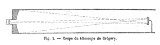
Gregory Teleskop
The Gregorian telescope consists of two concave mirror
Mirror

A mirror is an object with one surface polished, which leads to reflection and another opaque. The most familiar type of mirror is the plane mirror, which has a flat surface....
s; the primary mirror (a concave paraboloid
Paraboloid

In mathematics, a paraboloid is a quadric surface of special kind. There are two kinds of paraboloids: elliptic and hyperbolic. The elliptic paraboloid is shaped like an oval cup and can have a maximum or minimum point....
) collects the light and brings it to a focus
Focus (optics)

In geometrical optics, a focus, also called an image point, is the point where light rays originating from a point on the object converge ....
 before the secondary mirror (a concave ellipsoid
Ellipsoid

An ellipsoid is a type of Quadric that is a higher dimensional analogue of an ellipse. The equation of a standard axis-aligned ellipsoid body in an xyz-Cartesian coordinate system is...
) where it is reflected back through a hole in the centre of the primary
Primary mirror

A primary mirror is the principal light-gathering surface of a reflecting telescope....
, and thence out the bottom end of the instrument where it can be viewed with the aid of the eyepiece
Eyepiece

An eyepiece, or ocular lens, is a type of lens that is attached to a variety of optical devices such as Optical telescopes and microscopes....
.

The Gregorian design solved the problem of viewing the image in a reflector by allowing the observer to stand behind the primary mirror. This design of telescope renders an upright image, making it useful for terrestrial observations. It also works as a telephoto
Telephoto lens

In photography and cinematography, a telephoto lens is a specific construction of a long focal length photographic lens in which the physical length of the lens is shorter than the focal length....
 in that the tube is much shorter than the system's actual focal length
Focal length

The focal length of an optics system is a measure of how strongly it converges or diverges light. A system with a shorter focal length has greater optical power than one with a long focal length....
.

The design was largely superseded by the Cassegrain telescope
Cassegrain reflector

The Cassegrain reflector is a is a combination of a primary concave mirror and a secondary convex mirror, often used in optical telescopes and Antenna s....
. It is still used for some spotting scope
Spotting scope

A spotting scope is a portable telescope, optimized for the observation of terrestrial objects. The magnification of a spotting scope is typically on the order of 20X to 60X....
s because this design creates an erect image without the need for prisms. The Steward Observatory
Steward Observatory

The University of Arizona's Steward Observatorys main office is located on the University's campus and is closely tied to the Department of Astronomy....
 Mirror Lab has been making mirrors for large Gregorian telescopes at least since 1985.

In the Gregorian design, the primary mirror creates an actual image before the secondary mirror. This allows for a field stop to be placed at this location, so that the light from outside the field of view does not reach the secondary mirror. This is a major advantage for solar telescopes, where a field stop (Gregorian stop) can reduce the amount of heat reaching the secondary mirror and subsequent optical components. The Solar Optical Telescope on the Hinode
Hinode

Hinode , formerly known as Solar-B, is a Japan Aerospace Exploration Agency Sun mission with United States and United Kingdom collaboration....
 satellite is one example of this design.

For amateur telescope makers
Amateur telescope making

The field of amateur telescope making is considered an offshoot of the amateur astronomy community. Amateur telescope makers , as their name implies, are not paid professionals....
 the Gregorian can be less difficult to fabricate than a Cassegrain because the concave secondary is Foucault testable
Amateur telescope making

The field of amateur telescope making is considered an offshoot of the amateur astronomy community. Amateur telescope makers , as their name implies, are not paid professionals....
 like the primary, which is not the case with the Cassegrain's convex secondary.

Examples

  • The Green Bank Telescope
    Green Bank Telescope

    The Robert C. Byrd Green Bank Telescope is the world's largest fully steerable radio telescope and the world's largest land-based movable structure....
    , the Arecibo Observatory
    Arecibo Observatory

    The Arecibo Observatory is a very sensitive radio telescope located approximately south-southwest from the city of Arecibo, Puerto Rico in Puerto Rico....
    , and the Allen Telescope Array
    Allen Telescope Array

    The Allen Telescope Array , formerly known as the One Hectare Telescope , is a joint effort by the SETI Institute and the Radio Astronomy Laboratory at the University of California, Berkeley to construct a radio interferometer that is dedicated to astronomical observations and a simultaneous SETI....
     all use off-axis Gregorian optics.
  • The Vatican Advanced Technology Telescope
    Vatican Advanced Technology Telescope

    The Vatican Advanced Technology Telescope, aka the VATT, is a 1.8 meter Gregorian telescope observing in the Optical astronomy and Infrared astronomy....
     and the Magellan telescopes
    Magellan telescopes

    The Magellan Telescopes is a group of 6.5 m diameter optical telescopes located at Las Campanas Observatory in Chile. The two telescopes are named after the astronomer Walter Baade and the philanthropist Landon Clay....
     use Gregorian optics.
  • The Large Binocular Telescope
    Large Binocular Telescope

    The Large Binocular Telescope is located on 10,700-foot Mount Graham in the Pinaleno Mountains of southeastern Arizona and is a part of the Mount Graham International Observatory....
     and the Giant Magellan Telescope
    Giant Magellan Telescope

    The Giant Magellan Telescope is a ground-based telescope planned for completion in 2018. It will consist of 7 , diameter primary segments, with the resolving power of a primary mirror....
     will use Gregorian optics.


External links