


COBE

Encyclopedia
The COsmic Background Explorer (COBE), also referred to as Explorer 66, was a satellite
dedicated to cosmology
. Its goals were to investigate the cosmic microwave background radiation
(CMB) of the universe
and provide measurements that would help shape our understanding of the cosmos
.
This work provided evidence that supported the Big Bang
theory of the universe: that the CMB was a near-perfect black-body spectrum
and that it had very faint anisotropies
. Two of COBE's principal investigators, George Smoot and John Mather
, received the Nobel Prize in Physics
in 2006 for their work on the project. According to the Nobel Prize committee, "the COBE-project can also be regarded as the starting point for cosmology
as a precision science".
issued an Announcement of Opportunity for astronomical missions that would use a small- or medium-sized Explorer
spacecraft. Out of the 121 proposals received, three dealt with studying the cosmological background radiation. Though these proposals lost out to the Infrared Astronomical Satellite
(IRAS), their strength made NASA further explore the idea. In 1976, NASA formed a committee of members from each of 1974's three proposal teams to put together their ideas for such a satellite. A year later, this committee suggested a polar-orbiting
satellite called COBE to be launched by either a Delta rocket
or the Space Shuttle
. It would contain the following instruments:
 NASA accepted the proposal provided that the costs be kept under $30 million, excluding launcher and data analysis. Due to cost overruns in the Explorer program due to IRAS
, work on constructing the satellite at Goddard Space Flight Center (GSFC) did not begin until 1981. To save costs, the infrared detectors and liquid helium
dewar
on COBE would be similar to those used on IRAS.
COBE was originally planned to be launched on a Space Shuttle
mission STS-82-B
in 1988 from Vandenberg Air Force Base
, but the Challenger explosion
delayed this plan when the Shuttles were grounded. NASA kept COBE's engineers from going to other space agencies to launch COBE, but eventually, a redesigned COBE was placed into sun-synchronous orbit
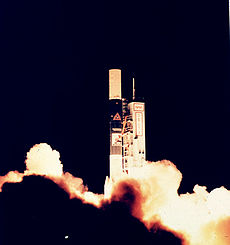
on November 18, 1989 aboard a Delta rocket. A team of American scientists announced, on April 23, 1992, that they had found the primordial "seeds" (CMBE anisotropy) in data from COBE. The announcement was reported worldwide as a fundamental scientific discovery and ran on the front page of the New York Times.
The Nobel Prize in Physics
for 2006 was jointly awarded to John C. Mather, NASA Goddard Space Flight Center
, and George F. Smoot, University of California, Berkeley
, "for their discovery of the blackbody form and anisotropy of the cosmic microwave background radiation."
, but with some unique characteristics.
The need to control and measure all the sources of systematic errors required a rigorous and integrated design. COBE would have to operate for a minimum of 6 months, and constrain the amount of radio interference from the ground, COBE and other satellites as well as radiative interference from the Earth
, Sun
and Moon
. The instruments required temperature stability and to maintain gain, and a high level of cleanliness to reduce entry of stray light and thermal emission from particulates.
The need to control systematic error in the measurement of the CMB anisotropy
and measuring the zodiacal cloud at different elongation angles for subsequent modeling required that the satellite rotate at a 0.8 rpm spin rate. The spin axis is also tilted back from the orbital velocity vector as a precaution against possible deposits of residual atmospheric gas on the optics as well against the infrared glow that would result from fast neutral particles hitting its surfaces at extremely high speed.
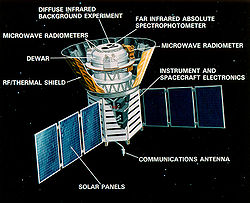 In order to meet the twin demands of slow rotation and three-axis attitude control, a sophisticated pair of yaw angular momentum wheel
s were employed with their axis oriented along the spin axis . These wheels were used to carry an angular momentum opposite that of the entire spacecraft in order to create a zero net angular momentum system.
The orbit would prove to be determined based on the specifics of the spacecraft’s mission. The overriding considerations were the need for full sky coverage, the need to eliminate stray radiation from the instruments and the need to maintain thermal stability of the dewar and the instruments. A circular Sun-synchronous orbit satisfied all these requirements. A 900 km altitude orbit with a 99° inclination was chosen as it fit within the capabilities of either a Shuttle
(with an auxiliary propulsion on COBE) or a Delta rocket. This altitude was a good compromise between Earth's radiation and the charged particle in Earth's radiation belts
at higher altitudes. An ascending node at 6 p.m. was chosen to allow COBE to follow the boundary between sunlight and darkness on Earth throughout the year.
The orbit combined with the spin axis made it possible to keep the Earth and the Sun continually below the plane of the shield, allowing a full sky scan every six months.
The last two important parts pertaining to the COBE mission were the dewar and Sun-Earth shield. The dewar was a 650 liter superfluid helium cryostat designed to keep the FIRAS and DIRBE instruments cooled during the duration of the mission. It was based on the same design as one used on IRAS
and was able to vent helium along the spin axis near the communication arrays. The conical Sun-Earth shield protected the instruments from direct solar and Earth based radiation as well as radio interference from Earth and the COBE's transmitting antenna. Its multilayer insulating blankets provided thermal isolation for the dewar.
 The science mission was conducted by the three instruments detailed previously: DIRBE, FIRAS and the DMR. The instruments overlapped in wavelength coverage, providing consistency check on measurements in the regions of spectral overlap and assistance in discriminating signals from our galaxy, solar system and CMB.
COBE's instruments would fulfill each of their objectives as well as making observations that would have implications outside of COBE’s initial scope.
 During the long gestation period of COBE, there were two significant astronomical developments. First, in 1981, two teams of astronomers, one led by David Wilkinson of Princeton and the other by Francesco Melchiorri of the University of Florence, simultaneously announced that they detected a quadrupole
distribution of CMB using balloon-borne instruments. This finding would have been the detection of the black-body distribution of CMB that FIRAS on COBE was to measure.
In particular, the Florence group claimed a detection of intermediate angular scale
anisotropies at the level 100 microkelvins in agreement with later measurements made by the BOOMERanG experiment
.
However, a number of other experiments attempted to duplicate their results and were unable to do so.
Second, in 1987 a Japanese-American team led by Andrew Lange
and Paul Richards of UC Berkeley and Toshio Matsumoto of Nagoya University made an announcement that CMB was not that of a true black body. In a sounding rocket
experiment, they detected an excess brightness at 0.5 and 0.7 mm wavelengths.
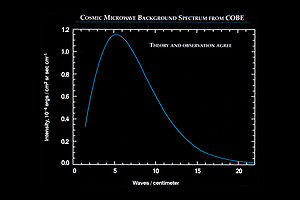
With these developments serving as a backdrop to COBE’s mission, scientists eagerly awaited results from FIRAS. The results of FIRAS were startling in that they showed a perfect fit of the CMB and the theoretical curve for a black body at a temperature of 2.7 K, thus proving the Berkeley-Nagoya results erroneous.
FIRAS measurements were made by measuring the spectral difference between a 7° patch of the sky against an internal black body. The interferometer in FIRAS covered between 2 and 95 cm−1 in two bands separated at 20 cm−1. There are two scan lengths (short and long) and two scan speeds (fast and slow) for a total of four different scan modes. The data were collected over a ten month period.
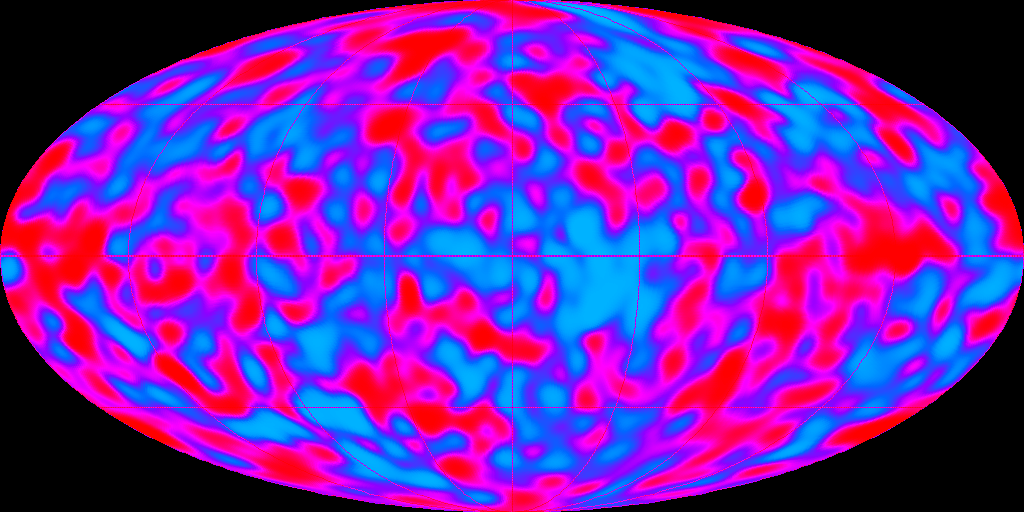
 The DMR was able to spend four years mapping the detectable anisotropy
of cosmic background radiation as it was the only instrument not dependent on the dewar’s supply of helium to keep it cooled. This operation was able to create full sky maps of the CMB by subtracting out galactic emissions and dipole at various frequencies. The cosmic microwave background fluctuations are extremely faint, only one part in 100,000 compared to the 2.73 kelvin
average temperature of the radiation field. The cosmic microwave background radiation is a remnant of the Big Bang
and the fluctuations are the imprint of density contrast in the early universe. The density ripples are believed to have produced structure formation
as observed in the universe today: clusters of galaxies and vast regions devoid of galaxies (NASA).
as well as nine other candidates in the weak far-IR that may be spiral galaxies.
Galaxies that were detected at the 140 and 240 μm were also able to provide information on very cold dust (VCD). At these wavelengths, the mass and temperature of VCD can be derived.
When these data were joined with 60 and 100 μm data taken from IRAS
, it was found that the far-infrared luminosity arises from cold (≈17–22 K) dust associated with diffuse HI
cirrus clouds, 15-30% from cold (≈19 K) dust associated with molecular gas, and less than 10% from warm (≈29 K) dust in the extended low-density HII region
s.
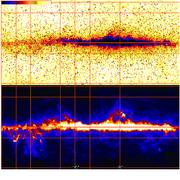 On top of the findings DIRBE had on galaxies, it also made two other significant contributions to science.
The DIRBE instrument was able to conduct studies on interplanetary dust (IPD) and determine if its origin was from asteroid or cometary particles. The DIRBE data collected at 12, 25, 50 and 100 μm were able to conclude that grains of asteroid
al origin populate the IPD bands and the smooth IPD cloud.
The second contribution DIRBE made was a model of the Galactic disk as seen edge-on from our position. According to the model, if our Sun is 8.6 kpc
from the Galactic center, then the sun is 15.6 pc above the midplane of the disk, which has a radial and vertical scale lengths of 2.64 and 0.333 kpc, respectively, and is warped in a way consistent with the HI layer. There is also no indication of a thick disk.
To create this model, the IPD had to be subtracted out of the DIRBE data. It was found that this cloud, which as seen from Earth is Zodiacal light
, was not centered on the Sun, as previously thought, but on a place in space a few million kilometers away. This is due to the gravitation influence of Saturn
and Jupiter
.
(EBL) can also provide important constraints on the integrated cosmological history of star formation, metal and dust production, and the conversion of starlight into infrared emissions by dust.
By looking at the results from DIRBE and FIRAS in the 140 to 5000 μm we can detect that the integrated EBL intensity is ≈16 nW/(m2·sr). This is consistent with the energy released during nucleosynthesis and constitutes about 20–50% of the total energy released in the formation of helium and metals throughout the history of the universe. Attributed only to nuclear sources, this intensity implies that more than 5–15% of the baryonic mass density implied by big bang nucleosynthesis analysis has been processed in stars to helium and heavier elements.
There were also significant implications into star formation
. COBE observations provide important constraints on the cosmic star formation rate, and help us calculate the EBL spectrum for various star formation histories. Observation made by COBE require that star formation rate at redshifts of z ≈ 1.5 to be larger than that inferred from UV-optical observations by a factor of 2. This excess stellar energy must be mainly generated by massive stars in yet-undetected dust enshrouded galaxies or extremely dusty star forming regions in observed galaxies. The exact star formation history cannot unambiguously be resolved by COBE and further observations must be made in the future.
On June 30, 2001, NASA launched a follow-up mission to COBE led by DMR Deputy Principal Investigator Charles L. Bennett
. The Wilkinson Microwave Anisotropy Probe
has clarified and expanded upon COBE's accomplishments.
Satellite
In the context of spaceflight, a satellite is an object which has been placed into orbit by human endeavour. Such objects are sometimes called artificial satellites to distinguish them from natural satellites such as the Moon....
dedicated to cosmology
Physical cosmology
Physical cosmology, as a branch of astronomy, is the study of the largest-scale structures and dynamics of the universe and is concerned with fundamental questions about its formation and evolution. For most of human history, it was a branch of metaphysics and religion...
. Its goals were to investigate the cosmic microwave background radiation
Cosmic microwave background radiation
In cosmology, cosmic microwave background radiation is thermal radiation filling the observable universe almost uniformly....
(CMB) of the universe
Universe
The Universe is commonly defined as the totality of everything that exists, including all matter and energy, the planets, stars, galaxies, and the contents of intergalactic space. Definitions and usage vary and similar terms include the cosmos, the world and nature...
and provide measurements that would help shape our understanding of the cosmos
Cosmos
In the general sense, a cosmos is an orderly or harmonious system. It originates from the Greek term κόσμος , meaning "order" or "ornament" and is antithetical to the concept of chaos. Today, the word is generally used as a synonym of the word Universe . The word cosmos originates from the same root...
.
This work provided evidence that supported the Big Bang
Big Bang
The Big Bang theory is the prevailing cosmological model that explains the early development of the Universe. According to the Big Bang theory, the Universe was once in an extremely hot and dense state which expanded rapidly. This rapid expansion caused the young Universe to cool and resulted in...
theory of the universe: that the CMB was a near-perfect black-body spectrum
Electromagnetic spectrum
The electromagnetic spectrum is the range of all possible frequencies of electromagnetic radiation. The "electromagnetic spectrum" of an object is the characteristic distribution of electromagnetic radiation emitted or absorbed by that particular object....
and that it had very faint anisotropies
Anisotropy
Anisotropy is the property of being directionally dependent, as opposed to isotropy, which implies identical properties in all directions. It can be defined as a difference, when measured along different axes, in a material's physical or mechanical properties An example of anisotropy is the light...
. Two of COBE's principal investigators, George Smoot and John Mather
John C. Mather
John Cromwell Mather is an American astrophysicist, cosmologist and Nobel Prize in Physics laureate for his work on the Cosmic Background Explorer Satellite with George Smoot. COBE was the first experiment to measure ".....
, received the Nobel Prize in Physics
Nobel Prize in Physics
The Nobel Prize in Physics is awarded once a year by the Royal Swedish Academy of Sciences. It is one of the five Nobel Prizes established by the will of Alfred Nobel in 1895 and awarded since 1901; the others are the Nobel Prize in Chemistry, Nobel Prize in Literature, Nobel Peace Prize, and...
in 2006 for their work on the project. According to the Nobel Prize committee, "the COBE-project can also be regarded as the starting point for cosmology
Cosmology
Cosmology is the discipline that deals with the nature of the Universe as a whole. Cosmologists seek to understand the origin, evolution, structure, and ultimate fate of the Universe at large, as well as the natural laws that keep it in order...
as a precision science".
History
In 1974, NASANASA
The National Aeronautics and Space Administration is the agency of the United States government that is responsible for the nation's civilian space program and for aeronautics and aerospace research...
issued an Announcement of Opportunity for astronomical missions that would use a small- or medium-sized Explorer
Explorer program
The Explorer program is a United States space exploration program that provides flight opportunities for physics, heliophysics, and astrophysics investigations from space. Over 90 space missions have been launched from 1958 to 2011, and it is still active...
spacecraft. Out of the 121 proposals received, three dealt with studying the cosmological background radiation. Though these proposals lost out to the Infrared Astronomical Satellite
IRAS
The Infrared Astronomical Satellite was the first-ever space-based observatory to perform a survey of the entire sky at infrared wavelengths....
(IRAS), their strength made NASA further explore the idea. In 1976, NASA formed a committee of members from each of 1974's three proposal teams to put together their ideas for such a satellite. A year later, this committee suggested a polar-orbiting
Polar orbit
A polar orbit is an orbit in which a satellite passes above or nearly above both poles of the body being orbited on each revolution. It therefore has an inclination of 90 degrees to the equator...
satellite called COBE to be launched by either a Delta rocket
Delta rocket
Delta is a versatile family of expendable launch systems that has provided space launch capability in the United States since 1960. There have been more than 300 Delta rockets launched, with a 95 percent success rate. Two Delta launch systems – Delta II and Delta IV – are in active use...
or the Space Shuttle
Space Shuttle
The Space Shuttle was a manned orbital rocket and spacecraft system operated by NASA on 135 missions from 1981 to 2011. The system combined rocket launch, orbital spacecraft, and re-entry spaceplane with modular add-ons...
. It would contain the following instruments:
| Instrument | Acronym | Description | Principal Investigator |
|---|---|---|---|
| Differential Microwave Radiometer | DMR | a microwave Microwave Microwaves, a subset of radio waves, have wavelengths ranging from as long as one meter to as short as one millimeter, or equivalently, with frequencies between 300 MHz and 300 GHz. This broad definition includes both UHF and EHF , and various sources use different boundaries... instrument that would map variations (or anisotropies) in the CMB Cosmic microwave background radiation In cosmology, cosmic microwave background radiation is thermal radiation filling the observable universe almost uniformly.... |
George Smoot |
| Far-InfraRed Absolute Spectrophotometer | FIRAS | a spectrophotometer used to measure the spectrum of the CMB | John Mather John C. Mather John Cromwell Mather is an American astrophysicist, cosmologist and Nobel Prize in Physics laureate for his work on the Cosmic Background Explorer Satellite with George Smoot. COBE was the first experiment to measure "..... |
| Diffuse InfraRed Background Experiment Diffuse Infrared Background Experiment Diffuse Infrared Background Experiment was an experiment on NASA's COBE mission, to survey the diffuse infrared sky. The DIRBE instrument was an absolute radiometer with an off-axis folded-Gregorian reflecting telescope, with 19 cm diameter aperture... |
DIRBE | a multiwavelength infrared detector used to map dust emission | Mike Hauser |
IRAS
The Infrared Astronomical Satellite was the first-ever space-based observatory to perform a survey of the entire sky at infrared wavelengths....
, work on constructing the satellite at Goddard Space Flight Center (GSFC) did not begin until 1981. To save costs, the infrared detectors and liquid helium
Helium
Helium is the chemical element with atomic number 2 and an atomic weight of 4.002602, which is represented by the symbol He. It is a colorless, odorless, tasteless, non-toxic, inert, monatomic gas that heads the noble gas group in the periodic table...
dewar
Dewar flask
A Dewar flask is a vessel designed to provide very good thermal insulation. For instance, when filled with a hot liquid, the vessel will not allow the heat to easily escape, and the liquid will stay hot for far longer than in a typical container...
on COBE would be similar to those used on IRAS.
COBE was originally planned to be launched on a Space Shuttle
Space Shuttle
The Space Shuttle was a manned orbital rocket and spacecraft system operated by NASA on 135 missions from 1981 to 2011. The system combined rocket launch, orbital spacecraft, and re-entry spaceplane with modular add-ons...
mission STS-82-B
Cancelled Space Shuttle missions
During the Space Shuttle program, a number of missions were cancelled. Many were cancelled as a result of the Challenger and the Columbia disasters. Furthermore, many early missions were cancelled due to delays in the development of the shuttle...
in 1988 from Vandenberg Air Force Base
Vandenberg Air Force Base
Vandenberg Air Force Base is a United States Air Force Base, located approximately northwest of Lompoc, California. It is under the jurisdiction of the 30th Space Wing, Air Force Space Command ....
, but the Challenger explosion
STS-51-L
STS-51-L was the twenty-fifth flight of the American Space Shuttle program, which marked the first time an ordinary civilian, schoolteacher Christa McAuliffe, had flown aboard the Space Shuttle. The mission used Space Shuttle Challenger, which lifted off from the Launch Complex 39-B on 28 January...
delayed this plan when the Shuttles were grounded. NASA kept COBE's engineers from going to other space agencies to launch COBE, but eventually, a redesigned COBE was placed into sun-synchronous orbit
Sun-synchronous orbit
A Sun-synchronous orbit is a geocentric orbit which combines altitude and inclination in such a way that an object on that orbit ascends or descends over any given point of the Earth's surface at the same local mean solar time. The surface illumination angle will be nearly the same every time...
on November 18, 1989 aboard a Delta rocket. A team of American scientists announced, on April 23, 1992, that they had found the primordial "seeds" (CMBE anisotropy) in data from COBE. The announcement was reported worldwide as a fundamental scientific discovery and ran on the front page of the New York Times.
The Nobel Prize in Physics
Nobel Prize in Physics
The Nobel Prize in Physics is awarded once a year by the Royal Swedish Academy of Sciences. It is one of the five Nobel Prizes established by the will of Alfred Nobel in 1895 and awarded since 1901; the others are the Nobel Prize in Chemistry, Nobel Prize in Literature, Nobel Peace Prize, and...
for 2006 was jointly awarded to John C. Mather, NASA Goddard Space Flight Center
Goddard Space Flight Center
The Goddard Space Flight Center is a major NASA space research laboratory established on May 1, 1959 as NASA's first space flight center. GSFC employs approximately 10,000 civil servants and contractors, and is located approximately northeast of Washington, D.C. in Greenbelt, Maryland, USA. GSFC,...
, and George F. Smoot, University of California, Berkeley
University of California, Berkeley
The University of California, Berkeley , is a teaching and research university established in 1868 and located in Berkeley, California, USA...
, "for their discovery of the blackbody form and anisotropy of the cosmic microwave background radiation."
Spacecraft
COBE was an Explorer class satellite, with technology borrowed heavily from IRASIRAS
The Infrared Astronomical Satellite was the first-ever space-based observatory to perform a survey of the entire sky at infrared wavelengths....
, but with some unique characteristics.
The need to control and measure all the sources of systematic errors required a rigorous and integrated design. COBE would have to operate for a minimum of 6 months, and constrain the amount of radio interference from the ground, COBE and other satellites as well as radiative interference from the Earth
Earth
Earth is the third planet from the Sun, and the densest and fifth-largest of the eight planets in the Solar System. It is also the largest of the Solar System's four terrestrial planets...
, Sun
Sun
The Sun is the star at the center of the Solar System. It is almost perfectly spherical and consists of hot plasma interwoven with magnetic fields...
and Moon
Moon
The Moon is Earth's only known natural satellite,There are a number of near-Earth asteroids including 3753 Cruithne that are co-orbital with Earth: their orbits bring them close to Earth for periods of time but then alter in the long term . These are quasi-satellites and not true moons. For more...
. The instruments required temperature stability and to maintain gain, and a high level of cleanliness to reduce entry of stray light and thermal emission from particulates.
The need to control systematic error in the measurement of the CMB anisotropy
Anisotropy
Anisotropy is the property of being directionally dependent, as opposed to isotropy, which implies identical properties in all directions. It can be defined as a difference, when measured along different axes, in a material's physical or mechanical properties An example of anisotropy is the light...
and measuring the zodiacal cloud at different elongation angles for subsequent modeling required that the satellite rotate at a 0.8 rpm spin rate. The spin axis is also tilted back from the orbital velocity vector as a precaution against possible deposits of residual atmospheric gas on the optics as well against the infrared glow that would result from fast neutral particles hitting its surfaces at extremely high speed.
Momentum wheel
A reaction wheel is a type of flywheel used primarily by spacecraft for attitude control without using fuel for rockets or other reaction devices....
s were employed with their axis oriented along the spin axis . These wheels were used to carry an angular momentum opposite that of the entire spacecraft in order to create a zero net angular momentum system.
The orbit would prove to be determined based on the specifics of the spacecraft’s mission. The overriding considerations were the need for full sky coverage, the need to eliminate stray radiation from the instruments and the need to maintain thermal stability of the dewar and the instruments. A circular Sun-synchronous orbit satisfied all these requirements. A 900 km altitude orbit with a 99° inclination was chosen as it fit within the capabilities of either a Shuttle
Space Shuttle
The Space Shuttle was a manned orbital rocket and spacecraft system operated by NASA on 135 missions from 1981 to 2011. The system combined rocket launch, orbital spacecraft, and re-entry spaceplane with modular add-ons...
(with an auxiliary propulsion on COBE) or a Delta rocket. This altitude was a good compromise between Earth's radiation and the charged particle in Earth's radiation belts
Van Allen radiation belt
The Van Allen radiation belt is a torus of energetic charged particles around Earth, which is held in place by Earth's magnetic field. It is believed that most of the particles that form the belts come from solar wind, and other particles by cosmic rays. It is named after its discoverer, James...
at higher altitudes. An ascending node at 6 p.m. was chosen to allow COBE to follow the boundary between sunlight and darkness on Earth throughout the year.
The orbit combined with the spin axis made it possible to keep the Earth and the Sun continually below the plane of the shield, allowing a full sky scan every six months.
The last two important parts pertaining to the COBE mission were the dewar and Sun-Earth shield. The dewar was a 650 liter superfluid helium cryostat designed to keep the FIRAS and DIRBE instruments cooled during the duration of the mission. It was based on the same design as one used on IRAS
IRAS
The Infrared Astronomical Satellite was the first-ever space-based observatory to perform a survey of the entire sky at infrared wavelengths....
and was able to vent helium along the spin axis near the communication arrays. The conical Sun-Earth shield protected the instruments from direct solar and Earth based radiation as well as radio interference from Earth and the COBE's transmitting antenna. Its multilayer insulating blankets provided thermal isolation for the dewar.
Scientific findings
COBE's instruments would fulfill each of their objectives as well as making observations that would have implications outside of COBE’s initial scope.
Black-body curve of CMB
Quadrupole
A quadrupole or quadrapole is one of a sequence of configurations of—for example—electric charge or current, or gravitational mass that can exist in ideal form, but it is usually just part of a multipole expansion of a more complex structure reflecting various orders of complexity.-Mathematical...
distribution of CMB using balloon-borne instruments. This finding would have been the detection of the black-body distribution of CMB that FIRAS on COBE was to measure.
In particular, the Florence group claimed a detection of intermediate angular scale
anisotropies at the level 100 microkelvins in agreement with later measurements made by the BOOMERanG experiment
BOOMERanG experiment
The BOOMERanG experiment measured the cosmic microwave background radiation of a part of the sky during three sub-orbital balloon flights. It was the first experiment to make large, high fidelity images of the CMB temperature anisotropies...
.
However, a number of other experiments attempted to duplicate their results and were unable to do so.
Second, in 1987 a Japanese-American team led by Andrew Lange
Andrew E. Lange
Andrew E. Lange was an astrophysicist and Goldberger Professor of Physics at the California Institute of Technology in Pasadena, California. Lange came to Caltech in 1993 and was most recently the chair of the Division of Physics, Mathematics and Astronomy...
and Paul Richards of UC Berkeley and Toshio Matsumoto of Nagoya University made an announcement that CMB was not that of a true black body. In a sounding rocket
Sounding rocket
A sounding rocket, sometimes called a research rocket, is an instrument-carrying rocket designed to take measurements and perform scientific experiments during its sub-orbital flight. The origin of the term comes from nautical vocabulary, where to sound is to throw a weighted line from a ship into...
experiment, they detected an excess brightness at 0.5 and 0.7 mm wavelengths.
With these developments serving as a backdrop to COBE’s mission, scientists eagerly awaited results from FIRAS. The results of FIRAS were startling in that they showed a perfect fit of the CMB and the theoretical curve for a black body at a temperature of 2.7 K, thus proving the Berkeley-Nagoya results erroneous.
FIRAS measurements were made by measuring the spectral difference between a 7° patch of the sky against an internal black body. The interferometer in FIRAS covered between 2 and 95 cm−1 in two bands separated at 20 cm−1. There are two scan lengths (short and long) and two scan speeds (fast and slow) for a total of four different scan modes. The data were collected over a ten month period.
Intrinsic anisotropy of CMB
Anisotropy
Anisotropy is the property of being directionally dependent, as opposed to isotropy, which implies identical properties in all directions. It can be defined as a difference, when measured along different axes, in a material's physical or mechanical properties An example of anisotropy is the light...
of cosmic background radiation as it was the only instrument not dependent on the dewar’s supply of helium to keep it cooled. This operation was able to create full sky maps of the CMB by subtracting out galactic emissions and dipole at various frequencies. The cosmic microwave background fluctuations are extremely faint, only one part in 100,000 compared to the 2.73 kelvin
Kelvin
The kelvin is a unit of measurement for temperature. It is one of the seven base units in the International System of Units and is assigned the unit symbol K. The Kelvin scale is an absolute, thermodynamic temperature scale using as its null point absolute zero, the temperature at which all...
average temperature of the radiation field. The cosmic microwave background radiation is a remnant of the Big Bang
Big Bang
The Big Bang theory is the prevailing cosmological model that explains the early development of the Universe. According to the Big Bang theory, the Universe was once in an extremely hot and dense state which expanded rapidly. This rapid expansion caused the young Universe to cool and resulted in...
and the fluctuations are the imprint of density contrast in the early universe. The density ripples are believed to have produced structure formation
Structure formation
Structure formation refers to a fundamental problem in physical cosmology. The universe, as is now known from observations of the cosmic microwave background radiation, began in a hot, dense, nearly uniform state approximately 13.7 Gyr ago...
as observed in the universe today: clusters of galaxies and vast regions devoid of galaxies (NASA).
Detecting early galaxies
DIRBE also detected 10 new far-IR emitting galaxies in the region not surveyed by IRASIRAS
The Infrared Astronomical Satellite was the first-ever space-based observatory to perform a survey of the entire sky at infrared wavelengths....
as well as nine other candidates in the weak far-IR that may be spiral galaxies.
Galaxies that were detected at the 140 and 240 μm were also able to provide information on very cold dust (VCD). At these wavelengths, the mass and temperature of VCD can be derived.
When these data were joined with 60 and 100 μm data taken from IRAS
IRAS
The Infrared Astronomical Satellite was the first-ever space-based observatory to perform a survey of the entire sky at infrared wavelengths....
, it was found that the far-infrared luminosity arises from cold (≈17–22 K) dust associated with diffuse HI
H I region
An H I region is an interstellar cloud composed of neutral atomic hydrogen , in addition to the local abundance of helium and other elements. These regions are non-luminous, save for emission of the 21-cm region spectral line. This line has a very low transition probability, so requires large...
cirrus clouds, 15-30% from cold (≈19 K) dust associated with molecular gas, and less than 10% from warm (≈29 K) dust in the extended low-density HII region
H II region
An H II region is a large, low-density cloud of partially ionized gas in which star formation has recently taken place. The short-lived, blue stars forged in these regions emit copious amounts of ultraviolet light, ionizing the surrounding gas...
s.
DIRBE
The DIRBE instrument was able to conduct studies on interplanetary dust (IPD) and determine if its origin was from asteroid or cometary particles. The DIRBE data collected at 12, 25, 50 and 100 μm were able to conclude that grains of asteroid
Asteroid
Asteroids are a class of small Solar System bodies in orbit around the Sun. They have also been called planetoids, especially the larger ones...
al origin populate the IPD bands and the smooth IPD cloud.
The second contribution DIRBE made was a model of the Galactic disk as seen edge-on from our position. According to the model, if our Sun is 8.6 kpc
Parsec
The parsec is a unit of length used in astronomy. It is about 3.26 light-years, or just under 31 trillion kilometres ....
from the Galactic center, then the sun is 15.6 pc above the midplane of the disk, which has a radial and vertical scale lengths of 2.64 and 0.333 kpc, respectively, and is warped in a way consistent with the HI layer. There is also no indication of a thick disk.
To create this model, the IPD had to be subtracted out of the DIRBE data. It was found that this cloud, which as seen from Earth is Zodiacal light
Zodiacal light
Zodiacal light is a faint, roughly triangular, whitish glow seen in the night sky which appears to extend up from the vicinity of the sun along the ecliptic or zodiac. Caused by sunlight scattered by space dust in the zodiacal cloud, it is so faint that either moonlight or light pollution renders...
, was not centered on the Sun, as previously thought, but on a place in space a few million kilometers away. This is due to the gravitation influence of Saturn
Saturn
Saturn is the sixth planet from the Sun and the second largest planet in the Solar System, after Jupiter. Saturn is named after the Roman god Saturn, equated to the Greek Cronus , the Babylonian Ninurta and the Hindu Shani. Saturn's astronomical symbol represents the Roman god's sickle.Saturn,...
and Jupiter
Jupiter
Jupiter is the fifth planet from the Sun and the largest planet within the Solar System. It is a gas giant with mass one-thousandth that of the Sun but is two and a half times the mass of all the other planets in our Solar System combined. Jupiter is classified as a gas giant along with Saturn,...
.
Cosmological implications
In addition to the science results detailed in the last section, there are numerous cosmological questions left unanswered by COBE’s results. A direct measurement of the extragalactic background lightExtragalactic background light
The Extragalactic Background Light or simply the "extragalactic background" is the faint diffuse light of the night sky, consisting of the combined flux of all extragalactic sources...
(EBL) can also provide important constraints on the integrated cosmological history of star formation, metal and dust production, and the conversion of starlight into infrared emissions by dust.
By looking at the results from DIRBE and FIRAS in the 140 to 5000 μm we can detect that the integrated EBL intensity is ≈16 nW/(m2·sr). This is consistent with the energy released during nucleosynthesis and constitutes about 20–50% of the total energy released in the formation of helium and metals throughout the history of the universe. Attributed only to nuclear sources, this intensity implies that more than 5–15% of the baryonic mass density implied by big bang nucleosynthesis analysis has been processed in stars to helium and heavier elements.
There were also significant implications into star formation
Star formation
Star formation is the process by which dense parts of molecular clouds collapse into a ball of plasma to form a star. As a branch of astronomy star formation includes the study of the interstellar medium and giant molecular clouds as precursors to the star formation process and the study of young...
. COBE observations provide important constraints on the cosmic star formation rate, and help us calculate the EBL spectrum for various star formation histories. Observation made by COBE require that star formation rate at redshifts of z ≈ 1.5 to be larger than that inferred from UV-optical observations by a factor of 2. This excess stellar energy must be mainly generated by massive stars in yet-undetected dust enshrouded galaxies or extremely dusty star forming regions in observed galaxies. The exact star formation history cannot unambiguously be resolved by COBE and further observations must be made in the future.
On June 30, 2001, NASA launched a follow-up mission to COBE led by DMR Deputy Principal Investigator Charles L. Bennett
Charles L. Bennett
Charles L. Bennett is an American observational astrophysicist and the Alumni Centennial Professor of Physics and Astronomy at Johns Hopkins University. He is the Principal Investigator of NASA's highly successful Wilkinson Microwave Anisotropy Probe...
. The Wilkinson Microwave Anisotropy Probe
Wilkinson Microwave Anisotropy Probe
The Wilkinson Microwave Anisotropy Probe — also known as the Microwave Anisotropy Probe , and Explorer 80 — is a spacecraft which measures differences in the temperature of the Big Bang's remnant radiant heat — the Cosmic Microwave Background Radiation — across the full sky. Headed by Professor...
has clarified and expanded upon COBE's accomplishments.
See also
- Wilkinson Microwave Anisotropy ProbeWilkinson Microwave Anisotropy ProbeThe Wilkinson Microwave Anisotropy Probe — also known as the Microwave Anisotropy Probe , and Explorer 80 — is a spacecraft which measures differences in the temperature of the Big Bang's remnant radiant heat — the Cosmic Microwave Background Radiation — across the full sky. Headed by Professor...
- The successor of COBE - 9997 COBE9997 COBE9997 COBE is a main belt asteroid. It orbits the Sun once every 4.06 years.Discovered on March 25, 1971 by C. J. van Houten and I. van Houten-Groeneveld in archival data produced by T. Gehrels, it was given the provision designation 1217 T-1. It was later renamed 9997 COBE in honour of the Cosmic...
- A minor planetMinor planetAn asteroid group or minor-planet group is a population of minor planets that have a share broadly similar orbits. Members are generally unrelated to each other, unlike in an asteroid family, which often results from the break-up of a single asteroid...
named after the experiment.
External links
- NASA's website on COBE
- NASA informational video prior to COBE launch
- COBE Mission Profile by NASA's Solar System Exploration
- APOD picture of the COBE dipole, showing the 600 kps motion of the Earth relative to the cosmic background radiation
- Cosmic Background Explorer article from ScholarpediaScholarpediaScholarpedia is an English-language online wiki-based encyclopedia that uses the same MediaWiki software as Wikipedia, but has features more commonly associated with open-access online academic journals....