
All Topics  
Cosmic microwave background radiation

 
Cosmic Microwave Background Radiation

   Email Print
   Bookmark   Link


Cosmic microwave background radiation


In cosmology
Physical cosmology

Physical cosmology, as a branch of astronomy, is the study of the largest-scale structures and dynamics of our universe and is concerned with fundamental questions about its formation and evolution....
, the cosmic microwave background radiation CMB (also CMBR, CBR, MBR, and relic radiation) is a form of electromagnetic radiation
Electromagnetic radiation

Electromagnetic radiation takes the form of wave propagation waves in a vacuum or in matter. EM radiation has an electric field and magnetic field component which oscillate in phase perpendicular to each other and to the direction of energy Wave propagation....
 filling the universe
Universe

The universe is defined as everything that physically exists: the entirety of space and time, all forms of matter, energy and momentum, and the physical laws and physical constants that govern them....
. With a traditional optical telescope
Optical telescope

An optical telescope is a telescope which is used to gather and Focus light mainly from the Visible spectrum part of the electromagnetic spectrum for directly viewing a magnification image for making a photograph, or collecting data through electronic s....
, the space between stars and galaxies (the background) is pitch black. But with a radio telescope
Radio telescope

A radio telescope is a form of Directional antennae radio Antenna used in radio astronomy and in tracking and collecting data from satellites and space probes....
, there is a faint background glow, almost exactly the same in all directions, that is not associated with any star, galaxy, or other object.


Discussion
Ask a question about 'Cosmic microwave background radiation'
Start a new discussion about 'Cosmic microwave background radiation'
Answer questions from other users
Full Discussion Forum


Recent Posts


Encyclopedia


In cosmology
Physical cosmology

Physical cosmology, as a branch of astronomy, is the study of the largest-scale structures and dynamics of our universe and is concerned with fundamental questions about its formation and evolution....
, the cosmic microwave background radiation CMB (also CMBR, CBR, MBR, and relic radiation) is a form of electromagnetic radiation
Electromagnetic radiation

Electromagnetic radiation takes the form of wave propagation waves in a vacuum or in matter. EM radiation has an electric field and magnetic field component which oscillate in phase perpendicular to each other and to the direction of energy Wave propagation....
 filling the universe
Universe

The universe is defined as everything that physically exists: the entirety of space and time, all forms of matter, energy and momentum, and the physical laws and physical constants that govern them....
. With a traditional optical telescope
Optical telescope

An optical telescope is a telescope which is used to gather and Focus light mainly from the Visible spectrum part of the electromagnetic spectrum for directly viewing a magnification image for making a photograph, or collecting data through electronic s....
, the space between stars and galaxies (the background) is pitch black. But with a radio telescope
Radio telescope

A radio telescope is a form of Directional antennae radio Antenna used in radio astronomy and in tracking and collecting data from satellites and space probes....
, there is a faint background glow, almost exactly the same in all directions, that is not associated with any star, galaxy, or other object. This glow is strongest in the microwave
Microwave

Microwaves are electromagnetic radiation with wavelengths ranging from 1 mm to 1 m, or frequency between 0.3 hertz and 300 GHz....
 region of the radio spectrum, hence the name cosmic microwave background radiation. The CMB's discovery in 1964 by astronomers Arno Penzias and Robert Wilson
Robert Woodrow Wilson

Robert Woodrow Wilson is an United States astronomer, Nobel laureate in Nobel Prize in physics, who with Arno Allan Penzias discovered in 1964 the cosmic microwave background radiation ....
 was the culmination of work initiated in the 1940s, and earned them the 1978 Nobel Prize
Nobel Prize in Physics

The Nobel Prize in Physics is awarded once a year by the Royal Swedish Academy of Sciences. It is one of the five Nobel Prizes established by the will of Alfred Nobel in 1895 and awarded since 1901; the others are the Nobel Prize in chemistry, Nobel Prize in literature, Nobel Peace Prize, and Nobel Prize in physiology or medicine....
.

The CMBR is well explained by the Big Bang
Big Bang

The Big Bang is the physical cosmology model of the initial conditions and subsequent development of the universe supported by the most comprehensive and accurate explanations from current scientific method and observation....
 theory – when the universe was young, before the formation of stars and planets, it was smaller, much hotter, and filled with a uniform glow from its red-hot fog of hydrogen plasma
Plasma (physics)

In physics and chemistry, plasma is a partially ionized gas, in which a certain proportion of electrons are free rather than being bound to an atom or molecule....
. As the universe expanded, both the plasma and the radiation filling it grew cooler. When the universe cooled enough, stable atoms could form. These atoms could no longer absorb the thermal radiation
Thermal radiation

Thermal radiation is electromagnetic radiation emitted from the surface of an object which is due to the object's temperature. Infrared radiation from a common household radiator or electric heater is an example of thermal radiation, as is the light emitted by a glowing incandescent light bulb....
, and the universe became transparent instead of being an opaque fog. The photons that were around at that time have been propagating ever since, though growing fainter and less energetic, since the exact same photons fill a larger and larger universe. This is the source for the term relic radiation, another name for the CMBR.

Precise measurements of cosmic background radiation are critical to cosmology, since any proposed model of the universe must explain this radiation. The CMBR has a thermal black body
Black body

In physics, a black body is an Physical body that absorbs all electromagnetic radiation that falls on it. No electromagnetic radiation passes through it and none is Reflection ....
 spectrum at a temperature of 2.725 K, thus the spectrum peaks in the microwave
Microwave

Microwaves are electromagnetic radiation with wavelengths ranging from 1 mm to 1 m, or frequency between 0.3 hertz and 300 GHz....
 range frequency of 160.2 GHz, corresponding to a 1.9 mm wavelength. The glow is almost but not quite uniform in all directions, and shows a very specific pattern equal to that expected if the inherent randomness of a red-hot gas is blown up to the size of the universe. In particular, the spatial power spectrum
Spectral density

In statistical signal processing and physics, the spectral density, power spectral density , or energy spectral density , is a positive real function of a frequency variable associated with a stationary stochastic process, or a deterministic function of time, which has dimensions of power per Hz, or energy per Hz....
 (how much difference is observed versus how far apart the regions are on the sky) contains small anisotropies
Anisotropy

Anisotropy is the property of being directionally dependent, as opposed to isotropy, which means homogeneity in all directions. It can be defined as a difference in a physical property for some material when measured along different axes....
, or irregularities, which vary with the size of the region examined. They have been measured in detail, and match to within experimental error what would be expected if small thermal fluctuations had expanded to the size of the observable space we can detect today.

Although many different processes might produce the general form of a black body spectrum, no model other than the Big Bang
Big Bang

The Big Bang is the physical cosmology model of the initial conditions and subsequent development of the universe supported by the most comprehensive and accurate explanations from current scientific method and observation....
 has yet explained the fluctuations. As a result, most cosmologists consider the Big Bang theory of the universe to be the best explanation for the CMBR.

Features

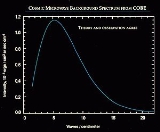
Firas Spectrum
The cosmic microwave background is isotropic to roughly one part in 100,000: the root mean square
Root mean square

In mathematics, the root mean square , also known as the quadratic mean, is a statistics measure of the magnitude of a varying quantity. It is especially useful when variates are positive and negative, e.g., sinusoids....
 variations are only 18 µK.This ignores the dipole
Dipole

In physics, there are two kinds of dipoles :*An electric dipole is a separation of positive and negative charge. The simplest example of this is a pair of electric charges of equal magnitude but opposite sign, separated by some, usually small, distance....
 anisotropy, which is due to the Doppler shift of the microwave background radiation due to our peculiar velocity
Peculiar velocity

In physical cosmology, the term peculiar velocity refers to the components of a receding galaxy's velocity that cannot be explained by Hubble's law....
 relative to the comoving cosmic rest frame. This feature is consistent with the Earth moving at some 380 km/s towards the constellation Virgo
Virgo (constellation)

Virgo is one of the constellations of the zodiac. Its name is Latin for virgin, and its symbol is . Lying between Leo to the west and Libra to the east, it is the second largest constellation in the sky....
.
The Far-Infrared Absolute Spectrophotometer (FIRAS) instrument on the NASA
NASA

The National Aeronautics and Space Administration is an agency of the Federal government of the United States, responsible for the nation's public list of space agencies....
 Cosmic Background Explorer
COBE

The Cosmic Background Explorer , also referred to as Explorer 66, was a satellite dedicated to physical cosmology. Its goals were to investigate the cosmic microwave background radiation of the universe and provide measurements that would help shape our understanding of the cosmos....
 (COBE) satellite has carefully measured the spectrum of the cosmic microwave background. The FIRAS project members compared the CMB with an internal reference black body
Black body

In physics, a black body is an Physical body that absorbs all electromagnetic radiation that falls on it. No electromagnetic radiation passes through it and none is Reflection ....
 and the spectra agreed to within the experimental error. They concluded that any deviations from the black body form that might still remain undetected in the CMB spectrum over the wavelength range from 0.5 to 5 mm must have a weighted rms
Root mean square

In mathematics, the root mean square , also known as the quadratic mean, is a statistics measure of the magnitude of a varying quantity. It is especially useful when variates are positive and negative, e.g., sinusoids....
 value of at most 50 parts per million (0.005%) of the CMB peak brightness. This made the CMB spectrum the most precisely measured black body spectrum in nature.

The cosmic microwave background, and its level of isotropy
Isotropy

Isotropy is uniformity in all directions. Precise definitions depend on the subject area. The word is made up from Greek iso and tropos ....
, are both predictions of Big Bang
Big Bang

The Big Bang is the physical cosmology model of the initial conditions and subsequent development of the universe supported by the most comprehensive and accurate explanations from current scientific method and observation....
 theory. In the theory, after about 10-37 seconds the nascent universe underwent exponential growth
Exponential growth

Exponential growth occurs when the growth rate of a mathematical function is proportionality to the function's current value. In the case of a discrete domain of definition with equal intervals it is also called geometric growth or geometric decay ....
 that smoothed out nearly all inhomogeneities—a process known as cosmic inflation
Cosmic inflation

In physical cosmology, cosmic inflation is the hypothesis that the wiktionary:nascent universe passed through a phase of exponential growth metric expansion of space was driven by a negative pressure vacuum energy density....
.The exception being inhomogeneities caused by quantum fluctuations in the inflaton
Inflaton

The inflaton is the generic name of the unidentified Scalar field theory that may be responsible for an episode of cosmic inflation in the very early universe....
 field.
This was followed by symmetry breaking; a type of phase transition that set the fundamental forces and elementary particle
Elementary particle

In particle physics, an elementary particle or fundamental particle is a wiktionary:particle not known to have substructure; that is, it is not known to be made up of smaller particles....
s in their present form. After 10-6 seconds, the early universe was made up of a hot plasma
Plasma (physics)

In physics and chemistry, plasma is a partially ionized gas, in which a certain proportion of electrons are free rather than being bound to an atom or molecule....
 of photon
Photon

In physics, the photon is an elementary particle, the quantum of the electromagnetic field and the basic unit of light and all other forms of electromagnetic radiation....
s, electrons and baryon
Baryon

Baryons are the family of composite particle subatomic particle made of three quarks, as opposed to the mesons which are the family of composite particles made of one quark and one antiquark....
s. The photons were constantly interacting with the plasma through Thomson scattering
Thomson scattering

In physics, Thomson scattering is the elastic scattering of electromagnetic radiation by acharged particle. The electric and magnetic components of the...
. As the universe expanded
Metric expansion of space

The metric expansion of space is the averaged increase of metric distance between objects in the universe with time. It is an intrinsic and extrinsic properties expansion?that is, it is defined by the relative separation of parts of the universe and not by motion "outward" into preexisting space....
, adiabatic cooling caused the plasma to cool until it became favourable for electrons to combine with protons and form hydrogen
Hydrogen

Hydrogen is the chemical element with atomic number 1. It is represented by the chemical symbol H. At standard temperature and pressure, hydrogen is a colorless, odorless, nonmetallic, tasteless, highly combustion and explosive Diatomic molecule gas with the molecular formula H2....
 atoms. This recombination
Timeline of the Big Bang

This timeline of the Big Bang describes the events according to the widely accepted scientific theory of the Big Bang, using the cosmological time parameter of comoving coordinates....
 event happened at around 3,000 K or when the universe was approximately 379,000 years old.This is equivalent to a redshift
Redshift

In physics and astronomy, redshift occurs when electromagnetic radiation?usually visible light?emitted or reflected by an object is shifted towards the red end of the electromagnetic spectrum due to the Doppler effect....
 of z = 1088.
At this point, the photons scattered off the now electrically-neutral atoms and began to travel freely through space, resulting in the decoupling
Decoupling

The term "decoupling" is used in many different contexts....
 of matter and radiation.

The color temperature
Color temperature

Color temperature is a characteristic of visible light that has important applications in lighting, photography, videography, publishing, and other fields....
 of the photons has continued to diminish ever since; now down to 2.725 K, their temperature will continue to drop as the universe expands. According to the Big Bang theory, the radiation from the sky we measure today comes from a spherical surface called the surface of last scattering. This represents the collection of points in space at which the decoupling event is believed to have occurred, less than 400,000 years after the Big Bang, and at a point in time such that the photons from that distance have just reached observers. The estimated age of the Universe is 13.7 billion years. However, because the Universe has continued expanding since that time, the comoving distance
Comoving distance

In Big Bang, 'comoving' distance and 'proper distance' are two closely related distance measures used by cosmologists to define distances between objects....
 from the Earth to edge of the observable universe
Observable universe

In Big Bang cosmology, the observable universe consists of the galaxies and other matter that we can in principle observe from Earth in the present day, because light from those objects has had time to reach us since the beginning of the cosmological expansion....
 is now at least 46.5 billion light years.

The Big Bang theory suggests that the cosmic microwave background fills all of observable space, and that most of the radiation energy in the universe is in the cosmic microwave background, which makes up a fraction of roughly of the total density of the universe.

Two of the greatest successes of the big bang theory are its prediction of its almost perfect black body
Black body

In physics, a black body is an Physical body that absorbs all electromagnetic radiation that falls on it. No electromagnetic radiation passes through it and none is Reflection ....
 spectrum and its detailed prediction of the anisotropies in the cosmic microwave background. The recent Wilkinson Microwave Anisotropy Probe
Wilkinson Microwave Anisotropy Probe

The Wilkinson Microwave Anisotropy Probe ? also known as the Microwave Anisotropy Probe , and Explorer 80 ? measures differences in the cosmic microwave background radiation of the Big Bang's remnant radiant heat across the full sky....
 has precisely measured these anisotropies over the whole sky down to angular scales of 0.2 degrees. These can be used to estimate the parameters of the standard Lambda-CDM model
Lambda-CDM model

ΛCDM or Lambda-CDM is an abbreviation for Lambda-Cold Dark Matter. It is frequently referred to as the concordance model of big bang physical cosmology, since it attempts to explain cosmic microwave background observations, as well as Large-scale structure of the cosmos observations and supernovae observations of th...
 of the big bang. Some information, such as the shape of the Universe
Shape of the Universe

The shape of the Universe is an informal name for a subject of investigation within physical cosmology which describes the geometry of the universe including both #Local geometry and #Global geometry....
, can be obtained straightforwardly from the cosmic microwave background, while others, such as the Hubble constant, are not constrained and must be inferred from other measurements. The latter value gives the redshift
Redshift

In physics and astronomy, redshift occurs when electromagnetic radiation?usually visible light?emitted or reflected by an object is shifted towards the red end of the electromagnetic spectrum due to the Doppler effect....
 of galaxies (interpreted as the recessional velocity
Recessional velocity

Recessional Velocity is a term used to describe the rate at which an object is moving away, typically from Earth....
) as a proportion of their distance.

History

Timeline of the CMB
Important people and dates
>1941 Andrew McKellar
Andrew McKellar

Dr. Andrew McKellar was a Canada astronomer.He was born in Vancouver, British Columbia, Canada, to Scotland parents, one of six children of John H....
 reported the observation of an average bolometric temperature of 2.3 K based on the study of interstellar absorption lines.
>1946 Robert Dicke predicts ".. radiation from cosmic matter" at <20 K, but did not refer to background radiation
>1948George Gamow
George Gamow

George Gamow , born Georgiy Antonovich Gamov , was a Russian Empire-born theoretical physicist and cosmologist. He discovered quantum tunneling and worked on radioactive decay of the atomic nucleus, stellar evolution, stellar nucleosynthesis, big bang nucleosynthesis, nucleocosmogenesis and genetics....
 calculates a temperature of 50 K (assuming a 3-billion year old Universe), commenting it ".. is in reasonable agreement with the actual temperature of interstellar space", but does not mention background radiation.
>1948Ralph Alpher and Robert Herman
Robert Herman

Robert Herman was a United States scientist, best known for his work with Ralph Alpher in 1948-50, on estimating the temperature of cosmic microwave background radiation from the Big Bang explosion....
 estimate "the temperature in the Universe" at 5 K. Although they do not specifically mention microwave background radiation, it may be inferred.
>1950Ralph Alpher and Robert Herman re-re-estimate the temperature at 28 K.
>1953George Gamow
George Gamow

George Gamow , born Georgiy Antonovich Gamov , was a Russian Empire-born theoretical physicist and cosmologist. He discovered quantum tunneling and worked on radioactive decay of the atomic nucleus, stellar evolution, stellar nucleosynthesis, big bang nucleosynthesis, nucleocosmogenesis and genetics....
 estimates 7 K.
>1956George Gamow
George Gamow

George Gamow , born Georgiy Antonovich Gamov , was a Russian Empire-born theoretical physicist and cosmologist. He discovered quantum tunneling and worked on radioactive decay of the atomic nucleus, stellar evolution, stellar nucleosynthesis, big bang nucleosynthesis, nucleocosmogenesis and genetics....
 estimates 6 K.
>1957Tigran Shmaonov reports that "the absolute effective temperature of the radioemission background ... is 4±3K". It is noted that the "measurements showed that radiation intensity was independent of either time or direction of observation... it is now clear that Shmaonov did observe the cosmic microwave background at a wavelength of 3.2 cm"
>1960sRobert Dicke re-estimates a MBR (microwave background radiation) temperature of 40 K
>1964 A. G. Doroshkevich
A. G. Doroshkevich

A. G. Doroshkevich is a Russians astrophysics and physical cosmology.He is best known for his work with Igor Novikov on the recognition of Cosmic microwave background radiation as a detectable phenomenon in the spring of 1964....
 and Igor Novikov
Igor Dmitriyevich Novikov

Igor Dmitriyevich Novikov is a Russians astrophysics and physical cosmology.Novikov formulated the Novikov self-consistency principle in the mid-1980s, an important contribution to the theory of time travel....
 publish a brief paper, where they name the CMB radiation phenomenon as detectable.
>1964–65 Arno Penzias and Robert Woodrow Wilson
Robert Woodrow Wilson

Robert Woodrow Wilson is an United States astronomer, Nobel laureate in Nobel Prize in physics, who with Arno Allan Penzias discovered in 1964 the cosmic microwave background radiation ....
 measure the temperature to be approximately 3 K. Robert Dicke, P. J. E. Peebles, P. G. Roll and D. T. Wilkinson
David Todd Wilkinson

David Todd Wilkinson was a world-renowned pioneer in the field of physical cosmology, specializing in the study of the cosmic microwave background radiation left over from the Big Bang....
 interpret this radiation as a signature of the big bang.
>1983 RELIKT-1
RELIKT-1

RELIKT-1 - a Soviet Union cosmic microwave background anisotropy experiment on board the Prognoz 9 satellite first gave only upper limits on the large-scale anisotropy, but reanalysis of the data in 1992 claimed a signal roughly compatible with the later experiments....
 Soviet CMB anisotropy experiment was launched.
>1990 FIRAS measures the black body form of the CMB spectrum with exquisite precision.
>January 1992 Scientists who analysed data from RELIKT-1
RELIKT-1

RELIKT-1 - a Soviet Union cosmic microwave background anisotropy experiment on board the Prognoz 9 satellite first gave only upper limits on the large-scale anisotropy, but reanalysis of the data in 1992 claimed a signal roughly compatible with the later experiments....
 spacecraft report the discovery of anisotropy at the Moscow astrophysical seminar.
>April, 1992 Scientists who analysed data from COBE
COBE

The Cosmic Background Explorer , also referred to as Explorer 66, was a satellite dedicated to physical cosmology. Its goals were to investigate the cosmic microwave background radiation of the universe and provide measurements that would help shape our understanding of the cosmos....
 DMR announce the discovery of the primary temperature anisotropy.
>1999 First measurements of acoustic oscillations in the CMB anisotropy angular power spectrum from the TOCO, BOOMERANG and Maxima Experiments.
>2002 Polarization discovered by DASI.
>2004 E-mode polarization spectrum obtained by the CBI.


The cosmic microwave background was predicted in 1948 by George Gamow
George Gamow

George Gamow , born Georgiy Antonovich Gamov , was a Russian Empire-born theoretical physicist and cosmologist. He discovered quantum tunneling and worked on radioactive decay of the atomic nucleus, stellar evolution, stellar nucleosynthesis, big bang nucleosynthesis, nucleocosmogenesis and genetics....
, Ralph Alpher and Robert Herman
Robert Herman

Robert Herman was a United States scientist, best known for his work with Ralph Alpher in 1948-50, on estimating the temperature of cosmic microwave background radiation from the Big Bang explosion....
. Alpher and Herman were able to estimate the temperature of the cosmic microwave background to be 5 K, though two years later they re-estimated it at 28 K. Although there were several previous estimates of the temperature of space,See the timeline. these suffered from two flaws. First, they were measurements of the effective temperature of space and did not suggest that space was filled with a thermal Planck spectrum. Second, they depend on our being at a special place at the edge of the Milky Way galaxy and they did not suggest the radiation is isotropic. The estimates would yield very different predictions if Earth happened to be located elsewhere in the Universe.

The 1948 results of Gamow and Alpher were not widely discussed. However, they were rediscovered by Yakov Zel'dovich in the early 1960s, and independently predicted by Robert Dicke at the same time. The first published recognition of the CMB radiation as a detectable phenomenon appeared in a brief paper by Soviet
Soviet Union

The Union of Soviet Socialist Republics was a Constitution of the Soviet Union socialist state that existed in Eurasia from 1922 to 1991.The name is a translation of the , romanization of Russian Soyuz Sovetskikh Sotsialisticheskikh Respublik, abbreviated ????, SSSR....
 astrophysicists A. G. Doroshkevich
A. G. Doroshkevich

A. G. Doroshkevich is a Russians astrophysics and physical cosmology.He is best known for his work with Igor Novikov on the recognition of Cosmic microwave background radiation as a detectable phenomenon in the spring of 1964....
 and Igor Novikov
Igor Dmitriyevich Novikov

Igor Dmitriyevich Novikov is a Russians astrophysics and physical cosmology.Novikov formulated the Novikov self-consistency principle in the mid-1980s, an important contribution to the theory of time travel....
, in the spring of 1964. In 1964, David Todd Wilkinson
David Todd Wilkinson

David Todd Wilkinson was a world-renowned pioneer in the field of physical cosmology, specializing in the study of the cosmic microwave background radiation left over from the Big Bang....
 and Peter Roll, Dicke's colleagues at Princeton University
Princeton University

Princeton University is a private university university located in Princeton, New Jersey, New Jersey, United States. The school is one of the eight universities of the Ivy League and has the largest per-student Financial endowment in the world....
, began constructing a Dicke radiometer to measure the cosmic microwave background. In 1965, Arno Penzias and Robert Woodrow Wilson
Robert Woodrow Wilson

Robert Woodrow Wilson is an United States astronomer, Nobel laureate in Nobel Prize in physics, who with Arno Allan Penzias discovered in 1964 the cosmic microwave background radiation ....
 at the Crawford Hill
Crawford Hill

Crawford Hill is located in Holmdel Township, New Jersey, New Jersey, United States. It is Monmouth County, New Jersey's highest point, standing at least 380 feet above sea level....
 location of Bell Telephone Laboratories in nearby Holmdel Township, New Jersey
Holmdel Township, New Jersey

Holmdel Township is a Township in Monmouth County, New Jersey, New Jersey, United States. As of the United States 2000 Census, the township population was 15,781....
 had built a Dicke radiometer that they intended to use for radio astronomy and satellite communication experiments. Their instrument had an excess 3.5 K antenna temperature
Noise temperature

In electronics, noise temperature is a temperature assigned to a component such that the noise power delivered by the noisy component to a noiseless matched resistor is given by...
 which they could not account for. After receiving a telephone call from Crawford Hill, Dicke famously quipped: "Boys, we've been scooped." A meeting between the Princeton and Crawford Hill groups determined that the antenna temperature was indeed due to the microwave background. Penzias and Wilson received the 1978 Nobel Prize in Physics
Nobel Prize in Physics

The Nobel Prize in Physics is awarded once a year by the Royal Swedish Academy of Sciences. It is one of the five Nobel Prizes established by the will of Alfred Nobel in 1895 and awarded since 1901; the others are the Nobel Prize in chemistry, Nobel Prize in literature, Nobel Peace Prize, and Nobel Prize in physiology or medicine....
 for their discovery.

The interpretation of the cosmic microwave background was a controversial issue in the 1960s with some proponents of the steady state theory
Steady State theory

In physical cosmology, the Steady State theory is a model developed in 1948 by Fred Hoyle, Thomas Gold, Hermann Bondi and others as an non-standard cosmology to the Big Bang theory ....
 arguing that the microwave background was the result of scattered starlight from distant galaxies. Using this model, and based on the study of narrow absorption line features in the spectra of stars, the astronomer Andrew McKellar
Andrew McKellar

Dr. Andrew McKellar was a Canada astronomer.He was born in Vancouver, British Columbia, Canada, to Scotland parents, one of six children of John H....
 wrote in 1941: "It can be calculated that the 'rotational temperature
Rotational temperature

The rotational temperature is commonly used in thermodynamics, to simplify certain equations. It has units of temperature and is defined asWhere is the rotational constant, and k is the Boltzmann constant, given in wavenumbers per kelvin ....
' of interstellar space is 2 K." However, during the 1970s the consensus was established that the cosmic microwave background is a remnant of the big bang. This was largely because new measurements at a range of frequencies showed that the spectrum was a thermal, black body
Black body

In physics, a black body is an Physical body that absorbs all electromagnetic radiation that falls on it. No electromagnetic radiation passes through it and none is Reflection ....
 spectrum, a result that the steady state model was unable to reproduce.

Horn Antenna in Holmdel, New Jersey
Harrison, Peebles and Yu, and Zel'dovich realized that the early universe would have to have inhomogeneities at the level of 10-4 or 10-5. Rashid Sunyaev
Rashid Sunyaev

Rashid Alievich Sunyaev was born in Tashkent, Uzbek SSR, on March 1, 1943 to a Tatar family, and educated at the Moscow Institute of Physics and Technology and Moscow State University ....
 later calculated the observable imprint that these inhomogeneities would have on the cosmic microwave background. Increasingly stringent limits on the anisotropy of the cosmic microwave background were set by ground based experiments, but the anisotropy was first detected by the Differential Microwave Radiometer instrument on the COBE
COBE

The Cosmic Background Explorer , also referred to as Explorer 66, was a satellite dedicated to physical cosmology. Its goals were to investigate the cosmic microwave background radiation of the universe and provide measurements that would help shape our understanding of the cosmos....
 satellite.

Inspired by the COBE results, a series of ground and balloon-based experiments measured cosmic microwave background anisotropies on smaller angular scales over the next decade. The primary goal of these experiments was to measure the scale of the first acoustic peak, which COBE did not have sufficient resolution to resolve. This peak corresponds to large scale density variations in the early universe that are created by gravitational instabilities, resulting in acoustical oscillations in the plasma. The first peak in the anisotropy was tentatively detected by the Toco experiment and the result was confirmed by the BOOMERanG
BOOMERanG experiment

The BOOMERanG experiment measured the cosmic microwave background radiation of a part of the sky during three sub-orbital balloon flights. It was the first experiment to make large, high fidelity images of the CMB temperature anisotropies....
 and MAXIMA
Millimeter Anisotropy eXperiment IMaging Array

The Millimeter Anisotropy eXperiment IMaging Array experiment was a balloon-borne experiment funded by the U.S. National Science Foundation , NASA and United States Department of Energy, and operated by an international collaboration headed by the University of California, to measure the fluctuations of the cosmic microwave background....
 experiments. These measurements demonstrated that the geometry of the Universe
Shape of the Universe

The shape of the Universe is an informal name for a subject of investigation within physical cosmology which describes the geometry of the universe including both #Local geometry and #Global geometry....
 is approximately flat, rather than curved
Curved space

Curved space often refers to a spatial geometry which is not ?flat? where a flat space is described by Euclidean Geometry. Curved spaces can generally be described by Riemannian geometry though some simple cases can be described in other ways....
. They ruled out cosmic strings as a major component of cosmic structure formation and suggested cosmic inflation
Cosmic inflation

In physical cosmology, cosmic inflation is the hypothesis that the wiktionary:nascent universe passed through a phase of exponential growth metric expansion of space was driven by a negative pressure vacuum energy density....
 was the right theory of structure formation.

The second peak was tentatively detected by several experiments before being definitively detected by WMAP, which has also tentatively detected the third peak. As of 2008, several experiments to improve measurements of the polarization and the microwave background on small angular scales are ongoing. These include DASI, WMAP, BOOMERanG and the Cosmic Background Imager
Cosmic Background Imager

The Cosmic Background Imager is a 13-element interferometer perched at an elevation of 5,080 metres at Llano de Chajnantor Observatory in the Chilean Andes....
. Forthcoming experiments include the Planck satellite, Atacama Cosmology Telescope
Atacama Cosmology Telescope

The Atacama Cosmology Telescope is a six-metre telescope on Cerro Toco in the Atacama Desert in the north of Chile, near the Llano de Chajnantor Observatory....
, QUIET telescope and the South Pole Telescope
South Pole Telescope

The South Pole Telescope is a 10 meter diameter telescope located at the South Pole, Antarctica. It is a microwave/extremely high frequency telescope that observes in a frequency range between 70 and 300 GHz....
.

Relationship to the Big Bang

Measurements of the CMB have made the inflationary Big Bang theory the standard model of the earliest eras of the universe.This theory predicts that the initial conditions for the universe are originally random in nature, and follow a roughly Gaussian distribution. The power spectrum of these fluctuations has been calculated, and agrees startlingly well with the observations, although certain observables, for example the overall amplitude of the fluctuations, are more or less free parameters of the cosmic inflation
Cosmic inflation

In physical cosmology, cosmic inflation is the hypothesis that the wiktionary:nascent universe passed through a phase of exponential growth metric expansion of space was driven by a negative pressure vacuum energy density....
 model. Therefore, meaningful statements about the inhomogeneities in the universe need to be statistical
Statistics

Statistics is a Mathematics pertaining to the collection, analysis, interpretation or explanation, and presentation of data. It also provides tools for prediction and forecasting based on data....
 in nature. This leads to cosmic variance
Cosmic variance

Cosmic variance is the Statistics uncertainty inherent in observations of the universe at extreme distances. It is based on the idea that it is only possible to observe part of the universe at one particular time, so it is difficult to make statistical statements about physical cosmology on the scale of the entire universe....
 in which the uncertainties in the variance of the largest scale fluctuations observed in the universe are difficult to accurately compare to theory. The model uses a Gaussian random field
Gaussian random field

A Gaussian random field is a random field involving normal distribution of the variables. The initial conditions of physical cosmology generated by quantum fluctuation during cosmic inflation are thought to be a Gaussian random field with a nearly scale invariant spectrum....
 with a nearly scale invariant or Harrison-Zel'dovich spectrum to represent the primeval inhomogeneities.

Temperature

The cosmic microwave background radiation and the cosmological red shift
Red shift

Redshift or red shift can refer to:...
 are together regarded as the best available evidence for the Big Bang
Big Bang

The Big Bang is the physical cosmology model of the initial conditions and subsequent development of the universe supported by the most comprehensive and accurate explanations from current scientific method and observation....
 (BB) theory. The discovery of the CMB in the mid-1960s curtailed interest in alternatives
Non-standard cosmology

A non-standard cosmology is any physical cosmology of the universe that has been, or still is, proposed as an alternative to the big bang model of physical cosmology....
 such as the steady state theory
Steady State theory

In physical cosmology, the Steady State theory is a model developed in 1948 by Fred Hoyle, Thomas Gold, Hermann Bondi and others as an non-standard cosmology to the Big Bang theory ....
. The CMB gives a snapshot of the Universe
Universe

The universe is defined as everything that physically exists: the entirety of space and time, all forms of matter, energy and momentum, and the physical laws and physical constants that govern them....
 when, according to standard cosmology, the temperature dropped enough to allow electron
Electron

The electron is a subatomic particle that carries a negative electric charge. It has elementary particle and is believed to be a point particle....
s and proton
Proton

The proton is a subatomic particle with an electric charge of +1 elementary charge. It is found in the nucleus of each atom but is also stable by itself and has a second identity as the hydrogen ion, H+....
s to form hydrogen
Hydrogen

Hydrogen is the chemical element with atomic number 1. It is represented by the chemical symbol H. At standard temperature and pressure, hydrogen is a colorless, odorless, nonmetallic, tasteless, highly combustion and explosive Diatomic molecule gas with the molecular formula H2....
 atoms, thus making the universe transparent to radiation. When it originated some 400,000 years after the Big Bang – this time period is generally known as the "time of last scattering" or the period of recombination
Recombination

Recombination may refer to:* Genetic recombination, the process by which genetic material is broken and joined to other genetic material* Carrier generation and recombination, processes by which mobile electrons and electron holes are created and eliminated...
 or decoupling
Decoupling

The term "decoupling" is used in many different contexts....
 – the temperature of the Universe was about 3,000 K. This corresponds to an energy of about 0.25 eV
Electronvolt

In physics, the electron volt is a unit of energy. By definition, it is equal to the amount of kinetic energy gained by a single unbound electron when it accelerates through an Electrostatics potential difference of one volt....
, which is much less than the 13.6 eV ionization energy of hydrogen. Since then, the temperature of the radiation has dropped by a factor of roughly 1100 due to the expansion of the Universe. As the universe expands, the CMB photons are redshift
Redshift

In physics and astronomy, redshift occurs when electromagnetic radiation?usually visible light?emitted or reflected by an object is shifted towards the red end of the electromagnetic spectrum due to the Doppler effect....
ed, making the radiation's temperature inversely proportional to the Universe's scale length
Scale factor (Universe)

The scale factor or cosmic scale factor parameter of the Friedmann equations is a function of time which represents the metric expansion of space of the universe....
. For details about the reasoning that the radiation is evidence for the Big Bang, see Cosmic background radiation of the Big Bang
Big Bang

The Big Bang is the physical cosmology model of the initial conditions and subsequent development of the universe supported by the most comprehensive and accurate explanations from current scientific method and observation....
.

Primary anisotropy


The anisotropy
Anisotropy

Anisotropy is the property of being directionally dependent, as opposed to isotropy, which means homogeneity in all directions. It can be defined as a difference in a physical property for some material when measured along different axes....
 of the cosmic microwave background is divided into two sorts: primary anisotropy – which is due to effects which occur at the last scattering surface and before – and secondary anisotropy – which is due to effects, such as interactions with hot gas or gravitational potentials, between the last scattering surface and the observer.

The structure of the cosmic microwave background anisotropies is principally determined by two effects: acoustic oscillations and diffusion damping (also called collisionless damping or Silk damping). The acoustic oscillations arise because of a competition in the photon
Photon

In physics, the photon is an elementary particle, the quantum of the electromagnetic field and the basic unit of light and all other forms of electromagnetic radiation....
-baryon
Baryon

Baryons are the family of composite particle subatomic particle made of three quarks, as opposed to the mesons which are the family of composite particles made of one quark and one antiquark....
 plasma in the early universe. The pressure of the photons tends to erase anisotropies, whereas the gravitational attraction of the baryons – which are moving at speeds much less than the speed of light – makes them tend to collapse to form dense haloes. These two effects compete to create acoustic oscillations which give the microwave background its characteristic peak structure. The peaks correspond, roughly, to resonances in which the photons decouple when a particular mode is at its peak amplitude.

The peaks contain interesting physical signatures. The angular scale of the first peak determines the curvature of the Universe
Shape of the Universe

The shape of the Universe is an informal name for a subject of investigation within physical cosmology which describes the geometry of the universe including both #Local geometry and #Global geometry....
 (but not the topology
Topology

Topology is a major area of mathematics that has emerged through the development of concepts from geometry and set theory, such as those of space, dimension, shape, transformation and others....
 of the Universe). The second peak – truly the ratio of the odd peaks to the even peaks – determines the reduced baryon density. The third peak can be used to extract information about the dark matter density.

The locations of the peaks also give important information about the nature of the primordial density perturbations. There are two fundamental types of density perturbations -- called "adiabatic" and "isocurvature." A general density perturbation is a mixture of these two types, and different theories that purport to explain the primordial density perturbation spectrum predict different mixtures.

  • adiabatic density perturbations
the fractional overdensity in each matter component (baryon
Baryon

Baryons are the family of composite particle subatomic particle made of three quarks, as opposed to the mesons which are the family of composite particles made of one quark and one antiquark....
s, photon
Photon

In physics, the photon is an elementary particle, the quantum of the electromagnetic field and the basic unit of light and all other forms of electromagnetic radiation....
s ...) is the same. That is, if there is 1% more energy in baryons than average in one spot, then with a pure adiabatic density perturbations there is also 1% more energy in photons, and 1% more energy in neutrinos, than average. Cosmic inflation
Cosmic inflation

In physical cosmology, cosmic inflation is the hypothesis that the wiktionary:nascent universe passed through a phase of exponential growth metric expansion of space was driven by a negative pressure vacuum energy density....
 predicts that the primordial perturbations are adiabatic.
  • isocurvature density perturbations
the sum of the fractional overdensities is zero. That is, a perturbation where at some spot there is 1% more energy in baryons than average, 1% more energy in photons than average, and 2% lower energy in neutrinos than average, would be a pure isocurvature perturbation. Cosmic string
Cosmic string

A cosmic string is a hypothetical 1-dimensional topological defect in various fields. Cosmic strings are hypothesized to form when the field undergoes a phase change in different regions of spacetime, resulting in condensations of energy density at the boundaries between regions....
s would produce mostly isocurvature primordial perturbations.


The CMB spectrum is able to distinguish these two because these two types of perturbations produce different peak locations. Isocurvature density perturbations produce a series of peaks whose angular scales (l-values of the peaks) are roughly in the ratio , while adiabatic density perturbations produce peaks whose locations are in the ratio . Observations are consistent with the primordial density perturbations being entirely adiabatic, providing key support for inflation, and ruling out many models of structure formation involving, for example, cosmic strings.

Collisionless damping is caused by two effects, when the treatment of the primordial plasma as a fluid
Fluid

A fluid is defined as a substance that continually deforms under an applied shear stress. All liquids and all gases are fluids. Fluids are a subset of the Phase and include liquids, gas, Plasma physics and, to some extent, plasticity ....
 begins to break down:
  • the increasing mean free path
    Mean free path

    In physics the mean free path of a particle is the average distance covered by a particle between subsequent impacts....
     of the photons as the primordial plasma becomes increasingly rarefied in an expanding universe
  • the finite thickness of the last scattering surface (LSS), which causes the mean free path to increase rapidly during decoupling, even while some Compton scattering is still occurring.
These effects contribute about equally to the suppression of anisotropies on small scales, and give rise to the characteristic exponential damping tail seen in the very small angular scale anisotropies.

The thickness of the LSS refers to the fact that the decoupling of the photons and baryons does not happen instantaneously, but instead requires an appreciable fraction of the age of the Universe up to that era. One method to quantify exactly how long this process took uses the photon visibility function (PVF). This function is defined so that, denoting the PVF by P(t), the probability that a CMB photon last scattered between time t and t+dt is given by P(t)dt.

The maximum of the PVF (the time where it is most likely that a given CMB photon last scattered) is known quite precisely. The first-year WMAP results put the time at which P(t) is maximum as . This is often taken as the "time" at which the CMB formed. However, to figure out how long it took the photons and baryons to decouple, we need a measure of the width of the PVF. The WMAP team finds that the PVF is greater than half of its maximum value (the "full width at half maximum", or FWHM) over an interval of . By this measure, decoupling took place over roughly 115,000 years, and when it was complete, the universe was roughly 487,000 years old.

Late time anisotropy


After the creation of the CMB, it is modified by several physical processes collectively referred to as late-time anisotropy or secondary anisotropy. After the emission of the CMB, ordinary matter in the universe was mostly in the form of neutral hydrogen and helium atoms, but from observations of galaxies it seems that most of the volume of the intergalactic medium (IGM) today consists of ionized material (since there are few absorption lines due to hydrogen atoms). This implies a period of reionization
Reionization

In Big Bang physical cosmology, reionization is the process that reionized the matter in the universe after the "Timeline of the Big Bang#Dark ages." It is the second of two major phase changes of hydrogen gas in the universe....
 in which the material of the universe breaks down into hydrogen ions.

The CMB photons scatter off free charges such as electrons that are not bound in atoms. In an ionized universe, such electrons have been liberated from neutral atoms by ionizing (ultraviolet) radiation. Today these free charges are at sufficiently low density in most of the volume of the Universe that they do not measurably affect the CMB. However, if the IGM was ionized at very early times when the universe was still denser, then there are two main effects on the CMB:
  1. Small scale anisotropies are erased (just as when looking at an object through fog, details of the object appear fuzzy).
  2. The physics of how photons scatter off free electrons (Thomson scattering
    Thomson scattering

    In physics, Thomson scattering is the elastic scattering of electromagnetic radiation by acharged particle. The electric and magnetic components of the...
    ) induces polarization anisotropies on large angular scales. This large angle polarization is correlated with the large angle temperature perturbation.


Both of these effects have been observed by the WMAP satellite, providing evidence that the universe was ionized at very early times, at a redshift
Redshift

In physics and astronomy, redshift occurs when electromagnetic radiation?usually visible light?emitted or reflected by an object is shifted towards the red end of the electromagnetic spectrum due to the Doppler effect....
 larger than 17. The detailed provenance of this early ionizing radiation is still a matter of scientific debate. It may have included starlight from the very first population of stars (population III stars), supernovae when these first stars reached the end of their lives, or the ionizing radiation produced by the accretion disks of massive black holes.

The period after the emission of the cosmic microwave background and before the observation of the first stars is semi-humorously referred to by cosmologists as the dark age
Dark Ages (disambiguation)

The term Dark Ages may refer to:In history and sociology:*any "Dark Age" of cultural decline:** any type of Societal collapse**the European Middle Ages...
, and is a period which is under intense study by astronomers (See 21 centimeter radiation).

Other effects that occur between reionization and our observation of the cosmic microwave background which cause anisotropies include the Sunyaev-Zel'dovich effect
Sunyaev-Zel'dovich effect

The Sunyaev-Zel'dovich effect is the result of high energy electrons distorting the cosmic microwave background radiation through Compton_scattering#Inverse_Compton_scattering, in which some of the energy of the electrons is transferred to the low energy CMB photons....
, in which a cloud of high energy electrons scatters the radiation, transferring some energy to the CMB photons, and the Sachs-Wolfe effect
Sachs-Wolfe effect

The Sachs?Wolfe effect, named after Rainer Kurt Sachs and Arthur Michael Wolfe, is a property of the cosmic microwave background radiation , in which photons from the CMB are Gravitational redshift, causing the CMB spectrum to appear uneven....
, which causes photon
Photon

In physics, the photon is an elementary particle, the quantum of the electromagnetic field and the basic unit of light and all other forms of electromagnetic radiation....
s from the cosmic microwave background to be gravitationally redshifted or blue shifted due to changing gravitational fields.

Wmap 3yr Ee

Velocity relative to CMB anisotropy

From the CMB data it is seen that our local group of galaxies (the galactic cluster that includes the Solar System's Milky Way Galaxy) appears to be moving at relative to the reference frame of the CMB (also called the CMB rest frame) in the direction of galactic longitude l = 276° ± 3°, b = 30° ± 3°. This motion results in an anisotropy of the data (CMB appearing slightly warmer in the direction of movement than in the opposite direction). The standard interpretation of this temperature variation is a simple velocity redshift and blueshift due to motion relative to the CMB, however alternative cosmological models can explain some fraction of the observed dipole temperature distribution in the CMB (see reference for one example).

Polarization


The cosmic microwave background is polarized
Polarization

Polarization is a property of waves that describes the orientation of their oscillations. For transverse waves such as many electromagnetic waves, it describes the orientation of the oscillations in the plane perpendicular to the wave's direction of travel....
 at the level of a few microkelvins. There are two types of polarization, called E-modes and B-modes. This is in analogy to electrostatics
Electrostatics

Electrostatics is the branch of science that deals with the phenomena arising from stationary or slowly moving electric charges.Since classical antiquity it was known that some materials such as amber attract light particles after Triboelectric effect....
, in which the electric field (E-field) has a vanishing curl and the magnetic field (B-field) has a vanishing divergence
Divergence

In vector calculus, the divergence is an operator that measures the magnitude of a vector field's source or sink at a given point; the divergence of a vector field is a scalar....
. The E-modes arise naturally from Thomson scattering
Thomson scattering

In physics, Thomson scattering is the elastic scattering of electromagnetic radiation by acharged particle. The electric and magnetic components of the...
 in an inhomogeneous plasma. The B-modes, which have not been measured and are thought to have an amplitude of at most a 0.1 µK, are not produced from the plasma physics alone. They are a signal from cosmic inflation
Cosmic inflation

In physical cosmology, cosmic inflation is the hypothesis that the wiktionary:nascent universe passed through a phase of exponential growth metric expansion of space was driven by a negative pressure vacuum energy density....
 and are determined by the density of primordial gravitational wave
Gravitational wave

In physics, a gravitational wave is a fluctuation in the curvature of spacetime which propagates as a wave#Traveling wave, traveling outward from a moving object or system of objects....
s. Detecting the B-modes will be extremely difficult, particularly given that the degree of foreground contamination is unknown, and the weak gravitational lensing
Weak gravitational lensing

While the presence of any mass bends the path of light passing near it, this effect rarely produces the giant arcs and multiple images associated with gravitational lens....
 signal mixes the relatively strong E-mode signal with the B-mode signal.

Microwave background observations

Subsequent to the discovery of the CMB, hundreds of cosmic microwave background experiments have been conducted to measure and characterize the signatures of the radiation. The most famous experiment is probably the NASA
NASA

The National Aeronautics and Space Administration is an agency of the Federal government of the United States, responsible for the nation's public list of space agencies....
 Cosmic Background Explorer (COBE
COBE

The Cosmic Background Explorer , also referred to as Explorer 66, was a satellite dedicated to physical cosmology. Its goals were to investigate the cosmic microwave background radiation of the universe and provide measurements that would help shape our understanding of the cosmos....
) satellite that orbited in 1989–1996 and which detected and quantified the large scale anisotropies at the limit of its detection capabilities. Inspired by the initial COBE results of an extremely isotropic and homogeneous background, a series of ground- and balloon-based experiments quantified CMB anisotropies on smaller angular scales over the next decade. The primary goal of these experiments was to measure the angular scale of the first acoustic peak, for which COBE did not have sufficient resolution. These measurements were able to rule out cosmic strings as the leading theory of cosmic structure formation, and suggested cosmic inflation
Cosmic inflation

In physical cosmology, cosmic inflation is the hypothesis that the wiktionary:nascent universe passed through a phase of exponential growth metric expansion of space was driven by a negative pressure vacuum energy density....
 was the right theory. During the 1990s, the first peak was measured with increasing sensitivity and by 2000 the BOOMERanG experiment
BOOMERanG experiment

The BOOMERanG experiment measured the cosmic microwave background radiation of a part of the sky during three sub-orbital balloon flights. It was the first experiment to make large, high fidelity images of the CMB temperature anisotropies....
 reported that the highest power fluctuations occur at scales of approximately one degree. Together with other cosmological data, these results implied that the geometry of the Universe is flat. A number of ground-based interferometers provided measurements of the fluctuations with higher accuracy over the next three years, including the Very Small Array
Very Small Array

The Very Small Array is a 14-element interferometer radio telescope operating between 26 and 36 GHz that is used to study the cosmic microwave background radiation....
, Degree Angular Scale Interferometer
Degree Angular Scale Interferometer

The Degree Angular Scale Interferometer is a telescope located in Antarctica. It is a 13-element interferometer operating between 26 and 36 GHz in ten bands....
 (DASI) and the Cosmic Background Imager
Cosmic Background Imager

The Cosmic Background Imager is a 13-element interferometer perched at an elevation of 5,080 metres at Llano de Chajnantor Observatory in the Chilean Andes....
 (CBI). DASI made the first detection of the polarization of the CMB and the CBI provided the first E-mode polarization spectrum with compelling evidence that it is out of phase with the T-mode spectrum.

In June 2001, NASA
NASA

The National Aeronautics and Space Administration is an agency of the Federal government of the United States, responsible for the nation's public list of space agencies....
 launched a second CMB space mission, WMAP, to make much more precise measurements of the large scale anisotropies over the full sky. The first results from this mission, disclosed in 2003, were detailed measurements of the angular power spectrum to below degree scales, tightly constraining various cosmological parameters. The results are broadly consistent with those expected from cosmic inflation
Cosmic inflation

In physical cosmology, cosmic inflation is the hypothesis that the wiktionary:nascent universe passed through a phase of exponential growth metric expansion of space was driven by a negative pressure vacuum energy density....
 as well as various other competing theories, and are available in detail at NASA's data center for Cosmic Microwave Background (CMB) (see links below). Although WMAP provided very accurate measurements of the large angular-scale fluctuations in the CMB (structures about as large in the sky as the moon), it did not have the angular resolution to measure the smaller scale fluctuations which had been observed using previous ground-based interferometers.

A third space mission, the Planck Surveyor
Planck Surveyor

Planck is a space observatory built in the Cannes Mandelieu Space Center designed to observe the Anisotropy of the Cosmic microwave background radiation over the entire sky, using high sensitivity and angular resolution....
, is to be launched in 2009. Planck employs both HEMT
HEMT

HEMT stands for High Electron Mobility Transistor, and is also called heterostructure FET or modulation-doped FET . A HEMT is a field effect transistor incorporating a junction between two materials with different band gaps as the channel instead of a doped region, as is generally the case for MOSFETs....
 radiometers as well as bolometer
Bolometer

A bolometer is a device for measuring the energy of incident electromagnetic radiation. It was invented in 1878 by the American astronomer Samuel Pierpont Langley....
 technology and will measure the CMB on smaller scales than WMAP. Unlike the previous two space missions, Planck is a collaboration between NASA and ESA
European Space Agency

The European Space Agency , established in 1975, is an intergovernmentalism organisation dedicated to the Space exploration, currently with 18 member states....
 (the European Space Agency). Its detectors got a trial run at the Antarctic Viper telescope
Viper telescope

The Viper telescope is used to view mainly cosmic background radiation. Currently the telescope is helping scientists prove or disprove the Big Crunch theory....
 as ACBAR (Arcminute Cosmology Bolometer Array Receiver
Arcminute Cosmology Bolometer Array Receiver

ACBAR is an experiment to measure the anisotropy of the Cosmic microwave background....
) experiment – which has produced the most precise measurements at small angular scales to date – and at the Archeops
Archeops

Archeops was a balloon-borne instrument dedicated to measuring the Cosmic microwave background temperature anisotropies. The study of this radiation is essential to obtain precise information on the evolution of the Universe: density, Hubble constant, age of the Universe, etc....
 balloon telescope.

Additional ground-based instruments such as the South Pole Telescope
South Pole Telescope

The South Pole Telescope is a 10 meter diameter telescope located at the South Pole, Antarctica. It is a microwave/extremely high frequency telescope that observes in a frequency range between 70 and 300 GHz....
 in Antarctica and the proposed Clover
Clover (telescope)

Clover is an experiment to measure the polarization of the Cosmic Microwave Background. It was approved for funding in late 2004, with the aim of having the full telescope operational by 2009....
 Project, Atacama Cosmology Telescope
Atacama Cosmology Telescope

The Atacama Cosmology Telescope is a six-metre telescope on Cerro Toco in the Atacama Desert in the north of Chile, near the Llano de Chajnantor Observatory....
 and the QUIET telescope in Chile will provide additional data not available from satellite observations, possibly including the B-mode polarization.

Data analysis


The analysis of cosmic microwave background data to produce maps, an angular power spectrum and ultimately cosmological parameters is a complicated, computationally difficult problem. Although computing a power spectrum from a map is in principle a simple Fourier transform
Fourier transform

In mathematics, Fourier analysis is a subject area which grew out of the study of Fourier series. The subject began with trying to understand when it was possible to represent general functions by sums of simpler trigonometric functions....
, decomposing the map of the sky into spherical harmonics
Spherical harmonics

In mathematics, the spherical harmonics are the angular portion of an orthogonal set of solutions to Laplace's equation represented in a system of spherical coordinates....
, in practice it is hard to take the effects of noise and foregrounds into account. In particular, these foregrounds are dominated by galactic emissions such free-free
Bremsstrahlung

Bremsstrahlung , is electromagnetic radiation produced by the deceleration of a charged particle, such as an electron, when deflected by another charged particle, such as an atomic nucleus....
, synchrotron
Synchrotron

A synchrotron is a particular type of cyclic particle accelerator in which the magnetic field and the electric field are carefully synchronized with the travelling particle beam....
 and dust
Dust

Dust is a general name for minute solid particles with diameters less than 20 Thou . Particles in the Earth's atmosphere arise from various sources such as soil dust lifted up by wind, volcanic eruptions, and pollution....
 that emit in the microwave band; in practice, the galaxy has to be removed resulting in a CMB map that is not a full-sky map. In addition, point sources like galaxies and clusters represent another source of foreground which must be removed lest they distort the short scale structure of the CMB power spectrum.

Constraints on many cosmological parameters can be obtained from their effects on the power spectrum, and results are often calculated using Markov Chain Monte Carlo
Markov chain Monte Carlo

Markov chain Monte Carlo method methods , are a class of algorithms for sampling from probability distributions based on constructing a Markov chain that has the desired distribution as its Markov chain#Steady-state_analysis_and_limiting_distributions....
 sampling techniques.

Low multipoles


With the increasingly precise data provided by WMAP, there have been a number of claims that the CMB suffers from anomalies, such as non-Gaussianity
Non-gaussianity

In physics, a non-Gaussianity is the correction that modifies the expected Gaussian function estimate for the measurement of a physical quantity....
. The most longstanding of these is the low-l multipole controversy. Even in the COBE map, it was observed that the quadrupole
Quadrupole

A quadrupole or quadrapole is one of a sequence of configurations of ? for example ? electric charge or current, or gravitational mass that can exist in ideal form, but it is usually just part of a multipole expansion of a more complex structure reflecting various orders of complexity....
 (l = 2 spherical harmonic) has a low amplitude compared to the predictions of the big bang. Some observers have pointed out that the anisotropies in the WMAP data did not appear to be consistent with the big bang picture. In particular, the quadrupole and octupole (l = 3) modes appear to have an unexplained alignment with each other and with the ecliptic plane. A number of groups have suggested that this could be the signature of new physics at the largest observable scales. Ultimately, due to the foregrounds and the cosmic variance
Cosmic variance

Cosmic variance is the Statistics uncertainty inherent in observations of the universe at extreme distances. It is based on the idea that it is only possible to observe part of the universe at one particular time, so it is difficult to make statistical statements about physical cosmology on the scale of the entire universe....
 problem, the largest modes will never be as well measured as the small angular scale modes. The analyses were performed on two maps that have had the foregrounds removed as best as is possible: the "internal linear combination" map of the WMAP collaboration and a similar map prepared by Max Tegmark
Max Tegmark

Max Tegmark is a Sweden-United States physical cosmology. Tegmark is an Associate Professor at the Massachusetts Institute of Technology where he belongs to the scientific directorate of the Foundational Questions Institute....
 and others. Later analyses have pointed out that these are the modes most susceptible to foreground contamination from synchrotron
Synchrotron radiation

Synchrotron radiation is electromagnetic radiation, similar to cyclotron radiation, but generated by the acceleration of Ultrarelativistic limit charged particles through magnetic fields....
, dust and free-free
Bremsstrahlung

Bremsstrahlung , is electromagnetic radiation produced by the deceleration of a charged particle, such as an electron, when deflected by another charged particle, such as an atomic nucleus....
 emission, and from experimental uncertainty in the monopole and dipole. A full Bayesian analysis of the WMAP power spectrum demonstrates that the quadrupole prediction of Lambda-CDM cosmology is consistent with the data at the 10% level and that the octupole is not remarkable. Carefully accounting for the procedure used to remove the foregrounds from the full sky map further reduces the significance of the alignment by ~5%.

External links