

Lambda-CDM model

Encyclopedia
ΛCDM or Lambda-CDM is an abbreviation for Lambda-Cold Dark Matter, which is also known as the cold dark matter model with dark energy. It is frequently referred to as the standard model of big bang
cosmology
, since it attempts to explain:
It is the simplest model that is in general agreement with observed phenomena; however, a significant minority of astrophysicists have challenged the validity of the model.
Historically, the dominant cosmological model previous to the now "standard model" was the Steady State theory
, proposed independently in 1948 by H. Bondi
& T. Gold
and by Fred Hoyle
. The universe in this model was flat, infinitely large, infinitely old (homogeneity and isotropy were extended in time as well as space) and was continuously creating matter to stabilize the mass-energy density of expanding space. There is currently active research into many aspects of the ΛCDM model, the details of which are very likely to change as new information becomes available. In particular, it is difficult to measure accurately the distance of very far galaxies or supernovae, so that distance related estimates (of stellar or galactic luminosities, or of key parameters such as the Hubble constant) are still uncertain. In addition, ΛCDM has no explicit physical theory for the origin or physical nature of dark matter or dark energy; the nearly scale-invariant spectrum of the CMB perturbations, and their image across the celestial sphere, are believed to result from very small thermal and acoustic irregularities at the point of recombination. The overwhelming majority of astronomers and astrophysicists support the ΛCDM model, but Milgrom
, McGaugh
, and Kroupa
are leading critics.
s: physical baryon density, physical dark matter density, dark energy density, scalar spectral index, curvature fluctuation amplitude and reionization optical depth. From these the other model values, including the Hubble constant
and age of the universe, can be derived.
Parameter values listed below are from the Seven-Year Wilkinson Microwave Anisotropy Probe
(WMAP) temperature and polarization observations. These include estimates based on data from Baryon Acoustic Oscillations
and Type Ia supernova
luminosity/time dilation measurements. Implications of the data for cosmological models are discussed in Komatsu et al. and Spergel et al.
The "physical baryon density" Ωbh2 differs from the "baryon density" Ωb in that the baryon density gives the fraction of the critical density made up of baryons (the critical density is the total density of matter/energy needed for the universe to be spatially flat, with measurements indicating that the actual total density Ωtot is very close if not equal to this value, see below), while the physical baryon density is equal to the baryon density multiplied by the square of the reduced Hubble constant h, where h is related to the Hubble constant H0 by the equation H0 = 100 h (km/s)/Mpc. Likewise for the difference between "physical dark matter density" and "dark matter density".
rather than a cosmological constant
. In this case, the equation of state
of dark energy is allowed to differ from −1. Cosmic inflation predicts tensor fluctuations (gravitational wave
s). Their amplitude is parameterized by the tensor-to-scalar ratio, which is determined by the energy scale of inflation. Other modifications allow for spatial curvature (Ωtot may be different from 1), hot dark matter
in the form of neutrino
s, or a running spectral index, which are generally viewed as inconsistent with cosmic inflation.
Allowing these parameters will generally increase the errors in the parameters quoted above, and may also shift the observed values somewhat.
Some researchers have suggested that there is a running spectral index, but no statistically significant study has revealed one. Theoretical expectations suggest that the tensor-to-scalar ratio r should be between 0 and 0.3, and the latest results are now within those limits.
Big Bang
The Big Bang theory is the prevailing cosmological model that explains the early development of the Universe. According to the Big Bang theory, the Universe was once in an extremely hot and dense state which expanded rapidly. This rapid expansion caused the young Universe to cool and resulted in...
cosmology
Physical cosmology
Physical cosmology, as a branch of astronomy, is the study of the largest-scale structures and dynamics of the universe and is concerned with fundamental questions about its formation and evolution. For most of human history, it was a branch of metaphysics and religion...
, since it attempts to explain:
- the existence and structure of the cosmic microwave background
- the large scale structure of galaxy clusters
- the distribution of hydrogen, helium, deuterium and lithiumBig Bang nucleosynthesisIn physical cosmology, Big Bang nucleosynthesis refers to the production of nuclei other than those of H-1 during the early phases of the universe...
- the accelerating expansion of the universeMetric expansion of spaceThe metric expansion of space is the increase of distance between distant parts of the universe with time. It is an intrinsic expansion—that is, it is defined by the relative separation of parts of the universe and not by motion "outward" into preexisting space...
observed in the light from distant galaxies and supernovaSupernovaA supernova is a stellar explosion that is more energetic than a nova. It is pronounced with the plural supernovae or supernovas. Supernovae are extremely luminous and cause a burst of radiation that often briefly outshines an entire galaxy, before fading from view over several weeks or months...
e
It is the simplest model that is in general agreement with observed phenomena; however, a significant minority of astrophysicists have challenged the validity of the model.
Overview
- All modern cosmological models are based on the cosmological principleCosmological PrincipleIn modern physical cosmology, the cosmological principle is the working assumption that observers on Earth do not occupy an unusual or privileged location within the universe as a whole, judged as observers of the physical phenomena produced by uniform and universal laws of physics...
that our observational location in the universe is in no way unusual or special; on a large enough scale, the universe looks the same in all directions (isotropy) and from every location (homogeneity).
- The model includes an expansion of metric space that is well documented both as the red shiftRed shift-Science:* Redshift, the increase of wavelength of detected electromagnetic radiation with respect to the original wavelength of the emission* Red shift, an informal term for a bathochromic shift...
of prominent spectral absorption or emission lines in the light from distant galaxies and as the time dilation in the light decay of supernova luminosity curves. Both effects are attributed to a Doppler shift in electromagnetic radiation as it travels across expanding space. Paradoxically, while this expansion increases the distance between objects that are not under shared gravitational influence, it does not increase the size of the objects in space. It also allows for distant galaxies to recede from each other at speeds greater than the speed of light.
- The model assumes a "flat" spatial geometry, which means that the interior angles of a triangle defined by three beams of light will sum to 180°; space is defined by straight lines. (Alternative geometries include a spherical or "closed universe" in which the interior angles of a triangle would sum to more than 180°, and a hyperbolic or "open universe", in which the angles would sum to less than 180°.) The current values of key parameters imply that the universe is either flat or slightly open, the universe will expand forever, and the expansion is accelerating.
- Λ (Lambda) stands for the cosmological constantCosmological constantIn physical cosmology, the cosmological constant was proposed by Albert Einstein as a modification of his original theory of general relativity to achieve a stationary universe...
which is currently associated with a vacuum energy or dark energyDark energyIn physical cosmology, astronomy and celestial mechanics, dark energy is a hypothetical form of energy that permeates all of space and tends to accelerate the expansion of the universe. Dark energy is the most accepted theory to explain recent observations that the universe appears to be expanding...
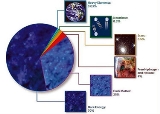
inherent in empty space that explains the current accelerating expansion of space against the attractive (collapsing) effects of gravity. The cosmological constant is denoted as , which is interpreted as the fraction of the total mass-energy density of a flat universe that is attributed to dark energy. Currently, about 73% of the energy density of the present universe is estimated to be dark energy.
- Cold dark matterCold dark matterCold dark matter is the improvement of the big bang theory that contains the additional assumption that most of the matter in the Universe consists of material that cannot be observed by its electromagnetic radiation and whose constituent particles move slowly...
is a form of matter necessary to account for gravitational effects observed in very large scale structures (anomalies in the rotation of galaxies, the gravitational lensing of light by galaxy clusters, enhanced clustering of galaxies) that cannot be accounted for by the quantity of observed matter. Dark matterDark matterIn astronomy and cosmology, dark matter is matter that neither emits nor scatters light or other electromagnetic radiation, and so cannot be directly detected via optical or radio astronomy...
is described as being cold (i.e. its velocity is non-relativistic [far below the speed of light] at the epoch of radiation-matter equality), possibly non-baryonic (consisting of matter other than protons and neutrons), dissipationless (cannot cool by radiating photons) and collisionless (i.e., the dark matter particles interact with each other and other particles only through gravity). This component is currently estimated to constitute about 23% of the mass-energy density of the universe.
- The remaining 5% comprises all matter and energy observed as subatomic particles, chemical elements and electromagnetic radiation, the stuff of which visible planets, stars and galaxies are made.
- The model includes a single originating event, the "Big Bang" or initial singularity, which was not an explosion but the abrupt appearance of expanding space-time containing radiation at temperatures of around 1015 K. This was immediately (within 10−29 seconds) followed by an exponential expansion of space by a scale multiplier of 1027 or more, known as cosmic inflationCosmic inflationIn physical cosmology, cosmic inflation, cosmological inflation or just inflation is the theorized extremely rapid exponential expansion of the early universe by a factor of at least 1078 in volume, driven by a negative-pressure vacuum energy density. The inflationary epoch comprises the first part...
. The early universe remained hot (above 10,000 K) for several hundred thousand years, a state that is detectable as a residual cosmic microwave background or CMB, a very low energy radiation emanating from all parts of the sky. The "Big Bang" scenario, with cosmic inflation and standard particle physics, is the only current cosmological model consistent with the observed continuing expansion of space, the observed distribution of lighter elements in the universeBig Bang nucleosynthesisIn physical cosmology, Big Bang nucleosynthesis refers to the production of nuclei other than those of H-1 during the early phases of the universe...
(hydrogen, helium, and lithium), and the spatial texture of minute irregularities (anisotropiesAnisotropyAnisotropy is the property of being directionally dependent, as opposed to isotropy, which implies identical properties in all directions. It can be defined as a difference, when measured along different axes, in a material's physical or mechanical properties An example of anisotropy is the light...
) in the CMB radiation. Cosmic inflation is also necessary to address the "horizon problemHorizon problemThe horizon problem is a problem with the standard cosmological model of the Big Bang which was identified in the 1970s. It points out that different regions of the universe have not "contacted" each other because of the great distances between them, but nevertheless they have the same temperature...
" in the CMB. Indeed, it seems likely that the universe is larger than the observable particle horizon.
- The model uses the FLRW metric, the Friedmann equationsFriedmann equationsThe Friedmann equations are a set of equations in physical cosmology that govern the expansion of space in homogeneous and isotropic models of the universe within the context of general relativity...
and the cosmological equations of stateEquation of state (cosmology)In cosmology, the equation of state of a perfect fluid is characterized by a dimensionless number \! w, equal to the ratio of its pressure \! p to its energy density \! \rho: \! w=p/\rho...
to describe the observable universe from right after the inflationary epoch to present and future.
Historically, the dominant cosmological model previous to the now "standard model" was the Steady State theory
Steady State theory
In cosmology, the Steady State theory is a model developed in 1948 by Fred Hoyle, Thomas Gold, Hermann Bondi and others as an alternative to the Big Bang theory...
, proposed independently in 1948 by H. Bondi
Hermann Bondi
Sir Hermann Bondi, KCB, FRS was an Anglo-Austrian mathematician and cosmologist. He is best known for developing the steady-state theory of the universe with Fred Hoyle and Thomas Gold as an alternative to the Big Bang theory, but his most lasting legacy will probably be his important...
& T. Gold
Thomas Gold
Thomas Gold was an Austrian-born astrophysicist, a professor of astronomy at Cornell University, a member of the U.S. National Academy of Sciences, and a Fellow of the Royal Society . Gold was one of three young Cambridge scientists who in the 1950s proposed the now mostly abandoned 'steady...
and by Fred Hoyle
Fred Hoyle
Sir Fred Hoyle FRS was an English astronomer and mathematician noted primarily for his contribution to the theory of stellar nucleosynthesis and his often controversial stance on other cosmological and scientific matters—in particular his rejection of the "Big Bang" theory, a term originally...
. The universe in this model was flat, infinitely large, infinitely old (homogeneity and isotropy were extended in time as well as space) and was continuously creating matter to stabilize the mass-energy density of expanding space. There is currently active research into many aspects of the ΛCDM model, the details of which are very likely to change as new information becomes available. In particular, it is difficult to measure accurately the distance of very far galaxies or supernovae, so that distance related estimates (of stellar or galactic luminosities, or of key parameters such as the Hubble constant) are still uncertain. In addition, ΛCDM has no explicit physical theory for the origin or physical nature of dark matter or dark energy; the nearly scale-invariant spectrum of the CMB perturbations, and their image across the celestial sphere, are believed to result from very small thermal and acoustic irregularities at the point of recombination. The overwhelming majority of astronomers and astrophysicists support the ΛCDM model, but Milgrom
Mordehai Milgrom
Mordehai Milgrom is an Israeli physicist and professor in the department of Condensed Matter Physics at the Weizmann Institute in Rehovot, Israel. He is most famous for his proposal of Modified Newtonian dynamics as an alternative to the dark matter and galaxy rotation curve problems, in 1981...
, McGaugh
Stacy McGaugh
Stacy McGaugh is an American astronomer and professor in the Department of Astronomy at the University of Maryland in College Park, Maryland. His fields of speciality include low surface brightness galaxies, galaxy formation and evolution, tests of dark matter and alternative hypotheses, and...
, and Kroupa
Pavel Kroupa
Pavel Kroupa is an Australian astrophysicist and professor at the University of Bonn.- Biography and career:...
are leading critics.
Parameters
The ΛCDM model is based on six parameterParameter
Parameter from Ancient Greek παρά also “para” meaning “beside, subsidiary” and μέτρον also “metron” meaning “measure”, can be interpreted in mathematics, logic, linguistics, environmental science and other disciplines....
s: physical baryon density, physical dark matter density, dark energy density, scalar spectral index, curvature fluctuation amplitude and reionization optical depth. From these the other model values, including the Hubble constant
Hubble's law
Hubble's law is the name for the astronomical observation in physical cosmology that: all objects observed in deep space are found to have a doppler shift observable relative velocity to Earth, and to each other; and that this doppler-shift-measured velocity, of various galaxies receding from...
and age of the universe, can be derived.
Parameter values listed below are from the Seven-Year Wilkinson Microwave Anisotropy Probe
Wilkinson Microwave Anisotropy Probe
The Wilkinson Microwave Anisotropy Probe — also known as the Microwave Anisotropy Probe , and Explorer 80 — is a spacecraft which measures differences in the temperature of the Big Bang's remnant radiant heat — the Cosmic Microwave Background Radiation — across the full sky. Headed by Professor...
(WMAP) temperature and polarization observations. These include estimates based on data from Baryon Acoustic Oscillations
Baryon acoustic oscillations
In cosmology, baryon acoustic oscillations refers to an overdensity or clustering of baryonic matter at certain length scales due to acoustic waves which propagated in the early universe. In the same way that supernova experiments provide a "standard candle" for astronomical observations, BAO...
and Type Ia supernova
Type Ia supernova
A Type Ia supernova is a sub-category of supernovae, which in turn are a sub-category of cataclysmic variable stars, that results from the violent explosion of a white dwarf star. A white dwarf is the remnant of a star that has completed its normal life cycle and has ceased nuclear fusion...
luminosity/time dilation measurements. Implications of the data for cosmological models are discussed in Komatsu et al. and Spergel et al.
| Parameter | Value | Description |
|---|---|---|
| t0 |  years years |
Age of the universe Age of the universe The age of the universe is the time elapsed since the Big Bang posited by the most widely accepted scientific model of cosmology. The best current estimate of the age of the universe is 13.75 ± 0.13 billion years within the Lambda-CDM concordance model... |
| H0 |  km s−1 Mpc km s−1 MpcParsec The parsec is a unit of length used in astronomy. It is about 3.26 light-years, or just under 31 trillion kilometres .... −1 |
Hubble constant |
| Ωbh2 |  |
Physical baryon density |
| Ωch2 |  |
Physical dark matter density |
| Ωb |  |
Baryon density |
| Ωc |  |
Dark matter density |
| ΩΛ |  |
Dark energy Dark energy In physical cosmology, astronomy and celestial mechanics, dark energy is a hypothetical form of energy that permeates all of space and tends to accelerate the expansion of the universe. Dark energy is the most accepted theory to explain recent observations that the universe appears to be expanding... density |
| ΔR2 |  , k0 = 0.002Mpc−1 , k0 = 0.002Mpc−1 |
Curvature fluctuation amplitude |
| σ8 |  |
Fluctuation amplitude at 8h−1Mpc |
| ns |  |
Scalar spectral index |
| z* |  |
Redshift at decoupling |
| t* |  years years |
Age at decoupling |
| τ |  |
Reionization Reionization In Big Bang cosmology, reionization is the process that reionized the matter in the universe after the "dark ages," and is the second of two major phase changes of gas in the universe. As the majority of baryonic matter is in the form of hydrogen, reionization usually refers to the reionization of... optical depth Optical depth Optical depth, or optical thickness, is a measure of transparency. Optical depth is defined by the negative logarithm of the fraction of radiation that is not scattered or absorbed on a path... |
| zreion |  |
Redshift of reionization |
The "physical baryon density" Ωbh2 differs from the "baryon density" Ωb in that the baryon density gives the fraction of the critical density made up of baryons (the critical density is the total density of matter/energy needed for the universe to be spatially flat, with measurements indicating that the actual total density Ωtot is very close if not equal to this value, see below), while the physical baryon density is equal to the baryon density multiplied by the square of the reduced Hubble constant h, where h is related to the Hubble constant H0 by the equation H0 = 100 h (km/s)/Mpc. Likewise for the difference between "physical dark matter density" and "dark matter density".
Extended models
Possible extensions of the simplest ΛCDM model are to allow quintessenceQuintessence (physics)
In physics, quintessence is a hypothetical form of dark energy postulated as an explanation of observations of an accelerating universe. It has been proposed by some physicists to be a fifth fundamental force...
rather than a cosmological constant
Cosmological constant
In physical cosmology, the cosmological constant was proposed by Albert Einstein as a modification of his original theory of general relativity to achieve a stationary universe...
. In this case, the equation of state
Equation of state (cosmology)
In cosmology, the equation of state of a perfect fluid is characterized by a dimensionless number \! w, equal to the ratio of its pressure \! p to its energy density \! \rho: \! w=p/\rho...
of dark energy is allowed to differ from −1. Cosmic inflation predicts tensor fluctuations (gravitational wave
Gravitational wave
In physics, gravitational waves are theoretical ripples in the curvature of spacetime which propagates as a wave, traveling outward from the source. Predicted to exist by Albert Einstein in 1916 on the basis of his theory of general relativity, gravitational waves theoretically transport energy as...
s). Their amplitude is parameterized by the tensor-to-scalar ratio, which is determined by the energy scale of inflation. Other modifications allow for spatial curvature (Ωtot may be different from 1), hot dark matter
Hot dark matter
Hot dark matter is a hypothetical form of dark matter which consists of particles that travel with ultrarelativistic velocities. The best candidate for the identity of hot dark matter is the neutrino. Neutrinos have very small masses, and do not take part in two of the four fundamental forces, the...
in the form of neutrino
Neutrino
A neutrino is an electrically neutral, weakly interacting elementary subatomic particle with a half-integer spin, chirality and a disputed but small non-zero mass. It is able to pass through ordinary matter almost unaffected...
s, or a running spectral index, which are generally viewed as inconsistent with cosmic inflation.
Allowing these parameters will generally increase the errors in the parameters quoted above, and may also shift the observed values somewhat.
| Parameter | Value | Description |
|---|---|---|
| Ωtot |  |
Total density |
| w |  |
Equation of state |
| r |  , k0 = 0.002Mpc−1 (2σ) , k0 = 0.002Mpc−1 (2σ) |
Tensor-to-scalar ratio |
| d ns / d ln k |  , k0 = 0.002Mpc−1 , k0 = 0.002Mpc−1 |
Running of the spectral index |
| Ωvh2 |  |
Physical neutrino density |
| Σmν |  eV (2σ) eV (2σ) |
Neutrino mass |
Some researchers have suggested that there is a running spectral index, but no statistically significant study has revealed one. Theoretical expectations suggest that the tensor-to-scalar ratio r should be between 0 and 0.3, and the latest results are now within those limits.
See also
- WIMPs
- Galaxy formation and evolutionGalaxy formation and evolutionThe study of galaxy formation and evolution is concerned with the processes that formed a heterogeneous universe from a homogeneous beginning, the formation of the first galaxies, the way galaxies change over time, and the processes that have generated the variety of structures observed in nearby...
- Dark matterDark matterIn astronomy and cosmology, dark matter is matter that neither emits nor scatters light or other electromagnetic radiation, and so cannot be directly detected via optical or radio astronomy...