


Rube Goldberg

Encyclopedia
Reuben Garrett Lucius Goldberg (July 4, 1883 – December 7, 1970) was an American
cartoonist
, sculptor, author, engineer and inventor.
He is best known for a series of popular cartoons depicting complex gadgets that perform simple tasks in indirect, convoluted ways. These devices, now known as Rube Goldberg machine
s, are similar to those drawn by W. Heath Robinson
in the UK and Storm P in Denmark. Goldberg received many honors in his lifetime, including a Pulitzer Prize
for his political cartooning in 1948 and the Banshees' Silver Lady Award 1959.
Goldberg was a founding member and the first president of the National Cartoonists Society
, and he is the namesake of the Reuben Award, which the organization awards to the Cartoonist of the Year. He is the inspiration for various international competitions, known as Rube Goldberg Machine Contest
s, which challenge participants to make a complex machine to perform a simple task.
, to Jewish
parents Max and Hannah Goldberg. He was the second of four children (older brother Garrett, younger brother Walter, and younger sister Lillian). Rube married Irma Seeman in 1916. They lived at 88 Central Park West in New York City and had two sons named Thomas and George
. Goldberg did not share a surname with his children because of the amount of hate mail he received during World War II
from the political nature of his cartoons. He ordered his sons to change their names from Goldberg for safety reasons. Both of his sons chose the last name of George, wanting to keep a sense of family cohesiveness. Thomas and George's children now run a company called RGI (Rube Goldberg Incorporated) to maintain the Goldberg name. John George (Thomas's son) is assisted by his cousin Jennifer George (George's daughter) and John's son Joshua George to keep the family name alive. Reuben died in 1970 at the age of 87, while his widow, Irma, died 20 years later on April 26, 1990 at the age of 95.
in 1904 with a College of Mining degree and was hired by the city of San Francisco as an engineer for the Water and Sewers Department. After six months he resigned his position with the city to join the San Francisco Chronicle
where he became a sports cartoonist. The following year, he took a job with the San Francisco Bulletin, where he remained until he moved to New York City
in 1907.
Goldberg drew cartoons for five newspapers, including the New York Evening Journal
and the New York Evening Mail
. His work entered syndication
in 1915, beginning his nationwide popularity. He was syndicated by the McNaught Syndicate
from 1922 until 1934.
A prolific artist
, Goldberg produced several cartoon series simultaneously, including Mike and Ike (They Look Alike)
, Boob McNutt
, Foolish Questions, Lala Palooza and The Weekly Meeting of the Tuesday Women's Club. The cartoons that brought him lasting fame involved a character named Professor Lucifer Gorgonzola Butts. In that series, Goldberg drew labeled schematics of the comical "invention
s" that would later bear his name.
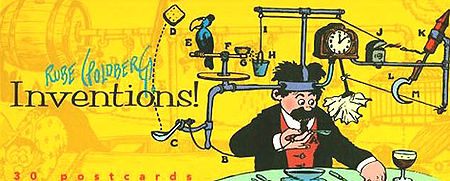 This postcard book, Rube Goldberg's Inventions!, was compiled by Maynard Frank Wolfe from the Rube Goldberg Archives. The cover illustration shows Professor Butts and the Self-Operating Napkin. The "Self-Operating Napkin" is activated when the soup spoon (A) is raised to mouth, pulling string (B) and thereby jerking ladle (C), which throws cracker (D) past parrot (E). Parrot jumps after cracker and perch (F) tilts, upsetting seeds (G) into pail (H). Extra weight in pail pulls cord (I), which opens and lights automatic lighter (J), setting off skyrocket (K), which causes sickle (L) to cut string (M) and allow the pendulum with the attached napkin to swing back and forth, thereby wiping chin.
In 1931 the Merriam-Webster
dictionary adopted the word "Rube Goldberg" as an adjective defined as accomplishing something simple through complex means.
Predating Goldberg, the corresponding term in the U.K. was, and still is, "Heath Robinson", after the English illustrator with an equal devotion to odd machinery (although Heath Robinson's creations did not have the same emphasis on the sequential or chain reaction
element).
Goldberg's work was commemorated posthumously in 1995 with the inclusion of Rube Goldberg's Inventions, depicting Professor Butts' "Self-Operating Napkin" in the Comic Strip Classics
series of U.S. postage stamp
s.
, which was released in 1930 and starred Ted Healy
and The Three Stooges.
In the 1962 John Wayne movie Hatari!
, an invention to catch monkeys by character Pockets, played by Red Buttons, is described as a "Rube Goldberg."
In the late 1960s and early 70s, educational shows like Sesame Street
and The Electric Company
routinely showed bits that involved Rube Goldberg devices, including the Rube Goldberg Alphabet Contraption, and the What Happens Next Machine.
Various other films and cartoons have included highly complex machines that perform simple tasks. Among these are Flåklypa Grand Prix
, Looney Tunes
, Tom and Jerry
, Wallace and Gromit
, Pee-wee's Big Adventure
, The Way Things Go
, Edward Scissorhands
, Back to the Future
, Honey, I Shrunk the Kids
, The Goonies
, Gremlins
, the Saw film series, Chitty Chitty Bang Bang
, The Cat from Outer Space
, Malcolm
, Family Guy
, and Waiting...
Also in the Final Destination film series
the characters often die in Rube Goldberg-esque ways. In the film The Great Mouse Detective
, the villain Ratigan attempts to kill the film's heroes, Basil of Baker Street and David Q. Dawson, with a Rube Goldberg style device.
The classic video in this genre was done by the artist duo Peter Fischli & David Weiss
in 1987 with their 30 minute video "Der Lauf der Dinge" or "The Way Things Go".
Honda produced a video in 2003 called "The Cog" using many of the same principles that Fischli and Weiss had done in 1987.
In 2005, the American indie/alternative rock band The Bravery released a video for their debut single, "An Honest Mistake," which features the band performing the song in the middle of a Rube Goldberg machine.
In 1999, an episode of The X-Files
was titled "The Goldberg Variation". The episode intertwined characters FBI agents Mulder and Scully, a simple apartment super, Henry Weems (Willie Garson) and an ailing young boy, Ritchie Lupone (Shia LaBeouf
) in a real-life Goldberg device.
The 2010 music video "This Too Shall Pass - RGM Version" by the rock band OK Go
features a machine that, after four minutes of kinetic activity, shoots the band members in the face with paint. "RGM" presumably stands for Rube Goldberg Machine.
, as well as its sequels Crazy Clock (1964), and Fish Bait (1965) are based on Rube Goldberg machines. Some examples of Goldberg-inspired video games are Incredibots
, LittleBigPlanet
, LittleBigPlanet 2
, the 1990s-era series of The Incredible Machine games, and Crazy Machines
.
United States
The United States of America is a federal constitutional republic comprising fifty states and a federal district...
cartoonist
Cartoonist
A cartoonist is a person who specializes in drawing cartoons. This work is usually humorous, mainly created for entertainment, political commentary or advertising...
, sculptor, author, engineer and inventor.
He is best known for a series of popular cartoons depicting complex gadgets that perform simple tasks in indirect, convoluted ways. These devices, now known as Rube Goldberg machine
Rube Goldberg machine
A Rube Goldberg machine, contraption, device, or apparatus is a deliberately over-engineered or overdone machine that performs a very simple task in a very complex fashion, usually including a chain reaction...
s, are similar to those drawn by W. Heath Robinson
W. Heath Robinson
William Heath Robinson was an English cartoonist and illustrator, best known for drawings of eccentric machines....
in the UK and Storm P in Denmark. Goldberg received many honors in his lifetime, including a Pulitzer Prize
Pulitzer Prize for Editorial Cartooning
The Pulitzer Prize for Editorial Cartooning has been awarded since 1922 for a distinguished cartoon or portfolio of cartoons published during the year, characterized by originality, editorial effectiveness, quality of drawing, and pictorial effect...
for his political cartooning in 1948 and the Banshees' Silver Lady Award 1959.
Goldberg was a founding member and the first president of the National Cartoonists Society
National Cartoonists Society
The National Cartoonists Society is an organization of professional cartoonists in the United States. It presents the National Cartoonists Society Awards. The Society was born in 1946 when groups of cartoonists got together to entertain the troops...
, and he is the namesake of the Reuben Award, which the organization awards to the Cartoonist of the Year. He is the inspiration for various international competitions, known as Rube Goldberg Machine Contest
Rube Goldberg Machine Contest
The Rube Goldberg Machine Contest is a contest that seeks to be "a way of helping students transcend traditional ways of looking at problems", by using a challenge that "must be completed in as creative a way as possible"...
s, which challenge participants to make a complex machine to perform a simple task.
Life
Goldberg was born July 4, 1883, in San Francisco, CaliforniaCalifornia
California is a state located on the West Coast of the United States. It is by far the most populous U.S. state, and the third-largest by land area...
, to Jewish
Jews
The Jews , also known as the Jewish people, are a nation and ethnoreligious group originating in the Israelites or Hebrews of the Ancient Near East. The Jewish ethnicity, nationality, and religion are strongly interrelated, as Judaism is the traditional faith of the Jewish nation...
parents Max and Hannah Goldberg. He was the second of four children (older brother Garrett, younger brother Walter, and younger sister Lillian). Rube married Irma Seeman in 1916. They lived at 88 Central Park West in New York City and had two sons named Thomas and George
George W. George
George W. George was an American theater, Broadway and film producer. His credits included the 1981 film My Dinner With Andre and several hit Broadway productions....
. Goldberg did not share a surname with his children because of the amount of hate mail he received during World War II
World War II
World War II, or the Second World War , was a global conflict lasting from 1939 to 1945, involving most of the world's nations—including all of the great powers—eventually forming two opposing military alliances: the Allies and the Axis...
from the political nature of his cartoons. He ordered his sons to change their names from Goldberg for safety reasons. Both of his sons chose the last name of George, wanting to keep a sense of family cohesiveness. Thomas and George's children now run a company called RGI (Rube Goldberg Incorporated) to maintain the Goldberg name. John George (Thomas's son) is assisted by his cousin Jennifer George (George's daughter) and John's son Joshua George to keep the family name alive. Reuben died in 1970 at the age of 87, while his widow, Irma, died 20 years later on April 26, 1990 at the age of 95.
Career
Goldberg's father was a San Francisco police and fire commissioner, who encouraged the young Reuben to pursue a career in engineering. Rube graduated from the University of California, BerkeleyUniversity of California, Berkeley
The University of California, Berkeley , is a teaching and research university established in 1868 and located in Berkeley, California, USA...
in 1904 with a College of Mining degree and was hired by the city of San Francisco as an engineer for the Water and Sewers Department. After six months he resigned his position with the city to join the San Francisco Chronicle
San Francisco Chronicle
thumb|right|upright|The Chronicle Building following the [[1906 San Francisco earthquake|1906 earthquake]] and fireThe San Francisco Chronicle is a newspaper serving primarily the San Francisco Bay Area of the U.S. state of California, but distributed throughout Northern and Central California,...
where he became a sports cartoonist. The following year, he took a job with the San Francisco Bulletin, where he remained until he moved to New York City
New York City
New York is the most populous city in the United States and the center of the New York Metropolitan Area, one of the most populous metropolitan areas in the world. New York exerts a significant impact upon global commerce, finance, media, art, fashion, research, technology, education, and...
in 1907.
Goldberg drew cartoons for five newspapers, including the New York Evening Journal
New York Journal American
The New York Journal American was a newspaper published from 1937 to 1966. The Journal American was the product of a merger between two New York newspapers owned by William Randolph Hearst: The New York American , a morning paper, and the New York Evening Journal, an afternoon paper...
and the New York Evening Mail
New York Evening Mail
The New York Evening Mail was an American daily newspaper published in New York City.The paper was made up of the New York Evening Express, which dated from 1836, and the Daily Advertiser. It was eventually merged with the Evening Telegram, which became the New York World-Telegram in 1927.From New...
. His work entered syndication
Print syndication
Print syndication distributes news articles, columns, comic strips and other features to newspapers, magazines and websites. They offer reprint rights and grant permissions to other parties for republishing content of which they own/represent copyrights....
in 1915, beginning his nationwide popularity. He was syndicated by the McNaught Syndicate
McNaught Syndicate
The McNaught Syndicate was an American newspaper syndicate founded in 1922. It was established by Virgil Venice McNitt and Charles V. McAdam. Its best known contents were the columns by Will Rogers and O. O. McIntyre, the Dear Abby letters section and comic strips, including Joe Palooka and...
from 1922 until 1934.
A prolific artist
Artist
An artist is a person engaged in one or more of any of a broad spectrum of activities related to creating art, practicing the arts and/or demonstrating an art. The common usage in both everyday speech and academic discourse is a practitioner in the visual arts only...
, Goldberg produced several cartoon series simultaneously, including Mike and Ike (They Look Alike)
Mike and Ike (They Look Alike)
Mike and Ike was a comic strip by Rube Goldberg, who introduced the identical twin characters in the San Francisco Bulletin on September 29, 1907.Don Markstein traced the history of the characters in his Toonopedia:...
, Boob McNutt
Boob McNutt
Boob McNutt was a comic strip by Rube Goldberg which ran from 1915 to September 1934. It was syndicated by the McNaught Syndicate from 1922 until the end of its run....
, Foolish Questions, Lala Palooza and The Weekly Meeting of the Tuesday Women's Club. The cartoons that brought him lasting fame involved a character named Professor Lucifer Gorgonzola Butts. In that series, Goldberg drew labeled schematics of the comical "invention
Invention
An invention is a novel composition, device, or process. An invention may be derived from a pre-existing model or idea, or it could be independently conceived, in which case it may be a radical breakthrough. In addition, there is cultural invention, which is an innovative set of useful social...
s" that would later bear his name.
Cultural legacy
In 1931 the Merriam-Webster
Merriam-Webster
Merriam–Webster, which was originally the G. & C. Merriam Company of Springfield, Massachusetts, is an American company that publishes reference books, especially dictionaries that are descendants of Noah Webster’s An American Dictionary of the English Language .Merriam-Webster Inc. has been a...
dictionary adopted the word "Rube Goldberg" as an adjective defined as accomplishing something simple through complex means.
Predating Goldberg, the corresponding term in the U.K. was, and still is, "Heath Robinson", after the English illustrator with an equal devotion to odd machinery (although Heath Robinson's creations did not have the same emphasis on the sequential or chain reaction
Chain reaction
A chain reaction is a sequence of reactions where a reactive product or by-product causes additional reactions to take place. In a chain reaction, positive feedback leads to a self-amplifying chain of events....
element).
Goldberg's work was commemorated posthumously in 1995 with the inclusion of Rube Goldberg's Inventions, depicting Professor Butts' "Self-Operating Napkin" in the Comic Strip Classics
Comic Strip Classics
The Comic Strip Classics series of commemorative postage stamps was issued by the US Postal Service in 1995 to honor the centennial of the newspaper comic strip....
series of U.S. postage stamp
Postage stamp
A postage stamp is a small piece of paper that is purchased and displayed on an item of mail as evidence of payment of postage. Typically, stamps are made from special paper, with a national designation and denomination on the face, and a gum adhesive on the reverse side...
s.
Film and television
Rube Goldberg wrote a feature film featuring his machines and sculptures called Soup to NutsSoup to Nuts
Soup to Nuts is an American feature film written by Rube Goldberg and directed by Benjamin Stoloff, which marks the film debut of the comic trio who would go on to become known as the Three Stooges...
, which was released in 1930 and starred Ted Healy
Ted Healy
Ted Healy was an American vaudeville performer, comedian, and actor. He is chiefly remembered today as the original creator of the Three Stooges, but had a successful stage and film career of his own.- Early life :...
and The Three Stooges.
In the 1962 John Wayne movie Hatari!
Hatari!
Hatari! is a 1962 American film directed by Howard Hawks and starring John Wayne. The title means "danger" in Swahili, which was mentioned in the film as well...
, an invention to catch monkeys by character Pockets, played by Red Buttons, is described as a "Rube Goldberg."
In the late 1960s and early 70s, educational shows like Sesame Street
Sesame Street
Sesame Street has undergone significant changes in its history. According to writer Michael Davis, by the mid-1970s the show had become "an American institution". The cast and crew expanded during this time, including the hiring of women in the crew and additional minorities in the cast. The...
and The Electric Company
The Electric Company
The Electric Company is an educational American children's television series that was produced by the Children's Television Workshop for PBS in the United States. PBS broadcast 780 episodes over the course of its six seasons from October 25, 1971 to April 15, 1977...
routinely showed bits that involved Rube Goldberg devices, including the Rube Goldberg Alphabet Contraption, and the What Happens Next Machine.
Various other films and cartoons have included highly complex machines that perform simple tasks. Among these are Flåklypa Grand Prix
Flåklypa Grand Prix
Flåklypa Grand Prix is a Norwegian stop motion-animated feature film directed by Ivo Caprino. It was released in 1975 and is based on characters from a series of books by Norwegian cartoonist and author Kjell Aukrust...
, Looney Tunes
Looney Tunes
Looney Tunes is a Warner Bros. animated cartoon series. It preceded the Merrie Melodies series and was Warner Bros.'s first animated theatrical series. Since its first official release, 1930's Sinkin' in the Bathtub, the series has become a worldwide media franchise, spawning several television...
, Tom and Jerry
Tom and Jerry
Tom and Jerry are the cat and mouse cartoon characters that were evolved starting in 1939.Tom and Jerry also may refer to:Cartoon works featuring the cat and mouse so named:* The Tom and Jerry Show...
, Wallace and Gromit
Wallace and Gromit
Wallace and Gromit are the main characters in a series consisting of four British animated short films and a feature-length film by Nick Park of Aardman Animations...
, Pee-wee's Big Adventure
Pee-wee's Big Adventure
Pee-wee's Big Adventure is a 1985 American adventure comedy film directed by Tim Burton in his full-length debut and starring Paul Reubens as Pee-wee Herman. Reubens also co-wrote the script with Phil Hartman and Michael Varhol. Supporting roles are played by Elizabeth Daily, Mark Holton, Diane...
, The Way Things Go
The Way Things Go
The Way Things Go is a 1987 art film by the Swiss artist duo Peter Fischli and David Weiss. It documents a long causal chain assembled of everyday objects, resembling a Rube Goldberg machine....
, Edward Scissorhands
Edward Scissorhands
Edward Scissorhands is a 1990 romantic fantasy film directed by Tim Burton and starring Johnny Depp. The film shows the story of an artificial man named Edward, an unfinished creation, who has scissors for hands. Edward is taken in by a suburban family and falls in love with their teenage daughter...
, Back to the Future
Back to the Future
Back to the Future is a 1985 American science-fiction adventure film. It was directed by Robert Zemeckis, written by Zemeckis and Bob Gale, produced by Steven Spielberg, and starred Michael J. Fox, Christopher Lloyd, Lea Thompson, Crispin Glover and Thomas F. Wilson. The film tells the story of...
, Honey, I Shrunk the Kids
Honey, I Shrunk the Kids
Honey, I Shrunk the Kids is a 1989 comedy film. The directorial debut of Joe Johnston and released through Walt Disney Pictures and Silver Screen Partners III, the film tells the story of an inventor who accidentally shrinks his and his neighbor's kids to 1/4 of an inch with his electromagnetic...
, The Goonies
The Goonies
The Goonies is a 1985 American adventure-comedy film directed by Richard Donner. The screenplay was written by Chris Columbus from a story by executive producer Steven Spielberg. The premise surrounds a band of pre-teens who live in the "Goon Docks" neighborhood of Astoria, Oregon hoping to save...
, Gremlins
Gremlins
Gremlins is a 1984 American horror comedy film directed by Joe Dante, released by Warner Bros. The film is about a young man who receives a strange creature—called a Mogwai—as a pet, which then spawns other creatures who transform into small, destructive, evil monsters. It was followed by a sequel,...
, the Saw film series, Chitty Chitty Bang Bang
Chitty Chitty Bang Bang (film)
Chitty Chitty Bang Bang is a 1968 musical film with a script by Roald Dahl and Ken Hughes, and songs by the Sherman Brothers, loosely based on Ian Fleming's novel Chitty Chitty Bang Bang: The Magical Car. It starred Dick Van Dyke as Caractacus Potts and Sally Ann Howes as Truly Scrumptious. The...
, The Cat from Outer Space
The Cat from Outer Space
The Cat from Outer Space is a 1978 Disney film, starring Ronnie Schell, Ken Berry, Sandy Duncan, Harry Morgan, Roddy McDowall and McLean Stevenson.-Plot:...
, Malcolm
Malcolm (film)
Malcolm is a 1986 Australian cult film, written by David Parker and directed by Nadia Tass. The film stars Colin Friels as the titular tram enthusiast who becomes involved with petty crime. The film won the 1986 Australian Film Institute Award for Best Film.At the start of the film Malcolm is...
, Family Guy
Family Guy
Family Guy is an American animated television series created by Seth MacFarlane for the Fox Broadcasting Company. The series centers on the Griffins, a dysfunctional family consisting of parents Peter and Lois; their children Meg, Chris, and Stewie; and their anthropomorphic pet dog Brian...
, and Waiting...
Also in the Final Destination film series
Final Destination (film series)
The Final Destination series is a series of horror films based on an unproduced script written by Jeffrey Reddick for the X-Files television series. Distributed by New Line Cinema, all five films are centered on the themes of fatalism, predestination, and precognition, in relation to death...
the characters often die in Rube Goldberg-esque ways. In the film The Great Mouse Detective
The Great Mouse Detective
The Great Mouse Detective is a 1986 animated feature produced by Walt Disney Feature Animation, originally released to movie theaters on July 2, 1986 by Walt Disney Pictures...
, the villain Ratigan attempts to kill the film's heroes, Basil of Baker Street and David Q. Dawson, with a Rube Goldberg style device.
The classic video in this genre was done by the artist duo Peter Fischli & David Weiss
Peter Fischli & David Weiss
Peter Fischli and David Weiss , often shortened to Fischli/Weiss, are an artist duo that have been collaborating since 1979. They are among the most renowned contemporary artists of Switzerland...
in 1987 with their 30 minute video "Der Lauf der Dinge" or "The Way Things Go".
Honda produced a video in 2003 called "The Cog" using many of the same principles that Fischli and Weiss had done in 1987.
In 2005, the American indie/alternative rock band The Bravery released a video for their debut single, "An Honest Mistake," which features the band performing the song in the middle of a Rube Goldberg machine.
In 1999, an episode of The X-Files
The X-Files
The X-Files is an American science fiction television series and a part of The X-Files franchise, created by screenwriter Chris Carter. The program originally aired from to . The show was a hit for the Fox network, and its characters and slogans became popular culture touchstones in the 1990s...
was titled "The Goldberg Variation". The episode intertwined characters FBI agents Mulder and Scully, a simple apartment super, Henry Weems (Willie Garson) and an ailing young boy, Ritchie Lupone (Shia LaBeouf
Shia LaBeouf
Shia Saide LaBeouf is an American actor who became known among younger audiences for his part in the Disney Channel series Even Stevens and made his film debut in Holes . In 2007, he starred as the leads in Disturbia and Transformers...
) in a real-life Goldberg device.
The 2010 music video "This Too Shall Pass - RGM Version" by the rock band OK Go
OK Go
OK Go is a rock band originally from Chicago, Illinois, USA, now residing in Los Angeles, California, USA. The band is composed of Damian Kulash , Tim Nordwind , Dan Konopka and Andy Ross , who joined them in 2005, replacing Andy Duncan...
features a machine that, after four minutes of kinetic activity, shoots the band members in the face with paint. "RGM" presumably stands for Rube Goldberg Machine.
Games
The popular 1963 board game Mouse TrapMouse Trap (board game)
Mouse Trap is a board game first published by Ideal in 1963 for two or more players. Over the course of the game, players at first cooperate to build a working Rube Goldberg-like mouse trap...
, as well as its sequels Crazy Clock (1964), and Fish Bait (1965) are based on Rube Goldberg machines. Some examples of Goldberg-inspired video games are Incredibots
Incredibots
IncrediBots is a physics simulation game produced by Grubby Games and was later purchased by Big Fish Games. It uses the Box2D Physics Engine, which allows objects created in a simple click and drag fashion to interact realistically. Users can create basic geometric shapes such as triangles,...
, LittleBigPlanet
LittleBigPlanet
LittleBigPlanet, commonly abbreviated LBP, is a puzzle platformer video game, based on user-generated content, for the PlayStation 3 first announced on 7 March 2007, by Phil Harrison at the Game Developers Conference in San Francisco, California...
, LittleBigPlanet 2
LittleBigPlanet 2
LittleBigPlanet 2 is a puzzle platformer video game, centred around user-generated content. The game is developed by Media Molecule, published by Sony Computer Entertainment Europe for PlayStation 3 and was originally scheduled for release in November 2010 but was delayed until January 2011...
, the 1990s-era series of The Incredible Machine games, and Crazy Machines
Crazy Machines
Crazy Machines is a puzzle computer game created by a FAKT Software GmbH. Crazy Machines based many of its ideas on The Incredible Machine series of games...
.
See also
- ChindōguChindoguis the Japanese art of inventing ingenious everyday gadgets that, on the face of it, seem like an ideal solution to a particular problem. However, chindōgu has a distinctive feature: anyone actually attempting to use one of these inventions would find that it causes so many new problems, or such...
- Deathtrap (plot device)Deathtrap (plot device)A deathtrap is a literary and dramatic plot device in which a villain, who has captured the hero or another sympathetic character, attempts to use an elaborate and usually sadistic method of murdering him/her....
- Domino effectDomino effectThe domino effect is a chain reaction that occurs when a small change causes a similar change nearby, which then will cause another similar change, and so on in linear sequence. The term is best known as a mechanical effect, and is used as an analogy to a falling row of dominoes...
- Frederick Roland EmettFrederick Roland EmettFrederick Rowland Emett OBE, his name frequently misspelled as Roland Emmett, was an English cartoonist and constructor of whimsical kinetic sculpture.- Early Life :...
- Jean TinguelyJean TinguelyJean Tinguely was a Swiss painter and sculptor. He is best known for his sculptural machines or kinetic art, in the Dada tradition; known officially as metamechanics...
, Swiss artist who created Rube Goldberg–like sculptures - Mickey OneMickey OneMickey One is a 1965 surrealistic dramatic film starring Warren Beatty and directed by Arthur Penn from a script by Alan Surgal. Its kaleidoscopic camerawork, film noir atmosphere, lighting and design aspects, Kafkaesque paranoia, philosophical themes and Warren Beatty's performance in the title...
- PythagoraSwitch
- Robert Storm PetersenRobert Storm PetersenRobert Storm Petersen was a Danish cartoonist, writer, animator, illustrator, painter and humorist. He is known almost exclusively by his pen name Storm P.- Biography :...
(Storm P.), a Danish contemporary artist who drew "inventions" similar to Rube Goldberg's - SteampunkSteampunkSteampunk is a sub-genre of science fiction, fantasy, alternate history, and speculative fiction that came into prominence during the 1980s and early 1990s. Steampunk involves a setting where steam power is still widely used—usually Victorian era Britain or "Wild West"-era United...
- William Heath Robinson, English cartoonist and illustrator best known for drawings of eccentric machines.
External links
- Toonopedia entry
- Smithsonian Archives of American Art: Oral History Interview, 1970
- Annual National Rube Goldberg Machine Contest
- NCS Awards
- Rube Goldberg in 'Creative Contraptions'
- IMDB biography
- Rube Goldberg Honda Commercial, "Cog", at Snopes.com
- Guide to the Rube Goldberg Papers at The Bancroft Library
- 10 Viral Rube Goldberg clips at Salon.comSalon.comSalon.com, part of Salon Media Group , often just called Salon, is an online liberal magazine, with content updated each weekday. Salon was founded by David Talbot and launched on November 20, 1995. It was the internet's first online-only commercial publication. The magazine focuses on U.S...