
Home      Discussion      Topics      Dictionary      Almanac
Signup       Login
Pi Kappa Phi

Pi Kappa Phi

Overview
Pi Kappa Phi is an American social fraternity
Fraternities and sororities
Fraternities and sororities are fraternal social organizations for undergraduate students. In Latin, the term refers mainly to such organizations at colleges and universities in the United States, although it is also applied to analogous European groups also known as corporations...

. It was founded by Andrew Alexander Kroeg, Jr., Lawrence Harry Mixson, and Simon Fogarty, Jr. on December 10, 1904 at the College of Charleston
College of Charleston
The College of Charleston is a public, sea-grant and space-grant university located in historic downtown Charleston, South Carolina, United States...

 in Charleston, South Carolina
Charleston, South Carolina
Charleston is the second largest city in the U.S. state of South Carolina. It was made the county seat of Charleston County in 1901 when Charleston County was founded. The city's original name was Charles Towne in 1670, and it moved to its present location from a location on the west bank of the...

. The fraternity has 141 active chapters, 93 alumni groups, 21 colonies, and more than 100,000 initiated members.
Discussion
Ask a question about 'Pi Kappa Phi'
Start a new discussion about 'Pi Kappa Phi'
Answer questions from other users
Full Discussion Forum
 
Unanswered Questions
Encyclopedia
Pi Kappa Phi is an American social fraternity
Fraternities and sororities
Fraternities and sororities are fraternal social organizations for undergraduate students. In Latin, the term refers mainly to such organizations at colleges and universities in the United States, although it is also applied to analogous European groups also known as corporations...

. It was founded by Andrew Alexander Kroeg, Jr., Lawrence Harry Mixson, and Simon Fogarty, Jr. on December 10, 1904 at the College of Charleston
College of Charleston
The College of Charleston is a public, sea-grant and space-grant university located in historic downtown Charleston, South Carolina, United States...

 in Charleston, South Carolina
Charleston, South Carolina
Charleston is the second largest city in the U.S. state of South Carolina. It was made the county seat of Charleston County in 1901 when Charleston County was founded. The city's original name was Charles Towne in 1670, and it moved to its present location from a location on the west bank of the...

. The fraternity has 141 active chapters, 93 alumni groups, 21 colonies, and more than 100,000 initiated members.

Pi Kappa Phi operates its own philanthropy, Push America
Push America
Push America is a 501 non-profit organization, founded in 1977 through Pi Kappa Phi as a way for undergraduate fraternity brothers to experience leadership development through service of people with disabilities...

, which works with individual chapters to serve people with disabilities. Push America hosts a number of national events including Journey of Hope, a 4,100-mile bicycle ride across the United States, and Build America, a traveling construction team around the U.S. to camps that help children with disabilities. Both raise money and awareness for people with disabilities.

Nu Phi


In 1904, the College of Charleston
College of Charleston
The College of Charleston is a public, sea-grant and space-grant university located in historic downtown Charleston, South Carolina, United States...

 was a small, municipal college
College
A college is an educational institution or a constituent part of an educational institution. Usage varies in English-speaking nations...

. The all-male college was the first to be supported solely by city funds, and the eleventh oldest in the United States. In 1897, the college saw the creation of its athletic program, and by 1904, the basketball, football and baseball programs were a popular entertainment outlet. There was also a thriving campus literary society called the Chrestomathics, which allowed students to expand their education. Activities included debating ideas and issues of the times. The college's monthly magazine was staffed by the officers of the Chrestomathics, forming the equivalent of a modern day student government.
In 1904, a man named Andrew Alexander Kroeg, Jr. was a 19-year-old senior at the college. His father was an insurance salesman who owned a business on Broad Street in Charleston, South Carolina
Charleston, South Carolina
Charleston is the second largest city in the U.S. state of South Carolina. It was made the county seat of Charleston County in 1901 when Charleston County was founded. The city's original name was Charles Towne in 1670, and it moved to its present location from a location on the west bank of the...

. Simon Fogarty, Jr., a 17-year-old junior, was a friend of Kroeg's. Fogarty, the son of a Charleston grocer, lived down the street from Kroeg and was a member of the college's baseball, basketball, and football teams. Lawrence Harry Mixson was a 16-year-old sophomore and close childhood friend to Fogarty. Mixson was also on all three of the college's athletic teams. "Harry" had been destined to work for his father in Charleston at the family's successful seed business.

At this time, students at the college were known to be extremely competitive in their endeavors in and out of the classroom. The three friends were no exception to this and set a goal to obtain officer positions within the Chrestomathic Literary Society. In 1904, there were only three chapters of national fraternities on campus and the organizations developed a slate of candidates. All fraternity men were sworn to vote for these candidates, making it virtually impossible for any non-fraternity men to win election.

Kroeg, Mixson, Fogarty, and a group of their friends, all non-fraternity men, were angered by the move and knew they had no chance of election unless an opposition party was formed. Several meetings were held at Mixson's home on Wentworth Street leading to the formation of "Nu Phi", which stood for non-fraternity. The group of 15 men developed an opposing slate and began campaigning.

The group adopted the outline of a hand as its secret symbol. A sketched hand on a classroom chalkboard signified an upcoming meeting. Inside the hand was written the meeting time and the host's last name.

The society elections were heated. The Nu Phis even assigned a member to kidnap those who might vote for the fraternity ticket on election day. However, the Nu Phi ticket was not victorious in the elections. Later, it was revealed that several disloyal members cast their votes for the opposing fraternity slate. Kroeg, determined to see his friends have a chance at winning elections, decided that the only way to gain the influence of the fraternity men on campus was to begin his own fraternity.

Founding


On December 10, 1904, a meeting of the loyal Nu Phis was held at Fogarty's home at 90 Broad Street in order to found a new fraternity. There were seven men in attendance at the meeting: Kroeg, Fogarty, Mixson, Anthony Pelzer Wagener, Thomas F. Mosimann, Theodore ("Teddy") Barnwell Kelley, and James Fogarty, Simon's younger brother. All of the original members were students at the college and had grown up together in Charleston.

Wagener was a scholar of Greek and Latin who would go on to teach Greek and Latin at William and Mary. It was he that recommended the letters Pi Kappa Phi and their secret meaning as the official new name of the group. At that first meeting, Harry Mixson wrote out the first minutes of Pi Kappa Phi Fraternity in dark green ink.

Because there were so many civic and honorary organizations in the city of Charleston, a visit to a local jeweler offered a great variety of possible fraternity badges from which to choose. Simon was the one who proposed the design of the fraternity's pin. In his words: "...a plain, diamond-shaped block of black enamel, bearing across its short diagonal an arched raised band of gold with scrolled edges projecting beyond the body of the pin. On this band were engraved, in black enamel, the Greek letters of ΠΚΦ. Engraved in gold on the body of the pin, above and below the band respectively, were the figures of a star and student's lamp." Kroeg was selected as the new chapter's first Archon
Archon
Archon is a Greek word that means "ruler" or "lord", frequently used as the title of a specific public office. It is the masculine present participle of the verb stem ἀρχ-, meaning "to rule", derived from the same root as monarch, hierarchy, and anarchy.- Ancient Greece :In ancient Greece the...

, a term taken from the title of a chief magistrate in ancient Greece. He then began work on a constitution for chapter. The group quickly set out to recruit new members to its ranks. Although H. Klugh Purdy is pictured with the original founders in the first group picture, he did not join until February 1905.

On December 10, 1905, the first anniversary of the fraternity's founding, Mixson's mother cooked the men a special dinner in her home to celebrate a successful first year as a fraternity. Today, chapters of Pi Kappa Phi celebrate "Founders Day" with a dinner or a similar ceremony marking the achievements of the founding fathers. Harry Mixson and Pelzer Wagener penned the fraternity's initiation ritual in 1906. The two men had attended historic St. John's Lutheran Church growing up. Fogarty added a Roman Catholic influence, and the ritual was developed in the "highest ideals of Christian manhood" (although it does not exclude men of other religions). Henry Patrick Wagener, Pelzer Wagener's younger brother, was the first member initiated by means of the ritual on March 24, 1906.

Expansion


That same year, the group was offered a charter from another U.S. fraternity. Instead, they chose to expand and create more Pi Kappa Phi chapters. The founders of Pi Kappa Phi had made many friends in the upstate of South Carolina at Presbyterian College
Presbyterian College
Presbyterian College is a private liberal arts college in Clinton, South Carolina, USA. Presbyterian College, or PC, is affiliated with the Presbyterian Church USA. PC was founded in 1880 by William Plumer Jacobs, a prominent Presbyterian minister who also founded the nearby Thornwell Home and...

 through sports and other activities. Working off of those contacts, Kroeg was able to create interest in the formation of a second chapter. Alpha Chapter in Charleston, officially granted a charter for Beta Chapter at Presbyterian College on March 9, 1907. Due to a state law banning fraternities at state supported schools, Presbyterian College and the College of Charleston were the only two South Carolina schools where fraternities were allowed.

It was at this time that Teddy Kelly had moved to California
California
California is a state located on the West Coast of the United States. It is by far the most populous U.S. state, and the third-largest by land area...

 to attend the University of California
University of California
The University of California is a public university system in the U.S. state of California. Under the California Master Plan for Higher Education, the University of California is a part of the state's three-tier public higher education system, which also includes the California State University...

. There, he was able to stir interest in Pi Kappa Phi and the men of Charleston granted a long distance charter to Gamma Chapter. This was significant in that it made Pi Kappa Phi a national fraternity. Gamma Chapter was also the first chapter to obtain a house.

At this point, Kroeg was studying law at the College of Charleston. Seeing the need for the fraternity to protect its name and existence, Kroeg developed "Articles of Incorporation" and the name Pi Kappa Phi became legally registered in the state of South Carolina
South Carolina
South Carolina is a state in the Deep South of the United States that borders Georgia to the south, North Carolina to the north, and the Atlantic Ocean to the east. Originally part of the Province of Carolina, the Province of South Carolina was one of the 13 colonies that declared independence...

 on December 23, 1907.

The interest in Pi Kappa Phi within South Carolina was growing despite laws and policies banning fraternities. In 1909, Delta Chapter at Furman University
Furman University
Furman University is a selective, private, coeducational, liberal arts college in Greenville, South Carolina, United States. Furman is one of the oldest, and more selective private institutions in South Carolina...

 formed and operated sub rosa (in secret) until state laws changed, allowing fraternal organizations. In 1910, a charter was granted to Sigma Chapter at the University of South Carolina
University of South Carolina
The University of South Carolina is a public, co-educational research university located in Columbia, South Carolina, United States, with 7 surrounding satellite campuses. Its historic campus covers over in downtown Columbia not far from the South Carolina State House...

 and the chapter was operated as the Sigma Club due to the laws banning fraternities.

Psi Chapter at Cornell University
Cornell University
Cornell University is an Ivy League university located in Ithaca, New York, United States. It is a private land-grant university, receiving annual funding from the State of New York for certain educational missions...

 was founded on November 24, 1921. Psi Chapter is very significant to the history of Pi Kappa Phi, as it was the first chapter to be founded in the northern United States, thus redefining Pi Kappa Phi as more than a purely southern fraternity.

Coat of arms


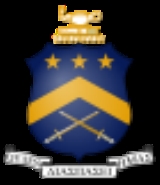
In 1909, the fraternity developed its first coat of arms. Originally, the coat of arms had only two stars, and a student's lamp below the chevron. Instead of a lamp and book, the original crest was a hand, holding a red rose. The first motto was the Latin: Nil Separabit, meaning "Nothing Shall Separate Us." (The original motto appeared on the scroll as Nil Separ Abit without hyphenation to create three equal sections of the scroll. It must have been assumed that the audience would recognize and understand the Latin word "separabit" divided into syllables.)

The coat of arms was modified many times in the early years as historical symbols of Charleston
Charleston, South Carolina
Charleston is the second largest city in the U.S. state of South Carolina. It was made the county seat of Charleston County in 1901 when Charleston County was founded. The city's original name was Charles Towne in 1670, and it moved to its present location from a location on the west bank of the...

 were incorporated. The current coat of arms is much different from the original. A third star and the swords were added, first turned downward, later upward. The lamp was moved to the crest and the motto was changed to Greek: OΥΔΕΝ ΔΙΑΣΠΑΣΕΙ ΗΜΑΣ, meaning, "Nothing Shall Ever Tear Us Asunder."

The Star and Lamp


With a national fraternity, the founders realized the need for open communication between chapters, particularly with Gamma Chapter. The Pi Kappa Phi Fraternity Journal was begun in 1909 with Henry Wagener as editor. In 1911, the fraternity would change the name of its official publication to the Star & Lamp, a name which endures to this day. The journal has received numerous awards from the College Fraternity Editors Association. In 2005, the CFEA awarded Star & Lamp the Fred F. Yoder Award for Excellence.

C.L.A.S.S.


In the membership education process of all Pi Kappa Phi (Pi Kapps), one of the more commonly stressed notions is that a Pi Kapp is a man of C.L.A.S.S.
This stands for Character, Leadership, Academics, Sportsmanship, Service.
It is these ideals that the national organization and individual chapters strive to attain throughout the recruitment and new member education processes, as well as lifelong objectives of every brother. The national organization adapted this acronym from the original version developed in 1991 by Todd Kline of the Eta Gamma chapter in Boulder, Colorado
Boulder, Colorado
Boulder is the county seat and most populous city of Boulder County and the 11th most populous city in the U.S. state of Colorado. Boulder is located at the base of the foothills of the Rocky Mountains at an elevation of...

. That chapter still recognizes the original acronym which stands for Chivalry, Loyalty, Accountability, Scholarship and Sportsmanship.

Chapters


Pi Kappa Phi has granted 223 charters in 38 states and the District of Columbia. There are currently 142 active chapters and 21 colonies.

External links