

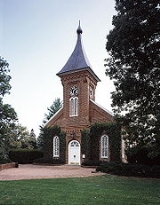
Lee Chapel

Encyclopedia
Lee Chapel is a National Historic Landmark in Lexington, Virginia
, on the campus of Washington and Lee University
. It was constructed during 1867-68 at the request of Robert E. Lee
, who was President of the University (then known as Washington College) at the time, and after whom the building is named. The Victorian brick architectural design was probably the work of his son, George Washington Custis Lee
, with details contributed by Col. Thomas Williamson, an architect and professor of engineering at the neighboring Virginia Military Institute
. General Lee, along with much of the rest of the Lexington community, attended church services at Grace Episcopal Church, a hundred yards south, at the edge of the college campus. (That church was later renamed R. E. Lee Memorial Episcopal Church)
When Lee died in 1870, he was buried beneath the chapel. His body remains there to this day, and for this reason among others, the Chapel is one of Lexington's major historical tourist attractions.
A centerpiece on the stage of the chapel -- where the pulpit would be in a less secular place of worship -- is a statue of Lee, in his uniform, asleep on the battlefield (the "Recumbent Lee"), designed by Edward Valentine
. On the walls are two paintings: one of General Washington himself, by Charles Willson Peale
, from the Washington family collections, and the other of Lee in his uniform, painted by Edward Pine. There is also a plaque given by the Sigma Society
on one of the walls that honors two Sigma alumni from the classes of 1912 and 1915 who lost their lives in World War I.
In the basement a crypt (added after Lee's burial) contains much of Lee's direct family: the General himself, his wife Mary, his seven children, and his parents - Henry "Light Horse Harry" Lee, who had been a general during the Revolutionary War
, and Anne Carter Lee. Lee's favorite horse, Traveller
, is buried just outside the Chapel, where students of Washington & Lee traditionally leave coins in hopes of being compensated with good fortune in their studies. In the basement of the Chapel is a museum that illuminates the history of the family of George Washington
and Lee as well as that of the university itself. Lee's office has been meticulously preserved in almost exactly the same condition as it was when he died.
Further, the Chapel continues to play an important role in the modern operation of Washington and Lee. It seats about 600 in its main area and a small, three-sided balcony. Freshmen are brought there to hear a lecture from the President of the University's student-run Executive Committee on the school's famous Honor System
. Important school-wide lectures, concerts, and other notable activities are also held here from time to time.
Lee Chapel was designated a National Historic Landmark
in 1963. It is open for tours based on the following schedule:
Lexington, Virginia
Lexington is an independent city within the confines of Rockbridge County in the Commonwealth of Virginia. The population was 7,042 in 2010. Lexington is about 55 minutes east of the West Virginia border and is about 50 miles north of Roanoke, Virginia. It was first settled in 1777.It is home to...
, on the campus of Washington and Lee University
Washington and Lee University
Washington and Lee University is a private liberal arts college in Lexington, Virginia, United States.The classical school from which Washington and Lee descended was established in 1749 as Augusta Academy, about north of its present location. In 1776 it was renamed Liberty Hall in a burst of...
. It was constructed during 1867-68 at the request of Robert E. Lee
Robert E. Lee
Robert Edward Lee was a career military officer who is best known for having commanded the Confederate Army of Northern Virginia in the American Civil War....
, who was President of the University (then known as Washington College) at the time, and after whom the building is named. The Victorian brick architectural design was probably the work of his son, George Washington Custis Lee
George Washington Custis Lee
George Washington Custis Lee , also known as Custis Lee, was the eldest son of Robert E. Lee and Mary Anna Custis Lee...
, with details contributed by Col. Thomas Williamson, an architect and professor of engineering at the neighboring Virginia Military Institute
Virginia Military Institute
The Virginia Military Institute , located in Lexington, Virginia, is the oldest state-supported military college and one of six senior military colleges in the United States. Unlike any other military college in the United States—and in keeping with its founding principles—all VMI students are...
. General Lee, along with much of the rest of the Lexington community, attended church services at Grace Episcopal Church, a hundred yards south, at the edge of the college campus. (That church was later renamed R. E. Lee Memorial Episcopal Church)
When Lee died in 1870, he was buried beneath the chapel. His body remains there to this day, and for this reason among others, the Chapel is one of Lexington's major historical tourist attractions.
A centerpiece on the stage of the chapel -- where the pulpit would be in a less secular place of worship -- is a statue of Lee, in his uniform, asleep on the battlefield (the "Recumbent Lee"), designed by Edward Valentine
Edward Valentine
Edward Virginius Valentine was an American sculptor.-Biography:He was born on November 12, 1838 in Richmond, Virginia. He studied in Europe: in Paris with Couture and Jouffroy, in Italy under Bonanti, and with August Kiss in Berlin. He briefly headed the Valentine Richmond History Center, which...
. On the walls are two paintings: one of General Washington himself, by Charles Willson Peale
Charles Willson Peale
Charles Willson Peale was an American painter, soldier and naturalist. He is best remembered for his portrait paintings of leading figures of the American Revolution, as well as establishing one of the first museums....
, from the Washington family collections, and the other of Lee in his uniform, painted by Edward Pine. There is also a plaque given by the Sigma Society
Sigma Society
The Sigma Society is a secret society at Washington and Lee University in Lexington, Virginia. Founded in 1880, it is one of the older secret societies in the United States, and remains "one of the oldest continuous social organizations at Washington and Lee." The Sigma Society is roughly 70 years...
on one of the walls that honors two Sigma alumni from the classes of 1912 and 1915 who lost their lives in World War I.
In the basement a crypt (added after Lee's burial) contains much of Lee's direct family: the General himself, his wife Mary, his seven children, and his parents - Henry "Light Horse Harry" Lee, who had been a general during the Revolutionary War
American Revolutionary War
The American Revolutionary War , the American War of Independence, or simply the Revolutionary War, began as a war between the Kingdom of Great Britain and thirteen British colonies in North America, and ended in a global war between several European great powers.The war was the result of the...
, and Anne Carter Lee. Lee's favorite horse, Traveller
Traveller (horse)
Traveller was Confederate General Robert E. Lee's most famous horse during the American Civil War.-Birth and war service:...
, is buried just outside the Chapel, where students of Washington & Lee traditionally leave coins in hopes of being compensated with good fortune in their studies. In the basement of the Chapel is a museum that illuminates the history of the family of George Washington
George Washington
George Washington was the dominant military and political leader of the new United States of America from 1775 to 1799. He led the American victory over Great Britain in the American Revolutionary War as commander-in-chief of the Continental Army from 1775 to 1783, and presided over the writing of...
and Lee as well as that of the university itself. Lee's office has been meticulously preserved in almost exactly the same condition as it was when he died.
Further, the Chapel continues to play an important role in the modern operation of Washington and Lee. It seats about 600 in its main area and a small, three-sided balcony. Freshmen are brought there to hear a lecture from the President of the University's student-run Executive Committee on the school's famous Honor System
Honor system
An honor system or honesty system is a philosophical way of running a variety of endeavors based on trust, honor, and honesty. Something that operates under the rule of the "honor system" is usually something that does not have strictly enforced rules governing its principles...
. Important school-wide lectures, concerts, and other notable activities are also held here from time to time.
Lee Chapel was designated a National Historic Landmark
National Historic Landmark
A National Historic Landmark is a building, site, structure, object, or district, that is officially recognized by the United States government for its historical significance...
in 1963. It is open for tours based on the following schedule:
- Apr 1 - Oct 31: 9 a.m. to 5 p.m., Monday through Saturday, and 1 to 5 p.m. on Sundays
- Nov 1 - Mar 31: 9 a.m. to 4 p.m., Monday through Saturday, and 1 to 4 p.m. on Sundays