

Dixieland

Encyclopedia
Dixieland music, sometimes referred to as Hot jazz, Early Jazz or New Orleans jazz, is a style of jazz
music
which developed in New Orleans
at the start of the 20th century, and was spread to Chicago
and New York City
by New Orleans bands in the 1910s.
Well-known jazz standard
songs from the Dixieland era, such as "Basin Street Blues
" and "When the Saints Go Marching In
", are known even to non-jazz fans.
and blues
with collective, polyphonic
improvisation
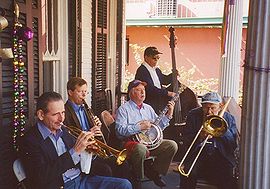
. While instrumentation and size of bands can be very flexible, the "standard" band consists of a "front line" of trumpet
(or cornet
), trombone
, and clarinet
, with a "rhythm section
" of at least two of the following instruments: guitar
or banjo
, string bass or tuba
, piano
, and drum
s.
The term Dixieland became widely used after the advent of the first million-selling hit records of the Original Dixieland Jazz Band in 1917. The music has been played continuously since the early part of the 20th century. Louis Armstrong
's All-Stars was the band most popularly identified with Dixieland, although Armstrong's own influence runs through all of jazz.
The definitive Dixieland sound is created when one instrument (usually the trumpet
) plays the melody or a recognizable paraphrase or variation on it, and the other instruments of the "front line" improvise around that melody. This creates a more polyphonic sound than the extremely regimented big band
sound or the unison melody of bebop
.
The swing era of the 1930s led to the end of many Dixieland Jazz musicians' careers. Only a few musicians were able to maintain popularity. Most retired.
With the advent of bebop
in the 1940s, the earlier group-improvisation style fell out of favor with the majority of younger black players, while some older players of both races continued on in the older style. Though younger musicians developed new forms, many beboppers revered Armstrong, and quoted fragments of his recorded music in their own improvisations.
There was a revival of Dixieland in the late 1940s and 1950s, which brought many semi-retired musicians a measure of fame late in their lives as well as bringing retired musicians back onto the jazz circuit after years of not playing (e.g. Kid Ory
). Many Dixieland groups of the revival era consciously imitated the recordings and bands of decades earlier. Other musicians continued to create innovative performances and new tunes. For example, in the 1950s a style called "Progressive Dixieland" sought to blend traditional Dixieland melody
with bebop
-style rhythm
. Steve Lacy
played with several such bands early in his career. This style is sometimes called "Dixie-bop".
played without passion or deep understanding of the music.
 Dixieland is often today applied to white bands playing in a traditional style. White bands such as those of Eddie Condon
and Muggsy Spanier
were tagged with the Dixieland label.
, Eddie Condon
, Muggsy Spanier
, and Bud Freeman
. The rhythm sections of these bands substitute the string bass for the tuba
and the guitar
for the banjo
. Musically, the Chicagoans play in more of a swing-style 4-to-the-bar manner. The New Orleanian preference for an ensemble sound is deemphasized in favor of solos. Chicago-style dixieland also differs from its southern origin by being faster paced, resembling the hustle-bustle of city life. Chicago-style bands play a wide variety of tunes, including most of those of the more traditional bands plus many of the Great American Songbook
selections from the 1930s by George Gershwin
, Jerome Kern
, Cole Porter
, and Irving Berlin
. Non-Chicagoans such as Pee Wee Russell
and Bobby Hackett
are often thought of as playing in this style. This modernized style came to be called Nicksieland, after Nick's Greenwich Village night club, where it was popular, though the term was not limited to that club.
. It started out as a backlash to the Chicago style, which is closer in development towards swing
. The repertoire of these bands is based on the music of Joe "King" Oliver, Jelly Roll Morton
, Louis Armstrong
, and W.C. Handy. Bands playing in the West Coast style use banjo and tuba in the rhythm sections, which play in a 2-to-the-bar rhythmic style.
in 1942 and was extended by the founding of Preservation Hall
in the French Quarter during the 1960s. The most famous of which was the various line ups led by George Lewis, clarinet with Jim Robinson on trombone, and one of two trumpet players, Elmer Talbot or Avery ‘Kid’ Howard, backed by Lawrence Marrero on banjo, Alcide Pavageau on string bass, and Joe Watkins or Edgar Moseley on drums. Bands playing in this style used string bass (or tuba) and banjo in the rhythm section playing 4-to-the-bar and feature popular tunes and Gospel hymns that were played in New Orleans since the early 20th century such as "Ice Cream
," "You Tell Me Your Dream," "Just a Closer Walk With Thee" and some tunes from the New Orleans brass band literature. The New Orleans "revival" of the 1960s added a greater number of solos, in a style influenced by mid-century New York Dixieland combos, as this was less of a strain on some musicians of advanced years than the older New Orleans style with much more ensemble playing. It should be pointed out that the New Orleans revival movement was not ‘Dixieland’ but ‘New Orleans Jazz’ and the many followers around the world such as Ken Colyer in England played their music in the spirit demonstrated by George Lewis and company.
Famous traditional Dixieland tunes include: "When the Saints Go Marching In
," "Muskrat Ramble
," "Struttin' With Some Barbecue," "Tiger Rag
," "Dippermouth Blues," "Milenberg Joys," "Basin Street Blues
," "Tin Roof Blues
," "At the Jazz Band Ball," "Panama
," "I Found a New Baby," "Royal Garden Blues
" and many others. All of these tunes were widely played by jazz bands of both races of the pre-WWII
era, especially Louis Armstrong
. They came to be grouped as Dixieland standards beginning in the 1950s.
, traditional jazz music made a come-back in the Low Countries
. However, most Dutch jazz bands (such as The Ramblers) had long since evolved into the Swing-era while the few remaining traditional jazz bands (such as the Dutch Swing College Band
) did not partake in the broader traditional revival movement, and continued to play ragtime
and early jazz, greatly limiting the number of bands aspiring jazz musicians could join or (as they were using instruments unavailable to most Dutch musicians such as double bass
es and the piano) were forced to improvise, resulting in a new form of jazz ensemble generally referred to 'Oude Stijl' ('Old Style') jazz in Dutch
.
Influenced by the instrumentation of the two principle orchestral forms of the wind band in the Netherlands
and Belgium
, the 'harmonie
' and the 'fanfare
', traditional Dutch jazz bands do not feature a piano
and contain no stringed instruments
apart from the banjo
. They include multiple trumpet
s, trombone
s and saxophone
s accompanied by a single clarinet
, sousaphone
and a section of Marching percussion
usually including a washboard
.
The music played by Dutch jazz bands includes both the original New Orleans tunes, as well as the songs of the revival era. In terms of playing style, Dutch jazz bands occupy a position between revivalist and original New Orleans Jazz, with more solos
than the latter but without abandoning the principle of ensemble playing. With the average band containing up to 15-players, Dutch jazz bands tend to be the largest ensembles to play traditional jazz music.
being an example. The contemporary New Orleans Brass Band styles, such as the Dirty Dozen Brass Band
, The Primate Fiasco, the Hot Tamale Brass Band
and the Rebirth Brass Band
have combined traditional New Orleans brass band jazz with such influences as contemporary jazz, funk, hip hop, and rap.
, the Jazz Rambler, and the American Rag published in the US; and to an extent Jazz Journal published in Europe.
- Richard Sudhalter
Jazz
Jazz is a musical style that originated at the beginning of the 20th century in African American communities in the Southern United States. It was born out of a mix of African and European music traditions. From its early development until the present, jazz has incorporated music from 19th and 20th...
music
Music
Music is an art form whose medium is sound and silence. Its common elements are pitch , rhythm , dynamics, and the sonic qualities of timbre and texture...
which developed in New Orleans
New Orleans, Louisiana
New Orleans is a major United States port and the largest city and metropolitan area in the state of Louisiana. The New Orleans metropolitan area has a population of 1,235,650 as of 2009, the 46th largest in the USA. The New Orleans – Metairie – Bogalusa combined statistical area has a population...
at the start of the 20th century, and was spread to Chicago
Chicago
Chicago is the largest city in the US state of Illinois. With nearly 2.7 million residents, it is the most populous city in the Midwestern United States and the third most populous in the US, after New York City and Los Angeles...
and New York City
New York City
New York is the most populous city in the United States and the center of the New York Metropolitan Area, one of the most populous metropolitan areas in the world. New York exerts a significant impact upon global commerce, finance, media, art, fashion, research, technology, education, and...
by New Orleans bands in the 1910s.
Well-known jazz standard
Jazz standard
Jazz standards are musical compositions which are an important part of the musical repertoire of jazz musicians, in that they are widely known, performed, and recorded by jazz musicians, and widely known by listeners. There is no definitive list of jazz standards, and the list of songs deemed to be...
songs from the Dixieland era, such as "Basin Street Blues
Basin Street Blues
"Basin Street Blues" is a song often performed by Dixieland jazz bands, written by Spencer Williams. The song was published in 1926 and made famous in a recording by Louis Armstrong in 1928...
" and "When the Saints Go Marching In
When the Saints Go Marching In
"When the Saints Go Marching In", often referred to as "The Saints", is an American gospel hymn that has taken on certain aspects of folk music. The precise origins of the song are not known. Though it originated as a spiritual, today people are more likely to hear it played by a jazz band...
", are known even to non-jazz fans.
History
Dixieland, an early style of Jazz that was developed in New Orleans, is the earliest style of Jazz music. The style combined earlier brass band marches, French Quadrilles, ragtimeRagtime
Ragtime is an original musical genre which enjoyed its peak popularity between 1897 and 1918. Its main characteristic trait is its syncopated, or "ragged," rhythm. It began as dance music in the red-light districts of American cities such as St. Louis and New Orleans years before being published...
and blues
Blues
Blues is the name given to both a musical form and a music genre that originated in African-American communities of primarily the "Deep South" of the United States at the end of the 19th century from spirituals, work songs, field hollers, shouts and chants, and rhymed simple narrative ballads...
with collective, polyphonic
Polyphony
In music, polyphony is a texture consisting of two or more independent melodic voices, as opposed to music with just one voice or music with one dominant melodic voice accompanied by chords ....
improvisation
Improvisation
Improvisation is the practice of acting, singing, talking and reacting, of making and creating, in the moment and in response to the stimulus of one's immediate environment and inner feelings. This can result in the invention of new thought patterns, new practices, new structures or symbols, and/or...
. While instrumentation and size of bands can be very flexible, the "standard" band consists of a "front line" of trumpet
Trumpet
The trumpet is the musical instrument with the highest register in the brass family. Trumpets are among the oldest musical instruments, dating back to at least 1500 BCE. They are played by blowing air through closed lips, producing a "buzzing" sound which starts a standing wave vibration in the air...
(or cornet
Cornet
The cornet is a brass instrument very similar to the trumpet, distinguished by its conical bore, compact shape, and mellower tone quality. The most common cornet is a transposing instrument in B. It is not related to the renaissance and early baroque cornett or cornetto.-History:The cornet was...
), trombone
Trombone
The trombone is a musical instrument in the brass family. Like all brass instruments, sound is produced when the player’s vibrating lips cause the air column inside the instrument to vibrate...
, and clarinet
Clarinet
The clarinet is a musical instrument of woodwind type. The name derives from adding the suffix -et to the Italian word clarino , as the first clarinets had a strident tone similar to that of a trumpet. The instrument has an approximately cylindrical bore, and uses a single reed...
, with a "rhythm section
Rhythm section
A rhythm section is a collection of musicians who make up a section of instruments which provides the accompaniment section of the music, giving the music its rhythmic texture and pulse, also serving as a rhythmic reference for the rest of the band...
" of at least two of the following instruments: guitar
Guitar
The guitar is a plucked string instrument, usually played with fingers or a pick. The guitar consists of a body with a rigid neck to which the strings, generally six in number, are attached. Guitars are traditionally constructed of various woods and strung with animal gut or, more recently, with...
or banjo
Banjo
In the 1830s Sweeney became the first white man to play the banjo on stage. His version of the instrument replaced the gourd with a drum-like sound box and included four full-length strings alongside a short fifth-string. There is no proof, however, that Sweeney invented either innovation. This new...
, string bass or tuba
Tuba
The tuba is the largest and lowest-pitched brass instrument. Sound is produced by vibrating or "buzzing" the lips into a large cupped mouthpiece. It is one of the most recent additions to the modern symphony orchestra, first appearing in the mid-19th century, when it largely replaced the...
, piano
Piano
The piano is a musical instrument played by means of a keyboard. It is one of the most popular instruments in the world. Widely used in classical and jazz music for solo performances, ensemble use, chamber music and accompaniment, the piano is also very popular as an aid to composing and rehearsal...
, and drum
Drum
The drum is a member of the percussion group of musical instruments, which is technically classified as the membranophones. Drums consist of at least one membrane, called a drumhead or drum skin, that is stretched over a shell and struck, either directly with the player's hands, or with a...
s.
The term Dixieland became widely used after the advent of the first million-selling hit records of the Original Dixieland Jazz Band in 1917. The music has been played continuously since the early part of the 20th century. Louis Armstrong
Louis Armstrong
Louis Armstrong , nicknamed Satchmo or Pops, was an American jazz trumpeter and singer from New Orleans, Louisiana....
's All-Stars was the band most popularly identified with Dixieland, although Armstrong's own influence runs through all of jazz.
The definitive Dixieland sound is created when one instrument (usually the trumpet
Trumpet
The trumpet is the musical instrument with the highest register in the brass family. Trumpets are among the oldest musical instruments, dating back to at least 1500 BCE. They are played by blowing air through closed lips, producing a "buzzing" sound which starts a standing wave vibration in the air...
) plays the melody or a recognizable paraphrase or variation on it, and the other instruments of the "front line" improvise around that melody. This creates a more polyphonic sound than the extremely regimented big band
Big band
A big band is a type of musical ensemble associated with jazz and the Swing Era typically consisting of rhythm, brass, and woodwind instruments totaling approximately twelve to twenty-five musicians...
sound or the unison melody of bebop
Bebop
Bebop differed drastically from the straightforward compositions of the swing era, and was instead characterized by fast tempos, asymmetrical phrasing, intricate melodies, and rhythm sections that expanded on their role as tempo-keepers...
.
The swing era of the 1930s led to the end of many Dixieland Jazz musicians' careers. Only a few musicians were able to maintain popularity. Most retired.
With the advent of bebop
Bebop
Bebop differed drastically from the straightforward compositions of the swing era, and was instead characterized by fast tempos, asymmetrical phrasing, intricate melodies, and rhythm sections that expanded on their role as tempo-keepers...
in the 1940s, the earlier group-improvisation style fell out of favor with the majority of younger black players, while some older players of both races continued on in the older style. Though younger musicians developed new forms, many beboppers revered Armstrong, and quoted fragments of his recorded music in their own improvisations.
There was a revival of Dixieland in the late 1940s and 1950s, which brought many semi-retired musicians a measure of fame late in their lives as well as bringing retired musicians back onto the jazz circuit after years of not playing (e.g. Kid Ory
Kid Ory
Edward "Kid" Ory was a jazz trombonist and bandleader. He was born in Woodland Plantation near LaPlace, Louisiana.-Biography:...
). Many Dixieland groups of the revival era consciously imitated the recordings and bands of decades earlier. Other musicians continued to create innovative performances and new tunes. For example, in the 1950s a style called "Progressive Dixieland" sought to blend traditional Dixieland melody
Melody
A melody , also tune, voice, or line, is a linear succession of musical tones which is perceived as a single entity...
with bebop
Bebop
Bebop differed drastically from the straightforward compositions of the swing era, and was instead characterized by fast tempos, asymmetrical phrasing, intricate melodies, and rhythm sections that expanded on their role as tempo-keepers...
-style rhythm
Rhythm
Rhythm may be generally defined as a "movement marked by the regulated succession of strong and weak elements, or of opposite or different conditions." This general meaning of regular recurrence or pattern in time may be applied to a wide variety of cyclical natural phenomena having a periodicity or...
. Steve Lacy
Steve Lacy
Steve Lacy , born Steven Norman Lackritz in New York City, was a jazz saxophonist and composer recognized as one of the important players of soprano saxophone....
played with several such bands early in his career. This style is sometimes called "Dixie-bop".
Etymology
While the term Dixieland is still in wide use, the term's appropriateness is a hotly debated topic in some circles. For some it is the preferred label (especially bands on the USA's West coast and those influenced by the 1940s revival bands), while others would rather use terms like Classic Jazz or Traditional Jazz. Some of the latter consider Dixieland a derogatory term implying superficial hokumHokum
Hokum is a particular song type of American blues music - a humorous song which uses extended analogies or euphemistic terms to make sexual innuendos...
played without passion or deep understanding of the music.
Eddie Condon
Albert Edwin Condon , better known as Eddie Condon, was a jazz banjoist, guitarist, and bandleader. A leading figure in the so-called "Chicago school" of early Dixieland, he also played piano and sang on occasion....
and Muggsy Spanier
Muggsy Spanier
Francis Joseph Julian "Muggsy" Spanier was a prominent cornet player based in Chicago. He was renowned as the best trumpet/cornet in Chicago until Bix Beiderbecke entered the scene....
were tagged with the Dixieland label.
Chicago style
"Chicago style" is often applied to the sound of Chicagoans such as Jimmy McPartlandJimmy McPartland
James Dugald McPartland , better known as Jimmy McPartland, was an American cornetist and one of the originators of Chicago Jazz...
, Eddie Condon
Eddie Condon
Albert Edwin Condon , better known as Eddie Condon, was a jazz banjoist, guitarist, and bandleader. A leading figure in the so-called "Chicago school" of early Dixieland, he also played piano and sang on occasion....
, Muggsy Spanier
Muggsy Spanier
Francis Joseph Julian "Muggsy" Spanier was a prominent cornet player based in Chicago. He was renowned as the best trumpet/cornet in Chicago until Bix Beiderbecke entered the scene....
, and Bud Freeman
Bud Freeman
Lawrence "Bud" Freeman was a U.S. jazz musician, bandleader, and composer, known mainly for playing the tenor saxophone, but also able at the clarinet. He had a smooth and full tenor sax style with a heavy robust swing. He was one of the most influential and important jazz tenor saxophonists of...
. The rhythm sections of these bands substitute the string bass for the tuba
Tuba
The tuba is the largest and lowest-pitched brass instrument. Sound is produced by vibrating or "buzzing" the lips into a large cupped mouthpiece. It is one of the most recent additions to the modern symphony orchestra, first appearing in the mid-19th century, when it largely replaced the...
and the guitar
Guitar
The guitar is a plucked string instrument, usually played with fingers or a pick. The guitar consists of a body with a rigid neck to which the strings, generally six in number, are attached. Guitars are traditionally constructed of various woods and strung with animal gut or, more recently, with...
for the banjo
Banjo
In the 1830s Sweeney became the first white man to play the banjo on stage. His version of the instrument replaced the gourd with a drum-like sound box and included four full-length strings alongside a short fifth-string. There is no proof, however, that Sweeney invented either innovation. This new...
. Musically, the Chicagoans play in more of a swing-style 4-to-the-bar manner. The New Orleanian preference for an ensemble sound is deemphasized in favor of solos. Chicago-style dixieland also differs from its southern origin by being faster paced, resembling the hustle-bustle of city life. Chicago-style bands play a wide variety of tunes, including most of those of the more traditional bands plus many of the Great American Songbook
Great American Songbook
The Great American Songbook is a hypothetical construct that seeks to represent the best American songs of the 20th century principally from Broadway theatre, musical theatre, and Hollywood musicals, from the 1920s to 1960, including dozens of songs of enduring popularity...
selections from the 1930s by George Gershwin
George Gershwin
George Gershwin was an American composer and pianist. Gershwin's compositions spanned both popular and classical genres, and his most popular melodies are widely known...
, Jerome Kern
Jerome Kern
Jerome David Kern was an American composer of musical theatre and popular music. One of the most important American theatre composers of the early 20th century, he wrote more than 700 songs, used in over 100 stage works, including such classics as "Ol' Man River", "Can't Help Lovin' Dat Man", "A...
, Cole Porter
Cole Porter
Cole Albert Porter was an American composer and songwriter. Born to a wealthy family in Indiana, he defied the wishes of his domineering grandfather and took up music as a profession. Classically trained, he was drawn towards musical theatre...
, and Irving Berlin
Irving Berlin
Irving Berlin was an American composer and lyricist of Jewish heritage, widely considered one of the greatest songwriters in American history.His first hit song, "Alexander's Ragtime Band", became world famous...
. Non-Chicagoans such as Pee Wee Russell
Pee Wee Russell
Charles Ellsworth Russell, much better known by his nickname Pee Wee Russell, was a jazz musician. Early in his career he played clarinet and saxophones, but eventually focused solely on clarinet....
and Bobby Hackett
Bobby Hackett
Robert Leo "Bobby" Hackett was an US jazz musician who played trumpet, cornet and guitar with the bands of Glenn Miller and Benny Goodman in the late thirties and early forties.-Biography:...
are often thought of as playing in this style. This modernized style came to be called Nicksieland, after Nick's Greenwich Village night club, where it was popular, though the term was not limited to that club.
West Coast revival
The "West Coast revival" is a movement begun in the late 1930s by the Lu Watters Yerba Buena Jazz Band of San Francisco and extended by trombonist Turk MurphyTurk Murphy
Melvin Edward Alton “Turk” Murphy was renowned as a trombonist who played traditional and dixieland jazz in San Francisco....
. It started out as a backlash to the Chicago style, which is closer in development towards swing
Swing (genre)
Swing music, also known as swing jazz or simply swing, is a form of jazz music that developed in the early 1930s and became a distinctive style by 1935 in the United States...
. The repertoire of these bands is based on the music of Joe "King" Oliver, Jelly Roll Morton
Jelly Roll Morton
Ferdinand Joseph LaMothe , known professionally as Jelly Roll Morton, was an American ragtime and early jazz pianist, bandleader and composer....
, Louis Armstrong
Louis Armstrong
Louis Armstrong , nicknamed Satchmo or Pops, was an American jazz trumpeter and singer from New Orleans, Louisiana....
, and W.C. Handy. Bands playing in the West Coast style use banjo and tuba in the rhythm sections, which play in a 2-to-the-bar rhythmic style.
New Orleans Traditional
The "New Orleans Traditional" revival movement began with the rediscovery of Bunk JohnsonBunk Johnson
Willie Gary "Bunk" Johnson was a prominent early New Orleans jazz trumpet player in the early years of the 20th century who enjoyed a revived career in the 1940s....
in 1942 and was extended by the founding of Preservation Hall
Preservation Hall
Preservation Hall is a noted jazz performance hall located at 726 St. Peter Street in the French Quarter of New Orleans, Louisiana. It hosts nightly concerts featuring a rotating roster of bands. The bands of Preservation Hall typically perform jazz in the New Orleans style.Despite the fame of the...
in the French Quarter during the 1960s. The most famous of which was the various line ups led by George Lewis, clarinet with Jim Robinson on trombone, and one of two trumpet players, Elmer Talbot or Avery ‘Kid’ Howard, backed by Lawrence Marrero on banjo, Alcide Pavageau on string bass, and Joe Watkins or Edgar Moseley on drums. Bands playing in this style used string bass (or tuba) and banjo in the rhythm section playing 4-to-the-bar and feature popular tunes and Gospel hymns that were played in New Orleans since the early 20th century such as "Ice Cream
Ice cream
Ice cream is a frozen dessert usually made from dairy products, such as milk and cream, and often combined with fruits or other ingredients and flavours. Most varieties contain sugar, although some are made with other sweeteners...
," "You Tell Me Your Dream," "Just a Closer Walk With Thee" and some tunes from the New Orleans brass band literature. The New Orleans "revival" of the 1960s added a greater number of solos, in a style influenced by mid-century New York Dixieland combos, as this was less of a strain on some musicians of advanced years than the older New Orleans style with much more ensemble playing. It should be pointed out that the New Orleans revival movement was not ‘Dixieland’ but ‘New Orleans Jazz’ and the many followers around the world such as Ken Colyer in England played their music in the spirit demonstrated by George Lewis and company.
Famous traditional Dixieland tunes include: "When the Saints Go Marching In
When the Saints Go Marching In
"When the Saints Go Marching In", often referred to as "The Saints", is an American gospel hymn that has taken on certain aspects of folk music. The precise origins of the song are not known. Though it originated as a spiritual, today people are more likely to hear it played by a jazz band...
," "Muskrat Ramble
Muskrat Ramble
"Muskrat Ramble" is a jazz composition written by Kid Ory in 1926. It was first recorded on February 26, 1926 by Louis Armstrong and his Hot Five, and became the group's most frequently recorded piece...
," "Struttin' With Some Barbecue," "Tiger Rag
Tiger Rag
"Tiger Rag" is a jazz standard, originally recorded and copyrighted by the Original Dixieland Jass Band in 1917. It is one of the most recorded jazz compositions of all time.-Origins:...
," "Dippermouth Blues," "Milenberg Joys," "Basin Street Blues
Basin Street Blues
"Basin Street Blues" is a song often performed by Dixieland jazz bands, written by Spencer Williams. The song was published in 1926 and made famous in a recording by Louis Armstrong in 1928...
," "Tin Roof Blues
Tin Roof Blues
Tin Roof Blues is a jazz composition first recorded by the New Orleans Rhythm Kings in 1923. It was written by band members Paul Mares, Ben Pollack, Mel Stitzel, George Brunies and Leon Roppolo...
," "At the Jazz Band Ball," "Panama
Panama
Panama , officially the Republic of Panama , is the southernmost country of Central America. Situated on the isthmus connecting North and South America, it is bordered by Costa Rica to the northwest, Colombia to the southeast, the Caribbean Sea to the north and the Pacific Ocean to the south. The...
," "I Found a New Baby," "Royal Garden Blues
Royal Garden Blues
"Royal Garden Blues" is a blues song composed by Clarence and Spencer Williams in 1919. Popularized in jazz by the Original Dixieland Jazz Band, it has since been recorded by numerous artists and has become a jazz standard...
" and many others. All of these tunes were widely played by jazz bands of both races of the pre-WWII
World War II
World War II, or the Second World War , was a global conflict lasting from 1939 to 1945, involving most of the world's nations—including all of the great powers—eventually forming two opposing military alliances: the Allies and the Axis...
era, especially Louis Armstrong
Louis Armstrong
Louis Armstrong , nicknamed Satchmo or Pops, was an American jazz trumpeter and singer from New Orleans, Louisiana....
. They came to be grouped as Dixieland standards beginning in the 1950s.
Dutch 'Old Style Jazz'
Largely occurring at the same time as the "New Orleans Traditional" revival movement in the United StatesUnited States
The United States of America is a federal constitutional republic comprising fifty states and a federal district...
, traditional jazz music made a come-back in the Low Countries
Low Countries
The Low Countries are the historical lands around the low-lying delta of the Rhine, Scheldt, and Meuse rivers, including the modern countries of Belgium, the Netherlands, Luxembourg and parts of northern France and western Germany....
. However, most Dutch jazz bands (such as The Ramblers) had long since evolved into the Swing-era while the few remaining traditional jazz bands (such as the Dutch Swing College Band
Dutch Swing College Band
The Dutch Swing College Band "DSCB" is a traditional dixieland band founded on May 5, 1945 by bandleader and clarinetist/saxophonist Peter Schilperoort....
) did not partake in the broader traditional revival movement, and continued to play ragtime
Ragtime
Ragtime is an original musical genre which enjoyed its peak popularity between 1897 and 1918. Its main characteristic trait is its syncopated, or "ragged," rhythm. It began as dance music in the red-light districts of American cities such as St. Louis and New Orleans years before being published...
and early jazz, greatly limiting the number of bands aspiring jazz musicians could join or (as they were using instruments unavailable to most Dutch musicians such as double bass
Double bass
The double bass, also called the string bass, upright bass, standup bass or contrabass, is the largest and lowest-pitched bowed string instrument in the modern symphony orchestra, with strings usually tuned to E1, A1, D2 and G2...
es and the piano) were forced to improvise, resulting in a new form of jazz ensemble generally referred to 'Oude Stijl' ('Old Style') jazz in Dutch
Dutch language
Dutch is a West Germanic language and the native language of the majority of the population of the Netherlands, Belgium, and Suriname, the three member states of the Dutch Language Union. Most speakers live in the European Union, where it is a first language for about 23 million and a second...
.
Influenced by the instrumentation of the two principle orchestral forms of the wind band in the Netherlands
Netherlands
The Netherlands is a constituent country of the Kingdom of the Netherlands, located mainly in North-West Europe and with several islands in the Caribbean. Mainland Netherlands borders the North Sea to the north and west, Belgium to the south, and Germany to the east, and shares maritime borders...
and Belgium
Belgium
Belgium , officially the Kingdom of Belgium, is a federal state in Western Europe. It is a founding member of the European Union and hosts the EU's headquarters, and those of several other major international organisations such as NATO.Belgium is also a member of, or affiliated to, many...
, the 'harmonie
Harmonie
Harmonie is a German word that, in the context of the history of music, designates a band of wind instruments employed by an aristocratic patron, particularly during the Classical era of the 18th century...
' and the 'fanfare
Fanfare
A Fanfare is a relatively short piece of music that is typically played by trumpets and other brass instruments often accompanied by percussion...
', traditional Dutch jazz bands do not feature a piano
Piano
The piano is a musical instrument played by means of a keyboard. It is one of the most popular instruments in the world. Widely used in classical and jazz music for solo performances, ensemble use, chamber music and accompaniment, the piano is also very popular as an aid to composing and rehearsal...
and contain no stringed instruments
String instrument
A string instrument is a musical instrument that produces sound by means of vibrating strings. In the Hornbostel-Sachs scheme of musical instrument classification, used in organology, they are called chordophones...
apart from the banjo
Banjo
In the 1830s Sweeney became the first white man to play the banjo on stage. His version of the instrument replaced the gourd with a drum-like sound box and included four full-length strings alongside a short fifth-string. There is no proof, however, that Sweeney invented either innovation. This new...
. They include multiple trumpet
Trumpet
The trumpet is the musical instrument with the highest register in the brass family. Trumpets are among the oldest musical instruments, dating back to at least 1500 BCE. They are played by blowing air through closed lips, producing a "buzzing" sound which starts a standing wave vibration in the air...
s, trombone
Trombone
The trombone is a musical instrument in the brass family. Like all brass instruments, sound is produced when the player’s vibrating lips cause the air column inside the instrument to vibrate...
s and saxophone
Saxophone
The saxophone is a conical-bore transposing musical instrument that is a member of the woodwind family. Saxophones are usually made of brass and played with a single-reed mouthpiece similar to that of the clarinet. The saxophone was invented by the Belgian instrument maker Adolphe Sax in 1846...
s accompanied by a single clarinet
Clarinet
The clarinet is a musical instrument of woodwind type. The name derives from adding the suffix -et to the Italian word clarino , as the first clarinets had a strident tone similar to that of a trumpet. The instrument has an approximately cylindrical bore, and uses a single reed...
, sousaphone
Sousaphone
The sousaphone is a type of tuba that is widely employed in marching bands. Designed so that it fits around the body of the musician and is supported by the left shoulder, the sousaphone may be readily played while being carried...
and a section of Marching percussion
Marching percussion
Marching percussion instruments are specially designed to be played while moving. This is achieved by attaching the drum to a special harness worn by the drummer. The drums are designed and tuned for maximum articulation and projection of sound, as marching activities are almost always outdoors or...
usually including a washboard
Washboard
A washboard is a tool designed for hand washing clothing. With mechanized cleaning of clothing becoming more common by the end of the 20th century, the washboard has become better known for its originally subsidiary use as a musical instrument....
.
The music played by Dutch jazz bands includes both the original New Orleans tunes, as well as the songs of the revival era. In terms of playing style, Dutch jazz bands occupy a position between revivalist and original New Orleans Jazz, with more solos
Solo (music)
In music, a solo is a piece or a section of a piece played or sung by a single performer...
than the latter but without abandoning the principle of ensemble playing. With the average band containing up to 15-players, Dutch jazz bands tend to be the largest ensembles to play traditional jazz music.
Styles influenced by Traditional Jazz
Musical styles with important influence from Dixieland or Traditional Jazz include Swing music, some Rhythm & Blues and early Rock & Roll also show significant trad jazz influence, Fats DominoFats Domino
Antoine Dominique "Fats" Domino, Jr. is an American R&B and rock and roll pianist and singer-songwriter. He was born and raised in New Orleans, Louisiana, and Creole was his first language....
being an example. The contemporary New Orleans Brass Band styles, such as the Dirty Dozen Brass Band
Dirty Dozen Brass Band
The Dirty Dozen Brass Band is a New Orleans, Louisiana, brass band. The ensemble was established in 1977 by Benny Jones together with members of the Tornado Brass Band...
, The Primate Fiasco, the Hot Tamale Brass Band
Hot Tamale Brass Band
Hot Tamale Brass Band is a brass band that plays traditional New Orleans jazz, dixieland, jazz funeral and funky second line music. The band is based in the Boston area...
and the Rebirth Brass Band
Rebirth Brass Band
The Rebirth Brass Band is a New Orleans brass band. The group was founded in 1982 by tuba/sousaphone player Philip Frazier, his brother, bass drummer, Keith Frazier and trumpeter Kermit Ruffins, and other school marching band members from Joseph S. Clark Senior High School in New Orleans’ Tremé...
have combined traditional New Orleans brass band jazz with such influences as contemporary jazz, funk, hip hop, and rap.
Partial list of Dixieland musicians
Some of the artists historically identified with Dixieland are mentioned in List of jazz musicians. Some of the best-selling and famous Dixieland artists of the post-WWII era:- Louis ArmstrongLouis ArmstrongLouis Armstrong , nicknamed Satchmo or Pops, was an American jazz trumpeter and singer from New Orleans, Louisiana....
All-Stars, organized in the late 1940s, featured at various times Earl "Fatha" Hines, Barney Bigard, Edmond Hall, Jack Teagarden, Trummy Young, Arvell Shaw, Billy Kyle, Marty Napoleon, Big Sid Catlett, Cozy Cole, Barrett Deems and Danny Barcelona. - Kenny BallKenny BallKenny Ball is an English jazz musician, best known as the lead trumpet player in Kenny Ball and his Jazzmen.-Career:...
, had a top-40 hit with "Midnight in Moscow" in the early 1960s, is a leader of the British Trad movement. - Eddie CondonEddie CondonAlbert Edwin Condon , better known as Eddie Condon, was a jazz banjoist, guitarist, and bandleader. A leading figure in the so-called "Chicago school" of early Dixieland, he also played piano and sang on occasion....
, guitarist who led bands and ran a series of nightclubs in New York City and had a popular radio series. Successor bands played until the 1970s, and their mainstream style is still heard today, especially in touring bands led by cornetist Ed Polcer who was a co-owner of Condon's last nightclub in New York. - Jim Cullum Jazz BandJim Cullum Jazz BandThe Jim Cullum Jazz Band is an acoustic seven-piece traditional jazz ensemble led by cornetist Jim Cullum, Jr.. Since 1989, the band has been featured nationally on their own weekly public radio series Riverwalk Jazz...
, led by cornetist Jim Cullum, based in San Antonio, TX. Founded in 1962 in partnerhsip with his late father, was originally known as the Happy Jazz Band. The Jim Cullum Jazz Band is currently featured on the long-running USA public radio series, Riverwalk Jazz. Cullum's Landing Jazz Club has been in continuous operation on the San Antonio Riverwalk since 1963. - The Mission City Hot Rhythm CatsMission City Hot Rhythm CatsThe Mission City Hot Rhythm Cats is a 6-piece traditional jazz band based in San Antonio, TX. The band organized in early 2008 and is composed of several former members of the Jim Cullum Jazz Band....
, co-led by cornetist David Jellema and former Jim Cullum Jazz BandJim Cullum Jazz BandThe Jim Cullum Jazz Band is an acoustic seven-piece traditional jazz ensemble led by cornetist Jim Cullum, Jr.. Since 1989, the band has been featured nationally on their own weekly public radio series Riverwalk Jazz...
trombonist Mike Pittsley, is a relatively new 6-piece San Antonio, TX based traditional jazz band composed of many former JCJB members. - The Dukes of DixielandDukes of DixielandDukes of Dixieland was a New Orleans dixieland revival band formed in 1948 by brothers Frank Assunto, trumpet; Fred Assunto, trombone; and their father Papa Jac Assunto, trombone and banjo. Their first records featured Jack Maheu, clarinet; Stanley Mendelsohn, piano; Tommy Rundell, drums; and...
, the Assunto family band of New Orleans. A successor band continues on in New Orleans today. - Pete FountainPete FountainPete Fountain , is an American clarinetist based in New Orleans. He has played jazz, Dixieland and Creole music.-Early life and education:...
, clarinetist who led popular bands in New Orleans, retired recently. - Al HirtAl HirtAl Hirt was an American trumpeter and bandleader. He is best remembered for his million selling recordings of "Java", and the accompanying album, Honey in the Horn . His nicknames included 'Jumbo' and 'The Round Mound of Sound'...
, trumpeter who had a string of top-40 hits in the 1960s, led bands in New Orleans until his death. - Ward KimballWard KimballWard Walrath Kimball was an animator for the Walt Disney Studios. He was one of Walt Disney's team of animators known as Disney's Nine Old Men.-Career:...
, leader of the Firehouse Five Plus TwoFirehouse Five Plus TwoThe Firehouse Five Plus Two was a Dixieland jazz band, popular in the 1950s, consisting of members of the Walt Disney Studios animation department;-Members:Danny Alguire — cornetHarper Goff — banjo...
based in Los Angeles. - George LewisGeorge Lewis (clarinetist)George Lewis was an American jazz clarinetist who achieved his greatest fame and influence in the later decades of his life.-Ancestry:...
was a New Orleans clarinetist featured at Preservation Hall in the 1960s, also led his own band. - Turk MurphyTurk MurphyMelvin Edward Alton “Turk” Murphy was renowned as a trombonist who played traditional and dixieland jazz in San Francisco....
, trombonist who led a band at Earthquake McGoons and other San Francisco venues from the late 1940s through the 1970s. - Chris TyleChris TyleChris Tyle is a traditional jazz musician performing on cornet, trumpet, drums, clarinet and saxophone.-Career:Tyle grew up in a musical family...
, cornetist, trumpeter, drummer, clarinetist, saxophonist, leader of the Silver Leaf Jazz Band. Also known as a jazz writer and educator. A member of the Jazz Journalists AssociationJazz Journalists AssociationThe Jazz Journalists Association is an international organization of all types of media professionals who document, promulgate, or appreciate jazz. As of 2011, it has approximately 500 members, primarily in North America but also on other continents...
.
Festivals
- In the United StatesUnited StatesThe United States of America is a federal constitutional republic comprising fifty states and a federal district...
, the largest traditional jazz festival, the Sacramento Jazz JubileeSacramento Jazz JubileeThe Sacramento Jazz Jubilee is held every May during Memorial Day weekend in Sacramento, California, United States. It is organized and put on by the Sacramento Traditional Jazz Society, usually sponsored by Raley's and Bel-Air supermarkets, and features some of the most noted jazz musicians in the...
, is held in Sacramento, CASacramento, CaliforniaSacramento is the capital city of the U.S. state of California and the county seat of Sacramento County. It is located at the confluence of the Sacramento River and the American River in the northern portion of California's expansive Central Valley. With a population of 466,488 at the 2010 census,...
annually on Memorial DayMemorial DayMemorial Day is a United States federal holiday observed on the last Monday of May. Formerly known as Decoration Day, it originated after the American Civil War to commemorate the fallen Union soldiers of the Civil War...
weekend, with about 100,000 visitors and about 150 bands from all over the world. Other smaller festivals and jazz parties arose in the late 1960s as the rockRock musicRock music is a genre of popular music that developed during and after the 1960s, particularly in the United Kingdom and the United States. It has its roots in 1940s and 1950s rock and roll, itself heavily influenced by rhythm and blues and country music...
revolution displaced many of the jazz nightclubs. - The New Orleans Jazz & Heritage FestivalNew Orleans Jazz & Heritage FestivalThe New Orleans Jazz & Heritage Festival, often known as Jazz Fest, is an annual celebration of the music and culture of New Orleans and Louisiana...
features jazz and many other genres by local, national, and internationally known artists. - In Tarragona, Catalonia, the Tarragona International Dixieland FestivalTarragona international dixieland festivalThe Tarragona International Dixieland Festival was born in Tarragona, Catalonia, Spain, in 1994, where since the restoration of democratic local governments jazz had been recovered as a stable form within the different cultural programmes during the year...
(Catalan: Festival Internacional Dixieland de Tarragona), Spain's only dixieland festival, has been held annually the week before Easter, since 1994, with 25 bands from all over the world and 100 performances in streets, theatres, cafés and hotels. - In DresdenDresdenDresden is the capital city of the Free State of Saxony in Germany. It is situated in a valley on the River Elbe, near the Czech border. The Dresden conurbation is part of the Saxon Triangle metropolitan area....
, GermanyGermanyGermany , officially the Federal Republic of Germany , is a federal parliamentary republic in Europe. The country consists of 16 states while the capital and largest city is Berlin. Germany covers an area of 357,021 km2 and has a largely temperate seasonal climate...
, a week-long international Dixieland festival has been held every year since 1970. The event culminates in a parade with floats. - In Davenport, IowaDavenport, IowaDavenport is a city located along the Mississippi River in Scott County, Iowa, United States. Davenport is the county seat of and largest city in Scott County. Davenport was founded on May 14, 1836 by Antoine LeClaire and was named for his friend, George Davenport, a colonel during the Black Hawk...
, the Bix Beiderbecke Memorial Jazz Festival is held on the Mississippi RiverMississippi RiverThe Mississippi River is the largest river system in North America. Flowing entirely in the United States, this river rises in western Minnesota and meanders slowly southwards for to the Mississippi River Delta at the Gulf of Mexico. With its many tributaries, the Mississippi's watershed drains...
waterfront each summer celebrating Dixieland music and the life of cornetist Bix BeiderbeckeBix BeiderbeckeLeon Bismark "Bix" Beiderbecke was an American jazz cornetist, jazz pianist, and composer.With Louis Armstrong, Beiderbecke was one of the most influential jazz soloists of the 1920s...
, a 1920s musician from Davenport. It is combined with a prestigious road race, the "Bix 7". - In Gent, Belgium, every year during the second week of July there is an international Jazz festival
Periodicals
There are several active periodicals devoted to traditional jazz: The Mississippi RagThe Mississippi Rag
The Mississippi Rag was an internationally influential monthly newspaper about traditional jazz and ragtime music published by Leslie Johnson since 1973....
, the Jazz Rambler, and the American Rag published in the US; and to an extent Jazz Journal published in Europe.
Quotations
- Scott YanowScott Yanow
Scott Yanow is an American jazz commentator, known for many contributions to the Allmusic website, for writing ten books on jazz and for reviewing jazz recordings for over 30 years.-Biography:...
- Richard Sudhalter
External links
- Dixieland Jazz - John P. Birchall
- A History of New Orleans Music in 100 Tracks, edited by Ted Gioia (jazz.com)
- Dix Moitié, story link
- Listen to Australian Graeme BellGraeme BellGraeme Emerson Bell AO MBE is an Australian Dixieland and classical jazz pianist, composer and band leader...
's 'Swanston St Shamble' and 'Two Day Jag' on australianscreen online