

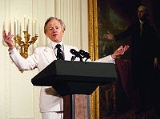
Tom Wolfe

Encyclopedia
Thomas Kennerly "Tom" Wolfe, Jr. (born March 2, 1931) is a best-selling American author
and journalist
. He is one of the founders of the New Journalism
movement of the 1960s and 1970s.
, the son of Louise (née Agnew), a landscape designer, and Thomas Kennerly Wolfe, Sr., an agronomist
.
Wolfe was student council president, editor of the school newspaper and a star baseball
player at St. Christopher's School
, an Episcopalian
all-boys school in Richmond, Virginia.
Upon graduation in 1947, he turned down admission at Princeton University
to attend Washington and Lee University
, both all-male schools at the time. Wolfe majored in English and practiced his writing outside the classroom as well. He was sports editor of the college newspaper and helped found a literary magazine, Shenandoah. Of particular influence was his professor Marshall Fishwick
, a teacher of American Studies educated at Yale. More in the tradition of anthropology than literary scholarship, Fishwick taught his classes to look at the whole of a culture, even those elements considered profane. The very title of Wolfe's undergraduate thesis, "A Zoo Full of Zebras: Anti-Intellectualism in America," evinced his fondness for words and aspirations toward cultural criticism. Wolfe graduated cum laude in 1951.
Wolfe had continued playing baseball as a pitcher and had begun to play semiprofessionally while still in college. In 1952 he earned a tryout with the New York Giants
but was cut after three days, which Wolfe blamed on his inability to throw good fastballs. Wolfe abandoned baseball and instead followed the example of his professor Marshall Fishwick by enrolling in Yale University
's American Studies
doctoral program. His Ph.D.
thesis was entitled The League of American Writers: Communist Organizational Activity Among American Writers, 1929–1942. While the thesis was historical, it was on a literary subject, and for it Wolfe interviewed many of the writers chronicled in his thesis, including Malcolm Cowley
, Archibald MacLeish
, and James T. Farrell
. A biographer remarked on the thesis: "Reading it, one sees what has been the most baleful influence of graduate education on many who have suffered through it: it deadens all sense of style."
. Wolfe finished his thesis in 1957 and in 1959 was hired by The Washington Post
. Wolfe has said that part of the reason he was hired by the Post was his lack of interest in politics. The Post's city editor was "amazed that Wolfe preferred cityside to Capitol Hill, the beat every reporter wanted." He won an award from The Newspaper Guild for foreign reporting in Cuba
in 1961 and also won the Guild's award for humor. While there, he experimented with using fiction-writing techniques in feature stories.
In 1962, Wolfe left Washington for New York City
, taking a position with the New York Herald Tribune
as a general assignment reporter and feature writer. The editors of the Herald Tribune, including Clay Felker
of the Sunday section supplement New York
magazine, encouraged their writers to break the conventions of newspaper writing. During the 1962 New York City newspaper strike
, Wolfe approached Esquire
magazine about an article on the hot rod
and custom car
culture of Southern California
. He struggled with the article until finally a desperate editor, Byron Dobell, suggested that Wolfe send him his notes so they could piece the story together.
Wolfe procrastinated until, on the evening before the article was due, he sat down at his typewriter and banged out a letter to Dobell explaining what he wanted to say on the subject, ignoring all journalistic conventions. Dobell's response was to remove the salutation "Dear Byron" from the top of the letter and publish it intact as reportage. The result, published in 1964, was "There Goes (Varoom! Varoom!) That Kandy-Kolored Tangerine-Flake Streamline Baby." The article was widely discussed—loved by some, hated by others—and helped Wolfe publish his first book, The Kandy-Kolored Tangerine-Flake Streamline Baby
, a collection of his writings in the Herald-Tribune, Esquire, and other publications.
This was what Wolfe called New Journalism
, in which some journalists and essayists experimented with a variety of literary technique
s, mixing them with the traditional ideal of dispassionate, even-handed reporting. One of the most striking examples of this idea is Wolfe's The Electric Kool-Aid Acid Test
. The book, a narrative account of the adventures of the Merry Pranksters
, a famous sixties counter-culture group, was highly experimental in its use of onomatopoeia, free association
, and eccentric use of punctuation—such as multiple exclamation marks and italics—to convey the manic ideas and personalities of Ken Kesey
and his followers.
In addition to his own forays into this new style of journalism, Wolfe edited a collection of New Journalism with E.W. Johnson, published in 1973 and titled simply The New Journalism
. This book brought together pieces from Truman Capote
, Hunter S. Thompson
, Norman Mailer
, Gay Talese
, Joan Didion
, and several other well-known writers with the common theme of journalism that incorporated literary techniques and that could be considered literature.
, and Wolfe's fame grew. A second volume of articles, The Pump House Gang
, followed in 1968. Wolfe wrote on popular culture, architecture, politics, and other topics that underscored, among other things, how American life in the 1960s had been transformed as a result of post-WWII economic prosperity. His defining work from this era is The Electric Kool-Aid Acid Test
(published the same day as The Pump House Gang in 1968), which for many epitomized the decade of the 1960s. Although a conservative in many ways and certainly not a hippie
(in 2008, he claimed never to have used LSD
and to have tried marijuana only once ) Wolfe became one of the notable figures of the decade.
In 1970, he published two essays in book form as Radical Chic & Mau-Mauing the Flak Catchers
: "Radical Chic," a biting account of a party given by Leonard Bernstein
to raise money for the Black Panther Party
, and "Mau-Mauing The Flak Catchers," about the practice of using racial intimidation ("mau-mauing") to extract funds from government welfare bureaucrats ("flak catchers"). The phrase "radical chic
" soon became a popular derogatory term for upper-class leftism
. In 1977, Mauve Gloves & Madmen, Clutter & Vine
hit bookstores, embodying one of Wolfe's more famous essays, "The Me Decade and the Third Great Awakening."
 In 1979, Wolfe published The Right Stuff
, an account of the pilots who became America's first astronauts. Famously following their training and unofficial, even foolhardy, exploits, he likened these heroes to "single combat champions" of a bygone era, going forth to battle in the space race
on behalf of their country. In 1983, the book was adapted as a successful feature film.
and modern architecture
, The Painted Word
and From Bauhaus to Our House
, in 1975 and 1981, respectively. The Painted Word mocked the excessive insularity of the art world and its dependence on faddish critical theory, while From Bauhaus to Our House explored the negative effects of the Bauhaus
style on the evolution of modern architecture.
He has championed the book A Fragile Union by James W. Whitehead, a biography of the early 20th century artist Louise Herreshoff, an eccentric Impressionist painter. In his introduction to the book, Wolfe says that her story would have been envied by Charles Dickens and Edith Wharton.
's Vanity Fair, which described the society of 19th century England. Wolfe remained occupied writing nonfiction books on his own and contributing to Harper's until 1981, when he ceased his other projects to work on the novel.
Wolfe began researching the novel by observing cases at the Manhattan Criminal Court and shadowing members of the Bronx homicide squad. While the research came easily, the writing did not immediately follow. To overcome his writer's block, Wolfe wrote to Jann Wenner
, editor of Rolling Stone
, to propose an idea drawn from Charles Dickens
and Thackeray. The Victorian novelists that Wolfe viewed as his models had often written their novels in serial installments. Wenner offered Wolfe around $200,000 to serialize his work. The deadline pressure gave him the motivation he had hoped for, and from July 1984 to August 1985 each biweekly issue of Rolling Stone contained a new installment. Wolfe was not happy with his "very public first draft" and thoroughly revised his work. Even Sherman McCoy, the central character of the novel, changed: Originally a writer, the book version cast McCoy as a bond salesman. Wolfe researched and revised for two years. The Bonfire of the Vanities
appeared in 1987. The book was a commercial and critical success, spending weeks on bestseller lists and earning praise from much of the literary establishment on which Wolfe had long heaped scorn.
Because of the success of Wolfe's first novel, there was widespread interest in his second work of fiction. This project took him more than 11 years to complete; A Man in Full
was published finally in 1998. The book's reception was not universally favorable, though it received glowing reviews in Time, Newsweek
, and The Wall Street Journal
and elsewhere. An enormous initial printing of 1.2 million copies was announced and the book stayed at number one on the New York Times bestseller list for ten weeks. John Updike
wrote a critical review for The New Yorker in which he wrote that the novel "amounts to Entertainment, not literature, even literature in a modest aspirant form." This touched off an intense war of words in the print and broadcast media between Wolfe and Updike, John Irving
, and Norman Mailer
. In 2001, Wolfe published an essay referring to these three authors as "My Three Stooges."
After publishing Hooking Up
(a collection of short pieces, including the 1997 novella Ambush at Fort Bragg) in 2001, he followed up with his third novel, I Am Charlotte Simmons
(2004), which chronicles the culture clash between a poor, scholarship student from Alleghany County, North Carolina, and the class prejudice, materialism, and sexual promiscuity she finds at a prestigious contemporary American university. The novel met with a mostly tepid response by critics but won praise from many social conservatives, who saw the book's disturbing account of college sexuality as revealing moral decline. The novel won a dubious award from the London-based Literary Review
"to draw attention to the crude, tasteless, often perfunctory use of redundant passages of sexual description in the modern novel," though the author later explained that such sexual references were deliberately clinical.
Wolfe has written that his goal in writing fiction is to document contemporary society in the tradition of John Steinbeck
, Charles Dickens
, and Emile Zola
.
In early 2008, it was announced that Wolfe was leaving his longtime publisher, Farrar, Strauss. His fourth novel, Back to Blood
, is set to be published in 2012 by Little, Brown. According to The New York Times
, Wolfe will be paid close to US$7 million for the book. According to the publisher, Back to Blood will be about "class, family, wealth, race, crime, sex, corruption and ambition in Miami, the city where America's future has arrived first."
, A Man in Full
, and I Am Charlotte Simmons
as well as several of his journalistic pieces. Male characters in his fiction often suffer from feelings of extreme inadequacy or hugely inflated egos, often alternating between both. He often satirizes racial politics, most commonly between whites and blacks; he also frequently highlights class divisions between characters. Men's fashions often play a large part in his stories, being used to indicate economic status. Much of his recent work also addresses neuroscience, a subject which he himself admitted a fascination with in "Sorry, Your Soul Just Died," one of the essays in Hooking Up, and which played a large role in I Am Charlotte Simmons—the title character being a student of neuroscience, and characters' thought processes, such as fear, humiliation and lust, frequently being described in the terminology of brain chemistry. Wolfe's writing also frequently goes into exaggerated detail describing characters' anatomy
.
Two of his novels (A Man in Full and I Am Charlotte Simmons) feature major characters (Conrad Hensley and Jojo Johanssen, respectively) who are set on a path to self-discovery by reading classical Roman and Greek philosophy.
Law and banking firms in Wolfe's writing often have humorous, satirical names formed by the surnames of the partners. "Dunning, Sponget and Leach" and "Curry, Goad and Pesterall" appear in Bonfire of the Vanities, and "Tripp, Snayer and Billings" and "Clockett, Padett, Skynnham and Glote" in A Man in Full. In Ambush at Fort Bragg, there is even a law firm called "Crotalus, Adder, Cobran and Krate" (all names or homophones of poisonous snakes).
Some characters appear in multiple novels, creating a sense of a "universe" that is continuous throughout Wolfe's fiction. The character of Freddy Button, a lawyer from Bonfire of the Vanities, is mentioned briefly in I Am Charlotte Simmons. A character named Ronald Vine, an interior decorator who is mentioned in Bonfire of the Vanities, shows up again in A Man in Full as the designer of Charlie Croker's home.
The surname "Bolka" appears in three Wolfe novels—as the name of a rendering plant in A Man in Full, as a partner in an accounting firm in Bonfire of the Vanities, and as a college lacrosse
player from the Balkans in I Am Charlotte Simmons.
hat, and two-tone shoes. Wolfe has said that the outfit disarms the people he observes, making him, in their eyes, "a man from Mars, the man who didn't know anything and was eager to know."
entitled Stalking the Billion-Footed Beast
, which criticized modern American novelists for failing to engage fully with their subjects, and suggested that modern literature could be saved by a greater reliance on journalistic technique. This essay was seen as an attack on the mainstream literary establishment and a boast that Wolfe's work was superior to more highly-regarded authors.
Wolfe was a supporter of George W. Bush
and voted for him for president in 2004 because of what he called Bush's "great decisiveness and willingness to fight." (Bush apparently reciprocates the admiration, having read all of Wolfe's books, according to friends in 2005.) After this fact emerged in a The New York Times interview, Wolfe said that the reaction in the literary world was as if he had said, "I forgot to tell you—I'm a child molester." Because of this incident, he sometimes wears an American flag pin on his suit, which he compared to "holding up a cross to werewolves."
Wolfe's views and choice of subject material, such as mocking left-wing intellectuals in Radical Chic and glorifying astronauts in The Right Stuff, have sometimes led to him being labeled conservative or reactionary
, and his depiction of the Black Panther Party in Radical Chic led to a member of the party calling him a racist. Wolfe rejects such labels; in a 2004 interview, he said that his "idol" in writing about society and culture is Emile Zola
, who, in Wolfe's words, was "a man of the left" but "went out, and found a lot of ambitious, drunk, slothful and mean people out there. Zola simply could not—and was not interested in—telling a lie."
Asked to comment by the Wall Street Journal on blog
s in 2007 to mark the tenth anniversary of their advent, Wolfe wrote that "the universe of blogs is a universe of rumors" and that "blogs are an advance guard to the rear." He also took the opportunity to criticize Wikipedia
, saying that "only a primitive would believe a word of" it. He noted a story about him in his Wikipedia entry at the time, which he said had never happened.
" as well, but this is incorrect: he described emaciated wives as "X-rays" in his novel The Bonfire of the Vanities but did not use the term "trophy wife". According to journalism professor Ben Yagoda
, Wolfe is also responsible for the use of the present tense
in magazine profile pieces; before he began doing so in the early 1960s, profile articles had always been written in the past tense
.
Author
An author is broadly defined as "the person who originates or gives existence to anything" and that authorship determines responsibility for what is created. Narrowly defined, an author is the originator of any written work.-Legal significance:...
and journalist
Journalist
A journalist collects and distributes news and other information. A journalist's work is referred to as journalism.A reporter is a type of journalist who researchs, writes, and reports on information to be presented in mass media, including print media , electronic media , and digital media A...
. He is one of the founders of the New Journalism
New Journalism
New Journalism was a style of 1960s and 1970s news writing and journalism which used literary techniques deemed unconventional at the time. The term was codified with its current meaning by Tom Wolfe in a 1973 collection of journalism articles he published as The New Journalism, which included...
movement of the 1960s and 1970s.
Early life and education
Wolfe was born in Richmond, VirginiaRichmond, Virginia
Richmond is the capital of the Commonwealth of Virginia, in the United States. It is an independent city and not part of any county. Richmond is the center of the Richmond Metropolitan Statistical Area and the Greater Richmond area...
, the son of Louise (née Agnew), a landscape designer, and Thomas Kennerly Wolfe, Sr., an agronomist
Agronomy
Agronomy is the science and technology of producing and using plants for food, fuel, feed, fiber, and reclamation. Agronomy encompasses work in the areas of plant genetics, plant physiology, meteorology, and soil science. Agronomy is the application of a combination of sciences like biology,...
.
Wolfe was student council president, editor of the school newspaper and a star baseball
Baseball
Baseball is a bat-and-ball sport played between two teams of nine players each. The aim is to score runs by hitting a thrown ball with a bat and touching a series of four bases arranged at the corners of a ninety-foot diamond...
player at St. Christopher's School
St. Christopher's School, Richmond
St. Christopher’s School, founded in 1911, is a college preparatory school for boys located in Richmond, Virginia. A program of coordination with nearby St. Catherine's School allows a broader selection of courses at the Upper School level, taught in coeducational classes on both campuses...
, an Episcopalian
Episcopal Church (United States)
The Episcopal Church is a mainline Anglican Christian church found mainly in the United States , but also in Honduras, Taiwan, Colombia, Ecuador, Haiti, the Dominican Republic, Venezuela, the British Virgin Islands and parts of Europe...
all-boys school in Richmond, Virginia.
Upon graduation in 1947, he turned down admission at Princeton University
Princeton University
Princeton University is a private research university located in Princeton, New Jersey, United States. The school is one of the eight universities of the Ivy League, and is one of the nine Colonial Colleges founded before the American Revolution....
to attend Washington and Lee University
Washington and Lee University
Washington and Lee University is a private liberal arts college in Lexington, Virginia, United States.The classical school from which Washington and Lee descended was established in 1749 as Augusta Academy, about north of its present location. In 1776 it was renamed Liberty Hall in a burst of...
, both all-male schools at the time. Wolfe majored in English and practiced his writing outside the classroom as well. He was sports editor of the college newspaper and helped found a literary magazine, Shenandoah. Of particular influence was his professor Marshall Fishwick
Marshall Fishwick
Marshall Fishwick was a multidisciplinary scholar, professor, writer, and editor who started the academic movement known as popular culture studies and established the journal International Popular Culture. In 1970 he cofounded the Popular Culture Association with Ray B. Browne and Russel B...
, a teacher of American Studies educated at Yale. More in the tradition of anthropology than literary scholarship, Fishwick taught his classes to look at the whole of a culture, even those elements considered profane. The very title of Wolfe's undergraduate thesis, "A Zoo Full of Zebras: Anti-Intellectualism in America," evinced his fondness for words and aspirations toward cultural criticism. Wolfe graduated cum laude in 1951.
Wolfe had continued playing baseball as a pitcher and had begun to play semiprofessionally while still in college. In 1952 he earned a tryout with the New York Giants
San Francisco Giants
The San Francisco Giants are a Major League Baseball team based in San Francisco, California, playing in the National League West Division....
but was cut after three days, which Wolfe blamed on his inability to throw good fastballs. Wolfe abandoned baseball and instead followed the example of his professor Marshall Fishwick by enrolling in Yale University
Yale University
Yale University is a private, Ivy League university located in New Haven, Connecticut, United States. Founded in 1701 in the Colony of Connecticut, the university is the third-oldest institution of higher education in the United States...
's American Studies
American studies
American studies or American civilization is an interdisciplinary field dealing with the study of the United States. It traditionally incorporates the study of history, literature, and critical theory, but also includes fields as diverse as law, art, the media, film, religious studies, urban...
doctoral program. His Ph.D.
Ph.D.
A Ph.D. is a Doctor of Philosophy, an academic degree.Ph.D. may also refer to:* Ph.D. , a 1980s British group*Piled Higher and Deeper, a web comic strip*PhD: Phantasy Degree, a Korean comic series* PhD Docbook renderer, an XML renderer...
thesis was entitled The League of American Writers: Communist Organizational Activity Among American Writers, 1929–1942. While the thesis was historical, it was on a literary subject, and for it Wolfe interviewed many of the writers chronicled in his thesis, including Malcolm Cowley
Malcolm Cowley
Malcolm Cowley was an American novelist, poet, literary critic, and journalist.-Early life:...
, Archibald MacLeish
Archibald MacLeish
Archibald MacLeish was an American poet, writer, and the Librarian of Congress. He is associated with the Modernist school of poetry. He received three Pulitzer Prizes for his work.-Early years:...
, and James T. Farrell
James T. Farrell
James Thomas Farrell was an American novelist. One of his most famous works was the Studs Lonigan trilogy, which was made into a film in 1960 and into a television miniseries in 1979...
. A biographer remarked on the thesis: "Reading it, one sees what has been the most baleful influence of graduate education on many who have suffered through it: it deadens all sense of style."
Journalism and New Journalism
Though Wolfe was offered teaching jobs in academia, he opted to work as a reporter. In 1956, while still working on his thesis, Wolfe became a reporter for the Springfield Union in Springfield, MassachusettsSpringfield, Massachusetts
Springfield is the most populous city in Western New England, and the seat of Hampden County, Massachusetts, United States. Springfield sits on the eastern bank of the Connecticut River near its confluence with three rivers; the western Westfield River, the eastern Chicopee River, and the eastern...
. Wolfe finished his thesis in 1957 and in 1959 was hired by The Washington Post
The Washington Post
The Washington Post is Washington, D.C.'s largest newspaper and its oldest still-existing paper, founded in 1877. Located in the capital of the United States, The Post has a particular emphasis on national politics. D.C., Maryland, and Virginia editions are printed for daily circulation...
. Wolfe has said that part of the reason he was hired by the Post was his lack of interest in politics. The Post's city editor was "amazed that Wolfe preferred cityside to Capitol Hill, the beat every reporter wanted." He won an award from The Newspaper Guild for foreign reporting in Cuba
Cuba
The Republic of Cuba is an island nation in the Caribbean. The nation of Cuba consists of the main island of Cuba, the Isla de la Juventud, and several archipelagos. Havana is the largest city in Cuba and the country's capital. Santiago de Cuba is the second largest city...
in 1961 and also won the Guild's award for humor. While there, he experimented with using fiction-writing techniques in feature stories.
In 1962, Wolfe left Washington for New York City
New York City
New York is the most populous city in the United States and the center of the New York Metropolitan Area, one of the most populous metropolitan areas in the world. New York exerts a significant impact upon global commerce, finance, media, art, fashion, research, technology, education, and...
, taking a position with the New York Herald Tribune
New York Herald Tribune
The New York Herald Tribune was a daily newspaper created in 1924 when the New York Tribune acquired the New York Herald.Other predecessors, which had earlier merged into the New York Tribune, included the original The New Yorker newsweekly , and the Whig Party's Log Cabin.The paper was home to...
as a general assignment reporter and feature writer. The editors of the Herald Tribune, including Clay Felker
Clay Felker
Clay Schuette Felker was an American magazine editor and journalist who founded New York Magazine in 1968. He was known for bringing large numbers of journalists into the profession...
of the Sunday section supplement New York
New York (magazine)
New York is a weekly magazine principally concerned with the life, culture, politics, and style of New York City. Founded by Milton Glaser and Clay Felker in 1968 as a competitor to The New Yorker, it was brasher and less polite than that magazine, and established itself as a cradle of New...
magazine, encouraged their writers to break the conventions of newspaper writing. During the 1962 New York City newspaper strike
1962 New York City newspaper strike
The 1962-63 New York City Newspaper Strike ran from December 8, 1962 until March 31, 1963, lasting for a total of 114 days.-Preliminary actions:...
, Wolfe approached Esquire
Esquire (magazine)
Esquire is a men's magazine, published in the U.S. by the Hearst Corporation. Founded in 1932, it flourished during the Great Depression under the guidance of founder and editor Arnold Gingrich.-History:...
magazine about an article on the hot rod
Hot rod
Hot rods are typically American cars with large engines modified for linear speed. The origin of the term "hot rod" is unclear. One explanation is that the term is a contraction of "hot roadster," meaning a roadster that was modified for speed. Another possible origin includes modifications to or...
and custom car
Custom car
A custom car is a passenger vehicle that has been modified in either of the following two ways. First, a custom car may be altered to improve its performance, often by altering or replacing the engine and transmission. Second, a custom car may be a personal "styling" statement, making the car look...
culture of Southern California
Southern California
Southern California is a megaregion, or megapolitan area, in the southern area of the U.S. state of California. Large urban areas include Greater Los Angeles and Greater San Diego. The urban area stretches along the coast from Ventura through the Southland and Inland Empire to San Diego...
. He struggled with the article until finally a desperate editor, Byron Dobell, suggested that Wolfe send him his notes so they could piece the story together.
Wolfe procrastinated until, on the evening before the article was due, he sat down at his typewriter and banged out a letter to Dobell explaining what he wanted to say on the subject, ignoring all journalistic conventions. Dobell's response was to remove the salutation "Dear Byron" from the top of the letter and publish it intact as reportage. The result, published in 1964, was "There Goes (Varoom! Varoom!) That Kandy-Kolored Tangerine-Flake Streamline Baby." The article was widely discussed—loved by some, hated by others—and helped Wolfe publish his first book, The Kandy-Kolored Tangerine-Flake Streamline Baby
The Kandy-Kolored Tangerine-Flake Streamline Baby
The Kandy-Kolored Tangerine-Flake Streamline Baby is the title of Tom Wolfe's first collected book of essays, published in 1965...
, a collection of his writings in the Herald-Tribune, Esquire, and other publications.
This was what Wolfe called New Journalism
New Journalism
New Journalism was a style of 1960s and 1970s news writing and journalism which used literary techniques deemed unconventional at the time. The term was codified with its current meaning by Tom Wolfe in a 1973 collection of journalism articles he published as The New Journalism, which included...
, in which some journalists and essayists experimented with a variety of literary technique
Literary technique
A literary technique is any element or the entirety of elements a writer intentionally uses in the structure of their work...
s, mixing them with the traditional ideal of dispassionate, even-handed reporting. One of the most striking examples of this idea is Wolfe's The Electric Kool-Aid Acid Test
The Electric Kool-Aid Acid Test
The Electric Kool-Aid Acid Test is a work of literary journalism by Tom Wolfe, published in 1968. Using techniques from the genre of hysterical realism and pioneering new journalism, the "nonfiction novel" tells the story of Ken Kesey and his band of Merry Pranksters...
. The book, a narrative account of the adventures of the Merry Pranksters
Merry Pranksters
The Merry Pranksters were a group of people who formed around American author Ken Kesey in 1964 and sometimes lived communally at his homes in California and Oregon...
, a famous sixties counter-culture group, was highly experimental in its use of onomatopoeia, free association
Free association
Free association may refer to:*Free association , a clinical technique of psychoanalysis devised by Sigmund Freud*Free Association, a musical group formed by David Holmes for the Code 46 soundtrack...
, and eccentric use of punctuation—such as multiple exclamation marks and italics—to convey the manic ideas and personalities of Ken Kesey
Ken Kesey
Kenneth Elton "Ken" Kesey was an American author, best known for his novel One Flew Over the Cuckoo's Nest , and as a counter-cultural figure who considered himself a link between the Beat Generation of the 1950s and the hippies of the 1960s. "I was too young to be a beatnik, and too old to be a...
and his followers.
In addition to his own forays into this new style of journalism, Wolfe edited a collection of New Journalism with E.W. Johnson, published in 1973 and titled simply The New Journalism
The New Journalism
The New Journalism is a 1973 anthology of journalism edited by Tom Wolfe and E. W. Johnson. The book is both a manifesto for a new type of journalism by Wolfe, and a collection of examples of New Journalism by American writers, covering a variety of subjects from the frivolous to the deadly serious...
. This book brought together pieces from Truman Capote
Truman Capote
Truman Streckfus Persons , known as Truman Capote , was an American author, many of whose short stories, novels, plays, and nonfiction are recognized literary classics, including the novella Breakfast at Tiffany's and the true crime novel In Cold Blood , which he labeled a "nonfiction novel." At...
, Hunter S. Thompson
Hunter S. Thompson
Hunter Stockton Thompson was an American journalist and author who wrote The Rum Diary , Fear and Loathing in Las Vegas and Fear and Loathing on the Campaign Trail '72 .He is credited as the creator of Gonzo journalism, a style of reporting where reporters involve themselves in the action to...
, Norman Mailer
Norman Mailer
Norman Kingsley Mailer was an American novelist, journalist, essayist, poet, playwright, screenwriter, and film director.Along with Truman Capote, Joan Didion, Hunter S...
, Gay Talese
Gay Talese
Gay Talese is an American author. He wrote for The New York Times in the early 1960s and helped to define literary journalism...
, Joan Didion
Joan Didion
Joan Didion is an American author best known for her novels and her literary journalism. Her novels and essays explore the disintegration of American morals and cultural chaos, where the overriding theme is individual and social fragmentation...
, and several other well-known writers with the common theme of journalism that incorporated literary techniques and that could be considered literature.
Non-fiction books
In 1965, a collection of his articles in this style was published under the title The Kandy-Kolored Tangerine-Flake Streamline BabyThe Kandy-Kolored Tangerine-Flake Streamline Baby
The Kandy-Kolored Tangerine-Flake Streamline Baby is the title of Tom Wolfe's first collected book of essays, published in 1965...
, and Wolfe's fame grew. A second volume of articles, The Pump House Gang
The Pump House Gang
The Pump House Gang is a 1968 collection of essays and journalism by Tom Wolfe. The stories in the book explored various aspects of the counterculture of the 1960s...
, followed in 1968. Wolfe wrote on popular culture, architecture, politics, and other topics that underscored, among other things, how American life in the 1960s had been transformed as a result of post-WWII economic prosperity. His defining work from this era is The Electric Kool-Aid Acid Test
The Electric Kool-Aid Acid Test
The Electric Kool-Aid Acid Test is a work of literary journalism by Tom Wolfe, published in 1968. Using techniques from the genre of hysterical realism and pioneering new journalism, the "nonfiction novel" tells the story of Ken Kesey and his band of Merry Pranksters...
(published the same day as The Pump House Gang in 1968), which for many epitomized the decade of the 1960s. Although a conservative in many ways and certainly not a hippie
Hippie
The hippie subculture was originally a youth movement that arose in the United States during the mid-1960s and spread to other countries around the world. The etymology of the term 'hippie' is from hipster, and was initially used to describe beatniks who had moved into San Francisco's...
(in 2008, he claimed never to have used LSD
LSD
Lysergic acid diethylamide, abbreviated LSD or LSD-25, also known as lysergide and colloquially as acid, is a semisynthetic psychedelic drug of the ergoline family, well known for its psychological effects which can include altered thinking processes, closed and open eye visuals, synaesthesia, an...
and to have tried marijuana only once ) Wolfe became one of the notable figures of the decade.
In 1970, he published two essays in book form as Radical Chic & Mau-Mauing the Flak Catchers
Radical Chic & Mau-Mauing the Flak Catchers
Radical Chic & Mau-Mauing the Flak Catchers is a 1970 book by Tom Wolfe. The book, Wolfe's fourth, is composed of two articles by Wolfe, "These Radical Chic Evenings," first published in June of 1970 in New York magazine, about a gathering Leonard Bernstein held for the Black Panther Party and...
: "Radical Chic," a biting account of a party given by Leonard Bernstein
Leonard Bernstein
Leonard Bernstein August 25, 1918 – October 14, 1990) was an American conductor, composer, author, music lecturer and pianist. He was among the first conductors born and educated in the United States of America to receive worldwide acclaim...
to raise money for the Black Panther Party
Black Panther Party
The Black Panther Party wasan African-American revolutionary leftist organization. It was active in the United States from 1966 until 1982....
, and "Mau-Mauing The Flak Catchers," about the practice of using racial intimidation ("mau-mauing") to extract funds from government welfare bureaucrats ("flak catchers"). The phrase "radical chic
Radical chic
Radical chic is a term coined by journalist Tom Wolfe in his 1970 essay "Radical Chic: That Party at Lenny's," to describe the adoption and promotion of radical political causes by celebrities, socialites, and high society...
" soon became a popular derogatory term for upper-class leftism
Left-wing politics
In politics, Left, left-wing and leftist generally refer to support for social change to create a more egalitarian society...
. In 1977, Mauve Gloves & Madmen, Clutter & Vine
Mauve Gloves & Madmen, Clutter & Vine
Mauve Gloves & Madmen, Clutter & Vine is a 1976 book by Tom Wolfe, consisting of eleven essays and one short story that Wolfe wrote between 1967 and 1976. It includes the essay in which he coined the term "Me Decade" to refer to the 1970s...
hit bookstores, embodying one of Wolfe's more famous essays, "The Me Decade and the Third Great Awakening."
The Right Stuff (book)
The Right Stuff is a 1979 book by Tom Wolfe about the pilots engaged in U.S. postwar experiments with experimental rocket-powered, high-speed aircraft as well as documenting the stories of the first Project Mercury astronauts selected for the NASA space program...
, an account of the pilots who became America's first astronauts. Famously following their training and unofficial, even foolhardy, exploits, he likened these heroes to "single combat champions" of a bygone era, going forth to battle in the space race
Space Race
The Space Race was a mid-to-late 20th century competition between the Soviet Union and the United States for supremacy in space exploration. Between 1957 and 1975, Cold War rivalry between the two nations focused on attaining firsts in space exploration, which were seen as necessary for national...
on behalf of their country. In 1983, the book was adapted as a successful feature film.
Art critiques
Wolfe also wrote two highly critical social histories of modern artModern art
Modern art includes artistic works produced during the period extending roughly from the 1860s to the 1970s, and denotes the style and philosophy of the art produced during that era. The term is usually associated with art in which the traditions of the past have been thrown aside in a spirit of...
and modern architecture
Modern architecture
Modern architecture is generally characterized by simplification of form and creation of ornament from the structure and theme of the building. It is a term applied to an overarching movement, with its exact definition and scope varying widely...
, The Painted Word
The Painted Word
- Background :By the 1970s Wolfe was, according to Douglas Davis of Newsweek magazine "more of a celebrity than the celebrities he describes." The success of Wolfe's previous books, in particular The Electric Kool-Aid Acid Test in 1968 and Radical Chic & Mau-Mauing the Flak Catchers in 1970, had...
and From Bauhaus to Our House
From Bauhaus to Our House
From Bauhaus to Our House is a 1981 narrative of Modern architecture, written by Tom Wolfe.- Background :In 1975 Wolfe made his first foray into art criticism with The Painted Word, in which he argued that art theory had become too pervasive because the art world was controlled by a small elitist...
, in 1975 and 1981, respectively. The Painted Word mocked the excessive insularity of the art world and its dependence on faddish critical theory, while From Bauhaus to Our House explored the negative effects of the Bauhaus
Bauhaus
', commonly known simply as Bauhaus, was a school in Germany that combined crafts and the fine arts, and was famous for the approach to design that it publicized and taught. It operated from 1919 to 1933. At that time the German term stood for "School of Building".The Bauhaus school was founded by...
style on the evolution of modern architecture.
He has championed the book A Fragile Union by James W. Whitehead, a biography of the early 20th century artist Louise Herreshoff, an eccentric Impressionist painter. In his introduction to the book, Wolfe says that her story would have been envied by Charles Dickens and Edith Wharton.
Novels
Throughout his early career, Wolfe had planned to write a novel that would capture the wide spectrum of American society. Among his models was William Makepeace ThackerayWilliam Makepeace Thackeray
William Makepeace Thackeray was an English novelist of the 19th century. He was famous for his satirical works, particularly Vanity Fair, a panoramic portrait of English society.-Biography:...
's Vanity Fair, which described the society of 19th century England. Wolfe remained occupied writing nonfiction books on his own and contributing to Harper's until 1981, when he ceased his other projects to work on the novel.
Wolfe began researching the novel by observing cases at the Manhattan Criminal Court and shadowing members of the Bronx homicide squad. While the research came easily, the writing did not immediately follow. To overcome his writer's block, Wolfe wrote to Jann Wenner
Jann Wenner
Jann Simon Wenner is the co-founder and publisher of the music and politics biweekly Rolling Stone, as well as the owner of Men's Journal and Us Weekly magazines.-Childhood:...
, editor of Rolling Stone
Rolling Stone
Rolling Stone is a US-based magazine devoted to music, liberal politics, and popular culture that is published every two weeks. Rolling Stone was founded in San Francisco in 1967 by Jann Wenner and music critic Ralph J...
, to propose an idea drawn from Charles Dickens
Charles Dickens
Charles John Huffam Dickens was an English novelist, generally considered the greatest of the Victorian period. Dickens enjoyed a wider popularity and fame than had any previous author during his lifetime, and he remains popular, having been responsible for some of English literature's most iconic...
and Thackeray. The Victorian novelists that Wolfe viewed as his models had often written their novels in serial installments. Wenner offered Wolfe around $200,000 to serialize his work. The deadline pressure gave him the motivation he had hoped for, and from July 1984 to August 1985 each biweekly issue of Rolling Stone contained a new installment. Wolfe was not happy with his "very public first draft" and thoroughly revised his work. Even Sherman McCoy, the central character of the novel, changed: Originally a writer, the book version cast McCoy as a bond salesman. Wolfe researched and revised for two years. The Bonfire of the Vanities
The Bonfire of the Vanities
The Bonfire of the Vanities is a 1987 novel by Tom Wolfe. The story is a drama about ambition, racism, social class, politics, and greed in 1980s New York City and centers on four main characters: WASP bond trader Sherman McCoy, Jewish assistant district attorney Larry Kramer, British expatriate...
appeared in 1987. The book was a commercial and critical success, spending weeks on bestseller lists and earning praise from much of the literary establishment on which Wolfe had long heaped scorn.
Because of the success of Wolfe's first novel, there was widespread interest in his second work of fiction. This project took him more than 11 years to complete; A Man in Full
A Man in Full
A Man in Full is a novel by Tom Wolfe, published in 1998 by Farrar, Straus & Giroux. It is set primarily in Atlanta.-Summary:As with Wolfe's other novels, A Man In Full features a number of point-of-view characters...
was published finally in 1998. The book's reception was not universally favorable, though it received glowing reviews in Time, Newsweek
Newsweek
Newsweek is an American weekly news magazine published in New York City. It is distributed throughout the United States and internationally. It is the second-largest news weekly magazine in the U.S., having trailed Time in circulation and advertising revenue for most of its existence...
, and The Wall Street Journal
The Wall Street Journal
The Wall Street Journal is an American English-language international daily newspaper. It is published in New York City by Dow Jones & Company, a division of News Corporation, along with the Asian and European editions of the Journal....
and elsewhere. An enormous initial printing of 1.2 million copies was announced and the book stayed at number one on the New York Times bestseller list for ten weeks. John Updike
John Updike
John Hoyer Updike was an American novelist, poet, short story writer, art critic, and literary critic....
wrote a critical review for The New Yorker in which he wrote that the novel "amounts to Entertainment, not literature, even literature in a modest aspirant form." This touched off an intense war of words in the print and broadcast media between Wolfe and Updike, John Irving
John Irving
John Winslow Irving is an American novelist and Academy Award-winning screenwriter.Irving achieved critical and popular acclaim after the international success of The World According to Garp in 1978...
, and Norman Mailer
Norman Mailer
Norman Kingsley Mailer was an American novelist, journalist, essayist, poet, playwright, screenwriter, and film director.Along with Truman Capote, Joan Didion, Hunter S...
. In 2001, Wolfe published an essay referring to these three authors as "My Three Stooges."
After publishing Hooking Up
Hooking Up
Hooking Up is a collection of essays and short stories by American author Tom Wolfe, a number of which were earlier published in popular magazines....
(a collection of short pieces, including the 1997 novella Ambush at Fort Bragg) in 2001, he followed up with his third novel, I Am Charlotte Simmons
I Am Charlotte Simmons
I Am Charlotte Simmons is a 2004 novel by Tom Wolfe, concerning sexual and status relationships at the fictional Dupont University, closely modeled after Duke University, the University of Pennsylvania and Stanford University...
(2004), which chronicles the culture clash between a poor, scholarship student from Alleghany County, North Carolina, and the class prejudice, materialism, and sexual promiscuity she finds at a prestigious contemporary American university. The novel met with a mostly tepid response by critics but won praise from many social conservatives, who saw the book's disturbing account of college sexuality as revealing moral decline. The novel won a dubious award from the London-based Literary Review
Literary Review
Literary Review is a British literary magazine founded in 1979 by Anne Smith, then head of the Department of English at Edinburgh University. Its offices are currently on Lexington Street in Soho, London, and it has a circulation of 44,750. Britain's principal literary monthly, the magazine was...
"to draw attention to the crude, tasteless, often perfunctory use of redundant passages of sexual description in the modern novel," though the author later explained that such sexual references were deliberately clinical.
Wolfe has written that his goal in writing fiction is to document contemporary society in the tradition of John Steinbeck
John Steinbeck
John Ernst Steinbeck, Jr. was an American writer. He is widely known for the Pulitzer Prize-winning novel The Grapes of Wrath and East of Eden and the novella Of Mice and Men...
, Charles Dickens
Charles Dickens
Charles John Huffam Dickens was an English novelist, generally considered the greatest of the Victorian period. Dickens enjoyed a wider popularity and fame than had any previous author during his lifetime, and he remains popular, having been responsible for some of English literature's most iconic...
, and Emile Zola
Émile Zola
Émile François Zola was a French writer, the most important exemplar of the literary school of naturalism and an important contributor to the development of theatrical naturalism...
.
In early 2008, it was announced that Wolfe was leaving his longtime publisher, Farrar, Strauss. His fourth novel, Back to Blood
Back to Blood
Back to Blood is the working title of Tom Wolfe's fourth novel, to be published by Little, Brown. The novel, to be set in Miami, will focus on the subject of immigration.- Background :...
, is set to be published in 2012 by Little, Brown. According to The New York Times
The New York Times
The New York Times is an American daily newspaper founded and continuously published in New York City since 1851. The New York Times has won 106 Pulitzer Prizes, the most of any news organization...
, Wolfe will be paid close to US$7 million for the book. According to the publisher, Back to Blood will be about "class, family, wealth, race, crime, sex, corruption and ambition in Miami, the city where America's future has arrived first."
Recurring themes
There are several themes which are shared throughout much of Wolfe's writing, including his novels. One such theme is male power jockeying, which is a major part of The Bonfire of the VanitiesThe Bonfire of the Vanities
The Bonfire of the Vanities is a 1987 novel by Tom Wolfe. The story is a drama about ambition, racism, social class, politics, and greed in 1980s New York City and centers on four main characters: WASP bond trader Sherman McCoy, Jewish assistant district attorney Larry Kramer, British expatriate...
, A Man in Full
A Man in Full
A Man in Full is a novel by Tom Wolfe, published in 1998 by Farrar, Straus & Giroux. It is set primarily in Atlanta.-Summary:As with Wolfe's other novels, A Man In Full features a number of point-of-view characters...
, and I Am Charlotte Simmons
I Am Charlotte Simmons
I Am Charlotte Simmons is a 2004 novel by Tom Wolfe, concerning sexual and status relationships at the fictional Dupont University, closely modeled after Duke University, the University of Pennsylvania and Stanford University...
as well as several of his journalistic pieces. Male characters in his fiction often suffer from feelings of extreme inadequacy or hugely inflated egos, often alternating between both. He often satirizes racial politics, most commonly between whites and blacks; he also frequently highlights class divisions between characters. Men's fashions often play a large part in his stories, being used to indicate economic status. Much of his recent work also addresses neuroscience, a subject which he himself admitted a fascination with in "Sorry, Your Soul Just Died," one of the essays in Hooking Up, and which played a large role in I Am Charlotte Simmons—the title character being a student of neuroscience, and characters' thought processes, such as fear, humiliation and lust, frequently being described in the terminology of brain chemistry. Wolfe's writing also frequently goes into exaggerated detail describing characters' anatomy
Anatomy
Anatomy is a branch of biology and medicine that is the consideration of the structure of living things. It is a general term that includes human anatomy, animal anatomy , and plant anatomy...
.
Two of his novels (A Man in Full and I Am Charlotte Simmons) feature major characters (Conrad Hensley and Jojo Johanssen, respectively) who are set on a path to self-discovery by reading classical Roman and Greek philosophy.
Law and banking firms in Wolfe's writing often have humorous, satirical names formed by the surnames of the partners. "Dunning, Sponget and Leach" and "Curry, Goad and Pesterall" appear in Bonfire of the Vanities, and "Tripp, Snayer and Billings" and "Clockett, Padett, Skynnham and Glote" in A Man in Full. In Ambush at Fort Bragg, there is even a law firm called "Crotalus, Adder, Cobran and Krate" (all names or homophones of poisonous snakes).
Some characters appear in multiple novels, creating a sense of a "universe" that is continuous throughout Wolfe's fiction. The character of Freddy Button, a lawyer from Bonfire of the Vanities, is mentioned briefly in I Am Charlotte Simmons. A character named Ronald Vine, an interior decorator who is mentioned in Bonfire of the Vanities, shows up again in A Man in Full as the designer of Charlie Croker's home.
The surname "Bolka" appears in three Wolfe novels—as the name of a rendering plant in A Man in Full, as a partner in an accounting firm in Bonfire of the Vanities, and as a college lacrosse
Lacrosse
Lacrosse is a team sport of Native American origin played using a small rubber ball and a long-handled stick called a crosse or lacrosse stick, mainly played in the United States and Canada. It is a contact sport which requires padding. The head of the lacrosse stick is strung with loose mesh...
player from the Balkans in I Am Charlotte Simmons.
The White Suit
Wolfe adopted the white suit as a trademark in 1962. He bought his first white suit planning to wear it in the summer in the style of Southern gentlemen. The suit he purchased, however, was too heavy in the summer for his tastes and so he wore it in winter instead. He found wearing the suit in the winter created a sensation and adopted it as his trademark. Wolfe has maintained the uniform ever since, sometimes worn with a matching white tie, white homburgHomburg (hat)
A homburg is a felt hat, a Tyrolean hat-style fedora, characterized by a single dent running down the center of the crown and a stiff brim shaped in a "kettle curl". The Homburg is a stiff, formal felt hat....
hat, and two-tone shoes. Wolfe has said that the outfit disarms the people he observes, making him, in their eyes, "a man from Mars, the man who didn't know anything and was eager to know."
Views
In 1989, Wolfe wrote an essay for Harper's MagazineHarper's Magazine
Harper's Magazine is a monthly magazine of literature, politics, culture, finance, and the arts, with a generally left-wing perspective. It is the second-oldest continuously published monthly magazine in the U.S. . The current editor is Ellen Rosenbush, who replaced Roger Hodge in January 2010...
entitled Stalking the Billion-Footed Beast
Stalking the Billion-Footed Beast
Stalking the Billion-Footed Beast is an essay by Tom Wolfe that appeared in the November 1989 issue of Harper's Magazine criticizing the American literary establishment for retreating from realism.- Background :...
, which criticized modern American novelists for failing to engage fully with their subjects, and suggested that modern literature could be saved by a greater reliance on journalistic technique. This essay was seen as an attack on the mainstream literary establishment and a boast that Wolfe's work was superior to more highly-regarded authors.
Wolfe was a supporter of George W. Bush
George W. Bush
George Walker Bush is an American politician who served as the 43rd President of the United States, from 2001 to 2009. Before that, he was the 46th Governor of Texas, having served from 1995 to 2000....
and voted for him for president in 2004 because of what he called Bush's "great decisiveness and willingness to fight." (Bush apparently reciprocates the admiration, having read all of Wolfe's books, according to friends in 2005.) After this fact emerged in a The New York Times interview, Wolfe said that the reaction in the literary world was as if he had said, "I forgot to tell you—I'm a child molester." Because of this incident, he sometimes wears an American flag pin on his suit, which he compared to "holding up a cross to werewolves."
Wolfe's views and choice of subject material, such as mocking left-wing intellectuals in Radical Chic and glorifying astronauts in The Right Stuff, have sometimes led to him being labeled conservative or reactionary
Reactionary
The term reactionary refers to viewpoints that seek to return to a previous state in a society. The term is meant to describe one end of a political spectrum whose opposite pole is "radical". While it has not been generally considered a term of praise it has been adopted as a self-description by...
, and his depiction of the Black Panther Party in Radical Chic led to a member of the party calling him a racist. Wolfe rejects such labels; in a 2004 interview, he said that his "idol" in writing about society and culture is Emile Zola
Émile Zola
Émile François Zola was a French writer, the most important exemplar of the literary school of naturalism and an important contributor to the development of theatrical naturalism...
, who, in Wolfe's words, was "a man of the left" but "went out, and found a lot of ambitious, drunk, slothful and mean people out there. Zola simply could not—and was not interested in—telling a lie."
Asked to comment by the Wall Street Journal on blog
Blog
A blog is a type of website or part of a website supposed to be updated with new content from time to time. Blogs are usually maintained by an individual with regular entries of commentary, descriptions of events, or other material such as graphics or video. Entries are commonly displayed in...
s in 2007 to mark the tenth anniversary of their advent, Wolfe wrote that "the universe of blogs is a universe of rumors" and that "blogs are an advance guard to the rear." He also took the opportunity to criticize Wikipedia
Wikipedia
Wikipedia is a free, web-based, collaborative, multilingual encyclopedia project supported by the non-profit Wikimedia Foundation. Its 20 million articles have been written collaboratively by volunteers around the world. Almost all of its articles can be edited by anyone with access to the site,...
, saying that "only a primitive would believe a word of" it. He noted a story about him in his Wikipedia entry at the time, which he said had never happened.
Personal Life
Wolfe lives in New York City with his wife, Sheila; his daughter, Alexandra; and his son, Tommy. Wolfe is an atheist.Influence
Wolfe is credited with introducing the terms "statusphere," "the right stuff," "radical chic," "the Me Decade," "social x-ray," and "good ol' boy" into the English lexicon. He is sometimes credited with inventing the term "trophy wifeTrophy wife
Trophy wife is an expression used to describe a wife, usually young and attractive, who is regarded as a status symbol for the husband, who is often older and affluent.-History:The term's etymological origins are disputed...
" as well, but this is incorrect: he described emaciated wives as "X-rays" in his novel The Bonfire of the Vanities but did not use the term "trophy wife". According to journalism professor Ben Yagoda
Ben Yagoda
Ben Yagoda is a professor of journalism and English at the University of Delaware.Born to Louis Yagoda and the former Harriet Lewis, he grew up in New Rochelle, New York, and entered Yale University to study English in 1971...
, Wolfe is also responsible for the use of the present tense
Present tense
The present tense is a grammatical tense that locates a situation or event in present time. This linguistic definition refers to a concept that indicates a feature of the meaning of a verb...
in magazine profile pieces; before he began doing so in the early 1960s, profile articles had always been written in the past tense
Past tense
The past tense is a grammatical tense that places an action or situation in the past of the current moment , or prior to some specified time that may be in the speaker's past, present, or future...
.
List of Awards
- 1961 Washington Newspaper Guild Award for Foreign News Reporting
- 1961 Washington Newspaper Guild Awards for Humor
- 1970 Society of Magazine Writers Award for Excellence
- 1971 D.F.A., Minneapolis College of Art
- 1973 Frank Luther Mott Research Award
- 1974 D.Litt., Washington and Lee UniversityWashington and Lee UniversityWashington and Lee University is a private liberal arts college in Lexington, Virginia, United States.The classical school from which Washington and Lee descended was established in 1749 as Augusta Academy, about north of its present location. In 1776 it was renamed Liberty Hall in a burst of...
- 1977 Virginia Laureate for literature
- 1980 American Book AwardAmerican Book AwardThe American Book Award was established in 1978 by the Before Columbus Foundation. It seeks to recognize outstanding literary achievement by contemporary American authors, without restriction to race, sex, ethnic background, or genre...
for The Right Stuff - 1980 National Book AwardNational Book AwardThe National Book Awards are a set of American literary awards. Started in 1950, the Awards are presented annually to American authors for literature published in the current year. In 1989 the National Book Foundation, a nonprofit organization which now oversees and manages the National Book...
for The Right Stuff - 1980 Columbia Journalism Award for The Right Stuff
- 1980 Harold D. Vursell Memorial Award of the American Institute of Arts and Letters
- 1980 Art History Citation from the National Sculpture SocietyNational Sculpture SocietyFounded in 1893, the National Sculpture Society was the first organization of professional sculptors formed in the United States. The purpose of the organization was to promote the welfare of American sculptors, although its founding members included several renowned architects. The founding...
- 1983 L.H.D., Virginia Commonwealth UniversityVirginia Commonwealth UniversityVirginia Commonwealth University is a public university located in Richmond, Virginia. It comprises two campuses in the Downtown Richmond area, the product of a merger between the Richmond Professional Institute and the Medical College of Virginia in 1968...
- 1984 L.H.D., Southampton CollegeSouthampton CollegeStony Brook Southampton is a campus location of the State University of New York at Stony Brook, located in Southampton, New York between the Shinnecock Indian Reservation and Shinnecock Hills Golf Club on the eastern end of Long Island. The campus features an innovative curriculum devoted to...
- 1984 John Dos Passos Award
- 1986 Gari Melchers Medal
- 1986 Benjamin Pierce Cheney Medal from Eastern Washington UniversityEastern Washington UniversityEastern Washington University is an American public, coeducational university located in Cheney, Washington.Founded in 1882, the university is academically divided into four colleges: Arts and Letters; Business and Public Administration; Science, Health and Engineering; and Social & Behavioral...
- 1986 Washington Irving Medal for Literary Excellence
- 1987 D.F.A., School of Visual ArtsSchool of Visual ArtsThe School of Visual Arts , is a proprietary art school located in Manhattan, New York City, and is widely considered to be one of the leading art schools in the United States. It was established in 1947 by co-founders Silas H. Rhodes and Burne Hogarth as the Cartoonists and Illustrators School and...
- 1988 L.H.D., Randolph-Macon CollegeRandolph-Macon CollegeRandolph–Macon College is a private, co-educational liberal arts college located in Ashland, Virginia, United States, near the capital city of Richmond. Founded in 1830, the school has an enrollment of over 1,200 students...
- 1988 L.H.D., Manhattanville CollegeManhattanville CollegeManhattanville College is a private, coeducational liberal arts college offering undergraduate and graduate degrees, located in Purchase, New York. Founded in 1841 it was known initially as Manhattanville College of the Sacred Heart...
- 1989 L.H.D., Longwood College
- 1990 St. Louis Literary Award
- 1990 D.Litt., St. Andrews Presbyterian CollegeSt. Andrews Presbyterian CollegeSt. Andrews University, formerly St. Andrews Presbyterian College, is a private, Presbyterian, four-year liberal arts college in Laurinburg, North Carolina....
- 1990 D.Litt., John Hopkins University
- 1993 D.Litt., University of RichmondUniversity of RichmondThe University of Richmond is a selective, private, nonsectarian, liberal arts university located on the border of the city of Richmond and Henrico County, Virginia. The University of Richmond is a primarily undergraduate, residential university with approximately 4,000 undergraduate and graduate...
- 1998 Finalist for the National Book AwardNational Book AwardThe National Book Awards are a set of American literary awards. Started in 1950, the Awards are presented annually to American authors for literature published in the current year. In 1989 the National Book Foundation, a nonprofit organization which now oversees and manages the National Book...
for A Man in FullA Man in FullA Man in Full is a novel by Tom Wolfe, published in 1998 by Farrar, Straus & Giroux. It is set primarily in Atlanta.-Summary:As with Wolfe's other novels, A Man In Full features a number of point-of-view characters... - 2001 National Humanities MedalNational Humanities MedalThe National Humanities Medal honors individuals or groups whose work has deepened the nation’s understanding of the humanities, broadened citizens’ engagement with the humanities, or helped preserve and expand Americans’ access to important resources in the humanities.The award, given by the...
- 2003 Chicago Tribune Literary Prize for Lifetime Achievement
- 2004 Bad Sex in Fiction Award from the Literary ReviewLiterary ReviewLiterary Review is a British literary magazine founded in 1979 by Anne Smith, then head of the Department of English at Edinburgh University. Its offices are currently on Lexington Street in Soho, London, and it has a circulation of 44,750. Britain's principal literary monthly, the magazine was...
- 2005 Academy of AchievementAcademy of AchievementThe Academy of Achievement is a U.S.-based nonprofit organization founded in 1961 by photographer Hy Peskin. He established the Academy of Achievement to bring aspiring young people together with accomplished people...
Golden Plate Award - 2006 Jefferson Lecture in Humanities
- 2010 National Book AwardNational Book AwardThe National Book Awards are a set of American literary awards. Started in 1950, the Awards are presented annually to American authors for literature published in the current year. In 1989 the National Book Foundation, a nonprofit organization which now oversees and manages the National Book...
Medal for Distinguished Contribution to American Letters
Television appearances
- Wolfe was featured on the February 2006 episode, "The White Stuff," of Speed ChannelSPEED ChannelSpeed , is a cable and satellite television network broadcast to various parts of North America, but primarily the United States...
's Unique WhipsUnique WhipsUnique Whips was a television show that aired on Speed Channel from 2005–2008 and then on Spike TV in 2010. It is similar in concept to other automotive shows such as West Coast Customs and Modern HotrodZ. The show follows the work of Unique Autosports based on Long Island, New York as they...
, where his CadillacCadillacCadillac is an American luxury vehicle marque owned by General Motors . Cadillac vehicles are sold in over 50 countries and territories, but mostly in North America. Cadillac is currently the second oldest American automobile manufacturer behind fellow GM marque Buick and is among the oldest...
's interior was customized to match his trademark white suit. - Wolfe guest starred alongside Jonathan FranzenJonathan FranzenJonathan Franzen is an American novelist and essayist. His third novel, The Corrections , a sprawling, satirical family drama, drew widespread critical acclaim, earned Franzen a National Book Award, and was a finalist for the 2002 Pulitzer Prize for Fiction...
, Gore VidalGore VidalGore Vidal is an American author, playwright, essayist, screenwriter, and political activist. His third novel, The City and the Pillar , outraged mainstream critics as one of the first major American novels to feature unambiguous homosexuality...
and Michael ChabonMichael ChabonMichael Chabon born May 24, 1963) is an American author and "one of the most celebrated writers of his generation", according to The Virginia Quarterly Review....
in the The Simpsons episode "Moe'N'a LisaMoe'N'a Lisa"Moe'n'a Lisa" is the sixth episode of the The Simpsons eighteenth season, and first aired on November 19, 2006. Lisa aides Moe in discovering his inner-poet and he gains swift popularity and recognition from a group of successful American authors, when Lisa helps to get his poetry published...
", which aired November 19, 2006. He was originally slated to be killed by a giant boulder, but that ending was edited out.
Non-fiction
- The Kandy-Kolored Tangerine-Flake Streamline BabyThe Kandy-Kolored Tangerine-Flake Streamline BabyThe Kandy-Kolored Tangerine-Flake Streamline Baby is the title of Tom Wolfe's first collected book of essays, published in 1965...
(1965) - The Electric Kool-Aid Acid TestThe Electric Kool-Aid Acid TestThe Electric Kool-Aid Acid Test is a work of literary journalism by Tom Wolfe, published in 1968. Using techniques from the genre of hysterical realism and pioneering new journalism, the "nonfiction novel" tells the story of Ken Kesey and his band of Merry Pranksters...
(1968) - The Pump House GangThe Pump House GangThe Pump House Gang is a 1968 collection of essays and journalism by Tom Wolfe. The stories in the book explored various aspects of the counterculture of the 1960s...
(1968) - Radical Chic & Mau-Mauing the Flak CatchersRadical Chic & Mau-Mauing the Flak CatchersRadical Chic & Mau-Mauing the Flak Catchers is a 1970 book by Tom Wolfe. The book, Wolfe's fourth, is composed of two articles by Wolfe, "These Radical Chic Evenings," first published in June of 1970 in New York magazine, about a gathering Leonard Bernstein held for the Black Panther Party and...
(1970) - The New JournalismThe New JournalismThe New Journalism is a 1973 anthology of journalism edited by Tom Wolfe and E. W. Johnson. The book is both a manifesto for a new type of journalism by Wolfe, and a collection of examples of New Journalism by American writers, covering a variety of subjects from the frivolous to the deadly serious...
(1973) (Ed. with EW Johnson) - The Painted WordThe Painted Word- Background :By the 1970s Wolfe was, according to Douglas Davis of Newsweek magazine "more of a celebrity than the celebrities he describes." The success of Wolfe's previous books, in particular The Electric Kool-Aid Acid Test in 1968 and Radical Chic & Mau-Mauing the Flak Catchers in 1970, had...
(1975) - Mauve Gloves & Madmen, Clutter & VineMauve Gloves & Madmen, Clutter & VineMauve Gloves & Madmen, Clutter & Vine is a 1976 book by Tom Wolfe, consisting of eleven essays and one short story that Wolfe wrote between 1967 and 1976. It includes the essay in which he coined the term "Me Decade" to refer to the 1970s...
(1976) - The Right StuffThe Right Stuff (book)The Right Stuff is a 1979 book by Tom Wolfe about the pilots engaged in U.S. postwar experiments with experimental rocket-powered, high-speed aircraft as well as documenting the stories of the first Project Mercury astronauts selected for the NASA space program...
(1979) - In Our Time (1980)
- From Bauhaus to Our HouseFrom Bauhaus to Our HouseFrom Bauhaus to Our House is a 1981 narrative of Modern architecture, written by Tom Wolfe.- Background :In 1975 Wolfe made his first foray into art criticism with The Painted Word, in which he argued that art theory had become too pervasive because the art world was controlled by a small elitist...
(1981) - The Purple DecadesThe Purple DecadesThe Purple Decades: A Reader is a collection of the non-fiction writing of Tom Wolfe, published in 1982. The book contains 20 pieces of Wolfe's best-known writing....
(1982) - Hooking UpHooking UpHooking Up is a collection of essays and short stories by American author Tom Wolfe, a number of which were earlier published in popular magazines....
(2000)
Novels
- The Bonfire of the VanitiesThe Bonfire of the VanitiesThe Bonfire of the Vanities is a 1987 novel by Tom Wolfe. The story is a drama about ambition, racism, social class, politics, and greed in 1980s New York City and centers on four main characters: WASP bond trader Sherman McCoy, Jewish assistant district attorney Larry Kramer, British expatriate...
(1987) - A Man in FullA Man in FullA Man in Full is a novel by Tom Wolfe, published in 1998 by Farrar, Straus & Giroux. It is set primarily in Atlanta.-Summary:As with Wolfe's other novels, A Man In Full features a number of point-of-view characters...
(1998) - I Am Charlotte SimmonsI Am Charlotte SimmonsI Am Charlotte Simmons is a 2004 novel by Tom Wolfe, concerning sexual and status relationships at the fictional Dupont University, closely modeled after Duke University, the University of Pennsylvania and Stanford University...
(2004) - Back to BloodBack to BloodBack to Blood is the working title of Tom Wolfe's fourth novel, to be published by Little, Brown. The novel, to be set in Miami, will focus on the subject of immigration.- Background :...
(2012)
Notable articles
- "The Last American Hero Is Junior Johnson. Yes!" EsquireEsquire (magazine)Esquire is a men's magazine, published in the U.S. by the Hearst Corporation. Founded in 1932, it flourished during the Great Depression under the guidance of founder and editor Arnold Gingrich.-History:...
, March 1965. - "Tiny Mummies! The True Story of the Ruler of 43rd Street's Land of the Walking Dead!" New York Herald-Tribune supplement (April 11, 1965).
- "Lost in the Whichy Thicket," New York Herald-Tribune supplement (April 18, 1965).
- "The Birth of the New Journalism: Eyewitness Report by Tom Wolfe." New YorkNew York (magazine)New York is a weekly magazine principally concerned with the life, culture, politics, and style of New York City. Founded by Milton Glaser and Clay Felker in 1968 as a competitor to The New Yorker, it was brasher and less polite than that magazine, and established itself as a cradle of New...
, February 14, 1972. - "The New Journalism: A la Recherche des Whichy Thickets." New York Magazine, February 21, 1972.
- "Why They Aren't Writing the Great American Novel Anymore." EsquireEsquire (magazine)Esquire is a men's magazine, published in the U.S. by the Hearst Corporation. Founded in 1932, it flourished during the Great Depression under the guidance of founder and editor Arnold Gingrich.-History:...
, December 1972. - "Stalking the Billion-Footed BeastStalking the Billion-Footed BeastStalking the Billion-Footed Beast is an essay by Tom Wolfe that appeared in the November 1989 issue of Harper's Magazine criticizing the American literary establishment for retreating from realism.- Background :...
", Harper'sHarper's MagazineHarper's Magazine is a monthly magazine of literature, politics, culture, finance, and the arts, with a generally left-wing perspective. It is the second-oldest continuously published monthly magazine in the U.S. . The current editor is Ellen Rosenbush, who replaced Roger Hodge in January 2010...
. November 1989. - "Sorry, but Your Soul Just Died." ForbesForbesForbes is an American publishing and media company. Its flagship publication, the Forbes magazine, is published biweekly. Its primary competitors in the national business magazine category are Fortune, which is also published biweekly, and Business Week...
1996. - "Pell Mell." The Atlantic MonthlyThe Atlantic MonthlyThe Atlantic is an American magazine founded in Boston, Massachusetts, in 1857. It was created as a literary and cultural commentary magazine. It quickly achieved a national reputation, which it held for more than a century. It was important for recognizing and publishing new writers and poets,...
(November, 2007). - "The Rich Have Feelings, Too." Vanity FairVanity Fair (magazine)Vanity Fair is a magazine of pop culture, fashion, and current affairs published by Condé Nast. The present Vanity Fair has been published since 1983 and there have been editions for four European countries as well as the U.S. edition. This revived the title which had ceased publication in 1935...
(September, 2009).
See also
- Creative nonfictionCreative nonfictionCreative nonfiction is a genre of writing that uses literary styles and techniques to create factually accurate narratives. Creative nonfiction contrasts with other nonfiction, such as technical writing or journalism, which is also rooted in accurate fact, but is not primarily written in service...
- Hysterical realismHysterical realismHysterical realism, also called recherché postmodernism, is a term coined in 2000 by the English critic James Wood in an essay on Zadie Smith's White Teeth to describe what he sees as a literary genre typified by a strong contrast between elaborately absurd prose, plotting, or characterization and...
- Wolfe's concept of fiction-absoluteFiction-absoluteThe concept of fiction-absolute exists firstly within the context of anthropology, secondly within the study of group psychology and tribalism. The term was coined and defined by journalist Tom Wolfe, who defined it as the propaganda that a tribe or social group employs to explain why that group is...
External links
- Official website
- Article about Wolfe's recent public appearance at the Chicago Public Library from fNews (a publication of the School of the Art Institute of Chicago)
- "The Word According to Tom Wolfe": Episode 1, Episode 2, Episode 3, Episode 4, and Episode 5 from National ReviewNational ReviewNational Review is a biweekly magazine founded by the late author William F. Buckley, Jr., in 1955 and based in New York City. It describes itself as "America's most widely read and influential magazine and web site for conservative news, commentary, and opinion."Although the print version of the...
- The Future of the American Idea: Pell-Mell in "The Atlantic Monthly" (November 2007)
- June 2006 interview from frieze
- Tom Wolfe author page by Guardian UnlimitedGuardian Unlimitedguardian.co.uk, formerly known as Guardian Unlimited, is a British website owned by the Guardian Media Group. Georgina Henry is the editor...
- National Review 100 Best Non Fiction Books 20th Century
- Tom Wolfe's 2006 Jefferson Lecture
- Sorry, but Your Soul Just Died
- TOM WOLFE'S STEAMY PORTRAIT OF COLLEGE LIFE: an interview about 'I Am Charlotte Simmons' " in BookPage (December 2004)