

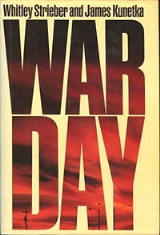
Warday

Encyclopedia
Warday is a novel
by Whitley Strieber
and James Kunetka, first published in 1984. It is a fictionalized account of the authors traveling across America five years after a limited nuclear attack in order to assess how the nation had changed after the war. The novel takes the form of a research article and is written in first-person narrative
form. It includes fictionalized government documents and interviews with individuals regarding the events and aftermath of the war.
in October 1988. He is traveling on a bus when he sees an intense flash of light. Strieber also sees the flooding of the subway system
due to a tsunami
that was triggered by a nuclear detonation at sea. Strieber makes his way to his son's school, where he is reunited with his family and shelters there. During this period, Strieber survives radiation sickness
. Upon his recovery, he and his family leave New York for San Antonio
which they soon discover was destroyed as well, and eventually settle in Dallas
, which was not attacked.
Five years later, Strieber and Kunetka decide to document the effects of Warday on the United States. They travel through devastated southeastern and southwestern Texas, then the newly formed nation-state of Aztlan
in the former American Southwest, and conduct interviews with the Aztlanian foreign minister and citizens. From Aztlan, they sneak into California which was unhurt from the war and became a self-governing authoritarian police state
. In Los Angeles
, they conduct interviews while trying to evade the omnipresent police. They go to San Francisco where they reunite with an old friend of Streiber's, Chelsea Quinn Yarbro
, and are ultimately captured, arrested, and sentenced to five years of hard labor and imprisonment.
While en route to prison they escape, and flee California by train. By train, they travel and conduct interviews across the Midwest, taking refuge whenever highly radioactive duststorms—caused by dustbowl conditions as a result of the nuclear bombings of the Dakotas—happen. After visiting Chicago
, they continue east into Pennsylvania and into what remains of New York City, where Strieber, overcome with emotion and at great personal risk to himself, visits what remains of a very dangerous Manhattan
to visit his old apartment. The book ends with Strieber and Kunetka back in Texas facing an uncertain future.
explains how the war happened. The United States was about to deploy an advanced anti-ballistic missile system
known as Spiderweb. The system used an orbiting particle beam
to destroy both land and submarine launched missiles coming from the Soviet Union. Panicked by the threat of Spiderweb making the United States potentially invulnerable to missile attack, the Soviets destroyed the Space Shuttle Enterprise
which was deploying the first component of Spiderweb using a hunter-killer satellite
. The USSR then detonated a set of six large nuclear warheads in space
some 200 to 225 miles above the United States that caused a massive electromagnetic pulse
that crippled electronics across the country. The Soviets then launched a limited first strike
using satellites
to deploy their warheads. In response, the U.S. President, aboard NEACP, launched a counter electromagnetic pulse strike and a limited nuclear strike on the USSR to destroy Moscow
, Leningrad
, Sevastopol
, and the administrative capitals of the Soviet Republics. Shortly after American missiles launch, the NEACP, crippled by the electromagnetic pulse, crash landed in North Carolina
, killing the President but leaving other survivors including the Under Secretary.
The "limited attack" by the USSR only destroyed Washington, D.C.
, San Antonio, the Brooklyn
and Queens
boroughs of New York City
, and ICBM missile fields and major air bases in North Dakota
, South Dakota
, Montana
, and Wyoming
, killing a total of 7,340,548 people. The subsequent firestorms and fallout
from these attacks destroyed Long Island
, Baltimore
, and most of Southwest Texas. The Soviet Navy
also launched nuclear attacks on the United States Navy
, destroying the Third, Sixth, and Seventh fleets, killing tens of thousands of sailors and reducing the strength of the US Navy by 90%.
The limited attack excluded the rest of the country, but the nation suffers nevertheless. Manhattan
and the remaining boroughs that were not destroyed in the initial attack are evacuated, cordoned off, and eventually allowed to fall into ruin, not due to radioactive fallout, but by lack of a working water, electrical, and transit system along with highly toxic runoff from damaged petrochemical industries. Towards the end of the novel the authors visit Manhattan and its ongoing salvage operations. Philadelphia and Houston are also evacuated due to the heavy fallout from the DC and San Antonio bombings. The dusting of the Midwest and Central Plains by radioactive materials caused a famine
that killed millions. Less than a year after the war, a new strain of influenza
known as the Cincinnati Flu quickly reached epidemic
levels, killing 21,600,000 throughout the United States and millions more worldwide. The danger of radiation poisoning remains even for those far away from the blasts, as well as Non-Specific Sclerosing Disease or NSD, a new, unknown, deadly, and cureless disease that ravages the surviving population. It is suggested through interviews that these diseases could have been the result of biological warfare.
A Canadian businessman tells Strieber and Kunetka that regional interests in the country have become stronger than national ones, that there is no longer a single United States but "five or six" separate ones. Individual states like California and Texas form de facto independent nations, with autonomous military forces and currency. The Federal Government was able to reestablish the capital and government in Los Angeles, but is too weak and powerless to be of any significance.
, and became an authoritarian police state that ruthlessly hunts down the refugees. Suspected illegal immigrants are immediately deported or imprisoned, or even executed. Other states such as the Pacific Northwest and the Deep South that also escaped the worst of Warday, adopted similar but less draconian measures as California.
emerges through secession and, apparent, ethnic cleansing
of the White population of far western Texas and southeastern New Mexico. The Aztlanian government claims all of the area from West Texas to the California border up to Nevada. Aztlan's foreign minister claims that the nation is a Libertarian Socialist
country that grants total autonomy to the Native American tribes living within its borders. The minister also tells the authors of Aztlan's goal of forming a Hispanic nation along the Mexican border that includes California, Arizona, New Mexico, and Texas west of the Pecos
. Although Aztlan is not a part of Mexico, it does welcome Mexican immigrants. In reality, Aztlan becomes a vassal state
of Japan; the Japanese help develop Aztlan in exchange for exploitation of natural resources such as soy and uranium
. Aztlan is recognized by most nations in Africa and Latin America, but the Governor of Texas plans to retake Aztlan by force, since the non-Hispanic residents of the area were forced out of their homes by the new government.
and other assets stored electronically, both in the United States and Canada, vanished. Money undergoes a rapid deflation and paper currency is no longer used, as the economy reverts back to a Gold Dollar system
. For example, the cost of a home is reduced to 800 gold dollars. The EMP also rendered electronic machinery and devices useless, as nearly all electronic machinery and equipment are imported. Oil has reportedly fallen to 12 cents a barrel, while many foreign nations called in loans and debts owed by the United States.
The Catholic
and Episcopal
churches reunite, and assisted suicide
in the face of painful terminal illness is accepted and sanctioned by religious leaders including the Holy See
. Wicca
, "alternative" medicine, and organic medicine become mainstream. Many Americans become Destructuralists; anarchists, and luddites who seek to dismantle all civic authority and reliance on technology to return to a primitive lifestyle. Due to the EMP destroying communication systems the American people remain isolated, and the authors encounter many rumors and unsubstantiated reports of the state of the rest of the world such as believing that the USSR had won the war.
Many foreign companies and nations are present in the unaffected regions of the US and see America as a ripe market to sell electronics, machinery, and investments, while exploiting it for natural resources. Some interviewees see their presence as an attempt by foreign powers to reduce the United States to a Third World
dependency.
Despite Warday, most Americans interviewed and surveyed by Strieber and Kunetka believe that the United States will recover and be restored. Over 60% of people they interview believe that the United States should be restored from coast to coast, and disapprove of the growing foreign presence within the country.
" is mentioned) have declared themselves independent states, there are military-run enclaves, and even the White Russians have reemerged. It has been reported, though unconfirmed, that mysterious "purple bombs" destroyed Ukraine's wheat fields. Although the Soviet Army units stationed in the Warsaw Pact
nations disbanded due to no orders from Moscow or the rest of the USSR, rogue USSR submarines actively hunted by the Royal Navy
still roam the Arctic
, sacking Alaskan and Canadian communities for supplies with missiles still targeted at the US.
, France
, and West Germany
signed a secret "Treaty of Coventry", that declared themselves neutral
to the USSR while they seized American military facilities located in their countries. In exchange, the Soviets spared Europe from nuclear attack.
In the absence of the USSR and the United States, the United Kingdom, and Japan have become superpowers. The United States is dependent on Britain and Japan for aid and support, and many Americans hope to emigrate to the United Kingdom. An IGO called "British Relief", an aid organization that has backing from British military units stationed in the United States, has a large role in governing the country and occupies some areas. A large Japanese military presence also exists, especially in the Aztlan region around El Paso
. Important technological resources, such as the Los Alamos National Laboratory
, have been seized by the Japanese, with scientists being shipped to Japan in a similar manner to Operation Paperclip
in World War II. Many interviewees mention the potential of a future Cold War
between the UK and Japan.
Mexico
, while escaping destruction, without American aid and trade, quickly collapsed into anarchy with revolutions reported in Mexico City
, mass death from famine, and outbreaks of the Cincinnati Flu. Canada
, despite escaping direct hits from nuclear weapons, was affected by the electromagnetic pulse attack on the United States and had its economy destroyed as a result. The country closed its borders to American refugees, expelling many people from North Dakota
who sought shelter across the border in the days following the war. The Canadians blame the United States for having entered the war without thinking of the consequences to neighboring countries. The United States sold Alaska to the Canadians, with the oil of Prudhoe Bay being diverted to Vancouver
.
Argentina
and most of Latin America, though unhurt from the war, was occupied and divided among Western nations to stabilize food stocks directed to Europe and to prevent a similar fate as Mexico's. Poland invaded the Ukraine to retake territory it lost during World War II, South Africa is at war with Zimbabwe, while the Israel/Palestinian conflict
continues. The developing world, particularly the Indian sub-continent, Latin America, Asia, and Africa, experienced severe population declines due to famine.
series, chronicling his own supposed experiences of alien contact, along with his collaborations with Art Bell
, has resulted in the indefinite shelving of this project.
Novel
A novel is a book of long narrative in literary prose. The genre has historical roots both in the fields of the medieval and early modern romance and in the tradition of the novella. The latter supplied the present generic term in the late 18th century....
by Whitley Strieber
Whitley Strieber
Louis Whitley Strieber is an American writer best known for his horror novels The Wolfen and The Hunger and for Communion, a non-fiction account of his perceived experiences with non-human entities. Strieber also co-authored The Coming Global Superstorm with Art Bell, which inspired the film about...
and James Kunetka, first published in 1984. It is a fictionalized account of the authors traveling across America five years after a limited nuclear attack in order to assess how the nation had changed after the war. The novel takes the form of a research article and is written in first-person narrative
First-person narrative
First-person point of view is a narrative mode where a story is narrated by one character at a time, speaking for and about themselves. First-person narrative may be singular, plural or multiple as well as being an authoritative, reliable or deceptive "voice" and represents point of view in the...
form. It includes fictionalized government documents and interviews with individuals regarding the events and aftermath of the war.
Plot summary
The novel opens with Strieber's account of a nuclear attack on New York CityNew York City
New York is the most populous city in the United States and the center of the New York Metropolitan Area, one of the most populous metropolitan areas in the world. New York exerts a significant impact upon global commerce, finance, media, art, fashion, research, technology, education, and...
in October 1988. He is traveling on a bus when he sees an intense flash of light. Strieber also sees the flooding of the subway system
New York City Subway
The New York City Subway is a rapid transit system owned by the City of New York and leased to the New York City Transit Authority, a subsidiary agency of the Metropolitan Transportation Authority and also known as MTA New York City Transit...
due to a tsunami
Tsunami
A tsunami is a series of water waves caused by the displacement of a large volume of a body of water, typically an ocean or a large lake...
that was triggered by a nuclear detonation at sea. Strieber makes his way to his son's school, where he is reunited with his family and shelters there. During this period, Strieber survives radiation sickness
Radiation Sickness
Radiation Sickness is a VHS by the thrash metal band Nuclear Assault. The video is a recording of a concert at the Hammersmith Odeon, London in 1988. It was released in 1991...
. Upon his recovery, he and his family leave New York for San Antonio
San Antonio, Texas
San Antonio is the seventh-largest city in the United States of America and the second-largest city within the state of Texas, with a population of 1.33 million. Located in the American Southwest and the south–central part of Texas, the city serves as the seat of Bexar County. In 2011,...
which they soon discover was destroyed as well, and eventually settle in Dallas
Dallas, Texas
Dallas is the third-largest city in Texas and the ninth-largest in the United States. The Dallas-Fort Worth Metroplex is the largest metropolitan area in the South and fourth-largest metropolitan area in the United States...
, which was not attacked.
Five years later, Strieber and Kunetka decide to document the effects of Warday on the United States. They travel through devastated southeastern and southwestern Texas, then the newly formed nation-state of Aztlan
Aztlán
Aztlán is the mythical ancestral home of the Nahua peoples, one of the main cultural groups in Mesoamerica. And, by extension, is the mythical homeland of the Uto-Aztecan peoples. Aztec is the Nahuatl word for "people from Aztlan".-Legend:...
in the former American Southwest, and conduct interviews with the Aztlanian foreign minister and citizens. From Aztlan, they sneak into California which was unhurt from the war and became a self-governing authoritarian police state
Police state
A police state is one in which the government exercises rigid and repressive controls over the social, economic and political life of the population...
. In Los Angeles
Los Ángeles
Los Ángeles is the capital of the province of Biobío, in the commune of the same name, in Region VIII , in the center-south of Chile. It is located between the Laja and Biobío rivers. The population is 123,445 inhabitants...
, they conduct interviews while trying to evade the omnipresent police. They go to San Francisco where they reunite with an old friend of Streiber's, Chelsea Quinn Yarbro
Chelsea Quinn Yarbro
-Biography:She was born in Berkeley, California. She attended Berkeley schools through high school followed by three years at San Francisco State College .In November 1969 she married Donald Simpson and divorced in February 1982...
, and are ultimately captured, arrested, and sentenced to five years of hard labor and imprisonment.
While en route to prison they escape, and flee California by train. By train, they travel and conduct interviews across the Midwest, taking refuge whenever highly radioactive duststorms—caused by dustbowl conditions as a result of the nuclear bombings of the Dakotas—happen. After visiting Chicago
Chicago
Chicago is the largest city in the US state of Illinois. With nearly 2.7 million residents, it is the most populous city in the Midwestern United States and the third most populous in the US, after New York City and Los Angeles...
, they continue east into Pennsylvania and into what remains of New York City, where Strieber, overcome with emotion and at great personal risk to himself, visits what remains of a very dangerous Manhattan
Manhattan
Manhattan is the oldest and the most densely populated of the five boroughs of New York City. Located primarily on the island of Manhattan at the mouth of the Hudson River, the boundaries of the borough are identical to those of New York County, an original county of the state of New York...
to visit his old apartment. The book ends with Strieber and Kunetka back in Texas facing an uncertain future.
The United States
An interview Strieber conducts with the former Undersecretary of DefenseUnder Secretary of Defense for Intelligence
The Under Secretary for Intelligence or USD is a high-ranking civilian position in the Office of the Secretary of Defense within the U.S. Department of Defense that acts as the principal advisor and deputy to the Secretary and Deputy Secretary of Defense on matters relating to intelligence...
explains how the war happened. The United States was about to deploy an advanced anti-ballistic missile system
Missile defense
Missile defense is a system, weapon, or technology involved in the detection, tracking, interception and destruction of attacking missiles. Originally conceived as a defence against nuclear-armed Intercontinental ballistic missiles , its application has broadened to include shorter-ranged...
known as Spiderweb. The system used an orbiting particle beam
Particle beam
A particle beam is a stream of charged or neutral particles which may be directed by magnets and focused by electrostatic lenses, although they may also be self-focusing ....
to destroy both land and submarine launched missiles coming from the Soviet Union. Panicked by the threat of Spiderweb making the United States potentially invulnerable to missile attack, the Soviets destroyed the Space Shuttle Enterprise
Space Shuttle Enterprise
The Space Shuttle Enterprise was the first Space Shuttle orbiter. It was built for NASA as part of the Space Shuttle program to perform test flights in the atmosphere. It was constructed without engines or a functional heat shield, and was therefore not capable of spaceflight...
which was deploying the first component of Spiderweb using a hunter-killer satellite
Anti-satellite weapon
Anti-satellite weapons are designed to incapacitate or destroy satellites for strategic military purposes. Currently, only the United States, the former Soviet Union, and the People's Republic of China are known to have developed these weapons. On September 13, 1985, the United States destroyed US...
. The USSR then detonated a set of six large nuclear warheads in space
High altitude nuclear explosion
High-altitude nuclear explosions have historically been nuclear explosions which take place above altitudes of 30 km, still inside the Earth's atmosphere. Such explosions have been tests of nuclear weapons, used to determine the effects of the blast and radiation in the exoatmospheric...
some 200 to 225 miles above the United States that caused a massive electromagnetic pulse
Electromagnetic pulse
An electromagnetic pulse is a burst of electromagnetic radiation. The abrupt pulse of electromagnetic radiation usually results from certain types of high energy explosions, especially a nuclear explosion, or from a suddenly fluctuating magnetic field...
that crippled electronics across the country. The Soviets then launched a limited first strike
First strike
In nuclear strategy, a first strike is a preemptive surprise attack employing overwhelming force. First strike capability is a country's ability to defeat another nuclear power by destroying its arsenal to the point where the attacking country can survive the weakened retaliation while the opposing...
using satellites
Fractional Orbital Bombardment System
The Fractional Orbital Bombardment System was a Soviet ICBM program in the 1960s that after launch would go into a low Earth orbit and would then de-orbit for an attack. It had no range limit and the orbital flight path would not reveal the target location...
to deploy their warheads. In response, the U.S. President, aboard NEACP, launched a counter electromagnetic pulse strike and a limited nuclear strike on the USSR to destroy Moscow
Moscow
Moscow is the capital, the most populous city, and the most populous federal subject of Russia. The city is a major political, economic, cultural, scientific, religious, financial, educational, and transportation centre of Russia and the continent...
, Leningrad
Saint Petersburg
Saint Petersburg is a city and a federal subject of Russia located on the Neva River at the head of the Gulf of Finland on the Baltic Sea...
, Sevastopol
Sevastopol
Sevastopol is a city on rights of administrative division of Ukraine, located on the Black Sea coast of the Crimea peninsula. It has a population of 342,451 . Sevastopol is the second largest port in Ukraine, after the Port of Odessa....
, and the administrative capitals of the Soviet Republics. Shortly after American missiles launch, the NEACP, crippled by the electromagnetic pulse, crash landed in North Carolina
North Carolina
North Carolina is a state located in the southeastern United States. The state borders South Carolina and Georgia to the south, Tennessee to the west and Virginia to the north. North Carolina contains 100 counties. Its capital is Raleigh, and its largest city is Charlotte...
, killing the President but leaving other survivors including the Under Secretary.
The "limited attack" by the USSR only destroyed Washington, D.C.
Washington, D.C.
Washington, D.C., formally the District of Columbia and commonly referred to as Washington, "the District", or simply D.C., is the capital of the United States. On July 16, 1790, the United States Congress approved the creation of a permanent national capital as permitted by the U.S. Constitution....
, San Antonio, the Brooklyn
Brooklyn
Brooklyn is the most populous of New York City's five boroughs, with nearly 2.6 million residents, and the second-largest in area. Since 1896, Brooklyn has had the same boundaries as Kings County, which is now the most populous county in New York State and the second-most densely populated...
and Queens
Queens
Queens is the easternmost of the five boroughs of New York City. The largest borough in area and the second-largest in population, it is coextensive with Queens County, an administrative division of New York state, in the United States....
boroughs of New York City
New York City
New York is the most populous city in the United States and the center of the New York Metropolitan Area, one of the most populous metropolitan areas in the world. New York exerts a significant impact upon global commerce, finance, media, art, fashion, research, technology, education, and...
, and ICBM missile fields and major air bases in North Dakota
North Dakota
North Dakota is a state located in the Midwestern region of the United States of America, along the Canadian border. The state is bordered by Canada to the north, Minnesota to the east, South Dakota to the south and Montana to the west. North Dakota is the 19th-largest state by area in the U.S....
, South Dakota
South Dakota
South Dakota is a state located in the Midwestern region of the United States. It is named after the Lakota and Dakota Sioux American Indian tribes. Once a part of Dakota Territory, South Dakota became a state on November 2, 1889. The state has an area of and an estimated population of just over...
, Montana
Montana
Montana is a state in the Western United States. The western third of Montana contains numerous mountain ranges. Smaller, "island ranges" are found in the central third of the state, for a total of 77 named ranges of the Rocky Mountains. This geographical fact is reflected in the state's name,...
, and Wyoming
Wyoming
Wyoming is a state in the mountain region of the Western United States. The western two thirds of the state is covered mostly with the mountain ranges and rangelands in the foothills of the Eastern Rocky Mountains, while the eastern third of the state is high elevation prairie known as the High...
, killing a total of 7,340,548 people. The subsequent firestorms and fallout
Fallout
Fallout or nuclear fallout is the residual radiation hazard from a nuclear explosion.Fallout may also refer to:*Fallout , a 1997 post-apocalyptic computer role-playing game released by Interplay Entertainment...
from these attacks destroyed Long Island
Long Island
Long Island is an island located in the southeast part of the U.S. state of New York, just east of Manhattan. Stretching northeast into the Atlantic Ocean, Long Island contains four counties, two of which are boroughs of New York City , and two of which are mainly suburban...
, Baltimore
Baltimore
Baltimore is the largest independent city in the United States and the largest city and cultural center of the US state of Maryland. The city is located in central Maryland along the tidal portion of the Patapsco River, an arm of the Chesapeake Bay. Baltimore is sometimes referred to as Baltimore...
, and most of Southwest Texas. The Soviet Navy
Soviet Navy
The Soviet Navy was the naval arm of the Soviet Armed Forces. Often referred to as the Red Fleet, the Soviet Navy would have played an instrumental role in a Warsaw Pact war with NATO, where it would have attempted to prevent naval convoys from bringing reinforcements across the Atlantic Ocean...
also launched nuclear attacks on the United States Navy
United States Navy
The United States Navy is the naval warfare service branch of the United States Armed Forces and one of the seven uniformed services of the United States. The U.S. Navy is the largest in the world; its battle fleet tonnage is greater than that of the next 13 largest navies combined. The U.S...
, destroying the Third, Sixth, and Seventh fleets, killing tens of thousands of sailors and reducing the strength of the US Navy by 90%.
The limited attack excluded the rest of the country, but the nation suffers nevertheless. Manhattan
Manhattan
Manhattan is the oldest and the most densely populated of the five boroughs of New York City. Located primarily on the island of Manhattan at the mouth of the Hudson River, the boundaries of the borough are identical to those of New York County, an original county of the state of New York...
and the remaining boroughs that were not destroyed in the initial attack are evacuated, cordoned off, and eventually allowed to fall into ruin, not due to radioactive fallout, but by lack of a working water, electrical, and transit system along with highly toxic runoff from damaged petrochemical industries. Towards the end of the novel the authors visit Manhattan and its ongoing salvage operations. Philadelphia and Houston are also evacuated due to the heavy fallout from the DC and San Antonio bombings. The dusting of the Midwest and Central Plains by radioactive materials caused a famine
Famine
A famine is a widespread scarcity of food, caused by several factors including crop failure, overpopulation, or government policies. This phenomenon is usually accompanied or followed by regional malnutrition, starvation, epidemic, and increased mortality. Every continent in the world has...
that killed millions. Less than a year after the war, a new strain of influenza
Influenza
Influenza, commonly referred to as the flu, is an infectious disease caused by RNA viruses of the family Orthomyxoviridae , that affects birds and mammals...
known as the Cincinnati Flu quickly reached epidemic
Epidemic
In epidemiology, an epidemic , occurs when new cases of a certain disease, in a given human population, and during a given period, substantially exceed what is expected based on recent experience...
levels, killing 21,600,000 throughout the United States and millions more worldwide. The danger of radiation poisoning remains even for those far away from the blasts, as well as Non-Specific Sclerosing Disease or NSD, a new, unknown, deadly, and cureless disease that ravages the surviving population. It is suggested through interviews that these diseases could have been the result of biological warfare.
A Canadian businessman tells Strieber and Kunetka that regional interests in the country have become stronger than national ones, that there is no longer a single United States but "five or six" separate ones. Individual states like California and Texas form de facto independent nations, with autonomous military forces and currency. The Federal Government was able to reestablish the capital and government in Los Angeles, but is too weak and powerless to be of any significance.
California
A prewar standard of living exists in California, with heavy Japanese and British investment and influence. Due to no direct attacks, no fallout, and having recovered from the EMP, California attracted millions of refugees from the rest of the United States. Fearful of these immigrants damaging its prosperity, the state shut its borders, suspended habeas corpusHabeas corpus
is a writ, or legal action, through which a prisoner can be released from unlawful detention. The remedy can be sought by the prisoner or by another person coming to his aid. Habeas corpus originated in the English legal system, but it is now available in many nations...
, and became an authoritarian police state that ruthlessly hunts down the refugees. Suspected illegal immigrants are immediately deported or imprisoned, or even executed. Other states such as the Pacific Northwest and the Deep South that also escaped the worst of Warday, adopted similar but less draconian measures as California.
Aztlan
A new Hispanic/Native American nation named AztlanAztlán
Aztlán is the mythical ancestral home of the Nahua peoples, one of the main cultural groups in Mesoamerica. And, by extension, is the mythical homeland of the Uto-Aztecan peoples. Aztec is the Nahuatl word for "people from Aztlan".-Legend:...
emerges through secession and, apparent, ethnic cleansing
Ethnic cleansing
Ethnic cleansing is a purposeful policy designed by one ethnic or religious group to remove by violent and terror-inspiring means the civilian population of another ethnic orreligious group from certain geographic areas....
of the White population of far western Texas and southeastern New Mexico. The Aztlanian government claims all of the area from West Texas to the California border up to Nevada. Aztlan's foreign minister claims that the nation is a Libertarian Socialist
Libertarian socialism
Libertarian socialism is a group of political philosophies that promote a non-hierarchical, non-bureaucratic, stateless society without private property in the means of production...
country that grants total autonomy to the Native American tribes living within its borders. The minister also tells the authors of Aztlan's goal of forming a Hispanic nation along the Mexican border that includes California, Arizona, New Mexico, and Texas west of the Pecos
Pecos River
The headwaters of the Pecos River are located north of Pecos, New Mexico, United States, at an elevation of over 12,000 feet on the western slope of the Sangre de Cristo mountain range in Mora County. The river flows for through the eastern portion of that state and neighboring Texas before it...
. Although Aztlan is not a part of Mexico, it does welcome Mexican immigrants. In reality, Aztlan becomes a vassal state
Vassal state
A vassal state is any state that is subordinate to another. The vassal in these cases is the ruler, rather than the state itself. Being a vassal most commonly implies providing military assistance to the dominant state when requested to do so; it sometimes implies paying tribute, but a state which...
of Japan; the Japanese help develop Aztlan in exchange for exploitation of natural resources such as soy and uranium
Uranium
Uranium is a silvery-white metallic chemical element in the actinide series of the periodic table, with atomic number 92. It is assigned the chemical symbol U. A uranium atom has 92 protons and 92 electrons, of which 6 are valence electrons...
. Aztlan is recognized by most nations in Africa and Latin America, but the Governor of Texas plans to retake Aztlan by force, since the non-Hispanic residents of the area were forced out of their homes by the new government.
Economy, culture, and society
Due to the EMP, virtually all bank accounts, 401ks, pension funds, financial records, the stock market, the credit systemCredit (finance)
Credit is the trust which allows one party to provide resources to another party where that second party does not reimburse the first party immediately , but instead arranges either to repay or return those resources at a later date. The resources provided may be financial Credit is the trust...
and other assets stored electronically, both in the United States and Canada, vanished. Money undergoes a rapid deflation and paper currency is no longer used, as the economy reverts back to a Gold Dollar system
National Gold Bank Note
-History:National Gold Bank Notes were banknotes that were redeemable for gold in the 1870s. National gold bank notes came in $5, $10, $20, $50, $100, $500, $1,000, and $5,000. Today, all are very rare and in the higher grades and denominations many are unknown to even exist now. Most notes show...
. For example, the cost of a home is reduced to 800 gold dollars. The EMP also rendered electronic machinery and devices useless, as nearly all electronic machinery and equipment are imported. Oil has reportedly fallen to 12 cents a barrel, while many foreign nations called in loans and debts owed by the United States.
The Catholic
Catholic
The word catholic comes from the Greek phrase , meaning "on the whole," "according to the whole" or "in general", and is a combination of the Greek words meaning "about" and meaning "whole"...
and Episcopal
Episcopal Church (United States)
The Episcopal Church is a mainline Anglican Christian church found mainly in the United States , but also in Honduras, Taiwan, Colombia, Ecuador, Haiti, the Dominican Republic, Venezuela, the British Virgin Islands and parts of Europe...
churches reunite, and assisted suicide
Euthanasia
Euthanasia refers to the practice of intentionally ending a life in order to relieve pain and suffering....
in the face of painful terminal illness is accepted and sanctioned by religious leaders including the Holy See
Holy See
The Holy See is the episcopal jurisdiction of the Catholic Church in Rome, in which its Bishop is commonly known as the Pope. It is the preeminent episcopal see of the Catholic Church, forming the central government of the Church. As such, diplomatically, and in other spheres the Holy See acts and...
. Wicca
Wicca
Wicca , is a modern Pagan religious movement. Developing in England in the first half of the 20th century, Wicca was popularised in the 1950s and early 1960s by a Wiccan High Priest named Gerald Gardner, who at the time called it the "witch cult" and "witchcraft," and its adherents "the Wica."...
, "alternative" medicine, and organic medicine become mainstream. Many Americans become Destructuralists; anarchists, and luddites who seek to dismantle all civic authority and reliance on technology to return to a primitive lifestyle. Due to the EMP destroying communication systems the American people remain isolated, and the authors encounter many rumors and unsubstantiated reports of the state of the rest of the world such as believing that the USSR had won the war.
Many foreign companies and nations are present in the unaffected regions of the US and see America as a ripe market to sell electronics, machinery, and investments, while exploiting it for natural resources. Some interviewees see their presence as an attempt by foreign powers to reduce the United States to a Third World
Third World
The term Third World arose during the Cold War to define countries that remained non-aligned with either capitalism and NATO , or communism and the Soviet Union...
dependency.
Despite Warday, most Americans interviewed and surveyed by Strieber and Kunetka believe that the United States will recover and be restored. Over 60% of people they interview believe that the United States should be restored from coast to coast, and disapprove of the growing foreign presence within the country.
The USSR
Through interviews, Strieber and Kunetka hear many reports and rumors about the state of the Soviet Union. It is certain that the USSR collapsed, as reportedly nearly half of its population was killed immediately on Warday or had died by the time the authors wrote the book five years later, but whether the Soviet Premier and the Politburo survived is unknown. Some of the former USSR states (the "kingdom of AzerbaijanAzerbaijan
Azerbaijan , officially the Republic of Azerbaijan is the largest country in the Caucasus region of Eurasia. Located at the crossroads of Western Asia and Eastern Europe, it is bounded by the Caspian Sea to the east, Russia to the north, Georgia to the northwest, Armenia to the west, and Iran to...
" is mentioned) have declared themselves independent states, there are military-run enclaves, and even the White Russians have reemerged. It has been reported, though unconfirmed, that mysterious "purple bombs" destroyed Ukraine's wheat fields. Although the Soviet Army units stationed in the Warsaw Pact
Warsaw Pact
The Warsaw Treaty Organization of Friendship, Cooperation, and Mutual Assistance , or more commonly referred to as the Warsaw Pact, was a mutual defense treaty subscribed to by eight communist states in Eastern Europe...
nations disbanded due to no orders from Moscow or the rest of the USSR, rogue USSR submarines actively hunted by the Royal Navy
Royal Navy
The Royal Navy is the naval warfare service branch of the British Armed Forces. Founded in the 16th century, it is the oldest service branch and is known as the Senior Service...
still roam the Arctic
Arctic
The Arctic is a region located at the northern-most part of the Earth. The Arctic consists of the Arctic Ocean and parts of Canada, Russia, Greenland, the United States, Norway, Sweden, Finland, and Iceland. The Arctic region consists of a vast, ice-covered ocean, surrounded by treeless permafrost...
, sacking Alaskan and Canadian communities for supplies with missiles still targeted at the US.
The rest of the world
As the conflict escalated between the US and USSR, the United KingdomUnited Kingdom
The United Kingdom of Great Britain and Northern IrelandIn the United Kingdom and Dependencies, other languages have been officially recognised as legitimate autochthonous languages under the European Charter for Regional or Minority Languages...
, France
France
The French Republic , The French Republic , The French Republic , (commonly known as France , is a unitary semi-presidential republic in Western Europe with several overseas territories and islands located on other continents and in the Indian, Pacific, and Atlantic oceans. Metropolitan France...
, and West Germany
West Germany
West Germany is the common English, but not official, name for the Federal Republic of Germany or FRG in the period between its creation in May 1949 to German reunification on 3 October 1990....
signed a secret "Treaty of Coventry", that declared themselves neutral
Neutrality (international relations)
A neutral power in a particular war is a sovereign state which declares itself to be neutral towards the belligerents. A non-belligerent state does not need to be neutral. The rights and duties of a neutral power are defined in Sections 5 and 13 of the Hague Convention of 1907...
to the USSR while they seized American military facilities located in their countries. In exchange, the Soviets spared Europe from nuclear attack.
In the absence of the USSR and the United States, the United Kingdom, and Japan have become superpowers. The United States is dependent on Britain and Japan for aid and support, and many Americans hope to emigrate to the United Kingdom. An IGO called "British Relief", an aid organization that has backing from British military units stationed in the United States, has a large role in governing the country and occupies some areas. A large Japanese military presence also exists, especially in the Aztlan region around El Paso
El Paso, Texas
El Paso, is a city in and the county seat of El Paso County, Texas, United States, and lies in far West Texas. In the 2010 census, the city had a population of 649,121. It is the sixth largest city in Texas and the 19th largest city in the United States...
. Important technological resources, such as the Los Alamos National Laboratory
Los Alamos National Laboratory
Los Alamos National Laboratory is a United States Department of Energy national laboratory, managed and operated by Los Alamos National Security , located in Los Alamos, New Mexico...
, have been seized by the Japanese, with scientists being shipped to Japan in a similar manner to Operation Paperclip
Operation Paperclip
Operation Paperclip was the Office of Strategic Services program used to recruit the scientists of Nazi Germany for employment by the United States in the aftermath of World War II...
in World War II. Many interviewees mention the potential of a future Cold War
Cold War
The Cold War was the continuing state from roughly 1946 to 1991 of political conflict, military tension, proxy wars, and economic competition between the Communist World—primarily the Soviet Union and its satellite states and allies—and the powers of the Western world, primarily the United States...
between the UK and Japan.
Mexico
Mexico
The United Mexican States , commonly known as Mexico , is a federal constitutional republic in North America. It is bordered on the north by the United States; on the south and west by the Pacific Ocean; on the southeast by Guatemala, Belize, and the Caribbean Sea; and on the east by the Gulf of...
, while escaping destruction, without American aid and trade, quickly collapsed into anarchy with revolutions reported in Mexico City
Mexico City
Mexico City is the Federal District , capital of Mexico and seat of the federal powers of the Mexican Union. It is a federal entity within Mexico which is not part of any one of the 31 Mexican states but belongs to the federation as a whole...
, mass death from famine, and outbreaks of the Cincinnati Flu. Canada
Canada
Canada is a North American country consisting of ten provinces and three territories. Located in the northern part of the continent, it extends from the Atlantic Ocean in the east to the Pacific Ocean in the west, and northward into the Arctic Ocean...
, despite escaping direct hits from nuclear weapons, was affected by the electromagnetic pulse attack on the United States and had its economy destroyed as a result. The country closed its borders to American refugees, expelling many people from North Dakota
North Dakota
North Dakota is a state located in the Midwestern region of the United States of America, along the Canadian border. The state is bordered by Canada to the north, Minnesota to the east, South Dakota to the south and Montana to the west. North Dakota is the 19th-largest state by area in the U.S....
who sought shelter across the border in the days following the war. The Canadians blame the United States for having entered the war without thinking of the consequences to neighboring countries. The United States sold Alaska to the Canadians, with the oil of Prudhoe Bay being diverted to Vancouver
Vancouver
Vancouver is a coastal seaport city on the mainland of British Columbia, Canada. It is the hub of Greater Vancouver, which, with over 2.3 million residents, is the third most populous metropolitan area in the country,...
.
Argentina
Argentina
Argentina , officially the Argentine Republic , is the second largest country in South America by land area, after Brazil. It is constituted as a federation of 23 provinces and an autonomous city, Buenos Aires...
and most of Latin America, though unhurt from the war, was occupied and divided among Western nations to stabilize food stocks directed to Europe and to prevent a similar fate as Mexico's. Poland invaded the Ukraine to retake territory it lost during World War II, South Africa is at war with Zimbabwe, while the Israel/Palestinian conflict
Intifada
Intifada is an Arabic word which literally means "shaking off", though it is usually translated into English as "uprising" or "resistance" or "rebellion". , not to be confused with the Arabic plural ...
continues. The developing world, particularly the Indian sub-continent, Latin America, Asia, and Africa, experienced severe population declines due to famine.
Sequels
During the book tour surrounding the release of Warday, both Strieber and Kunetka hinted that they were planning a sequel in which the two would venture overseas and reveal how Western Europe, Africa, China, Japan, and the remnants of the Soviet Union fared ten years after the limited exchange. However, both writers instead released Nature's End, and then ceased writing together for reasons neither have explained. In the years since Nature's End was released, Strieber's switch in focus towards his CommunionCommunion (book)
Communion: A True Story is a book by American ufologist and horror author Whitley Strieber that was first published in February 1987. The book is based on Strieber's alleged experiences with non-human, possibly extraterrestrial entities....
series, chronicling his own supposed experiences of alien contact, along with his collaborations with Art Bell
Art Bell
Arthur W. "Art" Bell, III is an American broadcaster and author, known primarily as one of the founders and the original host of the paranormal-themed radio program Coast to Coast AM. He also created and formerly hosted its companion show, Dreamland...
, has resulted in the indefinite shelving of this project.
See also
- Alas, BabylonAlas, BabylonAlas, Babylon is a 1959 novel by American writer Pat Frank . It was one of the first apocalyptic novels of the nuclear age and remains popular fifty years after it was first published...
- List of Nuclear Holocaust fiction
- Nuclear HolocaustNuclear holocaustNuclear holocaust refers to the possibility of the near complete annihilation of human civilization by nuclear warfare. Under such a scenario, all or most of the Earth is made uninhabitable by nuclear weapons in future world wars....
- Nuclear summerNuclear summerA Nuclear summer is a hypothetical scenario resulting from nuclear warfare that would follow a nuclear winter, caused by aerosols inserted into the atmosphere that would prevent sunlight from reaching lower levels or the surface...
- Nuclear weapons in popular cultureNuclear weapons in popular cultureSince their public debut in August 1945, nuclear weapons and their potential effects have been a recurring motif in popular culture, to the extent that the decades of the Cold War are often referred to as the "atomic age."-Images of nuclear weapons:...