
All Topics  
Electromagnetic pulse

 
Electromagnetic Pulse

   Email Print
   Bookmark   Link


Electromagnetic pulse


The term electromagnetic pulse (sometimes abbreviated EMP) has the following meanings:

  1. Electromagnetic radiation
    Electromagnetic radiation

    Electromagnetic radiation takes the form of wave propagation waves in a vacuum or in matter. EM radiation has an electric field and magnetic field component which oscillate in phase perpendicular to each other and to the direction of energy Wave propagation....
     from an explosion
    Explosion

    An explosion is a sudden increase in volume and release of energy in an extreme manner, usually with the generation of high temperatures and the release of gases....
     (especially a nuclear explosion
    Nuclear explosion

    A nuclear explosion occurs as a result of the rapid release of energy from an intentionally high-speed nuclear reaction. The driving reaction may be nuclear fission, nuclear fusion or a multistage cascading combination of the two, though to date all fusion based weapons have used a fission device to initiate fusion, and a pure fusion weapon...
    ) or an intensely fluctuating
    Change

    selfref|For Wikipedia uses, see...
     magnetic field
    Magnetic field

    A magnetism field is a vector field which can exert a magnetic force on moving electric charges and on magnetic dipoles . When placed in a magnetic field, magnetic dipoles tend to align their axes parallel to the magnetic field....
     caused by Compton-recoil
    Compton scattering

    In physics, Compton scattering or the Compton effect is the decrease in energy of an X-ray or gamma ray photon, when it interacts with matter....
     electron
    Electron

    The electron is a subatomic particle that carries a negative electric charge. It has elementary particle and is believed to be a point particle....
    s and photoelectrons from photon
    Photon

    In physics, the photon is an elementary particle, the quantum of the electromagnetic field and the basic unit of light and all other forms of electromagnetic radiation....
    s scattered
    Scattering

    Scattering is a general physical process where some forms of radiation, such as light, sound, or moving particles,are forced to deviate from a straight trajectory by one or more localized non-uniformities in the medium through which they pass....
     in the materials of the electronic or explosive device or in a surrounding medium
    Transmission medium

    A transmission medium is a material substance which can wave propagation energy waves. For example, the transmission medium for sound received by the ears is usually air, but solids and liquids may also act as transmission media for sound....
    . The resulting electric
    Electric field

    In physics, the space surrounding an electric charge or in the presence of a time-varying magnetic field has a property called an electric field ....
     and magnetic fields may couple with electrical/electronic systems to produce damaging current and voltage surges.


    Discussion
    Ask a question about 'Electromagnetic pulse'
    Start a new discussion about 'Electromagnetic pulse'
    Answer questions from other users
    Full Discussion Forum


    Encyclopedia


    The term electromagnetic pulse (sometimes abbreviated EMP) has the following meanings:

    1. Electromagnetic radiation
      Electromagnetic radiation

      Electromagnetic radiation takes the form of wave propagation waves in a vacuum or in matter. EM radiation has an electric field and magnetic field component which oscillate in phase perpendicular to each other and to the direction of energy Wave propagation....
       from an explosion
      Explosion

      An explosion is a sudden increase in volume and release of energy in an extreme manner, usually with the generation of high temperatures and the release of gases....
       (especially a nuclear explosion
      Nuclear explosion

      A nuclear explosion occurs as a result of the rapid release of energy from an intentionally high-speed nuclear reaction. The driving reaction may be nuclear fission, nuclear fusion or a multistage cascading combination of the two, though to date all fusion based weapons have used a fission device to initiate fusion, and a pure fusion weapon...
      ) or an intensely fluctuating
      Change

      selfref|For Wikipedia uses, see...
       magnetic field
      Magnetic field

      A magnetism field is a vector field which can exert a magnetic force on moving electric charges and on magnetic dipoles . When placed in a magnetic field, magnetic dipoles tend to align their axes parallel to the magnetic field....
       caused by Compton-recoil
      Compton scattering

      In physics, Compton scattering or the Compton effect is the decrease in energy of an X-ray or gamma ray photon, when it interacts with matter....
       electron
      Electron

      The electron is a subatomic particle that carries a negative electric charge. It has elementary particle and is believed to be a point particle....
      s and photoelectrons from photon
      Photon

      In physics, the photon is an elementary particle, the quantum of the electromagnetic field and the basic unit of light and all other forms of electromagnetic radiation....
      s scattered
      Scattering

      Scattering is a general physical process where some forms of radiation, such as light, sound, or moving particles,are forced to deviate from a straight trajectory by one or more localized non-uniformities in the medium through which they pass....
       in the materials of the electronic or explosive device or in a surrounding medium
      Transmission medium

      A transmission medium is a material substance which can wave propagation energy waves. For example, the transmission medium for sound received by the ears is usually air, but solids and liquids may also act as transmission media for sound....
      . The resulting electric
      Electric field

      In physics, the space surrounding an electric charge or in the presence of a time-varying magnetic field has a property called an electric field ....
       and magnetic fields may couple with electrical/electronic systems to produce damaging current and voltage surges. See Electromagnetic bomb
      Electromagnetic bomb

      An electromagnetic bomb or E-bomb is a weapon designed to disable electronics with an electromagnetic pulse that can couple with electrical/electronic systems to produce damaging current and voltage surges by electromagnetic induction....
       for details on the damages resulting to electronic devices. The effects are usually not noticeable beyond the blast radius unless the device is nuclear or specifically designed to produce an electromagnetic shockwave
      Effects of nuclear explosions

      The energy released from a nuclear weapon detonated in the troposphere can be divided into four basic categories:*explosion—40-50% of total energy...
      .  For a comprehensive assessment of likely damages to electronics equipment and electrical infrastructure, see the U.S. government's Critical National Infrastructures Report by the U.S. EMP Commission.
    2. A broadband, high-intensity, short-duration burst of electromagnetic energy.


    Introduction and early history


    The fact that an electromagnetic pulse is produced by a nuclear explosion was known since the earliest days of nuclear weapons testing, but the magnitude of the EMP and the significance of its effects were realized very slowly.

    In July 1962, a 1.44 megaton United States nuclear test in space, 400 km. above the mid-Pacific Ocean, called the Starfish Prime
    Starfish Prime

    Starfish Prime was a high altitude nuclear explosion conducted by the United States of America on July 9, 1962, a joint effort of the Defense Atomic Support Agency and the United States Atomic Energy Commission ....
     test, demonstrated to nuclear scientists that the magnitude and effects of a high altitude nuclear explosion
    High altitude nuclear explosion

    High altitude nuclear explosions have historically been nuclear explosions which take place above altitudes of 50 km, still inside the Earth's atmosphere....
     were much larger than had been previously calculated. Starfish Prime
    Starfish Prime

    Starfish Prime was a high altitude nuclear explosion conducted by the United States of America on July 9, 1962, a joint effort of the Defense Atomic Support Agency and the United States Atomic Energy Commission ....
     also made those effects known to the public by causing electrical damage in Hawaii, more than 800 miles away from the detonation point, knocking out about 300 streetlights, setting off numerous burglar alarms and damaging a telephone company microwave link.

    The EMP damage of the Starfish Prime test was quickly repaired because of the ruggedness (compared to today) of the electrical and electronic infrastructure of Hawaii in 1962. Realization of the potential impacts of EMP became more apparent to some scientists and engineers during the 1970s as more sensitive solid-state electronics began to come into widespread use.

    The larger scientific community became aware of the significance of the EMP problem after a series of three articles were published about nuclear electromagnetic pulse in 1981 by William J. Broad
    William Broad

    William J. Broad is an author and a senior writer at The New York Times. In twenty-five years as a science correspondent, he has written hundreds of front-page articles and won every major journalistic award in print and film....
     in the weekly publication Science
    Science (journal)

    Science is the academic journal of the American Association for the Advancement of Science and is considered one of the world's most prestigious scientific journals....
    .

    The relatively small magnitude of the Starfish Prime
    Starfish Prime

    Starfish Prime was a high altitude nuclear explosion conducted by the United States of America on July 9, 1962, a joint effort of the Defense Atomic Support Agency and the United States Atomic Energy Commission ....
     EMP in Hawaii (about 5,600 volts/meter) and the relatively small amount of damage done (for example, only 1 to 3 percent of streetlights extinguished) led some scientists to believe, in the early days of EMP research, that the problem might not be as significant as was later realized. Newer calculations showed that if the Starfish Prime warhead had been detonated over the northern continental United States, the magnitude of the EMP would have been much larger (22,000 to 30,000 volts/meter) because of the greater strength of the earth's magnetic field
    Earth's magnetic field

    Earth's magnetic field is approximately a magnetic dipole, with one magnetic pole near the north pole and the other near the geographic south pole ....
     over the United States, as well as the different orientation of the earth's magnetic field at high latitudes. These new calculations, combined with the accelerating reliance on EMP-sensitive microelectronics, heightened awareness that the EMP threat could be a very significant problem.

    In 1962, the Soviet Union
    Soviet Union

    The Union of Soviet Socialist Republics was a Constitution of the Soviet Union socialist state that existed in Eurasia from 1922 to 1991.The name is a translation of the , romanization of Russian Soyuz Sovetskikh Sotsialisticheskikh Respublik, abbreviated ????, SSSR....
     also performed a series of three EMP-producing nuclear tests in space over Kazakhstan called "The K Project". Although these weapons were much smaller (300 kilotons) than the Starfish Prime test, since those tests were done over a populated large land mass (and also at a location where the earth's magnetic field
    Earth's magnetic field

    Earth's magnetic field is approximately a magnetic dipole, with one magnetic pole near the north pole and the other near the geographic south pole ....
     was greater), the damage caused by the resulting EMP was reportedly much greater than in the Starfish Prime
    Starfish Prime

    Starfish Prime was a high altitude nuclear explosion conducted by the United States of America on July 9, 1962, a joint effort of the Defense Atomic Support Agency and the United States Atomic Energy Commission ....
     nuclear test. The geomagnetic storm
    Geomagnetic storm

    A geomagnetic storm is a temporary disturbance of the Earth's magnetosphere caused by a disturbance in space weather. Associated with solar coronal mass ejections , coronal holes, or solar flares, a geomagnetic storm is caused by a solar wind shock wave which typically strikes the Earth's magnetic field 24 to 36 hours after the event....
    -like E3 pulse even induced an electrical current surge in a long underground power line that caused a fire in the power plant in the city of Karagandy. After the collapse of the Soviet Union, the level of this damage was communicated informally to scientists in the United States. Formal documentation of some of the EMP damage in Kazakhstan exists but is still sparse in the open scientific literature.

    Characteristics of nuclear EMP

    The case of a nuclear electromagnetic pulse differs from other kinds of electromagnetic pulse (EMP) in being a complex electromagnetic multi-pulse. The complex multi-pulse is usually described in terms of 3 components, and these 3 components have been defined as such by the international standards commission called the International Electrotechnical Commission
    International Electrotechnical Commission

    The International Electrotechnical Commission is a Non-profit organization, non-governmental international standards organization that prepares and publishes International Standards for all electrical, electronic and related technologies ? collectively known as "electrotechnology"....
     (IEC).

    The 3 components of nuclear EMP, as defined by the IEC, are called E1, E2 and E3.

    The E1 pulse is the very fast component of nuclear EMP. The E1 component has an intense electric field
    Electric field

    In physics, the space surrounding an electric charge or in the presence of a time-varying magnetic field has a property called an electric field ....
     that can quickly induce very high voltages in electrical conductors. E1 is the component that can destroy computers and communications equipment and is too fast for ordinary lightning protectors.

    The E2 component of the pulse has many similarities to the electromagnetic pulses produced by lightning. Because of the similarities to lightning-caused pulses and the widespread use of lightning protection technology, the E2 pulse is generally considered to be the easiest to protect against.

    The E3 component of the pulse is a very slow pulse, lasting tens to hundreds of seconds, that is caused by the nuclear detonation heaving the earth's magnetic field
    Earth's magnetic field

    Earth's magnetic field is approximately a magnetic dipole, with one magnetic pole near the north pole and the other near the geographic south pole ....
     out of the way, followed by the restoration of the magnetic field to its natural place. The E3 component has similarities to a geomagnetic storm
    Geomagnetic storm

    A geomagnetic storm is a temporary disturbance of the Earth's magnetosphere caused by a disturbance in space weather. Associated with solar coronal mass ejections , coronal holes, or solar flares, a geomagnetic storm is caused by a solar wind shock wave which typically strikes the Earth's magnetic field 24 to 36 hours after the event....
     caused by a very severe solar flare
    Solar flare

    A solar flare is a violent explosion in a star's atmosphere releasing as much energy as 6 × 1025 Joules. Solar flares affect all layers of the solar atmosphere , heating Plasma to tens of million Kelvin and accelerating electrons, protons and heavier ions to near the speed of light....
    . Like a geomagnetic storm
    Geomagnetic storm

    A geomagnetic storm is a temporary disturbance of the Earth's magnetosphere caused by a disturbance in space weather. Associated with solar coronal mass ejections , coronal holes, or solar flares, a geomagnetic storm is caused by a solar wind shock wave which typically strikes the Earth's magnetic field 24 to 36 hours after the event....
    , E3 can produce geomagnetically induced current
    Geomagnetically induced current

    Geomagnetically induced currents , affecting the normal operation of long technological Electrical conductor systems, are a manifestation at ground level of space weather....
    s in long electrical conductors, which can then damage components such as power line transformer
    Transformer

    A transformer is a device that transfers electrical energy from one electrical network to another through inductive coupling conductors — the transformer's coils or "windings"....
    s.

    Practical considerations for nuclear EMP


    The strongest part of the pulse lasts for only a fraction of a second, but any unprotected electrical equipment — and anything connected to electrical cables, which act as giant lightning rod
    Lightning rod

    A lightning rod or lightning conductor is a single component in a lightning protection system. In addition to rods placed at regular intervals on the highest portions of a structure, a lightning protection system typically includes a rooftop network of conductors, multiple conductive paths from the roof to the ground, bonding conne...
    s or antennas
    Antenna (radio)

    An 'antenna' is a transducer designed to transmitter or receive Electromagnetic radiations. In other words, antennas convert electromagnetic waves into electrical currents and vice versa....
     — will be affected by the pulse. Older, vacuum tube
    Vacuum tube

    In electronics, a vacuum tube, electron tube , thermionic valve, or just valve is a device used to amplifier, switch, otherwise modify, or create an Electricity signal by controlling the movement of electrons in a low-pressure space....
     (valve) based equipment is much less vulnerable to EMP; Soviet
    Soviet Union

    The Union of Soviet Socialist Republics was a Constitution of the Soviet Union socialist state that existed in Eurasia from 1922 to 1991.The name is a translation of the , romanization of Russian Soyuz Sovetskikh Sotsialisticheskikh Respublik, abbreviated ????, SSSR....
     Cold War
    Cold War

    The Cold War was the continuing state of conflict, tension and competition that existed between a number of world powers, including the United States, the Soviet Union, People's Republic of China, France, United Kingdom and those countries' respective allies from the mid-1940s to the early 1990s....
    –era military aircraft often had avionics based on vacuum tubes. There are a number of websites that explore methods for protecting equipment in the home or business from the effects of an EMP attack.

    Many nuclear detonations have taken place using bombs dropped by aircraft. The B-29 aircraft that delivered the atomic weapons at Hiroshima
    Hiroshima

    The Japanese city of is the capital of Hiroshima Prefecture, and the largest city in the Chugoku region of western Honshu, the largest of Japan's islands....
     and Nagasaki did not lose power due to damage to their electrical or electronic systems. This is simply because electron
    Electron

    The electron is a subatomic particle that carries a negative electric charge. It has elementary particle and is believed to be a point particle....
    s (ejected from the air by gamma rays) are stopped quickly in normal air for bursts below 10 km, so they do not get a chance to be significantly deflected by the Earth's magnetic field
    Earth's magnetic field

    Earth's magnetic field is approximately a magnetic dipole, with one magnetic pole near the north pole and the other near the geographic south pole ....
     (the deflection causes the powerful EMP seen in high altitude bursts), but it does point out the limited use of smaller burst altitudes for widespread EMP.

    If the aircraft carrying the Hiroshima
    Hiroshima

    The Japanese city of is the capital of Hiroshima Prefecture, and the largest city in the Chugoku region of western Honshu, the largest of Japan's islands....
     and Nagasaki bombs had been within the intense nuclear radiation zone when the bombs exploded over those cities, then they would have suffered effects from the charge separation
    Photoinduced charge separation

    Photoinduced charge separation is the process of an electron in an atom being excited to a higher energy level and then leaving the atom to a nearby electron acceptor....
     (radial) EMP. But this only occurs within the severe blast radius for detonations below about 10 km altitude.

    During nuclear tests in 1962, EMP disruptions were suffered aboard KC-135 photographic aircraft flying 300 km from the 410 kt Bluegill
    Operation Dominic I and II

    Operation Dominic was a series of 105 nuclear test explosions conducted in 1962 and 1963 by the United States. Those conducted in the Pacific Proving Grounds are sometimes called Dominic I....
     and 410 kt Kingfish detonations (48 and 95 km burst altitude, respectively) but the vital aircraft electronics were far less sophisticated than today and did not down the aircraft.

    Generation of nuclear EMP


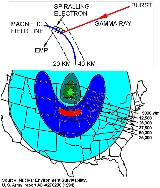
    Emp Mechanism
    Several major factors control the effectiveness of a nuclear EMP weapon. These are:
    1. The altitude of the weapon when detonated;
    2. The yield
      Nuclear weapon yield

      The explosive yield of a nuclear weapon is the amount of energy, called the yield, discharged when a nuclear weapon is detonated, expressed usually in the equivalent mass of trinitrotoluene , either in kilotons or megatons , but sometimes also in terajoules ....
       and construction details of the weapon;
    3. The distance from the weapon when detonated;
    4. Geographical depth or intervening geographical features;
    5. The local strength of the earth's magnetic field.


    Beyond a certain altitude a nuclear weapon will not produce any EMP, as the gamma rays will have had sufficient distance to disperse. In deep space or on worlds with no magnetic field (the moon or Mars for example) there will be little or no EMP. This has implications for certain kinds of nuclear rocket engines. See Project Orion
    Project Orion (nuclear propulsion)

    Project Orion was the first engineering design study of a spacecraft powered by nuclear pulse propulsion, an idea first proposed by Stanislaw Ulam in 1947....
    .

    Weapon altitude

    High Altitude Emp2
    According to an internet primer published by the Federation of American Scientists
    Federation of American Scientists

    The Federation of American Scientists is a non-profit organization formed in 1945 by scientists from the Manhattan Project who felt that scientists, engineers and other innovators had an ethical obligation to bring their knowledge and experience to bear on critical national decisions....


    A high-altitude nuclear detonation produces an immediate flux
    Flux

    In the various subfields of physics, there exist two common usages of the term flux, both with rigorous mathematical frameworks.*In the study of transport phenomena , flux is defined as the amount that flows through a unit area per unit time....
     of gamma ray
    Gamma ray

    Gamma rays are a form of electromagnetic radiation produced by atom particle interactions, such as electron-positron annihilation or radioactive decay....
    s from the nuclear reactions within the device. These photon
    Photon

    In physics, the photon is an elementary particle, the quantum of the electromagnetic field and the basic unit of light and all other forms of electromagnetic radiation....
    s in turn produce high energy free electron
    Electron

    The electron is a subatomic particle that carries a negative electric charge. It has elementary particle and is believed to be a point particle....
    s by Compton scattering
    Compton scattering

    In physics, Compton scattering or the Compton effect is the decrease in energy of an X-ray or gamma ray photon, when it interacts with matter....
     at altitudes between (roughly) 20 and 40 km. These electrons are then trapped in the Earth's magnetic field
    Earth's magnetic field

    Earth's magnetic field is approximately a magnetic dipole, with one magnetic pole near the north pole and the other near the geographic south pole ....
    , giving rise to an oscillating electric current
    Electric current

    Electric current is the flow of electric charge. The electric charge may be either electrons or ions.The International System of Units unit of electric current intensity is the ampere....
    . This current is asymmetric in general and gives rise to a rapidly rising radiated electromagnetic field
    Electromagnetic field

    The electromagnetic field is a physical field produced by electric charge. It affects the behavior of charged objects in the vicinity of the field....
     called an electromagnetic pulse (EMP). Because the electrons are trapped essentially simultaneously, a very large electromagnetic source radiates coherently
    Coherence (physics)

    In physics, coherence is a property of waves, that enables stationary interference. More generally, coherence describes all correlation properties between physical quantities of a wave....
    .


    The pulse can easily span continent-sized areas, and this radiation can affect systems on land, sea, and air. The first recorded EMP incident accompanied a high-altitude nuclear test over the South Pacific
    Australasia

    Australasia is a region of Oceania: New Zealand, Australia, Papua New Guinea, and neighbouring islands in the Pacific Ocean. The term was coined by Charles de Brosses in Histoire des navigations aux terres australes ....
     and resulted in power system failures as far away as Hawaii
    Hawaii

    File:Pahoehoe and Aa flows at Hawaii.jpgThe State of Hawaii is a U.S. state in the United States, located on an archipelago in the central Pacific Ocean southwest of the continental United States, southeast of Japan, and northeast of Australia....
    . A large device detonated at 400–500 km (250 to 312 miles) over Kansas
    Kansas

    The State of Kansas is a Midwestern U.S. state in the Central United States of the United States of America, an area often referred to as the United States "Heartland"....
     would affect all of the continental U.S. The signal from such an event extends to the visual horizon as seen from the burst point.


    Thus, for equipment to be affected, the weapon needs to be above the visual horizon
    Horizon

    The horizon is the apparent line that separates earth from sky.More precisely, it is the line that divides all of the directions one can possibly look into two categories: those which intersect the Earth's surface, and those which do not....
    . Because of the nature of the pulse as a large, long, high powered, noisy spike
    Voltage spike

    In electrical engineering, spikes are fast, short duration electrical transient s in voltage , current , or transferred energy in an electrical circuit....
    , it is doubtful that there would be much protection if the explosion were seen in the sky just below the tops of hills or mountains.

    The altitude indicated above is greater than that of the International Space Station
    International Space Station

    The International Space Station is a research facility Assembly of the International Space Station in outer space. On-orbit construction of the station began in 1998, and is scheduled to be complete by 2011, with operations continuing until around 2015....
     and many low Earth orbit
    Low Earth orbit

    A Low Earth Orbit is generally defined as an orbit within the Locus extending from the Earth?s surface up to an altitude of 2,000 km. Given the rapid orbital decay of objects below approximately 200 km, the commonly accepted definition for LEO is between 160 - 2,000 km above the Earth surface....
     satellites. Large weapons could have a dramatic impact on satellite
    Satellite

    In the context of spaceflight, a satellite is an Physical body which has been placed into orbit by human endeavor. Such objects are sometimes called artificial satellites to distinguish them from natural satellites such as the Moon....
     operations and communications; smaller weapons have less such potential.

    Weapon yield


    Typical nuclear weapon yield
    Nuclear weapon yield

    The explosive yield of a nuclear weapon is the amount of energy, called the yield, discharged when a nuclear weapon is detonated, expressed usually in the equivalent mass of trinitrotoluene , either in kilotons or megatons , but sometimes also in terajoules ....
    s used during Cold War
    Cold War

    The Cold War was the continuing state of conflict, tension and competition that existed between a number of world powers, including the United States, the Soviet Union, People's Republic of China, France, United Kingdom and those countries' respective allies from the mid-1940s to the early 1990s....
     planning for EMP attacks were in the range of 1 to 10 megatons. This is roughly 50 to 500 times the sizes of the weapons the United States
    United States

    The United States of America is a Federal government constitutional republic comprising U.S. state and a federal district. The country is situated mostly in central North America, where its Contiguous United States and Washington, D.C., the Capital districts and territories, lie between the Pacific Ocean and Atlantic Oceans, Borders of the U...
     used in Japan
    Japan

    Japan is an island country in East Asia. Located in the Pacific Ocean, it lies to the east of the Sea of Japan, People's Republic of China, North Korea, South Korea and Russia, stretching from the Sea of Okhotsk in the north to the East China Sea and Taiwan in the south....
     at Hiroshima
    Hiroshima

    The Japanese city of is the capital of Hiroshima Prefecture, and the largest city in the Chugoku region of western Honshu, the largest of Japan's islands....
     and Nagasaki. Physicists have testified at United States Congressional hearings, however, that weapons with yields of 10 kilotons or less can produce a very large EMP.

    The EMP at a fixed distance from a nuclear weapon does not depend directly on the yield but at most only increases as the square root of the yield (see illustration above). This means that although a 10 kiloton weapon has only 0.7% of the total energy release of the 1.44 megaton Starfish Prime
    Starfish Prime

    Starfish Prime was a high altitude nuclear explosion conducted by the United States of America on July 9, 1962, a joint effort of the Defense Atomic Support Agency and the United States Atomic Energy Commission ....
     test, the EMP will be at least 8% as powerful. Since the E1 component of nuclear EMP depends on the prompt gamma ray output, which was only 0.1% of yield in Starfish Prime
    Starfish Prime

    Starfish Prime was a high altitude nuclear explosion conducted by the United States of America on July 9, 1962, a joint effort of the Defense Atomic Support Agency and the United States Atomic Energy Commission ....
     but can be 0.5% of yield in pure fission weapons of low yield, a 10 kiloton bomb can easily be 5 x 8% = 40% as powerful as the 1.44 megaton Starfish Prime
    Starfish Prime

    Starfish Prime was a high altitude nuclear explosion conducted by the United States of America on July 9, 1962, a joint effort of the Defense Atomic Support Agency and the United States Atomic Energy Commission ....
     at producing EMP.

    The total prompt gamma ray energy in a fission explosion is 3.5% of the yield, but in a 10 kiloton detonation the high explosive around the bomb core absorbs about 85% of the prompt gamma rays, so the output is only about 0.5% of the yield in kilotons. In the thermonuclear Starfish Prime
    Starfish Prime

    Starfish Prime was a high altitude nuclear explosion conducted by the United States of America on July 9, 1962, a joint effort of the Defense Atomic Support Agency and the United States Atomic Energy Commission ....
     the fission yield was less than 100% to begin with, and then the thicker outer casing absorbed about 95% of the prompt gamma rays from the pusher around the fusion stage. Thermonuclear weapons are also less efficient at producing EMP because the first stage can pre-ionise the air which becomes conductive and hence rapidly shorts out the electron Compton currents generated by the final, larger yield thermonuclear stage. Hence, small pure fission weapons with thin cases are far more efficient at causing EMP than most megaton bombs.

    This analysis, however, only applies to the fast E1 and E2 components of nuclear EMP. The geomagnetic storm
    Geomagnetic storm

    A geomagnetic storm is a temporary disturbance of the Earth's magnetosphere caused by a disturbance in space weather. Associated with solar coronal mass ejections , coronal holes, or solar flares, a geomagnetic storm is caused by a solar wind shock wave which typically strikes the Earth's magnetic field 24 to 36 hours after the event....
    -like E3 component of nuclear EMP is more closely proportional to the total energy yield of the weapon.


    Weapon distance


    Emp Areas
    A unique and important aspect of nuclear EMP is that all of the components of the electromagnetic pulse are generated outside of the weapon. The important E1 component is generated by interaction with the electrons in the upper atmosphere that are hit by gamma radiation from the weapon -- and the subsequent effects upon those electrons by the earth's magnetic field
    Earth's magnetic field

    Earth's magnetic field is approximately a magnetic dipole, with one magnetic pole near the north pole and the other near the geographic south pole ....
    .

    For high-altitude nuclear explosions
    High altitude nuclear explosion

    High altitude nuclear explosions have historically been nuclear explosions which take place above altitudes of 50 km, still inside the Earth's atmosphere....
    , this means that the much of the EMP is actually generated at a large distance from the detonation (where the gamma radiation from the explosion hits the upper atmosphere). This causes the electric field from the EMP to be remarkably uniform over the large area affected.

    According to the standard reference text on nuclear weapons effects published by the U.S. Department of Defense, "The peak electric field (and its amplitude) at the earth's surface from a high-altitude burst will depend upon the explosion yield, the height of the burst, the location of the observer, and the orientation with respect to the geomagnetic field.   As a general rule, however, the field strength may be expected to be tens of kilovolts per meter over most of the area receiving the EMP radiation."

    The same reference book also states that, ". . . over most of the area affected by the EMP the electric field strength on the ground would exceed 0.5Emax.   For yields of less than a few hundred kilotons, this would not necessarily be true because the field strength at the earth's tangent could be substantially less than 0.5Emax."


    In other words, the electric field strength in the entire area that is affected by the EMP will be fairly uniform for weapons with a large gamma ray output; but for much smaller weapons, the electric field may fall off at a comparatively faster rate at large distances from the detonation point.

    It is the peak electric field of the EMP that determines the peak voltage induced in equipment and other electrical conductors on the ground, and most of the damage is determined by induced voltages.

    (For nuclear detonations within the atmosphere, the situation is more complex. Within the range of gamma ray deposition, simple laws no longer hold as the air is ionised and there are other EMP effects such as a radial electric field due to the separation of Compton electron
    Compton scattering

    In physics, Compton scattering or the Compton effect is the decrease in energy of an X-ray or gamma ray photon, when it interacts with matter....
    s from air molecules, together with other complex phenomena. For a surface burst, absorption of gamma rays by air would limit the range of gamma ray deposition to approximately 10 miles, while for a burst in the lower-density air at high altitudes, the range of deposition would be far greater.)

    Non-nuclear electromagnetic pulse

    Non-nuclear electromagnetic pulse (NNEMP) is an electromagnetic pulse generated without use of nuclear weapons. There are a number of devices that can achieve this objective, ranging from a large low-inductance capacitor
    Capacitor

    A capacitor or condenser is a Passive component electronic component consisting of a pair of electrical conductor separated by a dielectric....
     bank discharged into a single-loop antenna or a microwave generator to an explosively pumped flux compression generator
    Explosively pumped flux compression generator

    An explosively pumped flux compression generator is a device used to generate a high-power electromagnetic pulse by compressing magnetic flux using high explosive....
    . To achieve the frequency characteristics of the pulse needed for optimal coupling
    Coupling (electronics)

    In electronics and telecommunication, coupling is the desirable or undesirable transfer of energy from one Transmission medium, such as a metallic wire or an optical fiber, to another medium, including fortuitous transfer....
     into the target, wave-shaping circuits and/or microwave generators are added between the pulse source and the antenna
    Antenna (radio)

    An 'antenna' is a transducer designed to transmitter or receive Electromagnetic radiations. In other words, antennas convert electromagnetic waves into electrical currents and vice versa....
    . A vacuum tube particularly suitable for microwave conversion of high energy pulses is the vircator
    Vircator

    A vircator is a microwave generator that is capable of generating brief pulses of tunable, narrow band microwaves at very high power levels....
    .

    NNEMP generators can be carried as a payload of bombs and cruise missiles, allowing construction of electromagnetic bomb
    Electromagnetic bomb

    An electromagnetic bomb or E-bomb is a weapon designed to disable electronics with an electromagnetic pulse that can couple with electrical/electronic systems to produce damaging current and voltage surges by electromagnetic induction....
    s with diminished mechanical, thermal and ionizing radiation effects and without the political consequences of deploying nuclear weapons.

    NNEMP generators also include large structures built to generate EMP for testing of electronics to determine how well it survives EMP. In addition, the use of ultra-wideband radars can generate EMP in areas immediately adjacent to the radar; this phenomenon is only partly understood.

    Information about the EMP simulators used by the United States during the latter part of the Cold War
    Cold War

    The Cold War was the continuing state of conflict, tension and competition that existed between a number of world powers, including the United States, the Soviet Union, People's Republic of China, France, United Kingdom and those countries' respective allies from the mid-1940s to the early 1990s....
     are now in papers under the care of the SUMMA Foundation, which is now hosted at the University of New Mexico.

    The SUMMA Foundation web site includes documentation about the huge wooden Trestle simulator in New Mexico, which was the world's largest EMP simulator; and which used a specialized version of a Marx generator
    Marx generator

    A Marx generator is a type of electrical circuit first described by Erwin Otto Marx in 1924 whose purpose is to generate a high-voltage pulse. It is extensively used for simulating the effects of lightning during high voltage and aviation equipment testing....
    .


    Modern scenarios


    Typical modern scenarios seen in news accounts speculate about the use of nuclear weapons by rogue state
    Rogue state

    Rogue state is a term applied by some international theorists to states considered threatening to the world's peace. This means meeting certain criteria, such as being ruled by authoritarianism regimes that severely restrict human rights, sponsor terrorism, and seek to proliferation weapons of mass destruction....
    s or terrorists in an EMP attack. Details of such scenarios are always controversial. It is impossible to know what kind of capabilities such terrorists might acquire, especially if they are aided by state sponsors with access to advanced technology.

    Some rogue state
    Rogue state

    Rogue state is a term applied by some international theorists to states considered threatening to the world's peace. This means meeting certain criteria, such as being ruled by authoritarianism regimes that severely restrict human rights, sponsor terrorism, and seek to proliferation weapons of mass destruction....
    s have developed an ability to deliver a light missile payload to the necessary altitude for an EMP attack. Nuclear weapons in general have a much heavier missile payload, however advanced weapons design enables larger weapon yields with lighter weight. It is difficult to know if any particular rogue state has the necessary combination of advanced missile technology and nuclear weapons technology to perform an effective nuclear EMP attack over an industrialized country.

    A common scenario is the detonation of a device over the middle of the U.S. using long-range missiles that have historically been available only to major military powers. An offshore detonation at high altitude, by contrast, would present less technical difficulty and would disrupt both an entire coast and regions hundreds of miles inland (e.g. 120 mile altitude, 1,000 mile EMP radius
    Electromagnetic pulse

    The term electromagnetic pulse has the following meanings:# Electromagnetic radiation from an explosion or an intensely change magnetic field caused by Compton scattering electrons and photoelectrons from photons scattering in the materials of the electronic or explosive device or in a surrounding Transmission medium....
    ).

    United States EMP Commission


    The United States EMP Commission was authorized by the United States Congress in Fiscal Year 2001, and re-authorized in Fiscal Year 2006. The commission is formally known as the Commission to Assess the Threat to the United States from Electromagnetic Pulse (EMP) Attack.

    The United States EMP Commission has brought together a group of notable scientists and technologists to compile several reports. In 2008, the EMP Commission released the Critical National Infrastructures Report. This report describes, in as much detail as practical, the likely consequences of a nuclear EMP on civilian infrastructures. Although this report was directed specifically toward the United States, most of the information can obviously be generalized to the civilian infrastructure of other industrialized countries.

    The 2008 report was a followup to a more generalized report issued by the commission in 2004.

    Common misconceptions


    Non-technical writings about nuclear EMP, both in print and on the internet, quite often contain some very common misconceptions about EMP. Although these misconceptions usually contain an element of truth, they lead to a very considerable amount of confusion about the subject.

    Such misconceptions include:

    (1) Nuclear EMP is caused by a nuclear explosion in the atmosphere.   The fact: Although it is true that a nuclear explosion in the atmosphere produces a strong electromagnetic pulse, the range of the EMP is extremely limited compared to the EMP produced by a nuclear explosion in space. (See the discussion above in the "Weapon altitude" and "Weapon distance" sections.) The statement about EMP as a result of a nuclear explosion in the atmosphere (or an air burst) is very commonly made when the writer is actually referring to a nuclear explosion above the atmosphere.   The lack of public understanding of the importance of the relationship of altitude to weapon effects is a longstanding problem. The standard reference text on nuclear weapon effects published by the U.S. Department of Defense discusses this relationship extensively in the first two chapters, and provides mutually-exclusive definitions for phrases such as "air burst" and "high-altitude burst."

    (2) EMP is produced directly by special EMP weapons.   The fact: This statement is only true about special types of non-nuclear EMP weapons of limited range (as discussed in the NNEMP section above).   The statement is commonly made when referring to nuclear EMP.   Electromagnetic pulse is a prompt secondary effect of a nuclear explosion, and nearly all of the nuclear EMP is produced outside of the weapon.   (All nuclear weapons can produce EMP as a secondary effect, but the effect can be enhanced by special weapon design.)

    (3) The only defense against nuclear EMP is a ballistic missile defense system.   The fact: Although an anti-ballistic missile system can be a component of protection against nuclear EMP, it is seldom mentioned in the writings of scientists or the testimony of members of the United States EMP Commission. The experts on the EMP problem tend to concentrate upon making electronic equipment and electrical components resistant to EMP and upon keeping adequate spare parts on hand, and in the proper location, to enable prompt repairs to be made.

    (4) EMP requires the use of very large thermonuclear weapons.   The fact: This misconception continues to persist, and it contains an element of truth only because the E3 component of the pulse is roughly proportional to weapon yield.   Thermonuclear weapons are very inefficient in producing the fast E1 component of EMP.   (See the discussion in the "Weapon yield" section above.) Large thermonuclear weapons produce large energy yields through a multi-stage process. This multi-stage process is completed within a small fraction of a second, but it nevertheless requires a finite length of time. The first fission reaction is usually of relatively small yield, and the gamma rays that it produces pre-ionize the molecules of the upper atmosphere. This pre-ionization causes the gamma ray emission from the high-energy final fission explosion of the thermonuclear weapon (a fraction of a second later) to be relatively ineffective at producing a large E1 pulse. (See the blue pre-ionization curve in the "Peak Electric Field at Ground Zero" graph above.)

    (5) Nuclear EMP is not a problem because there are ways to protect against it.   The fact: Although there are ways to protect against nuclear EMP (or to quickly begin repairs where protection is not practical), the United States EMP Commission determined that such protections are almost completely absent in the civilian infrastructure of the United States, and that even large sectors of the United States military services were no longer protected against EMP to the level that they were during the Cold War. The United States EMP Commission did not look at the civilian infrastructures of other nations.

    See also

    • High Energy Radio Frequency weapons (HERF)
    • Explosively pumped flux compression generator
      Explosively pumped flux compression generator

      An explosively pumped flux compression generator is a device used to generate a high-power electromagnetic pulse by compressing magnetic flux using high explosive....
    • Transient electromagnetic device
    • Electromagnetic environment
      Electromagnetic environment

      In telecommunication, the term electromagnetic environment has the following meanings:1. For a telecommunications system, the spatial distribution of electromagnetic fields surrounding a given site....
    • Electromagnetic bomb
      Electromagnetic bomb

      An electromagnetic bomb or E-bomb is a weapon designed to disable electronics with an electromagnetic pulse that can couple with electrical/electronic systems to produce damaging current and voltage surges by electromagnetic induction....
    • Electromagnetism
      Electromagnetism

      Electromagnetism is the physics of the electromagnetic field, a field which exerts a force on Elementary particles with the property of electric charge and which is reciprocally affected by the presence and motion of such particles....
    • Pulsed power
      Pulsed power

      Pulsed power is the term used to describe the science and technology of accumulating energy over a relatively long period of time and releasing it very quickly thus increasing the instantaneous power....
    • Faraday's law of induction
      Faraday's law of induction

      Faraday's law of induction describes a basic law of electromagnetism, which is involved in the working of transformers, inductors, and many forms of electrical generators....
    • Marx generator
      Marx generator

      A Marx generator is a type of electrical circuit first described by Erwin Otto Marx in 1924 whose purpose is to generate a high-voltage pulse. It is extensively used for simulating the effects of lightning during high voltage and aviation equipment testing....

    External links

    • – U.S. Army Corps of Engineers