
All Topics  
Anti-satellite weapon

 
Anti Satellite Weapon

   Email Print
   Bookmark   Link


Anti-satellite weapon


Anti-satellite weapons (ASATs) are space weapon
Space weapon

Space weapons are weapons used in space warfare. They include weapons that can attack space systems in orbit , attack targets on the earth from space or disable missiles travelling through space....
s designed to incapacitate or destroy satellite
Satellite

In the context of spaceflight, a satellite is an Physical body which has been placed into orbit by human endeavor. Such objects are sometimes called artificial satellites to distinguish them from natural satellites such as the Moon....
s for strategic military purposes. Currently, only the USA, the former USSR (now Russia
Russia

Russia , or the Russian Federation , is a list of countries spanning more than one continent country extending over much of northern Eurasia....
) and the People's Republic of China
People's Republic of China

The People's Republic of China , commonly known as China, is the largest country in East Asia and the List of countries by population in the world with over 1.3 billion people, approximately a fifth of the world's population....
 are known to have developed these weapons. On January 11, 2007, China destroyed an old orbiting weather satellite. The United States also destroyed a malfunctioning reconnaissance satellite on February 21, 2008.

development and design of anti-satellite weapons has followed a number of paths.


Discussion
Ask a question about 'Anti-satellite weapon'
Start a new discussion about 'Anti-satellite weapon'
Answer questions from other users
Full Discussion Forum


Encyclopedia


Anti-satellite weapons (ASATs) are space weapon
Space weapon

Space weapons are weapons used in space warfare. They include weapons that can attack space systems in orbit , attack targets on the earth from space or disable missiles travelling through space....
s designed to incapacitate or destroy satellite
Satellite

In the context of spaceflight, a satellite is an Physical body which has been placed into orbit by human endeavor. Such objects are sometimes called artificial satellites to distinguish them from natural satellites such as the Moon....
s for strategic military purposes. Currently, only the USA, the former USSR (now Russia
Russia

Russia , or the Russian Federation , is a list of countries spanning more than one continent country extending over much of northern Eurasia....
) and the People's Republic of China
People's Republic of China

The People's Republic of China , commonly known as China, is the largest country in East Asia and the List of countries by population in the world with over 1.3 billion people, approximately a fifth of the world's population....
 are known to have developed these weapons. On January 11, 2007, China destroyed an old orbiting weather satellite. The United States also destroyed a malfunctioning reconnaissance satellite on February 21, 2008.

History

The development and design of anti-satellite weapons has followed a number of paths. The initial efforts by the USA
United States

The United States of America is a Federal government constitutional republic comprising U.S. state and a federal district. The country is situated mostly in central North America, where its Contiguous United States and Washington, D.C., the Capital districts and territories, lie between the Pacific Ocean and Atlantic Oceans, Borders of the U...
 and the USSR
Soviet Union

The Union of Soviet Socialist Republics was a Constitution of the Soviet Union socialist state that existed in Eurasia from 1922 to 1991.The name is a translation of the , romanization of Russian Soyuz Sovetskikh Sotsialisticheskikh Respublik, abbreviated ????, SSSR....
 were using ground-launched missile
Missile

A guided missile is a self-propelled projectile used as a weapon. Missiles are typically propelled by rockets or jet engines. Missiles generally have one or more explosive warheads, although other weapon types may also be used....
s from the 1950s; many more exotic proposals came afterwards.

US Programs

Asat Missile 20040710 150339 1
Asat Missile Launch
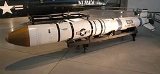
In the late 1950s the US Air Force started a series of advanced strategic missile projects under the designation Weapon System WS-199A. One of the projects studied under the 199A umbrella was Martin
Glenn L. Martin Company

The Glenn L. Martin Company was an early United States aircraft company founded by aviation pioneer Glenn Luther Martin. The company went through a number of mergers over time and now exists as Lockheed Martin....
's Bold Orion air-launched ballistic missile
Air-launched ballistic missile

An air-launched ballistic missile or ALBM is a ballistic missile launched from an aircraft. This class of missile never saw active use. The only known missile of this type, the AGM-48 Skybolt, intended to be launched from a B-52 Stratofortress bomber, was in development by the United States Air Force, with Great Britain as a customer....
 (ALBM) for the B-47 Stratojet
B-47 Stratojet

The Boeing B-47 Stratojet jet bomber was a medium-range and medium-size bomber capable of flying at high subsonic speeds and primarily designed for penetrating the airspace of the Soviet Union....
, based on the rocket motor from the Sergeant missile
MGM-29 Sergeant

The MGM-29 Sergeant was an American short-range, Solid rocket, surface-to-surface missile developed at the Jet Propulsion Laboratory. Activated by the US Army in 1962 to replace the MGM-5 Corporal it was deployed overseas by 1963, carrying the W52 nuclear warhead or alternatively one of high explosives....
. Twelve test launches were carried out between 26 May 1958 and 13 October 1959, but these were generally unsuccessful and further work as an ALBM ended. The system was then modified with the addition of an Altair upper stage to create an anti-satellite weapon with a 1100 mile (1700 km) range. Only one test flight of the anti-satellite mission was carried out, making a mock attack on the Explorer VI at an altitude of . To record its flight path, the Bold Orion transmitted telemetry to the ground, ejected flares to aid visual tracking, and was continuously tracked by radar. The missile successfully passed within of the satellite, which would be suitable for use with a nuclear weapon, but useless for conventional warheads.

A similar project carried out under 199A, Lockheed's High Virgo, was initially another ALBM for the B-58 Hustler
B-58 Hustler

The Convair B-58 Hustler was the first operational jet bomber capable of Mach 2 supersonic flight. The aircraft was developed for the United States Air Force for service in the Strategic Air Command during the late 1950s....
, likewise based on the Sergeant. It too was adapted for the anti-satellite role, and made an attempted intercept on Explorer V on 22 September 1959. However, shortly after launch communications with the missile were lost and the camera packs could not be recovered to see if the test was successful. In any event, work on the WS-199 projects ended with the start of the AGM-48 Skybolt
AGM-48 Skybolt

The Douglas GAM-87A Skybolt was an air-launched ballistic missile developed during the late 1950s. It was intended to provide a mobile basing for the USAF's ICBM missile force by mounting them on heavy bombers rather than in fixed missile silos....
 project. Simultaneous U.S. Navy
United States Navy

The United States Navy is the navy of the United States Armed Forces. It is one of the seven uniformed services of the United States. The U.S. Navy currently has approximately 331,682 personnel on active duty as of 31 December 2008 and 124,000 in the United States Navy Reserve....
 projects were also abandoned although smaller projects did drag on until the early 1970s.

The use of high altitude nuclear explosion
High altitude nuclear explosion

High altitude nuclear explosions have historically been nuclear explosions which take place above altitudes of 50 km, still inside the Earth's atmosphere....
s to destroy satellites was considered after the tests of the first conventional missile systems in the 1960s. During the Hardtack Teak
Hardtack Teak

HARDTACK-Teak was an wiktionary:exoatmospheric nuclear weapon high altitude nuclear explosion performed during Operation Hardtack I. On 1 August, 1958, the shot reached an altitude of 78 km....
 test in 1958 observers noted the damaging effects of the electromagnetic pulse
Electromagnetic pulse

The term electromagnetic pulse has the following meanings:# Electromagnetic radiation from an explosion or an intensely change magnetic field caused by Compton scattering electrons and photoelectrons from photons scattering in the materials of the electronic or explosive device or in a surrounding Transmission medium....
 (EMP) caused by the explosions on electronic equipment, and during the Starfish Prime
Starfish Prime

Starfish Prime was a high altitude nuclear explosion conducted by the United States of America on July 9, 1962, a joint effort of the Defense Atomic Support Agency and the United States Atomic Energy Commission ....
 test in 1962 the EMP from a 1.4 Mt warhead detonated over the Pacific damaged three satellites and also disrupted power transmission and communications across the Pacific. Further testing of weapons effects was carried out under the DOMINIC I series. An adapted version of the nuclear armed Nike Zeus
Project Nike

Project Nike was a United States Army project, proposed in May 1945 by Bell Labs, to develop a line-of-sight anti-aircraft missile system. The project delivered the United States' first operational anti-aircraft missile system in 1953, the #Nike Ajax....
 was used for an ASAT from 1962. Codenamed Mudflap, the missile was designated DM-15S and a single missile was deployed at the Kwajalein
Kwajalein

Kwajalein Atoll is part of the Republic of the Marshall Islands . The southernmost and largest island in the atoll is named Kwajalein Island....
 atoll until 1966 when the project was ended in favour of the USAF Thor-based Program 437
Program 437

Program 437 was the second Anti-satellite weapon weapons program of the Military of the United States. The US anti-satellite weapons program began development in the early 1960s and was officially discontinued on 1 April, 1975....
 ASAT which was operational until 6 March 1975.

Another area of research was into directed energy weapons, including a nuclear-explosion powered X-ray laser proposal developed at Lawrence Livermore National Laboratory
Lawrence Livermore National Laboratory

The Lawrence Livermore National Laboratory in Livermore, California is a scientific research laboratory founded by the University of California in 1952....
 (LLNL) in 1968. Other research was based on more conventional laser
Laser

A laser is a device that emits light through a process called stimulated emission. The term laser is an acronym for light amplification by stimulated emission of radiation....
s or maser
Maser

A maser is a device that produces coherence electromagnetic waves through amplification due to stimulated emission. Historically the term came from the acronym "Microwave Amplification by Stimulated Emission of Radiation", although modern masers emit over a broad portion of the electromagnetic spectrum....
s and developed to include the idea of a satellite with a fixed laser and a deployable mirror for targeting. LLNL continued to consider more edgy technology but their X-ray laser system development was cancelled in 1977 (although research into X-ray lasers was resurrected during the 1980s as part of the SDI
Strategic Defense Initiative

The Strategic Defense Initiative was a proposal by U.S. President Ronald Reagan on March 23, 1983 to use ground and space-based systems to protect the United States from attack by strategic nuclear weapon ballistic missiles....
).

ASATs were generally given low priority until 1982, when information about a successful USSR program became widely known in the west. A "crash program" followed, which developed into the Vought
Vought

Vought is the name of several related aerospace firms. These have included, in the past, Lewis and Vought Corporation, Chance Vought, Vought Sikorsky, LTV Aerospace , Vought Aircraft Companies, and the current Vought Aircraft Industries....
 ASM-135 ASAT
ASM-135 ASAT

The ASM-135 ASAT is an Air launch Anti-satellite weapon multistage rocket missile that was developed by Vought. The ASM-135 was carried exclusively by the US Air Force 's F-15 Eagle fighter aircraft....
, based on the AGM-69 SRAM
AGM-69 SRAM

The Boeing AGM-69 SRAM was a nuclear weapon air-to-surface missile designed to replace the older AGM-28 Hound Dog stand-off missile.The requirement for the weapon was issued by the Strategic Air Command of the USAF in 1964, and the resultant AGM-69A SRAM entered service in 1972....
 with an Altair upper stage. The system was carried on a modified F-15 that carried the missile directly under the central line of the plane. The F-15's guidance system was modified for the mission and provided new directional cueing through the pilot's heads up display, and allowed for mid-course updates via a data link
Data link

In telecommunication a data link is the means of connecting one location to another for the purpose of transmitting and receiving digital information....
. The first launch of the new anti-satellite missile took place in January 1984. The first, and only, successful interception was on September 13, 1985. The F-15 took off from Edwards Air Force Base, climbed to and vertically launched the missile at the Solwind P78-1, a US gamma ray spectroscopy satellite orbiting at 555 km, which was launched in 1979. Although successful, the program was cancelled in 1988.

USSR/Russia


The origins of the Soviet ASAT program are unclear. According to some accounts, Sergei Korolev started some work on the concept in 1956 at his OKB-1, while others attribute the work to Vladimir Chelomei
Vladimir Chelomei

File:Vladimir Chelomei.jpgVladimir Nikolayevich Chelomei was a Soviet Union mechanics scientist and rocket engineer....
's OKB-52 around 1959. What is certain is that at the beginning of April 1960, Nikita Khrushchev
Nikita Khrushchev

Nikita Sergeyevich Khrushchev served as General Secretary of the Communist Party of the Soviet Union of the Communist Party of the Soviet Union from 1953 to 1964, following the death of Joseph Stalin, and Premier of the Soviet Union from 1958 to 1964....
 held a meeting at his summer residence in Crimea, discussing an array of defense industry issues. Here, Chelomei outlined his rocket and spacecraft program, and received a go-ahead to start development of the UR-200
UR-200

The UR-200 was an intercontinental ballistic missile developed by OKB-52 of Vladimir Chelomei in the Soviet Union. It was known during the Cold War by the NATO reporting name SS-10 Scrag and internally by the GRAU index 8K81....
 rocket, one of its many roles being the launcher for his anti-satellite project. The decision to start work on the weapon was made in March 1961 as the Istrebitel Sputnikov (IS) (Interceptor of satellites, or literally "Destroyer of satellites").

The IS system was "co-orbital", approaching its target over time and then exploding a shrapnel warhead close enough to kill it. The missile was launched when a target satellite's ground track rises above the launch site. Once the satellite is detected, the missile is launched into orbit close to the targeted satellite. It takes 90 to 200 minutes (or one to two orbits) for the missile interceptor to get close enough to its target. The missile is guided by an onboard radar. The interceptor, which weighs 1400 kg, may be effective up to one kilometer from a target.

Delays in the UR-200 missile program prompted Chelomei to request R-7 rockets for prototype testing of the IS. Two such tests were carried out on November 1, 1963 and April 12, 1964. Later in the year Khrushchev cancelled the UR-200 in favor of the R-36, forcing the IS to switch to this launcher, who's space launcher version was developed as the Tsyklon 2. Delays in that program led to the introduction of a simpler version, the 2A, which launched its first IS test on October 27, 1967, and a second on April 28, 1968. Further tests carried out against a special target spacecraft, the DS-P1-M, which recorded hits by the IS warhead's shrapnel. A total of 23 launches have been identified as being part of the IS test series. The system was declared operational in February 1973.

Testing resumed in 1976 as a result of the US work on the Space Shuttle
Space Shuttle

NASA's Space Shuttle, officially called the Space Transportation System , is the spacecraft currently used by the United States government for its human spaceflight missions....
. Elements within the Soviet space industry convinced Leonid Brezhnev
Leonid Brezhnev

Leonid Ilyich Brezhnev was General Secretary of the Communist Party of the Soviet Union from 1964 to 1982, serving in that position longer than anyone other than Joseph Stalin....
 that the Shuttle was a single-orbit weapon that would be launched from Vandenberg, maneuver to avoid existing anti-ballistic missile sites, bomb Moscow in a first strike, and then land. Although the Soviet military was aware these claims were false, Brezhnev believed them and ordered a resumption of IS testing along with a Shuttle of their own. As part of this work the IS system was expanded to allow attacks at higher altitudes and was declared operational in this new arrangement on July 1, 1979. However, in 1983, Yuri Andropov
Yuri Andropov

Yuri Vladimirovich Andropov was a Soviet Union politician and General Secretary of the Communist Party of the Soviet Union of the Communist Party of the Soviet Union from 12 November 1982 until his death fifteen months later....
 ended all IS testing and all attempts to resume it failed. Ironically, it was at about this point that the US started its own testing in response to the Soviet program.

The Soviet Union also experimented with large, ground-based ASAT lasers from the 1970s onwards (see Terra-3
Terra-3

Terra-3 is a laser testing centre, located on the Sary Shagan anti-ballistic missile testing range in Karagandy Province of Kazakhstan. ...
), with a number of US spysats reportedly being 'blinded' (temporarily) during the 70s and 80s. The USSR had also researched directed energy weapons, under the Fon project from 1976, but the technical requirements needed of the high-powered gas dynamic lasers and neutral or charged particle beam systems seemed to be beyond reach. The USSR also experimented with military space stations with a capability for anti-satellite duty in its Almaz
Almaz

The Almaz program was a series of military space stations launched by the Soviet Union under cover of the civilian Salyut DOS-17K program after 1971....
 program.

In the early 80s, the Soviet Union also started developing a counterpart to the US air-launched ASAT system, using modified MiG-31 'Foxhounds'
Mikoyan MiG-31

For the fictional aircraft of the novel and movie Firefox , see Fictional military aircraft#Mikoyan MiG-31 .The Mikoyan MiG-31 is a supersonic interceptor aircraft developed to replace the Mikoyan-Gurevich MiG-25....
 (at least six of which were completed) as the launch platform.

ASAT in the era of Strategic Defense


The era of the Strategic Defense Initiative
Strategic Defense Initiative

The Strategic Defense Initiative was a proposal by U.S. President Ronald Reagan on March 23, 1983 to use ground and space-based systems to protect the United States from attack by strategic nuclear weapon ballistic missiles....
 (proposed in 1983) focused primarily on the development of systems to defend against nuclear warheads, however, some of the technologies developed may be useful also for antisatellite use.

After the Soviet Union collapsed, there were proposals to use this aircraft as a launch platform for lofting commercial and science packages into orbit. Recent political developments (see below) may have seen the reactivation of the Russian Air-Launched ASAT program, although there is no confirmation of this as yet.

The Strategic Defense Initiative gave the US and Russian ASAT programs a major boost; ASAT projects were adapted for ABM
Anti-ballistic missile

An anti-ballistic missile is a missile designed to counter ballistic missiles . A ballistic missile is used to deliver nuclear weapon, Chemical warfare, Biological warfare or conventional warheads in a ballistics flight trajectory....
 use and the reverse was also true. The initial US plan was to use the already developed MHV as the basis for a space based constellation of about 40 platforms deploying up to 1,500 kinetic interceptors. By 1988 the US project had evolved into an extended four stage development. The initial stage would consist of the Brilliant Pebbles
Strategic Defense Initiative

The Strategic Defense Initiative was a proposal by U.S. President Ronald Reagan on March 23, 1983 to use ground and space-based systems to protect the United States from attack by strategic nuclear weapon ballistic missiles....
 defense system, a satellite constellation
Satellite constellation

A group of Electronics satellites working in concert is known as a satellite constellation. Such a constellation can be considered to be a number of satellites with coordinated ground coverage, operating together under shared control, synchronised so that they overlap well in coverage and complement rather than interfere with other satelli...
 of 4,600 kinetic interceptors (KE ASAT), of 100 lb (45 kg) each, in Low Earth orbit
Low Earth orbit

A Low Earth Orbit is generally defined as an orbit within the Locus extending from the Earth?s surface up to an altitude of 2,000 km. Given the rapid orbital decay of objects below approximately 200 km, the commonly accepted definition for LEO is between 160 - 2,000 km above the Earth surface....
, and their associated tracking systems. The next stage would deploy the larger platforms and the following phases would include the laser and charged particle beam weapons that would be developed by that time from existing projects such as MIRACL
MIRACL

MIRACL, or Mid-Infrared Advanced Chemical Laser, is the only known successful directed energy weapon developed by the US Navy. It is a hydrogen fluoride laser, a type of chemical laser....
. The first stage was intended to be completed by 2000 at a cost of around $125 billion.

Research in the US and Russia was proving that the requirements, at least for orbital based energy weapon systems, were, with available technology, close to impossible. Nonetheless, the strategic implications of a possible unforeseen breakthrough in technology forced the USSR to initiate massive spending on research in the 12th Five Year Plan
Five-Year Plan (USSR)

The Five-Year Plans for the National Economy of the USSR were a series of nation-wide centralized exercises in rapid economic development in the Soviet Union....
, drawing all the various parts of the project together under the control of GUKOS and matching the US proposed deployment date of 2000.

Both countries began to reduce expenditure from 1989 and the Russian Federation unilaterally discontinued all SDI research in 1992. Research and Development (both of ASAT systems and other space based/deployed weapons) has, however reported to have been resumed under the government of Vladimir Putin
Vladimir Putin

Vladimir Vladimirovich Putin was the second President of Russia and is the current Prime Minister of Russia as well as chairman of United Russia and Chairman of the Council of Ministers of the Union of Russia and Belarus....
 as a counter to renewed US Strategic Defense efforts post Anti-Ballistic Missile Treaty
Anti-Ballistic Missile Treaty

The Anti-Ballistic Missile Treaty was a treaty between the United States and the Soviet Union on the limitation of the anti-ballistic missile systems used in defending areas against missile-delivered nuclear weapons....
. However the status of these efforts, or indeed how they are being funded through National Reconnaissance Office
National Reconnaissance Office

The National Reconnaissance Office , located in Chantilly, Virginia, is one of the U.S. intelligence community in the U.S. It designs, builds and operates the reconnaissance satellites of the United States government....
 projects of record, remains unclear. The U.S. has begun working on a number of programs which could be foundational for a space-based ASAT. These programs include the Experimental Spacecraft System (XSS 11
XSS 11

XSS-11 was a small, low-cost spacecraft developed by the U.S. Air Force Research Laboratory Space Vehicles Directorate to test technology for proximity operations....
), the Near-Field Infrared Experiment (NFIRE), and the space-based interceptor (SBI).

2007 missile test by China

At 5:28 p.m. EST January 11, 2007, the People's Republic of China
People's Republic of China

The People's Republic of China , commonly known as China, is the largest country in East Asia and the List of countries by population in the world with over 1.3 billion people, approximately a fifth of the world's population....
 successfully destroyed a defunct Chinese weather satellite, FY-1C. The destruction was reportedly carried out by an SC-19 ASAT missile with a kinetic kill warhead similar in concept to the American Exoatmospheric Kill Vehicle
Exoatmospheric Kill Vehicle

Exoatmospheric Kill Vehicle can refer to two related missile defense concepts:* Most common: the Raytheon-manufactured interceptor component with subcontractor Aerojet of the U.S....
. FY-1C was a weather satellite orbiting Earth in polar orbit at an altitude of about 537 miles (865 km), with a mass of about 750 kg (1,650 lb). Launched in 1999, it was the fourth satellite in the Feng Yun series. The missile was launched from a mobile Transporter-Erector-Launcher (TEL) vehicle at Xichang
Xichang Satellite Launch Center

The Xichang Satellite Launch Center also known as Base 27 is a People's Republic of China space vehicle launch facility approximately 64 km northwest of Xichang City in Sichuan Province....
  and the warhead destroyed the satellite in a head-on collision at an extremely high relative velocity.

This test raised concerns in some other countries, partly because China did not publicly confirm whether or not the test had occurred until January 23, 2007 but mainly because of fears that it could prompt or accelerate an "arms race" in space. The EU stated that "...a test of an anti-satellite weapon is inconsistent with international efforts to avert an arms race in outer space and undermines security in outer space." . These concerns were also reflected in public statements from the governments of the United States, Canada, Australia and Japan. According to CNN, global security analysts stated at the time that the test was most likely aimed at the United States.

USA-193


USA-193 was an American
United States

The United States of America is a Federal government constitutional republic comprising U.S. state and a federal district. The country is situated mostly in central North America, where its Contiguous United States and Washington, D.C., the Capital districts and territories, lie between the Pacific Ocean and Atlantic Oceans, Borders of the U...
 spy satellite
Spy satellite

A spy satellite is an Earth observation satellite or communications satellite deployed for military or espionage applications. These are essentially Space observatory that are pointed toward the Earth instead of toward the stars....
, which was launched on 14 December 2006 by a Delta II
Delta II

Delta II is a space launch system originally designed and built by McDonnell Douglas. Delta II is part of the Delta rocket family and has been in service since 1989....
 rocket, from Vandenberg Air Force Base
Vandenberg Air Force Base

Vandenberg Air Force Base is a United States military installation with a spaceport, in Santa Barbara County, California, California, United States....
. It was reported about a month after launch that the satellite had failed. In January 2008, it was noted that the satellite was decaying from orbit
ORBit

ORBit is a Common Object Request Broker Architecture 2.4 compliant Object Request Broker . It features mature C , C++ and Python bindings, and less developed bindings for Perl, Lisp , Pascal , Ruby , and Tcl....
 at a rate of per day. On 14 February 2008, it was reported that the US Navy had been instructed to fire an SM-3 ABM
Anti-ballistic missile

An anti-ballistic missile is a missile designed to counter ballistic missiles . A ballistic missile is used to deliver nuclear weapon, Chemical warfare, Biological warfare or conventional warheads in a ballistics flight trajectory....
 weapon at it, to act as an anti-satellite weapon.

According to the US Government, the primary reason for destroying the satellite was the approximately . of toxic hydrazine
Hydrazine

Hydrazine is a chemical compound with the chemical formula N2H4. It is a colourless liquid with an ammonia-like odor and is derived from the same industrial chemistry processes that manufacture ammonia....
 fuel contained on board, which could pose health risks to persons in the immediate vicinity of the crash site should any significant amount survive the re-entry. On February 20, 2008, it was announced that the launch was carried out successfully and an explosion was observed consistent with the destruction of the hydrazine fuel tank.

Experts debated whether the hydrazine tank would have survived an uncontrolled reentry. However, if it had, any human fatality would still have been very unlikely. Although hydrazine is toxic, a small dose would not have been immediately lethal. The chance of the (assumed intact) hydrazine tank landing close enough to at least one person for that person to be killed if he or she lingered in the vicinity of the crash site was about one percent, while the cost of the intercept was about $100 million.

The intercept was widely interpreted as a demonstration of US capabilities in response to the Chinese anti-satellite test a year earlier. The intercept was different from typical ASAT missions in that it took place at a much lower altitude (133 nautical miles or 247 kilometers) than would normally be the case, and the SM-3 missile as currently deployed would not have adequate range and altitude reach for typical ASAT missions in low-Earth orbit. However, the warhead was shown capable of hitting a satellite at orbital closing speeds, and the booster may be upgraded in the future.

See also

  • Anti-ballistic missile
    Anti-ballistic missile

    An anti-ballistic missile is a missile designed to counter ballistic missiles . A ballistic missile is used to deliver nuclear weapon, Chemical warfare, Biological warfare or conventional warheads in a ballistics flight trajectory....
  • High altitude nuclear explosion
    High altitude nuclear explosion

    High altitude nuclear explosions have historically been nuclear explosions which take place above altitudes of 50 km, still inside the Earth's atmosphere....
  • Kessler syndrome
    Kessler Syndrome

    The Kessler Syndrome is a scenario, proposed by NASA scientist Donald J. Kessler in a 1978 publication, where the volume of space debris in Low Earth orbit is so high that objects in orbit are frequently struck by debris, creating even more debris and a greater risk of further impacts....
    , in which runaway ablation
    Ablation

    Ablation is defined as the removal of material from the surface of an object by vaporization, chipping, or other erosion processes. The term occurs in space physics associated with atmospheric reentry, in glaciology, medicine and passive fire protection....
     could render Earth orbit uninhabitable for centuries
  • Kill vehicle
    Kill vehicle

    Kill vehicle is a term from space weapon development and science fiction which denotes either a or an explosive warhead supposed to impact on or near a target....
  • Militarisation of space
    Militarisation of space

    The militarisation of space is the placement and development of weaponry and military technology in outer space....
  • Outer Space Treaty
    Outer Space Treaty

    The Outer Space Treaty, formally known as the Treaty on Principles Governing the Activities of States in the Exploration and Use of Outer Space, including the Moon and Other Celestial Bodies, is a treaty that forms the basis of international space law....
  • Asia's Space Race


External links