


Vilna offensive

Encyclopedia
Vilnius
Vilnius is the capital of Lithuania, and its largest city, with a population of 560,190 as of 2010. It is the seat of the Vilnius city municipality and of the Vilnius district municipality. It is also the capital of Vilnius County...
from the Red Army
Red Army
The Workers' and Peasants' Red Army started out as the Soviet Union's revolutionary communist combat groups during the Russian Civil War of 1918-1922. It grew into the national army of the Soviet Union. By the 1930s the Red Army was among the largest armies in history.The "Red Army" name refers to...
. After three days of street fighting
Urban warfare
Urban warfare is combat conducted in urban areas such as towns and cities. Urban combat is very different from combat in the open at both the operational and tactical level...
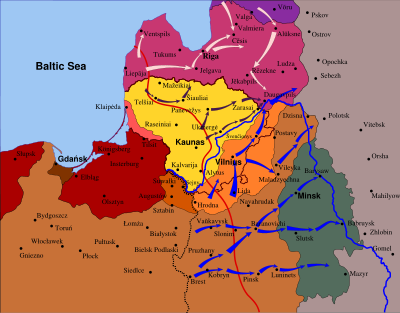
from April 19–21, the city was captured by Polish forces, causing the Red Army to retreat. During the offensive, the Poles also succeeded in securing the nearby cities of Lida
Lida
Lida is a city in western Belarus in Hrodna Voblast, situated 160 km west of Minsk. It is the fourteenth largest city in Belarus.- Etymology :...
, Pinsk
Pinsk
Pinsk , a town in Belarus, in the Polesia region, traversed by the river Pripyat, at the confluence of the Strumen and Pina rivers. The region was known as the Marsh of Pinsk. It is a fertile agricultural center. It lies south-west of Minsk. The population is about 130,000...
, Navahrudak, and Baranovichi
Baranovichi
Baranovichi , is a city in the Brest Province of western Belarus with a population of 173,000. It is a significant railway junction and home to a state university.-Overview:...
.
The Red Army launched a series of counterattacks in late April, all of which ended in failure. The Soviets briefly recaptured the city a year later, in spring 1920, when the Polish army was retreating along the entire front. In the aftermath, the Vilna offensive would cause much turmoil on the political scene in Poland and abroad.
Prelude
Soviet RussiaRussian Soviet Federative Socialist Republic
The Russian Soviet Federative Socialist Republic , commonly referred to as Soviet Russia, Bolshevik Russia, or simply Russia, was the largest, most populous and economically developed republic in the former Soviet Union....
, while at the time publicly supporting Polish and Lithuanian independence, sponsored communist agitators working against the government of the Second Polish Republic
Second Polish Republic
The Second Polish Republic, Second Commonwealth of Poland or interwar Poland refers to Poland between the two world wars; a period in Polish history in which Poland was restored as an independent state. Officially known as the Republic of Poland or the Commonwealth of Poland , the Polish state was...
, and considered that its eastern borders should approximate those of the defunct Congress Poland
Congress Poland
The Kingdom of Poland , informally known as Congress Poland , created in 1815 by the Congress of Vienna, was a personal union of the Russian parcel of Poland with the Russian Empire...
. Poles and Lithuanians, on the other hand, inspired by memories of the greatness of the erstwhile Grand Duchy of Lithuania
Grand Duchy of Lithuania
The Grand Duchy of Lithuania was a European state from the 12th /13th century until 1569 and then as a constituent part of Polish-Lithuanian Commonwealth until 1791 when Constitution of May 3, 1791 abolished it in favor of unitary state. It was founded by the Lithuanians, one of the polytheistic...
, part of the Polish–Lithuanian Commonwealth, saw their borders as lying much farther east. The leader of the Polish forces, Józef Piłsudski, discerned an opportunity for regaining territories that were once the part of the Polish–Lithuanian Commonwealth, and since then were the part of the Russian Empire
Russian Empire
The Russian Empire was a state that existed from 1721 until the Russian Revolution of 1917. It was the successor to the Tsardom of Russia and the predecessor of the Soviet Union...
, shaken by the 1917 Revolution
Russian Revolution of 1917
The Russian Revolution is the collective term for a series of revolutions in Russia in 1917, which destroyed the Tsarist autocracy and led to the creation of the Soviet Union. The Tsar was deposed and replaced by a provisional government in the first revolution of February 1917...
and the ongoing Russian Civil War
Russian Civil War
The Russian Civil War was a multi-party war that occurred within the former Russian Empire after the Russian provisional government collapsed to the Soviets, under the domination of the Bolshevik party. Soviet forces first assumed power in Petrograd The Russian Civil War (1917–1923) was a...
.
In the first weeks of 1919, following the retreat of the German Ober-Ost forces under Max Hoffmann
Max Hoffmann
Max Hoffmann was a German officer and military strategist during World War I. He is widely regarded as one of the finest staff officers of the imperial period....
, Vilnius
Vilnius
Vilnius is the capital of Lithuania, and its largest city, with a population of 560,190 as of 2010. It is the seat of the Vilnius city municipality and of the Vilnius district municipality. It is also the capital of Vilnius County...
found itself in a power vacuum. It promptly became the scene of struggles among competing political groups and experienced several internal revolutions.
On January 1, Polish officers, led by generals Władysław Wejtko and Stefan Mokrzecki
Stefan Mokrzecki
Stefan Mokrzecki of Ostoja coat of arms was a general in the Russian Army and the Polish Army. During Polish-Soviet War commanded 8 DP and other units. Later member of armed forces of Republic of Central Lithuania. Retired in 1925...
, attempted to take control of the city by establishing a Samoobrona ("Self-Defense") provisional government
Provisional government
A provisional government is an emergency or interim government set up when a political void has been created by the collapse of a very large government. The early provisional governments were created to prepare for the return of royal rule...
. Their aim was to defeat the Communist
Communism
Communism is a social, political and economic ideology that aims at the establishment of a classless, moneyless, revolutionary and stateless socialist society structured upon common ownership of the means of production...
"Workers' Council", a rival faction within Vilnius plotting to seize the city. Samoobrona rule of Vilnius did not last long. Four days later January 5, 1919, the Polish forces were forced to make a hasty retreat when the Russian Western Army
Western Army (Russia)
The Western Army or 16th Army was created on November 15, 1918, by the Russian SFSR for the purpose of recovering territories lost by the Russian Empire during the First World War and establishing Soviet republics in those territories...
marched in from Smolensk
Smolensk
Smolensk is a city and the administrative center of Smolensk Oblast, Russia, located on the Dnieper River. Situated west-southwest of Moscow, this walled city was destroyed several times throughout its long history since it was on the invasion routes of both Napoleon and Hitler. Today, Smolensk...
to support the local communists as part of the Russian westward offensive
Russian westward offensive of 1918-1919
The Soviet westward offensive of 1918–1919 was part of the general move of the Russian Soviet Federated Socialist Republic into the areas abandoned by the Ober-Ost garrisons, that were being withdrawn to Germany following that country's defeat in the World War I. The Soviet Western Front...
.
Vilnius, the historical capital of the Grand Duchy of Lithuania
Grand Duchy of Lithuania
The Grand Duchy of Lithuania was a European state from the 12th /13th century until 1569 and then as a constituent part of Polish-Lithuanian Commonwealth until 1791 when Constitution of May 3, 1791 abolished it in favor of unitary state. It was founded by the Lithuanians, one of the polytheistic...
, became part of the Lithuanian Soviet Socialist Republic
Lithuanian Soviet Socialist Republic (1918–1919)
The Lithuanian Soviet Socialist Republic was an early short-lived Soviet republic declared on December 16, 1918 by the provisional revolutionary government, led by Vincas Mickevičius-Kapsukas...
and was soon proclaimed capital of the Lithuanian–Belorussian Soviet Socialist Republic (Lit-Bel) on February 27, 1919. The Lit-Bel became the 8th government to control Vilnius in two years. During the month and a half that the Lit-Bel controlled the city, the new communist government turned Vilnius into a social experiment, testing various applications of left-leaning governmental systems on the city's inhabitants.
Józef Piłsudski, Polish commander-in-chief
Commander-in-Chief
A commander-in-chief is the commander of a nation's military forces or significant element of those forces. In the latter case, the force element may be defined as those forces within a particular region or those forces which are associated by function. As a practical term it refers to the military...
, determined that regaining control of Vilnius, whose population consisted mostly of Poles
Poles
thumb|right|180px|The state flag of [[Poland]] as used by Polish government and diplomatic authoritiesThe Polish people, or Poles , are a nation indigenous to Poland. They are united by the Polish language, which belongs to the historical Lechitic subgroup of West Slavic languages of Central Europe...
and Jews
Jews
The Jews , also known as the Jewish people, are a nation and ethnoreligious group originating in the Israelites or Hebrews of the Ancient Near East. The Jewish ethnicity, nationality, and religion are strongly interrelated, as Judaism is the traditional faith of the Jewish nation...
, should be a priority of the renascent Polish state. He had been working on plans to take control of Vilnius since at least March; he gave preliminary orders to prepare a push in that direction—and counter an expected Soviet westward push—on March 26. One of Piłsudski's objectives was to take control of Vilnius before Western diplomats at the Paris Peace Conference
Paris Peace Conference, 1919
The Paris Peace Conference was the meeting of the Allied victors following the end of World War I to set the peace terms for the defeated Central Powers following the armistices of 1918. It took place in Paris in 1919 and involved diplomats from more than 32 countries and nationalities...
could rule on whom the city, demanded by various factions, should be given to. The action was not discussed with Polish politicians or the government, who at that time were more concerned with the situation on the southern Polish–Ukrainian front. By early April, when members of the Kresy
Kresy
The Polish term Kresy refers to a land considered by Poles as historical eastern provinces of their country. Today, it makes western Ukraine, western Belarus, as well as eastern Lithuania, with such major cities, as Lviv, Vilnius, and Hrodna. This territory belonged to the Polish-Lithuanian...
Defence Committee (Komitet Obrony Kresów) Michał Pius Römer, Aleksander Prystor
Aleksander Prystor
Aleksander Błażej Prystor was a Polish politician, soldier and activist who served as Prime Minister of Poland from 1931 to 1933.He was a member of the Combat Organization of the Polish Socialist Party and in 1908 took part in the Bezdany raid....
, Witold Abramowicz, and Kazimierz Świtalski
Kazimierz Switalski
Col. Kazimierz Stanisław Świtalski was a Polish officer, politician, and a Prime Minister of Poland.-Biographical note:Before the World War I he joined the Związek Walki Czynnej, an underground organisation formed by Józef Piłsudski. In 1914 Świtalski joined the Polish Legions and in 1918 the...
met with Pilsudski, stressing the plight of occupied Vilnius and its inhabitants' need for self-government, Piłsudski was ready to move.
Diversionary attacks
Piłsudski arrived at the front near LidaLida
Lida is a city in western Belarus in Hrodna Voblast, situated 160 km west of Minsk. It is the fourteenth largest city in Belarus.- Etymology :...
on 15 April, bringing reinforcements from Warsaw
Warsaw
Warsaw is the capital and largest city of Poland. It is located on the Vistula River, roughly from the Baltic Sea and from the Carpathian Mountains. Its population in 2010 was estimated at 1,716,855 residents with a greater metropolitan area of 2,631,902 residents, making Warsaw the 10th most...
. His plan called for exploitation of the gap in the Soviet lines between Vilnius and Lida by an advance towards Vilnius using the road and railway. Amidst diversionary attacks, designed to draw Russian attention away from the main Polish thrust towards Vilnius, the main Polish attack began at dawn on 16 April. The forces moving on Vilnius included the cavalry group of Colonel Wladyslaw Belina-Prazmowski, composed of 800 men in nine cavalry squadrons and a battery of horse artillery; and infantry under General Edward Rydz-Smigly
Edward Rydz-Smigly
Edward Rydz-Śmigły , before 1922 Edward Rydz, since 1922 ; nom de guerre Śmigły, Tarłowski, Adam Zawisza) was a Marshal of Poland, Polish political figure, Commander-in-Chief of Poland's armed forces, and a painter and poet...
, composed of 2,500 men in three battalions of the Polish 1st Legions Infantry Division and two batteries of heavy artillery.
Soviet forces in the area were composed of the Western Rifle Division
Western Rifle Division
Western Rifle Division was one of the Bolsheviks military formations during the Russian Civil War.It was formed in summer 1918 from the initiative of Social Democracy of the Kingdom of Poland and Lithuania and Polish Socialist Party-Left...
, a unit which had many pro-communist Polish volunteers, and other units of the Western Army
Western Army (Russia)
The Western Army or 16th Army was created on November 15, 1918, by the Russian SFSR for the purpose of recovering territories lost by the Russian Empire during the First World War and establishing Soviet republics in those territories...
. The Soviet garrison of Vilnius numbered about 2,000 newly trained troops. Soviet forces in the area around Vilnius are estimated at 7,000 infantry, a few hundred cavalry, and 10 artillery pieces. These forces were to be engaged and thus prevented from coming to the aid of the Vilnius garrison.
The diversionary attacks went well, with Soviet forces acting under the impression that the Poles had targets other than Vilnius. Despite their diversionary intent, these attacks succeeded in their own right, with Generał Józef Adam Lasocki
Józef Adam Lasocki
Józef Adam Lasocki was an officer in Austro-Hungarian Army and from December 1918 a general in Polish Army. During First World War commanded formations from a regiment to division in size. Fought in the Polish-Soviet War. In 1919 commanded 2 BJ, Grupa Zaniemenska, 1 and 2 DLB and 8 DP. In 1920...
taking Lida
Lida
Lida is a city in western Belarus in Hrodna Voblast, situated 160 km west of Minsk. It is the fourteenth largest city in Belarus.- Etymology :...
in two days despite unexpectedly strong resistance, and Generał Stefan Mokrzecki
Stefan Mokrzecki
Stefan Mokrzecki of Ostoja coat of arms was a general in the Russian Army and the Polish Army. During Polish-Soviet War commanded 8 DP and other units. Later member of armed forces of Republic of Central Lithuania. Retired in 1925...
taking Nowogrodek in three days and Baranowicze in four.
Assault on Vilnius
On 18 April, Colonel Belina decided to use the element of surprise and move into Vilnius without waiting for the slower infantry units. Polish forces left the village of Myto in early morning. At 03:30 on 19 April, Maj. Zaruski took LipówkaLipówka
Lipówka may refer to the following places:*Lipówka, Łódź Voivodeship *Lipówka, Lublin Voivodeship *Lipówka, Podlaskie Voivodeship *Lipówka, Świętokrzyskie Voivodeship...
near Vilnius. Belina's cavalry bypassed Vilnius and attacked from behind, taking the train station on the night of 18 to 19 April; on 19 April, cavalry under lieutenant Gustaw Orlicz-Dreszer
Gustaw Orlicz-Dreszer
Gustaw Konstanty Orlicz-Dreszer was a Polish general, and a political and social activist.Before World War I, Orlicz-Dreszer was involved in pro-independence activities in partitioned Poland. In 1914-17 he served in the 1st Brigade of the Polish Legions. He was arrested during the Oath Crisis...
—future Polish general—charged into the suburbs, spreading panic among the confused garrison. He seized the train station and sent a train down the line to collect infantry. In this surprise raid about 400 prisoners, 13 trains, and various military supplies were captured. Piłsudski would declare Belina's cavalry action the "most exquisite military action carried out by Polish cavalry in this war".
Cavalrymen fought for control of the center of Vilnius and took Cathedral Square
Cathedral Square in Vilnius
The Cathedral Square in Vilnius is the main square of the city's downtown, right in front of the neo-classical Vilnius Cathedral. It is a key location in city's public life, situated as it is at the crossing of the city's main streets and reflecting the city's diversity...
, the castle complex
Vilnius Castle Complex
The Vilnius Castle Complex , is a group of cultural, and historic structures on the left bank of the Neris River, near its confluence with the Vilnia River, in Vilnius, Lithuania. The buildings, which evolved between the 10th and 18th centuries, were one of Lithuania's major defensive...
on the hillside, and the enemy quarters on the southern riverbank. They also captured hundreds of Bolshevik soldiers and officials, but their numbers were too small compared to the enemy forces, who had begun to reorganize, particularly in the north and west of the town, and prepare a counterattack. Belina sent a message reporting that "enemy is resisting with extreme strength" and asking for immediate reinforcements. At around 8:00 in the evening the train he had sent in the morning returned with the first infantry reinforcements. The Polish troops were also supported by the city's predominantly Polish population which formed a militia
Militia
The term militia is commonly used today to refer to a military force composed of ordinary citizens to provide defense, emergency law enforcement, or paramilitary service, in times of emergency without being paid a regular salary or committed to a fixed term of service. It is a polyseme with...
to aid them. By the evening of 19 April half of Vilnius was under Polish control, however, the Red Army troops and supporters were putting up a stubborn and coordinated defence. Only upon the arrival of the main force of Polish infantry under Generał Śmigły on 21 April did the Poles gain the upper hand, attacking those parts of the town still held by the Red Army. The Polish infantry was able to reinforce the cavalry in the city center, and during the night, with help of local guides, Polish forces crossed the river and took one of the bridges. On April 20, the bridges were in the hands of the Poles, and more of the city fell under their control. During the afternoon of that day, after a three-day-long urban battle
Urban warfare
Urban warfare is combat conducted in urban areas such as towns and cities. Urban combat is very different from combat in the open at both the operational and tactical level...
, the city was in Polish hands. Piłsudski arrived in Vilnius on the same day.
Jewish deaths
As the Polish troops entered the city first pogrom in modern VilniusVilnius
Vilnius is the capital of Lithuania, and its largest city, with a population of 560,190 as of 2010. It is the seat of the Vilnius city municipality and of the Vilnius district municipality. It is also the capital of Vilnius County...
started, as noted by the Timothy D. Snyder, citing Michał Pius Römer. Dozens of people connected with the Lit-Bel were arrested, and some were executed; Norman Davies
Norman Davies
Professor Ivor Norman Richard Davies FBA, FRHistS is a leading English historian of Welsh descent, noted for his publications on the history of Europe, Poland, and the United Kingdom.- Academic career :...
cites a death toll for all – Jews and non-Jews, under Polish rule – as 65. Jews constituted close to one-half of Vilnius's population, according to the German census of 1916, and many victims of fighting and subsequent repression in Vilnius were Jews. Henry Morgenthau, Sr.
Henry Morgenthau, Sr.
Henry Morgenthau was a lawyer, businessman and United States ambassador, most famous as the American ambassador to the Ottoman Empire during the First World War. He was father of the politician Henry Morgenthau, Jr. and the grandfather of Robert M. Morgenthau, who was the District Attorney of...
counted 65, Joseph W. Bendersky counted over a hundred.
There was a common belief among the Poles that most Jews were Bolsheviks and Communists, in league with the enemy of the Polish state, Soviet Russia
Russian Soviet Federative Socialist Republic
The Russian Soviet Federative Socialist Republic , commonly referred to as Soviet Russia, Bolshevik Russia, or simply Russia, was the largest, most populous and economically developed republic in the former Soviet Union....
. The Polish army stated that any Jews it killed were militants and collaborators engaged in actions against the Polish army. Having been fired at from Jewish homes, Polish soldiers took this as an excuse to break into many Jewish homes and stores, beating the Jews and robbing them, desecrating synagogues, arresting hundreds, depriving them of food and drink for days and deporting them from the city; such abuses were, however, not supported by – and even specifically forbidden by – the Polish high command.
The US Army representative on the scene, Colonel Wiliam F. Godson, agreed with the version of events presented by the Polish general staff. In his reports, Godson wrote that "Jews constituted at least 80% of every Bolshevik organization" and that, unlike the "harmless Polish Jews" (who really "had become Poles"), the "Litwaks or Russian Jews" are "extremely dangerous," making the "Jewish question the most important one [for the country]". Neglecting the plight of the Jews, Godson had only noted in his report the instances of Bolsheviks executing and mutilating civilians and Polish prisoners of war. The Nobel Prize
Nobel Prize
The Nobel Prizes are annual international awards bestowed by Scandinavian committees in recognition of cultural and scientific advances. The will of the Swedish chemist Alfred Nobel, the inventor of dynamite, established the prizes in 1895...
-winning author Władysław Reymont, in an article published by Gazeta Warszawska
Gazeta Warszawska
Gazeta Warszawska was the first newspaper published regularly in Warsaw for an extended period of time. Founded in 1774, it remained active under a variety of names until 1935...
, the main organ of the openly antisemitic National Democratic Party, also denied that pogroms had taken place. Henry Morgenthau, Sr.
Henry Morgenthau, Sr.
Henry Morgenthau was a lawyer, businessman and United States ambassador, most famous as the American ambassador to the Ottoman Empire during the First World War. He was father of the politician Henry Morgenthau, Jr. and the grandfather of Robert M. Morgenthau, who was the District Attorney of...
of the Anglo-American Investigating Commission in his report
Morgenthau Report
The Morgenthau report was a report issued by the United States' commission led by Henry Morgenthau, Sr., Homer H. Johnson, Brigadier General Edgar Jadwin and from the British side, Sir Stuart M. Samuel to investigate reports of mistreatment of Ashkenazi Jews in Poland...
acquitted the Polish side of having organized pogroms, noting the wartime confusion and the fact that some Jews had indeed shot at the Polish forces. The report was, however, highly critical of the activities of the Polish Army in Vilnius, noting that 65 Jews with no proven connections to the Bolsheviks had been killed, and that many arrests, robberies and mistreatments had occurred, while soldiers guilty of these acts had not been punished.
Soviet counteroffensive
The Polish victory infuriated the Soviets, leading to dozens of arrests and several executions among those connected to the Lit-Bel.; the former Lit-Bel leaders began accusing one another of culpability for the loss of their capital. LeninVladimir Lenin
Vladimir Ilyich Lenin was a Russian Marxist revolutionary and communist politician who led the October Revolution of 1917. As leader of the Bolsheviks, he headed the Soviet state during its initial years , as it fought to establish control of Russia in the Russian Civil War and worked to create a...
considered the city vital to his plans, and ordered its immediate recapture, with the Red Army
Red Army
The Workers' and Peasants' Red Army started out as the Soviet Union's revolutionary communist combat groups during the Russian Civil War of 1918-1922. It grew into the national army of the Soviet Union. By the 1930s the Red Army was among the largest armies in history.The "Red Army" name refers to...
attempting several counteroffensives in April 1919.
Near the end of the month about 12,000 infantry, 3,000 cavalry, 210 heavy machine gun
Heavy machine gun
The heavy machine gun or HMG is a larger class of machine gun generally recognized to refer to two separate stages of machine gun development. The term was originally used to refer to the early generation of machine guns which came into widespread use in World War I...
s and 44 guns were assembled by Soviet forces in the area of Szyrwiany, Podbrodzie, Soły and Oszmiana. Polish forces in the area under general Stanisław Szeptycki numbered 11,000; Rydz-Śmigly had 8 infantry battalions, 18 cavalry squadrons and 18 guns in Vilnius itself. Rydz-Śmigły decided to engage enemy forces before they combined their strengths. On the night of April 28–29, general Stefan Dąb-Biernacki
Stefan Dab-Biernacki
Stefan Dąb-Biernacki was a Polish general.Members of the Polish Legions in World War I, fought in the Polish-Soviet War commanding regiments and later 1DPLeg...
took Podbrodzie, capturing one of the Soviet formations. Simultaneously, Soviet forces attacked near Deliny–Ogrodniki
Ogrodniki
Ogrodniki may refer to the following places:*Ogrodniki, Gmina Biała Podlaska in Lublin Voivodeship *Ogrodniki, Gmina Tuczna in Lublin Voivodeship *Ogrodniki, Białystok County in Podlaskie Voivodeship...
, south of Vilnius. Polish defenses and counterattacks managed to halt Soviet movements towards Vilnius, pushing them back towards Szkodziszki–Grygajce. In retaliation, Soviet forces launched yet another counterattack, this one from north of Vilnius. The results were significantly better than those of the previous offensive, with Soviet forces breaking through Polish defenses in the area. However, Red Army forces halted their movements short of Vilnius, not wishing to attack a hostile city during the night. Polish forces took advantage of the opportunity to strengthen their defenses. Shortly afterwards, Polish forces counterattacked, pushing the Red Army back towards Mejszagoła and Podberezie. Polish forces pursued and took those two settlements, as well as Giedrojsc and Smorgoń
Smorgon
-People:* David Smorgon, an Australian businessman, President of the Western Bulldogs football club* Graham Smorgon, an Australian businessman, former President of the Carlton Football Club* Victor Smorgon, an Australian industrialist-Places:...
. By mid-May Polish forces had reached the line of Narocz lake – Hoduciszki – Ignalina
Ignalina
Ignalina is a city in eastern Lithuania, famous for the Ignalina Nuclear Power Plant in nearby Visaginas. It is said that Ignalina name got its name from Ignas and Lina, two lovers with quite popular Lithuanian names. Even though there are archeological evidences that people lived in Ignalina area...
– Lyngniany, leaving Vilnius well behind the frontline.
Aftermath
Because of the successful surprise attack, the Polish army in Vilnius managed to appropriate sizable stocks of supplies and take hundreds of prisoners. When Piłsudski entered the city, a victory paradeVictory parade
A victory parade is a type of parade held in order to celebrate a victory. Because of that, victory parades can be divided into military victory parades and more frequent sport victory parades....
was held in his honour. The city's Polish citizens on the whole were delighted; their politicians envisaged a separate Lithuanian state closely allied with Poland. Representatives from the city were immediately sent to the Paris Peace Conference
Paris Peace Conference, 1919
The Paris Peace Conference was the meeting of the Allied victors following the end of World War I to set the peace terms for the defeated Central Powers following the armistices of 1918. It took place in Paris in 1919 and involved diplomats from more than 32 countries and nationalities...
, and the Stefan Batory University in Vilnius, which had been closed in 1832 following the November 1830 Uprising
November Uprising
The November Uprising , Polish–Russian War 1830–31 also known as the Cadet Revolution, was an armed rebellion in the heartland of partitioned Poland against the Russian Empire. The uprising began on 29 November 1830 in Warsaw when the young Polish officers from the local Army of the Congress...
, was reopened.
Acting in accordance with his vision of a Polish-led "Międzymorze
Miedzymorze
Międzymorze was a plan, pursued after World War I by Polish leader Józef Piłsudski, for a federation, under Poland's aegis, of Central and Eastern European countries...
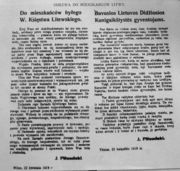
" federation of East-Central European states, Piłsudski on April 22, 1919, issued a bilingual statement, in Polish and Lithuanian, of his political intentions — the "Proclamation to the inhabitants of the former Grand Duchy of Lithuania
Proclamation to the inhabitants of the former Grand Duchy of Lithuania
The Proclamation to the Inhabitants of the Former Grand Duchy of Lithuania was a bilingual proclamation, formulated by Józef Piłsudski and distributed mainly in Vilnius on April 22, 1919. The proclamation was printed in the Polish and Lithuanian languages after Polish forces captured Vilnius in...
," pledging to provide "elections [which will] take place on the basis of secret, universal and direct voting, without distinction between the sexes" and to "create an opportunity for settling your nationality problems and religious affairs in a manner that you yourself will determine, without any kind of force or pressure from Poland." Piłsudski's proclamation was aimed at showing good will both to Lithuanians and international diplomats; the latter succeeded as the proclamation dealt a blow to the image of 'Polish conquest' and replaced it with the image of 'Poland fighting with Bolsheviks dictatorship and liberating other nations'; however the Lithuanians who demanded exclusive control over the city were much less convinced. Piłsudski's words also caused significant controversy on the Polish political scene; as they had not been discussed with the Sejm
Sejm
The Sejm is the lower house of the Polish parliament. The Sejm is made up of 460 deputies, or Poseł in Polish . It is elected by universal ballot and is presided over by a speaker called the Marshal of the Sejm ....
and caused much anger among Piłsudski's National-Democratic opponents; PSL Piast deputies demanded incorporation of the Vilnius Region
Vilnius region
Vilnius Region , refers to the territory in the present day Lithuania, that was originally inhabited by ethnic Baltic tribes and was a part of Lithuania proper, but came under East Slavic and Polish cultural influences over time,...
into Poland and even accused Piłsudski of treason. However, Piłsudski's supporters in the Polish Socialist Party
Polish Socialist Party
The Polish Socialist Party was one of the most important Polish left-wing political parties from its inception in 1892 until 1948...
managed to deflect those attacks.
Kaunas
Kaunas is the second-largest city in Lithuania and has historically been a leading centre of Lithuanian economic, academic, and cultural life. Kaunas was the biggest city and the center of a powiat in Trakai Voivodeship of the Grand Duchy of Lithuania since 1413. During Russian Empire occupation...
, which viewed the city as the historic capital of the Grand Duchy of Lithuania
Grand Duchy of Lithuania
The Grand Duchy of Lithuania was a European state from the 12th /13th century until 1569 and then as a constituent part of Polish-Lithuanian Commonwealth until 1791 when Constitution of May 3, 1791 abolished it in favor of unitary state. It was founded by the Lithuanians, one of the polytheistic...
, saw the Polish incursion as an occupation
Military occupation
Military occupation occurs when the control and authority over a territory passes to a hostile army. The territory then becomes occupied territory.-Military occupation and the laws of war:...
. The Lithuanian government demanded Vilnius back. Relations between the Polish and Lithuanian governments, unable to reach a compromise over Vilnius, continued to worsen, destroying the prospects for Piłsudski's plan of the Międzymorze
Miedzymorze
Międzymorze was a plan, pursued after World War I by Polish leader Józef Piłsudski, for a federation, under Poland's aegis, of Central and Eastern European countries...
federation and leading to open hostilities in the ensuing Polish–Lithuanian War
Polish–Lithuanian War
The Polish–Lithuanian War was an armed conflict between newly independent Lithuania and Poland in the aftermath of World War I. The conflict primarily concerned territorial control of the Vilnius Region, including Vilnius , and the Suwałki Region, including the towns of Suwałki, Augustów, and Sejny...
. In 1920, the Soviets recaptured Vilnius, followed by the Poles' establishment of the short-lived Republic of Central Lithuania
Republic of Central Lithuania
The Republic of Central Lithuania or Middle Lithuania , or simply Central Lithuania , was a short-lived political entity, which did not gain international recognition...
.
The Polish capture of Vilnius set the stage for further escalation of Polish conflicts with Soviet Russia
Polish-Soviet War
The Polish–Soviet War was an armed conflict between Soviet Russia and Soviet Ukraine and the Second Polish Republic and the Ukrainian People's Republic—four states in post–World War I Europe...
and Lithuania
Polish-Lithuanian War
The Polish–Lithuanian War was an armed conflict between newly independent Lithuania and Poland in the aftermath of World War I. The conflict primarily concerned territorial control of the Vilnius Region, including Vilnius , and the Suwałki Region, including the towns of Suwałki, Augustów, and Sejny...
. In coming months, Polish forces would push steadily eastward, launching Operation Minsk
Operation Minsk
Operation Minsk refers to the Polish offensive and capture of Minsk from the Bolshevik control in early August 1919.In the summer of 1919 after the Polish successes in several Polish-Russian skirmishes, the two combatants have been near the limits of their capabiity to wage warfare with each...
in August.
See also
- 1st Lithuanian-Belarusian Division
- Żeligowski's MutinyZeligowski's MutinyŻeligowski's Mutiny was a sham mutiny led by Polish General Lucjan Żeligowski in October 1920, which resulted in the creation of the short-lived Republic of Central Lithuania. Polish Chief of State Józef Piłsudski had surreptitiously ordered Żeligowski to carry out the operation, and revealed the...
- Republic of Central LithuaniaRepublic of Central LithuaniaThe Republic of Central Lithuania or Middle Lithuania , or simply Central Lithuania , was a short-lived political entity, which did not gain international recognition...
- Wilno Voivodeship (1923–1939)
Further reading
- Przemysław Różański, Wilno, 19-21 kwietnia 1919 roku (Vilna, April 19–21, 1919), Jewish History Quarterly (01/2006), C.E.E.O.L. ,