


Bhikaiji Cama

Encyclopedia
Bhikaiji Rustom CamaBhikhai- (with aspirated -kh-) is the name as it appears in the biographies. Another common form is Bhikai- (with unaspirated -k-), as it appears on the postage stamp. The name is also frequently misspelled 'Bhikha-' (with missing -i-), which is a male name (unlike the feminine Bhikhai-). (24 September 1861 – 13 August 1936) was a prominent figure in the Indian independence movement
.
) into a large, well-off Parsi
family. Her parents, Sorabji Framji Patel and Jaijibai Sorabji Patel, were well-known in the city, where her father Sorabji—a lawyer by training and a merchant by profession—was an influential member of the Parsi community.
Like many Parsi girls of the time, Bhikhaiji attended Alexandra Native Girl's English Institution. Bhikhaiji was by all accounts a diligent, disciplined child with a flair for languages.
On 3 August 1885, she married Rustom Cama, a wealthy, pro-British lawyer who aspired to enter politics. It was not a happy marriage, and Bhikhaiji spent most of her time and energy in philanthropic activities and social work.
was hit first by famine, and shortly thereafter by bubonic plague
. Bhikhaiji joined one of the many teams working out of Grant Medical College (which would subsequently become Haffkine's
plague vaccine research centre), in an effort to provide care for the afflicted, and (later) to inoculate the healthy. Cama subsequently contracted the plague herself, but survived. Severely weakened, she was sent to Britain for medical care in 1901.
She was preparing to return to India in 1902 when she came in contact with Shyamji Krishna Varma
, who was well known in London's Indian community for fiery nationalist speeches he gave in Hyde Park
. Through him, she met Dadabhai Naoroji
, then president of the British Committee of the Indian National Congress
, and for whom she came to work as private secretary. Together with Naoroji and Singh Rewabhai Rana, Cama supported the founding of Varma's Indian Home Rule Society
in February 1905. In London, she was told that her return to India would be prevented unless she would sign a statement promising not to participate in nationalist activities. She refused.
That same year Cama relocated to Paris, where—together with Singh Rewabhai Rana and Munchershah Burjorji Godrej—she co-founded the Paris Indian Society
. Together with other notable members of the movement for Indian sovereignty living in exile, Cama wrote, published (in Holland and Switzerland) and distributed revolutionary literature for the movement, including Bande Mataram
(founded in response to the Crown
ban on the poem Vande Mataram
) and later Madan's Talwar
(in response to the execution of Madan Lal Dhingra
). These weeklies were smuggled into India through the French colony of Pondicherry on the subcontinent's south-east coast.
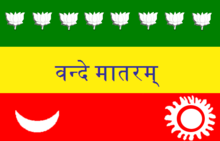 On 22 August 1907, Cama attended the International Socialist Conference in Stuttgart
, Germany
, where she described the devastating effects of a famine that had struck the Indian subcontinent. In her appeal for human rights, equality and for autonomy from Great Britain, she unfurled what she called the "Flag of Indian Independence"."This flag is of India's independence. Behold, it is born. It is already sanctified by the blood of martyred Indian youth. I call upon you, gentlemen, to rise and salute the flag of Indian independence. In the name of this flag I appeal to lovers of freedom all over the world to cooperate with this flag in freeing one-fifth of the human race." That flag, a modification of the Calcutta Flag
, was co-designed by Cama, Vinayak Damodar Savarkar
and Shyamji Krishna Varma
, and would later serve as one of the templates from which the current national flag of India
was created.
In 1909, following Madan Lal Dhingra
's assassination of William Hutt Curzon Wyllie
, an aide to the Secretary of State for India
, Scotland Yard
arrested several key activists living in Great Britain, among them Vinayak Savarkar. In 1910, Savarkar was ordered to be returned to India for trial. When the ship Savarkar was being transported on docked in Marseilles harbour, he squeezed out through a porthole window and jumped into the sea. Reaching shore, he expected to find Cama and others who had been told to expect him (who got there late), but ran into the local constabulary instead. Unable to communicate his predicament to the French authorities without Cama's help, he was returned to British custody. The British Government requested Cama's extradition, but the French Government refused to cooperate. In return, the British Government seized Cama's inheritance. Lenin reportedly invited her to reside in the Soviet Union, but she did not accept.
Influenced by Christabel Pankhurst
and the Suffragette
movement, Bhikhaiji Cama was vehement in her support for gender equality
. Speaking in Cairo
, Egypt
in 1910, she asked, "I see here the representatives of only half the population of Egypt. May I ask where is the other half? Sons of Egypt, where are the daughters of Egypt? Where are your mothers and sisters? Your wives and daughters?" Cama's stance with respect to the vote for women was however secondary to her position on Indian independence; in 1920, upon meeting Herabai and Mithan Tata, two Parsi women outspoken on the issue of the right to vote, Cama is said to have sadly shaken her head and observed: "'Work for Indian's freedom and [i]ndependence. When India is independent women will not only [have] the [v]ote, but all other rights.'"
With the outbreak of World War I
in 1914, France and Britain became allies, and all the members of Paris India Society except Cama and Singh Rewabhai Rana left the country (Cama had been advised by fellow-socialist Jean Longuet
to go to Spain with Acharya, but she had preferred to stay). Cama and Rana were briefly arrested in October 1914 when they tried to agitate among Punjab Regiment
troops that had just arrived in Marseilles on their way to the front
. They were required to leave Marseilles, and Cama then moved to Rana's wife's house in Arcachon
, near Bordeaux
. In January 1915, the French government deported Rana and his whole family to the Caribbean island of Martinique
, and Cama was sent to Vichy
, where she was interned. In bad health, she was released in November 1917 and permitted to return to Bordeaux provided that she report weekly to the local police. Following the war, Cama returned to her home at 25, Rue de Ponthieu in Paris.
Cama remained in exile in Europe until 1935, when, gravely ill and paralysed by a stroke that she had suffered earlier that year, she petitioned the British government through Sir Cowasji Jehangir
to be allowed to return home. Writing from Paris on 24 June 1935, she acceded to the requirement that she renounce sedetionist activities. Accompanied by Jehangir, she arrived in Bombay in November 1935 and died nine months later, aged , at Parsi General Hospital on 13 August 1936.
, the Framji Nusserwanjee Patel Agiary at Mazgaon, in South Bombay.
Several Indian cities have streets and places named after Bhikhaiji Cama, or Madame Cama as she is also known. On 26 January 1962, India's 11th Republic Day
, the Indian Posts and Telegraphs Department issued a commemorative stamp in her honour.
In 1997, the Indian Coast Guard commissioned a Priyadarshini-class fast patrol vessel ICGS Bikhaiji Cama after Bikhaiji Cama.
Following Cama's 1907 Stuttgart address, the flag she raised there was smuggled into British India by Idulal Yagnik and is now on display at the Maratha and Kesari Library in Pune
. In 2004, politicians of the BJP
, India's Hindu nationalist party, attempted to identify a later design (from the 1920s) as the flag Cama raised in Stuttgart. The flag Cama raised – misrepresented as "original national Tricolour" – has an (Islamic) crescent and a (Hindu) sun, which the later design does not have.
Bhikaiji Cama is the subject of several biographies:..
Indian independence movement
The term Indian independence movement encompasses a wide area of political organisations, philosophies, and movements which had the common aim of ending first British East India Company rule, and then British imperial authority, in parts of South Asia...
.
Early life
Bhikhaiji Rustom Cama was born Bhikai Sorab Patel on 24 September 1861 in Bombay (now MumbaiMumbai
Mumbai , formerly known as Bombay in English, is the capital of the Indian state of Maharashtra. It is the most populous city in India, and the fourth most populous city in the world, with a total metropolitan area population of approximately 20.5 million...
) into a large, well-off Parsi
Parsi
Parsi or Parsee refers to a member of the larger of the two Zoroastrian communities in South Asia, the other being the Irani community....
family. Her parents, Sorabji Framji Patel and Jaijibai Sorabji Patel, were well-known in the city, where her father Sorabji—a lawyer by training and a merchant by profession—was an influential member of the Parsi community.
Like many Parsi girls of the time, Bhikhaiji attended Alexandra Native Girl's English Institution. Bhikhaiji was by all accounts a diligent, disciplined child with a flair for languages.
On 3 August 1885, she married Rustom Cama, a wealthy, pro-British lawyer who aspired to enter politics. It was not a happy marriage, and Bhikhaiji spent most of her time and energy in philanthropic activities and social work.
Social life
In October 1896, the Bombay PresidencyBombay Presidency
The Bombay Presidency was a province of British India. It was established in the 17th century as a trading post for the English East India Company, but later grew to encompass much of western and central India, as well as parts of post-partition Pakistan and the Arabian Peninsula.At its greatest...
was hit first by famine, and shortly thereafter by bubonic plague
Bubonic plague
Plague is a deadly infectious disease that is caused by the enterobacteria Yersinia pestis, named after the French-Swiss bacteriologist Alexandre Yersin. Primarily carried by rodents and spread to humans via fleas, the disease is notorious throughout history, due to the unrivaled scale of death...
. Bhikhaiji joined one of the many teams working out of Grant Medical College (which would subsequently become Haffkine's
Waldemar Haffkine
Waldemar Mordecai Wolff Haffkine, CIE was a Russian Jewish bacteriologist, whose career was blighted in Russia because "he refused to convert to Russian Orthodoxy." He emigrated and worked at the Pasteur Institute in Paris, where he developed an anti-cholera vaccine that he tried out successfully...
plague vaccine research centre), in an effort to provide care for the afflicted, and (later) to inoculate the healthy. Cama subsequently contracted the plague herself, but survived. Severely weakened, she was sent to Britain for medical care in 1901.
She was preparing to return to India in 1902 when she came in contact with Shyamji Krishna Varma
Shyamji Krishna Varma
Shyamji Krishna Varma was an Indian revolutionary, lawyer and journalist who founded the Indian Home Rule Society, India House and The Indian Sociologist in London. A graduate of Balliol College, Krishna Varma was a noted scholar in Sanskrit and other Indian languages...
, who was well known in London's Indian community for fiery nationalist speeches he gave in Hyde Park
Hyde Park, London
Hyde Park is one of the largest parks in central London, United Kingdom, and one of the Royal Parks of London, famous for its Speakers' Corner.The park is divided in two by the Serpentine...
. Through him, she met Dadabhai Naoroji
Dadabhai Naoroji
Dadabhai Naoroji , known as the Grand Old Man of India, was a Parsi intellectual, educator, cotton trader, and an early Indian political leader. His book Poverty and Un-British Rule in India brought attention to the draining of India's wealth into Britain...
, then president of the British Committee of the Indian National Congress
History of the Indian National Congress
From its foundation on 28 December 1885 until the time of independence of India on August 15, 1947, the Indian National Congress was the largest and most prominent Indian public organization, and central and defining influence of the Indian Independence Movement.Although initially and primarily a...
, and for whom she came to work as private secretary. Together with Naoroji and Singh Rewabhai Rana, Cama supported the founding of Varma's Indian Home Rule Society
Indian Home Rule Society
The Indian Home Rule Society was an Indian organisation founded in London in 1905 that sought to promote the cause of self-rule in British India. The organisation was founded by Shyamji Krishna Varma, with support from a number of prominent Indian nationalists in Britain at the time, including...
in February 1905. In London, she was told that her return to India would be prevented unless she would sign a statement promising not to participate in nationalist activities. She refused.
That same year Cama relocated to Paris, where—together with Singh Rewabhai Rana and Munchershah Burjorji Godrej—she co-founded the Paris Indian Society
Paris Indian Society
The Paris Indian Society was an Indian nationalist organisation founded in 1905 at Paris under the patronage of Madam Bhikaji Rustom Cama, B.H. Godrej and S. R. Rana...
. Together with other notable members of the movement for Indian sovereignty living in exile, Cama wrote, published (in Holland and Switzerland) and distributed revolutionary literature for the movement, including Bande Mataram
Bande Mataram (Paris publication)
For other uses of the term Bande Mataram, see Bande Mataram .The Bande Mataram was a nationalist publication from Paris begun in September 1909 by the Paris Indian Society...
(founded in response to the Crown
The Crown
The Crown is a corporation sole that in the Commonwealth realms and any provincial or state sub-divisions thereof represents the legal embodiment of governance, whether executive, legislative, or judicial...
ban on the poem Vande Mataram
Vande Mataram
Vande Mataram is a poem from the famed novel Anandamath which was written by Bankim Chandra Chattopadhyay in 1882. It was written in Bengali and Sanskrit....
) and later Madan's Talwar
Talvar
Madan's Talwar, later known as The Talvar, was an early-20th century Indian Nationalist periodical published from Berlin.Originally named after Madan Lal Dhingra, one of the heroes of the Indian independence movement who had been executed for the political assassination of William Hutt Curzon...
(in response to the execution of Madan Lal Dhingra
Madan Lal Dhingra
Madan Lal Dhingra was an Indian revolutionary freedom fighter. While studying in England, he assassinated Sir William Hutt Curzon Wyllie, a British official, hailed as one of the first acts of revolution in the Indian independence movement in the 20th century.-Early life:Madan Lal Dhingra was born...
). These weeklies were smuggled into India through the French colony of Pondicherry on the subcontinent's south-east coast.
Stuttgart
Stuttgart is the capital of the state of Baden-Württemberg in southern Germany. The sixth-largest city in Germany, Stuttgart has a population of 600,038 while the metropolitan area has a population of 5.3 million ....
, Germany
Germany
Germany , officially the Federal Republic of Germany , is a federal parliamentary republic in Europe. The country consists of 16 states while the capital and largest city is Berlin. Germany covers an area of 357,021 km2 and has a largely temperate seasonal climate...
, where she described the devastating effects of a famine that had struck the Indian subcontinent. In her appeal for human rights, equality and for autonomy from Great Britain, she unfurled what she called the "Flag of Indian Independence"."This flag is of India's independence. Behold, it is born. It is already sanctified by the blood of martyred Indian youth. I call upon you, gentlemen, to rise and salute the flag of Indian independence. In the name of this flag I appeal to lovers of freedom all over the world to cooperate with this flag in freeing one-fifth of the human race." That flag, a modification of the Calcutta Flag
Calcutta Flag
thumb|220px|The Calcutta FlagThe Calcutta Flag was one of the first unofficial flags of India. It was designed by Sachindra Prasad Bose and unfurled on August 7, 1906 at Parsi Bagan Square , Calcutta....
, was co-designed by Cama, Vinayak Damodar Savarkar
Vinayak Damodar Savarkar
Vināyak Dāmodar Sāvarkar was an Indian freedom fighter, revolutionary and politician. He was the proponent of liberty as the ultimate ideal. Savarkar was a poet, writer and playwright...
and Shyamji Krishna Varma
Shyamji Krishna Varma
Shyamji Krishna Varma was an Indian revolutionary, lawyer and journalist who founded the Indian Home Rule Society, India House and The Indian Sociologist in London. A graduate of Balliol College, Krishna Varma was a noted scholar in Sanskrit and other Indian languages...
, and would later serve as one of the templates from which the current national flag of India
Flag of India
The National flag of India is a horizontal rectangular tricolour of deep saffron, white and India green; with the Ashok Chakra, a 24-spoke wheel, in navy blue at its centre. It was adopted in its present form during a meeting of the Constituent Assembly held on 22 July 1947, when it became the...
was created.
In 1909, following Madan Lal Dhingra
Madan Lal Dhingra
Madan Lal Dhingra was an Indian revolutionary freedom fighter. While studying in England, he assassinated Sir William Hutt Curzon Wyllie, a British official, hailed as one of the first acts of revolution in the Indian independence movement in the 20th century.-Early life:Madan Lal Dhingra was born...
's assassination of William Hutt Curzon Wyllie
William Hutt Curzon Wyllie
Sir William Hutt Curzon Wyllie KCIE was an Indian army officer, and later an official of the British Indian Government. Over a career spanning three decades, Curzon Wyllie rose to be Lieutant Colonel in the British Indian Army and occupied a number of administrative and diplomatic posts...
, an aide to the Secretary of State for India
Secretary of State for India
The Secretary of State for India, or India Secretary, was the British Cabinet minister responsible for the government of India and the political head of the India Office...
, Scotland Yard
Scotland Yard
Scotland Yard is a metonym for the headquarters of the Metropolitan Police Service of London, UK. It derives from the location of the original Metropolitan Police headquarters at 4 Whitehall Place, which had a rear entrance on a street called Great Scotland Yard. The Scotland Yard entrance became...
arrested several key activists living in Great Britain, among them Vinayak Savarkar. In 1910, Savarkar was ordered to be returned to India for trial. When the ship Savarkar was being transported on docked in Marseilles harbour, he squeezed out through a porthole window and jumped into the sea. Reaching shore, he expected to find Cama and others who had been told to expect him (who got there late), but ran into the local constabulary instead. Unable to communicate his predicament to the French authorities without Cama's help, he was returned to British custody. The British Government requested Cama's extradition, but the French Government refused to cooperate. In return, the British Government seized Cama's inheritance. Lenin reportedly invited her to reside in the Soviet Union, but she did not accept.
Influenced by Christabel Pankhurst
Christabel Pankhurst
Dame Christabel Harriette Pankhurst, DBE , was a suffragette born in Manchester, England. A co-founder of the Women's Social and Political Union , she directed its militant actions from exile in France from 1912 to 1913. In 1914 she became a fervent supporter of the war against Germany...
and the Suffragette
Suffragette
"Suffragette" is a term coined by the Daily Mail newspaper as a derogatory label for members of the late 19th and early 20th century movement for women's suffrage in the United Kingdom, in particular members of the Women's Social and Political Union...
movement, Bhikhaiji Cama was vehement in her support for gender equality
Gender equality
Gender equality is the goal of the equality of the genders, stemming from a belief in the injustice of myriad forms of gender inequality.- Concept :...
. Speaking in Cairo
Cairo
Cairo , is the capital of Egypt and the largest city in the Arab world and Africa, and the 16th largest metropolitan area in the world. Nicknamed "The City of a Thousand Minarets" for its preponderance of Islamic architecture, Cairo has long been a centre of the region's political and cultural life...
, Egypt
Egypt
Egypt , officially the Arab Republic of Egypt, Arabic: , is a country mainly in North Africa, with the Sinai Peninsula forming a land bridge in Southwest Asia. Egypt is thus a transcontinental country, and a major power in Africa, the Mediterranean Basin, the Middle East and the Muslim world...
in 1910, she asked, "I see here the representatives of only half the population of Egypt. May I ask where is the other half? Sons of Egypt, where are the daughters of Egypt? Where are your mothers and sisters? Your wives and daughters?" Cama's stance with respect to the vote for women was however secondary to her position on Indian independence; in 1920, upon meeting Herabai and Mithan Tata, two Parsi women outspoken on the issue of the right to vote, Cama is said to have sadly shaken her head and observed: "'Work for Indian's freedom and [i]ndependence. When India is independent women will not only [have] the [v]ote, but all other rights.'"
With the outbreak of World War I
World War I
World War I , which was predominantly called the World War or the Great War from its occurrence until 1939, and the First World War or World War I thereafter, was a major war centred in Europe that began on 28 July 1914 and lasted until 11 November 1918...
in 1914, France and Britain became allies, and all the members of Paris India Society except Cama and Singh Rewabhai Rana left the country (Cama had been advised by fellow-socialist Jean Longuet
Jean Longuet
Jean-Laurent-Frederick Longuet was a French socialist and Karl Marx's grandson.Son of Charles and Jenny Longuet. French lawyer and Socialist who in the First World War held a pacifist position but invariably voted for war credits. Founder and editor of the newspaper Le Populaire...
to go to Spain with Acharya, but she had preferred to stay). Cama and Rana were briefly arrested in October 1914 when they tried to agitate among Punjab Regiment
2nd Punjab Regiment
The 2nd Punjab Regiment was a British Indian Army regiment from 1922 to the partition of India in 1947.The regiment was formed by the amalgamation of other regiments:*1st Battalion, from the 67th Punjabis, formerly the 7th Regiment of Madras Native Infantry...
troops that had just arrived in Marseilles on their way to the front
Front (military)
A military front or battlefront is a contested armed frontier between opposing forces. This can be a local or tactical front, or it can range to a theater...
. They were required to leave Marseilles, and Cama then moved to Rana's wife's house in Arcachon
Arcachon
Arcachon is a commune in the Gironde department in southwestern France.It is a popular bathing location on the Atlantic coast southwest of Bordeaux in the Landes forest...
, near Bordeaux
Bordeaux
Bordeaux is a port city on the Garonne River in the Gironde department in southwestern France.The Bordeaux-Arcachon-Libourne metropolitan area, has a population of 1,010,000 and constitutes the sixth-largest urban area in France. It is the capital of the Aquitaine region, as well as the prefecture...
. In January 1915, the French government deported Rana and his whole family to the Caribbean island of Martinique
Martinique
Martinique is an island in the eastern Caribbean Sea, with a land area of . Like Guadeloupe, it is an overseas region of France, consisting of a single overseas department. To the northwest lies Dominica, to the south St Lucia, and to the southeast Barbados...
, and Cama was sent to Vichy
Vichy
Vichy is a commune in the department of Allier in Auvergne in central France. It belongs to the historic province of Bourbonnais.It is known as a spa and resort town and was the de facto capital of Vichy France during the World War II Nazi German occupation from 1940 to 1944.The town's inhabitants...
, where she was interned. In bad health, she was released in November 1917 and permitted to return to Bordeaux provided that she report weekly to the local police. Following the war, Cama returned to her home at 25, Rue de Ponthieu in Paris.
Cama remained in exile in Europe until 1935, when, gravely ill and paralysed by a stroke that she had suffered earlier that year, she petitioned the British government through Sir Cowasji Jehangir
Cowasji Jehangir
Sir Cowasji Jehangir, 2nd Baronet, GBE, KCIE was a prominent member of the Bombay Parsi community. He was the son of Sir Jehangir Cowasji Jehangir Readymoney, 1st Bt...
to be allowed to return home. Writing from Paris on 24 June 1935, she acceded to the requirement that she renounce sedetionist activities. Accompanied by Jehangir, she arrived in Bombay in November 1935 and died nine months later, aged , at Parsi General Hospital on 13 August 1936.
Legacy
Bikhaiji Cama bequeathed most of her personal assets to the Avabai Petit Orphanage for girls, which established a trust in her name. Rs. 54,000 (1936: £39,300; $157,200) to her family's fire templeFire temple
A fire temple in Zoroastrianism is the place of worship for Zoroastrians. Zoroastrians revere fire in any form. In the Zoroastrian religion, fire , together with clean water , are agents of ritual purity...
, the Framji Nusserwanjee Patel Agiary at Mazgaon, in South Bombay.
Several Indian cities have streets and places named after Bhikhaiji Cama, or Madame Cama as she is also known. On 26 January 1962, India's 11th Republic Day
Republic Day (India)
The Republic Day of India commemorates the date on which the Constitution of India came into force replacing the Government of India Act 1935 as the governing document of India on 26 January 1950....
, the Indian Posts and Telegraphs Department issued a commemorative stamp in her honour.
In 1997, the Indian Coast Guard commissioned a Priyadarshini-class fast patrol vessel ICGS Bikhaiji Cama after Bikhaiji Cama.
Following Cama's 1907 Stuttgart address, the flag she raised there was smuggled into British India by Idulal Yagnik and is now on display at the Maratha and Kesari Library in Pune
Pune
Pune , is the eighth largest metropolis in India, the second largest in the state of Maharashtra after Mumbai, and the largest city in the Western Ghats. Once the centre of power of the Maratha Empire, it is situated 560 metres above sea level on the Deccan plateau at the confluence of the Mula ...
. In 2004, politicians of the BJP
Bharatiya Janata Party
The Bharatiya Janata Party ,; translation: Indian People's Party) is one of the two major political parties in India, the other being the Indian National Congress. Established in 1980, it is India's second largest political party in terms of representation in the parliament...
, India's Hindu nationalist party, attempted to identify a later design (from the 1920s) as the flag Cama raised in Stuttgart. The flag Cama raised – misrepresented as "original national Tricolour" – has an (Islamic) crescent and a (Hindu) sun, which the later design does not have.
Bhikaiji Cama is the subject of several biographies:..