

Constituent assembly

Encyclopedia
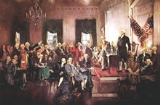
A constituent assembly is a body composed for the purpose of drafting or adopting a constitution
. As the fundamental document constituting a state, a constitution cannot normally be modified or amended by the state's normal legislative
procedures; instead a constituent assembly, the rules for which are normally laid down in the constitution, must be set up. A constituent assembly is usually set up for its specific purpose, which it carries out in a relatively short time, after which the assembly is dissolved.
Unlike forms of constitution-making in which a constitution is unilaterally imposed by a sovereign lawmaker, the constituent assembly creates a constitution through “internally imposed” actions, in that members of the constituent assembly are themselves citizens, but not necessarily the rulers, of the country for which they are creating a constitution. As described by Columbia University Social Sciences Professor Jon Elster
:
(from July 1789 to September 1791) a National Constituent Assembly
was formed when representatives assembled at the only location available – a tennis court – and swore the Tennis Court Oath
on June 20, 1789, promising that they would not adjourn until they had drafted a new constitution for France. Louis XVI
recognized the validity of the National Constituent Assembly on June 27, 1789.
, with 522 people vying for 25 delegate seats.
was elected to write the Constitution of India
, and served as its first Parliament
as an independent nation. It was set up as a result of negotiations between the leaders of Indian independence movement
and members of the British Cabinet Mission. The constituent assembly was elected indirectly by the members of the Provincial legislative assembly, that existed under the British Raj
. It first met on December 9, 1946 in Delhi
. On August 15, 1947, India became an independent nation, and the Constituent Assembly also started functioning as India's Parliament. The Assembly approved the Constitution on November 26, 1949. On January 26, 1950, the Constitution took effect — a day now commemorated as Republic Day
in India. At this point, the Constituent Assembly became the Provisional Parliament of India, until the first elections under the new Constitution took place in 1952.
about the adoption of Republic or the continuation of monarchy. Voters chose Republic, and the new assembly had the task to approve the new republic governments, as well as to write a new constitution. This was approved on 22 December 1947.
It was dissolved on 31 January 1948, to be replaced by the new Parliament of Italy
.
was established in Russia
in the wake of the October Revolution
of 1917 to form a new constitution after the overthrow of the Russian Provisional Government
.
that drafted the still-current Federal Constitution
in 1787. Unlike most constitutions, the U.S. constitution may be amended by Congress, although not as part of its normal business; again unlike other constitutions, amendments do not change the text of the constitution but are appended to it. While there is provision for calling one, no federal constitutional convention has been called. In part this is due to Congress being able to amend the constitution without a convention, and the daunting requirements for holding a new constitutional convention (requiring the consent of either two-thirds of both houses of Congress or two-thirds of the States), but also because of the fear that wholesale changes in the Federal Constitution might undermine a document that has stood the test of nearly 225 years.
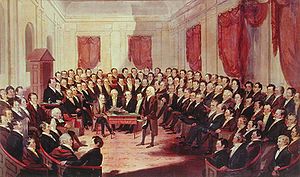 A rich tradition in the use of constituent assemblies exists at the state level of Constitutionalism
. In fact, constituent assemblies met in the states before the formation of the Federal Constitution in 1787 as well as after its ratification. Since 1776 nearly 150 state constitutional conventions have met to draft or revise state constitutions.
These early state constitutional conventions frequently did not use procedural steps like popular ratification that became commonplace in the mid-19th century. Yet they were considered to be constituent assemblies that exercised their authority as that of the people. As American Sovereigns: The People and America’s Constitutional Tradition Before the Civil War by Christian G. Fritz notes:
American state constituent assemblies in the 19th and 20th centuries reflected many qualities of a citizen’s movement. From the start of state American constitution-making, delegates to constitutional conventions studied earlier state models of constitutions. They often self-consciously "borrow[ed]" constitutional text and provisions from other states. They often used in their drafting and debates compact and pocket-sized compilations of all the existing American constitutions, so that the constituent’s assembly could draw upon the latest in constitutional design.
, New Zealand and Israel
are examples. In these countries there is no need to call constituent assemblies, and no provision to do so, as the legislature can effectively modify the constitution. If such a country decides to implement a constitution, presumably some sort of constituent assembly will have to be set up for the purpose.
The constitution of New Zealand consists of a collection of statutes (Acts of Parliament), Treaties, Orders-in-Council, Letters patent, decisions of the Courts and unwritten constitutional conventions. Because it is not supreme law, the constitution is comparatively easy to reform, requiring only a majority of Members of Parliament to amend it.
Constitution
A constitution is a set of fundamental principles or established precedents according to which a state or other organization is governed. These rules together make up, i.e. constitute, what the entity is...
. As the fundamental document constituting a state, a constitution cannot normally be modified or amended by the state's normal legislative
Legislature
A legislature is a kind of deliberative assembly with the power to pass, amend, and repeal laws. The law created by a legislature is called legislation or statutory law. In addition to enacting laws, legislatures usually have exclusive authority to raise or lower taxes and adopt the budget and...
procedures; instead a constituent assembly, the rules for which are normally laid down in the constitution, must be set up. A constituent assembly is usually set up for its specific purpose, which it carries out in a relatively short time, after which the assembly is dissolved.
Unlike forms of constitution-making in which a constitution is unilaterally imposed by a sovereign lawmaker, the constituent assembly creates a constitution through “internally imposed” actions, in that members of the constituent assembly are themselves citizens, but not necessarily the rulers, of the country for which they are creating a constitution. As described by Columbia University Social Sciences Professor Jon Elster
Jon Elster
Jon Elster is a Norwegian social and political theorist who has authored works in the philosophy of social science and rational choice theory...
:
Constitutions arise in a number of different ways. At the non-democratic extreme of the spectrum, we may imagine a sovereign lawgiver laying down the constitution for all later generations. At the democratic extreme, we may imagine a constituent assembly elected by universal suffrage for the sole task of writing a new constitution. And there are all sorts of intermediate arrangements.
France
During the French RevolutionFrench Revolution
The French Revolution , sometimes distinguished as the 'Great French Revolution' , was a period of radical social and political upheaval in France and Europe. The absolute monarchy that had ruled France for centuries collapsed in three years...
(from July 1789 to September 1791) a National Constituent Assembly
National Constituent Assembly
The National Constituent Assembly was formed from the National Assembly on 9 July 1789, during the first stages of the French Revolution. It dissolved on 30 September 1791 and was succeeded by the Legislative Assembly.-Background:...
was formed when representatives assembled at the only location available – a tennis court – and swore the Tennis Court Oath
Tennis Court Oath
The Tennis Court Oath was a pivotal event during the first days of the French Revolution. The Oath was a pledge signed by 576 of the 577 members from the Third Estate who were locked out of a meeting of the Estates-General on 20 June 1789...
on June 20, 1789, promising that they would not adjourn until they had drafted a new constitution for France. Louis XVI
Louis XVI of France
Louis XVI was a Bourbon monarch who ruled as King of France and Navarre until 1791, and then as King of the French from 1791 to 1792, before being executed in 1793....
recognized the validity of the National Constituent Assembly on June 27, 1789.
Iceland
On 27 November 2010, Iceland held an election for a constitutional assemblyIcelandic Constitutional Assembly
An Icelandic Constitutional Assembly for the purpose of reviewing the Constitution of the Republic was summoned by an act of Althingi, the Icelandic parliament, on June 16, 2010 as a conseccuence of the Kitchenware Revolution. In an election on November 27, 2010, 25 delegates were elected...
, with 522 people vying for 25 delegate seats.
India
The Constituent Assembly of IndiaIndia
India , officially the Republic of India , is a country in South Asia. It is the seventh-largest country by geographical area, the second-most populous country with over 1.2 billion people, and the most populous democracy in the world...
was elected to write the Constitution of India
Constitution of India
The Constitution of India is the supreme law of India. It lays down the framework defining fundamental political principles, establishes the structure, procedures, powers, and duties of government institutions, and sets out fundamental rights, directive principles, and the duties of citizens...
, and served as its first Parliament
Parliament
A parliament is a legislature, especially in those countries whose system of government is based on the Westminster system modeled after that of the United Kingdom. The name is derived from the French , the action of parler : a parlement is a discussion. The term came to mean a meeting at which...
as an independent nation. It was set up as a result of negotiations between the leaders of Indian independence movement
Indian independence movement
The term Indian independence movement encompasses a wide area of political organisations, philosophies, and movements which had the common aim of ending first British East India Company rule, and then British imperial authority, in parts of South Asia...
and members of the British Cabinet Mission. The constituent assembly was elected indirectly by the members of the Provincial legislative assembly, that existed under the British Raj
British Raj
British Raj was the British rule in the Indian subcontinent between 1858 and 1947; The term can also refer to the period of dominion...
. It first met on December 9, 1946 in Delhi
Delhi
Delhi , officially National Capital Territory of Delhi , is the largest metropolis by area and the second-largest by population in India, next to Mumbai. It is the eighth largest metropolis in the world by population with 16,753,265 inhabitants in the Territory at the 2011 Census...
. On August 15, 1947, India became an independent nation, and the Constituent Assembly also started functioning as India's Parliament. The Assembly approved the Constitution on November 26, 1949. On January 26, 1950, the Constitution took effect — a day now commemorated as Republic Day
Republic Day
Republic Day is the name of a holiday in several countries to commemorate the day when they became republics.-1 January in the Republic of Slovakia:This was the day of creation of the Republic of Slovakia. A national holiday since 1993...
in India. At this point, the Constituent Assembly became the Provisional Parliament of India, until the first elections under the new Constitution took place in 1952.
Italy
The Constituent Assembly of Italy was established in 1946 in the wake of Fascist Italy's defeat during World War II. It was elected with universal suffrage, simultaneously with a referendumReferendum
A referendum is a direct vote in which an entire electorate is asked to either accept or reject a particular proposal. This may result in the adoption of a new constitution, a constitutional amendment, a law, the recall of an elected official or simply a specific government policy. It is a form of...
about the adoption of Republic or the continuation of monarchy. Voters chose Republic, and the new assembly had the task to approve the new republic governments, as well as to write a new constitution. This was approved on 22 December 1947.
It was dissolved on 31 January 1948, to be replaced by the new Parliament of Italy
Parliament of Italy
The Parliament of Italy is the national parliament of Italy. It is a bicameral legislature with 945 elected members . The Chamber of Deputies, with 630 members is the lower house. The Senate of the Republic is the upper house and has 315 members .Since 2005, a party list electoral law is being...
.
Russia
The Russian Constituent AssemblyRussian Constituent Assembly
The All Russian Constituent Assembly was a constitutional body convened in Russia after the October Revolution of 1917. It is generally reckoned as the first democratically elected legislative body of any kind in Russian history. It met for 13 hours, from 4 p.m...
was established in Russia
Russia
Russia or , officially known as both Russia and the Russian Federation , is a country in northern Eurasia. It is a federal semi-presidential republic, comprising 83 federal subjects...
in the wake of the October Revolution
October Revolution
The October Revolution , also known as the Great October Socialist Revolution , Red October, the October Uprising or the Bolshevik Revolution, was a political revolution and a part of the Russian Revolution of 1917...
of 1917 to form a new constitution after the overthrow of the Russian Provisional Government
Russian Provisional Government
The Russian Provisional Government was the short-lived administrative body which sought to govern Russia immediately following the abdication of Tsar Nicholas II . On September 14, the State Duma of the Russian Empire was officially dissolved by the newly created Directorate, and the country was...
.
Federal
The most famous constituent assembly in U.S. history was the Federal constitutional conventionPhiladelphia Convention
The Constitutional Convention took place from May 14 to September 17, 1787, in Philadelphia, Pennsylvania, to address problems in governing the United States of America, which had been operating under the Articles of Confederation following independence from...
that drafted the still-current Federal Constitution
United States Constitution
The Constitution of the United States is the supreme law of the United States of America. It is the framework for the organization of the United States government and for the relationship of the federal government with the states, citizens, and all people within the United States.The first three...
in 1787. Unlike most constitutions, the U.S. constitution may be amended by Congress, although not as part of its normal business; again unlike other constitutions, amendments do not change the text of the constitution but are appended to it. While there is provision for calling one, no federal constitutional convention has been called. In part this is due to Congress being able to amend the constitution without a convention, and the daunting requirements for holding a new constitutional convention (requiring the consent of either two-thirds of both houses of Congress or two-thirds of the States), but also because of the fear that wholesale changes in the Federal Constitution might undermine a document that has stood the test of nearly 225 years.
States
Constitutionalism
Constitutionalism has a variety of meanings. Most generally, it is "a complex of ideas, attitudes, and patterns of behavior elaborating the principle that the authority of government derives from and is limited by a body of fundamental law"....
. In fact, constituent assemblies met in the states before the formation of the Federal Constitution in 1787 as well as after its ratification. Since 1776 nearly 150 state constitutional conventions have met to draft or revise state constitutions.
These early state constitutional conventions frequently did not use procedural steps like popular ratification that became commonplace in the mid-19th century. Yet they were considered to be constituent assemblies that exercised their authority as that of the people. As American Sovereigns: The People and America’s Constitutional Tradition Before the Civil War by Christian G. Fritz notes:
“A legitimate constitution depended on whether the sovereign people authorized it, not whether a particular procedure was used or whether revolutionary conventions were free of other responsibilities, such as passing ordinary legislation. It was the people as the sovereign who authorized drafting those first [state] constitutions that gave them their legitimacy, not whether they used procedures that matched what was later understood to be necessary to create fundamental law.”
American state constituent assemblies in the 19th and 20th centuries reflected many qualities of a citizen’s movement. From the start of state American constitution-making, delegates to constitutional conventions studied earlier state models of constitutions. They often self-consciously "borrow[ed]" constitutional text and provisions from other states. They often used in their drafting and debates compact and pocket-sized compilations of all the existing American constitutions, so that the constituent’s assembly could draw upon the latest in constitutional design.
Countries without an entrenched constitution
A few countries do not have an entrenched constitution which cannot be amended by normal legislative procedures; the United KingdomConstitution of the United Kingdom
The constitution of the United Kingdom is the set of laws and principles under which the United Kingdom is governed.Unlike many other nations, the UK has no single core constitutional document. In this sense, it is said not to have a written constitution but an uncodified one...
, New Zealand and Israel
Basic Laws of Israel
The Basic Laws of Israel are a key component of Israel's constitutional law. These laws deal with the formation and role of the principal state's institutions, and the relations between the state's authorities. Some of them also protect civil rights...
are examples. In these countries there is no need to call constituent assemblies, and no provision to do so, as the legislature can effectively modify the constitution. If such a country decides to implement a constitution, presumably some sort of constituent assembly will have to be set up for the purpose.
The constitution of New Zealand consists of a collection of statutes (Acts of Parliament), Treaties, Orders-in-Council, Letters patent, decisions of the Courts and unwritten constitutional conventions. Because it is not supreme law, the constitution is comparatively easy to reform, requiring only a majority of Members of Parliament to amend it.
See also
- List of constituent assemblies
- Convention parliament
- Constitutional convention (political meeting)Constitutional convention (political meeting)A constitutional convention is now a gathering for the purpose of writing a new constitution or revising an existing constitution. A general constitutional convention is called to create the first constitution of a political unit or to entirely replace an existing constitution...
- Constituent CortesConstituent CortesConstituent Cortes is the description of Spain's parliament, the Cortes, when convened as a constituent assembly.In the 20th century, only one Constituent Cortes was officially opened , and that was the Republican Cortes in 1931.The Cortes in 1977 enacted the new Spanish constitution...
- National Constituent AssemblyNational Constituent AssemblyThe National Constituent Assembly was formed from the National Assembly on 9 July 1789, during the first stages of the French Revolution. It dissolved on 30 September 1791 and was succeeded by the Legislative Assembly.-Background:...
- Third DáilThird DáilThe Third Dáil, also known as the Provisional Parliament or the Constituent Assembly, was:*the "provisional parliament" or "constituent assembly" of Southern Ireland from 9 August 1922 until 6 December 1922; and...
, also called the Constituent Assembly