
|
|
|
|
Lala Lajpat Rai
|
| |
|
| |
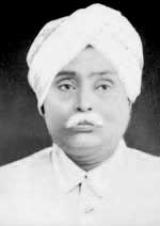
Lala Lajpat Rai (Punjabi: ???? ???? ???, ???? ???? ???; ) was an Indian author and politician who is chiefly remembered as a leader in the Indian fight for freedom from the British Raj. The freedom fighter was popularly known as Punjab Kesari (The Lion of Punjab). He was also the founder of Punjab National Bank and Lakshmi Insurance Company.
was born on January 28, 1865 in village Dhudi Ke, in present day Moga district of Punjab, India.

Discussion
Ask a question about 'Lala Lajpat Rai'
Start a new discussion about 'Lala Lajpat Rai'
Answer questions from other users
|
Encyclopedia
Lala Lajpat Rai (Punjabi: ???? ???? ???, ???? ???? ???; ) was an Indian author and politician who is chiefly remembered as a leader in the Indian fight for freedom from the British Raj. The freedom fighter was popularly known as Punjab Kesari (The Lion of Punjab). He was also the founder of Punjab National Bank and Lakshmi Insurance Company.
Early life
Rai was born on January 28, 1865 in village Dhudi Ke, in present day Moga district of Punjab, India. He was the eldest son of Munshi Radha Kishan Azad and Gulab Devi, Aggarwal Banias or some also consider them as Jains. His father had a chequered relationship with Hinduism and Jainism - having converted to Islam and then reverted back to Hinduism. This had a lasting effect on Rai's attitude towards religions other than Hinduism. He spent much of his youth in Ludhiana]], Punjab. His house still stands tall in Jagraon and houses a Library and museum..
Political career
Rai joined the Indian National Congress in 1888 and became one of its three most prominent Hindu Nationalist members, who fought for, and gave their lives during the Indian independence movement in the first half of the twentieth century. The other two were Bal Gangadhar Tilak of Maharashtra and Bipin Chandra Pal of Bengal. Collectively, they were dubbed Lal-Bal-Pal, and formed the Hindu faction of the Indian National Congress, as opposed to the moderate faction led first by Gopal Krishna Gokhale and later by Mahatma Gandhi. Rai was also a member of the Hindu Maha Sabha, a forerunner of the current day Hindu nationalist party, the Bharatiya Janata Party.
It was the Partition of Bengal in 1905 that aroused their robust nationalism and set them firmly on the path to fighting for freedom. The repressive measures of the British Government against the growing nationalist movement inspired them to infuse greater national pride and self-respect into the populace. The trio wanted a degree of self-government that was considered radical at the time. They were the first Indian leaders to demand complete political independence.
Rai presided over the first session of the All India Trade Union Congress in 1920. In 1923, he became a member of the Imperial Legislative Assembly. He also went to Geneva to attend the eighth International Labour Conference in 1926 as a representative of Indian labour. He had an opportunity to watch the labour movement in the USA and England where he was required to prolong his stay for political reasons.
Rai led the Punjab protests against the Amritsar Massacre (1919) and the Non-Cooperation Movement (1919 - 1922). He was repeatedly arrested. Rai however disagreed with Mohandas Gandhi's suspension of the movement due to the Chauri Chaura incident, and formed the Congress Independence Party, which was particularly pro-Hindu in voice and policy.
He was not only a good orator but also a prolific and versatile writer. His journal Arya Gazette concentrated mainly on subjects related to the Arya Samaj. Bande Mataram and People, contained his inspiring speeches to end oppression by the foreign rulers. He founded the Servants of the People Society, which worked for the freedom movement as well as for social reform in the country. He also wrote an autobiography in English titled The Story of My Life.
Simon Commission protests
A strong believer in leading by example, he led a procession with Pandit Madan Mohan Malaviya to demonstrate against the Simon Commission. He was the target of a lathi charge by a British Police Sergeant, in which he was seriously injured. A meeting was held the same evening where he spoke with such vigour that his words, "Every blow aimed at me is a nail in the coffin of British imperialism", became historic. Though he recovered from the fever and pain within three days, his health had received a permanent setback and on November 17, 1928, he died of his injuries. His death led to great disturbances in the country and it inspired national struggle for freedom.
Author
Lala Lajpat Rai wrote extensively, among them - Josiah Wedgwood - The Man And His Work, The United States of America: A Hindu's impressions and a study, History of the Arya Samaj, Swaraj and social change, England’s Debt to India: A historical narrative of Britain's fiscal policy in India, The Problems Of National Education In India and Unhappy India: Being a reply to Katherine Mayo's "Mother India", published in 1928. (Mother India was a polemical account of India's self rule by American historian Katherine Mayo.)
Inspiration and memorial
Lajpat Rai was one of the most important nationalist leaders from the Punjab, where he is remembered reverently by Hindu nationalists today. He was a key mentor of nationalists like Bhagat Singh and Chandrasekhar Azad.
The Lala Lajpat Rai Memorial Trust was formed in 1959 on the eve of his Centenary Birth Celebration, to promote education - a cause very dear to his heart. The trust was founded by a group of Punjabi philanthropists (including R.P Gupta and B.M Grover) who have settled and prospered in the Indian State of Maharashtra.
Lajpat Nagar and Lajpat Nagar Central Market in New Delhi, Lala Lajpat Rai Hall of Residence at Indian Institutes of Technology (IIT) in Kharagpur and Lala Lajpat Rai Institute of Engineering and Technology, Moga are named in his honor. Also many institutes, Schools and Library in his hometown of Jagraon, district Ludhiana are named after him.
|
| |
|
|