

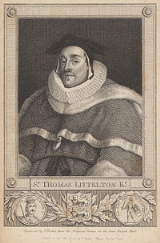
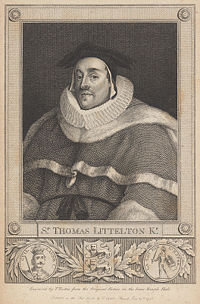
Thomas de Littleton

Encyclopedia
England
England is a country that is part of the United Kingdom. It shares land borders with Scotland to the north and Wales to the west; the Irish Sea is to the north west, the Celtic Sea to the south west, with the North Sea to the east and the English Channel to the south separating it from continental...
judge
Judge
A judge is a person who presides over court proceedings, either alone or as part of a panel of judges. The powers, functions, method of appointment, discipline, and training of judges vary widely across different jurisdictions. The judge is supposed to conduct the trial impartially and in an open...
and legal writer.
Early life
He was born, it is supposed, at FrankleyFrankley
Frankley is a village and civil parish in the Bromsgrove district of Worcestershire, near the border with Birmingham. The modern Frankley estate is part of the New Frankley civil parish in Birmingham, and has been part of the city since 1995. The parish has a population of 122.-St Leonards...
Manor House, Worcestershire
Worcestershire
Worcestershire is a non-metropolitan county, established in antiquity, located in the West Midlands region of England. For Eurostat purposes it is a NUTS 3 region and is one of three counties that comprise the "Herefordshire, Worcestershire and Warwickshire" NUTS 2 region...
, England
England
England is a country that is part of the United Kingdom. It shares land borders with Scotland to the north and Wales to the west; the Irish Sea is to the north west, the Celtic Sea to the south west, with the North Sea to the east and the English Channel to the south separating it from continental...
in about 1407. Littleton’s surname was that of his mother, who was the sole daughter and heiress of Thomas de Littleton, Lord of Frankley. She married one Thomas Westcote. Thomas was the eldest of four sons of the marriage, and took the name of Littleton, or, as it seems to have been more commonly spelt, Lyttelton. The date of his birth is uncertain; an MS. pedigree gives 1422, but it was probably earlier than this. If, as is generally accepted, he was born at Frankley Manor, it could not have been before 1407, in which year Littleton’s grandfather recovered the manor from a distant branch of the family.
It is likely he attended the grammar school at Worcester (now the Royal Grammar School Worcester) and he is said by Sir Edward Coke
Edward Coke
Sir Edward Coke SL PC was an English barrister, judge and politician considered to be the greatest jurist of the Elizabethan and Jacobean eras. Born into a middle class family, Coke was educated at Trinity College, Cambridge before leaving to study at the Inner Temple, where he was called to the...
to have "attended one of the universities", but there is no corroboration of this statement.
Career
He was probably a member of the Inner TempleInner Temple
The Honourable Society of the Inner Temple, commonly known as Inner Temple, is one of the four Inns of Court in London. To be called to the Bar and practise as a barrister in England and Wales, an individual must belong to one of these Inns...
, and lectured there on the statute of Westminster
Westminster
Westminster is an area of central London, within the City of Westminster, England. It lies on the north bank of the River Thames, southwest of the City of London and southwest of Charing Cross...
, i.e. Donis Conditionalibus
De donis conditionalibus
De donis conditionalibus is the chapter of the English Statutes of Westminster which originated the law of entail.Strictly speaking, a form of entail was known before the Norman feudal law had been domesticated in England...
. His name occurs in the Paston Letters
Paston Letters
The Paston Letters are a collection of letters and papers from England, consisting of the correspondence of members of the gentry Paston family, and others connected with them, between the years 1422 and 1509, and also including some state papers and other important documents.- History of the...
(ed. J. Gairdner, p. 60) about 1445 as that of a well-known counsel
Counsel
A counsel or a counselor gives advice, more particularly in legal matters.-U.K. and Ireland:The legal system in England uses the term counsel as an approximate synonym for a barrister-at-law, and may apply it to mean either a single person who pleads a cause, or collectively, the body of barristers...
and in 1481/2 he received a grant of the manor of Sheriff Hales
Sheriff Hales
Sheriffhales is a scattered village in Shropshire, England, north-east of Telford, north of Shifnal and south of Newport....
, Shropshire
Shropshire
Shropshire is a county in the West Midlands region of England. For Eurostat purposes, the county is a NUTS 3 region and is one of four counties or unitary districts that comprise the "Shropshire and Staffordshire" NUTS 2 region. It borders Wales to the west...
, from a Sir William Trussel as a reward for his services as counsel.
He appears to have been recorder of Coventry in 1450; he was made Escheator of Worcestershire
Worcestershire
Worcestershire is a non-metropolitan county, established in antiquity, located in the West Midlands region of England. For Eurostat purposes it is a NUTS 3 region and is one of three counties that comprise the "Herefordshire, Worcestershire and Warwickshire" NUTS 2 region...
, and in 1447/8 was under-sheriff of the same county
County
A county is a jurisdiction of local government in certain modern nations. Historically in mainland Europe, the original French term, comté, and its equivalents in other languages denoted a jurisdiction under the sovereignty of a count A county is a jurisdiction of local government in certain...
; he became sergeant-at-law in 1453 and was afterwards a Justice of Assize on the northern circuit. In 1466 he was made a judge of the common pleas
Court of Common Pleas (England)
The Court of Common Pleas, or Common Bench, was a common law court in the English legal system that covered "common pleas"; actions between subject and subject, which did not concern the king. Created in the late 12th to early 13th century after splitting from the Exchequer of Pleas, the Common...
, and in 1475 a knight of the Bath
Order of the Bath
The Most Honourable Order of the Bath is a British order of chivalry founded by George I on 18 May 1725. The name derives from the elaborate mediæval ceremony for creating a knight, which involved bathing as one of its elements. The knights so created were known as Knights of the Bath...
.
Marriage
He married, in about 1444, Joan, widow of Sir Philip Chetwind of IngestreIngestre
Ingestre is a village and former civil parish in Staffordshire, England. It is four miles to the north-east of the county town of Stafford.Ingestre Hall is a local landmark....
in Staffordshire
Staffordshire
Staffordshire is a landlocked county in the West Midlands region of England. For Eurostat purposes, the county is a NUTS 3 region and is one of four counties or unitary districts that comprise the "Shropshire and Staffordshire" NUTS 2 region. Part of the National Forest lies within its borders...
, and by her had three sons, through whom he became ancestor of the families holding the peerages of Cobham
Viscount Cobham
Viscount Cobham is a title in the Peerage of Great Britain. It was created in 1718 for Field Marshal Richard Temple, 1st Baron Cobham and 4th Baronet, of Stowe...
(formerly Lyttelton
Baron Lyttelton
Lord Lyttelton, Baron of Frankley, in the County of Worcester, is a title in the Peerage of Great Britain, created in 1794. Since 1889 it is a subsidiary title of the viscountcy of Cobham....
) and Hatherton
Baron Hatherton
Baron Hatherton, of Hatherton in the County of Stafford, is a title in the Peerage of the United Kingdom. It was created in 1835 for the politician Edward Littleton, Chief Secretary for Ireland from 1833 to 1834...
.
Death
He died, according to the inscription on his tombTomb
A tomb is a repository for the remains of the dead. It is generally any structurally enclosed interment space or burial chamber, of varying sizes...
in Worcester cathedral
Worcester Cathedral
Worcester Cathedral is an Anglican cathedral in Worcester, England; situated on a bank overlooking the River Severn. It is the seat of the Anglican Bishop of Worcester. Its official name is The Cathedral Church of Christ and the Blessed Mary the Virgin of Worcester...
, on 23 August 1481.
Background
His Treatise on Tenures was probably written after he had been appointed to the bench. According to tradition it is addressed to his second son, Richard, who went to the bar, and whose name occurs in the year books of the reign of Henry VIIHenry VII of England
Henry VII was King of England and Lord of Ireland from his seizing the crown on 22 August 1485 until his death on 21 April 1509, as the first monarch of the House of Tudor....
; it has however been argued that the words mon filz (my son) were simply a conventional way of addressing law students. The book, both historically and from its intrinsic merit, may be characterized as the first text-book upon the English law of property. The law of property in Littleton’s time was mainly concerned with rights over land, and it was the law relating to this class of rights that Littleton set himself to digest and classify. The time was ripe for the task: ever since the Norman conquest
Norman conquest of England
The Norman conquest of England began on 28 September 1066 with the invasion of England by William, Duke of Normandy. William became known as William the Conqueror after his victory at the Battle of Hastings on 14 October 1066, defeating King Harold II of England...
, regular courts of justice had been at work administering a law that had grown out of an admixture
Admixture
Admixture can refer to:* Genetic admixture, the result of interbreeding between two or more previously isolated populations within a species.* Racial admixture, admixture between humans, also referred to as Miscegenation* Hybrid...
of Teutonic custom
Early Germanic law
Several Latin law codes of the Germanic peoples written in the Early Middle Ages survive, dating to between the 5th and 9th centuries...
and of Norman feudalism.
Under Henry II
Henry II of England
Henry II ruled as King of England , Count of Anjou, Count of Maine, Duke of Normandy, Duke of Aquitaine, Duke of Gascony, Count of Nantes, Lord of Ireland and, at various times, controlled parts of Wales, Scotland and western France. Henry, the great-grandson of William the Conqueror, was the...
, the courts had been organized, and the practice of keeping regular records of the proceedings had been carefully observed. The centralizing influence of the royal court
Royal court
Royal court, as distinguished from a court of law, may refer to:* The Royal Court , Timbaland's production company*Court , the household and entourage of a monarch or other ruler, the princely court...
s and of the justices of assize, working steadily through three centuries, had made the rules governing the law of property uniform throughout the land; local customs were confined within certain prescribed limits, and were only recognized as giving rise to certain well defined classes of rights, such, for instance, as the security of tenure
Security of tenure
Security of tenure is a term used in political science to describe a constitutional or legal guarantee that an office-holder cannot be removed from office except in exceptional and specified circumstances....
acquired by villains by virtue of the custom of the manor, and the rights of freeholders, in some towns, to dispose of their land by will. Thus, by the time of Littleton (Henry VI
Henry VI of England
Henry VI was King of England from 1422 to 1461 and again from 1470 to 1471, and disputed King of France from 1422 to 1453. Until 1437, his realm was governed by regents. Contemporaneous accounts described him as peaceful and pious, not suited for the violent dynastic civil wars, known as the Wars...
and Edward IV
Edward IV of England
Edward IV was King of England from 4 March 1461 until 3 October 1470, and again from 11 April 1471 until his death. He was the first Yorkist King of England...
), an immense mass of material had been acquired and preserved in the rolls of the various courts. Reports of important cases were published in the "year books". A glance at Statham’s Abridgment, the earliest digest of decided cases, published nearly at the same time as Littleton’s Tenures, is sufficient to show the enormous bulk that reported cases had already attained as materials for the knowledge of English law.
Language
Littleton’s treatise was written in that peculiar dialect compounded of Norman FrenchAnglo-Norman language
Anglo-Norman is the name traditionally given to the kind of Old Norman used in England and to some extent elsewhere in the British Isles during the Anglo-Norman period....
and English
English language
English is a West Germanic language that arose in the Anglo-Saxon kingdoms of England and spread into what was to become south-east Scotland under the influence of the Anglian medieval kingdom of Northumbria...
phrases called law French
Law French
Law French is an archaic language originally based on Old Norman and Anglo-Norman, but increasingly influenced by Parisian French and, later, English. It was used in the law courts of England, beginning with the Norman Conquest by William the Conqueror...
.
Although it had been provided by a statute
Statute
A statute is a formal written enactment of a legislative authority that governs a state, city, or county. Typically, statutes command or prohibit something, or declare policy. The word is often used to distinguish law made by legislative bodies from case law, decided by courts, and regulations...
of Edward III
Edward III of England
Edward III was King of England from 1327 until his death and is noted for his military success. Restoring royal authority after the disastrous reign of his father, Edward II, Edward III went on to transform the Kingdom of England into one of the most formidable military powers in Europe...
, that viva voce
Viva voce
Viva voce is a Latin phrase literally meaning "with living voice," but most often translated as "by word of mouth."It may also refer to:*Italian for "live voice."*Voice vote in a deliberative assembly...
proceedings in court should no longer be conducted in the French tongue, "which was much unknown in the realm", the practice of reporting proceedings in that language, and of using it in legal treatises, lingered till a much later period, and was, at length, prohibited by a statute passed in the time of the Commonwealth
Commonwealth of England
The Commonwealth of England was the republic which ruled first England, and then Ireland and Scotland from 1649 to 1660. Between 1653–1659 it was known as the Commonwealth of England, Scotland and Ireland...
in 1650.
Sources
Unlike the preceding writers on English law, Glanville, Bracton, and the authors of the treatises known by the names of BrittonBritton
-Places:* Britton, Ontario, Canada* Britton, Michigan, U.S.* Britton, South Dakota, U.S.-Surname:* Andrew Britton , British-born American author* Brent Britton , American lawyer...
and Fleta
Fleta
Fleta is a treatise, written in Latin, with the sub-title seu Commentarius juris Anglicani, on the common law of England. The anonymous author of the book is sometimes referred to as "Fleta", although this is not in fact a person's name...
, Littleton borrows nothing from the sources of Roman law
Roman law
Roman law is the legal system of ancient Rome, and the legal developments which occurred before the 7th century AD — when the Roman–Byzantine state adopted Greek as the language of government. The development of Roman law comprises more than a thousand years of jurisprudence — from the Twelve...
or the commentators. He deals exclusively with English law.
The first two books are stated, in a note to the table at the conclusion of the work, to have been made for the better understanding of certain chapters of the "Ancient Book of Tenures". This refers to a tract called The Old Tenures, said to have been written in the reign of Edward III
Edward III of England
Edward III was King of England from 1327 until his death and is noted for his military success. Restoring royal authority after the disastrous reign of his father, Edward II, Edward III went on to transform the Kingdom of England into one of the most formidable military powers in Europe...
. By way of distinguishing it from this work, Littleton’s book is called in all the early editions "Tenores Novelli".
Method
The book is written on a definite system, and is the first attempt at a scientific classification of rights over land. Littleton’s method is to begin with a definition, usually clearly and briefly expressed, of the class of rights with which he is dealing. He then proceeds to illustrate the various characteristics and incidents of the class by stating particular instances, some of which refer to decisions that had actually occurred, but more of which are hypothetical cases put by way of illustration of his principles. He occasionally refers to reported cases. His book is thus much more than a mere digest of judicial decisions; to some extent, he pursues the method that gave to Roman law its breadth and consistency of principle. In Roman law, this result was attained through the practice of putting to jurisconsults hypothetical cases to be solved by them. Littleton, in like manner, is constantly stating and solving, by reference to principles of law, cases that may or may not have occurred in actual practice.Contents
In dealing with freehold estates, Littleton adopts a classification that has been followed by all writers who have attempted to systematize the English law of land, especially Sir Matthew HaleMatthew Hale (jurist)
Sir Matthew Hale SL was an influential English barrister, judge and jurist most noted for his treatise Historia Placitorum Coronæ, or The History of the Pleas of the Crown. Born to a barrister and his wife, who had both died by the time he was 5, Hale was raised by his father's relative, a strict...
and Sir William Blackstone. It is indeed the only possible approach to a scientific arrangement of the intricate "estates in land" that were known to English law. He classifies estates in land by reference to their duration, or, in other words, by reference to the differences between the persons who are entitled to succeed upon the death of the person in possession or "tenant".
First of all, he describes the characteristics of tenancy in fee simple. In Littleton’s time and until the present day, it was the largest interest in land known to the law. Next in order comes tenancy in fee tail
Fee tail
At common law, fee tail or entail is an estate of inheritance in real property which cannot be sold, devised by will, or otherwise alienated by the owner, but which passes by operation of law to the owner's heirs upon his death...
, the various classes of which are sketched by Littleton with brevity and accuracy; but he is silent as to the important practice, which first received judicial recognition shortly before his death, of "suffering a recovery", whereby, through a series of judicial fictions, a tenant in tail was enabled to convert his estate tail into a fee simple, thus acquiring full power of alienation.
After discussing, in their logical order, other freehold interests in land, he passes to interests in land that were called by later writers interests less than freehold — namely, tenancies for terms of years and tenancies at will. With the exception of tenancy from year to year, now so familiar to us, but which was a judicial creation of a date later than the time of Littleton, the first book is a complete statement of the principles of the common law, as they, for the most part, existed until 1925, governing and regulating interests in lands. The first book concludes with a very interesting chapter on copyhold tenures, which marks the exact point at which the tenant—by-copy-of-court-roll, the successor of the villein, who, in his turn, represented the freeman reduced to villeinage by the growth of the manorial system, acquired security of tenure.
The second book relates to the reciprocal rights and duties of lord and tenant, and is mainly of historical interest to the modern lawyer. It contains a complete statement of the law as it stood in Littleton’s time relating to homage, fealty, and escuage, the money compensation to be paid to the lord in lieu of military service to be rendered to the king, a peculiar characteristic of English as distinguished from Continental feudalism.
Littleton then proceeds to notice the important features of tenure by knight’s service with its distinguishing incidents of the right of wardship
Ward (law)
In law, a ward is someone placed under the protection of a legal guardian. A court may take responsibility for the legal protection of an individual, usually either a child or incapacitated person, in which case the ward is known as a ward of the court, or a ward of the state, in the United States,...
of the lands and person of the infant heir or heiress, and the right of disposing of the ward in marriage. The non-military freehold tenures are next dealt with: we have an account of "socage tenure", into which all military tenures were subsequently commuted by a now unrecognized act of the Long Parliament
Long Parliament
The Long Parliament was made on 3 November 1640, following the Bishops' Wars. It received its name from the fact that through an Act of Parliament, it could only be dissolved with the agreement of the members, and those members did not agree to its dissolution until after the English Civil War and...
in 1650, afterwards reënacted by the well known statute of Charles II
Charles II of England
Charles II was monarch of the three kingdoms of England, Scotland, and Ireland.Charles II's father, King Charles I, was executed at Whitehall on 30 January 1649, at the climax of the English Civil War...
(1660), and of "frankalmoign", or the spiritual tenure by which churchmen held.
In the description of burgage tenure and tenure in villeinage, the life of which consists in the validity of ancient customs recognized by law, we recognize survivals of a time before the iron rule of feudalism had moulded the law of land in the interests of the king and the great lords. Finally he deals with the law of rents, discussing the various kinds of rents that may be reserved to the grantor upon a grant of lands and the remedies for recovery of rent, especially the remedy by distress.
The third and concluding book of Littleton’s treatise deals mainly with the various ways in which rights over land can be acquired and terminated in the case of a single possessor or several possessors. This leads him to discuss the various modes in which several persons may simultaneously have rights over the same land, such as parcener
Coparcenary
Coparcenary is the concept whereby two or more people inherit a title equally between them as a result of which none can inherit until all but one have renounced their right to the inheritance. This could arise when a title passes through and vests in female heirs in the absence of a male heir....
s (daughters who are co-heiresses, or sons in gavelkind
Gavelkind
Gavelkind was a system of land tenure associated chiefly with the county of Kent, but found also in other parts of England. Its inheritance pattern bears resemblance to Salic patrimony and as such might testify in favour of a wider, probably ancient Germanic tradition.It was legally abolished in...
), joint tenants and tenants in common.
Next follows an elaborate discussion upon what are called estates upon condition — a class of interests that occupied a large space in the early common law, giving rise, on one side, to estates tail, and, on another, to mortgages. In Littleton’s time, a mortgage, which he carefully describes, was merely a conveyance of land by the tenant to the mortgagee, with a condition that, if the tenant paid to the mortgagee a certain sum on a certain day, he might reënter and have the land again. If the condition was not fulfilled, the interest of the mortgagee became absolute, and Littleton gives no indication of any modification of this strict rule, such as was introduced by courts of equity, permitting the debtor to redeem his land by payment of all that was due to the mortgagee although the day of payment had passed, and his interest had become, at law, indefeasible. The remainder of the work is occupied with an exposition of a miscellaneous class of modes of acquiring rights of property, the analysis of which would occupy too large a space.
The work is thus a complete summary of the common law as it stood at the time. It is nearly silent as to the remarkable class of rights that had already assumed vast practical importance — equitable interests in lands. These are only noticed incidentally in the chapter on “Releases”. But it was already clear, in Littleton’s time, that this class of rights would become the most important of all. Littleton’s own will, which has been preserved, may be adduced in proof of this assertion.
Editions
The first edition of The Tenures appeared in 1481 or 1482, being one of the earliest books printed in LondonLondon
London is the capital city of :England and the :United Kingdom, the largest metropolitan area in the United Kingdom, and the largest urban zone in the European Union by most measures. Located on the River Thames, London has been a major settlement for two millennia, its history going back to its...
and the earliest treatise on English law
English law
English law is the legal system of England and Wales, and is the basis of common law legal systems used in most Commonwealth countries and the United States except Louisiana...
printed anywhere. The second edition was printed about 1483 in London, and the third about 1490 in Rouen
Rouen
Rouen , in northern France on the River Seine, is the capital of the Haute-Normandie region and the historic capital city of Normandy. Once one of the largest and most prosperous cities of medieval Europe , it was the seat of the Exchequer of Normandy in the Middle Ages...
. These editions and many others were in the original Law French
Law French
Law French is an archaic language originally based on Old Norman and Anglo-Norman, but increasingly influenced by Parisian French and, later, English. It was used in the law courts of England, beginning with the Norman Conquest by William the Conqueror...
. In 1766 (second edition 1779) David Hoüard, a Norman advocate, published the Tenures under the title of Anciennes Loix des François conservées dans les coutumes angloises, arguing that they were derived from, and thus the best evidence for, early French customary law. There have also been many editions in English
English language
English is a West Germanic language that arose in the Anglo-Saxon kingdoms of England and spread into what was to become south-east Scotland under the influence of the Anglian medieval kingdom of Northumbria...
. In 1628 appeared the celebrated commentary of Coke
Edward Coke
Sir Edward Coke SL PC was an English barrister, judge and politician considered to be the greatest jurist of the Elizabethan and Jacobean eras. Born into a middle class family, Coke was educated at Trinity College, Cambridge before leaving to study at the Inner Temple, where he was called to the...
. There have been about 25 editions of Coke upon Littleton and about 90 editions of The Tenures without the commentary. With or without commentary, The Tenures formed an important part of legal education for almost three centuries and a half and is still cited in the courts of England and the United States as an authority on the feudal law of real estate. Professor Wambaugh
Eugene Wambaugh
Eugene Wambaugh was an American legal scholar. He was born on a farm near Brookville, Ohio to Rev. A. B. Wambaugh and Sarah Wells Wambaugh. He was educated at Harvard . Admitted to the Ohio bar in 1880, he practiced law in Cincinnati until 1889...
wrote a learned introduction to the 1903 edition of The Tenures (Washington).