

Styrax

Encyclopedia
Styrax is a genus
of about 130 species of large shrub
s or small tree
s in the family Styracaceae
, mostly native to warm temperate to tropical regions of the Northern Hemisphere
, with the majority in eastern and southeastern Asia
, but also crossing the equator
in South America
. Common names include styrax, or the more ambiguous storax
, snowbell, and benzoin
.
The genus Pamphilia, sometimes regarded as distinct, is now included within Styrax based on analysis of morphological
and DNA sequence
data. The spicebush
(Lindera benzoin) is a different plant, in the family Lauraceae
.
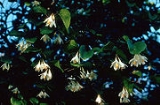
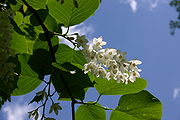
Styrax trees grow to 2–14 m tall, and have alternate, deciduous
or evergreen
simple ovate leaves
1–18 cm long and 2–10 cm broad. The flower
s are pendulous, with a white 5-10-lobed corolla, produced 3-30 together on open or dense panicle
s 5–25 cm long. The fruit
is an oblong dry drupe
, smooth and lacking ribs or narrow wings, unlike the fruit of the related snowdrop trees (Halesia
) and epaulette trees (Pterostyrax
).
, a dried exudation from pierced bark
, is currently produced from various Styrax species native to Sumatra
, Java, and Thailand
. Commonly traded are the resins of S. tonkinensis (Siam benzoin), S. benzoin
(Sumatra benzoin), and S. benzoides. The name "benzoin" is probably derived from Arabic
lubān jāwī (لبان جاوي, "Javan frankincense
"); compare the obsolete terms "gum benjamin" and "benjoin". This incidentally shows that the Arabs were aware of the origin of these resins, and that by the late Middle Ages
at latest international trade in them was probably of major importance.
The chemical benzoin
(2-Hydroxy-2-phenylacetophenone), despite the apparent similarity of the name, is not contained in benzoin resin in measurable quantities. However, benzoin resin does contain small amounts of the hydrocarbon
styrene, named however for Levant styrax (from Liquidambar orientalis
), from which it was first isolated, and not for the genus Styrax itself; industrially produced styrene is now used to produce polystyrene
plastic
s, including Styrofoam
TM.
 Since Antiquity
, styrax resin has been used in perfume
s, some kinds of incense
, and medicine
s.
There is some degree of uncertainty as to exactly what resin old sources refer to. Turkish sweetgum
(Liquidambar orientalis) is a quite unrelated tree in the family Altingiaceae
that produces a similar resin traded in modern times as storax
or as "Levant styrax," like the resins of other sweetgums, and a number of confusing variations thereupon. Turkish sweetgum is a relict
species that occurs only in a small area in SW Turkey
(and not in the Levant
at all); presumably, quite some of the "styrax resin" of the Ancient Greek
and the Ancient Roman sources was from this sweetgum, rather than a Styrax, although at least during the former era genuine Styrax resin, probably from S. officinalis
, was imported in quantity from the Near East
by Phoenicia
n merchants, and Herodotus of Halicarnassus in the 5th century BC indicates that different kinds of "storax" were traded.
The nataf (נטף) of the incense sacred to Yahweh
, mentioned in the Book of Exodus, is variously translated to the Greek
term staktḗ (στακτή, AMP
: ), or an unspecific "gum resin" or similar term (NIV
: ). Nataf may have meant the resin of Styrax officinalis or of some other plant, perhaps Turkish sweetgum, which is unlikely to have been imported in quantity into the Near East
.
Since the Middle Ages
, Southeast Asian benzoin resins became increasingly available; today there is little international trade in S. officinalis resin and little production of Turkish sweetgum resin due to that species' decline in numbers.
and adjacent regions as an air freshener
. This was adopted in the European Papier d'Arménie
. Though highly toxic benzene
and formaldehyde
are produced when burning Styrax incense (as with almost all organic substances), the amounts produced by burning a strip of Papier d'Arménie every 2–3 days are less than those achieved by many synthetic air fresheners. Styrax resin from southern Arabian species was burned during frankincense
(Boswellia
resin) harvesting; it was said to drive away snakes:

; Avicenna
(Ibn Seena, ابن سینا) discusses S. officinalis
it in his Al-Qanun fi al-Tibb (القانون في الطب, The Law of Medicine). He indicates that styrax resin mixed with other antibiotic substances and hardening material gives a good dental restorative material. Benzoin resin is a component of the "Theriaca Andromachi Senioris", a Venice treacle recipe in the 1686 d'Amsterdammer Apotheek.
Tincture of benzoin
is benzoin resin dissolved in alcohol
. This and its numerous derived versions like lait virginal and Friar's Balsam were highly esteemed in 19th-century European cosmetics
and other household purposes; they apparently had antibacterial properties. Today tincture of benzoin is most often used in first aid
for small injuries, as it acts as a disinfectant and local anesthetic and seems to promote healing. It can also be added to boiling water to produce fumes which when inhaled have a soothing effect on the lung
s and bronchia, helping recovery from the common cold
, bronchitis
, or asthma
. Benzoin resin and its derivatives are also used as an additives in cigarettes due to this soothing effect.
The antibiotic activity of benzoin resin seems mostly due to its abundant benzoic acid
and benzoic acid ester
s, which were named after the resin; other less well known secondary compounds such as lignans like pinoresinol
are likely significant too.
 Several species of styrax are popular ornamental trees in parks and gardens, especially S. japonicus and its cultivars like 'Emerald Pagoda', and Styrax obassia
.
(胡弓), the Japan
ese bowed instrument.
caterpillar
s eat styrax compared to other plants. Those of the Two-barred Flasher (Astraptes fulgerator) were recorded on S. argenteus, but they do not seem to use it on a regular basis.
Some styrax species have declined in numbers due to unsustainable logging and habitat degradation. While most of these are classified as Vulnerable
by the IUCN, only four trees of the nearly extinct palo de jazmin (S. portoricensis) are known to survive at a single location. Although legally protected, this species could be wiped out by a single hurricane.

Genus
In biology, a genus is a low-level taxonomic rank used in the biological classification of living and fossil organisms, which is an example of definition by genus and differentia...
of about 130 species of large shrub
Shrub
A shrub or bush is distinguished from a tree by its multiple stems and shorter height, usually under 5–6 m tall. A large number of plants may become either shrubs or trees, depending on the growing conditions they experience...
s or small tree
Tree
A tree is a perennial woody plant. It is most often defined as a woody plant that has many secondary branches supported clear of the ground on a single main stem or trunk with clear apical dominance. A minimum height specification at maturity is cited by some authors, varying from 3 m to...
s in the family Styracaceae
Styracaceae
Styracaceae is a small family of flowering plants in the order Ericales, containing 11 genera and about 160 species of trees and shrubs. The family occurs in warm temperate and subtropical regions of the Northern Hemisphere....
, mostly native to warm temperate to tropical regions of the Northern Hemisphere
Northern Hemisphere
The Northern Hemisphere is the half of a planet that is north of its equator—the word hemisphere literally means “half sphere”. It is also that half of the celestial sphere north of the celestial equator...
, with the majority in eastern and southeastern Asia
Asia
Asia is the world's largest and most populous continent, located primarily in the eastern and northern hemispheres. It covers 8.7% of the Earth's total surface area and with approximately 3.879 billion people, it hosts 60% of the world's current human population...
, but also crossing the equator
Equator
An equator is the intersection of a sphere's surface with the plane perpendicular to the sphere's axis of rotation and containing the sphere's center of mass....
in South America
South America
South America is a continent situated in the Western Hemisphere, mostly in the Southern Hemisphere, with a relatively small portion in the Northern Hemisphere. The continent is also considered a subcontinent of the Americas. It is bordered on the west by the Pacific Ocean and on the north and east...
. Common names include styrax, or the more ambiguous storax
Storax
Storax is also a name for trees in the genus StyraxStorax is the resinous exudate of the tree Liquidambar orientalis , occasionally used in incense or as an aromatic fixative in perfumery....
, snowbell, and benzoin
Lindera
Lindera is a genus of about 80-100 species of flowering plants in the family Lauraceae, mostly native to eastern Asia but with three species in eastern North America. The species are shrubs and small trees; common names include Spicewood, Spicebush, and Benjamin Bush.-Overview:They are dioecious,...
.
The genus Pamphilia, sometimes regarded as distinct, is now included within Styrax based on analysis of morphological
Morphology (biology)
In biology, morphology is a branch of bioscience dealing with the study of the form and structure of organisms and their specific structural features....
and DNA sequence
DNA sequence
The sequence or primary structure of a nucleic acid is the composition of atoms that make up the nucleic acid and the chemical bonds that bond those atoms. Because nucleic acids, such as DNA and RNA, are unbranched polymers, this specification is equivalent to specifying the sequence of...
data. The spicebush
Lindera benzoin
Lindera benzoin is a flowering plant in the family Lauraceae, native to eastern North America, ranging from Maine to Ontario in the north, and to Kansas, Texas and northern Florida in the south.-Characteristics:Spicebush is a medium-sized deciduous shrub growing to 5 m...
(Lindera benzoin) is a different plant, in the family Lauraceae
Lauraceae
The Lauraceae or Laurel family comprises a group of flowering plants included in the order Laurales. The family contains about 55 genera and over 3500, perhaps as many as 4000, species world-wide, mostly from warm or tropical regions, especially Southeast Asia and South America...
.
Styrax trees grow to 2–14 m tall, and have alternate, deciduous
Deciduous
Deciduous means "falling off at maturity" or "tending to fall off", and is typically used in reference to trees or shrubs that lose their leaves seasonally, and to the shedding of other plant structures such as petals after flowering or fruit when ripe...
or evergreen
Evergreen
In botany, an evergreen plant is a plant that has leaves in all seasons. This contrasts with deciduous plants, which completely lose their foliage during the winter or dry season.There are many different kinds of evergreen plants, both trees and shrubs...
simple ovate leaves
Leaf
A leaf is an organ of a vascular plant, as defined in botanical terms, and in particular in plant morphology. Foliage is a mass noun that refers to leaves as a feature of plants....
1–18 cm long and 2–10 cm broad. The flower
Flower
A flower, sometimes known as a bloom or blossom, is the reproductive structure found in flowering plants . The biological function of a flower is to effect reproduction, usually by providing a mechanism for the union of sperm with eggs...
s are pendulous, with a white 5-10-lobed corolla, produced 3-30 together on open or dense panicle
Panicle
A panicle is a compound raceme, a loose, much-branched indeterminate inflorescence with pedicellate flowers attached along the secondary branches; in other words, a branched cluster of flowers in which the branches are racemes....
s 5–25 cm long. The fruit
Fruit
In broad terms, a fruit is a structure of a plant that contains its seeds.The term has different meanings dependent on context. In non-technical usage, such as food preparation, fruit normally means the fleshy seed-associated structures of certain plants that are sweet and edible in the raw state,...
is an oblong dry drupe
Drupe
In botany, a drupe is a fruit in which an outer fleshy part surrounds a shell of hardened endocarp with a seed inside. These fruits develop from a single carpel, and mostly from flowers with superior ovaries...
, smooth and lacking ribs or narrow wings, unlike the fruit of the related snowdrop trees (Halesia
Halesia
Halesia , also known as is a small genus of four or five species of deciduous large shrubs or small trees in the family Styracaceae, native to eastern Asia and eastern North America...
) and epaulette trees (Pterostyrax
Pterostyrax
Pterostyrax is a small genus of four species of deciduous large shrubs or small trees in the family Styracaceae, native to eastern Asia in China and Japan. They grow to 4-12 m tall, and have alternate, simple ovate leaves 6-17 cm long and 4-10 cm broad. The flowers are white, produced in...
).
Uses of resin
Benzoin resinBenzoin resin
Benzoin resin or styrax resin is a balsamic resin obtained from the bark of several species of trees in the genus Styrax. It is used in perfumes, some kinds of incense, as a flavoring, and medicine . Its principal component is benzoic acid...
, a dried exudation from pierced bark
Bark
Bark is the outermost layers of stems and roots of woody plants. Plants with bark include trees, woody vines and shrubs. Bark refers to all the tissues outside of the vascular cambium and is a nontechnical term. It overlays the wood and consists of the inner bark and the outer bark. The inner...
, is currently produced from various Styrax species native to Sumatra
Sumatra
Sumatra is an island in western Indonesia, westernmost of the Sunda Islands. It is the largest island entirely in Indonesia , and the sixth largest island in the world at 473,481 km2 with a population of 50,365,538...
, Java, and Thailand
Thailand
Thailand , officially the Kingdom of Thailand , formerly known as Siam , is a country located at the centre of the Indochina peninsula and Southeast Asia. It is bordered to the north by Burma and Laos, to the east by Laos and Cambodia, to the south by the Gulf of Thailand and Malaysia, and to the...
. Commonly traded are the resins of S. tonkinensis (Siam benzoin), S. benzoin
Styrax benzoin
Styrax benzoin is a species of tree native to Sumatra in Indonesia. Common names for the tree include gum benjamin tree, loban, kemenyan, onycha, and Sumatra benzoin tree. -Distribution:...
(Sumatra benzoin), and S. benzoides. The name "benzoin" is probably derived from Arabic
Arabic language
Arabic is a name applied to the descendants of the Classical Arabic language of the 6th century AD, used most prominently in the Quran, the Islamic Holy Book...
lubān jāwī (لبان جاوي, "Javan frankincense
Frankincense
Frankincense, also called olibanum , is an aromatic resin obtained from trees of the genus Boswellia, particularly Boswellia sacra, B. carteri, B. thurifera, B. frereana, and B. bhaw-dajiana...
"); compare the obsolete terms "gum benjamin" and "benjoin". This incidentally shows that the Arabs were aware of the origin of these resins, and that by the late Middle Ages
Middle Ages
The Middle Ages is a periodization of European history from the 5th century to the 15th century. The Middle Ages follows the fall of the Western Roman Empire in 476 and precedes the Early Modern Era. It is the middle period of a three-period division of Western history: Classic, Medieval and Modern...
at latest international trade in them was probably of major importance.
The chemical benzoin
Benzoin
Benzoin is an organic compound with the formula PhCHCPh. It is a hydroxy ketone attached to two phenyl groups. It appears as off-white crystals, with a light camphor-like odor. Benzoin is synthesized from benzaldehyde in the benzoin condensation...
(2-Hydroxy-2-phenylacetophenone), despite the apparent similarity of the name, is not contained in benzoin resin in measurable quantities. However, benzoin resin does contain small amounts of the hydrocarbon
Hydrocarbon
In organic chemistry, a hydrocarbon is an organic compound consisting entirely of hydrogen and carbon. Hydrocarbons from which one hydrogen atom has been removed are functional groups, called hydrocarbyls....
styrene, named however for Levant styrax (from Liquidambar orientalis
Liquidambar orientalis
Liquidambar orientalis, commonly known as oriental sweetgum or Turkish sweetgum, is a deciduous tree in the genus Liquidambar, native to the eastern Mediterranean region, that occurs as pure stands mainly in the flood plains of southwestern Turkey and on the Greek island of Rhodes.-Biotope:The...
), from which it was first isolated, and not for the genus Styrax itself; industrially produced styrene is now used to produce polystyrene
Polystyrene
Polystyrene ) also known as Thermocole, abbreviated following ISO Standard PS, is an aromatic polymer made from the monomer styrene, a liquid hydrocarbon that is manufactured from petroleum by the chemical industry...
plastic
Plastic
A plastic material is any of a wide range of synthetic or semi-synthetic organic solids used in the manufacture of industrial products. Plastics are typically polymers of high molecular mass, and may contain other substances to improve performance and/or reduce production costs...
s, including Styrofoam
Styrofoam
Styrofoam is a trademark of The Dow Chemical Company for closed-cell currently made for thermal insulation and craft applications. In 1941, researchers in Dow's Chemical Physics Lab found a way to make foamed polystyrene...
TM.
History of sources
Ancient history
Ancient history is the study of the written past from the beginning of recorded human history to the Early Middle Ages. The span of recorded history is roughly 5,000 years, with Cuneiform script, the oldest discovered form of coherent writing, from the protoliterate period around the 30th century BC...
, styrax resin has been used in perfume
Perfume
Perfume is a mixture of fragrant essential oils and/or aroma compounds, fixatives, and solvents used to give the human body, animals, objects, and living spaces "a pleasant scent"...
s, some kinds of incense
Incense
Incense is composed of aromatic biotic materials, which release fragrant smoke when burned. The term "incense" refers to the substance itself, rather than to the odor that it produces. It is used in religious ceremonies, ritual purification, aromatherapy, meditation, for creating a mood, and for...
, and medicine
Medicine
Medicine is the science and art of healing. It encompasses a variety of health care practices evolved to maintain and restore health by the prevention and treatment of illness....
s.
There is some degree of uncertainty as to exactly what resin old sources refer to. Turkish sweetgum
Liquidambar orientalis
Liquidambar orientalis, commonly known as oriental sweetgum or Turkish sweetgum, is a deciduous tree in the genus Liquidambar, native to the eastern Mediterranean region, that occurs as pure stands mainly in the flood plains of southwestern Turkey and on the Greek island of Rhodes.-Biotope:The...
(Liquidambar orientalis) is a quite unrelated tree in the family Altingiaceae
Altingiaceae
Altingiaceae, a small family of flowering plants in the order Saxifragales, are wind-pollinated trees that produce hard, woody fruits containing numerous seeds. The fruits have been studied in considerable detail. They naturally occur in Central America, Mexico, eastern North America, the...
that produces a similar resin traded in modern times as storax
Storax
Storax is also a name for trees in the genus StyraxStorax is the resinous exudate of the tree Liquidambar orientalis , occasionally used in incense or as an aromatic fixative in perfumery....
or as "Levant styrax," like the resins of other sweetgums, and a number of confusing variations thereupon. Turkish sweetgum is a relict
Relict
A relict is a surviving remnant of a natural phenomenon.* In biology a relict is an organism that at an earlier time was abundant in a large area but now occurs at only one or a few small areas....
species that occurs only in a small area in SW Turkey
Turkey
Turkey , known officially as the Republic of Turkey , is a Eurasian country located in Western Asia and in East Thrace in Southeastern Europe...
(and not in the Levant
Levant
The Levant or ) is the geographic region and culture zone of the "eastern Mediterranean littoral between Anatolia and Egypt" . The Levant includes most of modern Lebanon, Syria, Jordan, Israel, the Palestinian territories, and sometimes parts of Turkey and Iraq, and corresponds roughly to the...
at all); presumably, quite some of the "styrax resin" of the Ancient Greek
Ancient Greek
Ancient Greek is the stage of the Greek language in the periods spanning the times c. 9th–6th centuries BC, , c. 5th–4th centuries BC , and the c. 3rd century BC – 6th century AD of ancient Greece and the ancient world; being predated in the 2nd millennium BC by Mycenaean Greek...
and the Ancient Roman sources was from this sweetgum, rather than a Styrax, although at least during the former era genuine Styrax resin, probably from S. officinalis
Styrax officinalis
Styrax offinalis is a shrub native to southern Europe and the Middle East. The same species is considered to occur native to California . The California varieties Styrax officinalis subsp. redidivus H. Howard and Styrax officinalis subsp...
, was imported in quantity from the Near East
Near East
The Near East is a geographical term that covers different countries for geographers, archeologists, and historians, on the one hand, and for political scientists, economists, and journalists, on the other...
by Phoenicia
Phoenicia
Phoenicia , was an ancient civilization in Canaan which covered most of the western, coastal part of the Fertile Crescent. Several major Phoenician cities were built on the coastline of the Mediterranean. It was an enterprising maritime trading culture that spread across the Mediterranean from 1550...
n merchants, and Herodotus of Halicarnassus in the 5th century BC indicates that different kinds of "storax" were traded.
The nataf (נטף) of the incense sacred to Yahweh
Yahweh
Yahweh is the name of God in the Bible, the God of Abraham, Isaac, Jacob, Jews and Christians.The word Yahweh is a modern scholarly convention for the Hebrew , transcribed into Roman letters as YHWH and known as the Tetragrammaton, for which the original pronunciation is unknown...
, mentioned in the Book of Exodus, is variously translated to the Greek
Greek language
Greek is an independent branch of the Indo-European family of languages. Native to the southern Balkans, it has the longest documented history of any Indo-European language, spanning 34 centuries of written records. Its writing system has been the Greek alphabet for the majority of its history;...
term staktḗ (στακτή, AMP
Amplified Bible
The Amplified Bible is an English translation of the Bible produced jointly by The Zondervan Corporation and The Lockman Foundation. The first edition was published in 1965. It is largely a revision of the American Standard Version of 1901, with reference made to various texts in the original...
: ), or an unspecific "gum resin" or similar term (NIV
New International Version
The New International Version is an English translation of the Christian Bible. Published by Zondervan in the United States and by Hodder & Stoughton in the UK, it has become one of the most popular modern translations in history.-History:...
: ). Nataf may have meant the resin of Styrax officinalis or of some other plant, perhaps Turkish sweetgum, which is unlikely to have been imported in quantity into the Near East
Near East
The Near East is a geographical term that covers different countries for geographers, archeologists, and historians, on the one hand, and for political scientists, economists, and journalists, on the other...
.
Since the Middle Ages
Middle Ages
The Middle Ages is a periodization of European history from the 5th century to the 15th century. The Middle Ages follows the fall of the Western Roman Empire in 476 and precedes the Early Modern Era. It is the middle period of a three-period division of Western history: Classic, Medieval and Modern...
, Southeast Asian benzoin resins became increasingly available; today there is little international trade in S. officinalis resin and little production of Turkish sweetgum resin due to that species' decline in numbers.
Use as incense
Styrax incense is used in the Middle EastMiddle East
The Middle East is a region that encompasses Western Asia and Northern Africa. It is often used as a synonym for Near East, in opposition to Far East...
and adjacent regions as an air freshener
Air freshener
Air fresheners are consumer products used in homes or commercial products used in restrooms that typically emit fragrance. There are two broad air freshener categories: continuous action and instant action...
. This was adopted in the European Papier d'Arménie
Papier d'Arménie
Papier d'Arménie, or Armenian Paper, is a room deodorizing product sold as booklets of twelve sheets of paper each cut into three pieces, which are coated with benzoin resin, the dried sap of styrax trees.-History:...
. Though highly toxic benzene
Benzene
Benzene is an organic chemical compound. It is composed of 6 carbon atoms in a ring, with 1 hydrogen atom attached to each carbon atom, with the molecular formula C6H6....
and formaldehyde
Formaldehyde
Formaldehyde is an organic compound with the formula CH2O. It is the simplest aldehyde, hence its systematic name methanal.Formaldehyde is a colorless gas with a characteristic pungent odor. It is an important precursor to many other chemical compounds, especially for polymers...
are produced when burning Styrax incense (as with almost all organic substances), the amounts produced by burning a strip of Papier d'Arménie every 2–3 days are less than those achieved by many synthetic air fresheners. Styrax resin from southern Arabian species was burned during frankincense
Frankincense
Frankincense, also called olibanum , is an aromatic resin obtained from trees of the genus Boswellia, particularly Boswellia sacra, B. carteri, B. thurifera, B. frereana, and B. bhaw-dajiana...
(Boswellia
Boswellia
Boswellia is a genus of trees known for their fragrant resin which has many pharmacological uses particularly as anti-inflammatories. The Biblical incense frankincense was probably an extract from the resin of the tree, Boswellia sacra....
resin) harvesting; it was said to drive away snakes:
"[The Arabians] gather frankincense by burning that storax which Phoenicians carry to Hellas; they burn this and so get the frankincense; for the spice-bearing trees are guarded by small winged snakes of varied color, many around each tree; these are the snakes that attack Egypt. Nothing except the smoke of storax will drive them away from the trees."
Medical uses
There has been little dedicated research into the medical properties of styrax resin, but it has been used for long, and apparently with favorable results. It was important in Islamic medicineIslamic medicine
In the history of medicine, Islamic medicine, Arabic medicine or Arabian medicine refers to medicine developed in the Islamic Golden Age, and written in Arabic, the lingua franca of Islamic civilization....
; Avicenna
Avicenna
Abū ʿAlī al-Ḥusayn ibn ʿAbd Allāh ibn Sīnā , commonly known as Ibn Sīnā or by his Latinized name Avicenna, was a Persian polymath, who wrote almost 450 treatises on a wide range of subjects, of which around 240 have survived...
(Ibn Seena, ابن سینا) discusses S. officinalis
Styrax officinalis
Styrax offinalis is a shrub native to southern Europe and the Middle East. The same species is considered to occur native to California . The California varieties Styrax officinalis subsp. redidivus H. Howard and Styrax officinalis subsp...
it in his Al-Qanun fi al-Tibb (القانون في الطب, The Law of Medicine). He indicates that styrax resin mixed with other antibiotic substances and hardening material gives a good dental restorative material. Benzoin resin is a component of the "Theriaca Andromachi Senioris", a Venice treacle recipe in the 1686 d'Amsterdammer Apotheek.
Tincture of benzoin
Tincture of benzoin
Tincture of benzoin is a pungent solution of benzoin resin in alcohol. A similar preparation called Friar's Balsam or Compound Benzoin Tincture contains, in addition, Cape aloes and storax .-Medical uses:Tincture of benzoin has two main medical uses: as a treatment for damaged skin in the...
is benzoin resin dissolved in alcohol
Alcohol
In chemistry, an alcohol is an organic compound in which the hydroxy functional group is bound to a carbon atom. In particular, this carbon center should be saturated, having single bonds to three other atoms....
. This and its numerous derived versions like lait virginal and Friar's Balsam were highly esteemed in 19th-century European cosmetics
Cosmetics
Cosmetics are substances used to enhance the appearance or odor of the human body. Cosmetics include skin-care creams, lotions, powders, perfumes, lipsticks, fingernail and toe nail polish, eye and facial makeup, towelettes, permanent waves, colored contact lenses, hair colors, hair sprays and...
and other household purposes; they apparently had antibacterial properties. Today tincture of benzoin is most often used in first aid
First aid
First aid is the provision of initial care for an illness or injury. It is usually performed by non-expert, but trained personnel to a sick or injured person until definitive medical treatment can be accessed. Certain self-limiting illnesses or minor injuries may not require further medical care...
for small injuries, as it acts as a disinfectant and local anesthetic and seems to promote healing. It can also be added to boiling water to produce fumes which when inhaled have a soothing effect on the lung
Lung
The lung is the essential respiration organ in many air-breathing animals, including most tetrapods, a few fish and a few snails. In mammals and the more complex life forms, the two lungs are located near the backbone on either side of the heart...
s and bronchia, helping recovery from the common cold
Common cold
The common cold is a viral infectious disease of the upper respiratory system, caused primarily by rhinoviruses and coronaviruses. Common symptoms include a cough, sore throat, runny nose, and fever...
, bronchitis
Bronchitis
Acute bronchitis is an inflammation of the large bronchi in the lungs that is usually caused by viruses or bacteria and may last several days or weeks. Characteristic symptoms include cough, sputum production, and shortness of breath and wheezing related to the obstruction of the inflamed airways...
, or asthma
Asthma
Asthma is the common chronic inflammatory disease of the airways characterized by variable and recurring symptoms, reversible airflow obstruction, and bronchospasm. Symptoms include wheezing, coughing, chest tightness, and shortness of breath...
. Benzoin resin and its derivatives are also used as an additives in cigarettes due to this soothing effect.
The antibiotic activity of benzoin resin seems mostly due to its abundant benzoic acid
Benzoic acid
Benzoic acid , C7H6O2 , is a colorless crystalline solid and the simplest aromatic carboxylic acid. The name derived from gum benzoin, which was for a long time the only source for benzoic acid. Its salts are used as a food preservative and benzoic acid is an important precursor for the synthesis...
and benzoic acid ester
Ester
Esters are chemical compounds derived by reacting an oxoacid with a hydroxyl compound such as an alcohol or phenol. Esters are usually derived from an inorganic acid or organic acid in which at least one -OH group is replaced by an -O-alkyl group, and most commonly from carboxylic acids and...
s, which were named after the resin; other less well known secondary compounds such as lignans like pinoresinol
Pinoresinol
Pinoresinol is a lignan found in Styrax sp. and in Forsythia suspensa. It is also found in the caterpillar of the cabbage butterfly, Pieris rapae where it serves as a defence against ants....
are likely significant too.
Horticultural uses
Styrax obassia
Styrax obassia is a species of flowering plant in the Styracaceae family. It is native to Hokkaido island of Japan and to China.-References:...
.
Uses of wood
The wood of larger species is suitable for fine handicrafts. That of egonoki (エゴノキ, S. japonicus) is used to build kokyūKokyu
The is a traditional Japanese string instrument, the only one played with a bow. Although it was introduced to Japan from China along with the shamisen, its material, shape, and sound are unique to Japan...
(胡弓), the Japan
Japan
Japan is an island nation in East Asia. Located in the Pacific Ocean, it lies to the east of the Sea of Japan, China, North Korea, South Korea and Russia, stretching from the Sea of Okhotsk in the north to the East China Sea and Taiwan in the south...
ese bowed instrument.
Ecology and conservation
The resin of Styrax acts to kill wound pathogens and deter herbivores. Consequently, for example, few LepidopteraLepidoptera
Lepidoptera is a large order of insects that includes moths and butterflies . It is one of the most widespread and widely recognizable insect orders in the world, encompassing moths and the three superfamilies of butterflies, skipper butterflies, and moth-butterflies...
caterpillar
Caterpillar
Caterpillars are the larval form of members of the order Lepidoptera . They are mostly herbivorous in food habit, although some species are insectivorous. Caterpillars are voracious feeders and many of them are considered to be pests in agriculture...
s eat styrax compared to other plants. Those of the Two-barred Flasher (Astraptes fulgerator) were recorded on S. argenteus, but they do not seem to use it on a regular basis.
Some styrax species have declined in numbers due to unsustainable logging and habitat degradation. While most of these are classified as Vulnerable
Vulnerable species
On 30 January 2010, the IUCN Red List of Threatened Species identified 9694 Vulnerable species, subspecies and varieties, stocks and sub-populations.-References:...
by the IUCN, only four trees of the nearly extinct palo de jazmin (S. portoricensis) are known to survive at a single location. Although legally protected, this species could be wiped out by a single hurricane.
Selected species