

Styracaceae

Encyclopedia
Styracaceae is a small family
of flowering plant
s in the order Ericales
, containing 11 genera and about 160 species of tree
s and shrub
s. The family occurs in warm temperate and subtropical regions of the Northern Hemisphere
.
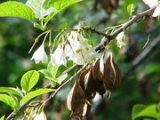
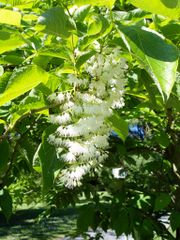 The family is characterised by spirally arranged simple leaves
with no stipule
s; symmetrical white flower
s with a corolla of 2-5 (-7) fused petals; and the fruit
usually a dry capsule
, sometimes winged, less often a fleshy drupe
, with 1-2 seed
s.
Most are large shrubs to small trees 3-15 m tall, but Halesia monticola (H. carolina var. monticola) is larger, with trees 39 m tall known in the Great Smoky Mountains National Park
in North Carolina
, United States
.
Several genera include species popular as ornamental trees valued for their decorative white flowers. Benzoin resin
, used in herbal medicine and perfume
s, is extracted from the bark of Styrax
species.
Genera
The genus Pamphilia, sometimes regarded as distinct, is now included within Styrax on genetic data.
Family (biology)
In biological classification, family is* a taxonomic rank. Other well-known ranks are life, domain, kingdom, phylum, class, order, genus, and species, with family fitting between order and genus. As for the other well-known ranks, there is the option of an immediately lower rank, indicated by the...
of flowering plant
Flowering plant
The flowering plants , also known as Angiospermae or Magnoliophyta, are the most diverse group of land plants. Angiosperms are seed-producing plants like the gymnosperms and can be distinguished from the gymnosperms by a series of synapomorphies...
s in the order Ericales
Ericales
The Ericales are a large and diverse order of dicotyledons, including for example tea, persimmon, blueberry, Brazil nut, and azalea. The order includes trees and bushes, lianas and herbaceous plants. Together with ordinary autophytic plants, the Ericales include chlorophyll-deficient...
, containing 11 genera and about 160 species of tree
Tree
A tree is a perennial woody plant. It is most often defined as a woody plant that has many secondary branches supported clear of the ground on a single main stem or trunk with clear apical dominance. A minimum height specification at maturity is cited by some authors, varying from 3 m to...
s and shrub
Shrub
A shrub or bush is distinguished from a tree by its multiple stems and shorter height, usually under 5–6 m tall. A large number of plants may become either shrubs or trees, depending on the growing conditions they experience...
s. The family occurs in warm temperate and subtropical regions of the Northern Hemisphere
Northern Hemisphere
The Northern Hemisphere is the half of a planet that is north of its equator—the word hemisphere literally means “half sphere”. It is also that half of the celestial sphere north of the celestial equator...
.
Leaf
A leaf is an organ of a vascular plant, as defined in botanical terms, and in particular in plant morphology. Foliage is a mass noun that refers to leaves as a feature of plants....
with no stipule
Stipule
In botany, stipule is a term coined by Linnaeus which refers to outgrowths borne on either side of the base of a leafstalk...
s; symmetrical white flower
Flower
A flower, sometimes known as a bloom or blossom, is the reproductive structure found in flowering plants . The biological function of a flower is to effect reproduction, usually by providing a mechanism for the union of sperm with eggs...
s with a corolla of 2-5 (-7) fused petals; and the fruit
Fruit
In broad terms, a fruit is a structure of a plant that contains its seeds.The term has different meanings dependent on context. In non-technical usage, such as food preparation, fruit normally means the fleshy seed-associated structures of certain plants that are sweet and edible in the raw state,...
usually a dry capsule
Capsule (fruit)
In botany a capsule is a type of simple, dry fruit produced by many species of flowering plants. A capsule is a structure composed of two or more carpels that in most cases is dehiscent, i.e. at maturity, it splits apart to release the seeds within. A few capsules are indehiscent, for example...
, sometimes winged, less often a fleshy drupe
Drupe
In botany, a drupe is a fruit in which an outer fleshy part surrounds a shell of hardened endocarp with a seed inside. These fruits develop from a single carpel, and mostly from flowers with superior ovaries...
, with 1-2 seed
Seed
A seed is a small embryonic plant enclosed in a covering called the seed coat, usually with some stored food. It is the product of the ripened ovule of gymnosperm and angiosperm plants which occurs after fertilization and some growth within the mother plant...
s.
Most are large shrubs to small trees 3-15 m tall, but Halesia monticola (H. carolina var. monticola) is larger, with trees 39 m tall known in the Great Smoky Mountains National Park
Great Smoky Mountains National Park
Great Smoky Mountains National Park is a United States National Park and UNESCO World Heritage Site that straddles the ridgeline of the Great Smoky Mountains, part of the Blue Ridge Mountains, which are a division of the larger Appalachian Mountain chain. The border between Tennessee and North...
in North Carolina
North Carolina
North Carolina is a state located in the southeastern United States. The state borders South Carolina and Georgia to the south, Tennessee to the west and Virginia to the north. North Carolina contains 100 counties. Its capital is Raleigh, and its largest city is Charlotte...
, United States
United States
The United States of America is a federal constitutional republic comprising fifty states and a federal district...
.
Several genera include species popular as ornamental trees valued for their decorative white flowers. Benzoin resin
Benzoin resin
Benzoin resin or styrax resin is a balsamic resin obtained from the bark of several species of trees in the genus Styrax. It is used in perfumes, some kinds of incense, as a flavoring, and medicine . Its principal component is benzoic acid...
, used in herbal medicine and perfume
Perfume
Perfume is a mixture of fragrant essential oils and/or aroma compounds, fixatives, and solvents used to give the human body, animals, objects, and living spaces "a pleasant scent"...
s, is extracted from the bark of Styrax
Styrax
Styrax is a genus of about 130 species of large shrubs or small trees in the family Styracaceae, mostly native to warm temperate to tropical regions of the Northern Hemisphere, with the majority in eastern and southeastern Asia, but also crossing the equator in South America...
species.
Genera
- AlniphyllumAlniphyllumAlniphyllum is a genus of three species of flowering plants in the family Styracaceae, native to eastern Asia, from central China south to India and Vietnam.The species are small to medium-sized deciduous trees growing to 15–30 m tall.Species...
Matsum. (3 species). - Bruinsmia Boer. & Koord. (2 species).
- ChangiostyraxChangiostyraxChangiostyrax, is a monotypic genus of flowering plant in the family Styracaceae. Its only member species is Changiostyrax dolichocarpa, formerly known as Sinojackia dolichocarpa....
C.T.Chen (1 species). - HalesiaHalesiaHalesia , also known as is a small genus of four or five species of deciduous large shrubs or small trees in the family Styracaceae, native to eastern Asia and eastern North America...
J.Ellis ex L. (3–5 species). - HuodendronHuodendronHuodendron is a genus of four species of flowering plants in the family Styracaceae, native to eastern Asia, from southern China south to Thailand and Vietnam.The species are small to medium-sized deciduous trees growing to 12–25 m tall.Species...
Rehder (4 species). - Melliodendron Hand.-Mazz. (1 species).
- Parastyrax W.W.Sm. (2 species).
- PterostyraxPterostyraxPterostyrax is a small genus of four species of deciduous large shrubs or small trees in the family Styracaceae, native to eastern Asia in China and Japan. They grow to 4-12 m tall, and have alternate, simple ovate leaves 6-17 cm long and 4-10 cm broad. The flowers are white, produced in...
Siebold & Zucc. (4 species). - RehderodendronRehderodendronRehderodendron is a genus of five species of flowering plants in the family Styracaceae, native to southeastern Asia, from southwestern China south to Myanmar and Vietnam.The species are small deciduous trees growing to 10–15 m tall.Species...
Hu (5 species). - SinojackiaSinojackiaSinojackia is a genus of five to eight species of flowering plants in the family Styracaceae, all endemic to China.The species are deciduous shrubs or small trees growing to 4–12 m tall.Species* Sinojackia dolichocarpa C.J.Qi...
Hu (5 species). - StyraxStyraxStyrax is a genus of about 130 species of large shrubs or small trees in the family Styracaceae, mostly native to warm temperate to tropical regions of the Northern Hemisphere, with the majority in eastern and southeastern Asia, but also crossing the equator in South America...
L. (c.130 species; syn. Pamphilia).
The genus Pamphilia, sometimes regarded as distinct, is now included within Styrax on genetic data.