


States of Mexico

Encyclopedia
The United Mexican States
is a federal republic
formed by 32 federal entities (31 states and 1 federal district).
According to the Constitution of 1917, the states of the federation are free and sovereign. Each state has their own congress and constitution, while the Federal District
has only limited autonomy with a local Congress
and government. The territory of the Federal District commonly known as Mexico City serves as the national capital.
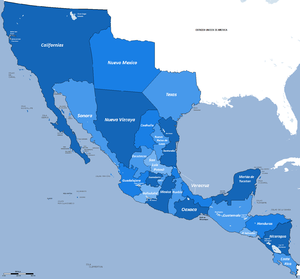 On September 27, 1821, after three centuries of Spanish rule, Mexico
gained its independence. The Treaty of Córdoba
recognized part of the Viceroyalty of New Spain as an Independent Empire, which was recognized as "Monarchist, constitutional and moderate." The new country took the name of Mexican Empire
.
A minority of the Constituent Congress, looking for stability, elected Agustín de Iturbide
as emperor. On July 21, 1822, Iturbide was crowned Emperor of Mexico. However, the Constitutional Empire quickly demonstrated the incompatibility of its two main parts: the Emperor and the Constituent Congress. The deputies were imprisoned just for expressing their opinions and finally, Iturbide decided to dissolve the Congress and establish instead a National Board.
The lack of a legitimate legislature, the illegitimacy of the Emperor and the absence of real solutions to the nation's problems increased revolutionary activity. Antonio López de Santa Anna
proclaimed the Plan of Casa Mata
, to which later joined Vicente Guerrero
and Nicolás Bravo
. Iturbide was forced to reestablish the Congress and in a vain attempt to save the order and keep the situation favorable to his supporters, he abdicated the crown of the Empire on March 19, 1823.
However, the Congress nullified the designation of Iturbide and therefore the recognition of the abdication and made the coronation of Iturbide seem a logical mistake in consummation of Independence.
The dissolution of the Empire was the first political realignment of independent Mexico
.
called the Supreme Executive Power was created. The provisional government would be responsible for the creation of the Federal Republic
, and it was in effect from April 1, 1823 to October 10, 1824.
Unrest in the provinces was huge. On May 21, 1823, was enacted The Basic Project of the Federal Republic. In it sixth article pointed that: The component parts of the Republic are free, sovereign and independent in its administration and government. Most of the Free States which were invited to form the Federal Republic
joined the Union, except for the former Captaincy General of Guatemala
which formed their own Federal Republic.
On January 31, 1824, the decree to create a Constitutive Act of the Mexican Federation was issued, which incorporated the basic structure of the Federal Republic. It was determined that the criteria for inviting states to the federation should be that they... Weren't so few that by its size and wealth in a few years could aspire to become independent nations, breaking the federation, nor so many that lack of manpower and resources come to be an unworkable system.
Between 1823 and 1824 some of the free states created their own constitutions and others had already installed a Constituent Congress. Special cases were those of Yucatan
, which on December 23, 1823 decided to join the federation but as a Federated Republic and Chiapas
, which decided by referendum to join the federation on September 14, 1824.
On October 4, 1824, the Federal Constitution of the United Mexican States of 1824
was enacted. The constitution officially created the United Mexican States. The country was composed of 19 states and 4 federal territories. After the publication of the constitution, on November 18, the Federal District
was created. On November 24, Tlaxcala
which had retained a special status since the colonial era, was incorporated as a territory.
On October 10, 1824, Guadalupe Victoria
took office as the first President of Mexico
.
was amended by a decree on October 3, 1835, when the centralist system
was established.
The constituent states of the Republic
lost their freedom, independence, and sovereignty by being totally subordinated to the central government. However, the territorial division itself was the same; the text of Article 8 of the Law determined: The national territory is divided into departments, on the basis of population, location and other leading circumstances: its number, extension and subdivisions, would be detailed by constitutional law.
The Seven Constitutional Laws
were promulgated on December 30, 1836. The 1st article confirmed the decree of the law of October 3, 1835; the Republic
would be divided into departments, these in districts and the districts in parties. The 2nd article pointed that the division of the Republic
in departments would be under a special law with constitutional character. On December 30, 1835, a transitory decree was added to the Seven Laws
. The decree stated that the territory of Tlaxcala and the Federal District would become a part of the Department of Mexico. The territories of Alta and Baja California would form the department of the Californias. Coahuila y Texas would be divided into two departments. Colima would form part of Michoacán and Aguascalientes would be declared a department.
This period of political instability caused several conflicts between the central government and the entities of the country. There were rebellions in several states such as:
On September 11, 1842, the region of Soconusco
joined Mexico
as part of the department of Chiapas
.
was erected in 1849 (provisionally), conditioned to the acceptance of the legislatures of the states of México, Puebla
and Michoacán
; which would be affected in their territories.
On February 5, 1857, was enacted the Federal Constitution of the United Mexican States of 1857. On 1864, however, after the French intervention
, the conservative Mexicans restored the constitutional monarchy, known as the Second Mexican Empire
, led by the emperor Maximilian of Habsburg and supported by the French army of Napoleon III. The Empire was deposed in 1867 by the republican forces of Benito Juarez
and the Federal Republic was restored again under the Constitution of 1857.
The Political Constitution of the United Mexican States of 1917 was the result of the Mexican Revolution
. The third Constitution of Mexico confirmed the federal system of government that is currently in force.
Notes:
is independent of the legislature and vested in a governor elected by universal suffrage
; and judicial power is vested in a Superior Court of Justice
. Since states have legal autonomy, each has its own civil and penal codes and judicial body.
In the Congress of the Union
, the federative entities – the States and the Federal District – are each represented by 3 senators, 2 elected by universal suffrage on the principle of relative majority and 1 assigned to the party which obtains the largest minority. In addition, the federation makes up a constituency in which 32 senators are elected by the method of proportional representation
. Federal Deputies, however, do not represent the states, but rather the citizens themselves. The Chamber of Deputies and the Senate together comprise the Congress of the Union
.
, is known as a "free municipality". In total there are 2438 municipalities in Mexico, the state with the highest number of municipalities is Oaxaca
, with 570, and the state with the lowest number is Baja California
, with only 5.
has a special status within the federation. According to Article 44 of the federal constitution, Mexico City is the Federal District, seat of government of the Union and the capital of the United Mexican States. The city is coextensive with the Federal District territorially and administratively. If the federal government moves to another city, the Federal District would be transformed into another state of the Union, called "State of the Valley of Mexico" with new borders and area that the Congress of the Union would give it.
Mexico City was separated from the State of Mexico, of which it was the capital, on November 18, 1824, to become the capital of the federation. As such, it does not belong to any state in particular but to all (i.e., to the federation). Therefore, it was the president of Mexico
, in representation of the federation, who designated its head of government
(previously called regente, "regent" or jefe del departamento del Distrito Federal, "head of the department of the Federal District"). However, the Federal District received full autonomy in 1997 and its citizens now elect directly their chief of government, the head of the boroughs (or delegaciones) and the representatives of the unicameral legislature called the Asamblea Legislativa, "Legislative Assembly". It does not have a constitution but a statute of autonomy. Nonetheless it enjoys many privileges as the capital of the federation.
. While not fully equivalent to a municipality (nor the concept of a municipio libre), the 16 boroughs have gained significant autonomy and since 2000 the heads of government of the boroughs are elected directly by plurality (they were previously appointed by the head of government of the Federal District). Given that Mexico City is organized entirely as a Federal District most of the city services are provided by the Government of the Federal District and not by the boroughs themselves, while in the constituent states these services would be provided by the municipalities. It should be noted that while other municipalities within the constituent states of the federation exercise their autonomy through the municipal council, some, like Mexicali or Querétaro, have further subdivided the municipality into delegaciones or boroughs for administrative purposes as well.
to whom the government grants the right of self-(free) determination and autonomy. According to this article the indigenous peoples are granted
The nation commits to and demands the constituent states and municipalities to promote the economic and social development of the indigenous communities as well as an intercultural and bilingual education. According to the Law of Linguistic Rights, the nation recognizes 62 indigenous languages as "national languages
" with the same validity as Spanish in the territories in which they are spoken and the indigenous peoples are entitled to request public services in their languages.
Mexico
The United Mexican States , commonly known as Mexico , is a federal constitutional republic in North America. It is bordered on the north by the United States; on the south and west by the Pacific Ocean; on the southeast by Guatemala, Belize, and the Caribbean Sea; and on the east by the Gulf of...
is a federal republic
Federation
A federation , also known as a federal state, is a type of sovereign state characterized by a union of partially self-governing states or regions united by a central government...
formed by 32 federal entities (31 states and 1 federal district).
According to the Constitution of 1917, the states of the federation are free and sovereign. Each state has their own congress and constitution, while the Federal District
Mexico City
Mexico City is the Federal District , capital of Mexico and seat of the federal powers of the Mexican Union. It is a federal entity within Mexico which is not part of any one of the 31 Mexican states but belongs to the federation as a whole...
has only limited autonomy with a local Congress
Legislative Assembly of the Federal District
The Legislative Assembly of the Federal District is the legislative branch of government of the Mexican Federal District. Between 1988 and 1993, it was known as the Assembly of Representatives of the Federal District , during which period it had reduced powers with respect to the current...
and government. The territory of the Federal District commonly known as Mexico City serves as the national capital.
Constitutional Empire
Mexico
The United Mexican States , commonly known as Mexico , is a federal constitutional republic in North America. It is bordered on the north by the United States; on the south and west by the Pacific Ocean; on the southeast by Guatemala, Belize, and the Caribbean Sea; and on the east by the Gulf of...
gained its independence. The Treaty of Córdoba
Treaty of Córdoba
The Treaty of Córdova established Mexican independence from Spain at the conclusion of the Mexican War of Independence. It was signed on August 24, 1821 in Córdoba, Veracruz, Mexico. The signatories were the head of the Army of the Three Guarantees, Agustín de Iturbide, and acting on behalf of the...
recognized part of the Viceroyalty of New Spain as an Independent Empire, which was recognized as "Monarchist, constitutional and moderate." The new country took the name of Mexican Empire
First Mexican Empire
The Mexican Empire was the official name of independent Mexico under a monarchical regime from 1821 to 1823. The territory of the Mexican Empire included the continental intendencies and provinces of New Spain proper...
.
A minority of the Constituent Congress, looking for stability, elected Agustín de Iturbide
Agustín de Iturbide
Agustín Cosme Damián de Iturbide y Aramburu , also known as Augustine I of Mexico, was a Mexican army general who built a successful political and military coalition that was able to march into Mexico City on 27 September 1821, decisively ending the Mexican War of Independence...
as emperor. On July 21, 1822, Iturbide was crowned Emperor of Mexico. However, the Constitutional Empire quickly demonstrated the incompatibility of its two main parts: the Emperor and the Constituent Congress. The deputies were imprisoned just for expressing their opinions and finally, Iturbide decided to dissolve the Congress and establish instead a National Board.
The lack of a legitimate legislature, the illegitimacy of the Emperor and the absence of real solutions to the nation's problems increased revolutionary activity. Antonio López de Santa Anna
Antonio López de Santa Anna
Antonio de Padua María Severino López de Santa Anna y Pérez de Lebrón , often known as Santa Anna or López de Santa Anna, known as "the Napoleon of the West," was a Mexican political leader, general, and president who greatly influenced early Mexican and Spanish politics and government...
proclaimed the Plan of Casa Mata
Plan of Casa Mata
The Plan of Casa Mata was formulated to abolish the monarchy in Mexico and to establish a republic.In December 1822, Antonio López de Santa Anna and Guadalupe Victoria signed the Plan de Casa Mata on February 1, 1823, as a start of their efforts to overthrow Emperor Agustín de Iturbide.In May...
, to which later joined Vicente Guerrero
Vicente Guerrero
Vicente Ramón Guerrero Saldaña was one of the leading revolutionary generals of the Mexican War of Independence, who fought against Spain for independence in the early 19th century, and served briefly as President of Mexico...
and Nicolás Bravo
Nicolás Bravo
Nicolás Bravo was a Mexican politician and soldier. He distinguished himself in both offices during the 1846–1848 U.S. invasion of Mexico....
. Iturbide was forced to reestablish the Congress and in a vain attempt to save the order and keep the situation favorable to his supporters, he abdicated the crown of the Empire on March 19, 1823.
However, the Congress nullified the designation of Iturbide and therefore the recognition of the abdication and made the coronation of Iturbide seem a logical mistake in consummation of Independence.
The dissolution of the Empire was the first political realignment of independent Mexico
Mexico
The United Mexican States , commonly known as Mexico , is a federal constitutional republic in North America. It is bordered on the north by the United States; on the south and west by the Pacific Ocean; on the southeast by Guatemala, Belize, and the Caribbean Sea; and on the east by the Gulf of...
.
Federal Republic
After the fall of the Empire a triumvirateTriumvirate
A triumvirate is a political regime dominated by three powerful individuals, each a triumvir . The arrangement can be formal or informal, and though the three are usually equal on paper, in reality this is rarely the case...
called the Supreme Executive Power was created. The provisional government would be responsible for the creation of the Federal Republic
Federal republic
A federal republic is a federation of states with a republican form of government. A federation is the central government. The states in a federation also maintain the federation...
, and it was in effect from April 1, 1823 to October 10, 1824.
Unrest in the provinces was huge. On May 21, 1823, was enacted The Basic Project of the Federal Republic. In it sixth article pointed that: The component parts of the Republic are free, sovereign and independent in its administration and government. Most of the Free States which were invited to form the Federal Republic
Federal republic
A federal republic is a federation of states with a republican form of government. A federation is the central government. The states in a federation also maintain the federation...
joined the Union, except for the former Captaincy General of Guatemala
Captaincy General of Guatemala
The Captaincy General of Guatemala , also known as the Kingdom of Guatemala , was an administrative division in Spanish America which covered much of Central America, including what are now the nations of Costa Rica, Nicaragua, Honduras, El Salvador and Guatemala, and the Mexican state of Chiapas...
which formed their own Federal Republic.
On January 31, 1824, the decree to create a Constitutive Act of the Mexican Federation was issued, which incorporated the basic structure of the Federal Republic. It was determined that the criteria for inviting states to the federation should be that they... Weren't so few that by its size and wealth in a few years could aspire to become independent nations, breaking the federation, nor so many that lack of manpower and resources come to be an unworkable system.
Between 1823 and 1824 some of the free states created their own constitutions and others had already installed a Constituent Congress. Special cases were those of Yucatan
Yucatán
Yucatán officially Estado Libre y Soberano de Yucatán is one of the 31 states which, with the Federal District, comprise the 32 Federal Entities of Mexico. It is divided in 106 municipalities and its capital city is Mérida....
, which on December 23, 1823 decided to join the federation but as a Federated Republic and Chiapas
Chiapas
Chiapas officially Estado Libre y Soberano de Chiapas is one of the 31 states that, with the Federal District, comprise the 32 Federal Entities of Mexico. It is divided in 118 municipalities and its capital city is Tuxtla Gutierrez. Other important cites in Chiapas include San Cristóbal de las...
, which decided by referendum to join the federation on September 14, 1824.
On October 4, 1824, the Federal Constitution of the United Mexican States of 1824
1824 Constitution of Mexico
The Federal Constitution of the United Mexican States of 1824 was enacted on October 4 of 1824, after the overthrow of the Mexican Empire of Agustin de Iturbide. In the new constitution, the republic took the name of United Mexican States, and was defined as a representative federal republic, with...
was enacted. The constitution officially created the United Mexican States. The country was composed of 19 states and 4 federal territories. After the publication of the constitution, on November 18, the Federal District
Mexico City
Mexico City is the Federal District , capital of Mexico and seat of the federal powers of the Mexican Union. It is a federal entity within Mexico which is not part of any one of the 31 Mexican states but belongs to the federation as a whole...
was created. On November 24, Tlaxcala
Tlaxcala
Tlaxcala officially Estado Libre y Soberano de Tlaxcala is one of the 31 states which along with the Federal District comprise the 32 federative entities of Mexico. It is divided into 60 municipalities and its capital city is Tlaxcala....
which had retained a special status since the colonial era, was incorporated as a territory.
On October 10, 1824, Guadalupe Victoria
Guadalupe Victoria
Guadalupe Victoria born José Miguel Ramón Adaucto Fernández y Félix, was a Mexican politician and military man who fought for independence against the Spanish Empire in the Mexican War of Independence. He was a deputy for Durango and a member of the Supreme Executive Power...
took office as the first President of Mexico
President of Mexico
The President of the United Mexican States is the head of state and government of Mexico. Under the Constitution, the president is also the Supreme Commander of the Mexican armed forces...
.
Centralist Republic
The political structure of the RepublicRepublic
A republic is a form of government in which the people, or some significant portion of them, have supreme control over the government and where offices of state are elected or chosen by elected people. In modern times, a common simplified definition of a republic is a government where the head of...
was amended by a decree on October 3, 1835, when the centralist system
Centralized government
A centralized or centralised government is one in which power or legal authority is exerted or coordinated by a de facto political executive to which federal states, local authorities, and smaller units are considered subject...
was established.
The constituent states of the Republic
Republic
A republic is a form of government in which the people, or some significant portion of them, have supreme control over the government and where offices of state are elected or chosen by elected people. In modern times, a common simplified definition of a republic is a government where the head of...
lost their freedom, independence, and sovereignty by being totally subordinated to the central government. However, the territorial division itself was the same; the text of Article 8 of the Law determined: The national territory is divided into departments, on the basis of population, location and other leading circumstances: its number, extension and subdivisions, would be detailed by constitutional law.
The Seven Constitutional Laws
Siete Leyes
The Siete Leyes were a series of constitutional instruments that fundamentally altered the organizational structure of the young first Mexican republic...
were promulgated on December 30, 1836. The 1st article confirmed the decree of the law of October 3, 1835; the Republic
Republic
A republic is a form of government in which the people, or some significant portion of them, have supreme control over the government and where offices of state are elected or chosen by elected people. In modern times, a common simplified definition of a republic is a government where the head of...
would be divided into departments, these in districts and the districts in parties. The 2nd article pointed that the division of the Republic
Republic
A republic is a form of government in which the people, or some significant portion of them, have supreme control over the government and where offices of state are elected or chosen by elected people. In modern times, a common simplified definition of a republic is a government where the head of...
in departments would be under a special law with constitutional character. On December 30, 1835, a transitory decree was added to the Seven Laws
Siete Leyes
The Siete Leyes were a series of constitutional instruments that fundamentally altered the organizational structure of the young first Mexican republic...
. The decree stated that the territory of Tlaxcala and the Federal District would become a part of the Department of Mexico. The territories of Alta and Baja California would form the department of the Californias. Coahuila y Texas would be divided into two departments. Colima would form part of Michoacán and Aguascalientes would be declared a department.
This period of political instability caused several conflicts between the central government and the entities of the country. There were rebellions in several states such as:
- YucatánYucatánYucatán officially Estado Libre y Soberano de Yucatán is one of the 31 states which, with the Federal District, comprise the 32 Federal Entities of Mexico. It is divided in 106 municipalities and its capital city is Mérida....
due its condition of Federated Republic declared itself independent in 1840 (officially in 1841). The Republic of YucatánRepublic of YucatánThe Republic of Yucatan was a nineteenth century sovereign state during two periods of the century. The first Republic of Yucatan, founded May 29, 1823, joined the Mexican federation as the Federated Republic of Yucatán on December 23, 1823, less than seven months later...
(Republic of Yucatán) rejoined Mexico in 1848. - TexasTexasTexas is the second largest U.S. state by both area and population, and the largest state by area in the contiguous United States.The name, based on the Caddo word "Tejas" meaning "friends" or "allies", was applied by the Spanish to the Caddo themselves and to the region of their settlement in...
declared its independence and declared war against the central government of MexicoMexicoThe United Mexican States , commonly known as Mexico , is a federal constitutional republic in North America. It is bordered on the north by the United States; on the south and west by the Pacific Ocean; on the southeast by Guatemala, Belize, and the Caribbean Sea; and on the east by the Gulf of...
. The Republic of TexasRepublic of TexasThe Republic of Texas was an independent nation in North America, bordering the United States and Mexico, that existed from 1836 to 1846.Formed as a break-away republic from Mexico by the Texas Revolution, the state claimed borders that encompassed an area that included all of the present U.S...
was created. Texas remained independent until 1845, when it joined the United States of America. From 1861-1865, Texas was part of the Confederate States of AmericaConfederate States of AmericaThe Confederate States of America was a government set up from 1861 to 1865 by 11 Southern slave states of the United States of America that had declared their secession from the U.S...
. After the defeat of the Confederacy in the American Civil WarAmerican Civil WarThe American Civil War was a civil war fought in the United States of America. In response to the election of Abraham Lincoln as President of the United States, 11 southern slave states declared their secession from the United States and formed the Confederate States of America ; the other 25...
(1861-65) and Reconstruction, Texas rejoined the United States of America in 1877. - The states of Nuevo LeónNuevo LeónNuevo León It is located in Northeastern Mexico. It is bordered by the states of Tamaulipas to the north and east, San Luis Potosí to the south, and Coahuila to the west. To the north, Nuevo León has a 15 kilometer stretch of the U.S.-Mexico border adjacent to the U.S...
, TamaulipasTamaulipasTamaulipas officially Estado Libre y Soberano de Tamaulipas is one of the 31 states which, with the Federal District, comprise the 32 Federal Entities of Mexico. It is divided in 43 municipalities and its capital city is Ciudad Victoria. The capital city was named after Guadalupe Victoria, the...
and CoahuilaCoahuilaCoahuila, formally Coahuila de Zaragoza , officially Estado Libre y Soberano de Coahuila de Zaragoza is one of the 31 states which, with the Federal District, comprise the 32 Federal Entities of Mexico...
declared themselves independent from Mexico (just under 250 days); the República del Río Grande never consolidated because independent forces were defeated by the centralist forces. - TabascoTabascoTabasco officially Estado Libre y Soberano de Tabasco is one of the 31 states which, with the Federal District, comprise the 32 Federal Entities of Mexico. It is divided in 17 municipalities and its capital city is Villahermosa....
declared its separation from Mexico in FebruaryFebruaryFebruary is the second month of the year in the Julian and Gregorian calendars. It is the shortest month and the only month with fewer than 30 days. The month has 28 days in common years and 29 days in leap years...
, 1841, in protest against centralism and the imposed sanctions by centralist president Anastasio BustamanteAnastasio BustamanteAnastasio Bustamante y Oseguera was president of Mexico three times, from 1830 to 1832, from 1837 to 1839 and from 1839 to 1841. He was a Conservative. He first came to power by leading a coup against president Vicente Guerrero...
, it rejoined DecemberDecemberDecember is the 12th and last month of the year in the Julian and Gregorian Calendars and one of seven months with the length of 31 days.December starts on the same day as September every year and ends on the same day as April every year.-Etymology:...
, 1842.
On September 11, 1842, the region of Soconusco
Soconusco
Soconusco is a region of the Mexican state of Chiapas, located in the extreme south of the state and separated from Guatemala by the Suchiate River. It is a region of rich lowlands and foothills. The economic center is Tapachula. Soconusco consists of 16 municipalities.The name comes from the...
joined Mexico
Mexico
The United Mexican States , commonly known as Mexico , is a federal constitutional republic in North America. It is bordered on the north by the United States; on the south and west by the Pacific Ocean; on the southeast by Guatemala, Belize, and the Caribbean Sea; and on the east by the Gulf of...
as part of the department of Chiapas
Chiapas
Chiapas officially Estado Libre y Soberano de Chiapas is one of the 31 states that, with the Federal District, comprise the 32 Federal Entities of Mexico. It is divided in 118 municipalities and its capital city is Tuxtla Gutierrez. Other important cites in Chiapas include San Cristóbal de las...
.
Restoration of the Republic and Second Empire
The Federal Republic was restored by the interim president José Mariano Salas on August 22, 1846. The state of GuerreroGuerrero
Guerrero officially Estado Libre y Soberano de Guerrero is one of the 31 states which, with the Federal District, comprise the 32 Federal Entities of Mexico. It is divided in 81 municipalities and its capital city is Chilpancingo....
was erected in 1849 (provisionally), conditioned to the acceptance of the legislatures of the states of México, Puebla
Puebla
Puebla officially Estado Libre y Soberano de Puebla is one of the 31 states which, with the Federal District, comprise the 32 Federal Entities of Mexico. It is divided in 217 municipalities and its capital city is Puebla....
and Michoacán
Michoacán
Michoacán officially Estado Libre y Soberano de Michoacán de Ocampo is one of the 31 states which, with the Federal District, comprise the 32 Federal Entities of Mexico. It is divided in 113 municipalities and its capital city is Morelia...
; which would be affected in their territories.
On February 5, 1857, was enacted the Federal Constitution of the United Mexican States of 1857. On 1864, however, after the French intervention
French intervention in Mexico
The French intervention in Mexico , also known as The Maximilian Affair, War of the French Intervention, and The Franco-Mexican War, was an invasion of Mexico by an expeditionary force sent by the Second French Empire, supported in the beginning by the United Kingdom and the Kingdom of Spain...
, the conservative Mexicans restored the constitutional monarchy, known as the Second Mexican Empire
Second Mexican Empire
The Second Mexican Empire was the name of Mexico under the regime established from 1864 to 1867. It was created by Napoleon III of France, who attempted to use the Mexican adventure to recapture some of the grandeur of earlier Napoleonic times...
, led by the emperor Maximilian of Habsburg and supported by the French army of Napoleon III. The Empire was deposed in 1867 by the republican forces of Benito Juarez
Benito Juárez
Benito Juárez born Benito Pablo Juárez García, was a Mexican lawyer and politician of Zapotec origin from Oaxaca who served five terms as president of Mexico: 1858–1861 as interim, 1861–1865, 1865–1867, 1867–1871 and 1871–1872...
and the Federal Republic was restored again under the Constitution of 1857.
The Political Constitution of the United Mexican States of 1917 was the result of the Mexican Revolution
Mexican Revolution
The Mexican Revolution was a major armed struggle that started in 1910, with an uprising led by Francisco I. Madero against longtime autocrat Porfirio Díaz. The Revolution was characterized by several socialist, liberal, anarchist, populist, and agrarianist movements. Over time the Revolution...
. The third Constitution of Mexico confirmed the federal system of government that is currently in force.
Federal entities of Mexico
Federal district
| Entity | Official Name | Flag | Area | Population (2010) | Date of establishment |
|---|---|---|---|---|---|
| Ciudad de México | Distrito Federal |  |
1,485 km2 (573.4 sq mi) |
8,720,916 | 1824-11-18 |
States
| State | Official Name Estado Libre y Soberano de: |
Flag | Capital | Largest city | Area | Population (2010) | Order of Admission to Federation |
Date of Admission to Federation |
|---|---|---|---|---|---|---|---|---|
| Aguascalientes Aguascalientes Aguascalientes is one of the 31 states which, with the Federal District, comprise the 32 Federal Entities of Mexico. It is divided in 11 municipalities and its capital city is Aguascalientes.... |
Aguascalientes |  |
Aguascalientes | Aguascalientes | 5618 km² (2,169.1 sq mi) | 1,184,996 | 24 | 1857-02-05 |
| Baja California Baja California Baja California officially Estado Libre y Soberano de Baja California is one of the 31 states which, with the Federal District, comprise the 32 Federal Entities of Mexico. It is both the northernmost and westernmost state of Mexico. Before becoming a state in 1953, the area was known as the North... |
Baja California |  |
Mexicali Mexicali Mexicali is the capital of the State of Baja California, seat of the Municipality of Mexicali, and 2nd largest city in Baja California. The City of Mexicali has a population of 689,775, according to the 2010 census, while the population of the entire metropolitan area reaches 936,826.The city... |
Tijuana Tijuana Tijuana is the largest city on the Baja California Peninsula and center of the Tijuana metropolitan area, part of the international San Diego–Tijuana metropolitan area. An industrial and financial center of Mexico, Tijuana exerts a strong influence on economics, education, culture, art, and politics... |
71446 km² (27,585.5 sq mi) | 3,155,070 | 29 | 1952-01-16 |
| Baja California Sur Baja California Sur Baja California Sur , is one of the 31 states which, with the Federal District, comprise the 32 Federal Entities of Mexico. Before becoming a state on October 8, 1974, the area was known as the South Territory of Baja California. It has an area of , or 3.57% of the land mass of Mexico and comprises... |
Baja California Sur |  |
La Paz | La Paz | 73922 km² (28,541.4 sq mi) | 637,026 | 31 | 1974-10-08 |
| Campeche Campeche Campeche is one of the 31 states which, with the Federal District, comprise the 32 Federal Entities of Mexico. Located in Southeast Mexico, it is bordered by the states of Yucatán to the north east, Quintana Roo to the east, and Tabasco to the south west... |
Campeche |  |
San Francisco de Campeche | San Francisco de Campeche | 57924 km² (22,364.6 sq mi) | 822,441 | 25 | 1863-04-29 |
| Chiapas Chiapas Chiapas officially Estado Libre y Soberano de Chiapas is one of the 31 states that, with the Federal District, comprise the 32 Federal Entities of Mexico. It is divided in 118 municipalities and its capital city is Tuxtla Gutierrez. Other important cites in Chiapas include San Cristóbal de las... |
Chiapas |  |
Tuxtla Gutiérrez Tuxtla Gutiérrez Tuxtla Gutiérrez is the capital and largest city of the Mexican state of Chiapas. It is considered to be the state’s most modern city, with most of its public buildings dating from the 20th century. One exception to this is the San Marcos Cathedral which began as a Dominican parish church built in... |
Tuxtla Gutiérrez Tuxtla Gutiérrez Tuxtla Gutiérrez is the capital and largest city of the Mexican state of Chiapas. It is considered to be the state’s most modern city, with most of its public buildings dating from the 20th century. One exception to this is the San Marcos Cathedral which began as a Dominican parish church built in... |
73289 km² (28,297 sq mi) | 4,796,580 | 19 | 1824-09-14 |
| Chihuahua | Chihuahua |  |
Chihuahua | Ciudad Juárez Ciudad Juárez Ciudad Juárez , officially known today as Heroica Ciudad Juárez, but abbreviated Juárez and formerly known as El Paso del Norte, is a city and seat of the municipality of Juárez in the Mexican state of Chihuahua. Juárez's estimated population is 1.5 million people. The city lies on the Rio Grande... |
247455 km² (95,542.9 sq mi) | 3,406,465 | 18 | 1824-07-06 |
| Coahuila Coahuila Coahuila, formally Coahuila de Zaragoza , officially Estado Libre y Soberano de Coahuila de Zaragoza is one of the 31 states which, with the Federal District, comprise the 32 Federal Entities of Mexico... 1 4 |
Coahuila de Zaragoza |  |
Saltillo Saltillo Saltillo is the capital city of the northeastern Mexican state of Coahuila and the municipal seat of the municipality of the same name. The city is located about 400 km south of the U.S. state of Texas, and 90 km west of Monterrey, Nuevo León.... |
Torreón Torreón Torreón is a city and seat of the surrounding municipality of the same name in the Mexican state of Coahuila. As of 2010, the city's population was 608,836 with 639,629 in the municipality. The metropolitan population, including Matamoros, Coahuila, and Gómez Palacio and Lerdo in adjacent Durango,... |
151563 km² (58,518.8 sq mi) | 2,748,391 | 16 | 1824-05-07 |
| Colima Colima Colima is one of the 31 states which, with the Federal District, make up the 32 Federal Entities of Mexico. It shares its name with its capital and main city, Colima.... |
Colima |  |
Colima | Manzanillo | 5625 km² (2,171.8 sq mi) | 650,555 | 23 | 1856-09-12 |
| Durango Durango Durango officially Estado Libre y Soberano de Durango is one of the 31 states which, with the Federal District, comprise the 32 Federal Entities of Mexico. The state is located in Northwest Mexico. With a population of 1,632,934, it has Mexico's second-lowest population density, after Baja... |
Durango |  |
Victoria de Durango | Victoria de Durango | 123451 km² (47,664.7 sq mi) | 1,632,934 | 17 | 1824-05-22 |
| Guanajuato Guanajuato Guanajuato officially Estado Libre y Soberano de Guanajuato is one of the 31 states which, with the Federal District, comprise the 32 Federal Entities of Mexico. It is divided in 46 municipalities and its capital city is Guanajuato.... |
Guanajuato | Guanajuato | León | 30608 km² (11,817.8 sq mi) | 5,486,372 | 2 | 1823-12-20 | |
| Guerrero Guerrero Guerrero officially Estado Libre y Soberano de Guerrero is one of the 31 states which, with the Federal District, comprise the 32 Federal Entities of Mexico. It is divided in 81 municipalities and its capital city is Chilpancingo.... |
Guerrero |  |
Chilpancingo de los Bravo |
Acapulco de Juárez | 63621 km² (24,564.2 sq mi) | 3,388,768 | 21 | 1849-10-27 |
| Hidalgo | Hidalgo |  |
Pachuca de Soto | Pachuca de Soto | 20846 km² (8,048.7 sq mi) | 2,665,018 | 26 | 1869-01-16 |
| Jalisco Jalisco Jalisco officially Estado Libre y Soberano de Jalisco is one of the 31 states which, with the Federal District, comprise the 32 Federal Entities of Mexico. It is located in Western Mexico and divided in 125 municipalities and its capital city is Guadalajara.It is one of the more important states... |
Jalisco |  |
Guadalajara | Guadalajara | 78599 km² (30,347.2 sq mi) | 7,350,682 | 9 | 1823-12-23 |
| México | México | Toluca de Lerdo | Ecatepec de Morelos Ecatepec de Morelos Ecatepec City, once officially San Cristóbal Ecatepec de Morelos, is a city in the State of México and the seat of Ecatepec de Morelos Municipality; however, both the city and the municipality are often known simply as "Ecatepec". The name "Ecatepec" is derived from Nahuatl, and means "windy hill".... |
22357 km² (8,632.1 sq mi) | 15,175,862 | 1 | 1823-12-20 | |
| Michoacán Michoacán Michoacán officially Estado Libre y Soberano de Michoacán de Ocampo is one of the 31 states which, with the Federal District, comprise the 32 Federal Entities of Mexico. It is divided in 113 municipalities and its capital city is Morelia... |
Michoacán de Ocampo |  |
Morelia Morelia Morelia is a city and municipality in the north central part of the state of Michoacán in central Mexico. The city is in the Guayangareo Valley and is the capital of the state. The main pre-Hispanic cultures here were the P'urhépecha and the Matlatzinca, but no major cities were founded in the... |
Morelia Morelia Morelia is a city and municipality in the north central part of the state of Michoacán in central Mexico. The city is in the Guayangareo Valley and is the capital of the state. The main pre-Hispanic cultures here were the P'urhépecha and the Matlatzinca, but no major cities were founded in the... |
58643 km² (22,642.2 sq mi) | 4,351,037 | 5 | 1823-12-22 |
| Morelos Morelos Morelos officially Estado Libre y Soberano de Morelos is one of the 31 states which, with the Federal District, comprise the 32 Federal Entities of Mexico. It is divided in 33 municipalities and its capital city is Cuernavaca.... |
Morelos |  |
Cuernavaca Cuernavaca Cuernavaca is the capital and largest city of the state of Morelos in Mexico. It was established at the archeological site of Gualupita I by the Olmec, "the mother culture" of Mesoamerica, approximately 3200 years ago... |
Cuernavaca Cuernavaca Cuernavaca is the capital and largest city of the state of Morelos in Mexico. It was established at the archeological site of Gualupita I by the Olmec, "the mother culture" of Mesoamerica, approximately 3200 years ago... |
4893 km² (1,889.2 sq mi) | 1,777,227 | 27 | 1869-04-17 |
| Nayarit Nayarit Nayarit officially Estado Libre y Soberano de Nayarit is one of the 31 states which, with the Federal District, comprise the 32 Federal Entities of Mexico. It is divided in 20 municipalities and its capital city is Tepic.It is located in Western Mexico... |
Nayarit |  |
Tepic Tepic Tepic is the capital and largest city of the Mexican state of Nayarit.It is located in the central part of the state, at.It stands at an altitude above sea level of some 915 meters, on the banks of the Río Mololoa and the Río Tepic, approximately 225 kilometers north-west of Guadalajara, Jalisco.... |
Tepic Tepic Tepic is the capital and largest city of the Mexican state of Nayarit.It is located in the central part of the state, at.It stands at an altitude above sea level of some 915 meters, on the banks of the Río Mololoa and the Río Tepic, approximately 225 kilometers north-west of Guadalajara, Jalisco.... |
27815 km² (10,739.4 sq mi) | 1,084,979 | 28 | 1917-01-26 |
| Nuevo León Nuevo León Nuevo León It is located in Northeastern Mexico. It is bordered by the states of Tamaulipas to the north and east, San Luis Potosí to the south, and Coahuila to the west. To the north, Nuevo León has a 15 kilometer stretch of the U.S.-Mexico border adjacent to the U.S... 4 |
Nuevo León |  |
Monterrey Monterrey Monterrey , is the capital city of the northeastern state of Nuevo León in the country of Mexico. The city is anchor to the third-largest metropolitan area in Mexico and is ranked as the ninth-largest city in the nation. Monterrey serves as a commercial center in the north of the country and is the... |
Monterrey Monterrey Monterrey , is the capital city of the northeastern state of Nuevo León in the country of Mexico. The city is anchor to the third-largest metropolitan area in Mexico and is ranked as the ninth-largest city in the nation. Monterrey serves as a commercial center in the north of the country and is the... |
64220 km² (24,795.5 sq mi) | 4,653,458 | 15 | 1824-05-07 |
| Oaxaca Oaxaca Oaxaca , , officially Estado Libre y Soberano de Oaxaca is one of the 31 states which, along with the Federal District, comprise the 32 federative entities of Mexico. It is divided into 571 municipalities; of which 418 are governed by the system of customs and traditions... |
Oaxaca |  |
Oaxaca de Juárez | Oaxaca de Juárez | 93793 km² (36,213.7 sq mi) | 3,801,962 | 3 | 1823-12-21 |
| Puebla Puebla Puebla officially Estado Libre y Soberano de Puebla is one of the 31 states which, with the Federal District, comprise the 32 Federal Entities of Mexico. It is divided in 217 municipalities and its capital city is Puebla.... |
Puebla | Puebla de Zaragoza | Puebla de Zaragoza | 34290 km² (13,239.4 sq mi) | 5,779,829 | 4 | 1823-12-21 | |
| Querétaro Querétaro Querétaro officially Estado Libre y Soberano de Querétaro de Arteaga is one of the 31 states which, with the Federal District, comprise the 32 Federal Entities of Mexico. It is divided into 18 municipalities and its capital city is Santiago de Querétaro.... |
Querétaro |  |
Santiago de Querétaro Santiago de Querétaro Santiago de Querétaro is the capital and largest city of the state of Querétaro, located in central Mexico. It is located 213 km northwest of Mexico City, 96 km southeast of San Miguel de Allende and 200 km south of San Luis Potosí... |
Santiago de Querétaro Santiago de Querétaro Santiago de Querétaro is the capital and largest city of the state of Querétaro, located in central Mexico. It is located 213 km northwest of Mexico City, 96 km southeast of San Miguel de Allende and 200 km south of San Luis Potosí... |
11684 km² (4,511.2 sq mi) | 1,827,937 | 11 | 1823-12-23 |
| Quintana Roo Quintana Roo Quintana Roo officially Estado Libre y Soberano de Quintana Roo is one of the 31 states which, with the Federal District, comprise the 32 Federal Entities of Mexico. It is divided in 10 municipalities and its capital city is Chetumal.... |
Quintana Roo |  |
Chetumal Chetumal Chetumal is a city on the east coast of the Yucatán Peninsula in Mexico. It is the capital of the state of Quintana Roo and the municipal seat of the Municipality of Othón P. Blanco... |
Cancún Cancún Cancún is a city of international tourism development certified by the UNWTO . Located on the northeast coast of Quintana Roo in southern Mexico, more than 1,700 km from Mexico City, the Project began operations in 1974 as Integrally Planned Center, a pioneer of FONATUR Cancún is a city of... |
42361 km² (16,355.7 sq mi) | 1,325,578 | 30 | 1974-10-08 |
| San Luis Potosí San Luis Potosí San Luis Potosí officially Estado Libre y Soberano de San Luis Potosí is one of the 31 states which, with the Federal District, comprise the 32 Federal Entities of Mexico. It is divided in 58 municipalities and its capital city is San Luis Potosí.... |
San Luis Potosí |  |
San Luis Potosí | San Luis Potosí | 60983 km² (23,545.7 sq mi) | 2,585,518 | 6 | 1823-12-22 |
| Sinaloa Sinaloa Sinaloa officially Estado Libre y Soberano de Sinaloa is one of the 31 states which, with the Federal District, comprise the 32 Federal Entities of Mexico. It is divided in 18 municipalities and its capital city is Culiacán Rosales.... |
Sinaloa |  |
Culiacán Rosales | Culiacán Rosales | 57377 km² (22,153.4 sq mi) | 2,767,761 | 20 | 1830-10-14 |
| Sonora Sonora Sonora officially Estado Libre y Soberano de Sonora is one of the 31 states which, with the Federal District, comprise the 32 Federal Entities of Mexico. It is divided into 72 municipalities; the capital city is Hermosillo.... 2 |
Sonora |  |
Hermosillo Hermosillo Hermosillo is a city and municipality located centrally in the northwestern Mexican state of Sonora. It is the capital and main economic center for the state and region. It contains almost all of the state's manufacturing and has thirty percent of its population... |
Hermosillo Hermosillo Hermosillo is a city and municipality located centrally in the northwestern Mexican state of Sonora. It is the capital and main economic center for the state and region. It contains almost all of the state's manufacturing and has thirty percent of its population... |
179503 km² (69,306.5 sq mi) | 2,662,480 | 12 | 1824-01-10 |
| Tabasco Tabasco Tabasco officially Estado Libre y Soberano de Tabasco is one of the 31 states which, with the Federal District, comprise the 32 Federal Entities of Mexico. It is divided in 17 municipalities and its capital city is Villahermosa.... 5 |
Tabasco |  |
Villahermosa Villahermosa Like most of the Tabasco, Villahermosa has a tropical climate. The city specifically features a tropical monsoon climate. Temperatures during spring and summer seasons reach upwards of 40°C , with humidity levels hovering around 30% during the same period... |
Villahermosa Villahermosa Like most of the Tabasco, Villahermosa has a tropical climate. The city specifically features a tropical monsoon climate. Temperatures during spring and summer seasons reach upwards of 40°C , with humidity levels hovering around 30% during the same period... |
24738 km² (9,551.4 sq mi) | 2,238,603 | 13 | 1824-02-07 |
| Tamaulipas Tamaulipas Tamaulipas officially Estado Libre y Soberano de Tamaulipas is one of the 31 states which, with the Federal District, comprise the 32 Federal Entities of Mexico. It is divided in 43 municipalities and its capital city is Ciudad Victoria. The capital city was named after Guadalupe Victoria, the... 4 |
Tamaulipas |  |
Ciudad Victoria Ciudad Victoria Ciudad Victoria , is the capital city of the Mexican state ofTamaulipas. It is located in the western-central region of the state. Ciudad Victoria is also the municipal seat of the surrounding Victoria Municipality, which covers an area of 1,638 km²... |
Reynosa Reynosa Reynosa is a border city in the northern part of Tamaulipas, in the country of Mexico. It is located on the southern bank of the Rio Grande, directly across the border from McAllen, Texas in the United States. As of 2010, the city of Reynosa counts with a population of 607,532... |
80175 km² (30,955.7 sq mi) | 3,268,554 | 14 | 1824-02-07 |
| Tlaxcala Tlaxcala Tlaxcala officially Estado Libre y Soberano de Tlaxcala is one of the 31 states which along with the Federal District comprise the 32 federative entities of Mexico. It is divided into 60 municipalities and its capital city is Tlaxcala.... |
Tlaxcala |  |
Tlaxcala de Xicohténcatl | Vicente Guerrero Vicente Guerrero, Tlaxcala Villa Vicente Guerrero is the largest city in the Mexican state of Tlaxcala, and is the municipal seat of the municipality of San Pablo del Monte. It is located at the southernmost point in the state, near the border with the adjoining state of Puebla. It is a suburb of the city of Puebla and a... |
3991 km² (1,540.9 sq mi) | 1,169,936 | 22 | 1856-12-09 |
| Veracruz Veracruz Veracruz, formally Veracruz de Ignacio de la Llave officially Estado Libre y Soberano de Veracruz de Ignacio de la Llave , is one of the 31 states that, along with the Federal District, comprise the 32 federative entities of Mexico. It is divided in 212 municipalities and its capital city is... |
Veracruz de Ignacio de la Llave |
 |
Xalapa-Enríquez | Veracruz Veracruz, Veracruz Veracruz, officially known as Heroica Veracruz, is a major port city and municipality on the Gulf of Mexico in the Mexican state of Veracruz. The city is located in the central part of the state. It is located along Federal Highway 140 from the state capital Xalapa, and is the state's most... |
71820 km² (27,729.9 sq mi) | 7,643,194 | 7 | 1823-12-22 |
| Yucatán Yucatán Yucatán officially Estado Libre y Soberano de Yucatán is one of the 31 states which, with the Federal District, comprise the 32 Federal Entities of Mexico. It is divided in 106 municipalities and its capital city is Mérida.... 3 |
Yucatán | Mérida | Mérida | 39612 km² (15,294.3 sq mi) | 1,955,577 | 8 | 1823-12-23 | |
| Zacatecas Zacatecas Zacatecas officially Estado Libre y Soberano de Zacatecas is one of the 31 states which, with the Federal District, comprise the 32 Federal Entities of Mexico. It is divided in 58 municipalities and its capital city is Zacatecas.... |
Zacatecas | Zacatecas | Zacatecas | 75539 km² (29,165.8 sq mi) | 1,490,668 | 10 | 1823-12-23 | |
Notes:
- Joined the federation with the name of Coahuila y Texas.
- Joined the federation with the name of Estado de Occidente also recognized as Sonora y SinaloaSonora y SinaloaSonora y Sinaloa was a province in the Provincias Internas and under the jurisdiction of the Real Audiencia of Guadalajara of Viceroyalty of New Spain. After Independence Sonora y Sinaloa became one of the constituent states of the Mexican Republic...
. - Joined the federation as República Federada de Yucatán (Federated Republic of Yucatán) formed by the current states of Yucatan, Campeche and Quintana Roo. Became independent in 1841 constituting the second Republic of YucatánRepublic of YucatánThe Republic of Yucatan was a nineteenth century sovereign state during two periods of the century. The first Republic of Yucatan, founded May 29, 1823, joined the Mexican federation as the Federated Republic of Yucatán on December 23, 1823, less than seven months later...
and definitely rejoined in 1848. - States of Nuevo LeónNuevo LeónNuevo León It is located in Northeastern Mexico. It is bordered by the states of Tamaulipas to the north and east, San Luis Potosí to the south, and Coahuila to the west. To the north, Nuevo León has a 15 kilometer stretch of the U.S.-Mexico border adjacent to the U.S...
, TamaulipasTamaulipasTamaulipas officially Estado Libre y Soberano de Tamaulipas is one of the 31 states which, with the Federal District, comprise the 32 Federal Entities of Mexico. It is divided in 43 municipalities and its capital city is Ciudad Victoria. The capital city was named after Guadalupe Victoria, the...
and CoahuilaCoahuilaCoahuila, formally Coahuila de Zaragoza , officially Estado Libre y Soberano de Coahuila de Zaragoza is one of the 31 states which, with the Federal District, comprise the 32 Federal Entities of Mexico...
became independent de factoDe factoDe facto is a Latin expression that means "concerning fact." In law, it often means "in practice but not necessarily ordained by law" or "in practice or actuality, but not officially established." It is commonly used in contrast to de jure when referring to matters of law, governance, or...
in 1840 to form the República del Río Grande (Republic of the Rio Grande); never consolidated its independence because independent forces were defeated by the centralist forces. - State of TabascoTabascoTabasco officially Estado Libre y Soberano de Tabasco is one of the 31 states which, with the Federal District, comprise the 32 Federal Entities of Mexico. It is divided in 17 municipalities and its capital city is Villahermosa....
seceded from Mexico on two occasions, the first on February 13, 1841, rejoining again on December 2, 1842. And the second time was from November 9, 1846 to December 8 of that year.
Mexican states
The states of the Mexican Federation are free, sovereign, autonomous, and independent of each other. They are free to govern themselves according to their own laws; each state has a constitution that cannot contradict the federal constitution, which covers issues of national competence. The states cannot make alliances with other states or any independent nation without the consent of the whole federation, except those of defense and security arrangements necessary to keep the border states secure in the event of an invasion. The political organization of each state is based on a separation of powers in a congressional system: legislative power is vested in a unicameral congress (the federal congress has two chambers); executive powerExecutive Power
Executive Power is Vince Flynn's fifth novel, and the fourth to feature Mitch Rapp, an American agent that works for the CIA as an operative for a covert counter terrorism unit called the "Orion Team."-Plot summary:...
is independent of the legislature and vested in a governor elected by universal suffrage
Universal suffrage
Universal suffrage consists of the extension of the right to vote to adult citizens as a whole, though it may also mean extending said right to minors and non-citizens...
; and judicial power is vested in a Superior Court of Justice
Court
A court is a form of tribunal, often a governmental institution, with the authority to adjudicate legal disputes between parties and carry out the administration of justice in civil, criminal, and administrative matters in accordance with the rule of law...
. Since states have legal autonomy, each has its own civil and penal codes and judicial body.
In the Congress of the Union
Congress of Mexico
The Congress of the Union is the legislative branch of the Mexican government...
, the federative entities – the States and the Federal District – are each represented by 3 senators, 2 elected by universal suffrage on the principle of relative majority and 1 assigned to the party which obtains the largest minority. In addition, the federation makes up a constituency in which 32 senators are elected by the method of proportional representation
Proportional representation
Proportional representation is a concept in voting systems used to elect an assembly or council. PR means that the number of seats won by a party or group of candidates is proportionate to the number of votes received. For example, under a PR voting system if 30% of voters support a particular...
. Federal Deputies, however, do not represent the states, but rather the citizens themselves. The Chamber of Deputies and the Senate together comprise the Congress of the Union
Congress of Mexico
The Congress of the Union is the legislative branch of the Mexican government...
.
Internal organization of states
The states are internally divided into municipalities. Each municipality is autonomous in its ability to elect their own council. The council is headed by a Mayor elected every 3 years with no possibility of immediate reelection. Each municipality has a council composed of councilors in terms of population size. The council is responsible, in most cases, to provide all utilities required for its population. This concept, which arises from the Mexican RevolutionMexican Revolution
The Mexican Revolution was a major armed struggle that started in 1910, with an uprising led by Francisco I. Madero against longtime autocrat Porfirio Díaz. The Revolution was characterized by several socialist, liberal, anarchist, populist, and agrarianist movements. Over time the Revolution...
, is known as a "free municipality". In total there are 2438 municipalities in Mexico, the state with the highest number of municipalities is Oaxaca
Oaxaca
Oaxaca , , officially Estado Libre y Soberano de Oaxaca is one of the 31 states which, along with the Federal District, comprise the 32 federative entities of Mexico. It is divided into 571 municipalities; of which 418 are governed by the system of customs and traditions...
, with 570, and the state with the lowest number is Baja California
Baja California
Baja California officially Estado Libre y Soberano de Baja California is one of the 31 states which, with the Federal District, comprise the 32 Federal Entities of Mexico. It is both the northernmost and westernmost state of Mexico. Before becoming a state in 1953, the area was known as the North...
, with only 5.
Distrito Federal
Mexico CityMexico City
Mexico City is the Federal District , capital of Mexico and seat of the federal powers of the Mexican Union. It is a federal entity within Mexico which is not part of any one of the 31 Mexican states but belongs to the federation as a whole...
has a special status within the federation. According to Article 44 of the federal constitution, Mexico City is the Federal District, seat of government of the Union and the capital of the United Mexican States. The city is coextensive with the Federal District territorially and administratively. If the federal government moves to another city, the Federal District would be transformed into another state of the Union, called "State of the Valley of Mexico" with new borders and area that the Congress of the Union would give it.
Mexico City was separated from the State of Mexico, of which it was the capital, on November 18, 1824, to become the capital of the federation. As such, it does not belong to any state in particular but to all (i.e., to the federation). Therefore, it was the president of Mexico
President of Mexico
The President of the United Mexican States is the head of state and government of Mexico. Under the Constitution, the president is also the Supreme Commander of the Mexican armed forces...
, in representation of the federation, who designated its head of government
Head of Government of the Federal District
The Head of Government wields executive power in the Mexican Federal District.The Head of Government serves a six-year term, running concurrently with that of the President of the Republic....
(previously called regente, "regent" or jefe del departamento del Distrito Federal, "head of the department of the Federal District"). However, the Federal District received full autonomy in 1997 and its citizens now elect directly their chief of government, the head of the boroughs (or delegaciones) and the representatives of the unicameral legislature called the Asamblea Legislativa, "Legislative Assembly". It does not have a constitution but a statute of autonomy. Nonetheless it enjoys many privileges as the capital of the federation.
Internal divisions of the Federal District
For administrative purposes, the Federal District is divided into 16 delegaciones or boroughsBoroughs of the Mexican Federal District
Mexico City — politically and administratively constituted as the Federal District — is divided into sixteen boroughs for administrative purposes. They constitute second-level administrative divisions, on par with the municipalities of Mexico. However, unlike municipalities, they do not have...
. While not fully equivalent to a municipality (nor the concept of a municipio libre), the 16 boroughs have gained significant autonomy and since 2000 the heads of government of the boroughs are elected directly by plurality (they were previously appointed by the head of government of the Federal District). Given that Mexico City is organized entirely as a Federal District most of the city services are provided by the Government of the Federal District and not by the boroughs themselves, while in the constituent states these services would be provided by the municipalities. It should be noted that while other municipalities within the constituent states of the federation exercise their autonomy through the municipal council, some, like Mexicali or Querétaro, have further subdivided the municipality into delegaciones or boroughs for administrative purposes as well.
Self-determination of the indigenous peoples
The second article of the constitution recognizes the multicultural composition of the nation founded upon the indigenous peoplesIndigenous peoples of Mexico
Mexico, in the second article of its Constitution, is defined as a "pluricultural" nation in recognition of the diverse ethnic groups that constitute it, and in which the indigenous peoples are the original foundation...
to whom the government grants the right of self-(free) determination and autonomy. According to this article the indigenous peoples are granted
- The right to decide the internal forms of social, economic, political and cultural organization;
- The right to apply their own normative systems of regulation as long as human rights and rights of women (gender equality) are granted;
- The right to preserve and enrich their languages and culture;
- The right to elect representatives before the municipal council in which their territories are located; amongst other rights.
The nation commits to and demands the constituent states and municipalities to promote the economic and social development of the indigenous communities as well as an intercultural and bilingual education. According to the Law of Linguistic Rights, the nation recognizes 62 indigenous languages as "national languages
Languages of Mexico
The government of Mexico recognizes 68 distinct indigenous Amerindian languages as national languages in addition to Spanish. According to the Commission for the Development of Indigenous Peoples and National Institute of Indigenous Languages [INALI], while 10-14% of the population identifies as...
" with the same validity as Spanish in the territories in which they are spoken and the indigenous peoples are entitled to request public services in their languages.
See also
- Administrative divisionAdministrative divisionAn administrative division, subnational entity, or country subdivision is a portion of a country or other political division, established for the purpose of government. Administrative divisions are each granted a certain degree of autonomy, and are required to manage themselves through their own...
- List of Latin American subnational entities by HDI
- List of Mexican state demonyms
- List of Mexican state governors
- List of Mexican states by area
- List of Mexican states by HDI
- List of Mexican states by population
- Mexican state name etymologiesMexican state name etymologiesThis article provides a collection of the etymologies of the names of the states of Mexico....
- Ranked list of Mexican statesRanked list of Mexican states-By population:RankStatePopulation%Density—United Mexican States102,797,200100%52.31Mexico State14,349,70014.0%668.6—Federal District8,720,700 8.5%5,817.72Veracruz6,980,900 6.8%95.93Jalisco6,540,700 6.4%81.64Puebla5,480,200 5.3%161.6...
- State governments of MexicoState governments of MexicoState governments of Mexico are those sovereign governments formed in each Mexican state.Structured in accordance with the constitution of each state, state governments in Mexico are modeled on the federal system, with three branches of government — executive, legislative, and judicial, and are...
- Territorial evolution of MexicoTerritorial evolution of MexicoMexico has experienced many changes in territorial organization during its history as an independent state, especially as the territorial boundaries of Mexico were affected by presidential and imperial decrees...