

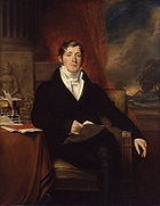
Stamford Raffles

Encyclopedia
Sir Thomas Stamford Bingley Raffles, FRS
(6 July 1781 – 5 July 1826) was a British
statesman
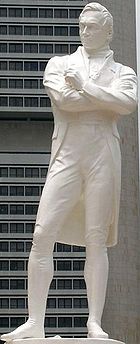
, best known for his founding of the city of Singapore
(now the city-state
of the Republic of Singapore). He is often described as the "Father of Singapore". He was also heavily involved in the conquest of the Indonesian island of Java
from Dutch and French military forces during the Napoleonic Wars
and contributed to the expansion of the British Empire
. He was also an amateur writer and wrote a book entitled History of Java
(1817).
, to Captain Benjamin Raffles (d. June 1797) and Anne Raffles (née Lyde). His father was a Yorkshire
man who had a burgeoning family and little luck in the West Indies trade during the American Revolution
, sending the family into debt. The little money the family had went into schooling Raffles. He attended a boarding school. In 1795, at the age of 14, Raffles started working as a clerk in London for the British East India Company
, the trading company that shaped many of Britain's overseas conquests. In 1805 he was sent to what is now Penang
in the country of Malaysia, then called the Prince of Wales Island, starting his long association with Southeast Asia
. He started with a post under the Honourable Philip Dundas
, the Governor of Penang.
He was appointed assistant secretary to the new Governor of Penang in 1805 and married Olivia Mariamne Fancourt
, a widow who was formerly married to Jacob Cassivelaun Fancourt, an assistant surgeon in Madras who had died in 1800. At this time he also made the acquaintance of Thomas Otho Travers
, who would accompany him for the next twenty years.
His knowledge of the Malay language
as well as his wit and ability, gained him favour with Lord Minto
, Governor-General of India
, and he was sent to Malacca
. Then, in 1811, after the invasion and annexation of the Kingdom of Holland
by France during Napoleon's war, Raffles had no choice but to leave the country. He mounted a military expedition against the Dutch and French in Java
, Indonesia
. The war was swiftly conducted by Admiral Robert Stopford, General Wetherhall, and Colonel Gillespie, who led a well-organized army against an army of mostly French conscripts with little proper leadership. The previous Dutch governor, Herman Willem Daendels
, had built a well-defended fortification at Meester Cornelis (now Jatinegara
), and at the time, the governor, Jan Willem Janssens
(who, coincidentally, surrendered to the British at the Cape Colony
), mounted a brave but ultimately futile defence at the fortress. The British, led by Colonel Gillespie, stormed the fort and captured it within three hours. Janssens attempted to escape inland but was captured. The British invasion of Java took a total of forty-five days, during which Raffles was appointed the Lieutenant-Governor by Lord Minto before hostilities formally ceased. He took his residence at Buitenzorg and despite having a small subset of Britons as his senior staff, he kept many of the Dutch civil servants in the governmental structure. He also negotiated peace and mounted some small military expeditions against local princes to subjugate them to British rule, as well as a takeover of Bangka Island
to set up a permanent British presence in the area in the case of the return of Java to Dutch rule after the end of the War of the Sixth Coalition
in Europe.
During his governorship, Raffles introduced partial self-government, stopped the slave trade, became an early opponent of the Opium trade by placing strict limitations upon its importation, much to the dismay of Calcutta, led an expedition to rediscover and restore Borobudur
and other ancient monuments, and replaced the Dutch forced agriculture system with a land tenure
system of land management, probably influenced by the earlier writings of Dirk van Hogendorp (1761–1822). He also changed the Dutch colonies to the British system of driving on the left, which is why Indonesia drives on the left today.
Under the harsh conditions of the island, Olivia died on 26 November 1814, an event that devastated Raffles. In 1815, he left again for England after the island of Java was returned to control of the Netherlands following the Napoleonic Wars
, under the terms of the Anglo-Dutch Treaty of 1814
, but not before he was officially replaced by John Fendall
on account of the poor financial performance of the colony during his administration, as deemed by the successors of Lord Minto in Calcutta. He sailed to England in early 1816 to clear his name, and en route, visited Napoleon, who was in exile at St. Helena, but found him unpleasant and unimpressive.
, was particularly close to him. At the publication of the book, he also stopped using the name "Thomas", preferring to use his middle name, "Stamford", possibly to avoid confusion amongst his associates with Sir Thomas Sevestre or his cousin who bore the same name. On February 22, he married his second wife, Sophia Hull.
He was appointed as the Governor-General of Bencoolen (now Bengkulu
) on 15 October 1817, and set sail to take the post with his new wife.
 Raffles arrived in Bencoolen (Bengkulu
) on 19 March 1818. Despite the prestige connected with the title, Bencoolen was a colonial backwater whose only real export was pepper and only the murder of a previous Resident, Thomas Parr, gained it any attention back home in Britain. Raffles found the place wrecked, and set about reforms immediately, mostly similar to what he had done in Java - abolishing slavery and limiting cockfighting and such games. To replace the slaves, he used a contingent of convicts, already sent to him from India. It is at this point when he realized the importance of a British presence that both challenged the Dutch hegemony in the area and could remain consistently profitable, unlike Bencoolen or Batavia. However, the strategic importance of poorly-maintained but well-positioned British possessions
such as Penang or Bencoolen made it impossible for the British to abandon such unprofitable colonies in such close proximity to the Dutch in Java. The competition in the area, between Raffles and the aggressive Dutch de jure Governor, Elout, certainly led at least in part to the later Anglo-Dutch Treaty of 1824
. Raffles looked into alternatives in the area - namely Bangka, which had been ceded to the Dutch after its conquest by the British during its occupation of Java.
Bintan
was also under consideration. Despite the fact that Warren Hastings
overlooked the island before settling upon Penang in 1786, the Riau Archipelago
was an attractive choice just to the south of the Malay Peninsula
, for its proximity to Malacca
. In his correspondences with Calcutta, Raffles also emphasized the need to establish a certain amount of influence with the native chiefs, which had greatly waned since the return of the Dutch. Raffles sent Thomas Travers as an ambassador to the Dutch, to possibly negotiate an expansion of British economic interests. When this failed, and when Raffles' own expeditions into his new dominion found only treacherous terrain and few exportable goods, his desire to establish a better British presence was cemented.
However, the Anglo-Dutch Convention of 1814 was not completely clear, especially on the issue of certain possessions such as Padang
. The Convention of 1814 only returned Dutch territory that was held before 1803, which did not include Padang. Raffles asserted the British claim personally, leading a small expedition to the Sultanate of Minangkabau. Yet, as Raffles confirmed with the sultan regarding the absolute British influence of the area, he realized that the local rulers had only limited power over the well-cultivated and civilized country, and the treaty was largely symbolic and had little actual force.
 Meanwhile, Major William Farquhar
, the British Resident
of Malacca, had been attempting to negotiate commercial treaties
with the local chiefs of the Riau Archipelago, especially with the heads of the Sultanate of Johore. Due to the death and subsequent turmoil of the sultanate at the time of Farquhar's arrival, Farquhar was compelled to sign the treaty not with the official head of the sultanate, but rather, the Raja Muda (Regent or Crown Prince) of Riau. Noting it as a success and reporting it as such back to Raffles, Raffles sailed to Malacca in late 1818 to personally secure a British presence in the Riau area, especially Singapura, which was favoured by him both through the readings of Malayan histories and by Farquhar's explorations.
Despite Lord Hastings'
less-than-stellar opinion of Raffles before (which had necessitated his trip to England to clear his name at the end of his tenure as Governor-General of Java), the now well-connected and successful Raffles was able to secure the permission to set up a settlement where in Malaysian history
the name Lion City was applied and was in a strategically advantageous position. However, he was not to provoke the Dutch, and his actions were officially disavowed. Despite the best efforts in London by authorities such as the Viscount Castlereagh to quell Dutch fears and the continuing efforts to reach an agreement between the nations that eventually became the Anglo-Dutch Treaty
of London of 1824, as well as to send instructions to Raffles to undertake far less intrusive actions, the distance between the Far East and Europe had meant that the orders had no chance of reaching Raffles in time for his venture to begin.
to Mount Muar". This man was Hussein Shah of Johor
, who, although having had no previous contact with the British, had certainly heard of the might of the British navy
and was in no position to argue against the terms. However, Raffles was able to charm the man and to reassure him that the Dutch posed no threat in the area. Hussein Shah had been the crown Prince of Johor, but while he was away in Pahang to get married, his father died and his younger brother was made sultan, supported by some of the court officials and the Dutch. To circumvent the situation of having to negotiate with a sultan influenced by the Dutch, Raffles decided to recognise, on behalf of the British Crown, Hussein Shah as being the rightful ruler of Johor. Farquhar's attempt to establish a more favorable treaty in Rhio was met with greater challenge, as the Dutch were present and made for a rather awkward position. The Dutch were alarmed and sent a small contingent to the island. Despite a covert offer of subterfuge against the Dutch offered by the Raja of Rhio, Farquhar returned and an official protest was sent by the Raja to Java regarding the matter.
Raffles declared the foundation of what was to become modern Singapore on 6 February, securing the transfer of control of the island to the East India Company. Much pomp and ceremony was done, and the official treaty was read aloud in languages representing all nations present, as well as the Malay and Chinese inhabitants. Hussien Shah was paid $5,000 a year while the local Temenggong received $3,000 a year, both massive sums at the time, equivalent to several hundred thousand dollars now. Farquhar was officially named the Resident of Singapore as Raffles was named as "Agent to the Most Noble the Governor-General with the States of Rhio, Lingin and Johor". Although ownership of the post was to be exclusively British, explicit orders were given to Farquhar to maintain free passage of ships through the Strait of Singapore and a small military presence was established alongside the trading post. After issuing orders to Farquhar and the remaining Europeans, Raffles left the next day, 7 February 1819.
The muddled political situation in Johore and Rhio also created a certain uneasiness and instability for the two nations.Tengku Long was claimed to be a pretender
to the throne, and, since the succession
laws in the Malay sultanates were not clear cut, the treaties signed between native rulers and the European powers always seemed to be on the verge of being invalidated, especially if a sultan is deposed by one of his siblings or other pretenders.
Nevertheless, amidst the uncertainty and intrigue, Raffles landed in Achin on 14 March 1819, with the begrudging help of Penang. Once again, it seems that multiple people were in power, but none wanted to formally deal with the British. The hostile atmosphere created allowed for Raffles to cancel the only meeting he was able to arrange, with Panglima Polim, a powerful divisional chief, fearing treachery. As the influential merchant John Palmer, Raffles, and fellow commissioner John Monckton Coombs of Penang sat offshore, waiting for a response, Calcutta debated whether to reinforce Singapore or not. Evacuation plans were made, but the Dutch never acted and finally Lord Hastings prompted Colonel Bannerman, the Governor of Penang, to send funds to reinforce Singapore.
Raffles finally was able to convince his fellow commissioners to sign a treaty with Jauhar al-Alam Shah, the ruler of Achin, which placed a British resident as well as the exclusivity of trade. By the time Raffles returned to Singapore, on 31 May, much of the immediate crisis that the establishment of the colony had caused in both Penang and Calcutta had passed. By then, the initial five-hundred villagers had grown to become five-thousand merchants, soldiers, and administrators on the island. Raffles was determined to both destroy the Dutch monopoly in the area, and create a gateway to the trade with China and Japan, the latter of which he attempted and failed to reach while governing Java.
as well. Currency was regulated and as he had an excess of out-of-work civil servants, formed committees to advise him in the running of the colony. However, Bencoolen was not as self-sufficient as Singapore. The area was poor and disease-ridden, and the first reports from the committees reflected very poorly upon the condition of the colony. Unlike the salutary neglect
Raffles granted upon Singapore, he slowed the European-inspired reforms and emphasized on the cultivation of whatever land that was available. Native authorities were given power in their respective districts and were answerable only to the Governor-General. The slave-debtor system was brought in in exchange instead of the old slavery system that Raffles abolished in Java, Borneo, and initially in Bencoolen. Slave-debtors were registered, and educational reforms started to focus on the children instead of the entire population. Raffles was looking into a long-term plan for a slow reform of Bencoolen.
Unlike many other European colonizers, Raffles did not impose upon the colonized the language, culture, or other aspects of the colonizer. In addition to preserving the artifacts
, fauna
, and flora
of his colonies, he also allowed religious freedom in his colonies, especially important as the Malay states were largely Muslim
. However, Christian
schools were started by missionaries in all of his colonies.
. He sailed to Calcutta and as Lord Hastings sought to consolidate all of the small British possessions in the East Indies
. During his sojourn, he had the opportunity to argue for free trade and the protection of the private enterprise. Education and the retention of small British outposts were also discussed.
The Dutch claim on the Sultanate of Johore and hence, Rhio, and the diplomatic exchanges between Baron Godert van der Capellen
and Calcutta continued throughout this time. The legitimacy of the British treaties were also questioned once again, but finally, as Singapore grew at an exponential rate, the Dutch gave up their claim on the island, allowing the colony to continue as a British possession. However, the pressures put upon Calcutta ensured that no single governor of all British possessions in the Strait or on Sumatra was appointed, and Raffles, whose health was slowly ailing, returned to Bencoolen.
cannibals of Tapanuli and their rituals and laws regarding the consumption of human flesh, writing in detail about the transgressions that warranted such an act as well as their methods. He also noted the rise of the Sikh religion in certain parts of Sumatra.
By early 1820, Tunku Long had firmly established himself as the Sultan of Johore to the British, but the political situation in the area remains a befuddled mess, with the old sultan dying and many new ones attempting to gain either the crown or regency. As Farquhar was involving himself poorly in local politics, Raffles appointed Travers as the Resident of Singapore, replacing Farquhar. Upon his arrival, Travers found the colony a delightful smörgåsbord of different races and cultures, numbering over six thousand, and the Singapore trade was slowly overtaking the Java trade.
As in Java, Raffles collected samples of local species of plants and animals, as well as described them in his journals. He also described other local tribes and their customs, especially their religions and laws. He brought the island of Nias
under British rule as well, noting its more civilized state and production of rice.
Yet, the production of food remained somewhat of a problem in Bencoolen. Raffles paid special attention to the agricultural methods of the Chinese
, and wrote an introduction to the only issue of Proceedings of the Agricultural Society, in order to remedy this. His employer, the East India Company
, however, had no other concerns outside of profit, and even as Raffles lived like a country gentleman and ran his colony as an estate, his expenditures in natural preservation was frowned upon. His removal was discussed in both Calcutta and London, while Castlereagh continued negotiations with the Dutch regarding the ongoing diplomatic conflicts.
Luckily, the Singapore issue had its supporters in the House, so as negotiations went on in Europe, Raffles remained largely idle in Bencoolen. The only major issue, outside of the politics of local sultans, involved the replacement of Farquhar, who decided that he had no intention of leaving his post voluntarily, causing a moment of tension between him and Travers. Raffles' request for Travers to deliver dispatches to India nullified the issue late in the year, and Farquhar remained in charge in Singapore, with its survival still in doubt for many in both India and London, who believed that it would either be handed over to the Dutch or taken violently by the Dutch at the end of Castlereagh's negotiations.
Farquhar, however, stirred up more trouble, conflicting especially with local English merchants over trivial matters of self-importance and overreaction over small infractions of white traders, for some of which he was reprimanded by Calcutta officially. Public works
, commissioned by Raffles but undertaken by Farquhar, was becoming overwhelmingly expensive.
Personal tragedies also started for Raffles. His eldest son, Leopold, died during an epidemic
on 4 July 1821. The oldest daughter, Charlotte, was also sick with dysentery by the end of the year, but it would be his youngest son, Stamford Marsden, who would perish first with the disease, 3 January 1822, with Charlotte to follow ten days later. For the good part of four month the couple remained devastated. The year would be eventful with the suicide of Castlereagh and the appointment of Lord Amherst
as the Governor-General of India
, replacing Hastings. As Raffles grew restless and depressed, he decided to visit Singapore before heading home to England. Accompanying him would be his wife Sophia and their only surviving child, Ella.
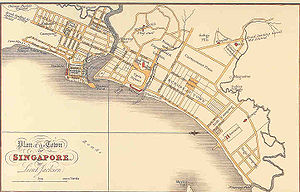 Raffles was pleased at the fact that Singapore had grown exponentially in such short years. The colony was a bustling hub of trade and activity. However, Farquhar's development work was deemed unsatisfactory and Raffles drew up what is now known as the Jackson Plan
, and replanned the city according to recommendations of a committee headed by the colony's engineer, Phillip Jackson.
It was still a segregated plan, giving the best land to the Europeans, yet it was considered remarkably scientific for the time. It was also during the replanning and reconstruction of the town that allowed Farquhar to clash dramatically with Raffles, who now considered Farquhar unfit for the position of Resident. Raffles took direct control with a heavy hand. In 1823, Raffles instituted a code of settlement for the populace, and soon followed with laws regarding the freedom of trade. He also quickly instituted a registration system for all land, regardless of ownership, and the repossession of the land by the government if land remained unregistered. This act greatly asserted the power of the British government as it covered land previously owned by the Sultan as well. A police force and magistrate was then set up, under British principles. In a very short period of time, Raffles had turned a semi-anarchic trading post into a proper city with some semblance of order.
Repeated efforts by Raffles for Calcutta to send a replacement for Farquhar remained unanswered. As Raffles started to hint at his impending retirement, he made Johore a British protectorate, causing a protest from van der Capellen. Finally, Calcutta appointed John Crawfurd
, who had followed Raffles for over twenty years, as the Resident of Singapore. Captain William Gordon MacKenzie took over Bencoolen from Raffles. In March 1823, and coincidentally, on the same day he was replaced, he received an official reprimand from London for the takeover of Nias.
With politics against him, Raffles finally turned back to the natural sciences. He gave a speech regarding the opening of a Malay college in Singapore that heavily involved his observations of his years in Southeast Asia and the importance of both the local and the European languages. Raffles personally gave $2,000 towards the effort, as the East India Company gave $4,000.
In 1823, Raffles drafted the first constitution for Singapore, which followed a fairly moralistic stance, outlawing gaming and slavery. A specific regulation in the constitution called for the multiethnic population of Singapore to remain as is, and there shall be no crimes based on race. He then went to work drafting laws, defining exactly "what" constituted a crime. Finally, on 9 July 1823, feeling that his work in establishing Singapore was finished, he boarded a ship for home, but not before a stop in Batavia to visit his old home and adversary, van der Capellen. A final stop in Bencoolen followed, and finally, a voyage home, interrupted by a harrowing experience when one of the ships caught fire off Rat Island, which claimed many of his drawings and papers.
The Anglo-Dutch Treaty of 1824
finally settled the score in the East Indies. The British gained dominance in the north, while the entirety of Sumatra became Dutch. The Malay Peninsula and the Indian subcontinent
were both free of Dutch interference.
Raffles finally returned to England 22 August 1824, over a year after he left Singapore. His longest tenure in Singapore was only eight months, but he was considered the founder of Singapore nevertheless.
until September, after which he entertained distinguished guests in both London and his home. He also made plans to run for parliament, but this ambition was never realized. He moved to London to a house in Berners Street at the end of November, just in time to have a war of words in front of the Court of Directors of the EIC regarding Singapore with Farquhar, who had also arrived in London. Despite raising several severe charges against Raffles, Farquhar was ultimately unable to discredit him; he was denied a chance to be restored to Singapore, but was given a military promotion instead.
With the Singapore matter settled, Raffles turned to his other great interests - botany and zoology. Raffles was a founder (in 1825) and first president (elected April 1826) of the Zoological Society of London
and the London Zoo
. Meanwhile, he was not only not granted a pension
, but was called to pay over twenty-two thousand pounds sterling for the losses incurred during his administrations. Raffles replied and clarified his actions, and moved to his country estate, Highwood, north London, but before the issue was resolved, he was already much too ill.
He died at Highwood House in Mill Hill, north London, a day before his forty-fifth birthday, on 5 July 1826, of apoplexy
. His estate amounted to around ten thousand pounds sterling, which was paid to the Company to cover his outstanding debt. Because of his anti-slavery
stance, he was refused burial inside his local parish church (St. Mary's, Hendon
) by the vicar
, Theodor Williams, whose family had made its money in Jamaica in the slave trade. A brass tablet was finally placed in 1887 and the actual whereabouts of his body was not known until 1914 when it was found in a vault. When the church was extended in the 1920s his tomb was incorporated into the body of the building and a square floor tablet with inscription now marks the spot.
Biology
Landmarks
Business
Education
Sports and recreation
Transport
Royal Society
The Royal Society of London for Improving Natural Knowledge, known simply as the Royal Society, is a learned society for science, and is possibly the oldest such society in existence. Founded in November 1660, it was granted a Royal Charter by King Charles II as the "Royal Society of London"...
(6 July 1781 – 5 July 1826) was a British
British people
The British are citizens of the United Kingdom, of the Isle of Man, any of the Channel Islands, or of any of the British overseas territories, and their descendants...
statesman
Statesman
A statesman is usually a politician or other notable public figure who has had a long and respected career in politics or government at the national and international level. As a term of respect, it is usually left to supporters or commentators to use the term...
, best known for his founding of the city of Singapore
Singapore
Singapore , officially the Republic of Singapore, is a Southeast Asian city-state off the southern tip of the Malay Peninsula, north of the equator. An island country made up of 63 islands, it is separated from Malaysia by the Straits of Johor to its north and from Indonesia's Riau Islands by the...
(now the city-state
City-state
A city-state is an independent or autonomous entity whose territory consists of a city which is not administered as a part of another local government.-Historical city-states:...
of the Republic of Singapore). He is often described as the "Father of Singapore". He was also heavily involved in the conquest of the Indonesian island of Java
Java
Java is an island of Indonesia. With a population of 135 million , it is the world's most populous island, and one of the most densely populated regions in the world. It is home to 60% of Indonesia's population. The Indonesian capital city, Jakarta, is in west Java...
from Dutch and French military forces during the Napoleonic Wars
Napoleonic Wars
The Napoleonic Wars were a series of wars declared against Napoleon's French Empire by opposing coalitions that ran from 1803 to 1815. As a continuation of the wars sparked by the French Revolution of 1789, they revolutionised European armies and played out on an unprecedented scale, mainly due to...
and contributed to the expansion of the British Empire
British Empire
The British Empire comprised the dominions, colonies, protectorates, mandates and other territories ruled or administered by the United Kingdom. It originated with the overseas colonies and trading posts established by England in the late 16th and early 17th centuries. At its height, it was the...
. He was also an amateur writer and wrote a book entitled History of Java
History of Java
The History of Java can refer to:* The history of the island of Java* The 1817 book on the history of the island, by Stamford Raffles, founder of Singapore.* The version history of the Java programming language.* The history of the Java platform....
(1817).
Early life
Raffles was born on the ship Ann off the coast of Port Morant, JamaicaJamaica
Jamaica is an island nation of the Greater Antilles, in length, up to in width and 10,990 square kilometres in area. It is situated in the Caribbean Sea, about south of Cuba, and west of Hispaniola, the island harbouring the nation-states Haiti and the Dominican Republic...
, to Captain Benjamin Raffles (d. June 1797) and Anne Raffles (née Lyde). His father was a Yorkshire
Yorkshire
Yorkshire is a historic county of northern England and the largest in the United Kingdom. Because of its great size in comparison to other English counties, functions have been increasingly undertaken over time by its subdivisions, which have also been subject to periodic reform...
man who had a burgeoning family and little luck in the West Indies trade during the American Revolution
American Revolution
The American Revolution was the political upheaval during the last half of the 18th century in which thirteen colonies in North America joined together to break free from the British Empire, combining to become the United States of America...
, sending the family into debt. The little money the family had went into schooling Raffles. He attended a boarding school. In 1795, at the age of 14, Raffles started working as a clerk in London for the British East India Company
British East India Company
The East India Company was an early English joint-stock company that was formed initially for pursuing trade with the East Indies, but that ended up trading mainly with the Indian subcontinent and China...
, the trading company that shaped many of Britain's overseas conquests. In 1805 he was sent to what is now Penang
Penang
Penang is a state in Malaysia and the name of its constituent island, located on the northwest coast of Peninsular Malaysia by the Strait of Malacca. It is bordered by Kedah in the north and east, and Perak in the south. Penang is the second smallest Malaysian state in area after Perlis, and the...
in the country of Malaysia, then called the Prince of Wales Island, starting his long association with Southeast Asia
Southeast Asia
Southeast Asia, South-East Asia, South East Asia or Southeastern Asia is a subregion of Asia, consisting of the countries that are geographically south of China, east of India, west of New Guinea and north of Australia. The region lies on the intersection of geological plates, with heavy seismic...
. He started with a post under the Honourable Philip Dundas
Philip Dundas
Philip Dundas, newly appointed Lieutenant-Governor of Penang, arrived at the newly created Presidency of the British East India Company, between the 18th and the 24th of September, 1805, together with his Council and the subordinate officials, including his Deputy Secretary, Stamford Raffles, who...
, the Governor of Penang.
He was appointed assistant secretary to the new Governor of Penang in 1805 and married Olivia Mariamne Fancourt
Olivia Mariamne Devenish
Olivia Mariamne Devenish , was the spouse of Thomas Stamford Raffles, vice governor of Java in 1811-1816. A memorial monument was erected to her memory in the botanical garden of Buitenzorg ....
, a widow who was formerly married to Jacob Cassivelaun Fancourt, an assistant surgeon in Madras who had died in 1800. At this time he also made the acquaintance of Thomas Otho Travers
Thomas Otho Travers
Thomas Otho Travers was a soldier and a friend of Stamford Raffles.He was born in Patrick Street, Cork, Ireland to Robert Travers a banker and Commissioner of the Peace for County Cork...
, who would accompany him for the next twenty years.
His knowledge of the Malay language
Malay language
Malay is a major language of the Austronesian family. It is the official language of Malaysia , Indonesia , Brunei and Singapore...
as well as his wit and ability, gained him favour with Lord Minto
Gilbert Elliot-Murray-Kynynmound, 1st Earl of Minto
Gilbert Elliot-Murray-Kynynmound, 1st Earl of Minto PC , known as Sir Gilbert Elliott between 1777 and 1797 and as The Lord Minto between 1797 and 1813, was a Scottish politician diplomat....
, Governor-General of India
Governor-General of India
The Governor-General of India was the head of the British administration in India, and later, after Indian independence, the representative of the monarch and de facto head of state. The office was created in 1773, with the title of Governor-General of the Presidency of Fort William...
, and he was sent to Malacca
Malacca
Malacca , dubbed The Historic State or Negeri Bersejarah among locals) is the third smallest Malaysian state, after Perlis and Penang. It is located in the southern region of the Malay Peninsula, on the Straits of Malacca. It borders Negeri Sembilan to the north and the state of Johor to the south...
. Then, in 1811, after the invasion and annexation of the Kingdom of Holland
Kingdom of Holland
The Kingdom of Holland 1806–1810 was set up by Napoleon Bonaparte as a puppet kingdom for his third brother, Louis Bonaparte, in order to better control the Netherlands. The name of the leading province, Holland, was now taken for the whole country...
by France during Napoleon's war, Raffles had no choice but to leave the country. He mounted a military expedition against the Dutch and French in Java
Java
Java is an island of Indonesia. With a population of 135 million , it is the world's most populous island, and one of the most densely populated regions in the world. It is home to 60% of Indonesia's population. The Indonesian capital city, Jakarta, is in west Java...
, Indonesia
Indonesia
Indonesia , officially the Republic of Indonesia , is a country in Southeast Asia and Oceania. Indonesia is an archipelago comprising approximately 13,000 islands. It has 33 provinces with over 238 million people, and is the world's fourth most populous country. Indonesia is a republic, with an...
. The war was swiftly conducted by Admiral Robert Stopford, General Wetherhall, and Colonel Gillespie, who led a well-organized army against an army of mostly French conscripts with little proper leadership. The previous Dutch governor, Herman Willem Daendels
Herman Willem Daendels
Herman Willem Daendels was a Dutch politician who served as the 36th Governor General of the Dutch East Indies between 1808 and 1811....
, had built a well-defended fortification at Meester Cornelis (now Jatinegara
Jatinegara
Jatinegara is a subdistrict of East Jakarta, Jakarta, Indonesia. The boundaries of Jatinegara are Bekasi Barat Raya - Bekasi Timur Raya - I...
), and at the time, the governor, Jan Willem Janssens
Jan Willem Janssens
Jonkheer Jan Willem Janssens GCMWO was a Dutch nobleman, soldier and statesman who served both as the governor-general of the Cape Colony and Dutch East Indies.-Early life:...
(who, coincidentally, surrendered to the British at the Cape Colony
Cape Colony
The Cape Colony, part of modern South Africa, was established by the Dutch East India Company in 1652, with the founding of Cape Town. It was subsequently occupied by the British in 1795 when the Netherlands were occupied by revolutionary France, so that the French revolutionaries could not take...
), mounted a brave but ultimately futile defence at the fortress. The British, led by Colonel Gillespie, stormed the fort and captured it within three hours. Janssens attempted to escape inland but was captured. The British invasion of Java took a total of forty-five days, during which Raffles was appointed the Lieutenant-Governor by Lord Minto before hostilities formally ceased. He took his residence at Buitenzorg and despite having a small subset of Britons as his senior staff, he kept many of the Dutch civil servants in the governmental structure. He also negotiated peace and mounted some small military expeditions against local princes to subjugate them to British rule, as well as a takeover of Bangka Island
Bangka Island
Bangka is an island lying east of Sumatra, Indonesia. Population 626,955. Area: c.4,600 sq mi .There is an additional small island named Pulau Bangka in northern Sulawesi, Indonesia.-Geography:...
to set up a permanent British presence in the area in the case of the return of Java to Dutch rule after the end of the War of the Sixth Coalition
War of the Sixth Coalition
In the War of the Sixth Coalition , a coalition of Austria, Prussia, Russia, the United Kingdom, Portugal, Sweden, Spain and a number of German States finally defeated France and drove Napoleon Bonaparte into exile on Elba. After Napoleon's disastrous invasion of Russia, the continental powers...
in Europe.
During his governorship, Raffles introduced partial self-government, stopped the slave trade, became an early opponent of the Opium trade by placing strict limitations upon its importation, much to the dismay of Calcutta, led an expedition to rediscover and restore Borobudur
Borobudur
Borobudur, or Barabudur, is a 9th-century Mahayana Buddhist monument near Magelang, Central Java, Indonesia. The monument comprises six square platforms topped by three circular platforms, and is decorated with 2,672 relief panels and 504 Buddha statues...
and other ancient monuments, and replaced the Dutch forced agriculture system with a land tenure
Land tenure
Land tenure is the name given, particularly in common law systems, to the legal regime in which land is owned by an individual, who is said to "hold" the land . The sovereign monarch, known as The Crown, held land in its own right. All private owners are either its tenants or sub-tenants...
system of land management, probably influenced by the earlier writings of Dirk van Hogendorp (1761–1822). He also changed the Dutch colonies to the British system of driving on the left, which is why Indonesia drives on the left today.
Under the harsh conditions of the island, Olivia died on 26 November 1814, an event that devastated Raffles. In 1815, he left again for England after the island of Java was returned to control of the Netherlands following the Napoleonic Wars
Napoleonic Wars
The Napoleonic Wars were a series of wars declared against Napoleon's French Empire by opposing coalitions that ran from 1803 to 1815. As a continuation of the wars sparked by the French Revolution of 1789, they revolutionised European armies and played out on an unprecedented scale, mainly due to...
, under the terms of the Anglo-Dutch Treaty of 1814
Anglo-Dutch Treaty of 1814
The Anglo-Dutch Treaty of 1814 was a treaty signed between Great Britain and the Netherlands in London on August 13, 1814...
, but not before he was officially replaced by John Fendall
John Fendall, Jr.
John Fendall, Jr. , also known as John of Java and Bengal, was a colonial official in the British Honourable East India Company and governor of Java for five months in 1816 before it was returned to Holland....
on account of the poor financial performance of the colony during his administration, as deemed by the successors of Lord Minto in Calcutta. He sailed to England in early 1816 to clear his name, and en route, visited Napoleon, who was in exile at St. Helena, but found him unpleasant and unimpressive.
Interlude in England
In 1817, Raffles wrote and published a book entitled History of Java, describing the history of the island from ancient times. In 1817 he was knighted by the prince regent, whose daughter, Princess CharlottePrincess Charlotte Augusta of Wales
Princess Charlotte of Wales was the only child of George, Prince of Wales and Caroline of Brunswick...
, was particularly close to him. At the publication of the book, he also stopped using the name "Thomas", preferring to use his middle name, "Stamford", possibly to avoid confusion amongst his associates with Sir Thomas Sevestre or his cousin who bore the same name. On February 22, he married his second wife, Sophia Hull.
He was appointed as the Governor-General of Bencoolen (now Bengkulu
Bengkulu
Bengkulu is a province of Indonesia. It is on the southwest coast of the island of Sumatra, and borders the provinces of West Sumatra, Jambi, South Sumatra and Lampung. The capital and largest city is Bengkulu city. It was formerly the site of a British garrison, which they called Bencoolen...
) on 15 October 1817, and set sail to take the post with his new wife.
Bencoolen (Bengkulu) and Malaya
Bengkulu
Bengkulu is a province of Indonesia. It is on the southwest coast of the island of Sumatra, and borders the provinces of West Sumatra, Jambi, South Sumatra and Lampung. The capital and largest city is Bengkulu city. It was formerly the site of a British garrison, which they called Bencoolen...
) on 19 March 1818. Despite the prestige connected with the title, Bencoolen was a colonial backwater whose only real export was pepper and only the murder of a previous Resident, Thomas Parr, gained it any attention back home in Britain. Raffles found the place wrecked, and set about reforms immediately, mostly similar to what he had done in Java - abolishing slavery and limiting cockfighting and such games. To replace the slaves, he used a contingent of convicts, already sent to him from India. It is at this point when he realized the importance of a British presence that both challenged the Dutch hegemony in the area and could remain consistently profitable, unlike Bencoolen or Batavia. However, the strategic importance of poorly-maintained but well-positioned British possessions
British overseas territories
The British Overseas Territories are fourteen territories of the United Kingdom which, although they do not form part of the United Kingdom itself, fall under its jurisdiction. They are remnants of the British Empire that have not acquired independence or have voted to remain British territories...
such as Penang or Bencoolen made it impossible for the British to abandon such unprofitable colonies in such close proximity to the Dutch in Java. The competition in the area, between Raffles and the aggressive Dutch de jure Governor, Elout, certainly led at least in part to the later Anglo-Dutch Treaty of 1824
Anglo-Dutch Treaty of 1824
The Anglo-Dutch Treaty of 1824, also known as the Treaty of London, was a treaty signed between the United Kingdom and the Netherlands in London on 17 March 1824. The treaty was to resolve disputes arising from the execution of the Anglo-Dutch Treaty of 1814...
. Raffles looked into alternatives in the area - namely Bangka, which had been ceded to the Dutch after its conquest by the British during its occupation of Java.
Bintan
Bintan
Bintan Island or Negeri Segantang Lada is an island in the Riau archipelago of Indonesia. It is part of the Riau Islands province, the capital of which, Tanjung Pinang, lies in the island's south and is the island's main community....
was also under consideration. Despite the fact that Warren Hastings
Warren Hastings
Warren Hastings PC was the first Governor-General of India, from 1773 to 1785. He was famously accused of corruption in an impeachment in 1787, but was acquitted in 1795. He was made a Privy Councillor in 1814.-Early life:...
overlooked the island before settling upon Penang in 1786, the Riau Archipelago
Riau Archipelago
Not to be confused with Riau Islands Province, a province of Indonesia.The Riau Archipelago is the core group of islands within the Riau Islands Province in Indonesia, and located south of Singapore...
was an attractive choice just to the south of the Malay Peninsula
Malay Peninsula
The Malay Peninsula or Thai-Malay Peninsula is a peninsula in Southeast Asia. The land mass runs approximately north-south and, at its terminus, is the southern-most point of the Asian mainland...
, for its proximity to Malacca
Malacca
Malacca , dubbed The Historic State or Negeri Bersejarah among locals) is the third smallest Malaysian state, after Perlis and Penang. It is located in the southern region of the Malay Peninsula, on the Straits of Malacca. It borders Negeri Sembilan to the north and the state of Johor to the south...
. In his correspondences with Calcutta, Raffles also emphasized the need to establish a certain amount of influence with the native chiefs, which had greatly waned since the return of the Dutch. Raffles sent Thomas Travers as an ambassador to the Dutch, to possibly negotiate an expansion of British economic interests. When this failed, and when Raffles' own expeditions into his new dominion found only treacherous terrain and few exportable goods, his desire to establish a better British presence was cemented.
However, the Anglo-Dutch Convention of 1814 was not completely clear, especially on the issue of certain possessions such as Padang
Padang, Indonesia
Padang is the capital and largest city of West Sumatra, Indonesia. It is located on the western coast of Sumatra at . It has an area of and a population of over 833,000 people at the 2010 Census.-History:...
. The Convention of 1814 only returned Dutch territory that was held before 1803, which did not include Padang. Raffles asserted the British claim personally, leading a small expedition to the Sultanate of Minangkabau. Yet, as Raffles confirmed with the sultan regarding the absolute British influence of the area, he realized that the local rulers had only limited power over the well-cultivated and civilized country, and the treaty was largely symbolic and had little actual force.
Founding of Singapore
William Farquhar
Major-General William Farquhar was an employee of the East India Company, and the first Resident of colonial Singapore.-Early life:Farquhar was born at Newhall, Aberdeenshire, near Aberdeen in 1774, and joined the East India Company as a cadet when he was 17...
, the British Resident
Resident (title)
A Resident, or in full Resident Minister, is a government official required to take up permanent residence in another country. A representative of his government, he officially has diplomatic functions which are often seen as a form of indirect rule....
of Malacca, had been attempting to negotiate commercial treaties
Commercial treaty
A Commercial treaty is a formal agreement between states for the purpose of establishing mutual rights and regulating conditions of trade.For example, the Methuen Treaty was a commercial treaty between Portugal and England....
with the local chiefs of the Riau Archipelago, especially with the heads of the Sultanate of Johore. Due to the death and subsequent turmoil of the sultanate at the time of Farquhar's arrival, Farquhar was compelled to sign the treaty not with the official head of the sultanate, but rather, the Raja Muda (Regent or Crown Prince) of Riau. Noting it as a success and reporting it as such back to Raffles, Raffles sailed to Malacca in late 1818 to personally secure a British presence in the Riau area, especially Singapura, which was favoured by him both through the readings of Malayan histories and by Farquhar's explorations.
Despite Lord Hastings'
Francis Rawdon-Hastings, 1st Marquess of Hastings
Francis Edward Rawdon-Hastings, 1st Marquess of Hastings KG PC , styled The Honourable Francis Rawdon from birth until 1762 and as The Lord Rawdon between 1762 and 1783 and known as The Earl of Moira between 1793 and 1816, was an Irish-British politician and military officer who served as...
less-than-stellar opinion of Raffles before (which had necessitated his trip to England to clear his name at the end of his tenure as Governor-General of Java), the now well-connected and successful Raffles was able to secure the permission to set up a settlement where in Malaysian history
History of Malaysia
Malaysia is a country in South East Asia whose strategic sea-lane position brought trade and foreign influences that fundamentally influenced its history. Hindu and Buddhist cultures imported from India dominated early Malaysian history...
the name Lion City was applied and was in a strategically advantageous position. However, he was not to provoke the Dutch, and his actions were officially disavowed. Despite the best efforts in London by authorities such as the Viscount Castlereagh to quell Dutch fears and the continuing efforts to reach an agreement between the nations that eventually became the Anglo-Dutch Treaty
Anglo-Dutch Treaty of 1824
The Anglo-Dutch Treaty of 1824, also known as the Treaty of London, was a treaty signed between the United Kingdom and the Netherlands in London on 17 March 1824. The treaty was to resolve disputes arising from the execution of the Anglo-Dutch Treaty of 1814...
of London of 1824, as well as to send instructions to Raffles to undertake far less intrusive actions, the distance between the Far East and Europe had meant that the orders had no chance of reaching Raffles in time for his venture to begin.
Establishment
After a brief survey of the Karimun Islands, on 29 January 1819, he established a post at the southern tip of the Malay Peninsula. It was established that there was no Dutch presence on the island of Singapore. Johore also no longer had any control of the area, so contact was made with the local Temenggong, or Raja. The contacts were friendly and Raffles, knowledgeable about the muddled political situation, took advantage to provide a rudimentary treaty between the nominal chiefs of the area that called for the exclusivity of trade and the British protection of the area. Members of Raffles' party surveyed the island and proceeded to request the presence of the sultan, or whoever at the time had supreme nominal power, to sign a formal treaty, while Major Farquhar was ordered to do the same in Rhio. A few days later, the formal treaty was signed by a man who claimed to be the "lawful sovereign of the whole of territories extending from Lingga and JohorJohor
Johor is a Malaysian state, located in the southern portion of Peninsular Malaysia. It is one of the most developed states in Malaysia. The state capital city and royal city of Johor is Johor Bahru, formerly known as Tanjung Puteri...
to Mount Muar". This man was Hussein Shah of Johor
Hussein Shah of Johor
Sultan Hussein Mua'zzam Shah ibni Mahmud Shah Alam was the 18th ruler of Johor. He was best remembered for his role as a signatory for two treaties with the British which culminated in the founding of modern Singapore; during which he was given recognition as the Sultan of Johor and Singapore in...
, who, although having had no previous contact with the British, had certainly heard of the might of the British navy
Royal Navy
The Royal Navy is the naval warfare service branch of the British Armed Forces. Founded in the 16th century, it is the oldest service branch and is known as the Senior Service...
and was in no position to argue against the terms. However, Raffles was able to charm the man and to reassure him that the Dutch posed no threat in the area. Hussein Shah had been the crown Prince of Johor, but while he was away in Pahang to get married, his father died and his younger brother was made sultan, supported by some of the court officials and the Dutch. To circumvent the situation of having to negotiate with a sultan influenced by the Dutch, Raffles decided to recognise, on behalf of the British Crown, Hussein Shah as being the rightful ruler of Johor. Farquhar's attempt to establish a more favorable treaty in Rhio was met with greater challenge, as the Dutch were present and made for a rather awkward position. The Dutch were alarmed and sent a small contingent to the island. Despite a covert offer of subterfuge against the Dutch offered by the Raja of Rhio, Farquhar returned and an official protest was sent by the Raja to Java regarding the matter.
Raffles declared the foundation of what was to become modern Singapore on 6 February, securing the transfer of control of the island to the East India Company. Much pomp and ceremony was done, and the official treaty was read aloud in languages representing all nations present, as well as the Malay and Chinese inhabitants. Hussien Shah was paid $5,000 a year while the local Temenggong received $3,000 a year, both massive sums at the time, equivalent to several hundred thousand dollars now. Farquhar was officially named the Resident of Singapore as Raffles was named as "Agent to the Most Noble the Governor-General with the States of Rhio, Lingin and Johor". Although ownership of the post was to be exclusively British, explicit orders were given to Farquhar to maintain free passage of ships through the Strait of Singapore and a small military presence was established alongside the trading post. After issuing orders to Farquhar and the remaining Europeans, Raffles left the next day, 7 February 1819.
Achin, and the early conflict/crisis with the Dutch
Raffles also planned to start a British presence in Achin, at the northern tip of Sumatra. As soon as he left, the Raja of Rhio sent letters to the Dutch, claiming innocence and a British encroachment. The Dutch in Malacca acted at once, and ordered that no Malays could go to Singapore. Raffles' bold claim of Singapore created a curious geographic situation where although Penang was clearly closer distance-wise to Singapore, Raffles, in his capacity as the Governor-General of Bencoolen, was in control. This undoubtedly irked the authorities in Penang to the point where they refused to send any sepoys to Singapore to complete the garrison. Official Dutch complaints came before the end of the month, and Raffles attempted to appease the situation by instructing Farquhar to not interfere with the politics of surrounding islands. Despite numerous threats and serious considerations by the Dutch Governor-General in Java, the Dutch did not take any military action.The muddled political situation in Johore and Rhio also created a certain uneasiness and instability for the two nations.Tengku Long was claimed to be a pretender
Pretender
A pretender is one who claims entitlement to an unavailable position of honour or rank. Most often it refers to a former monarch, or descendant thereof, whose throne is occupied or claimed by a rival, or has been abolished....
to the throne, and, since the succession
Order of succession
An order of succession is a formula or algorithm that determines who inherits an office upon the death, resignation, or removal of its current occupant.-Monarchies and nobility:...
laws in the Malay sultanates were not clear cut, the treaties signed between native rulers and the European powers always seemed to be on the verge of being invalidated, especially if a sultan is deposed by one of his siblings or other pretenders.
Nevertheless, amidst the uncertainty and intrigue, Raffles landed in Achin on 14 March 1819, with the begrudging help of Penang. Once again, it seems that multiple people were in power, but none wanted to formally deal with the British. The hostile atmosphere created allowed for Raffles to cancel the only meeting he was able to arrange, with Panglima Polim, a powerful divisional chief, fearing treachery. As the influential merchant John Palmer, Raffles, and fellow commissioner John Monckton Coombs of Penang sat offshore, waiting for a response, Calcutta debated whether to reinforce Singapore or not. Evacuation plans were made, but the Dutch never acted and finally Lord Hastings prompted Colonel Bannerman, the Governor of Penang, to send funds to reinforce Singapore.
Raffles finally was able to convince his fellow commissioners to sign a treaty with Jauhar al-Alam Shah, the ruler of Achin, which placed a British resident as well as the exclusivity of trade. By the time Raffles returned to Singapore, on 31 May, much of the immediate crisis that the establishment of the colony had caused in both Penang and Calcutta had passed. By then, the initial five-hundred villagers had grown to become five-thousand merchants, soldiers, and administrators on the island. Raffles was determined to both destroy the Dutch monopoly in the area, and create a gateway to the trade with China and Japan, the latter of which he attempted and failed to reach while governing Java.
First year of Singapore
While in Singapore, Raffles established schools and churches in the native languages. He allowed missionaries and local businesses to flourish. Certain colonial aspects remained: a European town was quickly built to segregate the population, separated by a river; carriage roads were built and cantonments constructed for the soldiers. Otherwise, however, no duties were imposed and confident that Farquhar would follow his instructions well, he sailed for Bencoolen once again on 28 June.Bencoolen, once again
Raffles was still the Governor-General of Bencoolen and having returned to it after the settling of Singapore, Raffles started more reforms that were, by now, almost trademarks of his reign upon colonies. Forced labour was abolished when he first arrived, and he declared Bencoolen a free portFree port
A free port or free zone , sometimes also called a bonded area is a port, port area or other area with relaxed jurisdiction with respect to the country of location...
as well. Currency was regulated and as he had an excess of out-of-work civil servants, formed committees to advise him in the running of the colony. However, Bencoolen was not as self-sufficient as Singapore. The area was poor and disease-ridden, and the first reports from the committees reflected very poorly upon the condition of the colony. Unlike the salutary neglect
Salutary neglect
Salutary neglect was an undocumented, though long-lasting, British policy of avoiding strict enforcement of parliamentary laws, meant to keep the American colonies obedient to Great Britain. Prime Minister Robert Walpole stated that "If no restrictions were placed on the colonies, they would...
Raffles granted upon Singapore, he slowed the European-inspired reforms and emphasized on the cultivation of whatever land that was available. Native authorities were given power in their respective districts and were answerable only to the Governor-General. The slave-debtor system was brought in in exchange instead of the old slavery system that Raffles abolished in Java, Borneo, and initially in Bencoolen. Slave-debtors were registered, and educational reforms started to focus on the children instead of the entire population. Raffles was looking into a long-term plan for a slow reform of Bencoolen.
Unlike many other European colonizers, Raffles did not impose upon the colonized the language, culture, or other aspects of the colonizer. In addition to preserving the artifacts
Cultural heritage
Cultural heritage is the legacy of physical artifacts and intangible attributes of a group or society that are inherited from past generations, maintained in the present and bestowed for the benefit of future generations...
, fauna
Fauna
Fauna or faunæ is all of the animal life of any particular region or time. The corresponding term for plants is flora.Zoologists and paleontologists use fauna to refer to a typical collection of animals found in a specific time or place, e.g. the "Sonoran Desert fauna" or the "Burgess shale fauna"...
, and flora
Flora
Flora is the plant life occurring in a particular region or time, generally the naturally occurring or indigenous—native plant life. The corresponding term for animals is fauna.-Etymology:...
of his colonies, he also allowed religious freedom in his colonies, especially important as the Malay states were largely Muslim
Muslim
A Muslim, also spelled Moslem, is an adherent of Islam, a monotheistic, Abrahamic religion based on the Quran, which Muslims consider the verbatim word of God as revealed to prophet Muhammad. "Muslim" is the Arabic term for "submitter" .Muslims believe that God is one and incomparable...
. However, Christian
Christian
A Christian is a person who adheres to Christianity, an Abrahamic, monotheistic religion based on the life and teachings of Jesus of Nazareth as recorded in the Canonical gospels and the letters of the New Testament...
schools were started by missionaries in all of his colonies.
Consolidation of the Eastern Isles
The death of Colonel Bannerman of Penang in October 1819 brought upon a new opportunity for Raffles to expand his power to also include the other minor British factories and outposts from Sumatra to Cochin ChinaCochinchina
Cochinchina is a region encompassing the southern third of Vietnam whose principal city is Saigon. It was a French colony from 1862 to 1954. The later state of South Vietnam was created in 1954 by combining Cochinchina with southern Annam. In Vietnamese, the region is called Nam Bộ...
. He sailed to Calcutta and as Lord Hastings sought to consolidate all of the small British possessions in the East Indies
Indies
The Indies is a term that has been used to describe the lands of South and Southeast Asia, occupying all of the present India, Pakistan, Bangladesh, Myanmar, Nepal, Sri Lanka, the Maldives, and also Thailand, Cambodia, Laos, Vietnam, Brunei, Singapore, the Philippines, East Timor, Malaysia and...
. During his sojourn, he had the opportunity to argue for free trade and the protection of the private enterprise. Education and the retention of small British outposts were also discussed.
The Dutch claim on the Sultanate of Johore and hence, Rhio, and the diplomatic exchanges between Baron Godert van der Capellen
Godert van der Capellen
Godert Alexander Gerard Philip, Baron van der Capellen was a Dutch statesman from Utrecht.Van der Capellen was made Prefect of Friesland and soon thereafter Minister of the Interior and a member of the Privy Council. At his advice, King Louis Napoleon abdicated the throne in 1810 in favor of his...
and Calcutta continued throughout this time. The legitimacy of the British treaties were also questioned once again, but finally, as Singapore grew at an exponential rate, the Dutch gave up their claim on the island, allowing the colony to continue as a British possession. However, the pressures put upon Calcutta ensured that no single governor of all British possessions in the Strait or on Sumatra was appointed, and Raffles, whose health was slowly ailing, returned to Bencoolen.
Administration of Bencoolen, 1820–1822
Raffles returned to Bencoolen in ill-health, but as his health improved, he continued on his quest to learn about the island which he now called home. He studied the BatakBatak (Indonesia)
Batak is a collective term used to identify a number of ethnic groups predominantly found in North Sumatra, Indonesia. The term is used to include the Toba, Karo, Pakpak, Simalungun, Angkola and Mandailing, each of which are distinct but related groups with distinct, albeit related, languages and...
cannibals of Tapanuli and their rituals and laws regarding the consumption of human flesh, writing in detail about the transgressions that warranted such an act as well as their methods. He also noted the rise of the Sikh religion in certain parts of Sumatra.
By early 1820, Tunku Long had firmly established himself as the Sultan of Johore to the British, but the political situation in the area remains a befuddled mess, with the old sultan dying and many new ones attempting to gain either the crown or regency. As Farquhar was involving himself poorly in local politics, Raffles appointed Travers as the Resident of Singapore, replacing Farquhar. Upon his arrival, Travers found the colony a delightful smörgåsbord of different races and cultures, numbering over six thousand, and the Singapore trade was slowly overtaking the Java trade.
As in Java, Raffles collected samples of local species of plants and animals, as well as described them in his journals. He also described other local tribes and their customs, especially their religions and laws. He brought the island of Nias
Nias
Nīas is an island off the western coast of Sumatra, Indonesia. Nias is also the name of the archipelago, containing the Hinako archipelago....
under British rule as well, noting its more civilized state and production of rice.
Yet, the production of food remained somewhat of a problem in Bencoolen. Raffles paid special attention to the agricultural methods of the Chinese
Chinese people
The term Chinese people may refer to any of the following:*People with Han Chinese ethnicity ....
, and wrote an introduction to the only issue of Proceedings of the Agricultural Society, in order to remedy this. His employer, the East India Company
British East India Company
The East India Company was an early English joint-stock company that was formed initially for pursuing trade with the East Indies, but that ended up trading mainly with the Indian subcontinent and China...
, however, had no other concerns outside of profit, and even as Raffles lived like a country gentleman and ran his colony as an estate, his expenditures in natural preservation was frowned upon. His removal was discussed in both Calcutta and London, while Castlereagh continued negotiations with the Dutch regarding the ongoing diplomatic conflicts.
Luckily, the Singapore issue had its supporters in the House, so as negotiations went on in Europe, Raffles remained largely idle in Bencoolen. The only major issue, outside of the politics of local sultans, involved the replacement of Farquhar, who decided that he had no intention of leaving his post voluntarily, causing a moment of tension between him and Travers. Raffles' request for Travers to deliver dispatches to India nullified the issue late in the year, and Farquhar remained in charge in Singapore, with its survival still in doubt for many in both India and London, who believed that it would either be handed over to the Dutch or taken violently by the Dutch at the end of Castlereagh's negotiations.
Farquhar, however, stirred up more trouble, conflicting especially with local English merchants over trivial matters of self-importance and overreaction over small infractions of white traders, for some of which he was reprimanded by Calcutta officially. Public works
Public works
Public works are a broad category of projects, financed and constructed by the government, for recreational, employment, and health and safety uses in the greater community...
, commissioned by Raffles but undertaken by Farquhar, was becoming overwhelmingly expensive.
Personal tragedies also started for Raffles. His eldest son, Leopold, died during an epidemic
Epidemic
In epidemiology, an epidemic , occurs when new cases of a certain disease, in a given human population, and during a given period, substantially exceed what is expected based on recent experience...
on 4 July 1821. The oldest daughter, Charlotte, was also sick with dysentery by the end of the year, but it would be his youngest son, Stamford Marsden, who would perish first with the disease, 3 January 1822, with Charlotte to follow ten days later. For the good part of four month the couple remained devastated. The year would be eventful with the suicide of Castlereagh and the appointment of Lord Amherst
William Amherst, 1st Earl Amherst
William Pitt Amherst, 1st Earl Amherst, GCH, PC was a British diplomat and colonial administrator. He was Governor-General of India between 1823 and 1828.-Background and education:...
as the Governor-General of India
Governor-General of India
The Governor-General of India was the head of the British administration in India, and later, after Indian independence, the representative of the monarch and de facto head of state. The office was created in 1773, with the title of Governor-General of the Presidency of Fort William...
, replacing Hastings. As Raffles grew restless and depressed, he decided to visit Singapore before heading home to England. Accompanying him would be his wife Sophia and their only surviving child, Ella.
Singapore (1822–1823)
Jackson Plan
The Jackson Plan of 1822, also known as the "Plan of the Town of Singapore", was an urban plan for Singapore drawn up to maintain some order in the urban development of the fledgling but thriving colony founded just three years earlier...
, and replanned the city according to recommendations of a committee headed by the colony's engineer, Phillip Jackson.
It was still a segregated plan, giving the best land to the Europeans, yet it was considered remarkably scientific for the time. It was also during the replanning and reconstruction of the town that allowed Farquhar to clash dramatically with Raffles, who now considered Farquhar unfit for the position of Resident. Raffles took direct control with a heavy hand. In 1823, Raffles instituted a code of settlement for the populace, and soon followed with laws regarding the freedom of trade. He also quickly instituted a registration system for all land, regardless of ownership, and the repossession of the land by the government if land remained unregistered. This act greatly asserted the power of the British government as it covered land previously owned by the Sultan as well. A police force and magistrate was then set up, under British principles. In a very short period of time, Raffles had turned a semi-anarchic trading post into a proper city with some semblance of order.
Repeated efforts by Raffles for Calcutta to send a replacement for Farquhar remained unanswered. As Raffles started to hint at his impending retirement, he made Johore a British protectorate, causing a protest from van der Capellen. Finally, Calcutta appointed John Crawfurd
John Crawfurd
John Crawfurd , Scottish physician, and colonial administrator and author, was born in the island of Islay, Scotland...
, who had followed Raffles for over twenty years, as the Resident of Singapore. Captain William Gordon MacKenzie took over Bencoolen from Raffles. In March 1823, and coincidentally, on the same day he was replaced, he received an official reprimand from London for the takeover of Nias.
With politics against him, Raffles finally turned back to the natural sciences. He gave a speech regarding the opening of a Malay college in Singapore that heavily involved his observations of his years in Southeast Asia and the importance of both the local and the European languages. Raffles personally gave $2,000 towards the effort, as the East India Company gave $4,000.
In 1823, Raffles drafted the first constitution for Singapore, which followed a fairly moralistic stance, outlawing gaming and slavery. A specific regulation in the constitution called for the multiethnic population of Singapore to remain as is, and there shall be no crimes based on race. He then went to work drafting laws, defining exactly "what" constituted a crime. Finally, on 9 July 1823, feeling that his work in establishing Singapore was finished, he boarded a ship for home, but not before a stop in Batavia to visit his old home and adversary, van der Capellen. A final stop in Bencoolen followed, and finally, a voyage home, interrupted by a harrowing experience when one of the ships caught fire off Rat Island, which claimed many of his drawings and papers.
The Anglo-Dutch Treaty of 1824
Anglo-Dutch Treaty of 1824
The Anglo-Dutch Treaty of 1824, also known as the Treaty of London, was a treaty signed between the United Kingdom and the Netherlands in London on 17 March 1824. The treaty was to resolve disputes arising from the execution of the Anglo-Dutch Treaty of 1814...
finally settled the score in the East Indies. The British gained dominance in the north, while the entirety of Sumatra became Dutch. The Malay Peninsula and the Indian subcontinent
Indian subcontinent
The Indian subcontinent, also Indian Subcontinent, Indo-Pak Subcontinent or South Asian Subcontinent is a region of the Asian continent on the Indian tectonic plate from the Hindu Kush or Hindu Koh, Himalayas and including the Kuen Lun and Karakoram ranges, forming a land mass which extends...
were both free of Dutch interference.
Raffles finally returned to England 22 August 1824, over a year after he left Singapore. His longest tenure in Singapore was only eight months, but he was considered the founder of Singapore nevertheless.
England and death
Upon arrival in England in poor health, both Sir Stamford and Lady Raffles convalesced in CheltenhamCheltenham
Cheltenham , also known as Cheltenham Spa, is a large spa town and borough in Gloucestershire, on the edge of the Cotswolds in the South-West region of England. It is the home of the flagship race of British steeplechase horse racing, the Gold Cup, the main event of the Cheltenham Festival held...
until September, after which he entertained distinguished guests in both London and his home. He also made plans to run for parliament, but this ambition was never realized. He moved to London to a house in Berners Street at the end of November, just in time to have a war of words in front of the Court of Directors of the EIC regarding Singapore with Farquhar, who had also arrived in London. Despite raising several severe charges against Raffles, Farquhar was ultimately unable to discredit him; he was denied a chance to be restored to Singapore, but was given a military promotion instead.
With the Singapore matter settled, Raffles turned to his other great interests - botany and zoology. Raffles was a founder (in 1825) and first president (elected April 1826) of the Zoological Society of London
Zoological Society of London
The Zoological Society of London is a charity devoted to the worldwide conservation of animals and their habitats...
and the London Zoo
London Zoo
London Zoo is the world's oldest scientific zoo. It was opened in London on 27 April 1828, and was originally intended to be used as a collection for scientific study. It was eventually opened to the public in 1847...
. Meanwhile, he was not only not granted a pension
Pension
In general, a pension is an arrangement to provide people with an income when they are no longer earning a regular income from employment. Pensions should not be confused with severance pay; the former is paid in regular installments, while the latter is paid in one lump sum.The terms retirement...
, but was called to pay over twenty-two thousand pounds sterling for the losses incurred during his administrations. Raffles replied and clarified his actions, and moved to his country estate, Highwood, north London, but before the issue was resolved, he was already much too ill.
He died at Highwood House in Mill Hill, north London, a day before his forty-fifth birthday, on 5 July 1826, of apoplexy
Apoplexy
Apoplexy is a medical term, which can be used to describe 'bleeding' in a stroke . Without further specification, it is rather outdated in use. Today it is used only for specific conditions, such as pituitary apoplexy and ovarian apoplexy. In common speech, it is used non-medically to mean a state...
. His estate amounted to around ten thousand pounds sterling, which was paid to the Company to cover his outstanding debt. Because of his anti-slavery
Abolitionism
Abolitionism is a movement to end slavery.In western Europe and the Americas abolitionism was a movement to end the slave trade and set slaves free. At the behest of Dominican priest Bartolomé de las Casas who was shocked at the treatment of natives in the New World, Spain enacted the first...
stance, he was refused burial inside his local parish church (St. Mary's, Hendon
Hendon
Hendon is a London suburb situated northwest of Charing Cross.-History:Hendon was historically a civil parish in the county of Middlesex. The manor is described in Domesday , but the name, 'Hendun' meaning 'at the highest hill', is earlier...
) by the vicar
Vicar
In the broadest sense, a vicar is a representative, deputy or substitute; anyone acting "in the person of" or agent for a superior . In this sense, the title is comparable to lieutenant...
, Theodor Williams, whose family had made its money in Jamaica in the slave trade. A brass tablet was finally placed in 1887 and the actual whereabouts of his body was not known until 1914 when it was found in a vault. When the church was extended in the 1920s his tomb was incorporated into the body of the building and a square floor tablet with inscription now marks the spot.
Legacy
In Singapore and in other parts of the world, his name lives on in numerous entities, including:Biology
- Chaetodon rafflesi, Latticed butterfly fish
- Dinopium rafflesii, Olive-backed Woodpecker
- Megalaima rafflesiRed-crowned BarbetThe Red-crowned Barbet is a species of bird in the Ramphastidae family. It is found in Brunei, Indonesia, Malaysia, Myanmar, Singapore, and Thailand. Its natural habitats are subtropical or tropical moist lowland forests and plantations...
, Red-crowned barbetMegalaimidaeA family of birds comprising the Asian barbets, the Megalaimidae were once united with all other barbets in the Capitonidae but they have turned out to be distinct... - Nepenthes rafflesianaNepenthes rafflesianaNepenthes rafflesiana , or Raffles' Pitcher-Plant, is a species of pitcher plant. It has a very wide distribution covering Borneo, Sumatra, Peninsular Malaysia, and Singapore. Nepenthes rafflesiana is extremely variable with numerous forms and varieties described. In Borneo alone, there are at...
, a species of pitcher plantPitcher plantPitcher plants are carnivorous plants whose prey-trapping mechanism features a deep cavity filled with liquid known as a pitfall trap. It has been widely assumed that the various sorts of pitfall trap evolved from rolled leaves, with selection pressure favouring more deeply cupped leaves over... - Protanilla rafflesi Taylor, 1990 — a species of antAntAnts are social insects of the family Formicidae and, along with the related wasps and bees, belong to the order Hymenoptera. Ants evolved from wasp-like ancestors in the mid-Cretaceous period between 110 and 130 million years ago and diversified after the rise of flowering plants. More than...
- Raffles Museum of Biodiversity Research
- RafflesiaRafflesiaRafflesia is a genus of parasitic flowering plants. It contains approximately 28 species , all found in southeastern Asia, on the Malay Peninsula, Borneo, Sumatra, Thailand and the Philippines.Rafflesia was found in the Indonesian rain forest by an Indonesian guide working for Dr...
, a genus of parasitic flowering plants, known for having the largest flowers in the world - Theridion rafflesi Simon, 1899 — spiderSpiderSpiders are air-breathing arthropods that have eight legs, and chelicerae with fangs that inject venom. They are the largest order of arachnids and rank seventh in total species diversity among all other groups of organisms...
from SumatraSumatraSumatra is an island in western Indonesia, westernmost of the Sunda Islands. It is the largest island entirely in Indonesia , and the sixth largest island in the world at 473,481 km2 with a population of 50,365,538...
Landmarks
- Raffles CityRaffles CityRaffles City is a large complex located in the Civic District within the Downtown Core of the city-state of Singapore. Occupying an entire city block bounded by Stamford Road, Beach Road, Bras Basah Road and North Bridge Road, it houses two hotels and an office tower over a podium which contains a...
- Raffles HospitalRaffles HospitalRaffles Hospital is a tertiary care private hospital and the flagship of the Raffles Medical Group , a leading private healthcare provider in Singapore and South East Asia...
- Raffles HotelRaffles HotelRaffles Hotel is a colonial-style hotel in Singapore, and one of the world's most famous hotels. The hotel was established by the famous Armenian Sarkies Brothers. Opened in 1887, it was named after Singapore's founder Sir Stamford Raffles. Managed by Fairmont Raffles Hotels International, it is...
- Sir Stamford at Circular Quay
- Sir Stamford Double Bay
- Stamford Grand Adelaide
- Stamford Grand North Ryde
- Stamford HouseStamford House, SingaporeStamford House is a historic building located at the corner of the junction of Stamford Road and Hill Street, in the Downtown Core of Singapore...
- Stamford Plaza Adelaide
- Stamford Plaza Auckland
- Stamford Plaza Brisbane
- Stamford Plaza Double Bay
- Stamford Plaza Melbourne
- Stamford Plaza Sydney Airport
- Swissôtel The StamfordSwissôtel The StamfordSwissôtel The Stamford , is a luxury hotel in Singapore managed by Swissôtel Hotels & Resorts. Designed by architect I.M. Pei, Swissôtel The Stamford, at a height of is one of Southeast Asia’s tallest hotels...
Business
- Raffles Class (business classBusiness classBusiness class is a travel class available on many commercial airlines and rail lines, known by brand names which vary by airline or rail company. In the airline industry, it was originally intended as an intermediate level of service between economy class and first class, but many airlines now...
) of Singapore AirlinesSingapore AirlinesSingapore Airlines Limited is the flag carrier airline of Singapore. Singapore Airlines operates a hub at Changi Airport and has a strong presence in the Southeast Asia, East Asia, South Asia, and "Kangaroo Route" markets... - Raffles HoldingsRaffles HoldingsRaffles Holdings was the parent company of Raffles International. It is owned by Temasek Holdings which is the investment arm of the Singapore government....
- Raffles International Patients Centre
- Raffles International Training Centre
- Raffles Investments Limited
- Raffles Medical GroupRaffles Medical GroupRaffles Medical Group , established in 1976. The group runs a network of clinics, hospitals, surgical centres, speciality units and medical laboratories islandwide....
- Raffles Tailor
- Stamford Global
- Stamford Hotels & Resorts (Singaporean hotel chain based in Australia)
- Yantai Raffles ShipyardYantai Raffles ShipyardYantai Raffles Shipyard is a shipbuilding company in Yantai, Shandong Province, Peoples Republic of China. Yantai Raffles specializes in offshore and marine fabrication, and shares in the company have been traded on the Oslo OTC system in Norway since May 2006.In 1994, Brian Chang founded Yantai...
Education
- Raffles College (currently National University of SingaporeNational University of SingaporeThe National University of Singapore is Singapore's oldest university. It is the largest university in the country in terms of student enrollment and curriculum offered....
) - Raffles College of Design and CommerceRaffles College of Design and CommerceRaffles College of Design and Commerce is a private higher education provider based in Sydney, Australia founded in 1978, making it one of the longest-established art schools in Sydney. Raffles College is located in North Sydney and occupies 8 floors of a central office building in the business...
- Raffles Girls' Primary SchoolRaffles Girls' Primary SchoolRaffles Girls' Primary School is a primary school for girls located in Singapore. It offers the Gifted Education Programme to Primary Four to Primary Six students. Despite its name, RGPS is not considered part of the Raffles family of schools, which consists of Raffles Girls' School , Raffles...
- Raffles Girls' School (Secondary)Raffles Girls' School (Secondary)Raffles Girls' School is an independent girls' secondary school in Singapore. RGS was recognised by the Ministry of Education in 2006 by being awarded the School Excellence Award , among other awards...
- Raffles Hall, National University of SingaporeNational University of SingaporeThe National University of Singapore is Singapore's oldest university. It is the largest university in the country in terms of student enrollment and curriculum offered....
- Raffles Institution (Secondary)Raffles InstitutionRaffles Institution , founded in 1823, is the oldest centre for pre-tertiary learning in Singapore. It is an independent school in Singapore providing secondary and pre-university education. RI consists of a boys-only secondary section , and a coeducational pre-university section...
- Raffles Institution (Junior College)Raffles Junior CollegeRaffles Institution offers the Raffles Programme at Year 5 and 6 . It is located in Bishan beside the Year 1-4 school campus of Raffles Institution. The Principal is Mrs Lim Lai Cheng...
- Raffles-BICT International College
- Raffles International Christian SchoolRaffles International Christian SchoolRaffles International Christian School is an international school in Pondok Indah, South Jakarta, Indonesia.-History:Raffles International Christian School was started on July 2005 by the Yayasan Pendidikan Kristen Ora et Labora...
- Stamford Primary School
Sports and recreation
- Raffles Country Club
- Raffles CupRaffles CupThe Raffles Cup is a Thoroughbred horse race held annually in the first week of November at Kranji Racecourse in Singapore. Contested on turf over a left-handed course, the domestic Group One race is run over a distance 1800 meters and is open to horses age three and older.The Raffles Cup was...
- Raffles Marina
- Raffles Town Club
- Raffle Tickets ( RaffleRaffleA raffle is a competition in which people obtain numbered tickets, each ticket having the chance of winning a prize. At a set time, the winners are drawn from a container holding a copy of every number...
)
Transport
- Raffles Avenue
- Raffles Boulevard
- Raffles Institution LaneRaffles Institution LaneRaffles Institution Lane is a lane leading from Bishan Street 21 to the shared entrance of Raffles Institution and Raffles Institution .The nearest Mass Rapid Transit station is Marymount....
- Raffles LighthouseRaffles LighthouseRaffles Lighthouse is a lighthouse located in the Straits of Singapore, about 14 kilometres south of the main island of Singapore....
- Raffles Link
- Raffles PlaceRaffles PlaceRaffles Place is a geographical location in Singapore, south of the mouth of the Singapore River. Located in the Downtown Core and the Central Area, it features some of the tallest buildings and landmarks of the country.-History:...
- Raffles Place MRT StationRaffles Place MRT StationRaffles Place MRT Station ' is a Mass Rapid Transit interchange station on the North South Line and the East West Line in Singapore. It is directly beneath the centre of the financial district of Raffles Place, located in the Downtown Core area, south of the Singapore River...
- Raffles Quay
- Stamford RoadStamford RoadStamford Road is a one-way road in Singapore within the planning areas of Downtown Core and Museum. The road continues after the traffic light junction of Nicoll Highway, Esplanade Drive and Raffles Avenue towards Orchard Road. It then ends at the junction of Fort Canning Road, Bencoolen Street...
See also
- History of SingaporeHistory of SingaporeThe history of Singapore dates to the 11th century. The island rose in importance during the 14th century under the rule of Srivijayan prince Parameswara and became an important port until it was destroyed by Acehnese raiders in 1613. The modern history of Singapore began in 1819 when Englishman...
- Raffles' Landing SiteRaffles' Landing SiteThe Raffles' Landing Site is the location where tradition holds that Sir Stamford Raffles landed in on 29 January 1819. The site is located at Boat Quay within the Civic District, in the Downtown Core of the Central Area, Singapore's central business district.-History:On 29 January 1819, Raffle's...
External links
- Biography at the Raffles Museum of Biodiversity Research
- Find-A-Grave profile for Sir Thomas Stamford Raffles
- The natural history of game birds by Sir William Jardine with a memoir on Sir Stamford Raffles
- The History of Java by Sir Stamford Raffles at the Internet Archive.