
All Topics  
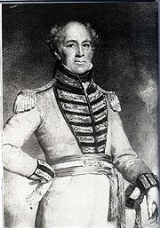
William Farquhar


   Email Print
   Bookmark   Link


William Farquhar


Major-General William Farquhar was an employee of the East India Company
British East India Company

The East India Company was an early England joint-stock company that was formed initially for pursuing trade with the Indies, but that ended up trading with the Indian subcontinent and China....
, and the 2nd Resident of colonial Singapore
Singapore

Singapore , officially the Republic of Singapore, is an island country microstate located at the southern tip of the Malay Peninsula. It lies 137 kilometres north of the equator, south of the Malaysian state of Johor and north of Indonesia's Riau Islands....
.

uhar was born near Aberdeen
Aberdeen

Aberdeen is Scotland's third most populous City status in the United Kingdom and one of Scotland's 32 Local government in Scotland Council areas of Scotland....
 in 1774, and joined the East India Company as a cadet when he was 20. He entered East India Company's service as cadet in the Madras Engineers at the age of twenty. Arrived in Madras on 19 June 1791, and shortly after on 22 June 1791, was promoted to a low-rank commissioned officer of the Madras Engineers.


Discussion
Ask a question about 'William Farquhar'
Start a new discussion about 'William Farquhar'
Answer questions from other users
Full Discussion Forum


Encyclopedia


Major-General William Farquhar was an employee of the East India Company
British East India Company

The East India Company was an early England joint-stock company that was formed initially for pursuing trade with the Indies, but that ended up trading with the Indian subcontinent and China....
, and the 2nd Resident of colonial Singapore
Singapore

Singapore , officially the Republic of Singapore, is an island country microstate located at the southern tip of the Malay Peninsula. It lies 137 kilometres north of the equator, south of the Malaysian state of Johor and north of Indonesia's Riau Islands....
.

Early life

Farquhar was born near Aberdeen
Aberdeen

Aberdeen is Scotland's third most populous City status in the United Kingdom and one of Scotland's 32 Local government in Scotland Council areas of Scotland....
 in 1774, and joined the East India Company as a cadet when he was 20. He entered East India Company's service as cadet in the Madras Engineers at the age of twenty. Arrived in Madras on 19 June 1791, and shortly after on 22 June 1791, was promoted to a low-rank commissioned officer of the Madras Engineers. Two years later on 16 August 1793, he became a Lieutenant in the Madras Engineers.

Career


Malacca

Farquhar was Chief Engineer in the expeditionary force which took Malacca from the Dutch on 18 August 1795. On 1 January 1803 he was promoted to the rank of full Captain. From 1803 he acted as Resident of Malacca, and was made a full Major in Corps on 26 September 1811, before he was officially appointed Resident and Commandant of Malacca in December 1813; a position he held for several years, in charge of both Civil and Military offices, until the Dutch returned in September 1818. During his tenure here he assisted in missions around the region, including the British invasion of Java led by Governor-General
Governor-General of India

The Governor-General of India was the head of the British Raj in India, and later, after Indian Independence Act 1947, the representative of the List of Indian monarchs#Kings of India and Pakistan....
 Lord Minto
Gilbert Elliot-Murray-Kynynmound, 1st Earl of Minto

Gilbert Elliot-Murray-Kynynmond, 1st Earl of Minto was a Scotland politician and diplomat.His great-grandfather the 1st Baronet Minto was also the ancestor of Robert Louis Stevenson....
 and Sir Stamford Raffles
Stamford Raffles

Sir Thomas Stamford Bingley Raffles was the founder of the city of Singapore . He was also heavily involved in the conquest of the Indonesian island of Java from Dutch and French military forces during the Napoleonic Wars....
 in August 1811. He spoke Malay
Malay language

The Malay language is an Austronesian languages spoken by the Malays and people of other ethnic groups who reside in Peninsular Malaysia, southern Thailand, Singapore, central eastern Sumatra, the Riau Islands and parts of the coast of Borneo....
, married a Malaccan girl, Nonio Clement (he had six children by her); and was popularly known as the Rajah of Malacca.

An engineer, his reputation was established by his long and successful term as Resident of Malacca, of which he was given charge when it passed into British hands from the Dutch
Netherlands

The Netherlands is a country that is part of the Kingdom of the Netherlands. It is a parliamentary democratic constitutional monarchy. The Netherlands is located in North-West Europe, and bordered by the North Sea to the north and west, Belgium to the south, and Germany to the east....
. A task given him by the British Government was to demolish all the structures left by the former occupants; he blew up the fortifications with gunpowder
Gunpowder

Gunpowder, also called black powder, is an explosive mixture of sulfur, charcoal and potassium nitrate, KNO3 that burns rapidly, producing volumes of hot solids and gases which can be used as a propellant in firearms and as a pyrotechnic composition in fireworks....
 but spared some of the other buildings, showing great foresight.

Singapore

With his long Malayan experience, and an intimate knowledge of Riau-Lingga politics, Major Farquhar was given the task to help Sir Stamford Raffles found a settlement on Singapore island. He helped negotiate the provisional agreement of 30 January 1819 with the local chieftain Temmengong Abdul Rahman of Johore; and the more formal Singapore Treaty of 16 February 1819, which Raffles signed with the Temmengong and His Highness the Sultan Hussein Mohammed Shah
Hussein Shah of Johor

Sultan Hussein Mohammed Shah was the seventeenth Sultan of Johor. He ruled Johor from 1819 to 1835. In the dispute regarding the succession to the throne of Johor following his father's death, Hussein Shah allowed a British settlement in Singapore to wrest the throne from his brother, Tengku Abdul Rahman, with the help of the United Kingdom....
, confirming the right for the British to set up a trading post. The next day on 17 February 1819, Raffles appointed Farquhar as Singapore's first Resident to develop the colony according to a specific plan Raffles had drawn up, Farquhar was left to manage the colony when Raffles
Stamford Raffles

Sir Thomas Stamford Bingley Raffles was the founder of the city of Singapore . He was also heavily involved in the conquest of the Indonesian island of Java from Dutch and French military forces during the Napoleonic Wars....
 left; an absence eventually lasting four year
Year

A year is the time between two recurrences of an event related to the orbit of the Earth around the Sun. By extension, this can be applied to any planet: for example, a "Martian year" is the time in which Mars completes its own orbit....
s. He was appointed the first British Resident and Commandant of Singapore, 1819–1823. Farquhar took a more laissez-faire
Laissez-faire

Laissez-faire is a term used to describe a policy of allowing events to take their own course. The term is a French language phrase literally meaning "let do"....
 approach, which suited the local traders who had followed him there. In his new post, he quickly set about clearing the plain on the north-east bank of the Singapore River. Word of this new trading post soon spread and Singapore became a thriving cosmopolitan town. Communication with Raffles in Bencoolen and the East India Company in Calcutta were so poor that for more than three years, Singapore developed on her own with Farquhar at the helm. On 9 May 1821, William Farquhar was promoted to the rank of Lieutenant Colonel. Despite his many positive achievements in the formative period of Singapore's development, he adopted measures in his administration which conflicted with Raffles' instructions, notably in allowing the erection of houses and godowns on the Padang and on the nearby banks of the Singapore River. His justification was that in the fast rapidly expanding settlement 'nothing is heard in the shape of complaint but the want of more ground to build on'.

However, when Raffles returned, he was furious to discover his plans had been neglected and that moreover local vices such as the trading of opium
Opium

Opium is a narcotic formed from the latex released by lacerating the immature seed pods of Opium poppy . It contains up to 12% morphine, an opiate alkaloid, which is most frequently processed chemically to produce heroin for the illegal drug trade....
 and slaves were being tolerated. He then dismissed Farquhar, who at first refused to leave, and later sued Raffles for tyrannical behavior. The conflicts which arose during Raffles' final stay in Singapore in 1822-23, led to his dismissal on May 1, 1823, and succeeded as Resident by Dr. John Crawfurd
John Crawfurd

John Crawfurd, Scotland physician, and colonial administrator and author, was born in the island of Islay, Scotland on August 13, 1783. He followed his father's footsteps in the study of medicine and completed his medical course at Edinburgh in 1803, at the age of 20....
. He remained in Singapore after that for a few months.

Farquhar was awarded the rank of Major General
Major General

Major General or Major-General is a military rank used in many countries. It is derived from the older rank of Sergeant Major General. A Major General is a high-ranking officer, normally subordinate to the rank of Lieutenant General and senior to the ranks of Brigadier and Brigadier General....
, and retired to Perth, Scotland, in 1829, where he bought two large recently completed Georgian houses (one for his brother, a naval Captain) and built a billiard hall for the entertainment of his many friends. He married again, and died in 1839. He has a mausoleum in Greyfriars Kirkyard
Greyfriars Kirkyard

Greyfriars Kirkyard is the graveyard surrounding Greyfriars Kirk in Edinburgh, Scotland, and is in the hands of a separate trust from the church....
.

Departure from Southeast Asia

At a farewell dinner with the principal merchants and British inhabitants on 27 December 1823, Colonel William Farquhar was presented with a plate valued at 3000 sicca rupees as a farewell gift. Shortly after, he finally departed from Singapore for Malacca, Penang and Calcutta en route back home to England. Farquhar's popularity with the Asian and the European community of Singapore was attested to by Munshi Abdullah bin Abdul Kadir, in his Hikayat Abdullah. One example was the moving account of Farquhar's departure from Singapore at the end of December 1823, which was confirmed by a report in one of Calcutta's newspapers, which states that on that day as he left, he was accompanied to the beach by most of the European inhabitants of the settlement as well as by 'a large concourse' of Asians of every class. As a compliment to him, the troops formed a guard-of-honour from his house to the landing place, and he embarked with the customary salute to his rank. Then many Asian boats accompanied him to his ship, the "Alexander", and as they sailed, some of the Siamese vessels fired salutes to him. Similar welcomes and tributes also awaited him up the Straits, in Malacca and in Penang.

He died in Perth, Scotland.

Sources

  • Brazil, David. Insider's Singapore. Singapore: TImes Books International, 2001.

Further reading