
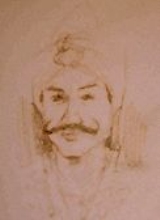
Although Singapore's history dates from the 11th century, the island was little known to the West until the 19th century, when in 1819, Sir Thomas Stamford Raffles arrived as an agent of the British East India Company. In 1824, the British purchased Singapore Island, and by 1825, the city of Singapore had become a major port, with trade exceeding that of Malaya's Malacca and Penang combined. In 1826, Singapore, Penang, and Malacca were combined as the Straits Settlements to form an outlying residency of the British East India Company; in 1867, the Straits Settlements were made a British Crown Colony, an arrangement that continued until 1946.
The opening of the Suez Canal in 1869 and the advent of steamships launched an era of prosperity for Singapore as transit trade expanded throughout Southeast Asia.
Although Singapore's history dates from the 11th century, the island was little known to the West until the 19th century, when in 1819, Sir Thomas Stamford Raffles arrived as an agent of the British East India Company. In 1824, the British purchased Singapore Island, and by 1825, the city of Singapore had become a major port, with trade exceeding that of Malaya's Malacca and Penang combined. In 1826, Singapore, Penang, and Malacca were combined as the Straits Settlements to form an outlying residency of the British East India Company; in 1867, the Straits Settlements were made a British Crown Colony, an arrangement that continued until 1946.
The opening of the Suez Canal in 1869 and the advent of steamships launched an era of prosperity for Singapore as transit trade expanded throughout Southeast Asia. In the 20th century, the automobile industry's demand for rubber from Southeast Asia and the packaging industry's need for tin helped make Singapore one of the world's major ports.
In 1921, the British constructed a naval base, which was soon supplemented by an air base. But the Japanese captured the island in February 1942, and it remained under their control until September 1945. The British returned after the Japanese withdrew.
In 1946, the Straits Settlements was dissolved; Penang and Malacca became part of the Malayan Union, and Singapore became a separate British Crown Colony. In 1959, Singapore became self-governing, and, in 1963, it joined the newly independent Federation of Malaya, Sabah, and Sarawak—the latter two former British Borneo territories—to form Malaysia.
Indonesia adopted a policy of "confrontation" against the new federation, charging that it was a "British colonial creation," and severed trade with Malaysia. The move particularly affected Singapore, since Indonesia had been the island's second-largest trading partner. The political dispute was resolved in 1966, and Indonesia resumed trade with Singapore.
After a period of friction between Singapore and the central government in Kuala Lumpur, Singapore separated from Malaysia on August 9, 1965, and became an independent republic.
The ruling political party in Singapore, reelected continuously since 1959, is the People's Action Party (PAP), now headed by Prime Minister Goh Chok Tong. Goh succeeded Lee Kuan Yew, who served as Singapore's prime minister from independence through 1990. Since stepping down as prime minister, Lee has remained influential as Minister Mentor. The current prime minister, PM Lee Hsien Loong, is MM Lee Kuan Yew's son.
The PAP has held the overwhelming majority of seats in Parliament since 1966, when the opposition Barisan Sosialis Party (Socialist Front), a left-wing group that split off from the PAP in 1961, resigned from Parliament, leaving the PAP as the sole representative party. In the general elections of 1968, 1972, 1976, and 1980, the PAP won all of the seats in an expanding Parliament.
Workers' Party Secretary General J.B. Jeyaretnam became the first opposition party MP in 15 years when he won a 1981 by-election. Opposition parties gained small numbers of seats in the general elections of 1984 (2 seats out of a total of 79), 1988 (1 seat of 81), 1991 (4 seats of 81), 1997 (2 seats of 83), and 2001 (2 seats of 84). Meanwhile, the PAP share of the popular vote in contested seats increased from 65% in 1997 to 75% in 2001. Since the opposition has contested less than half the seats in the last two elections, overall voter support for the PAP may be somewhat higher.
Facing severe unemployment and a housing crisis, Singapore embarked on a modernisation programme that focused on establishing a manufacturing industry, developing large public housing estates and investing heavily on public education. Since independence, Singapore's economy has grown by an average of nine percent each year. By the 1990s, the country has become one of the world's most prosperous nations, with a highly-
developedEconomic development is the increase in the standard of living of a nation's population associated with sustained growth from a simple, low-income economy to a modern, high-income economy...
free market economy, strong
international tradingInternational trade is exchange of capital, goods, and services across international borders or territories. In most countries, it represents a significant share of gross domestic product . While international trade has been present throughout much of history , its economic, social, and political...
links, and the highest
per capitaPer capita is a term adapted from Latin phrase pro capite meaning "per head" with pro meaning "per" or "for each", and capite meaning "head." Both words together equate to the phrase "for each head."...
gross domestic productThe gross domestic product or gross domestic income is a basic measure of a country's economic performance and is the market value of all final goods and services made within the borders of a country in a year...
in Asia outside of Japan.
Ancient times
The earliest written record of Singapore was a Chinese account from the third century, describing the island of
Pu Luo Chung (蒲罗中). This itself is transliterated from the
MalayMalay is a group of languages closely related to each other to the point of mutual intelligibility but that linguists consider to be separate languages. They are grouped into a group called "Local Malay", part of a larger group called "Malayan" within the Malayo-Polynesian branch of the...
name
"Pulau Ujong", or "island at the end" (of the
Malay peninsulaThe Malay Peninsula or Thai-Malay Peninsula is a major peninsula located in Southeast Asia, with its narrowest point at the Isthmus of Kra. The land mass runs approximately north-south and, at its teminus, is the most southern point of the Asian mainland...
). The quasi-mythological
Sejarah MelayuSejarah Melayu or Malay Annals is a Malay literary work that chronicles the genealogies of rulers in the Malay archipelago and spans a period of over 600 years...
(
Malay Annals) contains a tale of a prince of
SrivijayaSrivijaya or Sriwijaya was an ancient Malay kingdom on the island of Sumatra, Southeast Asia which influenced much of the Maritime Southeast Asia. The earliest solid proof of its existence dates from the 7th century; a Chinese monk, I-Tsing, wrote that he visited Srivijaya in 671 for 6 months...
, Sri Tri Buana (also known as
Sang Nila UtamaAccording to legend, Sang Nila Utama, also known as Sri Tri Buana, was a prince from Palembang who founded ancient Singapore. According to the Malay Annals, the prince ruled the island from 1299 to 1347.-The Founding Of Temasek :...
), who landed on the island during the 13th century. When he saw a lion, the prince took this as an auspicious sign and founded a settlement called Singapura, which means "Lion City" in
SanskritSanskrit is a historical Indo-Aryan language, one of the liturgical languages of Hinduism and Buddhism, and one of the 22 official languages of India. It is also declared as a classical language by the government of India....
.
In 1320, the
Mongol EmpireThe Mongol Empire was an empire from the 13th and 14th century spanning from Eastern Europe across Asia. It is the largest contiguous empire in the history of the world...
sent a trade mission to a place called
Long Ya MenLong Ya Men or Dragon's Teeth Gate, a craggy granite outcrop, formerly stood at the gateway to Keppel Harbour in Singapore. The Long Ya Men served as navigational aids to ancient mariners sailing through the swift waters of the narrow channel between them...
(or
Dragon's Tooth Strait), which is believed to be
Keppel HarbourKeppel Harbour is a stretch of water in Singapore between the mainland and the southern islands of Pulau Brani and Sentosa. Its naturally sheltered and deep waters was to meet the requirements of British colonists attempting to establish a Far East maritime colony in that part of the world, and...
, at the southern part of the island. The Chinese traveler
Wang DayuanWang Dayuan was a traveller from Quanzhou, China during the Yuan Dynasty in the 14th century. He made two major trips on ships. During 1328-1333, he sailed along the South China Sea and visited many places in Southeast Asia and reached as far as South Asia, landing in Sri Lanka and India. In...
, visiting the island around 1330, described a small settlement called Dan Ma Xi (淡马锡, from Malay
Tamasik) with
MalayMalays are an ethnic group of Austronesian peoples predominantly inhabiting the Malay Peninsula including the southernmost parts of Thailand, the east coast of Sumatra, the coast of Borneo, and the smaller islands which lie between these locations...
and Chinese residents. The
NagarakretagamaThe Nagarakretagama or Nagarakrtagama is an Old Javanese eulogy to Hayam Wuruk, the ruler of the Majapahit Kingdom. It was written as a kakawin by Mpu Prapanca in 1365 . The Nagarakretagama contains detailed descriptions of the Majapahit Kingdom during its greatest extent...
, a Javanese epic poem written in 1365, also referred to a settlement on the island called
TemasekTemasek was the name of an early city on the site of modern Singapore. From the 14th century, the island has also been known as Singapura, which is derived from Sanskrit and means "Lion City"...
(
Sea Town).
Recent excavationsArchaeology in Singapore is a niche discipline. Although there is a lack of government support for archeological work, many artifacts have been unearthed at sites around the island...
in
Fort CanningFort Canning ,: is a small hill slightly more than 60 metres high in the southeast portion of the island city-state of Singapore, within the Central Area that forms Singapore's central business district...
found evidences indicating that Singapore was an important port in the 14th century.
In the 1390s, Srivijayan prince
ParameswaraParameswara was a Malay-Hindu prince from Temasek who founded Malacca Sultanate around 1402.-Etymology:...
fled to Temasek after being deposed by the
Majapahit EmpireMajapahit was an archipelagic empire based on the island of Java from 1293 to around 1500. Majapahit reached its peak of glory during the era of Hayam Wuruk, whose reign from 1350 to 1389 marked by the conquest of kingdoms in Maritime Southeast Asia .Majapahit empire was the last of the major...
. He ruled the island for several years, before being forced to Melaka where he founded the Sultanate of Malacca. Singapore became an important trading port of the Malacca Sultanate and later the Sultanate of Johor. In 1613, Portuguese raiders burnt down the settlement at the mouth of
Singapore RiverThe Singapore River is a small river in Singapore with great historical importance. The Singapore River flows from the Central Area, which lies in the Central Region in the southern part of Singapore before emptying into the ocean...
and the island sank into obscurity.
Founding of modern Singapore (1819)
Between the 16th and 19th centuries, the
Malay archipelagoThe Malay Archipelago and Maritime Southeast Asia are names given to the archipelago located between mainland Southeastern Asia and Australia. Located between the Indian and Pacific Oceans, the group of 20,000 islands is the world's largest archipelago by area...
was gradually taken over by the European
colonialColonialism is the building and maintaining of colonies in one territory by people from another territory. Sovereignty over the colony is claimed by the metropole...
powers, beginning with the arrival of the
PortugueseThe Portuguese Empire was the first global empire in history, with territories in South America, Africa, India and South East Asia...
at
MalaccaMalacca is the third smallest Malaysian state, after Perlis and Penang. It is located in the southern region of the Malay Peninsula, on the Straits of Malacca. It borders Negeri Sembilan to the north and the state of Johor to the south. The capital is Malacca Town...
in 1509. The early dominance of the Portuguese was challenged during the 17th century by the Dutch, who came to control most of the ports in the region. The Dutch established a
monopolyIn economics, a monopoly exists when a specific individual or an enterprise has sufficient control over a particular product or service to determine significantly the terms on which other individuals shall have access to it...
over trade within the archipelago, particularly in
spiceA spice is a dried seed, fruit, root, bark, leaf, or vegetative substance used in nutritionally insignificant quantities as a food additive for the purpose of flavour, colour, or as a preservative that kills harmful bacteria or prevents their growth....
s, then the region's most important product. Other colonial powers, including the
BritishThe British Empire comprised the dominions, colonies, protectorates, mandates, and other territories ruled or administered by the United Kingdom, that had originated with the overseas colonies and trading posts established by England in the late 16th and early 17th centuries. At its height it was...
, were limited to a relatively minor presence.
In 1818, Sir Thomas Stamford Raffles was appointed as the Lieutenant Governor of the British colony at Bencoolen. He was determined that British should replace the Dutch as the dominant power in the archipelago, since the trade route between China and
British IndiaThe British Raj was the British colonial rule in the Indian subcontinent between 1858 and 1947; it can also refer to the period of dominion, and even the region under the rule...
, which had become vitally important with the institution of the
opiumOpium is a narcotic formed from the latex released by lacerating the immature seed pods of opium poppies . It contains up to 12% morphine, an opiate alkaloid, which is most frequently processed chemically to produce heroin for the illegal drug trade...
trade with China, passed through the archipelago. The Dutch had been stifling British trade in the region by prohibiting the British from operating in Dutch-controlled ports or by subjecting them with high tariff. Raffles hoped to challenge the Dutch by establishing a new port along the Straits of Malacca, the main ship passageway for the India-China trade. He convinced
Lord HastingsFrancis Rawdon-Hastings, 1st Marquess of Hastings KG PC , styled The Honourable Francis Rawdon from birth until 1762 and as The Lord Rawdon between 1762 and 1783 and known as The Earl of Moira between 1793 and 1816, was a British politician and military officer who served as Governor-General of...
, the
Governor-General of IndiaThe Governor-General of India was the head of the British administration in India, and later, after Indian independence, the representative of the monarch and de facto head of state. The office was created in 1773, with the title of Governor-General of the Presidency of Fort William...
and his superior at the
British East India CompanyThe East India Company was an early English joint-stock company that was formed initially for pursuing trade with the East Indies, but that ended up trading mainly with the Indian subcontinent and China...
, to fund an expedition to seek a new British base in the region.
Raffles arrived in Singapore on 29 January 1819 and soon recognised the island as a natural choice for the new port. It lay at the southern tip of the Malay peninsula, near the Straits of Malacca, and possessed a natural deep harbour, fresh water supplies, and timber for repairing ships. Raffles found a small Malay settlement, with a population of a few hundreds, at the mouth of the
Singapore RiverThe Singapore River is a small river in Singapore with great historical importance. The Singapore River flows from the Central Area, which lies in the Central Region in the southern part of Singapore before emptying into the ocean...
, headed by Temenggong Abdu'r Rahman. The island was nominally ruled by the
Sultan of JohorSultan of Johor is a hereditary seat and the nominal ruler of the Malaysian state of Johor. In the past, the sultan held absolute power over the state and was advised by a bendahara...
, Tengku Rahman, who was controlled by the Dutch and the
BugisThe Bugis are the most numerous of the three major linguistic and ethnic groups of South Sulawesi, the southwestern province of Sulawesi, Indonesia's third largest island. Although many Bugis live in the large port cities of Makassar and Parepare, the majority are farmers who grow wet rice on the...
. However, the Sultanate was weakened by factional division and Temenggong Abdu'r Rahman and his officials were loyal to Tengku Rahman's elder brother
Tengku HusseinSultan Hussein Mua'zzam Shah ibni Mahmud Shah Alam was the eighteenth ruler of Johor. He was best remembered for his role as a signatory for two treaties with the British which culiminated in the founding of modern Singapore; during which he was given recognition as the Sultan of Johor and...
(or Tengku Long) who was living in exile in Riau. With the Temenggong's help, Raffles managed to smuggle Hussein back into Singapore. He offered to recognise Hussein as the rightful Sultan of Johor and provide him with a yearly payment; in return, Hussein would grant the British the right to establish a trading post on Singapore. A formal treaty was signed on 6 February 1819 and modern Singapore was born.
Early growth (1819–1826)
Raffles returned to Bencoolen soon after the signing of the treaty and left
Major William FarquharMajor-General William Farquhar was an employee of the East India Company, and the 2nd Resident of colonial Singapore.-Early life:Farquhar was born near Aberdeen in 1774, and joined the East India Company as a cadet when he was 20. Arrived in Madras on 19 June 1791, and shortly after on 22 June...
in charge of the new settlement, with some artillery and a small regiment of Indian soldiers. Establishing a trading port from scratch was a daunting endeavour. Farquhar's administration was fairly funded and was prohibited from collecting port duties to raise revenue as Raffles had decided that Singapore would be a
free portA free port or free zone is a port or area with relaxed jurisdiction with respect to the country of location. Free economic zones may also be called free ports....
. Despite these difficulties, the new colony grew rapidly. As news of the free port spread across the archipelago,
BugisThe Bugis are the most numerous of the three major linguistic and ethnic groups of South Sulawesi, the southwestern province of Sulawesi, Indonesia's third largest island. Although many Bugis live in the large port cities of Makassar and Parepare, the majority are farmers who grow wet rice on the...
,
Peranakan ChinesePeranakan and Baba-Nyonya are terms used for the descendants of late 15th and 16th century Chinese immigrants to the Nusantara region during the Colonial era...
, and
ArabArab people or Arabs are an ethnic group whose members identify along linguistic, cultural or genealogical grounds...
traders flocked to the island, seeking to circumvent the Dutch trade restrictions. During the starting year of operation, $400,000 (
Spanish dollarThe Spanish dollar is a silver coin, worth eight reales, that was minted in the Spanish Empire after a Spanish currency reform in 1497. It was legal tender in the United States until an Act of the United States Congress discontinued the practice in 1857...
s) worth of trade passed through Singapore. By 1821, the island's population had gone up to around 5,000, and the trade volume was $8 million. The population reached the 10,000 mark in 1825, and with a trade volume of $22 million, Singapore surpassed the long-established port of
PenangPenang is a state in Malaysia, located on the northwest coast of Peninsular Malaysia by the Strait of Malacca. Penang is the second smallest state in Malaysia after Perlis, and the eighth most populous...
.
Raffles returned to Singapore in 1822 and became critical of many of Farquhar's decisions, despite Farquhar's success in leading the settlement through its difficult early years. In order to generate much-needed revenue, Farquhar had resorted to selling licenses for
gamblingGambling is the wagering of money or something of material value on an event with an uncertain outcome with the primary intent of winning additional money and/or material goods. Typically, the outcome of the wager is evident within a short period....
and the sale of opium, which Raffles saw as social evils. Shocked at the disarray of the colony, Raffles set about drafting a set of new policies for the settlement. He also organised Singapore into functional and ethnic subdivisions under the
Raffles Plan of Singapore. Today, remnants of this organisation can still be found in the
ethnic neighbourhoodsAs Singapore is a small and relatively modern amalgam of Chinese, Malay, Indian and European immigrants, the culture of Singapore expresses the diversity of the population as the various ethnic groups continue to celebrate their own cultures while they intermingle with one another...
.
On 7 June 1823, Raffles signed a second treaty with the Sultan and Temenggong, which extended British possession to most of the island. The Sultan and Temenggong traded most of their administrative rights of the island, including the collection of port taxes for lifelong monthly payments of $1500 and $800 respectively. This agreement brought the island under the British law, with the provision that it would take into account Malay customs, traditions and religion. Raffles replaced Farquhar with
John CrawfurdJohn Crawfurd , Scottish physician, and colonial administrator and author, was born in the island of Islay, Scotland...
, an efficient and frugal administrator, as the new governor. In October 1823, Raffles departed for Britain and would never return to Singapore as he died in 1826, at the age of 44.
The Straits Settlements (1826–1867)
The establishment of a British outpost in Singapore was initially in doubt as the Dutch government soon protested to Britain for violating their sphere of influence. But as Singapore rapidly emerged as an important trading post, Britain consolidated its claim on the island. The status of Singapore as a British possession was cemented by the
Anglo-Dutch Treaty of 1824The Anglo-Dutch Treaty of 1824, also known as the Treaty of London , was a treaty signed between the United Kingdom and the United Kingdom of the Netherlands in London on 17 March 1824. The treaty was to resolve disputes arising from the execution of the Anglo-Dutch Treaty of 1814...
, which carved up the Malay archipelago between the two colonial powers with the area north of the Straits of Malacca, including Singapore, falling under Britain's sphere of influence. In 1826, Singapore was grouped together with Penang and Malacca to form the
Straits SettlementsThe Straits Settlements were a group of British territories located in Southeast Asia.Originally established in 1826 as part of the territories controlled by the British East India Company, the Straits Settlements came under direct British control as a crown colony on 1 April 1867...
, administrated by the
British East India CompanyThe East India Company was an early English joint-stock company that was formed initially for pursuing trade with the East Indies, but that ended up trading mainly with the Indian subcontinent and China...
. In 1830, the Straits Settlements became a
residency, or subdivision, of the
Presidency of BengalThe Bengal Presidency originally comprising east and west Bengal, was a colonial region of British India, which comprised undivided Bengal, which is present day Bangladesh and West Bengal, as well as the states Assam, Bihar, Meghalaya, Orissa and Tripura...
in British India.
During the subsequent decades, Singapore grew to become an important port in the region. Its success was due to several reasons including the opening of market in China, the advent of ocean-going
steamshipsA steamboat or steamship, sometimes called a steamer, is a ship in which the primary method of propulsion is steam power, typically driving propellers or paddlewheels....
, and the production of
rubberNatural rubber is an elastomer that was originally derived from a milky colloidal suspension, or latex, found in the sap of some plants. The purified form of natural rubber is the chemical polyisoprene, which can also be produced synthetically...
and
tinTin is a chemical element with the symbol Sn and atomic number 50. It is a main group metal in group 14 of the periodic table. Tin shows chemical similarity to both neighboring group 14 elements, germanium and lead, like the two possible oxidation states +2 and +4...
in Malaya. Its status as a free port provided crucial advantage over other colonial port cities in Batavia (
JakartaJakarta is the capital and largest city of Indonesia. It also has a greater population than any other city in Southeast Asia. It was formerly known as Sunda Kelapa , Jayakarta , Batavia , and Djakarta . Located on the northwest coast of Java, it has an area of and a population of 8,489,910...
) and
ManilaThe City of Manila , or simply Manila or Maynila, is the capital of the Philippines and one of the 17 cities and municipalities that make up Metro Manila. It is located on the eastern shores of Manila Bay, on the western portion of the National Capital Region, in the western side of Luzon...
where tariffs were levied, and it drew many Chinese, Malay, Indian, and Arab traders operating in South-East Asia to Singapore. The later opening of the
Suez CanalThe Suez Canal is an artificial sea-level waterway in Egypt, connecting the Mediterranean Sea and the Red Sea. Opened on November 1869, it allows water transportation between Europe and Asia without navigating around Africa...
in 1869 would further boost trade in Singapore. By 1880, over 1.5 million tons of goods were passing through Singapore each year, with around 80% of the cargo transported by steamships. The main commercial activity was
entrepôtAn entrepôt is a trading post where merchandise can be imported and exported without paying import duties, often at a profit. This profit is possible because of trade conditions, for example, the reluctance of ships to travel the entire length of a long trading route, and selling to the entrepôt...
trade which flourished under no taxation and little restriction. Many merchant houses were set up in Singapore mainly by European trading firms, but also by Jewish, Chinese, Arab, Armenian, American and Indian merchants. There were also many Chinese middlemen who handled most of the trade between the European and Asian merchants.
By 1827, the Chinese became the largest ethnic group in Singapore. They consisted of
PeranakanPeranakan and Baba-Nyonya are terms used for the descendants of late 15th and 16th century Chinese immigrants to the Nusantara region during the Colonial era...
s, who were descendants of early Chinese settlers, and Chinese
coolieCoolie is:* A historical term for manual labourers from Asia, particularly China and India, in the 19th century and early 20th century....
s who flocked to Singapore to escape the economic hardship in southern China due to the
Opium WarsThe Opium Wars , also known as the Anglo-Chinese Wars, were the climax of trade disputes and diplomatic difficulties between China under the Qing Dynasty and the British Empire after China sought to restrict British opium traffickers...
. Many arrived in Singapore as impoverished
indentured labourersAn indentured servant is a laborer under contract to an employer for a fixed period of time, typically three to seven years, in exchange for their transportation, food, clothing, lodging and other necessities...
and they were predominantly males. The Malays were the second largest ethnic group until the 1860s and they worked as fishermen, craftsmen, or as wage earners while continued to live mostly in kampungs. By 1860, the Indians became the second largest ethnic group. They consisted of unskilled labourers, traders, and convicts who were sent to carry out public works projects such as clearing jungles and laying out roads. There were also Indian
SepoyA sepoy was a native of India, a soldier allied to a European power, usually the United Kingdom. Specifically, it was the term used in the British Indian Army, and earlier in the East India Company, for an infantry private , and is still so used in the modern Indian Army, Pakistan Army and...
troops garrisoned at Singapore by the British.
Despite Singapore's growing importance, the administration governing the island was understaffed, ineffectual and were unconcerned with the welfare of the populace. Administrators were usually posted from India and were unfamiliar with local culture and languages. While the population had quadrupled during 1830 to 1867, the size of the civil service in Singapore had remained unchanged. Most people had no access to public health services and diseases such as
choleraCholera, sometimes known as Asiatic or epidemic cholera, is an infectious gastroenteritis caused by enterotoxin-producing strains of the bacterium Vibrio cholerae. Transmission to humans occurs through eating food or drinking water contaminated with Vibrio cholerae from other cholera patients...
and
smallpoxSmallpox is an infectious disease unique to humans, caused by either of two virus variants, Variola major and Variola minor. The disease is also known by the Latin names Variola or Variola vera, which is a derivative of the Latin varius, meaning spotted, or varus, meaning "pimple"...
caused severe health problem, especially in overcrowded working-class areas. As a result of the administration's ineffectiveness and the predominantly male, transient, and uneducated nature of the population, the society was lawless and chaotic. In 1850 there were only twelve police officers in the city of nearly 60,000 people.
ProstitutionProstitution is the act or practice of engaging in sex acts for hire. In most cultures, prostitution is viewed by many as a deviant profession, either illegal or socially discouraged...
,
gamblingGambling is the wagering of money or something of material value on an event with an uncertain outcome with the primary intent of winning additional money and/or material goods. Typically, the outcome of the wager is evident within a short period....
, and
drug abuseDrug abuse has a huge range of definitions related to taking a psychoactive drug or performance enhancing drug for a non-therapeutic or non-medical effect. All of these definitions imply a negative judgement of the drug use in question...
(particularly of opium) were widespread. Chinese criminal
secret societiesSecret societies in Singapore are generally Chinese in origin. They have been largely eradicated as a security issue in the city state. However many smaller groups remain today which attempt to mimic societies of the past...
(analogous to modern-day triads) were extremely powerful, and some had tens of thousands of members. Turf wars between rival societies occasionally led to hundreds of deaths and attempts to suppress them had limited success.
Crown colony (1867–1942)
As Singapore continued to grow, the deficiencies in the Straits Settlements administration became serious and Singapore's merchant community began agitating against British Indian rule. The British government agreed to establish the Straits Settlements as a separate
Crown ColonyA Crown colony was a type of colonial administration of the British Empire.Crown colonies were ruled by a governor appointed by the Crown...
on 1 April 1867. This new colony was ruled by a governor under the supervision of the
Colonial OfficeColonial Office is the government agency which serves to oversee and supervise their colony* Colonial Office - The British Government department* Office of Insular Affairs - the American government agency* Reichskolonialamt - the German Colonial Office...
in
London[]London is the capital of England and the United Kingdom. It has been a major settlement for two millennia, and the history of London goes back to its founding by the Romans, when it was named Londinium. London's core, the ancient City of London, the 'square mile', retains its medieval boundaries...
. The governor was assisted by an
executive councilExecutive Council may refer to:In government:* Executive Council , a constitutional organ which exercises executive power and advises the governor.* Executive Council of Bern, the government of the Swiss canton of Bern....
and a
legislative councilThe Legislative Council of the Straits Settlements was a legislature formed on April 1, 1867, when the Straits Settlements was made a crown colony...
. Although members of the councils were not elected, more representatives for the local population were gradually included over the years.
The colonial government embarked on several measures to address the serious social problems facing Singapore. A
Chinese ProtectorateThe Chinese Protectorate was an administrative body responsible for the well-being of ethnic Chinese residents of the Straits Settlements during that territory's British colonial period. Protectorates were established in each area of the Settlements, namely Singapore, Penang and Malacca. Each was...
under Pickering was established in 1877 to address the needs of the Chinese community, especially in controlling the worst abuses of the coolie trade and protecting Chinese women from forced prostitution. In 1889 Governor Sir
Cecil Clementi SmithRt Hon Sir Cecil Clementi Smith G.C.M.G. , was a British colonial administrator. Better known as Frank. He was known for his effective work in quelling Chinese secret societies in the Straits Settlements, such as those in Singapore...
banned secret societies, driving them underground. Nevertheless, many social problems persisted up through the post-war era, including an acute housing shortage and poor health and living standards. In 1906, the
TongmenghuiThe Tongmenghui , also known as the Chinese United League or the Chinese Revolutionary Alliance, was a secret society and underground resistance movement organized by Sun Yat-sen and Song Jiaoren in Tokyo, Japan, on 20 August 1905...
, a
revolutionaryA revolutionary is a person who either actively participates in, or advocates revolution. Also, when used as an adjective, the term revolutionary refers to something that has a major, sudden impact on society or on some aspect of human endeavour...
Chinese organisation dedicated to the overthrow of the
Qing DynastyThe Qing Dynasty , also known as the Manchu Dynasty, was the last ruling dynasty of China, ruling from 1644 to 1912...
and led by
Sun Yat-SenSun Yat-sen was a Chinese revolutionary and political leader. As the foremost pioneer of Republican China, Sun is frequently referred to as the Father of the Nation. Sun played an instrumental role in overthrowing the Qing Dynasty in October 1911, the last imperial dynasty of China...
, founded its
NanyangNanyang is the Chinese name for the geographical region south of China, particularly Southeast Asia. Literally meaning "Southern Ocean", it came into common usage in self-reference to the large ethnic Chinese migrant population in Southeast Asia, to be more precise, in Singapore, the Philippines,...
branch in Singapore, which served as the organisation's headquarters in
Southeast AsiaManila
Bangkok
Ho Chi Minh City
Kuala Lumpur
Singapore
Yangon
Bandung
Hanoi
Surabaya
Taichung
Kaohsiung
Medan|-|}...
. The immigrant Chinese population in Singapore donated generously to Tongmenghui, which organised the 1911
Xinhai RevolutionThe Xinhai Revolution or Hsinhai Revolution , also known as the 1911 Revolution or the Chinese Revolution, began with the Wuchang Uprising on October 10, 1911 and ended with the abdication of Emperor Puyi on February 12, 1912...
that led to the establishment of the
Republic of ChinaThe Republic of China , commonly known as Taiwan, is a state in East Asia that has evolved from a single-party state with full global recognition and jurisdiction over China into a democratic state with limited international recognition and jurisdiction only over Taiwan and minor islands, though it...
.
Singapore was not much affected by
World War IWorld War I , also known as the First World War, the Great War, and the War to End All Wars, was a global military conflict which involved most of the world's great powers, assembled in two opposing alliances: the Triple Entente and the Triple Alliance...
(1914–18), as the conflict did not spread to Southeast Asia. The only significant event during the war was a
1915 mutinyThe 1915 Singapore Mutiny, also known as the 1915 Sepoy Mutiny, or Mutiny of the 5th Native Light Infantry was a mutiny by 850 sepoys against the British in Singapore during the First World War, part of the 1915 Ghadar Conspiracy...
by the British Muslim Indian sepoys garrisoned in Singapore. After hearing rumours that they were to be sent off to fight the
Ottoman EmpireThe Ottoman Empire or Ottoman State , also known by its contemporaries as the Turkish Empire or Turkey , was an empire that lasted from 1299 to November 1, 1922 The Ottoman Empire or Ottoman State (Ottoman Turkish: دَوْلَتِ عَلِیَّهِ عُثْمَانِیَّه Dawlet-il ʿAliyyat-il ʿOs̠māniyye, Modern Turkish:...
, the soldiers revolted, killing their officers and several British civilians before being suppressed by troops arriving from Johor and Burma. After the war, the British government devoted significant resources into building a
naval baseThe Singapore Naval Base was a cornerstone of British Defence policy in the Far East between the World Wars.After the Great War, the British government devoted significant resources into building a naval base in Singapore, as a deterrent to the increasingly ambitious Japanese Empire.Originally...
in Singapore, as a deterrent to the increasingly ambitious
Japanese EmpireThe Empire of Japan was a Japanese political entity that existed during the period from the...
. Completed in 1939 at a staggering cost of $500 million, the naval base boasted what was then the largest
dry dockA drydock is a narrow basin or vessel that can be flooded to allow a load to be floated in, then drained to allow that load to come to rest on a dry platform...
in the world, the third-largest
floating dockA floating dock is a platform or ramp supported by pontoons. These are usually joined to the shore with a ramp that rests upon the dock on rollers, to adjust for the vertical movement of the dock...
, and having enough fuel tanks to support the entire British navy for six months. It was defended by heavy 15-inch naval guns and by
Royal Air ForceThe Royal Air Force is the United Kingdom's air force, the oldest independent air force in the world. Formed on 1 April 1918, the RAF has taken a significant role in British military history ever since, playing a large part in World War II and in more recent conflicts.The RAF operates almost 1,109...
squadrons stationed at Tengah Air Base.
Winston ChurchillSir Winston Leonard Spencer Churchill KG, OM, CH, TD, FRS, PC was a British politician known chiefly for his leadership of the United Kingdom during World War II. He served as Prime Minister from 1940 to 1945 and again from 1951 to 1955. A noted statesman and orator, Churchill was also an officer...
touted it as the "
GibraltarGibraltar is a self-governing British overseas territory located on the southern end of the Iberian Peninsula and Europe at the entrance of the Mediterranean overlooking the Strait of Gibraltar. The territory covers and shares a land border with Spain to the north...
of the East." Unfortunately, it was a base without a fleet. The
British Home FleetThe Home Fleet is the traditional name of the fleet of the Royal Navy that protects the United Kingdom's territorial waters.-Pre-First World War:...
was stationed in Europe and the plan was for it to sail quickly to Singapore when needed. However, after
World War IIWorld War II, or the Second World War , was a global military conflict which involved a majority of the world's nations, including all great powers, organized into two opposing military alliances: the Allies and the Axis...
broke out in 1939, the Fleet was fully occupied with
defending BritainThe Battle of Britain is the name given to the air campaign waged by the German Air Force against the United Kingdom during the summer and autumn of 1940. The objective of the campaign was to gain air superiority over the Royal Air Force , especially Fighter Command...
.
The Battle of Singapore and the Japanese Occupation (1942–1945)
On 7 December 1941, Japan
attacked Pearl HarborThe attack on Pearl Harbor was a surprise military strike conducted by the Japanese navy against the United States' naval base at Pearl Harbor, Hawaii, on the morning of Sunday, December 7, 1941 , later resulting in the United...
and the
Pacific WarThe Pacific War was the part of World War II—and preceding conflicts—that took place in the Pacific Ocean, its islands, and in East Asia. The war began as a conflict with the Empire of Japan and the Republic of China on July 7, 1937, but by December 1941, became part of the greater World War II,...
began in earnest. One of Japan's objectives was to capture
Southeast AsiaManila
Bangkok
Ho Chi Minh City
Kuala Lumpur
Singapore
Yangon
Bandung
Hanoi
Surabaya
Taichung
Kaohsiung
Medan|-|}...
and secure the rich supply of
natural resourceNatural resources occur naturally within environments that exist relatively undisturbed by mankind, in a natural form. A natural resource is often characterized by amounts of biodiversity existent in various ecosystems.Natural resources are derived from the environment...
s to feed its military and industry needs. Singapore, the main Allied base in the region, was an obvious military target. The British military commanders in Singapore had believed that the Japanese attack would come by sea from the south, since the dense Malayan jungle in the north would serve as a natural barrier against invasion. Although the British had drawn up a plan for dealing with an attack on northern Malaya, preparations were never completed. The military was confident that "Fortress Singapore" would withstand any Japanese attack and this confidence was further reinforced by the arrival of Force Z, a squadron of British warships dispatched to the defense of Singapore, including the
battleshipA battleship is a large, heavily armored warship with a main battery consisting of the largest caliber of guns. Battleships were larger, better armed and armored than cruisers or destroyers. There are currently no battleships in service....
HMS Prince of WalesHMS Prince of Wales was a King George V-class battleship of the Royal Navy, built at the Cammell Laird shipyard in Birkenhead, England...
, and
cruiserA cruiser is a large type of warship, which had its prime period from the late 19th century to the end of the Cold War. The first cruisers were intended for individual raiding and protection missions on the seas...
HMS RepulseHMS Repulse was a Renown-class battlecruiser, the second to last battlecruiser built by John Brown and Company, Clydebank, Scotland, for the Royal Navy. She was originally intended to be a unit of the R class battleships, but was ordered to a modified design...
. The squadron was to have been accompanied by a third capital ship, the
aircraft carrierAn aircraft carrier is a warship designed with a primary mission of deploying and recovering aircraft, acting as a seagoing airbase. Aircraft carriers thus allow a naval force to project air power great distances without having to depend on local bases for staging aircraft operations...
HMS IndomitableHMS Indomitable was a modified Illustrious class aircraft carrier of the British Royal Navy. The Illustrious class came about due to the 1937 Naval Programme...
, but it ran aground en route, leaving the squadron without air cover.
On 8 December 1941, Japanese forces landed at Kota Bahru in northern Malaya. Just two days after the start of
the invasion of MalayaThe Battle of Malaya was a campaign fought by Allied and Japanese forces in Malaya, from December 8 1941 to January 31 1942 during the Second World War. The campaign was dominated by land battles between British Commonwealth army units, and the Imperial Japanese Army...
,
Prince of Wales and Repulse were sunkThe sinking of Prince of Wales and Repulse was a World War II naval engagement which illustrated the effectiveness of aerial attacks against naval forces that were not protected by air cover and the resulting importance of including an aircraft carrier in any major fleet action.The action took...
50 miles off the coast of
KuantanKuantan is the state capital of Pahang, the largest state in Peninsular Malaysia. It is situated near the mouth of the Kuantan River and faces the South China Sea. The population of Kuantan is 57% Malay, 32% Chinese, 4% Indian and 7% other races...
in
PahangPahang is the third largest state in Malaysia, after Sarawak and Sabah, occupying the huge Pahang River river basin. It is bordered to the north by Kelantan, to the west by Perak, Selangor, Negeri Sembilan, to the south by Johor and to the east by Terengganu and the South China Sea.Its state...
, by a force of Japanese
bomberA bomber is a military aircraft designed to attack ground and sea targets, primarily by dropping bombs on them.-Classifications of bombers:...
s and
torpedo bomberA torpedo bomber is a bomber aircraft designed primarily to attack ships with aerial torpedoes, but they could also carry out conventional bombings. Torpedo bombers existed almost exclusively prior to and during World War II when they were an important player in many famous battles, notably the...
aircraft, in the worst British naval defeat of World War II. Allied
air supportAir Support is a 1992 computer game for the Amiga and Atari ST. It is a top-down strategy game, with a first-person mode available for special missions....
did not arrive in time to protect the two capital ships. After this incident, Singapore and Malaya suffered daily
air raidsStrategic bombing is a military strategy used in a total war with the goal of defeating an enemy nation-state by destroying its economic ability to wage war rather than destroying its land or naval forces...
, including those targeting civilian structures such as hospitals or shophouses with casualties ranging from the tens to the hundreds each time.
The Japanese army advanced swiftly southward through the Malay Peninsula, crushing or bypassing Allied resistance. The Allied forces did not have
tankA tank is a tracked, armoured fighting vehicle designed for front-line combat which combines operational mobility and tactical offensive and defensive capabilities...
s, which they considered as unsuitable in the
tropical rainforestA tropical rainforest is an ecosystem usually found around the equator. They are common in Asia, Australia, Africa, South America, Central America, Mexico and on many of the Pacific Islands...
, and their
infantryInfantrymen are soldiers who are specifically trained for the role of fighting on foot to engage the enemy face to face and have historically borne the brunt of the casualties of combat in wars. As the oldest branch of the Combat Arms they are the backbone of armies...
proved powerless against the Japanese light tanks. As their resistance failed against the Japanese advance, the Allied forces were forced to retreat southwards towards Singapore. By 31 January 1942, a mere 55 days after the start of the invasion, the Japanese had conquered the entire
Malay peninsulaThe Malay Peninsula or Thai-Malay Peninsula is a major peninsula located in Southeast Asia, with its narrowest point at the Isthmus of Kra. The land mass runs approximately north-south and, at its teminus, is the most southern point of the Asian mainland...
and were poised to attack Singapore.
The
causewayIn modern usage, a causeway is a road or railway elevated on a sandbank, usually across a broad body of water or wetland.- Etymology :...
linking Johor and Singapore was blown up by the Allied forces in an effort to stop the Japanese army. However, the Japanese managed to cross the
Straits of JohorThe Straits of Johor is a strait that separates the Malaysian state of Johor to the north from Singapore to the south....
in inflatable boats days after. Several heroic fights by the Allied forces and volunteers of Singapore's population against the advancing Japanese, such as the
Battle of Pasir PanjangThe Battle of Pasir Panjang was initiated upon the advancement of elite Imperial Japanese Army forces towards Pasir Panjang at Pasir Panjang Ridge on 13 February 1942 during World War II in the Battle of Singapore....
, took place during this period. However, with most of the defences shattered and supplies exhausted, Lieutenant-General
Arthur PercivalLieutenant General Arthur Ernest Percival CB, DSO and Bar, OBE, MC, OStJ, DL, was a British Army officer and World War I veteran...
surrendered the Allied forces in Singapore to General
Tomoyuki YamashitaGeneral was a general of the Japanese Imperial Army during World War II. He was most famous for conquering the British colonies of Malaya and Singapore, earning the nickname "The Tiger of Malaya".-Early life:...
of the
Imperial Japanese ArmyThe Imperial Japanese Army , or literally Army of the Empire of Greater Japan was the official ground based armed force of Imperial Japan from 1867 to 1945...
on
Chinese New YearChinese New Year or Spring Festival is the most important of the traditional Chinese holidays. It is often called the Lunar New Year, especially by people in mainland China and Taiwan. The festival traditionally begins on the first day of the first month in the Chinese calendar and ends on the...
, 15 February 1942. About 130,000 Indian, Australian and British troops became prisoners of war, many of whom would later be transported to
BurmaThe Burma Railway, also known as the Death Railway, the Thailand-Burma Railway and similar names, is a 415 km railway between Bangkok, Thailand and Rangoon, Burma , built by the Empire of Japan during World War II, to support its forces in the Burma campaign.Forced labour was used in its...
, Japan, Korea, or Manchuria for use as slave labour via prisoner transports known as "
hell shipA hell ship is a ship with extremely unpleasant living conditions or with a reputation for cruelty among the crew. It now generally refers to the ships used by the Imperial Japanese Navy to transport Allied prisoners of war out of the Philippines, Hong Kong and Singapore during World War II. The...
s." The fall of Singapore was the largest surrender of British-led forces in history.
Singapore, renamed
Syonan-to (昭南島
Shōnan-tō, "Light of the South Island" in Japanese), was occupied by the Japanese from 1942 to 1945. The Japanese Occupation is the darkest period of Singaporean history as the Japanese army imposed harsh measures against the local population. Numerous atrocities were committed by Japanese troops, particularly by the
KempeitaiThe was the military police arm of the Imperial Japanese Army from 1881 to 1945. It was not an English-style military police, but was a French-style gendarmerie...
, the Japanese
military policeMilitary police are normally the police of a military organization.Military police may refer to:* a section of the military solely responsible for policing the armed forces...
. They were the enforcers of the
Sook Ching MassacreThe Sook Ching massacre was a systematic extermination of perceived hostile elements among the Chinese in Singapore by the Japanese military during the Japanese Occupation of Singapore, after the British colony surrendered on 15 February 1942 during the Second World War. Sook Ching was later...
of
ChineseChinese Singaporeans are people of Chinese descent who are born in or immigrated to Singapore and have attained citizenship or permanent residence status. As of 2009, Chinese Singaporeans constitute 74.2% of Singapore's resident population, or approximately three out of four Singaporeans, making...
civilians, to retaliate against them for their support of the
war effort in ChinaThe Second Sino-Japanese War was a military conflict fought between the Republic of China and the Empire of Japan. From 1937 to 1941, China fought Japan with some economic help from Germany and the Soviet Union...
. The mass executions claimed between 25,000 and 50,000 lives in Malaya and Singapore. The rest of the population suffered severe hardship throughout the three and a half years of Japanese occupation.
Post-war period (1945–1955)
After the Japanese surrender to the Allies on 15 August 1945, Singapore fell into a brief state of
anomieAnomie, in contemporary English language, is a sociological term which may most simply be described as a personal condition resulting from a lack of norms. For Émile Durkheim, a lack of social ethic produces moral deregulation and an absence of legitimate aspirations. Though anomie is commonly...
and looting and revenge-killing were widespread. British troops led by Lord Louis Mountbatten,
Supreme Allied CommanderSupreme Allied Commander is the title held by the most senior commander within certain multinational military alliances. It originated as a term used by the Western Allies during World War II, and is currently used only within NATO. Dwight Eisenhower served as Supreme Commander Allied Expeditionary...
for Southeast Asia Command, returned to Singapore to receive formal surrender of the Japanese forces in the region from General
Itagaki Seishirowas a General in the Imperial Japanese Army in World War II and a War Minister.- Biography :Itagaki was born in Morioka city, Iwate prefecture into a samurai class family formerly serving the Nanbu clan of Morioka han. He graduated from the Imperial Japanese Army Academy in 1904...
on behalf of General Hisaichi Terauchi on September 12, 1945 and a British Military Administration was formed to govern the island until March 1946. Much of the
infrastructureInfrastructure can be defined as the basic physical and organizational structures needed for the operation of a society or enterprise, or the services and facilities necessary for an economy to function....
had been destroyed during the war, including
electricityElectricity is a general term that encompasses a variety of phenomena resulting from the presence and flow of electric charge...
and
water supplyWater supply is the process of self-provision or provision by third parties in the water industry, commonly a public utility, of water resources of various qualities to different users. Irrigation is covered separately.- Global access to water:...
systems, telephone services, as well as the harbour facilities at the
Port of SingaporeThe Port of Singapore refers to the collective facilities and terminals that conduct maritime trade handling functions in Singapore's harbours and which handle Singapore's shipping...
. There was also a shortage of food leading to malnutrition, diseases and rampant crimes and violence. High food prices, unemployment, and workers' discontent culminated into a series of strikes in 1947 causing massive stoppages in public transport and other services. By late 1947, the economy began to recover, facilitated by a growing demand for tin and rubber around the world, but it would take several more years before the economy returned to pre-war levels.
The failure of Britain to defend Singapore had destroyed its credibility as infallible ruler in the eyes of Singaporeans. The decades after the war saw a political awakening amongst the local populace and the rise of anti-colonial and
nationalistNationalism is an ideology, a sentiment, a form of culture, or a social movement that focuses on the nation. It is a type of collectivism emphasizing the collective of a specific nation...
sentiments, epitomised by the slogan
MerdekaMerdeka is a word in the Malay language meaning independence. It is derived from a Sanskrit word used to designate former Portuguese and Dutch slaves from India in the East Indies, whence the Malay meaning of "free" is derived...
, or "independence" in the Malay language. The British, on their part, were prepared to gradually increase
self-governanceSelf-governance is an abstract concept that refers to several scales of organization. It may refer to personal conduct or family units but more commonly refers to larger scale activities, i.e., professions, industry bodies, religions and political units, up to and including autonomous regions and...
for Singapore and Malaya. On 1 April 1946, the
Straits SettlementsThe Straits Settlements were a group of British territories located in Southeast Asia.Originally established in 1826 as part of the territories controlled by the British East India Company, the Straits Settlements came under direct British control as a crown colony on 1 April 1867...
was dissolved and Singapore became a separate Crown Colony with a civil administration headed by a Governor. In July 1947, separate Executive and Legislative Councils were established and the election of six members of the Legislative Council was scheduled in the following year.
First Legislative Council (1948-1951)
The
first Singaporean electionsThe Legislative Council General Elections was the first election to be held in Singapore, taking place on 21 March 1948 when six of the 22 seats on the Legislative Council were open for popular voting, albeit only for British subjects. The election was announced on 1 February, and nominations were...
, held in March 1948, were limited as only six of the twenty-five seats on the
Legislative CouncilThe Legislative Council of Singapore was a Legislative Council in Singapore that assisted the Governor in making laws in Singapore. It officially came into existence on 1946, when the Repeal Act abolished the Straits Settlements, and Singapore became a Crown Colony on its own that would need its...
were to be
electedAn election is a formal decision-making process by which a population chooses an individual to hold public office. Elections have been the usual mechanism by which modern representative democracy since the 17th century. Elections may fill offices in the legislature, sometimes in the executive and...
. Only British subjects had the rights to vote, and only 23,000 or about 10% of those eligible
registered to voteVoter registration is the requirement in some democracies for citizens and residents to check in with some central registry specifically for the purpose of being allowed to vote in elections. An effort to get people to register is known as a voter registration drive.-Centralized/compulsory vs...
. Other members of the Council were chosen either by the Governor or by the chambers of commerce. Three of the elected seats were won by a newly-formed Singapore Progressive Party (SPP), a conservative party whose leaders were businessmen and professionals and were disinclined to press for immediate self-rule. The other three seats were won by independents.
Three months after the elections, an armed insurgency by
communistCommunism is a socioeconomic structure and political ideology that promotes the establishment of an egalitarian, classless, stateless society based on common ownership and control of the means of production and property in general. Karl Marx posited that communism would be the final stage in human...
groups in Malaya — the
Malayan EmergencyThe Malayan Emergency was a guerrilla war fought between Commonwealth armed forces and the Malayan National Liberation Army , the military arm of the Malayan Communist Party, from 1948 to 1960....
— broke out. The British imposed tough measures to control
left-wingIn politics, left-wing, political left, leftist and the Left are terms used to describe a number of positions and ideologies. They are most commonly used to refer to support for changing traditional social orders or for creating a more egalitarian distribution of wealth and privilege...
groups in both Singapore and Malaya and introduced the controversial
Internal Security ActThe Internal Security Act of Singapore confers on the government the right to arrest and detain individuals without trial in certain defined circumstances...
, which allowed indefinite detention without
trialIn law, a trial is when parties to a dispute come together to present information in a formal setting, usually a court, before a judge, jury, or other designated finder of fact, in order to achieve a resolution to their dispute....
for persons suspected of being "threats to security". Since the left-wing groups were the strongest critics of the colonial system, progress on self-government was stalled for several years.
Second Legislative Council (1951-1955)
A second Legislative Council election was held in 1951 with the number of elected seats increased to nine. This election was again dominated by the SPP which won six seats. While this contributed to the formation of a distinct local
government of SingaporeThe Government of Singapore is defined by the Constitution of the Republic of Singapore to mean the Executive branch of government, which is made up of the President and the Cabinet of Singapore. Although the President acts in his personal discretion in the exercise of certain functions as a check...
, the colonial administration was still dominant. In 1953, with the communists in Malaya suppressed and the worst of the Emergency over, a British Commission, headed by Sir George Rendel, proposed a limited form of self-government for Singapore. A new
Legislative AssemblyThe Legislative Assembly of Singapore was the legislature of the government of Singapore from 1955 to 1965 and the predecessor of the Parliament of Singapore. The Rendel Constitution, proposed in 1953, sought to give the local population more self-governance as the Merdeka independence movement grew...
with twenty-five out of thirty-two seats chosen by popular election would replace the Legislative Council, from which a
Chief MinisterA Chief Minister is the elected head of government of a sub-national state, provinces of Pakistan, notably a state of India, a territory of Australia or a British overseas territory that has attained self-government...
as
head of governmentHead of government is the chief officer of the executive branch of a government, often presiding over a cabinet. In a parliamentary system, the head of government is often styled Prime Minister, President of the Government, Premier, etc...
and Council of Ministers as a
cabinetA Cabinet is a body of high-ranking members of government, typically representing the executive branch. It can also sometimes be referred to as the Council of Ministers, an Executive Council, or Executive Committee.- Overview :...
would be picked under a
parliamentary systemA parliamentary system is a system of government where in the ministers of the executive branch are drawn from the legislature, and are accountable to that body, such that the executive and legislative branches are intertwined...
. The British would retain control over areas such as internal security and foreign affairs, as well as
vetoA veto, Latin for "I forbid", is used to denote that a certain party has the right to stop unilaterally a piece of legislation. In practice, the veto can be absolute A veto, Latin for "I forbid", is used to denote that a certain party has the right to stop unilaterally a piece of legislation....
power over legislation.
The election for the Legislative Assembly held on 2 April 1955 was a lively and closely-fought affair, with several new political parties joining the fray. Unlike previous elections, voters were automatically registered, expanding the electorate to around 300,000. The SPP was soundly defeated in the election, winning only four seats. The newly-formed, left-leaning
Labour FrontThe Labour Front was a political party in Singapore. It was founded before the 1955 legislative council elections by David Saul Marshall, Singapore's first chief minister in 1955 and Lim Yew Hock, Singapore's second chief minister...
was the biggest winner with ten seats and it formed a coalition government with the
UMNOThe United Malays National Organisation, or UMNO, , is a right-wing party and Malaysia's largest political party; a founding member of the Barisan Nasional coalition, which has been Malaysia's ruling political party since independence...
-
MCAMalaysian Chinese Association is a uni-racial political party in Malaysia that represents the Malaysian Chinese ethnic, is one of the three major component parties of the ruling coalition in Malaysia called the Barisan Nasional in Malay, or National Front in English.Along with the largest and...
Alliance, which won three seats. Another new party, the
leftistIn politics, left-wing, political left, leftist and the Left are terms used to describe a number of positions and ideologies. They are most commonly used to refer to support for changing traditional social orders or for creating a more egalitarian distribution of wealth and privilege...
People's Action PartyThe People's Action Party is the leading political party in Singapore. It has been the city-state's ruling political party since 1959...
(PAP), won three seats.
Partial internal self-government (1955–1959)
David MarshallDavid Marshall was the leader of the Singapore Labour Front and became the first Chief Minister of Singapore in 1955....
, leader of the
Labour FrontThe Labour Front was a political party in Singapore. It was founded before the 1955 legislative council elections by David Saul Marshall, Singapore's first chief minister in 1955 and Lim Yew Hock, Singapore's second chief minister...
, became the first Chief Minister of Singapore. He presided over a shaky government, receiving little cooperation from either the colonial government or the other local parties. Social unrest was on the rise, and in May 1955, the
Hock Lee Bus RiotsThe Hock Lee bus riots occurred on May 12 1955, in Singapore. Three people were killed and 31 injured in the violent and bloody riot.-Strikes begin:...
broke out, killing four people and seriously discrediting Marshall's government. In 1956, the Chinese Middle School riots broke out among students in
The Chinese High SchoolThe Chinese High School , formerly Singapore Nanyang Overseas Chinese Middle School was founded by philanthropist Tan Kah Kee on March 21, 1919 in Singapore...
and other schools, further increasing the tension between the local government and the Chinese students and unionists who were regarded of having communist sympathies.
In April 1956, Marshall led a delegation to London to negotiate for complete self-rule in the
Merdeka TalksMerdeka is a word in the Malay language meaning independence. It is derived from a Sanskrit word used to designate former Portuguese and Dutch slaves from India in the East Indies, whence the Malay meaning of "free" is derived...
, but the talks failed when the British were reluctant to give up control over Singapore's internal security. The British were concerned about communist influence and
labour strikesStrike action, often simply called a strike, is a work stoppage caused by the mass refusal of employees to perform work. A strike usually takes place in response to employee grievances. Strikes became important during the industrial revolution, when mass labour became important in factories and mines...
which were undermining Singapore's economic stability, and felt that the local government was ineffective in handling earlier riots. Marshall resigned following the failure of the talk.
The new Chief Minister,
Lim Yew HockLim Yew Hock , later renamed Haji Omar Lim Yew Hock, was Singapore’s second Chief Minister from 1956 to 1959...
, launched a crackdown on communist and leftist groups, imprisoning many trade union leaders and several pro-communist members of the PAP under the
Internal Security ActThe Internal Security Act of Singapore confers on the government the right to arrest and detain individuals without trial in certain defined circumstances...
. The British government approved of Lim's tough stance against communist agitators, and when a new round of talks was held beginning in March 1957, they agreed to grant complete internal self-government. A State of Singapore would be created, with its own citizenship. The Legislative Assembly would be expanded to fifty-one members, entirely chosen by popular election, and the
Prime MinisterA prime minister is the most senior minister of cabinet in the executive branch of government in a parliamentary system. The position is usually held by, but need not always be held by, a politician. In many systems, the prime minister selects and can dismiss other members of the cabinet, and...
and cabinet would control all aspects of government except defence and foreign affairs. The governorship was replaced by a
Yang di-Pertuan NegaraYang di-Pertuan Negara, meaning "Head of State" in Malay, was used as an official title at various times in Malaysia, Singapore and Brunei.-Singapore:...
or
head of stateHead of state is the generic term for the individual or collective office that serves as the chief public representative of a monarchy, republic, federation, commonwealth or other kind of state...
.
Full internal self-government (1959-1963)
Elections for the new Legislative AssemblyThe 1959 Singapore legislative assembly general election was a general election held in Singapore on 30 May 1959 to choose the members of the Legislative Assembly of Singapore...
were held in May 1959. The
People's Action PartyThe People's Action Party is the leading political party in Singapore. It has been the city-state's ruling political party since 1959...
(PAP) swept the election, winning forty-three of the fifty-one seats. They accomplished this by courting the Chinese-speaking majority, particularly those in the labour unions and radical student organisations. Its leader
Lee Kuan YewLee Kuan Yew, Honorary GCMG, Honorary CH is a former Prime Minister of the Republic of Singapore...
, a young
CambridgeThe University of Cambridge , located in the City of Cambridge, Cambridgeshire, United Kingdom, is the second oldest university in the English-speaking world and the fourth oldest in Europe...
-educated lawyer, became the first Prime Minister of Singapore.
The PAP's victory was viewed with dismay by foreign and local business leaders because some party's members were pro-communists. Many businesses promptly shifted their headquarters from Singapore to Kuala Lumpur. Despite these ill omens, the PAP government embarked on a vigorous program to address Singapore's various economic and social problems. Economic development was overseen by the new Minister of Finance
Goh Keng SweeGoh Keng Swee was the second Deputy Prime Minister of Singapore.Goh was a son of a rich Malacca family...
, whose strategy was to encourage foreign and local
investmentInvestment or investing is a term with several closely-related meanings in business management, finance and economics, related to saving or deferring consumption. Investing is the active redirection of resources: from being consumed today, to creating benefits in the future; the use of assets to...
with measures ranging from tax incentives to the establishment of a large industrial estate in
JurongJurong is a constituency and town of Singapore, located in the western part of the mainland, in the West Region. Jurong is further divided into two neighborhoods western and eastern.-Etymology:...
. The education system was revamped to train a skilled workforce and the
English languageEnglish is a West Germanic language that developed in England during the Anglo-Saxon era. As a result of the military, economic, scientific, political, and cultural influence of the British Empire during the 18th, 19th, and early 20th centuries, and of the United States since the mid 20th century,...
was promoted over the
Chinese languageChinese or the Sinitic language is a language family consisting of languages mutually unintelligible to varying degrees. Originally the indigenous languages spoken by the Han Chinese in China, it forms one of the two branches of Sino-Tibetan family of languages...
as the language of instruction. To eliminate labour unrest, existing labour unions were consolidated, sometimes forcibly, into a single umbrella organisation, called the
National Trades Union CongressThe National Trades Union Congress , also known as the Singapore National Trades Union Congress , is the sole national trade union centre in Singapore...
(NTUC) with strong oversight from the government. On the social front, an aggressive and well-funded
public housing programThe Housing and Development Board is the statutory board of the Ministry of National Development responsible for public housing in Singapore...
was launched to solve the long-standing housing problem. More than 25,000 high-rise, low-cost
apartmentAn apartment, or flat, is a self-contained housing unit that occupies only part of a building. Such a building may be called an apartment building, especially if it consists of many apartments for rent...
s were constructed during the first two years of the program.
Campaign for merger
Despite their successes in governing Singapore, the PAP leaders, including Lee and Goh, believed that Singapore's future lay with Malaya. They felt that the historical and economic ties between Singapore and Malaya were too strong for them to continue as separate nations, and they campaigned vigorously for a merger. On the other hand, the sizeable pro-communist wing of the PAP were strongly opposed to the merger, fearing a loss of influence as the ruling party of Malaya,
United Malays National OrganisationThe United Malays National Organisation, or UMNO, , is a right-wing party and Malaysia's largest political party; a founding member of the Barisan Nasional coalition, which has been Malaysia's ruling political party since independence...
, was staunchly anti-communist and would support the non-communist faction of PAP against them. The UMNO leaders were also skeptical of the merger idea due to their distrust of the PAP government and concerns that the large Chinese population in Singapore would alter the racial balance on which their political power base depended. The issue came to a head in 1961 when pro-communist PAP minister
Ong Eng GuanOng Eng Guan , former minister, politician of Singapore, a staunch anti-communist, he was a fiery Chinese-educated orator who was one of the pioneer members of the People's Action Party Ong was well-known among the Chinese community in Singapore, In the 1957 City Hall Elections, he was elected...
defected from the party and beat a PAP candidate in a subsequent
by-electionA by-election is an election held to fill a political office that has become vacant between regularly scheduled elections...
, a move that threatened to bring down Lee's government. Faced with the prospect of a takeover by the pro-communists, UMNO did an about-face on the merger. On 27 May, Malaya's Prime Minister,
Tunku Abdul RahmanTunku Abdul Rahman Putra Al-Haj ibni Almarhum Sultan Abdul Hamid Halim Shah, AC, CH was known as "Tunku" , and also called Bapa Kemerdekaan or Bapa Malaysia , was Chief Minister of the Federation of Malaya from 1955, and the country's first Prime Minister from...
, mooted the idea of a Federation of Malaysia, comprising the existing Federation of Malaya, Singapore,
BruneiBrunei , officially the State of Brunei Darussalam or the Nation of Brunei, the Abode of Peace , is a country located on the north coast of the island of Borneo, in Southeast Asia...
and the British Borneo territories of
SabahSabah is a Malaysian state located on the northern portion of the island of Borneo . It is the second largest state in Malaysia after Sarawak, which it borders on its south-west. It also shares a border with the province of East Kalimantan of Indonesia in the south...
and
SarawakSarawak is one of two Malaysian states on the island of Borneo. Known as Bumi Kenyalang , it is situated on the north-west of the island...
. The UMNO leaders believed that the additional Malay population in the Borneo territories would offset Singapore's Chinese population.
The Malaysia proposal ignited the long-brewing conflict between the moderates and pro-communists within the PAP. The pro-communists, led by
Lim Chin SiongLim Chin Siong was an influential leftwing politician and trade union leader in Singapore in the 1950s and 1960s.- Early life :...
, left the PAP to form a new opposition party, the
Barisan SosialisThe Barisan Sosialis is a former Singaporean left-wing political party formed in 1961, by left-wing members of the People's Action Party and led by Dr Lee Siew Choh and Lim Chin Siong.-Formation:...
(Socialist Front), to campaign against entry into Malaysia under the PAP's plan. In response, Lee called for a referendum on the merger and campaigned vigorously for his proposal, aided by the government's strong influence over the media. Barisan Sosialis prompted people to leave the referendum form blank, as they thought it would not be counted. In the referendum, held on 1 September 1962, 70% of the votes supported the PAP's proposal for merger. This included blank votes, as the PAP counted blank votes as Option A(
Singapore national referendum, 1962The Singapore national referendum of 1962, or also commonly referred to as the Merger Referendum of Singapore was the first and only referendum to date held in Singapore on September 1 1962. It called for people to vote on the terms of merger with Malaysia...
). This angered the members of
Barisan SosialisThe Barisan Sosialis is a former Singaporean left-wing political party formed in 1961, by left-wing members of the People's Action Party and led by Dr Lee Siew Choh and Lim Chin Siong.-Formation:...
.
On 2 February 1963, a mass security sweep codenamed
Operation ColdstoreOperation Coldstore was a security operation launched in Singapore on 2 February 1963 in which at least 111 anti-government left-wing activists were arrested and detained, including key members of the opposition political party Barisan Sosialis. Others arrested included newspaper editors, trade...
was launched by the joint Internal Security Council, comprising of representatives from British Colonial, Malaysian Federal and Singapore governments, which saw the arrests and detention of over a hundred allegedly pro-Communist activists in Singapore, including key leaders of the Barisan Sosialis such as Lim Chin Siong.
On 9 July 1963, the leaders of Singapore, Malaya, Sabah and Sarawak signed the Malaysia Agreement to establish the Federation of Malaysia.
Singapore in Malaysia (1963–1965)
Merger
On 16 September 1963, Malaya, Singapore,
SabahSabah is a Malaysian state located on the northern portion of the island of Borneo . It is the second largest state in Malaysia after Sarawak, which it borders on its south-west. It also shares a border with the province of East Kalimantan of Indonesia in the south...
and
SarawakSarawak is one of two Malaysian states on the island of Borneo. Known as Bumi Kenyalang , it is situated on the north-west of the island...
were formally merged and Malaysia was formed. The PAP Government felt that Singapore's survival as a nation would be difficult. They lacked natural resources and faced a declining entrepot trade and a growing population which required jobs. Therefore, Singapore felt that the merger was thought to benefit the economy by creating a common free market, eliminating trade tariffs, solving unemployment woes and to support new industries. The British government were reluctant to grant full independence to Singapore because of then communists which would lead to serious consequences to the whole region.
The union was rocky from the start. During the
1963 Singapore state electionsThe Singapore legislative assembly general election of 1963 was an election that took place in Singapore on 21 September, 1963 following five days after the merger with Malaysia and therefore as an autonomous state of Malaysia...
, a local branch of
UMNOThe United Malays National Organisation, or UMNO, , is a right-wing party and Malaysia's largest political party; a founding member of the Barisan Nasional coalition, which has been Malaysia's ruling political party since independence...
took part in the election despite an earlier UMNO's agreement with the PAP not to participate in the state's politics during Malaysia's formative years. Although UMNO lost all its bids, relations between PAP and UMNO worsened as the PAP, in a tit-for-tat, challenged UMNO candidates in the 1964 federal election as part of the Malaysian Solidarity Convention, winning one seat in Malaysian Parliament.
Racial tension
Racial tensions increased as the Chinese in Singapore disdained being discriminated against by the federal policies of
affirmative actionThe term affirmative action refers to policies that take race, ethnicity, or gender into consideration in an attempt to promote equal opportunity or increase ethnic or other forms of diversity. The focus of such policies ranges from employment and education to public contracting and health programs...
, which granted special privileges to the Malays guaranteed under
Article 153 of the Constitution of MalaysiaArticle 153 of the Constitution of Malaysia grants the Yang di-Pertuan Agong responsibility for safeguarding the special position of the Malay and other indigenous peoples of Malaysia, collectively referred to as Bumiputra and also the legitimate interests of the other communities...
. There were also other financial and economic benefits that were preferentially given to Malays. Lee Kuan Yew and other political leaders began advocating for the fair and equal treatment of all races in Malaysia, with a rallying cry of
"Malaysian MalaysiaThe phrase "Malaysian Malaysia" was originally used in the early 1960s as the rallying motto of the Malaysian Solidarity Council, a confederation of political parties formed to oppose Article 153 of the Constitution of Malaysia...
!".
Meanwhile, the Malays in Singapore were being increasingly incited by the federal government's accusations that the PAP was mistreating the Malays. The external political situation was also tense when
IndonesiaThe Republic of Indonesia is a country in Southeast Asia and Oceania. Indonesia comprises 17,508 islands. With an estimated population of around 237 million people, it is the world's fourth most populous country, with the world's largest population of Muslims.Indonesia is a republic, with an...
n President
SukarnoSukarno, born Kusno Sosrodihardjo was the first President of Indonesia. He helped the country win its independence from the Netherlands and was President from 1945 to 1967, presiding with mixed success over the country's turbulent transition to independence...
declared a state of
KonfrontasiThe Indonesia–Malaysia confrontation was an undeclared war over the future of the island of Borneo, between British-backed Malaysia and Indonesia during 1962–1966. The origins of the conflict lay in Indonesian attempts to destabilise the new Federation of Malaysia, which came into being in 1963...
(Confrontation) against Malaysia and initiated military and other actions against the new nation, including the
bombing of MacDonald HouseThe MacDonald House bombing occurred on 10 March, 1965, at the Hongkong and Shanghai Bank building along Orchard Road, Singapore. The time bomb was planted by Indonesian saboteurs, during the Konfrontasi period...
in Singapore 10 March 1965 by Indonesian commandos, killing three people. Indonesia also conducted sedition activities to provoke the Malays against the Chinese. Numerous racial riots resulted and curfews were frequently imposed to restore order. The most notorious riots were the
1964 Race RiotsThe 1964 Race Riots were a series of riots that took place in Singapore during two separate periods in July and September between Chinese and Malay groups. The first incident occurred on 21 July during a Malay procession that marked Muhammad's birthday. In total, the violence killed 36 people and...
that first took place on Prophet
MuhammadMuhammad ibn ‘Abdullāh , is the founder of the religion of Islam [ إِسْلامْ ] and is regarded by Muslims as a messenger and prophet of , the last and the greatest law-bearer in a series of Islamic prophets as taught by the...
's birthday on 21 July with twenty three people killed and hundreds injured. During the unrest, the price of food skyrocketed when transport system was disrupted, causing further hardship for the people.
The state and federal governments also had conflicts on the economic front. UMNO leaders feared that the economic dominance of Singapore would inevitably shift political power away from
Kuala LumpurKuala Lumpur , is the capital and largest city of Malaysia. The city proper, making up an area of , has an estimated population of 1.6 million in 2006. Greater Kuala Lumpur, also known as the Klang Valley, is an urban agglomeration of 7.2 million...
. Despite earlier agreement to establish a common market, Singapore continued to face restrictions when trading with the rest of Malaysia. In retaliation, Singapore refused to provide Sabah and Sarawak the full extent of the loans previously agreed to for the economic development of the two eastern states. The
Bank of ChinaBank of China Limited is one of the big four state-owned commercial banks of the People's Republic of China. It was founded in 1912 by the Government of the Republic of China, to replace the Government Bank of Imperial China. It is the oldest bank in China...
branch of Singapore was closed by the Central Government in
Kuala LumpurKuala Lumpur , is the capital and largest city of Malaysia. The city proper, making up an area of , has an estimated population of 1.6 million in 2006. Greater Kuala Lumpur, also known as the Klang Valley, is an urban agglomeration of 7.2 million...
as it was suspected to fund the communists in China. The situation escalated to such intensity that talks soon broke down and abusive speeches and writings became rife on both sides. UMNO extremists called for the
arrestAn arrest is the act of depriving a person of his or her liberty usually in relation to the investigation and prevention of crime. The term is Anglo-Norman in origin and is related to the French word arrêt, meaning "stop".-United States:...
of
Lee Kuan YewLee Kuan Yew, Honorary GCMG, Honorary CH is a former Prime Minister of the Republic of Singapore...
.
Separation
Seeing no other alternative to avoid further bloodshed, the Malaysian Prime Minister
Tunku Abdul RahmanTunku Abdul Rahman Putra Al-Haj ibni Almarhum Sultan Abdul Hamid Halim Shah, AC, CH was known as "Tunku" , and also called Bapa Kemerdekaan or Bapa Malaysia , was Chief Minister of the Federation of Malaya from 1955, and the country's first Prime Minister from...
decided to expel Singapore from the federation. The Parliament of Malaysia voted 126-0 in favour of the expulsion on 9 August 1965. On that day, a tearful Lee Kuan Yew announced on a televised press conference that Singapore was a sovereign, independent nation. In a widely remembered quote, he uttered that:
"For me, it is a moment of anguish. All my life, my whole adult life, I have believed in merger and unity of the two territories." The new state became the
Republic of Singapore and
Yusof bin IshakYusof bin Ishak was an eminent Singaporean politician and the first President of Singapore. His portrait appears on the Singapore Portrait Series currency notes introduced in 1999.-Early life:...
was appointed the first
PresidentThe President of the Republic of Singapore is Singapore's head of state. In a Westminster parliamentary system, which Singapore possesses, the prime minister is the head of the government while the position of president is largely ceremonial. Before 1993, the President of Singapore was chosen by...
.
1965 to 1979
After gaining independence abruptly, the future of Singapore was filled with uncertainties. The Konfrontasi was on-going and the conservative UMNO faction strongly opposed the separation; Singapore faced the danger of being attacked by Indonesian military or forcibly re-absorbed into the Malaysia Federation in unfavourable terms. Singapore immediately sought international recognition of its sovereignty. Singapore joined the
United NationsThe United Nations is an international organization whose stated aims are facilitating cooperation in international law, international security, economic development, social progress, human rights, and the achieving of world peace...
on 21 September 1965 and the
CommonwealthThe Commonwealth of Nations, often referred to as the Commonwealth and previously as the British Commonwealth, is an intergovernmental organisation of fifty-three independent member states. Most of them were formerly part of the British Empire. They co-operate within a framework of common values...
in October that year. Foreign minister
Sinnathamby RajaratnamS.Rajaratnam or Sinnathamby Rajaratnam , was a Deputy Prime Minister of Singapore from 1980 to 1985 and a long time Minister and member of the cabinet from 1959 to 1988. He is regarded as one of the founding fathers of independent Singapore as it achieved self-government in 1959 and later...
headed a new foreign service that helped assert Singapore's independence and establishing diplomatic relations with other countries. Singapore later co-founded the
Association of Southeast Asian NationsThe Association of Southeast Asian Nations, commonly abbreviated ASEAN , is a geo-political and economic organization of 10 countries located in Southeast Asia, which was formed on 8 August 1967 by Indonesia, Malaysia, the Philippines, Singapore and Thailand...
on 8 August 1967 and was admitted into the
Non-Aligned MovementThe Non-Aligned Movement is an international organisation of states considering themselves not formally aligned with or against any major power bloc. The movement is largely the brainchild of India's first Prime Minister Jawaharlal Nehru, former president of Egypt Gamal Abdul Nasser and Yugoslav...
in 1970.
As a small island nation, Singapore was seen as inadequate to be a viable country and much of the international
mediaMass media denotes a section of the media specifically designed to reach a very large audience such as the population of a nation state. The term was coined in the 1920s with the advent of nationwide radio networks, mass-circulation newspapers and magazines. However, some forms of mass media such...
was skeptical of prospects for Singapore's survival. Besides the issue of sovereignty, the pressing problems were unemployment, housing, education, and the lack of
natural resourceNatural resources occur naturally within environments that exist relatively undisturbed by mankind, in a natural form. A natural resource is often characterized by amounts of biodiversity existent in various ecosystems.Natural resources are derived from the environment...
s and
landIn the earth sciences and geology sub-fields, a landform or physical feature comprises a geomorphological unit, and is largely defined by its surface form and location in the landscape, as part of the terrain, and as such, is typically an element of topography...
.
UnemploymentUnemployment occurs when a person is available to work and seeking work but currently without work. The prevalence of unemployment is usually measured using the unemployment rate, which is defined as the percentage of those in the labor force who are unemployed...
was ranging between 10-12% threatening to trigger civil unrest.
The
Economic Development Board-Overview:The Economic Development Board is a statutory board of the Government of Singapore that plans and executes strategies to sustain Singapore as a leading global hub for business and investment....
was set up in 1961 to formulate and implement national economic strategies, focusing on promoting Singapore's manufacturing sector. Industrial estates were set up, especially in
JurongJurong is a constituency and town of Singapore, located in the western part of the mainland, in the West Region. Jurong is further divided into two neighborhoods western and eastern.-Etymology:...
, and foreign
investmentInvestment or investing is a term with several closely-related meanings in business management, finance and economics, related to saving or deferring consumption. Investing is the active redirection of resources: from being consumed today, to creating benefits in the future; the use of assets to...
was attracted to the country with tax incentives. The industrialisation transformed the manufacturing sector to one that produced higher value-added goods and achieved greater revenue. The service industry also grew at this time, driven by demand for services by ships calling at the port and increasing commerce. These progresses helped to alleviate the unemployment crisis. Singapore also attracted big oil companies like
ShellRoyal Dutch Shell plc, commonly known simply as Shell, is a multinational petroleum company of Dutch and British origins. One of the six "supermajors" , Shell was listed as the world's largest corporation for 2009 by Fortune...
and
EssoEsso is an international trade name for ExxonMobil and its related companies. Pronounced , it is derived from the initials of the pre-1911 Standard Oil, and as such became the focus of much litigation and regulatory restriction in the United States. In 1973, it was largely replaced in the U.S. by...
to establish oil refineries in Singapore which, by the mid 1970s, became the third largest oil-refining centre in the world. The government invested heavily in an education system that adopted English as the language of instruction and emphasised practical training to develop a competent workforce well suited for the industry.
The lack of good public housing, poor
sanitationSanitation is the hygienic means of promoting health through prevention of human contact with the hazards of wastes. Hazards can be either physical, microbiological, biological or chemical agents of disease. Wastes that can cause health problems are human and animal feces, solid wastes, domestic...
, and high unemployment led to social problems from crime to health issues. The proliferation of squatter settlements resulted in safety hazards and caused the
Bukit Ho Swee Squatter FireThe Bukit Ho Swee Fire is a fire that broke out in the squatter settlement of Bukit Ho Swee, Singapore, on May 25, 1961 at 3.20 p.m. Four people died, eighty-five were injured, and 16,000 were made homeless and more than 2,200 attap houses were destroyed...
in 1961 that killed four people and left 16,000 others homeless. The Housing Development Board set up before independence continued to be largely successful and huge building projects sprung up to provide affordable public housing to resettle the squatters. Within a decade, the majority of the population had been housed in these apartments. The
Central Provident FundThe Central Provident Fund is a compulsory comprehensive social security savings plan which aims to provide working Singaporeans with a sense of security and confidence in their old age. It is administered by the Central Provident Fund Board, a statutory board under the Ministry of Manpower...
(CPF) Housing Scheme, introduced in 1968, allows residents to use their compulsory savings account to purchase HDB flats and gradually increases home ownership in Singapore.
British troops had remained in Singapore following its independence, but in 1968, London announced its decision to withdraw the forces by 1971. Singapore set out to build its military, called the
Singapore Armed ForcesThe Singapore Armed Forces is the military arm of the Total Defence of Singapore; as well as the military component of the Ministry of Defence. The SAF comprises three branches: the Singapore Army, the Republic of Singapore Air Force and the Republic of Singapore Navy...
, and a
national serviceNational Service is the name given to the compulsory conscription in Singapore of all male Singaporean citizens and second-generation permanent residents upon reaching the age of 18...
programme was introduced in 1967.
The 1980s and 1990s
Further economic success continued through the 1980s, with the unemployment rate falling to 3% and real GDP growth averaging at about 8% up until 1999. During the 1980s, Singapore began to upgrade to higher-technology industries, such as the
wafer fabricationWafer Fabrication is a procedure composed of many repeated sequential processes to produce complete electrical or photonic circuits. Examples include production of radio frequency amplifiers, LEDs, optical computer components, and CPUs for computers...
sector, in order to compete with its neighbours which now had cheaper labour.
Singapore Changi AirportSingapore Changi Airport or simply Changi Airport is a major aviation hub in Asia, particularly in the Southeast Asian region, and is the main airport in Singapore...
was opened in 1981 and
Singapore AirlinesSingapore Airlines Limited is the state-owned national airline of Singapore. Singapore Airlines operates a hub at Singapore Changi Airport and has a strong presence in the Southeast Asia, East Asia, South Asia, and "Kangaroo Route" markets...
was developed to become a major airline. The
Port of SingaporeThe Port of Singapore refers to the collective facilities and terminals that conduct maritime trade handling functions in Singapore's harbours and which handle Singapore's shipping...
became one of the world's busiest ports and the service and tourism industries also grew immensely during this period. Singapore emerged as an important transportation hub and a major tourist destination.
The Housing Development Board continued to promote public housing with new towns, such as
Ang Mo KioAng Mo Kio is a heartland new town located in north central Singapore, and is generally within the North-East Region. It has a town centre which is Ang Mo Kio Neighbourhood 7 and six neighbourhoods. Although containing many of the common features of the island nation's neighbourhoods, e.g...
, being designed and built. These new residential estates have larger and higher-standard apartments and are served with better amenities. Today, 80-90% of the population lives in HDB apartments. In 1987, the first
Mass Rapid TransitThe Mass Rapid Transit or MRT is a rapid transit system that forms the backbone of the railway system in Singapore, spanning the entire city-state. The initial section of the MRT, between Yio Chu Kang Station and Toa Payoh Station, opened in 1987 establishing itself as the second-oldest metro...
(MRT) line began operation, connecting most of these housing estates and the city centre.
The political situation in Singapore was stable and dominated by the
People's Action PartyThe People's Action Party is the leading political party in Singapore. It has been the city-state's ruling political party since 1959...
which had a 15-year monopoly in parliament during 1966 to 1981, winning all seats in elections during that period. The PAP rule is termed
authoritarianAuthoritarianism describes a form of government characterized by an emphasis on the authority of state in a republic or union. It is a political system controlled by typically non-elected rulers who usually permit some degree of individual freedom....
by some activists and opposition politicians who see the strict regulation of political and media activities by the government as an infringement on political rights. The conviction of opposition politician
Chee Soon JuanDr. Chee Soon Juan is the Secretary-General of the Singapore Democratic Party .Chee is a neuropsychologist and received his Ph.D. from the University of Georgia in 1990. He joined SDP in 1992 and became the Secretary-General of SDP, replacing founder Chiam See Tong who left to join the Singapore...
for illegal protests and the defamation lawsuits against
J. B. JeyaretnamJoshua Benjamin Jeyaretnam ; more commonly known as "J.B. Jeyaretnam" or "J.B.J.") was a Singaporean politician...
have been cited by the opposition parties as examples of such authoritarianism. The lack of
separation of powersThe separation of powers, also known as trias politica, is a model for the governance of democratic states. The model was first developed in ancient Greece and came into widespread use by the Roman Republic as part of the uncodified Constitution of the Roman Republic...
between the court system and the government led to further accusations by the opposition parties of
miscarriage of justiceA miscarriage of justice primarily is the conviction and punishment of a person for a crime he or she did not commit. The term can also apply to errors in the other direction—"errors of impunity", and to civil case. Most criminal justice systems have some means to overturn, or "quash", a...
.
The
government of SingaporeThe Government of Singapore is defined by the Constitution of the Republic of Singapore to mean the Executive branch of government, which is made up of the President and the Cabinet of Singapore. Although the President acts in his personal discretion in the exercise of certain functions as a check...
underwent several significant changes. Non-Constituency Members of Parliament were introduced in 1984 to allow up to three losing candidates from opposition parties to be appointed as MPs. Group Representation Constituencies (GRCs) was introduced in 1988 to create multi-seat electoral divisions, intended to ensure minority representation in parliament. Nominated Members of Parliament were introduced in 1990 to allow non-elected non-partisan MPs. The
ConstitutionThe Constitution of Singapore is the supreme law of Singapore and it is a codified constitution.The constitution cannot be amended without the support of more than two-thirds of the members of parliament on the second and third readings . The president may seek opinion on constitutional issues...
was amended in 1991 to provide for an
Elected PresidentThe President of the Republic of Singapore is Singapore's head of state. In a Westminster parliamentary system, which Singapore possesses, the prime minister is the head of the government while the position of president is largely ceremonial. Before 1993, the President of Singapore was chosen by...
who has veto power in the use of national reserves and appointments to public office. The opposition parties have complained that the GRC system has made it difficult for them to gain a foothold in
parliamentary elections in SingaporeThe Parliamentary elections in Singapore began with the independence of Singapore from the Federation of Malaysia on 9 August 1965, thus renaming the Singapore State Government's Legislative Assembly as the Parliament of Singapore...
, and the
plurality voting systemThe plurality voting system is a single-winner voting system often used to elect executive officers or to elect members of a legislative assembly which is based on single-member constituencies....
tends to exclude minority parties.
In 1990,
Lee Kuan YewLee Kuan Yew, Honorary GCMG, Honorary CH is a former Prime Minister of the Republic of Singapore...
passed the leadership rein to successor
Goh Chok TongGoh Chok Tong is the Senior Minister of Singapore and the chairman of the central bank of Singapore, the Monetary Authority of Singapore...
who became the second prime minister of Singapore. Goh presented a more open and consultative style of leadership as the country continued to modernise. In 1997, Singapore experienced the effect of the Asian financial crisis and tough measures, such as cuts in the CPF contribution, were implemented.
2000 - present
In the early 2000s, Singapore went through some post-independence crises, including the SARS outbreak in 2003 and the threat of
terrorismTerrorism is the systematic use of terror especially as a means of coercion.At present, there is no internationally agreed definition of terrorism...
. In December 2001, a
plot to bomb embassiesThe Singapore embassies attack plot was a plan in 2001 by Jemaah Islamiyah to bomb the diplomatic missions and attack personnel of the United States, Australia, the United Kingdom, and Israel based in Singapore. There were also several other targets. The plot was uncovered in December 2001 and as...
and other infrastructure in Singapore was uncovered and as many as 36 members of the
Jemaah IslamiyahJemaah Islamiah Jemaah Islamiah Jemaah Islamiah in Southeast Asia incorporating Indonesia,...
group were arrested under the
Internal Security ActThe Internal Security Act of Singapore confers on the government the right to arrest and detain individuals without trial in certain defined circumstances...
.
Major counter-terrorism measuresCounter-terrorism in Singapore is a series of measures implemented in Singapore to detect and prevent terrorism, and to minimise damage from such terrorist acts should they occur. These measures involve all levels of society, including defence, internal security, border and infrastructure security,...
were put in place to detect and prevent potential terrorism acts and to minimise damages should they occur.
In 2004,
Lee Hsien LoongLee Hsien Loong is the third and current Prime Minister of Singapore. Lee Hsien Loong is married to Ho Ching, who is the former Executive Director and Chief Executive Officer of the government-owned Temasek Holdings...
, the eldest son of Lee Kuan Yew, became the third prime minister of Singapore. He introduced several policy changes, including the reduction of
national serviceNational Service is the name given to the compulsory conscription in Singapore of all male Singaporean citizens and second-generation permanent residents upon reaching the age of 18...
duration from two and a half years to two years, and the
legalisation of casino gamblingAn Integrated Resort is a Singaporean euphemism for a casino-based vacation resort. To date, licenses have been awarded to The Marina Bay Sands and Resorts World at Sentosa...
. The
general election of 2006The 2006 Singapore parliamentary general election was held on 6 May 2006. 1.22 million out of the 2.16 million eligible Singaporeans voted for Members of Parliament and elected their next government. The People's Action Party won 66.6% of the overall votes and gained 82 out of 84 seats. The PAP...
was a landmark election because of the prominent use of the
internetThe Internet is a global system of interconnected computer networks that use the standardized Internet Protocol Suite to serve billions of users worldwide...
and
blogA blog is a type of website, usually maintained by an individual with regular entries of commentary, descriptions of events, or other material such as graphics or video. Entries are commonly displayed in reverse-chronological order...
ging to cover and comment on the election, circumventing the official media. The PAP returned to power, winning 82 of the 84 parliamentary seats and 66% of the votes.
See also
- Timeline of Singaporean history
This is a timeline of the history of Singapore. For more detailed annual listings, see List of years in Singapore.-Before 1800:* 3rd century - Early Chinese account of Singapore describes the island of "Pu Luo Chung"....
- List of years in Singapore
- Military history of Singapore
-World War II:* Battle of Bukit Timah* Battle of Kranji* Battle of Sarimbun Beach* Battle of Singapore* Japanese Occupation of Singapore* The Battle Box-Konfrontasi:...
External links
- Singapore History A brief history, hosted by the Singapore Government.
- Singapore Entry for Singapore in the Library of Congress
The Library of Congress is the research library of the United States Congress and is the oldest federal cultural institution in the United States. Located in three buildings in Washington, D.C., it is the largest library in the world by shelf space and holds the largest number of books. The head...
' Country Studies handbook, featuring a fairly detailed history.
- Knowledgenet.com.sg The biographical and geographical histories are of particular interest.
- National Archives of Singapore Features a huge number of historical documents and photographs.
- Fall of Malaya and Singapore A detailed history of the Battle of Singapore.
- A dream shattered Full text of Tunku Abdul Rahman's speech to the Parliament of Malaysia announcing separation
- yesterday.sgInterest-based blog for people to share stories, ideas, happenings and so on in the Singapore heritage and museum scene.
- iremember.sgVisual representation of memories of Singapore, in the form of pictures, stories that are geographically tagged and laid out on the Singapore map. These pictures are also tagged by when they took place, allowing you to see how Singapore has changed through time.