

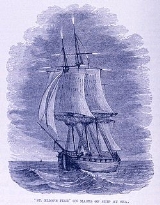
St. Elmo's fire

Encyclopedia
St. Elmo's fire is a weather phenomenon in which luminous plasma
is created by a coronal discharge from a grounded object
in an electric field
in the atmosphere
(such as those generated by thunderstorm
s created by a volcanic eruption)
St. Elmo's fire is named after St. Erasmus of Formiae
(also called St. Elmo, the Italian name for St. Erasmus), the patron saint
of sailor
s. The phenomenon sometimes appeared on ships at sea during thunderstorms and was regarded by sailors with religious awe for its glowing ball of light, accounting for the name.
s, masts
, spire
s and chimney
s, and on aircraft wings
. St. Elmo's fire can also appear on leaves, grass, and even at the tips of cattle horns. Often accompanying the glow is a distinct hissing or buzzing sound. It is sometimes confused with ball lightning
.
In 1750, Ben Franklin hypothesized that a pointed iron rod
would light up at the tip during a lightning storm, similar in appearance to St. Elmo's fire.
, as are flame
s in general and star
s. The electric field
around the object in question causes ionization
of the air molecules, producing a faint glow easily visible in low-light conditions. Approximately 1000 volts per centimeter induces St. Elmo's fire; however, this number is greatly dependent on the geometry
of the object in question. Sharp points tend to require lower voltage levels to produce the same result because electric fields are more concentrated in areas of high curvature
, thus discharges are more intense at the ends of pointed objects.
Conditions that can generate St.Elmo's fire are present during thunderstorms, when high voltage is present between clouds and the ground underneath, electrically charged. Air molecules glow due to the effects of such voltage, producing St. Elmo's fire.
The nitrogen
and oxygen
in the Earth's atmosphere
causes St. Elmo's fire to fluoresce with blue or violet light; this is similar to the mechanism that causes neon lights
to glow.
and two were called Castor and Pollux
. Occasionally, it was associated with the Greek element of fire
, as well as with one of Paracelsus
's elementals, specifically the salamander
, or, alternatively, with a similar creature referred to as an acthnici.
Welsh mariners knew it as canwyll yr ysbryd ("spirit-candles") or canwyll yr ysbryd glân ("candles of the Holy Ghost"), or the "candles of St. David".
The Chinese sea-goddess Mazu is believed to create an ethereal flame atop the mast of ships to guide and bless lost sailors. In China, St. Elmo's fire is colloquially known as the "fire of Mazu".
References to St. Elmo's fire can be found in the works of Julius Caesar
(De Bello Africo
, 47), Pliny the Elder
(Naturalis Historia
, book 2, par. 101) , and Antonio Pigafetta
's journal of his voyage with Ferdinand Magellan
. St. Elmo's fire, also known as "corposants" or "corpusants" from the Portuguese corpo santo ("holy body"), was a phenomenon described in The Lusiads.
Robert Burton
wrote of St. Elmo's fire in his Anatomy of Melancholy: "Radzivilius, the Polonian duke, calls this apparition, Sancti Germani sidus; and saith moreover that he saw the same after in a storm, as he was sailing, 1582, from Alexandria to Rhodes". This refers to the voyage made by Mikołaj Krzysztof "the Orphan" Radziwiłł in 1582-1584.
On Thursday February 20, 1817, during a severe electrical storm James Braid, then surgeon at Lord Hopetoun's mines at Leadhills
, Lanarkshire
, had an extraordinary experience whilst on horseback:
Charles Darwin
noted the effect while aboard the Beagle. He wrote of the episode in a letter to J. S. Henslow
that one night when the Beagle was anchored in the estuary of the Río de la Plata
:
St. Elmo's fire is reported to have been seen during the Siege of Constantinople by the Ottoman Empire
in 1453. It reportedly was seen emitting from the top of the Hippodrome
. The Byzantines attributed it to a sign that the Christian God would soon come and destroy the conquering Muslim
army. According to George Sphrantzes
, it disappeared just days before Constantinople fell, ending the Byzantine Empire.
In Two Years Before the Mast
, Richard Henry Dana, Jr.
describes seeing a corposant in the southern Atlantic Ocean. However, he may have been talking about ball lightning
; as mentioned earlier it is often erroneously identified as St. Elmo's fire: "There, directly over where we had been standing, upon the main top-gallant mast-head, was a ball of light, which the sailors name a corposant (corpus sancti), and which the mate had called out to us to look at. They were all watching it carefully, for sailors have a notion, that if the corposant rises in the rigging, it is a sign of fair weather
, but if it comes lower down, there will be a storm".
Many Russian sailors have seen them throughout the years. To them, they are "Saint Nicholas" or "Saint Peter's lights". They were also sometimes called St. Helen's or St. Hermes' fire, perhaps through linguistic confusion.
St Elmo's fire were also seen during the Great Chicago Fire
in Kansas and Oklahoma (US).
Accounts of Magellan's first circumnavigation of the globe refer to St. Elmo's fire being seen around the fleet's ships multiple times off the coast of South America. The sailors saw these as favorable omens.
On August 26, 1883, the British warship Charles Ball sailing the Sunda Strait en-route to Hong Kong came within 20 km of the exploding Krakatau volcano
and witnessed a great deal of static electricity in the atmosphere, generated by the movement of tiny particles of rocks and droplets of water from the volcano's steam, which caused spectacular brush discharges taking place from the masts and rigging of the ship.
Among the phenomena experienced on British Airways Flight 9
on June 24, 1982 were glowing light flashes along the leading edges of the aircraft, which were seen by both passengers and crew. While it shared similarities with St Elmo's fire, the glow experienced was from the impact of ash particles on the leading edges of the aircraft, similar to that seen by operators of sandblasting equipment.
St. Elmo's fire was observed and its optical spectrum recorded during a University of Alaska research flight over the Amazon in 1995 to study sprites.
. It is also referenced in Homeric Hymn 33 to the Dioscuri who were from Homeric times associated with it. Whether the Homeric Hymn antedates the Alcaeus fragment is unknown.
The phenomenon appears to be described first in the Gesta Herwardi
, written around 1100 and concerning an event of the 1070s. However, one of the earliest direct references to St. Elmo's fire made in fiction can be found in Ludovico Ariosto
's epic poem Orlando furioso
(1516). It is located in the 17th canto (19th in the revised edition of 1532) after a storm has punished the ship of Marfisa, Astolfo, Aquilant, Grifon, and others, for three straight days, and is positively associated with hope:
In Shakespeare's The Tempest
(c. 1623), Act I, Scene II, St. Elmo's fire acquires a more negative association, appearing as evidence of the tempest inflicted by Ariel according to the command of Prospero:
Later in 18th century and 19th century literature associated St. Elmo's fire with bad omen
or divine judgment
, coinciding with the growing conventions of Romanticism
and the Gothic novel. For example, in Ann Radcliffe
's The Mysteries of Udolpho
(1794), during a thunderstorm above the ramparts of the castle:
In Kurt Vonnegut's "Slaughterhouse-Five", when Billie Pilgrim sees the phenomenon on soldiers' helmets and on rooftops.
Plasma (physics)
In physics and chemistry, plasma is a state of matter similar to gas in which a certain portion of the particles are ionized. Heating a gas may ionize its molecules or atoms , thus turning it into a plasma, which contains charged particles: positive ions and negative electrons or ions...
is created by a coronal discharge from a grounded object
Ground (electricity)
In electrical engineering, ground or earth may be the reference point in an electrical circuit from which other voltages are measured, or a common return path for electric current, or a direct physical connection to the Earth....
in an electric field
Electric field
In physics, an electric field surrounds electrically charged particles and time-varying magnetic fields. The electric field depicts the force exerted on other electrically charged objects by the electrically charged particle the field is surrounding...
in the atmosphere
Atmosphere
An atmosphere is a layer of gases that may surround a material body of sufficient mass, and that is held in place by the gravity of the body. An atmosphere may be retained for a longer duration, if the gravity is high and the atmosphere's temperature is low...
(such as those generated by thunderstorm
Thunderstorm
A thunderstorm, also known as an electrical storm, a lightning storm, thundershower or simply a storm is a form of weather characterized by the presence of lightning and its acoustic effect on the Earth's atmosphere known as thunder. The meteorologically assigned cloud type associated with the...
s created by a volcanic eruption)
St. Elmo's fire is named after St. Erasmus of Formiae
Erasmus of Formiae
Saint Erasmus of Formiae was a Christian saint and martyr who died ca. 303, also known as Saint Elmo. He is venerated as the patron saint of sailors...
(also called St. Elmo, the Italian name for St. Erasmus), the patron saint
Patron saint
A patron saint is a saint who is regarded as the intercessor and advocate in heaven of a nation, place, craft, activity, class, clan, family, or person...
of sailor
Sailor
A sailor, mariner, or seaman is a person who navigates water-borne vessels or assists in their operation, maintenance, or service. The term can apply to professional mariners, military personnel, and recreational sailors as well as a plethora of other uses...
s. The phenomenon sometimes appeared on ships at sea during thunderstorms and was regarded by sailors with religious awe for its glowing ball of light, accounting for the name.
Characteristics
Physically, St. Elmo's fire is a bright blue or violet glow, appearing like fire in some circumstances, from tall, sharply pointed structures such as lightning rodLightning rod
A lightning rod or lightning conductor is a metal rod or conductor mounted on top of a building and electrically connected to the ground through a wire, to protect the building in the event of lightning...
s, masts
Mast (sailing)
The mast of a sailing vessel is a tall, vertical, or near vertical, spar, or arrangement of spars, which supports the sails. Large ships have several masts, with the size and configuration depending on the style of ship...
, spire
Spire
A spire is a tapering conical or pyramidal structure on the top of a building, particularly a church tower. Etymologically, the word is derived from the Old English word spir, meaning a sprout, shoot, or stalk of grass....
s and chimney
Chimney
A chimney is a structure for venting hot flue gases or smoke from a boiler, stove, furnace or fireplace to the outside atmosphere. Chimneys are typically vertical, or as near as possible to vertical, to ensure that the gases flow smoothly, drawing air into the combustion in what is known as the...
s, and on aircraft wings
Fixed-wing aircraft
A fixed-wing aircraft is an aircraft capable of flight using wings that generate lift due to the vehicle's forward airspeed. Fixed-wing aircraft are distinct from rotary-wing aircraft in which wings rotate about a fixed mast and ornithopters in which lift is generated by flapping wings.A powered...
. St. Elmo's fire can also appear on leaves, grass, and even at the tips of cattle horns. Often accompanying the glow is a distinct hissing or buzzing sound. It is sometimes confused with ball lightning
Ball lightning
Ball lightning is an unexplained atmospheric electrical phenomenon. The term refers to reports of luminous, usually spherical objects which vary from pea-sized to several metres in diameter. It is usually associated with thunderstorms, but lasts considerably longer than the split-second flash of a...
.
In 1750, Ben Franklin hypothesized that a pointed iron rod
Lightning rod
A lightning rod or lightning conductor is a metal rod or conductor mounted on top of a building and electrically connected to the ground through a wire, to protect the building in the event of lightning...
would light up at the tip during a lightning storm, similar in appearance to St. Elmo's fire.
Scientific explanation
St. Elmo's fire is a mixture of gas and plasmaPlasma (physics)
In physics and chemistry, plasma is a state of matter similar to gas in which a certain portion of the particles are ionized. Heating a gas may ionize its molecules or atoms , thus turning it into a plasma, which contains charged particles: positive ions and negative electrons or ions...
, as are flame
Flame
A flame is the visible , gaseous part of a fire. It is caused by a highly exothermic reaction taking place in a thin zone...
s in general and star
Star
A star is a massive, luminous sphere of plasma held together by gravity. At the end of its lifetime, a star can also contain a proportion of degenerate matter. The nearest star to Earth is the Sun, which is the source of most of the energy on Earth...
s. The electric field
Electric field
In physics, an electric field surrounds electrically charged particles and time-varying magnetic fields. The electric field depicts the force exerted on other electrically charged objects by the electrically charged particle the field is surrounding...
around the object in question causes ionization
Ionization
Ionization is the process of converting an atom or molecule into an ion by adding or removing charged particles such as electrons or other ions. This is often confused with dissociation. A substance may dissociate without necessarily producing ions. As an example, the molecules of table sugar...
of the air molecules, producing a faint glow easily visible in low-light conditions. Approximately 1000 volts per centimeter induces St. Elmo's fire; however, this number is greatly dependent on the geometry
Geometry
Geometry arose as the field of knowledge dealing with spatial relationships. Geometry was one of the two fields of pre-modern mathematics, the other being the study of numbers ....
of the object in question. Sharp points tend to require lower voltage levels to produce the same result because electric fields are more concentrated in areas of high curvature
Curvature
In mathematics, curvature refers to any of a number of loosely related concepts in different areas of geometry. Intuitively, curvature is the amount by which a geometric object deviates from being flat, or straight in the case of a line, but this is defined in different ways depending on the context...
, thus discharges are more intense at the ends of pointed objects.
Conditions that can generate St.Elmo's fire are present during thunderstorms, when high voltage is present between clouds and the ground underneath, electrically charged. Air molecules glow due to the effects of such voltage, producing St. Elmo's fire.
The nitrogen
Nitrogen
Nitrogen is a chemical element that has the symbol N, atomic number of 7 and atomic mass 14.00674 u. Elemental nitrogen is a colorless, odorless, tasteless, and mostly inert diatomic gas at standard conditions, constituting 78.08% by volume of Earth's atmosphere...
and oxygen
Oxygen
Oxygen is the element with atomic number 8 and represented by the symbol O. Its name derives from the Greek roots ὀξύς and -γενής , because at the time of naming, it was mistakenly thought that all acids required oxygen in their composition...
in the Earth's atmosphere
Atmosphere
An atmosphere is a layer of gases that may surround a material body of sufficient mass, and that is held in place by the gravity of the body. An atmosphere may be retained for a longer duration, if the gravity is high and the atmosphere's temperature is low...
causes St. Elmo's fire to fluoresce with blue or violet light; this is similar to the mechanism that causes neon lights
Neon sign
Neon signs are made using electrified, luminous tube lights that contain rarefied neon or other gases. They are the most common use for neon lighting, which was first demonstrated in a modern form in December, 1910 by Georges Claude at the Paris Motor Show. While they are used worldwide, neon signs...
to glow.
Notable observations
In ancient Greece, the appearance of a single one was called HelenaHelena
-First name:*Helena , Roman mother of Emperor Constantine*Helena, wife of Julian , Roman daughter of Emperor Constantine*Helena...
and two were called Castor and Pollux
Castor and Pollux
In Greek and Roman mythology, Castor and Pollux or Polydeuces were twin brothers, together known as the Dioscuri . Their mother was Leda, but Castor was the mortal son of Tyndareus, king of Sparta, and Pollux the divine son of Zeus, who visited Leda in the guise of a swan...
. Occasionally, it was associated with the Greek element of fire
Fire (classical element)
Fire has been an important part of all cultures and religions from pre-history to modern day and was vital to the development of civilization. It has been regarded in many different contexts throughout history, but especially as a metaphysical constant of the world.-Greek and Roman tradition:Fire...
, as well as with one of Paracelsus
Paracelsus
Paracelsus was a German-Swiss Renaissance physician, botanist, alchemist, astrologer, and general occultist....
's elementals, specifically the salamander
Salamander (legendary creature)
The salamander is an amphibian of the order Urodela. As with many real creatures, pre-modern authors often ascribed fantastic qualities to it , and in recent times some have come to identify a legendary salamander as a distinct concept from the real organism. This idea is most highly developed in...
, or, alternatively, with a similar creature referred to as an acthnici.
Welsh mariners knew it as canwyll yr ysbryd ("spirit-candles") or canwyll yr ysbryd glân ("candles of the Holy Ghost"), or the "candles of St. David".
The Chinese sea-goddess Mazu is believed to create an ethereal flame atop the mast of ships to guide and bless lost sailors. In China, St. Elmo's fire is colloquially known as the "fire of Mazu".
References to St. Elmo's fire can be found in the works of Julius Caesar
Julius Caesar
Gaius Julius Caesar was a Roman general and statesman and a distinguished writer of Latin prose. He played a critical role in the gradual transformation of the Roman Republic into the Roman Empire....
(De Bello Africo
De Bello Africo
De Bello Africo is part of the Caesarian corpus. Its authorship is disputed, though scholarly consensus has ruled out Julius Caesar as the author...
, 47), Pliny the Elder
Pliny the Elder
Gaius Plinius Secundus , better known as Pliny the Elder, was a Roman author, naturalist, and natural philosopher, as well as naval and army commander of the early Roman Empire, and personal friend of the emperor Vespasian...
(Naturalis Historia
Naturalis Historia
The Natural History is an encyclopedia published circa AD 77–79 by Pliny the Elder. It is one of the largest single works to have survived from the Roman Empire to the modern day and purports to cover the entire field of ancient knowledge, based on the best authorities available to Pliny...
, book 2, par. 101) , and Antonio Pigafetta
Antonio Pigafetta
Antonio Pigafetta was an Italian scholar and explorer from the Republic of Venice. He travelled with the Portuguese explorer Ferdinand Magellan and his crew on their voyage to the Indies. During the expedition, he served as Magellan's assistant and kept an accurate journal which later assisted him...
's journal of his voyage with Ferdinand Magellan
Ferdinand Magellan
Ferdinand Magellan was a Portuguese explorer. He was born in Sabrosa, in northern Portugal, and served King Charles I of Spain in search of a westward route to the "Spice Islands" ....
. St. Elmo's fire, also known as "corposants" or "corpusants" from the Portuguese corpo santo ("holy body"), was a phenomenon described in The Lusiads.
Robert Burton
Robert Burton (scholar)
Robert Burton was an English scholar at Oxford University, best known for the classic The Anatomy of Melancholy. He was also the incumbent of St Thomas the Martyr, Oxford, and of Segrave in Leicestershire.-Life:...
wrote of St. Elmo's fire in his Anatomy of Melancholy: "Radzivilius, the Polonian duke, calls this apparition, Sancti Germani sidus; and saith moreover that he saw the same after in a storm, as he was sailing, 1582, from Alexandria to Rhodes". This refers to the voyage made by Mikołaj Krzysztof "the Orphan" Radziwiłł in 1582-1584.
On Thursday February 20, 1817, during a severe electrical storm James Braid, then surgeon at Lord Hopetoun's mines at Leadhills
Leadhills
Leadhills is a village in South Lanarkshire, Scotland, 5¾ miles WSW of Elvanfoot. Population 835. Originally known as Waterhead, It is the second highest village in Scotland after Wanlockhead, lying 395m above sea-level, near the source of Glengonnar Water, an affluent of the River Clyde...
, Lanarkshire
Lanarkshire
Lanarkshire or the County of Lanark ) is a Lieutenancy area, registration county and former local government county in the central Lowlands of Scotland...
, had an extraordinary experience whilst on horseback:
Charles Darwin
Charles Darwin
Charles Robert Darwin FRS was an English naturalist. He established that all species of life have descended over time from common ancestry, and proposed the scientific theory that this branching pattern of evolution resulted from a process that he called natural selection.He published his theory...
noted the effect while aboard the Beagle. He wrote of the episode in a letter to J. S. Henslow
John Stevens Henslow
John Stevens Henslow was an English clergyman, botanist and geologist. He is best remembered as friend and mentor to his pupil Charles Darwin.- Early life :...
that one night when the Beagle was anchored in the estuary of the Río de la Plata
Río de la Plata
The Río de la Plata —sometimes rendered River Plate in British English and the Commonwealth, and occasionally rendered [La] Plata River in other English-speaking countries—is the river and estuary formed by the confluence of the Uruguay River and the Paraná River on the border between Argentina and...
:
St. Elmo's fire is reported to have been seen during the Siege of Constantinople by the Ottoman Empire
Ottoman Empire
The Ottoman EmpireIt was usually referred to as the "Ottoman Empire", the "Turkish Empire", the "Ottoman Caliphate" or more commonly "Turkey" by its contemporaries...
in 1453. It reportedly was seen emitting from the top of the Hippodrome
Hippodrome of Constantinople
The Hippodrome of Constantinople was a circus that was the sporting and social centre of Constantinople, capital of the Byzantine Empire. Today it is a square named Sultanahmet Meydanı in the Turkish city of Istanbul, with only a few fragments of the original structure surviving...
. The Byzantines attributed it to a sign that the Christian God would soon come and destroy the conquering Muslim
Muslim
A Muslim, also spelled Moslem, is an adherent of Islam, a monotheistic, Abrahamic religion based on the Quran, which Muslims consider the verbatim word of God as revealed to prophet Muhammad. "Muslim" is the Arabic term for "submitter" .Muslims believe that God is one and incomparable...
army. According to George Sphrantzes
George Sphrantzes
George Sphrantzes, also Phrantzes or Phrantza was a late Byzantine Greek historian. He was born in Constantinople. At an early age he became secretary to Manuel II Palaiologos; in 1432 protovestiarites; in 1446 prefect of Mistras, and subsequently great logothete...
, it disappeared just days before Constantinople fell, ending the Byzantine Empire.
In Two Years Before the Mast
Two Years Before the Mast
Two Years Before the Mast is a book by the American author Richard Henry Dana, Jr., published in 1840, having been written after a two-year sea voyage starting in 1834. A film adaptation under the same name was released in 1946.- Background :...
, Richard Henry Dana, Jr.
Richard Henry Dana, Jr.
Richard Henry Dana Jr. was an American lawyer and politician from Massachusetts, a descendant of an eminent colonial family who gained renown as the author of the American classic, the memoir Two Years Before the Mast...
describes seeing a corposant in the southern Atlantic Ocean. However, he may have been talking about ball lightning
Ball lightning
Ball lightning is an unexplained atmospheric electrical phenomenon. The term refers to reports of luminous, usually spherical objects which vary from pea-sized to several metres in diameter. It is usually associated with thunderstorms, but lasts considerably longer than the split-second flash of a...
; as mentioned earlier it is often erroneously identified as St. Elmo's fire: "There, directly over where we had been standing, upon the main top-gallant mast-head, was a ball of light, which the sailors name a corposant (corpus sancti), and which the mate had called out to us to look at. They were all watching it carefully, for sailors have a notion, that if the corposant rises in the rigging, it is a sign of fair weather
Fair Weather
Fair Weather was a British rock band formed in 1970 by former Amen Corner guitarist and vocalist, Andy Fairweather Low. They are best known for their track, "Natural Sinner".-Biography:The band evolved from a split within Amen Corner...
, but if it comes lower down, there will be a storm".
Many Russian sailors have seen them throughout the years. To them, they are "Saint Nicholas" or "Saint Peter's lights". They were also sometimes called St. Helen's or St. Hermes' fire, perhaps through linguistic confusion.
St Elmo's fire were also seen during the Great Chicago Fire
Great Chicago Fire
The Great Chicago Fire was a conflagration that burned from Sunday, October 8, to early Tuesday, October 10, 1871, killing hundreds and destroying about in Chicago, Illinois. Though the fire was one of the largest U.S...
in Kansas and Oklahoma (US).
Accounts of Magellan's first circumnavigation of the globe refer to St. Elmo's fire being seen around the fleet's ships multiple times off the coast of South America. The sailors saw these as favorable omens.
On August 26, 1883, the British warship Charles Ball sailing the Sunda Strait en-route to Hong Kong came within 20 km of the exploding Krakatau volcano
Krakatoa
Krakatoa is a volcanic island made of a'a lava in the Sunda Strait between the islands of Java and Sumatra in Indonesia. The name is used for the island group, the main island , and the volcano as a whole. The island exploded in 1883, killing approximately 40,000 people, although some estimates...
and witnessed a great deal of static electricity in the atmosphere, generated by the movement of tiny particles of rocks and droplets of water from the volcano's steam, which caused spectacular brush discharges taking place from the masts and rigging of the ship.
Among the phenomena experienced on British Airways Flight 9
British Airways Flight 9
British Airways Flight 9, sometimes referred to by its callsign Speedbird 9 or Jakarta incident, was a scheduled British Airways flight from London Heathrow to Auckland, with stops in Bombay, Madras, Kuala Lumpur, Perth, and Melbourne....
on June 24, 1982 were glowing light flashes along the leading edges of the aircraft, which were seen by both passengers and crew. While it shared similarities with St Elmo's fire, the glow experienced was from the impact of ash particles on the leading edges of the aircraft, similar to that seen by operators of sandblasting equipment.
St. Elmo's fire was observed and its optical spectrum recorded during a University of Alaska research flight over the Amazon in 1995 to study sprites.
In literature
One of the earliest references to the phenomenon appears in Alcaeus's Fragment 34a about the Dioscuri, or Castor and PolluxCastor and Pollux
In Greek and Roman mythology, Castor and Pollux or Polydeuces were twin brothers, together known as the Dioscuri . Their mother was Leda, but Castor was the mortal son of Tyndareus, king of Sparta, and Pollux the divine son of Zeus, who visited Leda in the guise of a swan...
. It is also referenced in Homeric Hymn 33 to the Dioscuri who were from Homeric times associated with it. Whether the Homeric Hymn antedates the Alcaeus fragment is unknown.
The phenomenon appears to be described first in the Gesta Herwardi
Gesta Herwardi
The Gesta Herewardi is the name of a Latin text probably written around 1109-31, recounting the deeds of Hereward the Wake. The Latin text of about 1109-31 claims to be a translation of an earlier work in Old English, with gaps in the damaged original filled out from oral history...
, written around 1100 and concerning an event of the 1070s. However, one of the earliest direct references to St. Elmo's fire made in fiction can be found in Ludovico Ariosto
Ludovico Ariosto
Ludovico Ariosto was an Italian poet. He is best known as the author of the romance epic Orlando Furioso . The poem, a continuation of Matteo Maria Boiardo's Orlando Innamorato, describes the adventures of Charlemagne, Orlando, and the Franks as they battle against the Saracens with diversions...
's epic poem Orlando furioso
Orlando Furioso
Orlando Furioso is an Italian epic poem by Ludovico Ariosto which has exerted a wide influence on later culture. The earliest version appeared in 1516, although the poem was not published in its complete form until 1532...
(1516). It is located in the 17th canto (19th in the revised edition of 1532) after a storm has punished the ship of Marfisa, Astolfo, Aquilant, Grifon, and others, for three straight days, and is positively associated with hope:
In Shakespeare's The Tempest
The Tempest
The Tempest is a play by William Shakespeare, believed to have been written in 1610–11, and thought by many critics to be the last play that Shakespeare wrote alone. It is set on a remote island, where Prospero, the exiled Duke of Milan, plots to restore his daughter Miranda to her rightful place,...
(c. 1623), Act I, Scene II, St. Elmo's fire acquires a more negative association, appearing as evidence of the tempest inflicted by Ariel according to the command of Prospero:
Later in 18th century and 19th century literature associated St. Elmo's fire with bad omen
Omen
An omen is a phenomenon that is believed to foretell the future, often signifying the advent of change...
or divine judgment
Divine Judgment
Divine judgment means the judgment of God or other supreme beings within a religion. The concept is prominent in Abrahamic religions, most significantly in the Last judgment.-Objective and subjective judgment:...
, coinciding with the growing conventions of Romanticism
Romanticism
Romanticism was an artistic, literary and intellectual movement that originated in the second half of the 18th century in Europe, and gained strength in reaction to the Industrial Revolution...
and the Gothic novel. For example, in Ann Radcliffe
Ann Radcliffe
Anne Radcliffe was an English author, and considered the pioneer of the gothic novel . Her style is romantic in its vivid descriptions of landscapes, and long travel scenes, yet the Gothic element is obvious through her use of the supernatural...
's The Mysteries of Udolpho
The Mysteries of Udolpho
The Mysteries of Udolpho, by Ann Radcliffe, was published in four volumes on 8 May 1794 by G. G. and J. Robinson of London. The firm paid her £500 for the manuscript. The contract is housed at the University of Virginia Library. Her fourth and most popular novel, The Mysteries of Udolpho follows...
(1794), during a thunderstorm above the ramparts of the castle:
In Kurt Vonnegut's "Slaughterhouse-Five", when Billie Pilgrim sees the phenomenon on soldiers' helmets and on rooftops.
See also
- Ball lighting
- Foo fighterFoo fighterThe term foo fighter was used by Allied aircraft pilots in World War II to describe various UFOs or mysterious aerial phenomena seen in the skies over both the European and Pacific Theater of Operations....
- List of plasma (physics) applications articles
- Naga fireballsNaga fireballsThe Naga fireballs , also referred to as Mekong lights, are a phenomenon seen in the Mekong river—in Thailand and in Laos —in which glowing balls rise from the water high into the air...
- Triboelectric effectTriboelectric effectThe triboelectric effect is a type of contact electrification in which certain materials become electrically charged after they come into contact with another different material and are then separated...
- Will-o'-the-wispWill-o'-the-wispA will-o'-the-wisp or ignis fatuus , also called a "will-o'-wisp", "jack-o'-lantern" , "hinkypunk", "corpse candle", "ghost-light", "spook-light", "fairy light", "friar's lantern", "hobby lantern", "ghost orb", or simply "wisp", is a ghostly light or lights sometimes seen at night or twilight over...