

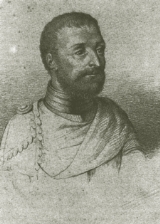
Antonio Pigafetta

Encyclopedia
Antonio Pigafetta was an Italian scholar and explorer from the Republic of Venice
. He travelled with the Portuguese
explorer Ferdinand Magellan
and his crew on their voyage to the Indies
. During the expedition, he served as Magellan's assistant and kept an accurate journal which later assisted him in translating one of the Philippine languages
, Cebuano
. It is the first recorded document concerning this language.
Pigafetta was one of the 18 men who returned to Spain
in 1522, out of the approximately 240 who set out three years earlier. The voyage completed the first circumnavigation
of the world; Juan Sebastián Elcano
served as captain after Magellan's death. Pigafetta's journal is the source for much of what we know about Magellan and Elcano's voyage.
At least one warship of the Italian Navy, a destroyer
of the Navigatori class
, was named after him in 1931.
. In his youth he studied astronomy
, geography
and cartography
. He served on board the ships of the Knights of Rhodes
at the beginning of the 16th century. Until 1519, he accompanied the papal nuncio, Monsignor Chieregati
, to Spain.
, Antonio Pigafetta heard of Magellan's planned expedition and elected to embark, accepting the title of sobrasaliente (supernumerary
) and a modest salary
of 1,000 maravedís. During the trip, Pigafetta collected extensive data concerning the geography
, climate
, flora
, fauna
and the inhabitants of the places that the expedition visited. His meticulous notes were invaluable to future explorers and cartographers, mainly due to his inclusion of nautical and linguistic data, and to latter-day historian
s because of its vivid, detailed style. The only other sailor to maintain a journal during the voyage was Francisco Albo, last Victoria
s pilot
, who kept a formal logbook
.
on board the Victoria, on the return voyage to Spain.
Upon reaching port in Sanlúcar de Barrameda
(Province of Cadiz
) in September of 1522, three years after his departure, Pigafetta returned to the Republic of Venice. He related his experiences in Relazione del primo viaggio intorno al mondo (Report on the First Voyage Around the World), which was composed in Italian
. Although parts were published in Paris
in 1525, the manuscript was not published in its entirety until the late eighteenth century. The original document was not preserved.
It was not through Antonio Pigafetta's writings that Europeans first learned of the circumnavigation of the globe. Rather, it was through an account written by Maximilianus Transylvanus
, which was published in 1523. Transylvanus had been instructed to interview some of the survivors of the voyage when Magellan’s surviving ship Victoria returned to Spain in September 1522. After Magellan's voyage, Pigafetta utilized the connections he had made prior to the voyage with the Knights of Rhodes to achieve membership in the order.
depicts Antonio Pigafetta as a member of Magellan's expedition on the island of Cebu
.
The 2010 book of poems Pigafetta Is My Wife by Joseph Hall incorporates portions of Antonio Pigafetta's account of Magellan's voyage, "taking the notion of circumnavigation to an unforeseeable confessional level." (Dan Beachy-Quick). Jessica Hagedorn
's novel, Dream Jungle
(2003), weaves excerpts from Pigafetta's travel narrative into plotlines that discuss more recent acts of "conquest," including the "discovery" of an allegedly paleolithic tribe (based on the controversy over the Tasaday) and the making of a Hollywood film, Napalm Sunset, that closely resembles Apocalypse Now
.
Pigafetta's book Regnum Congo is a central plot device in the H.P. Lovecraft short story "The Picture in the House
".
In Miguel Syjuco
's novel Illustrado, the fictional writer Crispin Salvador
writes what he calls a "disco opera" about Pigafetta's experiences as a member of Magellan's crew.
Republic of Venice
The Republic of Venice or Venetian Republic was a state originating from the city of Venice in Northeastern Italy. It existed for over a millennium, from the late 7th century until 1797. It was formally known as the Most Serene Republic of Venice and is often referred to as La Serenissima, in...
. He travelled with the Portuguese
Portugal
Portugal , officially the Portuguese Republic is a country situated in southwestern Europe on the Iberian Peninsula. Portugal is the westernmost country of Europe, and is bordered by the Atlantic Ocean to the West and South and by Spain to the North and East. The Atlantic archipelagos of the...
explorer Ferdinand Magellan
Ferdinand Magellan
Ferdinand Magellan was a Portuguese explorer. He was born in Sabrosa, in northern Portugal, and served King Charles I of Spain in search of a westward route to the "Spice Islands" ....
and his crew on their voyage to the Indies
Indies
The Indies is a term that has been used to describe the lands of South and Southeast Asia, occupying all of the present India, Pakistan, Bangladesh, Myanmar, Nepal, Sri Lanka, the Maldives, and also Thailand, Cambodia, Laos, Vietnam, Brunei, Singapore, the Philippines, East Timor, Malaysia and...
. During the expedition, he served as Magellan's assistant and kept an accurate journal which later assisted him in translating one of the Philippine languages
Languages of the Philippines
In the Philippines, there are between 120 and 175 languages, depending on the method of classification. Four languages no longer have any known speakers. Almost all the Philippine languages belong to the Austronesian language family...
, Cebuano
Cebuano language
Cebuano, referred to by most of its speakers as Bisaya , is an Austronesian language spoken in the Philippines by about 20 million people mostly in the Central Visayas. It is the most widely spoken of the languages within the so-named Bisayan subgroup and is closely related to other Filipino...
. It is the first recorded document concerning this language.
Pigafetta was one of the 18 men who returned to Spain
Spain
Spain , officially the Kingdom of Spain languages]] under the European Charter for Regional or Minority Languages. In each of these, Spain's official name is as follows:;;;;;;), is a country and member state of the European Union located in southwestern Europe on the Iberian Peninsula...
in 1522, out of the approximately 240 who set out three years earlier. The voyage completed the first circumnavigation
Circumnavigation
Circumnavigation – literally, "navigation of a circumference" – refers to travelling all the way around an island, a continent, or the entire planet Earth.- Global circumnavigation :...
of the world; Juan Sebastián Elcano
Juan Sebastián Elcano
Juan Sebastián Elcano was a Basque Spanish explorer who completed the first circumnavigation of the world. As Ferdinand Magellan's second in command, Elcano took over after Magellan's death in the Philippines.-Early life:Elcano was born to Domingo Sebastián Elcano I and Catalina del Puerto...
served as captain after Magellan's death. Pigafetta's journal is the source for much of what we know about Magellan and Elcano's voyage.
At least one warship of the Italian Navy, a destroyer
Destroyer
In naval terminology, a destroyer is a fast and maneuverable yet long-endurance warship intended to escort larger vessels in a fleet, convoy or battle group and defend them against smaller, powerful, short-range attackers. Destroyers, originally called torpedo-boat destroyers in 1892, evolved from...
of the Navigatori class
Navigatori class destroyer
The Navigatori class were a group of Italian destroyers built in 1928-29. These ships were named after Italian explorers. They fought in World War II. Just one unit, the Nicoloso Da Recco, survived the conflict.-Design:...
, was named after him in 1931.
Youth
Pigafetta belonged to a rich family of VicenzaVicenza
Vicenza , a city in north-eastern Italy, is the capital of the eponymous province in the Veneto region, at the northern base of the Monte Berico, straddling the Bacchiglione...
. In his youth he studied astronomy
Astronomy
Astronomy is a natural science that deals with the study of celestial objects and phenomena that originate outside the atmosphere of Earth...
, geography
Geography
Geography is the science that studies the lands, features, inhabitants, and phenomena of Earth. A literal translation would be "to describe or write about the Earth". The first person to use the word "geography" was Eratosthenes...
and cartography
Cartography
Cartography is the study and practice of making maps. Combining science, aesthetics, and technique, cartography builds on the premise that reality can be modeled in ways that communicate spatial information effectively.The fundamental problems of traditional cartography are to:*Set the map's...
. He served on board the ships of the Knights of Rhodes
Knights Hospitaller
The Sovereign Military Hospitaller Order of Saint John of Jerusalem of Rhodes and of Malta , also known as the Sovereign Military Order of Malta , Order of Malta or Knights of Malta, is a Roman Catholic lay religious order, traditionally of military, chivalrous, noble nature. It is the world's...
at the beginning of the 16th century. Until 1519, he accompanied the papal nuncio, Monsignor Chieregati
Francesco Chieregati
Francesco Chieregati was a papal nuncio and bishop.-Life and career:Sent by Pope Leo X as papal nuncio to England , he also filled a similar office in Portugal and in Spain , becoming acquainted with Cardinal Adrian Florent, Bishop of Tortosa, the Dutch preceptor of Charles V, and later Pope...
, to Spain.
Voyage
In SevilleSeville
Seville is the artistic, historic, cultural, and financial capital of southern Spain. It is the capital of the autonomous community of Andalusia and of the province of Seville. It is situated on the plain of the River Guadalquivir, with an average elevation of above sea level...
, Antonio Pigafetta heard of Magellan's planned expedition and elected to embark, accepting the title of sobrasaliente (supernumerary
Supernumerary
A Supernumerary is an additional member of an organization. A supernumerary is also a non-regular member of a staff, a member of the staff or an employee who works in a public office who is not part of the manpower complement...
) and a modest salary
Salary
A salary is a form of periodic payment from an employer to an employee, which may be specified in an employment contract. It is contrasted with piece wages, where each job, hour or other unit is paid separately, rather than on a periodic basis....
of 1,000 maravedís. During the trip, Pigafetta collected extensive data concerning the geography
Geography
Geography is the science that studies the lands, features, inhabitants, and phenomena of Earth. A literal translation would be "to describe or write about the Earth". The first person to use the word "geography" was Eratosthenes...
, climate
Climate
Climate encompasses the statistics of temperature, humidity, atmospheric pressure, wind, rainfall, atmospheric particle count and other meteorological elemental measurements in a given region over long periods...
, flora
Flora
Flora is the plant life occurring in a particular region or time, generally the naturally occurring or indigenous—native plant life. The corresponding term for animals is fauna.-Etymology:...
, fauna
Fauna
Fauna or faunæ is all of the animal life of any particular region or time. The corresponding term for plants is flora.Zoologists and paleontologists use fauna to refer to a typical collection of animals found in a specific time or place, e.g. the "Sonoran Desert fauna" or the "Burgess shale fauna"...
and the inhabitants of the places that the expedition visited. His meticulous notes were invaluable to future explorers and cartographers, mainly due to his inclusion of nautical and linguistic data, and to latter-day historian
Historian
A historian is a person who studies and writes about the past and is regarded as an authority on it. Historians are concerned with the continuous, methodical narrative and research of past events as relating to the human race; as well as the study of all history in time. If the individual is...
s because of its vivid, detailed style. The only other sailor to maintain a journal during the voyage was Francisco Albo, last Victoria
Victoria (ship)
Victoria was a Spanish carrack and the first ship to successfully circumnavigate the world. The Victoria was part of a Spanish expedition commanded by the Portuguese explorer Ferdinand Magellan, and after his demise during the voyage, by Juan Sebastián Elcano...
s pilot
Maritime pilot
A pilot is a mariner who guides ships through dangerous or congested waters, such as harbours or river mouths. With the exception of the Panama Canal, the pilot is only an advisor, as the captain remains in legal, overriding command of the vessel....
, who kept a formal logbook
Logbook
A logbook was originally a book for recording readings from the chip log, and is used to determine the distance a ship traveled within a certain amount of time...
.
Return
Pigafetta was wounded on Mactan in the Philippines, where Magellan was killed. Nevertheless, he recovered and was among the 18 who accompanied Juan Sebastián ElcanoJuan Sebastián Elcano
Juan Sebastián Elcano was a Basque Spanish explorer who completed the first circumnavigation of the world. As Ferdinand Magellan's second in command, Elcano took over after Magellan's death in the Philippines.-Early life:Elcano was born to Domingo Sebastián Elcano I and Catalina del Puerto...
on board the Victoria, on the return voyage to Spain.
Upon reaching port in Sanlúcar de Barrameda
Sanlúcar de Barrameda
Sanlúcar de Barrameda is a city in the northwest of Cádiz province, part of the autonomous community of Andalucía in southern Spain. Sanlúcar is located on the left bank at the mouth of the Guadalquivir River opposite the Doñana National Park, 52 km from the provincial capital Cádiz and...
(Province of Cadiz
Cádiz (province)
Cádiz is a province of southern Spain, in the southwestern part of the autonomous community of Andalusia, the southernmost part of continental Western Europe....
) in September of 1522, three years after his departure, Pigafetta returned to the Republic of Venice. He related his experiences in Relazione del primo viaggio intorno al mondo (Report on the First Voyage Around the World), which was composed in Italian
Italian language
Italian is a Romance language spoken mainly in Europe: Italy, Switzerland, San Marino, Vatican City, by minorities in Malta, Monaco, Croatia, Slovenia, France, Libya, Eritrea, and Somalia, and by immigrant communities in the Americas and Australia...
. Although parts were published in Paris
Paris
Paris is the capital and largest city in France, situated on the river Seine, in northern France, at the heart of the Île-de-France region...
in 1525, the manuscript was not published in its entirety until the late eighteenth century. The original document was not preserved.
It was not through Antonio Pigafetta's writings that Europeans first learned of the circumnavigation of the globe. Rather, it was through an account written by Maximilianus Transylvanus
Maximilianus Transylvanus
Maximilianus Transylvanus , also Maximilianus of Transylvania and Maximilian von Sevenborgen , was a sixteenth century author based in Flanders who wrote the earliest account published on Magellan and Elcano's first circumnavigation of the world...
, which was published in 1523. Transylvanus had been instructed to interview some of the survivors of the voyage when Magellan’s surviving ship Victoria returned to Spain in September 1522. After Magellan's voyage, Pigafetta utilized the connections he had made prior to the voyage with the Knights of Rhodes to achieve membership in the order.
In popular culture
A 2002 film (Lapu-Lapu) about the Philippine hero Lapu-LapuLapu-Lapu
Lapu-Lapu was the ruler of Mactan, an island in the Visayas, Philippines, who is known as the first native of the archipelago to have resisted the Spanish colonization...
depicts Antonio Pigafetta as a member of Magellan's expedition on the island of Cebu
Cebu
Cebu is a province in the Philippines, consisting of Cebu Island and 167 surrounding islands. It is located to the east of Negros, to the west of Leyte and Bohol islands...
.
The 2010 book of poems Pigafetta Is My Wife by Joseph Hall incorporates portions of Antonio Pigafetta's account of Magellan's voyage, "taking the notion of circumnavigation to an unforeseeable confessional level." (Dan Beachy-Quick). Jessica Hagedorn
Jessica Hagedorn
Jessica Tarahata Hagedorn is a Filipino-American playwright, writer, poet, storyteller, musician, and multimedia performance artist.-Biography:...
's novel, Dream Jungle
Dream Jungle
Dream Jungle is a novel by Jessica Hagedorn, a Filipino American author.The book was published in 2003 by Penguin Viking press.- Description :...
(2003), weaves excerpts from Pigafetta's travel narrative into plotlines that discuss more recent acts of "conquest," including the "discovery" of an allegedly paleolithic tribe (based on the controversy over the Tasaday) and the making of a Hollywood film, Napalm Sunset, that closely resembles Apocalypse Now
Apocalypse Now
Apocalypse Now is a 1979 American war film set during the Vietnam War, produced and directed by Francis Ford Coppola. The central character is US Army special operations officer Captain Benjamin L. Willard , of MACV-SOG, an assassin sent to kill the renegade and presumed insane Special Forces...
.
Pigafetta's book Regnum Congo is a central plot device in the H.P. Lovecraft short story "The Picture in the House
The Picture in the House
"The Picture in the House" is a short story written by H. P. Lovecraft. It was written on December 12, 1920, and first published in the July 1919 issue of The National Amateur-- which actually was published in the summer of 1921.-Lovecraft Country:...
".
In Miguel Syjuco
Miguel Syjuco
Miguel Syjuco is a Filipino writer from Manila and the Man Asian Literary Prize grand prize winner for 2008 known for his novel Ilustrado.-Personal Life and Education:...
's novel Illustrado, the fictional writer Crispin Salvador
Crispin Salvador
Crispin Narciso Lupas Salvador is a fictional Filipino writer and literary hoax created by author Miguel Syjuco.-Literary Character:Created as a figment of the imagination of author Miguel Syjuco, and featuring as a main character in Syjuco's novel Ilustrado, Crispin Salvador's existence has been...
writes what he calls a "disco opera" about Pigafetta's experiences as a member of Magellan's crew.
Sources
- Lord Stanley of AlderleyHenry Stanley, 3rd Baron Stanley of AlderleyHenry Edward John Stanley, 3rd Baron Stanley of Alderley and 2nd Baron Eddisbury was a historian who translated The first voyage round the world by Magellan and other works from the Age of Discovery...
, The first voyage round the world, by Magellan, London: The Hakluyt Society (1874) - includes Pigefetta's journal and his treatise of navigation