


Heme

Encyclopedia
A heme or haem (British English
) is a prosthetic group that consists of an iron
atom contained in the center of a large heterocyclic organic ring called a porphyrin
. Not all porphyrins contain iron, but a substantial fraction of porphyrin-containing metalloprotein
s have heme as their prosthetic group; these are known as hemoprotein
s. Hemes are most commonly recognized in their presence as components of hemoglobin
, the red pigment in blood
, but they are also components of a number of other hemoproteins.
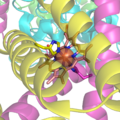 Hemoproteins have diverse biological functions including the transportation of diatomic gases, chemical catalysis
, diatomic gas detection, and electron transfer. The heme iron serves as a source or sink of electrons during electron transfer or redox chemistry. In peroxidase
reactions, the porphyrin
molecule also serves as an electron source. In the transportation or detection of diatomic gases, the gas binds to the heme iron. During the detection of diatomic gases, the binding of the gas ligand
to the heme iron induces conformational changes in the surrounding protein.
It has been speculated that the original evolutionary function of hemoproteins was electron transfer in primitive sulfur-based photosynthesis
pathways in ancestral cyanobacteria before the appearance of molecular oxygen.
Hemoproteins achieve their remarkable functional diversity by modifying the environment of the heme macrocycle within the protein matrix. For example, the ability of hemoglobin
to effectively deliver oxygen to tissues is due to specific amino acid residues located near the heme molecule. Hemoglobin binds oxygen in the pulmonary
vasculature, where the pH
is high and the pCO2 is low, and releases it in the tissues, where the situations are reversed. This phenomenon is known as the Bohr effect
. The molecular mechanism behind this effect is the steric organization of the globin chain; a histidine
residue, located adjacent to the heme group, becomes positively charged under acid (low pH) circumstances (which are caused by dissolved CO2
in working muscles, etc.), sterically releasing oxygen from the heme group.
The most common type is heme B
; other important types include heme A
and heme C
. Isolated hemes are commonly designated by capital letters while hemes bound to proteins are designated by lower case letters. Cytochrome a refers to the heme A in specific combination with membrane protein forming a portion of cytochrome c oxidase
.
The names of cytochrome
s typically (but not always) reflect the kinds of hemes they contain: cytochrome a contains heme A, cytochrome c contains heme C, etc.
.
 The enzymatic process that produces heme is properly called porphyrin
synthesis, as all the intermediates are tetrapyrrole
s that are chemically classified as porphyrins. The process is highly conserved across biology. In humans, this pathway serves almost exclusively to form heme. In other species, it also produces similar substances such as cobalamin (vitamin B12
).
The pathway is initiated by the synthesis of D-Aminolevulinic acid
(dALA or δALA) from the amino acid
glycine
and succinyl-CoA
from the citric acid cycle
(Krebs cycle). The rate-limiting enzyme responsible for this reaction, ALA synthase, is strictly regulated by intracellular iron
levels and heme concentration. A low-iron level, e.g., in iron deficiency
, leads to decreased porphyrin synthesis, which prevents accumulation of the toxic intermediates. This mechanism is of therapeutic importance: infusion of heme arginate or hematin can abort attacks of porphyria
in patients with an inborn error of metabolism
of this process, by reducing transcription of ALA synthase.
The organs mainly involved in heme synthesis are the liver
and the bone marrow
, although every cell requires heme to function properly. Heme is seen as an intermediate molecule in catabolism of haemoglobin in the process of bilirubin metabolism.
, which remove old and damaged erythrocytes from the circulation.
In the first step, heme is converted to biliverdin
by the enzyme heme oxygenase
(HOXG). NADPH is used as the reducing agent, molecular oxygen enters the reaction, carbon monoxide
(CO) is produced and the iron is released from the molecule as the ferric
ion (Fe3+).
In addition, heme degradation appears to be an evolutionary conserved response to oxidative stress. Briefly, when cells are exposed to free radicals, there is a rapid induction of the expression of the stress responsive heme oxygenase-1 (Hmox1) isoenzyme that catabolizes heme (see below). The reason why cells must increase exponentially their capability to degrade heme in response to oxidative stress remains unclear but this appears to be part of a cytoprotective response that avoids the deleterious effects of free heme.
HMOX1/2
heme --------------> biliverdin + Fe3+
/ \
H+ + NADPH NADP+
O2 CO
In the second reaction, biliverdin is converted to bilirubin by biliverdin reductase
(BVR):
BVR
biliverdin -----------> bilirubin
/ \
H+ + NADPH NADP+
Bilirubin is transported into the liver bound to a protein (serum albumin
), where it is conjugated with glucuronic acid
to become more water soluble. The reaction is catalyzed by the enzyme UDP-glucuronide transferase (UDPGUTF).
UDPGUTF
bilirubin + 2 UDP-glucuronate ------------> bilirubin diglucuronide
\
2 UMP + 2 Pi
This form of bilirubin is excreted from the liver in bile
. The intestinal bacteria deconjugate bilirubin diglucuronide
and convert bilirubin to urobilinogen
s. Some urobilinogen is absorbed by intestinal cells and transported into the kidneys and excreted with urine. The remainder travels down the digestive tract and is converted to stercobilinogen
. This is oxidized to stercobilin
, which is excreted and is responsible for the color of feces
.
to catalyze in an unfettered manner the production of free radicals. This property of free heme can sensitize a variety of cell types to undergo programmed cell death
in response to pro-inflammatory agonists. This deleterious effect is thought to play an important role in the pathogenesis of certain inflammatory diseases such as malaria
.
British English
British English, or English , is the broad term used to distinguish the forms of the English language used in the United Kingdom from forms used elsewhere...
) is a prosthetic group that consists of an iron
Iron
Iron is a chemical element with the symbol Fe and atomic number 26. It is a metal in the first transition series. It is the most common element forming the planet Earth as a whole, forming much of Earth's outer and inner core. It is the fourth most common element in the Earth's crust...
atom contained in the center of a large heterocyclic organic ring called a porphyrin
Porphyrin
Porphyrins are a group of organic compounds, many naturally occurring. One of the best-known porphyrins is heme, the pigment in red blood cells; heme is a cofactor of the protein hemoglobin. Porphyrins are heterocyclic macrocycles composed of four modified pyrrole subunits interconnected at...
. Not all porphyrins contain iron, but a substantial fraction of porphyrin-containing metalloprotein
Metalloprotein
Metalloprotein is a generic term for a protein that contains a metal ion cofactor. Metalloproteins have many different functions in cells, such as enzymes, transport and storage proteins, and signal transduction proteins. Indeed, about one quarter to one third of all proteins require metals to...
s have heme as their prosthetic group; these are known as hemoprotein
Hemoprotein
A hemeprotein , or heme protein, is a metalloprotein containing a heme prosthetic group- an organic compound that allows a protein to carry out a function that it cannot do alone....
s. Hemes are most commonly recognized in their presence as components of hemoglobin
Hemoglobin
Hemoglobin is the iron-containing oxygen-transport metalloprotein in the red blood cells of all vertebrates, with the exception of the fish family Channichthyidae, as well as the tissues of some invertebrates...
, the red pigment in blood
Blood
Blood is a specialized bodily fluid in animals that delivers necessary substances such as nutrients and oxygen to the cells and transports metabolic waste products away from those same cells....
, but they are also components of a number of other hemoproteins.
Function
Catalysis
Catalysis is the change in rate of a chemical reaction due to the participation of a substance called a catalyst. Unlike other reagents that participate in the chemical reaction, a catalyst is not consumed by the reaction itself. A catalyst may participate in multiple chemical transformations....
, diatomic gas detection, and electron transfer. The heme iron serves as a source or sink of electrons during electron transfer or redox chemistry. In peroxidase
Peroxidase
Peroxidases are a large family of enzymes that typically catalyze a reaction of the form:For many of these enzymes the optimal substrate is hydrogen peroxide, but others are more active with organic hydroperoxides such as lipid peroxides...
reactions, the porphyrin
Porphyrin
Porphyrins are a group of organic compounds, many naturally occurring. One of the best-known porphyrins is heme, the pigment in red blood cells; heme is a cofactor of the protein hemoglobin. Porphyrins are heterocyclic macrocycles composed of four modified pyrrole subunits interconnected at...
molecule also serves as an electron source. In the transportation or detection of diatomic gases, the gas binds to the heme iron. During the detection of diatomic gases, the binding of the gas ligand
Ligand
In coordination chemistry, a ligand is an ion or molecule that binds to a central metal atom to form a coordination complex. The bonding between metal and ligand generally involves formal donation of one or more of the ligand's electron pairs. The nature of metal-ligand bonding can range from...
to the heme iron induces conformational changes in the surrounding protein.
It has been speculated that the original evolutionary function of hemoproteins was electron transfer in primitive sulfur-based photosynthesis
Photosynthesis
Photosynthesis is a chemical process that converts carbon dioxide into organic compounds, especially sugars, using the energy from sunlight. Photosynthesis occurs in plants, algae, and many species of bacteria, but not in archaea. Photosynthetic organisms are called photoautotrophs, since they can...
pathways in ancestral cyanobacteria before the appearance of molecular oxygen.
Hemoproteins achieve their remarkable functional diversity by modifying the environment of the heme macrocycle within the protein matrix. For example, the ability of hemoglobin
Hemoglobin
Hemoglobin is the iron-containing oxygen-transport metalloprotein in the red blood cells of all vertebrates, with the exception of the fish family Channichthyidae, as well as the tissues of some invertebrates...
to effectively deliver oxygen to tissues is due to specific amino acid residues located near the heme molecule. Hemoglobin binds oxygen in the pulmonary
Lung
The lung is the essential respiration organ in many air-breathing animals, including most tetrapods, a few fish and a few snails. In mammals and the more complex life forms, the two lungs are located near the backbone on either side of the heart...
vasculature, where the pH
PH
In chemistry, pH is a measure of the acidity or basicity of an aqueous solution. Pure water is said to be neutral, with a pH close to 7.0 at . Solutions with a pH less than 7 are said to be acidic and solutions with a pH greater than 7 are basic or alkaline...
is high and the pCO2 is low, and releases it in the tissues, where the situations are reversed. This phenomenon is known as the Bohr effect
Bohr effect
Bohr effect is a property of hemoglobin first described in 1904 by the Danish physiologist Christian Bohr , which states that an increasing concentration of protons and/or carbon dioxide will reduce the oxygen affinity of hemoglobin...
. The molecular mechanism behind this effect is the steric organization of the globin chain; a histidine
Histidine
Histidine Histidine, an essential amino acid, has a positively charged imidazole functional group. It is one of the 22 proteinogenic amino acids. Its codons are CAU and CAC. Histidine was first isolated by German physician Albrecht Kossel in 1896. Histidine is an essential amino acid in humans...
residue, located adjacent to the heme group, becomes positively charged under acid (low pH) circumstances (which are caused by dissolved CO2
Carbonic acid
Carbonic acid is the inorganic compound with the formula H2CO3 . It is also a name sometimes given to solutions of carbon dioxide in water, because such solutions contain small amounts of H2CO3. Carbonic acid forms two kinds of salts, the carbonates and the bicarbonates...
in working muscles, etc.), sterically releasing oxygen from the heme group.
Major hemes
There are several biologically important kinds of heme:| Heme A Heme a Heme A is a heme, a coordination complex consisting of a macrocyclic ligand called a porphyrin, chelating an iron atom. Heme a is a biomolecule and is produced naturally by many organisms.-Relationship to other hemes:... |
Heme B Heme b Heme B or haem B is the most abundant heme, both hemoglobin and myoglobin are examples of oxygen transport proteins that contain heme B. The peroxidase family of enzymes also contain heme B... |
Heme C Heme c Heme C differs from heme B in that the two vinyl side chains of heme B are replaced by covalent, thioether linkages to the apoprotein... |
Heme O Heme o Heme O differs from the closely related heme A by having a methyl group at ring position 8 instead of the formyl group. The isoprenoid chain at position 2 is the same.... |
||
|---|---|---|---|---|---|
| PubChem number | 7888115 | 444098 | 444125 | 6323367 | |
| Chemical formula | C49H56O6N4Fe | C34H32O4N4Fe | C34H36O4N4S2Fe | C49H58O5N4Fe | |
| Functional group at C3 | -CH(OH)CH2Far Farnesene The term farnesene refers to a set of six closely related chemical compounds which all are sesquiterpenes. α-Farnesene and β-farnesene are isomers, differing by the location of one double bond. α-Farnesene is 3,7,11-trimethyl-1,3,6,10-dodecatetraene and β-farnesene is... |
-CH=CH2 Vinyl A vinyl compound is any organic compound that contains a vinyl group ,which are derivatives of ethene, CH2=CH2, with one hydrogen atom replaced with some other group... |
-CH(cystein-S-yl Cysteine Cysteine is an α-amino acid with the chemical formula HO2CCHCH2SH. It is a non-essential amino acid, which means that it is biosynthesized in humans. Its codons are UGU and UGC. The side chain on cysteine is thiol, which is polar and thus cysteine is usually classified as a hydrophilic amino acid... )CH3 |
-CH(OH)CH2Far Farnesene The term farnesene refers to a set of six closely related chemical compounds which all are sesquiterpenes. α-Farnesene and β-farnesene are isomers, differing by the location of one double bond. α-Farnesene is 3,7,11-trimethyl-1,3,6,10-dodecatetraene and β-farnesene is... |
|
| Functional group at C8 | -CH=CH2 | -CH=CH2 | -CH(cystein-S-yl Cysteine Cysteine is an α-amino acid with the chemical formula HO2CCHCH2SH. It is a non-essential amino acid, which means that it is biosynthesized in humans. Its codons are UGU and UGC. The side chain on cysteine is thiol, which is polar and thus cysteine is usually classified as a hydrophilic amino acid... )CH3 |
-CH=CH2 | |
| Functional group at C18 | -CH=O | -CH3 | -CH3 | -CH3 | |
The most common type is heme B
Heme b
Heme B or haem B is the most abundant heme, both hemoglobin and myoglobin are examples of oxygen transport proteins that contain heme B. The peroxidase family of enzymes also contain heme B...
; other important types include heme A
Heme a
Heme A is a heme, a coordination complex consisting of a macrocyclic ligand called a porphyrin, chelating an iron atom. Heme a is a biomolecule and is produced naturally by many organisms.-Relationship to other hemes:...
and heme C
Heme c
Heme C differs from heme B in that the two vinyl side chains of heme B are replaced by covalent, thioether linkages to the apoprotein...
. Isolated hemes are commonly designated by capital letters while hemes bound to proteins are designated by lower case letters. Cytochrome a refers to the heme A in specific combination with membrane protein forming a portion of cytochrome c oxidase
Cytochrome c oxidase
The enzyme cytochrome c oxidase or Complex IV is a large transmembrane protein complex found in bacteria and the mitochondrion.It is the last enzyme in the respiratory electron transport chain of mitochondria located in the mitochondrial membrane...
.
Other hemes
- The following carbon numbering system of porphyrins is an older numbering used by biochemists and not the 1-24 numbering system recommended by IUPAC which is shown in the table above.
- Heme l is the derivative of heme B which is covalently attached to the protein of lactoperoxidaseLactoperoxidaseLactoperoxidase is a peroxidase enzyme secreted from mammary, salivary, and other mucosal glands that functions as a natural antibacterial agent. Lactoperoxidase is a member of the heme peroxidase family of enzymes. In humans, lactoperoxidase is encoded by the LPO gene.Lactoperoxidase catalyzes...
, eosinophil peroxidaseEosinophil peroxidaseEosinophil peroxidase is a haloperoxidase enzyme that in humans is encoded by the EPX gene. The enzyme is a heterodimeric 71-77 kD peroxidase consisting of a heavier glycosylated chain and a lighter nonglycosylated chain...
, and thyroid peroxidaseThyroid peroxidaseThyroid peroxidase or thyroperoxidase is an enzyme expressed mainly in the thyroid that liberates iodine for addition onto tyrosine residues on thyroglobulin for the production of thyroxine or triiodothyronine , thyroid hormones. In humans, thyroperoxidase is encoded by the TPO...
. The addition of peroxidePeroxideA peroxide is a compound containing an oxygen–oxygen single bond or the peroxide anion .The O−O group is called the peroxide group or peroxo group. In contrast to oxide ions, the oxygen atoms in the peroxide ion have an oxidation state of −1.The simplest stable peroxide is hydrogen peroxide...
with the glutamyl-375 and aspartyl-225 of lactoperoxidase forms ester bonds between these amino acid residues and the heme 1- and 5-methyl groups, respectively. Similar ester bonds with these two methyl groups are thought to form in eosinophil and thyroid peroxidases. Heme l is one important characteristic of animal peroxidases; plant peroxidases incorporate heme B. Lactoperoxidase and eosinophil peroxidase are protective enzymes responsible for the destruction of invading bacteria and virus. Thyroid peroxidase is the enzyme catalyzing the biosynthesis of the important thyroid hormones. Because lactoperoxidase destroys invading organisms in the lungs and excrement, it is thought to be an important protective enzyme.
- Heme l is the derivative of heme B which is covalently attached to the protein of lactoperoxidase
- Heme m is the derivative of heme B covalently bound at the active site of myeloperoxidaseMyeloperoxidaseMyeloperoxidase is a peroxidase enzyme that in humans is encoded by the MPO gene. Myeloperoxidase is most abundantly expressed in neutrophil granulocytes . It is a lysosomal protein stored in azurophilic granules of the neutrophil...
. Heme m contains the two ester bonds at the heme 1- and 5-methyls as in heme l found in other mammalian peroxidases. In addition, a unique sulfoniumSulfoniumA sulfonium ion, also known as sulphonium ion or sulfanium ion, is a positively charged ion featuring three organic substituents attached to sulfur. They have the formula [SR3]+...
ion linkage between the sulfur of a methionyl amino-acid residue and the heme 2-vinyl group is formed, giving this enzyme the unique capability of easily oxidizing chlorideChlorideThe chloride ion is formed when the element chlorine, a halogen, picks up one electron to form an anion Cl−. The salts of hydrochloric acid HCl contain chloride ions and can also be called chlorides. The chloride ion, and its salts such as sodium chloride, are very soluble in water...
and bromideBromideA bromide is a chemical compound containing bromide ion, that is bromine atom with effective charge of −1. The class name can include ionic compounds such as caesium bromide or covalent compounds such as sulfur dibromide.-Natural occurrence:...
ions. Myeloperoxidase is present in mammalian neutrophils and is responsible for the destruction of invading bacteria and viruses. It also synthesizes hypobromiteHypobromiteThe hypobromite ion, also called alkaline bromine water, is BrO−. Bromine is in the +1 oxidation state. Hypobromite is the bromine compound analogous to hypochlorites found in common bleaches, and in immune cells...
by "mistake" which is a known mutagenic compound.
- Heme D is another derivative of heme B, but in which the propionic acidPropionic acidPropanoic acid is a naturally occurring carboxylic acid with chemical formula CH3CH2COOH. It is a clear liquid with a pungent odor...
side chain at the carbon of position 6, which is also hydroxylated, forms a γ-spirolactone. Ring III is also hydroxylated at position 5, in a conformation trans to the new lactone group. Heme D is the site for oxygen reduction to water of many types of bacteria at low oxygen tension.
- Heme S is related to heme B by the having a formyl group at position 2 in place of the 2-vinyl group. Heme S is found in the hemoglobin of marine worms. The correct structures of heme B and heme S were first elucidated by German chemist Hans FischerHans FischerHans Fischer was a German organic chemist and the recipient of the 1930 Nobel Prize for Chemistry.-Early years:...
.
The names of cytochrome
Cytochrome
Cytochromes are, in general, membrane-bound hemoproteins that contain heme groups and carry out electron transport.They are found either as monomeric proteins or as subunits of bigger enzymatic complexes that catalyze redox reactions....
s typically (but not always) reflect the kinds of hemes they contain: cytochrome a contains heme A, cytochrome c contains heme C, etc.
Synthesis
Details of heme synthesis can be found in the article on porphyrinPorphyrin
Porphyrins are a group of organic compounds, many naturally occurring. One of the best-known porphyrins is heme, the pigment in red blood cells; heme is a cofactor of the protein hemoglobin. Porphyrins are heterocyclic macrocycles composed of four modified pyrrole subunits interconnected at...
.
Porphyrin
Porphyrins are a group of organic compounds, many naturally occurring. One of the best-known porphyrins is heme, the pigment in red blood cells; heme is a cofactor of the protein hemoglobin. Porphyrins are heterocyclic macrocycles composed of four modified pyrrole subunits interconnected at...
synthesis, as all the intermediates are tetrapyrrole
Pyrrole
Pyrrole is a heterocyclic aromatic organic compound, a five-membered ring with the formula C4H4NH. It is a colourless volatile liquid that darkens readily upon exposure to air. Substituted derivatives are also called pyrroles, e.g., N-methylpyrrole, C4H4NCH3...
s that are chemically classified as porphyrins. The process is highly conserved across biology. In humans, this pathway serves almost exclusively to form heme. In other species, it also produces similar substances such as cobalamin (vitamin B12
Vitamin B12
Vitamin B12, vitamin B12 or vitamin B-12, also called cobalamin, is a water-soluble vitamin with a key role in the normal functioning of the brain and nervous system, and for the formation of blood. It is one of the eight B vitamins...
).
The pathway is initiated by the synthesis of D-Aminolevulinic acid
D-Aminolevulinic acid
δ-Aminolevulinic acid is the first compound in the porphyrin synthesis pathway, the pathway that leads to heme in mammals and chlorophyll in plants....
(dALA or δALA) from the amino acid
Amino acid
Amino acids are molecules containing an amine group, a carboxylic acid group and a side-chain that varies between different amino acids. The key elements of an amino acid are carbon, hydrogen, oxygen, and nitrogen...
glycine
Glycine
Glycine is an organic compound with the formula NH2CH2COOH. Having a hydrogen substituent as its 'side chain', glycine is the smallest of the 20 amino acids commonly found in proteins. Its codons are GGU, GGC, GGA, GGG cf. the genetic code.Glycine is a colourless, sweet-tasting crystalline solid...
and succinyl-CoA
Succinyl-CoA
Succinyl-Coenzyme A, abbreviated as Succinyl-CoA or SucCoA, is a combination of succinic acid and coenzyme A.-Source:It is an important intermediate in the citric acid cycle, where it is synthesized from α-Ketoglutarate by α-ketoglutarate dehydrogenase through decarboxylation...
from the citric acid cycle
Citric acid cycle
The citric acid cycle — also known as the tricarboxylic acid cycle , the Krebs cycle, or the Szent-Györgyi-Krebs cycle — is a series of chemical reactions which is used by all aerobic living organisms to generate energy through the oxidization of acetate derived from carbohydrates, fats and...
(Krebs cycle). The rate-limiting enzyme responsible for this reaction, ALA synthase, is strictly regulated by intracellular iron
Iron
Iron is a chemical element with the symbol Fe and atomic number 26. It is a metal in the first transition series. It is the most common element forming the planet Earth as a whole, forming much of Earth's outer and inner core. It is the fourth most common element in the Earth's crust...
levels and heme concentration. A low-iron level, e.g., in iron deficiency
Iron deficiency (medicine)
Iron deficiency is one of the most common of the nutritional deficiencies. Iron is present in all cells in the human body, and has several vital functions...
, leads to decreased porphyrin synthesis, which prevents accumulation of the toxic intermediates. This mechanism is of therapeutic importance: infusion of heme arginate or hematin can abort attacks of porphyria
Porphyria
Porphyrias are a group of inherited or acquired disorders of certain enzymes in the heme bio-synthetic pathway . They are broadly classified as acute porphyrias and cutaneous porphyrias, based on the site of the overproduction and accumulation of the porphyrins...
in patients with an inborn error of metabolism
Inborn error of metabolism
Inborn errors of metabolism comprise a large class of genetic diseases involving disorders of metabolism. The majority are due to defects of single genes that code for enzymes that facilitate conversion of various substances into others...
of this process, by reducing transcription of ALA synthase.
The organs mainly involved in heme synthesis are the liver
Liver
The liver is a vital organ present in vertebrates and some other animals. It has a wide range of functions, including detoxification, protein synthesis, and production of biochemicals necessary for digestion...
and the bone marrow
Bone marrow
Bone marrow is the flexible tissue found in the interior of bones. In humans, bone marrow in large bones produces new blood cells. On average, bone marrow constitutes 4% of the total body mass of humans; in adults weighing 65 kg , bone marrow accounts for approximately 2.6 kg...
, although every cell requires heme to function properly. Heme is seen as an intermediate molecule in catabolism of haemoglobin in the process of bilirubin metabolism.
Degradation
Degradation begins inside macrophages of the spleenSpleen
The spleen is an organ found in virtually all vertebrate animals with important roles in regard to red blood cells and the immune system. In humans, it is located in the left upper quadrant of the abdomen. It removes old red blood cells and holds a reserve of blood in case of hemorrhagic shock...
, which remove old and damaged erythrocytes from the circulation.
In the first step, heme is converted to biliverdin
Biliverdin
Biliverdin is a green tetrapyrrolic bile pigment, and is a product of heme catabolism. It is the pigment responsible for a greenish color sometimes seen in bruises.- Metabolism :...
by the enzyme heme oxygenase
Heme oxygenase
This reaction can occur in virtually every cell; the classic example is the formation of a bruise, which goes through different colors as it gradually heals: red heme to green biliverdin to yellow bilirubin...
(HOXG). NADPH is used as the reducing agent, molecular oxygen enters the reaction, carbon monoxide
Carbon monoxide
Carbon monoxide , also called carbonous oxide, is a colorless, odorless, and tasteless gas that is slightly lighter than air. It is highly toxic to humans and animals in higher quantities, although it is also produced in normal animal metabolism in low quantities, and is thought to have some normal...
(CO) is produced and the iron is released from the molecule as the ferric
Ferric
Ferric refers to iron-containing materials or compounds. In chemistry the term is reserved for iron with an oxidation number of +3, also denoted iron or Fe3+. On the other hand, ferrous refers to iron with oxidation number of +2, denoted iron or Fe2+...
ion (Fe3+).
In addition, heme degradation appears to be an evolutionary conserved response to oxidative stress. Briefly, when cells are exposed to free radicals, there is a rapid induction of the expression of the stress responsive heme oxygenase-1 (Hmox1) isoenzyme that catabolizes heme (see below). The reason why cells must increase exponentially their capability to degrade heme in response to oxidative stress remains unclear but this appears to be part of a cytoprotective response that avoids the deleterious effects of free heme.
HMOX1/2
heme --------------> biliverdin + Fe3+
/ \
H+ + NADPH NADP+
O2 CO
In the second reaction, biliverdin is converted to bilirubin by biliverdin reductase
Biliverdin reductase
Biliverdin reductase is an enzyme found in the liver that facilitates the conversion of biliverdin to bilirubin. It accomplishes this through the reduction of a double-bond between the second and third pyrrole ring into a single-bond....
(BVR):
BVR
biliverdin -----------> bilirubin
/ \
H+ + NADPH NADP+
Bilirubin is transported into the liver bound to a protein (serum albumin
Serum albumin
Serum albumin, often referred to simply as albumin is a protein that in humans is encoded by the ALB gene.Serum albumin is the most abundant plasma protein in mammals. Albumin is essential for maintaining the osmotic pressure needed for proper distribution of body fluids between intravascular...
), where it is conjugated with glucuronic acid
Glucuronic acid
Glucuronic acid is a carboxylic acid. Its structure is similar to that of glucose. However, glucuronic acid's sixth carbon is oxidized to a carboxylic acid...
to become more water soluble. The reaction is catalyzed by the enzyme UDP-glucuronide transferase (UDPGUTF).
UDPGUTF
bilirubin + 2 UDP-glucuronate ------------> bilirubin diglucuronide
\
2 UMP + 2 Pi
This form of bilirubin is excreted from the liver in bile
Bile
Bile or gall is a bitter-tasting, dark green to yellowish brown fluid, produced by the liver of most vertebrates, that aids the process of digestion of lipids in the small intestine. In many species, bile is stored in the gallbladder and upon eating is discharged into the duodenum...
. The intestinal bacteria deconjugate bilirubin diglucuronide
Bilirubin diglucuronide
Bilirubin diglucuronide is a conjugated form of bilirubin formed in bilirubin metabolism. The hydrophilic character of bilirubin diglucuronide enables it to be water-soluble. It is pumped across the hepatic canalicular membrane into the bile by the transporter MRP2....
and convert bilirubin to urobilinogen
Urobilinogen
Urobilinogen is a colourless product of bilirubin reduction. It is formed in the intestines by bacterial action. Some urobilinogen is reabsorbed, taken up into the circulation and excreted by the kidney. This constitutes the normal "enterohepatic urobilinogen cycle".Increased amounts of bilirubin...
s. Some urobilinogen is absorbed by intestinal cells and transported into the kidneys and excreted with urine. The remainder travels down the digestive tract and is converted to stercobilinogen
Stercobilinogen
Stercobilinogen is a chemical created by bacteria in the gut. It is made of broken-down hemoglobin. It is further processed to become the chemical that gives feces its brown color....
. This is oxidized to stercobilin
Stercobilin
Stercobilin is a tetrapyrrolic bile pigment and is one end-product of heme catabolism. It is the chemical responsible for the brown color of human fecal material and was originally isolated from feces in 1932...
, which is excreted and is responsible for the color of feces
Feces
Feces, faeces, or fæces is a waste product from an animal's digestive tract expelled through the anus or cloaca during defecation.-Etymology:...
.
Heme in health and disease
Under homeostasis, the reactivity of heme is controlled by its insertion into the “heme pockets” of hemoproteins. Under oxidative stress however, some hemoproteins, e.g. hemoglobin, can release their heme prosthetic groups. The non-protein-bound (free) heme produced in this manner becomes highly cytotoxic, most probably due to the Fe atom contained within its protoporphyrin IX ring, which can undergo Fenton chemistryFenton's reagent
Fenton's reagent is a solution of hydrogen peroxide and an iron catalyst that is used to oxidize contaminants or waste waters. Fenton's reagent can be used to destroy organic compounds such as trichloroethylene and tetrachloroethylene ....
to catalyze in an unfettered manner the production of free radicals. This property of free heme can sensitize a variety of cell types to undergo programmed cell death
Programmed cell death
Programmed cell-death is death of a cell in any form, mediated by an intracellular program. PCD is carried out in a regulated process which generally confers advantage during an organism's life-cycle...
in response to pro-inflammatory agonists. This deleterious effect is thought to play an important role in the pathogenesis of certain inflammatory diseases such as malaria
Malaria
Malaria is a mosquito-borne infectious disease of humans and other animals caused by eukaryotic protists of the genus Plasmodium. The disease results from the multiplication of Plasmodium parasites within red blood cells, causing symptoms that typically include fever and headache, in severe cases...
.
Genes
The following genes are part of the chemical pathway for making heme:- ALADALADDelta-aminolevulinic acid dehydratase is an enzyme that in humans is encoded by the ALAD gene.-Further reading:...
: aminolevulinic acid, delta-, dehydrataseDehydrataseDehydratase is an enzyme that catalyzes the removal of oxygen and hydrogen from organic compounds in the form of water. This process is also known as dehydration.There are four classes of dehydratases:... - ALAS1ALAS1Delta-aminolevulinate synthase 1 also known as ALAS1 is a protein that in humans is encoded by the ALAS1 gene. ALAS1 is an aminolevulinic acid synthase....
: aminolevulinate, delta-, synthase 1 - ALAS2ALAS2Delta-aminolevulinate synthase 2 also known as ALAS2 is a protein that in humans is encoded by the ALAS2 gene. ALAS2 is an aminolevulinic acid synthase....
: aminolevulinate, delta-, synthase 2 (sideroblastic/hypochromic anemia) - CPOXCPOXCPOX may refer to:*Coproporphyrinogen III oxidase*Catalytic partial oxidation...
: coproporphyrinogen oxidaseOxidaseAn oxidase is any enzyme that catalyzes an oxidation-reduction reaction involving molecular oxygen as the electron acceptor. In these reactions, oxygen is reduced to water or hydrogen peroxide .... - FECH: ferrochelataseFerrochelataseFerrochelatase is an enzyme that catalyses the terminal step in the biosynthesis of heme, converting protoporphyrin IX into heme. It catalyses the reaction:A ferrochelatase enzyme consists of 497 amino acid residues with a m.w...
(protoporphyria) - HMBS: hydroxymethylbilane synthaseSynthaseIn biochemistry, a synthase is an enzyme that catalyses a synthesis process.Following the EC number classification, they belong to the group of ligases, with lyases catalysing the reverse reaction....
- PPOXPPOXProtoporphyrinogen oxidase is an enzyme that in humans is encoded by the PPOX gene.PPOX is a human gene that produces an enzyme called protoporphyrinogen oxidase. This enzyme is responsible for the seventh step in heme production. Heme is the portion of hemoglobin that carries oxygen in the blood...
: protoporphyrinogen oxidaseOxidaseAn oxidase is any enzyme that catalyzes an oxidation-reduction reaction involving molecular oxygen as the electron acceptor. In these reactions, oxygen is reduced to water or hydrogen peroxide .... - UROD: uroporphyrinogen decarboxylase
- UROSUrosThe Uros are a pre-Incan people who live on forty-two self-fashioned floating islands in Lake Titicaca Puno, Peru and Bolivia. They form three main groups: Uru-Chipayas, Uru-Muratos and the Uru-Iruitos...
: uroporphyrinogen III synthaseSynthaseIn biochemistry, a synthase is an enzyme that catalyses a synthesis process.Following the EC number classification, they belong to the group of ligases, with lyases catalysing the reverse reaction....
(congenital erythropoietic porphyria)
See also
- bilirubin metabolism
- chlorinChlorinIn organic chemistry, a chlorin is a large heterocyclic aromatic ring consisting, at the core, of three pyrroles and one pyrroline coupled through four methine linkages...
- chlorophyllChlorophyllChlorophyll is a green pigment found in almost all plants, algae, and cyanobacteria. Its name is derived from the Greek words χλωρος, chloros and φύλλον, phyllon . Chlorophyll is an extremely important biomolecule, critical in photosynthesis, which allows plants to obtain energy from light...
- corrinCorrinCorrin is an heterocyclic compound. It is the parent macrocycle related to substituted derivative that is found in vitamin B12. Its name reflects that it is the "core" of vitamin B12 .-Coordination chemistry:...
- cobalamin
- respiration (physiology)Respiration (physiology)'In physiology, respiration is defined as the transport of oxygen from the outside air to the cells within tissues, and the transport of carbon dioxide in the opposite direction...