


Joseph Stilwell

Encyclopedia
General Joseph Warren Stilwell (March 19, 1883 – October 12, 1946) was a United States Army
four-star General known for service in the China Burma India Theater. His caustic personality was reflected in the nickname "Vinegar Joe". Although distrustful of his allies Stilwell showed himself to be a capable and daring tactician in the field but a lack of resources meant he was forced to make extraordinary demands of the US troops under his command.
of patrician Yankee
stock. His parents were Doctor
Benjamin Stilwell and Mary A. Peene. Stilwell was an eighth generation descendant of an English colonist who arrived in America in 1638, whose descendants remained in New York up through the birth of Stilwell's father. Named for a family friend, as well as the doctor who delivered him, Joseph Stilwell, known as Warren by his family, grew up in New York, under a strict regimen from his father that included an emphasis on religion. Stilwell later admitted to his daughter that he picked up criminal instincts due to,"...being forced to go to Church and Sunday School, and seeing how little real good religion does anybody, I advise passing them all up and using common sense instead."
Stilwell's rebellious attitude led him to a record of unruly behavior once he reached a post-graduate level at Yonkers High School
. Prior to this last year, Stilwell had performed meticulously in his classes, and had participated actively in football
(as quarterback
) and track
. Under the discretion of his father, Stilwell was placed into a post-graduate course following graduation, and immediately formed a group of friends whose activities ranged from card playing to stealing the desserts from the senior dance in 1900. This last event, in which an administrator was punched, led to the expulsions and suspensions for Stilwell's friends. Stilwell, meanwhile, having already graduated, was once again by his father's guidance sent to attend the United States Military Academy
at West Point, rather than to proceed to Yale University
as originally planned.
Despite missing the deadline to apply for Congressional appointment to the military academy, Stilwell gained entry through the use of family connections who knew President William McKinley
. In his first year, Stilwell underwent hazing
as a plebe that he referred to as "hell." While at West Point, Stilwell showed an aptitude for languages, such as French, in which he ranked first in his class during his second year. In the field of sports, Stilwell is credited with introducing basketball
to the Academy, and participating in cross-country running (as Captain), as well as playing on the varsity
football team. At West Point he had two demerit
s for laughing during drill. Ultimately, Stilwell graduated from the academy, class of 1904, ranked 32nd in a class of 124 cadets. His son, Joseph, Jr., served in World War II and Vietnam.
. During World War I
, he was the U.S. Fourth Corps intelligence officer and helped plan the St. Mihiel offensive
. He was awarded the Distinguished Service Medal
for his service in France.
Stilwell is often remembered by his sobriquet, "Vinegar Joe", which he acquired while a commander at Fort Benning
, Georgia
. Stilwell often gave harsh critiques of performance in field exercises, and a subordinate - stung by Joe's caustic remarks - drew a caricature of Stilwell rising out of a vinegar bottle. After discovering the caricature, Stilwell pinned it to a board and had the drawing photographed and distributed to friends. Yet another indication of his view of life was the motto he kept on his desk: Illegitimi non carborundum
, a form of fractured Latin
that translates as "Don't let the bastards grind you down."
Between the wars, Stilwell served three tours in China, where he became fluent in Chinese, and was the military attaché at the U.S. Legation in Beijing
from 1935 to 1939. In 1939 and 1940 he served in the 2nd Infantry Division and from 1940 to 1941 organized and trained the 7th Infantry Division at Fort Ord
, California
. It was there that his leadership style - which emphasized concern for the average soldier and minimized ceremonies and officious discipline - earned him the nickname of “Uncle Joe.”
Just prior to World War II
, Stilwell was recognized as the top corps commander in the Army and was initially selected to plan and command the Allied invasion of North Africa. However, when it became necessary to send a senior officer to China to keep that country in the War, Stilwell was selected, over his personal objections, by President Franklin Roosevelt and his old friend, Army Chief of Staff George C. Marshall. He became the Chief of Staff to Generalissimo
Chiang Kai-Shek
, served as the commander of the China Burma India Theater responsible for all Lend-Lease
supplies going to China, and later was Deputy Commander of the South East Asia Command
. Unfortunately, despite his status and position in China, he soon became embroiled in conflicts over U.S. Lend-Lease aid and Chinese political sectarianism.
and Douglas MacArthur
. However, unlike other combat theaters, for example the European Theater of Operations
, the CBI was never a "theater of operations" and did not have an overall American operational command structure. The China theater came under the operational command of Generalissimo Chiang Kai-Shek
, commander of Nationalist Chinese forces, while the Burma India theater came under the operational command of the British (first India Command and later Allied South East Asia Command
whose supreme commander was Admiral Lord Louis Mountbatten
). The British and the Chinese were ill-equipped and more often than not on the receiving end of Japanese offensives. Chiang Kai-Shek was interested in conserving his troops and Allied Lend-Lease supplies for use against any sudden Japanese offensive, as well as against Chinese Communist forces in a later civil war. The Generalissimo's wariness increased after observing the disastrous Allied performance against the Japanese in Burma. After fighting and resisting the Japanese for five years, many in the Nationalist government felt that it was time for the Allies to assume a greater burden in fighting the war.
However, the first step to fighting the war for Stilwell was the reformation of the Chinese Army. These reforms clashed with the delicate balance of political and military alliances in China, which kept the Generalissimo in power. Reforming the army meant removing men who maintained Chiang's position as commander-in-chief. While he gave Stilwell technical overall command of some Chinese troops, Chiang worried that the new American-led forces would become yet another independent force outside of his control. Since 1942, members of the Generalissimo's staff had continually objected to Chinese troops being used in Burma for the purpose, as they viewed it, of returning that country to British colonial control. Chiang therefore sided with General Claire Chennault
's proposals that the war against the Japanese be continued largely using smaller Chinese forces supported by air forces, something Chennault assured the Generalissimo was feasible. The dilemma forced Chennault and Stilwell into competition for the valuable Lend-Lease supplies arriving over the Himalayas
from British-controlled India — an obstacle referred to as "The Hump
". George Marshall
, in his biennial report covering the period of July 1, 1943 to June 30, 1945, acknowledged he had given Stilwell "one of the most difficult" assignments of any theater commander.
Arriving in Burma just in time to experience the collapse of the Allied defense of that country, which cut China off from all land and sea supply routes, Stilwell personally led his staff of 117 men and women out of Burma into Assam
, India on foot, marching at what his men called the 'Stilwell stride' - 105 paces per minute. The Assam route was also used by other retreating Allied and Chinese forces. In India, Stilwell soon became well known for his no-nonsense appearance and disregard for military pomp and ceremony. His trademarks were a battered Army campaign hat, GI shoes, and a plain service uniform with no insignia of rank; he frequently carried a .30 Springfield rifle in preference to a sidearm. His hazardous march out of Burma and his bluntly honest assessment of the disaster captured the imagination of the American public: "I claim we got a hell of a beating. We got run out of Burma and it is humiliating as hell. I think we ought to find out what caused it, go back and retake it.". However, Stilwell's derogatory remarks castigating the ineffectiveness of what he termed Limey forces, a viewpoint often repeated by Stilwell's staff, did not sit well with British and Commonwealth commanders. However, it was well known among the troops that Stilwell's disdain for the British was aimed toward those high command officers that he saw as overly stuffy and pompous.
After the Japanese occupied Burma, China was completely cut off from Allied aid and materiel except through the hazardous route of flying cargo aircraft over the Hump
. Early on, the Roosevelt administration and the War Department
had given priority to other theaters for U.S. combat forces, equipment, and logistical support. With the closure of the Burma Road and the fall of Burma, it was realized that even replacing Chinese war losses would be extremely difficult. Consequently, the Allies' initial strategy was to keep Chinese resistance to the Japanese going by providing a lifeline of logistical and air support.
Convinced that the Chinese soldier was the equal of any given proper care and leadership, Stilwell established a training center (in Ramgarh, India, 200 miles west of Calcutta) for two divisions of Chinese troops from forces that had retreated to Assam from Burma. His effort in this regard met passive, sometimes active, resistance from the British, who feared that armed, disciplined Chinese would set an example for Indian insurgents, and from Chiang Kai-shek who did not welcome a strong military unit outside of his control. From the outset, Stilwell's primary goals were the opening of a land route to China from northern Burma and India by means of a ground offensive in northern Burma, so that more supplies could be transported to China, and to organize, equip, and train a greatly expanded, modernized, and competent Chinese army that would fight the Japanese in the China-Burma-India theater (CBI). Stilwell argued that the CBI was the only area at that time where the possibility existed for the Allies of engaging large numbers of troops against their common enemy, Japan. Unfortunately, the huge airborne logistical train of support from the USA to British India was still being organized, while supplies being flown over the Hump were barely sufficient to maintain Chennault's air operations and replace some Chinese war losses, let alone equip and supply an entire army. Additionally, critical supplies intended for the CBI were being diverted due to various crises in other combat theaters. Of the supplies that made it over the Hump a certain percentage were diverted by Chinese (and American) personnel into the black market for their personal enrichment. As a result, most Allied commanders in India, with the exception of General Orde Wingate and his Chindit operations, were focused on defensive measures.
The portion of 111 Brigade east of the Irrawaddy were known as Morris Force, after its commander, Lieutenant-Colonel "Jumbo" Morris. They had spent several months harassing Japanese traffic from Bhamo to Myitkyina. They had then attempted to complete the encirclement of Myitkyina. Stilwell was angered that they were unable to do so, but Slim pointed out that Stilwell's Chinese troops (numbering 5,500) had also failed in that task. By 14 July, Morris Force was down to three platoons. A week later, they had only 25 men fit for duty. Morris Force was evacuated about the same time as 77th Brigade
Captain Charlton Ogburn
, Jr., a U.S. Army Marauder officer, and Chindit brigade commanders John Masters
and Michael Calvert later recalled that Stilwell's appointment of a staff officer specially detailed by him to visit subordinate commands in order to chastise their officers and men as being 'yellow'. In October 1943, after the Joint Planning Staff at GHQ India had rejected a plan by Stilwell to fly his Chinese troops into northern Burma, Field Marshal Wavell asked whether Stilwell was satisfied on purely military grounds that the plan could not work. Stilwell replied that he was. Wavell then asked what Stilwell would say to Chiang Kai-shek, and Stilwell replied "I shall tell him the bloody British wouldn't fight."
, while Chiang repeatedly expressed his pent-up grievances against Stilwell for his "recklessness, insubordination, contempt and arrogance" to U.S. envoys to China. Stilwell would press Chiang and the British to take immediate actions to retake Burma, but Chiang demanded impossibly large amounts of supplies before he would agree to take offensive action, and the British refused to meet their previous pledges to provide naval and ground troops due to Churchill's "Europe first
" strategy. Eventually Stilwell began to complain openly to Roosevelt that Chiang was hoarding U.S. lend lease supplies because he wanted to keep Chinese Nationalist forces
ready to fight the Communists under Mao Zedong
after the end of the war with the Japanese, even though from 1942 to 1944 98 percent of U.S. military aid over the Hump had gone directly to the 14th Air Force and U.S. military personnel in China.
Stilwell also continually clashed with Field Marshal Archibald Wavell
, and apparently came to believe that the British in India were more concerned with protecting their colonial possessions than helping the Chinese fight the Japanese. In August 1943, as a result of constant feuding and conflicting objectives of British, American, and Chinese commands, along with the lack of a coherent strategic vision for the China Burma India (CBI) theater, the Combined Chiefs of Staff split the CBI command into separate Chinese and Southeast Asia theaters.
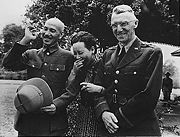 Stilwell was infuriated also by the rampant corruption of the Chiang regime. In his diary, which he faithfully kept, Stilwell began to note the corruption and the amount of money ($380,584,000 in 1944 dollars) being wasted upon the procrastinating Chiang and his government. The Cambridge History of China, for instance, also estimates that some 60%-70% of Chiang's Kuomintang conscripts did not make it through their basic training, with some 40% deserting and the remaining 20% dying of starvation before full induction into the military. Eventually, Stilwell’s belief that the Generalissimo and his generals were incompetent and corrupt reached such proportions that Stilwell sought to cut off Lend-Lease aid to China. Stilwell even ordered Office of Strategic Services
(OSS) officers to draw up contingency plans to assassinate Chiang Kai-shek after he heard Roosevelt's casual remarks regarding the possible defeat of Chiang by either internal or external enemies, and if this happened to replace Chiang with someone else to continue the Chinese resistance against Japan.
Lord Louis Mountbatten. Taking command of various Chinese and Allied forces, including a new U.S. Army special operations formation, the 5307th Composite Unit (provisional) later known as Merrill's Marauders
, Stilwell built up his Chinese forces for an eventual offensive in northern Burma. On December 21, 1943, Stilwell assumed direct control of planning for the invasion of Northern Burma, culminating with capture of the Japanese-held town of Myitkyina
. In the meantime, Stilwell ordered General Merrill
and the Marauders to commence long-range jungle penetration missions behind Japanese lines after the pattern of the British Chindits
. In February 1944, three Marauder battalions marched into Burma. Though Stilwell was at the Ledo Road front when the Marauders arrived at their jump-off point, the general did not walk out to the road to bid them farewell.
In April 1944, Stilwell launched his final offensive to capture the Burmese city of Myitkyina
. In support of this objective, the Marauders were ordered to undertake a long flanking maneuver towards the town, involving a grueling 65-mile jungle march. Having been deployed since February in combat operations in the jungles of Burma, the Marauders were seriously depleted and suffering from both combat losses and disease, and lost additional men while en route to the objective. A particularly devastating scourge was a severe outbreak of amoebic dysentery
, which erupted shortly after the Marauders linked up with X Force. By this time, the men of the Marauders had openly begun to suspect Stilwell's commitment to their welfare. Despite their sacrifices, Stilwell appeared unconcerned about their losses, and had rejected repeated requests for medals for individual acts of heroism. Initial promises of a rest and rotation were ignored; the Marauders were not even air-dropped replacement uniforms or mail until late April.
On May 17, 1,310 remaining Marauders attacked Myitkyina airfield in concert with elements of two Chinese infantry regiments and a small artillery contingent. The airfield was quickly taken, but the town, which Stilwell's intelligence staff had believed to be lightly defended, was garrisoned by significant numbers of well-equipped Japanese troops, who were steadily being reinforced. A preliminary attack on the town by two Chinese regiments was thrown back with heavy losses. The Marauders did not have the manpower to immediately overwhelm Myitkyina and its defenses; by the time additional Chinese forces arrived and were in a position to attack, Japanese forces totaled some 4,600 fanatical Japanese defenders.
During the Myitkyina siege, which took place during the height of the monsoon season, Marauders' second-in-command, Col. Hunter, as well as the unit's regimental and battalion level surgeons, had urgently recommended that the entire 5307th be relieved of duty and returned to rear areas for rest and recovery. By this time, most of the men had fevers and continual dysentery, forcing the men to cut the seats out of their uniform trousers in order to fire their weapons and relieve themselves simultaneously. Stilwell rejected the evacuation recommendation, though he did make a frontline inspection of the Myitkyina lines. Afterwards, he ordered all medical staff to stop returning combat troops suffering from disease or illness, and instead return them to combat status, using medications to keep down fevers. The feelings of many Marauders towards General Stilwell at that time were summed up by one soldier, who stated, "I had him [Stilwell] in my sights. I coulda' squeezed one off and no one woulda' known it wasn't a Jap who got that son of a bitch."
Stilwell also ordered that all Marauders evacuated from combat due to wounds or fever first submit to a special medical 'examination' by doctors appointed by his headquarters staff. These examinations passed many ailing soldiers as fit for duty; Stilwell's staff roamed hospital hallways in search of any Marauder with a temperature lower than 103 degrees Fahrenheit. Some of the men who were passed and sent back into combat were immediately re-evacuated as unfit at the insistence of forward medical personnel. Later, Stilwell's staff placed blame on Army medical personnel for overzealously interpreting Stilwell's return-to-duty order.
During the Myitkyina siege, Japanese soldiers resisted fiercely, generally fighting to the last man. As a result, Myitkyina did not fall until August 4, 1944, after Stilwell was forced to send in thousands of Chinese reinforcements, though Stilwell was pleased that the objective had at last been taken (his notes from his personal diary contain the notation, "Boy, will this burn up the Limeys!"). Later, Stilwell blamed the length of the siege, among other things, on British and Gurkha Chindit forces for not promptly responding to his demands to move north in an attempt to pressure Japanese troops. This was in spite of the fact that the Chindits themselves had suffered grievous casualties in several fierce pitched battles with Japanese troops in the Burmese jungles, along with losses from illness and combat exhaustion. Stilwell also had not kept his British allies clearly informed of his force movements, nor coordinated his offensive plans with those of General Slim.
Bereft of further combat replacements for his hard-pressed Marauder battalions, Stilwell felt he had no choice but to continue offensive operations with his existing forces, using the Marauders as 'the point of the spear' until they had either achieved all their objectives, or were wiped out. He was also concerned that pulling out the Marauders, the only U.S. ground unit in the campaign, resulted in charges of favoritism, forcing him to evacuate the exhausted Chinese and British Chindit forces as well. When General William Slim
, commander of British and Commonwealth
forces in Burma, informed Stilwell that his men were exhausted and should be withdrawn, Stilwell rejected the idea, insisting that his subordinate commanders simply did not understand enlisted men and their tendency to magnify physical challenges. Having made his own 'long march' out of Burma under his own power using jungle trails, Stilwell found it difficult to sympathize with those who had been in combat in the jungle for months on end without relief. In retrospect, his statements at the time revealed a lack of understanding of the limitations of lightly equipped unconventional forces when used in conventional roles. Myitkyina and the dispute over evacuation policy precipitated a hurried Army Inspector General investigation, followed by U.S. congressional committee hearings, though no disciplinary measures were taken against General Stilwell for his decisions as overall commander.
Only a week after the fall of Myitkyina in Burma, the 5307th Marauder force, down to only 130 combat-effective men (out of the original 2,997), was disbanded.
, the commander of the famed "Flying Tigers
" and later air force commander. As adviser to the Chinese air forces, Chennault proposed a limited air offensive against the Japanese in China in 1943 using a series of forward air bases. Stilwell insisted that the idea was untenable, and that any air campaign should not begin until fully fortified air bases supported by large infantry reserves had first been established. Stilwell then argued that all air resources be diverted to his forces in India for an early conquest of North Burma.
Following Chennault's advice, Generalissimo Chiang rejected the proposal; British commanders sided with Chennault, aware they could not launch a coordinated Allied offensive into Burma in 1943 with the resources then available. During the summer of 1943, Stilwell's headquarters concentrated on plans to rebuild the Chinese Army for an offensive in northern Burma, despite Chiang's insistence on support to Chennault's air operations. Stilwell believed that after forcing a supply route through northern Burma by means of a major ground offensive against the Japanese, he could train and equip thirty Chinese divisions with modern combat equipment. A smaller number of Chinese forces would transfer to India, where two or three new Chinese divisions would also be raised. This plan remained only theoretical at the time, since available airlift capacity for deliveries of supplies to China over the Hump
barely sustained Chennault's air operations, and were wholly insufficient to equip a new Chinese Army.
In 1944, the Japanese launched the counter-offensive, Operation Ichi-Go, quickly overrunning Chennault's forward air bases and proving Stilwell partially correct. However, by this time, Allied supply efforts via the Hump airlift were steadily improving in tonnage supplied per month; with the replacement of Chinese war losses, Chennault now saw little need for a ground offensive in northern Burma in order to re-open a ground supply route to China. This time, augmented with increased military equipment and additional troops, and concerned about defense of the approaches to India, British authorities sided with Stilwell.
In coordination with a southern offensive by Nationalist Chinese forces under General Wei Li-huang
, Allied troops under Stilwell's command launched the long-awaited invasion of northern Burma; after heavy fighting and casualties, the two forces linked up in January 1945. Stilwell's strategy remained unchanged: opening a new ground supply route from India to China would allow the Allies to equip and train new Chinese army divisions for use against the Japanese. The new road network, later called the Ledo Road
, would link the northern end of the Burma Road
as the primary supply route to China; Stilwell's staff planners had estimated the route would supply 65,000 tons of supplies per month. Using these figures, Stilwell argued that the Ledo Road network would greatly surpass the tonnage being airlifted over the Hump. General Chennault doubted that such an extended network of trails through difficult jungle could ever match the tonnage that could be delivered with modern cargo transport aircraft then deploying in-theater. Progress on the Ledo Road was slow, and could not be completed until the linkup of forces in January 1945.
In the end, Stilwell's plan to train and modernize thirty Chinese divisions in China (as well as two or three divisions from forces already in India) was never fully realized. As Chennault predicted, supplies carried over the Ledo Road at no time approached tonnage levels of supplies airlifted monthly into China via the Hump. In July 1945, 71,000 tons of supplies were flown over the Hump, compared to only 6,000 tons using the Ledo Road, and the airlift operation continued in operation until the end of the war. By the time supplies were flowing over the Ledo Road in large quantities, operations in other theaters had shaped the course of the war against Japan. Stilwell's drive into North Burma, however, allowed Air Transport Command to fly supplies into China more quickly and safely by allowing American planes to fly a more southerly route without fear of Japanese fighters. American airplanes no longer had to make the dangerous venture over the Hump
, increasing the delivery of supplies from 18,000 tons in June 1944, to 39,000 tons in November 1944. On August 1, 1945 a plane crossed the hump every one minute and 12 seconds.
In acknowledgment of Stilwell's efforts, the Ledo Road
was later renamed the Stilwell Road by Chiang Kai-shek.
On October 19, 1944, Stilwell was recalled from his command by President Franklin D. Roosevelt
. Partly as a result of controversy concerning the casualties suffered by U.S. forces in Burma and partly due to continuing difficulties with the British and Chinese commanders, Stilwell's return to the United States was not accompanied by the usual ceremony. Upon arrival, he was met by two Army generals at the airport, who told him that he was not to answer any media questions about China whatsoever.
Stilwell was replaced by General Albert C. Wedemeyer, who received a telegram from General Marshall on October 27, 1944 directing him to proceed to China to assume command of the China theatre and replace General Stilwell. Wedemeyer later recalled his initial dread over the assignment, as service in the China theater was considered a graveyard for American officials, both military and diplomatic. When Wedemeyer actually arrived at Stilwell’s headquarters after Stilwell’s dismissal, Wedemeyer was dismayed to discover that Stilwell had intentionally departed without seeing him, and did not leave a single briefing paper for his guidance, though departing U.S. military commanders habitually greeted their replacement in order to thoroughly brief them on the strengths and weaknesses of headquarters staff, the issues confronting the command, and planned operations. Searching the offices, Wedemeyer could find no documentary record of Stilwell's plans or records of his former or future operations. General Wedemeyer then spoke with Stilwell’s staff officers but learned little from them because Stilwell, according to the staff, kept everything in his “hip pocket”.
, U.S. Tenth Army
Commander in the closing Battle of Okinawa
in 1945, and as U.S. Sixth Army
Commander.
In November, he was appointed to lead a "War Department Equipment Board" in an investigation of the Army's modernization in light of its recent experience. Among his recommendations was the establishment of a combined arms force to conduct extended service tests of new weapons and equipment and then formulate doctrine for its use, and the abolition of specialized anti-tank
units. His most notable recommendation was for a vast improvement of the Army's defenses against all airborne threats, including ballistic missile
s. In particular, he called for "guided interceptor missiles
, dispatched in accordance with electronically computed data obtained from radar detection stations."
Stilwell died of stomach cancer
on October 12, 1946 at the Presidio of San Francisco
, while still on active duty. His ashes were scattered on the Pacific Ocean, and a cenotaph
was placed at the West Point Cemetery
. Among his military decorations are the Distinguished Service Cross
, Distinguished Service Medal
with one Oak Leaf Cluster
, the Legion of Merit
degree of Commander, the Bronze Star
, and the Combat Infantryman Badge
(this last award was given to him as he was dying from stomach cancer).
Stilwell’s home, built in 1933-1934 on Carmel Point, Carmel, California, remains a private home with a plaque in front identifying it as having been the general's home. A number of streets, buildings, and areas across the country have been named for Stilwell over the years, including Joseph Stilwell Middle School in Jacksonville, Florida
. The Soldiers’ Club he envisioned in 1940 (a time when there was no such thing as a soldiers’ club in the Army) was completed in 1943 at Fort Ord on the bluffs overlooking Monterey Bay
. Many years later the building was renamed “Stilwell Hall” in his honor, but because of the erosion of the bluffs over the decades, the building was taken down in 2003. Stilwell's former residence in Chongqing - a city along the Yangtze River to which Chiang's government retreated after being forced from Nanjing by Japanese troops - has now been converted to the General Joseph W. Stilwell Museum
in his honor.
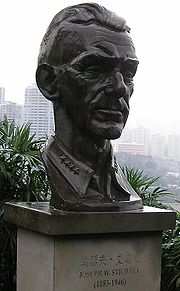 In her book Stilwell and the American Experience in China, 1911-45
, Barbara Tuchman
wrote that Stilwell was sacrificed as a political expedient due to his inability to get along with his allies in the theater. Stilwell's removal was certainly a result of substantial political pressure by Chiang through diplomatic means and using influential American friends who supported Chiang's government. One such group, informally called the "China Lobby
", included Time
publisher Henry Luce
and his wife Clare Boothe Luce
as well as J. Edgar Hoover
.
Some historians, such as David Halberstam
in his final book, The Coldest Winter: America and the Korean War
, have theorized that Roosevelt was concerned that Chiang would sign a separate peace with Japan, which would free many Japanese divisions to fight elsewhere, and that Roosevelt wanted to placate Chiang. The power struggle over the China Theater that emerged between Stilwell, Chennault, and Chiang reflected the American political divisions of the time.
A very different interpretation of events suggests that Stilwell, pressing for his full command of all Chinese forces, had made diplomatic inroads with the Chinese Communist Red Army commanded by Mao Zedong
. He bypassed his theater commander Chiang Kai-Shek and had gotten Mao to agree to follow an American commander. His confrontational approach in the power struggle with Chiang ultimately led to Chiang's determination to have Stilwell recalled to the United States.
Although Chiang was successful in removing Stilwell, the public relations damage suffered by his Kuomintang
regime was irreparable. Right before Stilwell's departure, New York Times drama critic-turned-war correspondent Brooks Atkinson
interviewed him in Chungking and wrote: "The decision to relieve General Stilwell represents the political triumph of a moribund, anti-democratic regime that is more concerned with maintaining its political supremacy than in driving the Japanese out of China. The Chinese Communists... have good armies that they are claiming to be fighting guerrilla warfare against the Japanese in North China—actually they are covertly or even overtly building themselves up to fight Generalissimo's government forces... The Generalissimo
naturally regards these armies as the chief threat to the country and his supremacy... has seen no need to make sincere attempt to arrange at least a truce with them for the duration of the war... No diplomatic genius could have overcome the Generalissimo's basic unwillingness to risk his armies in battle with the Japanese." Atkinson, who had visited Mao in Yenan, saw the Communist Chinese forces as a democratic movement (after Atkinson visited Mao, his article on his visit was titled Yenan: A Chinese Wonderland City), and the Nationalists in turn as hopelessly reactionary and corrupt; this view represented that of many of the U.S. press corps in China at the time. The negative image of the Kuomintang in America played a significant factor in Harry Truman's decision to end all U.S. aid to Chiang at the height of the Chinese civil war
, a war that resulted in the communist revolution in China and Chiang's retreat to Taiwan
.
in Objective, Burma!
(1945), by John Hoyt
in Samuel Fuller
's Merrill's Marauders
(1962), by Robert Stack
in Steven Spielberg
's 1941
(1979), and by Yachun Dong in Chinese Expeditionary Force (2011).
On August 24, 2000, the United States Postal Service
issued a 10¢ Distinguished Americans series
postage stamp honoring Stilwell.
The award for the Outstanding Overall Cadet, Senior Division, in the California Cadet Corps
is named the General Joseph W. Stilwell Award.
United States Army
The United States Army is the main branch of the United States Armed Forces responsible for land-based military operations. It is the largest and oldest established branch of the U.S. military, and is one of seven U.S. uniformed services...
four-star General known for service in the China Burma India Theater. His caustic personality was reflected in the nickname "Vinegar Joe". Although distrustful of his allies Stilwell showed himself to be a capable and daring tactician in the field but a lack of resources meant he was forced to make extraordinary demands of the US troops under his command.
Early life
Stilwell was born on March 19, 1883, in Palatka, FloridaPalatka, Florida
Palatka is a city in Putnam County, Florida, United States. The population was 10,033 at the 2000 census. As of 2004, the population recorded by the U.S. Census Bureau is 10,796. It is the county seat of Putnam County and includes East Palatka. Palatka is the principal city of the Palatka...
of patrician Yankee
Yankee
The term Yankee has several interrelated and often pejorative meanings, usually referring to people originating in the northeastern United States, or still more narrowly New England, where application of the term is largely restricted to descendants of the English settlers of the region.The...
stock. His parents were Doctor
Physician
A physician is a health care provider who practices the profession of medicine, which is concerned with promoting, maintaining or restoring human health through the study, diagnosis, and treatment of disease, injury and other physical and mental impairments...
Benjamin Stilwell and Mary A. Peene. Stilwell was an eighth generation descendant of an English colonist who arrived in America in 1638, whose descendants remained in New York up through the birth of Stilwell's father. Named for a family friend, as well as the doctor who delivered him, Joseph Stilwell, known as Warren by his family, grew up in New York, under a strict regimen from his father that included an emphasis on religion. Stilwell later admitted to his daughter that he picked up criminal instincts due to,"...being forced to go to Church and Sunday School, and seeing how little real good religion does anybody, I advise passing them all up and using common sense instead."
Stilwell's rebellious attitude led him to a record of unruly behavior once he reached a post-graduate level at Yonkers High School
Yonkers High School
Yonkers High School is located in Yonkers, New York and offers the International Baccalaureate program of studies.Yonkers High School is ranked the 41st best American High School by U.S. News and World Report.-External links:* *...
. Prior to this last year, Stilwell had performed meticulously in his classes, and had participated actively in football
American football
American football is a sport played between two teams of eleven with the objective of scoring points by advancing the ball into the opposing team's end zone. Known in the United States simply as football, it may also be referred to informally as gridiron football. The ball can be advanced by...
(as quarterback
Quarterback
Quarterback is a position in American and Canadian football. Quarterbacks are members of the offensive team and line up directly behind the offensive line...
) and track
Track and field
Track and field is a sport comprising various competitive athletic contests based around the activities of running, jumping and throwing. The name of the sport derives from the venue for the competitions: a stadium which features an oval running track surrounding a grassy area...
. Under the discretion of his father, Stilwell was placed into a post-graduate course following graduation, and immediately formed a group of friends whose activities ranged from card playing to stealing the desserts from the senior dance in 1900. This last event, in which an administrator was punched, led to the expulsions and suspensions for Stilwell's friends. Stilwell, meanwhile, having already graduated, was once again by his father's guidance sent to attend the United States Military Academy
United States Military Academy
The United States Military Academy at West Point is a four-year coeducational federal service academy located at West Point, New York. The academy sits on scenic high ground overlooking the Hudson River, north of New York City...
at West Point, rather than to proceed to Yale University
Yale University
Yale University is a private, Ivy League university located in New Haven, Connecticut, United States. Founded in 1701 in the Colony of Connecticut, the university is the third-oldest institution of higher education in the United States...
as originally planned.
Despite missing the deadline to apply for Congressional appointment to the military academy, Stilwell gained entry through the use of family connections who knew President William McKinley
William McKinley
William McKinley, Jr. was the 25th President of the United States . He is best known for winning fiercely fought elections, while supporting the gold standard and high tariffs; he succeeded in forging a Republican coalition that for the most part dominated national politics until the 1930s...
. In his first year, Stilwell underwent hazing
Hazing
Hazing is a term used to describe various ritual and other activities involving harassment, abuse or humiliation used as a way of initiating a person into a group....
as a plebe that he referred to as "hell." While at West Point, Stilwell showed an aptitude for languages, such as French, in which he ranked first in his class during his second year. In the field of sports, Stilwell is credited with introducing basketball
Basketball
Basketball is a team sport in which two teams of five players try to score points by throwing or "shooting" a ball through the top of a basketball hoop while following a set of rules...
to the Academy, and participating in cross-country running (as Captain), as well as playing on the varsity
Varsity team
In the United States and Canada, varsity sports teams are the principal athletic teams representing a college, university, high school or other secondary school. Such teams compete against the principal athletic teams at other colleges/universities, or in the case of secondary schools, against...
football team. At West Point he had two demerit
Demerit
Demerit may refer to:* Demerit point, in driving* Demerit good, in economics* Brownie point, in railroading...
s for laughing during drill. Ultimately, Stilwell graduated from the academy, class of 1904, ranked 32nd in a class of 124 cadets. His son, Joseph, Jr., served in World War II and Vietnam.
Military career
Stilwell later taught at West Point, and attended the Infantry Advanced Course and the Command and General Staff CollegeCommand and General Staff College
The United States Army Command and General Staff College at Fort Leavenworth, Kansas is a graduate school for United States Army and sister service officers, interagency representatives, and international military officers. The college was established in 1881 by William Tecumseh Sherman as a...
. During World War I
World War I
World War I , which was predominantly called the World War or the Great War from its occurrence until 1939, and the First World War or World War I thereafter, was a major war centred in Europe that began on 28 July 1914 and lasted until 11 November 1918...
, he was the U.S. Fourth Corps intelligence officer and helped plan the St. Mihiel offensive
Battle of Saint-Mihiel
The Battle of Saint-Mihiel was a World War I battle fought between September 12–15, 1918, involving the American Expeditionary Force and 48,000 French troops under the command of U.S. general John J. Pershing against German positions...
. He was awarded the Distinguished Service Medal
Distinguished Service Medal (United States)
The Distinguished Service Medal is the highest non-valorous military and civilian decoration of the United States military which is issued for exceptionally meritorious service to the government of the United States in either a senior government service position or as a senior officer of the United...
for his service in France.
Stilwell is often remembered by his sobriquet, "Vinegar Joe", which he acquired while a commander at Fort Benning
Fort Benning
Fort Benning is a United States Army post located southeast of the city of Columbus in Muscogee and Chattahoochee counties in Georgia and Russell County, Alabama...
, Georgia
Georgia (U.S. state)
Georgia is a state located in the southeastern United States. It was established in 1732, the last of the original Thirteen Colonies. The state is named after King George II of Great Britain. Georgia was the fourth state to ratify the United States Constitution, on January 2, 1788...
. Stilwell often gave harsh critiques of performance in field exercises, and a subordinate - stung by Joe's caustic remarks - drew a caricature of Stilwell rising out of a vinegar bottle. After discovering the caricature, Stilwell pinned it to a board and had the drawing photographed and distributed to friends. Yet another indication of his view of life was the motto he kept on his desk: Illegitimi non carborundum
Illegitimi non carborundum
Illegitimi non carborundum is a mock-Latin aphorism meaning "Don't let the bastards grind you down". -History:...
, a form of fractured Latin
Dog Latin
Dog Latin, Cod Latin, macaronic Latin, or mock Latin refers to the creation of a phrase or jargon in imitation of Latin, often by directly translating English words into Latin without conjugation or declension...
that translates as "Don't let the bastards grind you down."
Between the wars, Stilwell served three tours in China, where he became fluent in Chinese, and was the military attaché at the U.S. Legation in Beijing
Beijing
Beijing , also known as Peking , is the capital of the People's Republic of China and one of the most populous cities in the world, with a population of 19,612,368 as of 2010. The city is the country's political, cultural, and educational center, and home to the headquarters for most of China's...
from 1935 to 1939. In 1939 and 1940 he served in the 2nd Infantry Division and from 1940 to 1941 organized and trained the 7th Infantry Division at Fort Ord
Fort Ord
Fort Ord was a U.S. Army post on Monterey Bay in California. It was established in 1917 as a maneuver area and field artillery target range and was closed in September 1994. Fort Ord was one of the most attractive locations of any U.S. Army post, because of its proximity to the beach and California...
, California
California
California is a state located on the West Coast of the United States. It is by far the most populous U.S. state, and the third-largest by land area...
. It was there that his leadership style - which emphasized concern for the average soldier and minimized ceremonies and officious discipline - earned him the nickname of “Uncle Joe.”
Just prior to World War II
World War II
World War II, or the Second World War , was a global conflict lasting from 1939 to 1945, involving most of the world's nations—including all of the great powers—eventually forming two opposing military alliances: the Allies and the Axis...
, Stilwell was recognized as the top corps commander in the Army and was initially selected to plan and command the Allied invasion of North Africa. However, when it became necessary to send a senior officer to China to keep that country in the War, Stilwell was selected, over his personal objections, by President Franklin Roosevelt and his old friend, Army Chief of Staff George C. Marshall. He became the Chief of Staff to Generalissimo
Generalissimo
Generalissimo and Generalissimus are military ranks of the highest degree, superior to Field Marshal and other five-star ranks.-Usage:...
Chiang Kai-Shek
Chiang Kai-shek
Chiang Kai-shek was a political and military leader of 20th century China. He is known as Jiǎng Jièshí or Jiǎng Zhōngzhèng in Mandarin....
, served as the commander of the China Burma India Theater responsible for all Lend-Lease
Lend-Lease
Lend-Lease was the program under which the United States of America supplied the United Kingdom, the Soviet Union, China, Free France, and other Allied nations with materiel between 1941 and 1945. It was signed into law on March 11, 1941, a year and a half after the outbreak of war in Europe in...
supplies going to China, and later was Deputy Commander of the South East Asia Command
South East Asia Command
South East Asia Command was the body set up to be in overall charge of Allied operations in the South-East Asian Theatre during World War II.-Background:...
. Unfortunately, despite his status and position in China, he soon became embroiled in conflicts over U.S. Lend-Lease aid and Chinese political sectarianism.
Burma
Stilwell's assignment in the China-Burma-India Theater was a geographical administrative command on the same level as the commands of Dwight D. EisenhowerDwight D. Eisenhower
Dwight David "Ike" Eisenhower was the 34th President of the United States, from 1953 until 1961. He was a five-star general in the United States Army...
and Douglas MacArthur
Douglas MacArthur
General of the Army Douglas MacArthur was an American general and field marshal of the Philippine Army. He was a Chief of Staff of the United States Army during the 1930s and played a prominent role in the Pacific theater during World War II. He received the Medal of Honor for his service in the...
. However, unlike other combat theaters, for example the European Theater of Operations
European Theater of Operations
The European Theater of Operations, United States Army was a United States Army formation which directed U.S. Army operations in parts of Europe from 1942 to 1945. It referred to Army Ground Forces, United States Army Air Forces, and Army Service Forces operations north of Italy and the...
, the CBI was never a "theater of operations" and did not have an overall American operational command structure. The China theater came under the operational command of Generalissimo Chiang Kai-Shek
Chiang Kai-shek
Chiang Kai-shek was a political and military leader of 20th century China. He is known as Jiǎng Jièshí or Jiǎng Zhōngzhèng in Mandarin....
, commander of Nationalist Chinese forces, while the Burma India theater came under the operational command of the British (first India Command and later Allied South East Asia Command
South East Asia Command
South East Asia Command was the body set up to be in overall charge of Allied operations in the South-East Asian Theatre during World War II.-Background:...
whose supreme commander was Admiral Lord Louis Mountbatten
Louis Mountbatten, 1st Earl Mountbatten of Burma
Admiral of the Fleet Louis Francis Albert Victor Nicholas George Mountbatten, 1st Earl Mountbatten of Burma, KG, GCB, OM, GCSI, GCIE, GCVO, DSO, PC, FRS , was a British statesman and naval officer, and an uncle of Prince Philip, Duke of Edinburgh...
). The British and the Chinese were ill-equipped and more often than not on the receiving end of Japanese offensives. Chiang Kai-Shek was interested in conserving his troops and Allied Lend-Lease supplies for use against any sudden Japanese offensive, as well as against Chinese Communist forces in a later civil war. The Generalissimo's wariness increased after observing the disastrous Allied performance against the Japanese in Burma. After fighting and resisting the Japanese for five years, many in the Nationalist government felt that it was time for the Allies to assume a greater burden in fighting the war.
However, the first step to fighting the war for Stilwell was the reformation of the Chinese Army. These reforms clashed with the delicate balance of political and military alliances in China, which kept the Generalissimo in power. Reforming the army meant removing men who maintained Chiang's position as commander-in-chief. While he gave Stilwell technical overall command of some Chinese troops, Chiang worried that the new American-led forces would become yet another independent force outside of his control. Since 1942, members of the Generalissimo's staff had continually objected to Chinese troops being used in Burma for the purpose, as they viewed it, of returning that country to British colonial control. Chiang therefore sided with General Claire Chennault
Claire Lee Chennault
Lieutenant General Claire Lee Chennault , was an American military aviator. A contentious officer, he was a fierce advocate of "pursuit" or fight-interceptor aircraft during the 1930s when the U.S. Army Air Corps was focused primarily on high-altitude bombardment...
's proposals that the war against the Japanese be continued largely using smaller Chinese forces supported by air forces, something Chennault assured the Generalissimo was feasible. The dilemma forced Chennault and Stilwell into competition for the valuable Lend-Lease supplies arriving over the Himalayas
Himalayas
The Himalaya Range or Himalaya Mountains Sanskrit: Devanagari: हिमालय, literally "abode of snow"), usually called the Himalayas or Himalaya for short, is a mountain range in Asia, separating the Indian subcontinent from the Tibetan Plateau...
from British-controlled India — an obstacle referred to as "The Hump
The Hump
The Hump was the name given by Allied pilots in the Second World War to the eastern end of the Himalayan Mountains over which they flew military transport aircraft from India to China to resupply the Chinese war effort of Chiang Kai-shek and the units of the United States Army Air Forces based in...
". George Marshall
George Marshall
George Catlett Marshall was an American military leader, Chief of Staff of the Army, Secretary of State, and the third Secretary of Defense...
, in his biennial report covering the period of July 1, 1943 to June 30, 1945, acknowledged he had given Stilwell "one of the most difficult" assignments of any theater commander.
Arriving in Burma just in time to experience the collapse of the Allied defense of that country, which cut China off from all land and sea supply routes, Stilwell personally led his staff of 117 men and women out of Burma into Assam
Assam
Assam , also, rarely, Assam Valley and formerly the Assam Province , is a northeastern state of India and is one of the most culturally and geographically distinct regions of the country...
, India on foot, marching at what his men called the 'Stilwell stride' - 105 paces per minute. The Assam route was also used by other retreating Allied and Chinese forces. In India, Stilwell soon became well known for his no-nonsense appearance and disregard for military pomp and ceremony. His trademarks were a battered Army campaign hat, GI shoes, and a plain service uniform with no insignia of rank; he frequently carried a .30 Springfield rifle in preference to a sidearm. His hazardous march out of Burma and his bluntly honest assessment of the disaster captured the imagination of the American public: "I claim we got a hell of a beating. We got run out of Burma and it is humiliating as hell. I think we ought to find out what caused it, go back and retake it.". However, Stilwell's derogatory remarks castigating the ineffectiveness of what he termed Limey forces, a viewpoint often repeated by Stilwell's staff, did not sit well with British and Commonwealth commanders. However, it was well known among the troops that Stilwell's disdain for the British was aimed toward those high command officers that he saw as overly stuffy and pompous.
After the Japanese occupied Burma, China was completely cut off from Allied aid and materiel except through the hazardous route of flying cargo aircraft over the Hump
The Hump
The Hump was the name given by Allied pilots in the Second World War to the eastern end of the Himalayan Mountains over which they flew military transport aircraft from India to China to resupply the Chinese war effort of Chiang Kai-shek and the units of the United States Army Air Forces based in...
. Early on, the Roosevelt administration and the War Department
United States Department of War
The United States Department of War, also called the War Department , was the United States Cabinet department originally responsible for the operation and maintenance of the United States Army...
had given priority to other theaters for U.S. combat forces, equipment, and logistical support. With the closure of the Burma Road and the fall of Burma, it was realized that even replacing Chinese war losses would be extremely difficult. Consequently, the Allies' initial strategy was to keep Chinese resistance to the Japanese going by providing a lifeline of logistical and air support.
Convinced that the Chinese soldier was the equal of any given proper care and leadership, Stilwell established a training center (in Ramgarh, India, 200 miles west of Calcutta) for two divisions of Chinese troops from forces that had retreated to Assam from Burma. His effort in this regard met passive, sometimes active, resistance from the British, who feared that armed, disciplined Chinese would set an example for Indian insurgents, and from Chiang Kai-shek who did not welcome a strong military unit outside of his control. From the outset, Stilwell's primary goals were the opening of a land route to China from northern Burma and India by means of a ground offensive in northern Burma, so that more supplies could be transported to China, and to organize, equip, and train a greatly expanded, modernized, and competent Chinese army that would fight the Japanese in the China-Burma-India theater (CBI). Stilwell argued that the CBI was the only area at that time where the possibility existed for the Allies of engaging large numbers of troops against their common enemy, Japan. Unfortunately, the huge airborne logistical train of support from the USA to British India was still being organized, while supplies being flown over the Hump were barely sufficient to maintain Chennault's air operations and replace some Chinese war losses, let alone equip and supply an entire army. Additionally, critical supplies intended for the CBI were being diverted due to various crises in other combat theaters. Of the supplies that made it over the Hump a certain percentage were diverted by Chinese (and American) personnel into the black market for their personal enrichment. As a result, most Allied commanders in India, with the exception of General Orde Wingate and his Chindit operations, were focused on defensive measures.
Command of the Chindits
During this time in India, Stilwell became increasingly disenchanted with British forces, and did not hesitate to voice criticisms of what he viewed as hesitant or cowardly behavior, ninety percent of the Chindit casualties were incurred in the last phase of the campaign from 17 May when they were under the direct command of Stilwell. The British view was quite different and they pointed out that over the period from 6 June to 27 June, Calvert's 77th Brigade, which lacked heavy weapons, took Mogaung and suffered 800 casualties (50%) among those of the brigade involved in the operation. Stilwell expected 77th Brigade to join the siege of Myitkyin but Michael Calvert, sickened by demands on his troops which he considered abusive, switched off his radios and withdrew to Stilwell's base. 111 Brigade, after resting, were ordered to capture a hill known as Point 2171. They did so, but were now utterly exhausted. Most of them were suffering from malaria, dysentery and malnutrition. On 8 July, at the insistence of the Supreme Commander, Admiral Louis Mountbatten, doctors examined the brigade. Of the 2200 men present from four and a half battalions, only 119 were declared fit. The Brigade was evacuated, although Masters sarcastically kept the fit men, "111 Company" in the field until 1 August.The portion of 111 Brigade east of the Irrawaddy were known as Morris Force, after its commander, Lieutenant-Colonel "Jumbo" Morris. They had spent several months harassing Japanese traffic from Bhamo to Myitkyina. They had then attempted to complete the encirclement of Myitkyina. Stilwell was angered that they were unable to do so, but Slim pointed out that Stilwell's Chinese troops (numbering 5,500) had also failed in that task. By 14 July, Morris Force was down to three platoons. A week later, they had only 25 men fit for duty. Morris Force was evacuated about the same time as 77th Brigade
Captain Charlton Ogburn
Charlton Ogburn
Charlton Ogburn, Jr. was a journalist and author of memoirs and non-fiction works. He was also a well-known advocate of the Oxfordian theory of Shakespeare authorship...
, Jr., a U.S. Army Marauder officer, and Chindit brigade commanders John Masters
John Masters
Lieutenant Colonel John Masters, DSO was an English officer in the British Indian Army and novelist. His works are noted for their treatment of the British Empire in India.-Life:...
and Michael Calvert later recalled that Stilwell's appointment of a staff officer specially detailed by him to visit subordinate commands in order to chastise their officers and men as being 'yellow'. In October 1943, after the Joint Planning Staff at GHQ India had rejected a plan by Stilwell to fly his Chinese troops into northern Burma, Field Marshal Wavell asked whether Stilwell was satisfied on purely military grounds that the plan could not work. Stilwell replied that he was. Wavell then asked what Stilwell would say to Chiang Kai-shek, and Stilwell replied "I shall tell him the bloody British wouldn't fight."
Disagreements with Chiang and the Allies
After Stilwell left the defeated Chinese troops that he had been given nominal command by Chiang Kai-shek (Chinese generals admitted later that they had considered Stilwell as an 'adviser' and sometimes took orders directly from Chiang) and escaped Burma in 1941, Chiang was outraged by what he saw as Stilwell's blatant abandonment of his best army without orders and began to question Stilwell's capability and judgment as a military commander. Chiang was also infuriated at Stilwell's strict control of U.S. lend lease supplies to China. But instead of confronting Stilwell or communicating his concerns to Marshall and Roosevelt when they asked Chiang to assess Stilwell's leadership after the Allied disaster in Burma, Chiang reiterated his "full confidence and trust" in the general while countermanding some orders to Chinese units issued by Stilwell in his capacity as Chief of Staff. An outraged Stilwell began to call Chiang "the little dummy" or "Peanut" in his reports to WashingtonWashington, D.C.
Washington, D.C., formally the District of Columbia and commonly referred to as Washington, "the District", or simply D.C., is the capital of the United States. On July 16, 1790, the United States Congress approved the creation of a permanent national capital as permitted by the U.S. Constitution....
, while Chiang repeatedly expressed his pent-up grievances against Stilwell for his "recklessness, insubordination, contempt and arrogance" to U.S. envoys to China. Stilwell would press Chiang and the British to take immediate actions to retake Burma, but Chiang demanded impossibly large amounts of supplies before he would agree to take offensive action, and the British refused to meet their previous pledges to provide naval and ground troops due to Churchill's "Europe first
Europe first
Europe first, also known as Germany first, was the key element of the grand strategy employed by the United States and the United Kingdom during World War II. According to this policy, the United States and the United Kingdom would use the preponderance of their resources to subdue Nazi Germany in...
" strategy. Eventually Stilwell began to complain openly to Roosevelt that Chiang was hoarding U.S. lend lease supplies because he wanted to keep Chinese Nationalist forces
National Revolutionary Army
The National Revolutionary Army , pre-1928 sometimes shortened to 革命軍 or Revolutionary Army and between 1928-1947 as 國軍 or National Army was the Military Arm of the Kuomintang from 1925 until 1947, as well as the national army of the Republic of China during the KMT's period of party rule...
ready to fight the Communists under Mao Zedong
Mao Zedong
Mao Zedong, also transliterated as Mao Tse-tung , and commonly referred to as Chairman Mao , was a Chinese Communist revolutionary, guerrilla warfare strategist, Marxist political philosopher, and leader of the Chinese Revolution...
after the end of the war with the Japanese, even though from 1942 to 1944 98 percent of U.S. military aid over the Hump had gone directly to the 14th Air Force and U.S. military personnel in China.
Stilwell also continually clashed with Field Marshal Archibald Wavell
Archibald Wavell, 1st Earl Wavell
Field Marshal Archibald Percival Wavell, 1st Earl Wavell GCB, GCSI, GCIE, CMG, MC, PC was a British field marshal and the commander of British Army forces in the Middle East during the Second World War. He led British forces to victory over the Italians, only to be defeated by the German army...
, and apparently came to believe that the British in India were more concerned with protecting their colonial possessions than helping the Chinese fight the Japanese. In August 1943, as a result of constant feuding and conflicting objectives of British, American, and Chinese commands, along with the lack of a coherent strategic vision for the China Burma India (CBI) theater, the Combined Chiefs of Staff split the CBI command into separate Chinese and Southeast Asia theaters.
Office of Strategic Services
The Office of Strategic Services was a United States intelligence agency formed during World War II. It was the wartime intelligence agency, and it was a predecessor of the Central Intelligence Agency...
(OSS) officers to draw up contingency plans to assassinate Chiang Kai-shek after he heard Roosevelt's casual remarks regarding the possible defeat of Chiang by either internal or external enemies, and if this happened to replace Chiang with someone else to continue the Chinese resistance against Japan.
Myitkyina Offensive and aftermath
With the establishment of the new South East Asia Command in August 1943, Stilwell was appointed Deputy Supreme Allied Commander under Vice AdmiralVice Admiral (Royal Navy)
Vice admiral is a flag officer rank of the British Royal Navy. It equates to the NATO rank code OF-8 and is immediately superior to rear admiral and is subordinate to the full admiral rank.The Royal Navy has had vice admirals since at least the 16th century...
Lord Louis Mountbatten. Taking command of various Chinese and Allied forces, including a new U.S. Army special operations formation, the 5307th Composite Unit (provisional) later known as Merrill's Marauders
Merrill's Marauders
Merrill’s Marauders or Unit Galahad, officially named the 5307th Composite Unit , was a United States Army long range penetration special operations unit in the South-East Asian Theater of World War II which fought in the China-Burma-India Theater of Operations, or CBI...
, Stilwell built up his Chinese forces for an eventual offensive in northern Burma. On December 21, 1943, Stilwell assumed direct control of planning for the invasion of Northern Burma, culminating with capture of the Japanese-held town of Myitkyina
Myitkyina
Myitkyina is the capital city of Kachin State in Myanmar , located from Yangon, and from Mandalay. In Burmese it means "near the big river", and in fact "Myitkyina" lies on the west bank of the Ayeyarwady River, just below from Myit-son of its two headstreams...
. In the meantime, Stilwell ordered General Merrill
Frank Merrill
Frank Dow Merrill is best remembered for his command of Merrill's Marauders, officially the 5307th Composite Unit , in the Burma Campaign of World War II. Merrill's Marauders came under General Joseph Stilwell's Northern Combat Area Command...
and the Marauders to commence long-range jungle penetration missions behind Japanese lines after the pattern of the British Chindits
Chindits
The Chindits were a British India "Special Force" that served in Burma and India in 1943 and 1944 during the Burma Campaign in World War II. They were formed into long range penetration groups trained to operate deep behind Japanese lines...
. In February 1944, three Marauder battalions marched into Burma. Though Stilwell was at the Ledo Road front when the Marauders arrived at their jump-off point, the general did not walk out to the road to bid them farewell.
In April 1944, Stilwell launched his final offensive to capture the Burmese city of Myitkyina
Myitkyina
Myitkyina is the capital city of Kachin State in Myanmar , located from Yangon, and from Mandalay. In Burmese it means "near the big river", and in fact "Myitkyina" lies on the west bank of the Ayeyarwady River, just below from Myit-son of its two headstreams...
. In support of this objective, the Marauders were ordered to undertake a long flanking maneuver towards the town, involving a grueling 65-mile jungle march. Having been deployed since February in combat operations in the jungles of Burma, the Marauders were seriously depleted and suffering from both combat losses and disease, and lost additional men while en route to the objective. A particularly devastating scourge was a severe outbreak of amoebic dysentery
Amoebic dysentery
Amoebic dysentery is a type of dysentery caused primarily by the amoeba Entamoeba histolytica. Amoebic dysentery is transmitted through contaminated food and water. Amoebae spread by forming infective cysts which can be found in stools, and spread if whoever touches them does not sanitize their...
, which erupted shortly after the Marauders linked up with X Force. By this time, the men of the Marauders had openly begun to suspect Stilwell's commitment to their welfare. Despite their sacrifices, Stilwell appeared unconcerned about their losses, and had rejected repeated requests for medals for individual acts of heroism. Initial promises of a rest and rotation were ignored; the Marauders were not even air-dropped replacement uniforms or mail until late April.
On May 17, 1,310 remaining Marauders attacked Myitkyina airfield in concert with elements of two Chinese infantry regiments and a small artillery contingent. The airfield was quickly taken, but the town, which Stilwell's intelligence staff had believed to be lightly defended, was garrisoned by significant numbers of well-equipped Japanese troops, who were steadily being reinforced. A preliminary attack on the town by two Chinese regiments was thrown back with heavy losses. The Marauders did not have the manpower to immediately overwhelm Myitkyina and its defenses; by the time additional Chinese forces arrived and were in a position to attack, Japanese forces totaled some 4,600 fanatical Japanese defenders.
During the Myitkyina siege, which took place during the height of the monsoon season, Marauders' second-in-command, Col. Hunter, as well as the unit's regimental and battalion level surgeons, had urgently recommended that the entire 5307th be relieved of duty and returned to rear areas for rest and recovery. By this time, most of the men had fevers and continual dysentery, forcing the men to cut the seats out of their uniform trousers in order to fire their weapons and relieve themselves simultaneously. Stilwell rejected the evacuation recommendation, though he did make a frontline inspection of the Myitkyina lines. Afterwards, he ordered all medical staff to stop returning combat troops suffering from disease or illness, and instead return them to combat status, using medications to keep down fevers. The feelings of many Marauders towards General Stilwell at that time were summed up by one soldier, who stated, "I had him [Stilwell] in my sights. I coulda' squeezed one off and no one woulda' known it wasn't a Jap who got that son of a bitch."
Stilwell also ordered that all Marauders evacuated from combat due to wounds or fever first submit to a special medical 'examination' by doctors appointed by his headquarters staff. These examinations passed many ailing soldiers as fit for duty; Stilwell's staff roamed hospital hallways in search of any Marauder with a temperature lower than 103 degrees Fahrenheit. Some of the men who were passed and sent back into combat were immediately re-evacuated as unfit at the insistence of forward medical personnel. Later, Stilwell's staff placed blame on Army medical personnel for overzealously interpreting Stilwell's return-to-duty order.
During the Myitkyina siege, Japanese soldiers resisted fiercely, generally fighting to the last man. As a result, Myitkyina did not fall until August 4, 1944, after Stilwell was forced to send in thousands of Chinese reinforcements, though Stilwell was pleased that the objective had at last been taken (his notes from his personal diary contain the notation, "Boy, will this burn up the Limeys!"). Later, Stilwell blamed the length of the siege, among other things, on British and Gurkha Chindit forces for not promptly responding to his demands to move north in an attempt to pressure Japanese troops. This was in spite of the fact that the Chindits themselves had suffered grievous casualties in several fierce pitched battles with Japanese troops in the Burmese jungles, along with losses from illness and combat exhaustion. Stilwell also had not kept his British allies clearly informed of his force movements, nor coordinated his offensive plans with those of General Slim.
Bereft of further combat replacements for his hard-pressed Marauder battalions, Stilwell felt he had no choice but to continue offensive operations with his existing forces, using the Marauders as 'the point of the spear' until they had either achieved all their objectives, or were wiped out. He was also concerned that pulling out the Marauders, the only U.S. ground unit in the campaign, resulted in charges of favoritism, forcing him to evacuate the exhausted Chinese and British Chindit forces as well. When General William Slim
William Slim, 1st Viscount Slim
Field Marshal William Joseph "Bill"'Slim, 1st Viscount Slim, KG, GCB, GCMG, GCVO, GBE, DSO, MC, KStJ was a British military commander and the 13th Governor-General of Australia....
, commander of British and Commonwealth
Commonwealth of Nations
The Commonwealth of Nations, normally referred to as the Commonwealth and formerly known as the British Commonwealth, is an intergovernmental organisation of fifty-four independent member states...
forces in Burma, informed Stilwell that his men were exhausted and should be withdrawn, Stilwell rejected the idea, insisting that his subordinate commanders simply did not understand enlisted men and their tendency to magnify physical challenges. Having made his own 'long march' out of Burma under his own power using jungle trails, Stilwell found it difficult to sympathize with those who had been in combat in the jungle for months on end without relief. In retrospect, his statements at the time revealed a lack of understanding of the limitations of lightly equipped unconventional forces when used in conventional roles. Myitkyina and the dispute over evacuation policy precipitated a hurried Army Inspector General investigation, followed by U.S. congressional committee hearings, though no disciplinary measures were taken against General Stilwell for his decisions as overall commander.
Only a week after the fall of Myitkyina in Burma, the 5307th Marauder force, down to only 130 combat-effective men (out of the original 2,997), was disbanded.
Conflict with General Chennault
One of the most significant conflicts to emerge during the war was between General Stilwell and General Claire Lee ChennaultClaire Lee Chennault
Lieutenant General Claire Lee Chennault , was an American military aviator. A contentious officer, he was a fierce advocate of "pursuit" or fight-interceptor aircraft during the 1930s when the U.S. Army Air Corps was focused primarily on high-altitude bombardment...
, the commander of the famed "Flying Tigers
Flying Tigers
The 1st American Volunteer Group of the Chinese Air Force in 1941–1942, famously nicknamed the Flying Tigers, was composed of pilots from the United States Army , Navy , and Marine Corps , recruited under presidential sanction and commanded by Claire Lee Chennault. The ground crew and headquarters...
" and later air force commander. As adviser to the Chinese air forces, Chennault proposed a limited air offensive against the Japanese in China in 1943 using a series of forward air bases. Stilwell insisted that the idea was untenable, and that any air campaign should not begin until fully fortified air bases supported by large infantry reserves had first been established. Stilwell then argued that all air resources be diverted to his forces in India for an early conquest of North Burma.
Following Chennault's advice, Generalissimo Chiang rejected the proposal; British commanders sided with Chennault, aware they could not launch a coordinated Allied offensive into Burma in 1943 with the resources then available. During the summer of 1943, Stilwell's headquarters concentrated on plans to rebuild the Chinese Army for an offensive in northern Burma, despite Chiang's insistence on support to Chennault's air operations. Stilwell believed that after forcing a supply route through northern Burma by means of a major ground offensive against the Japanese, he could train and equip thirty Chinese divisions with modern combat equipment. A smaller number of Chinese forces would transfer to India, where two or three new Chinese divisions would also be raised. This plan remained only theoretical at the time, since available airlift capacity for deliveries of supplies to China over the Hump
The Hump
The Hump was the name given by Allied pilots in the Second World War to the eastern end of the Himalayan Mountains over which they flew military transport aircraft from India to China to resupply the Chinese war effort of Chiang Kai-shek and the units of the United States Army Air Forces based in...
barely sustained Chennault's air operations, and were wholly insufficient to equip a new Chinese Army.
In 1944, the Japanese launched the counter-offensive, Operation Ichi-Go, quickly overrunning Chennault's forward air bases and proving Stilwell partially correct. However, by this time, Allied supply efforts via the Hump airlift were steadily improving in tonnage supplied per month; with the replacement of Chinese war losses, Chennault now saw little need for a ground offensive in northern Burma in order to re-open a ground supply route to China. This time, augmented with increased military equipment and additional troops, and concerned about defense of the approaches to India, British authorities sided with Stilwell.
In coordination with a southern offensive by Nationalist Chinese forces under General Wei Li-huang
Wei Li-huang
Wei Lihuang was a Chinese general who served the Nationalist government throughout the Chinese Civil War and Second Sino-Japanese War as one of China's most successful military commanders....
, Allied troops under Stilwell's command launched the long-awaited invasion of northern Burma; after heavy fighting and casualties, the two forces linked up in January 1945. Stilwell's strategy remained unchanged: opening a new ground supply route from India to China would allow the Allies to equip and train new Chinese army divisions for use against the Japanese. The new road network, later called the Ledo Road
Ledo Road
The Ledo Road was built during World War II so that the Western Allies could supply the Chinese as an alternative to the Burma Road which had been cut by the Japanese in 1942. It was renamed the Stilwell Road in early 1945 at the suggestion of Chiang Kai-shek...
, would link the northern end of the Burma Road
Burma Road
The Burma Road is a road linking Burma with the southwest of China. Its terminals are Kunming, Yunnan, and Lashio, Burma. When it was built, Burma was a British colony.The road is long and runs through rough mountain country...
as the primary supply route to China; Stilwell's staff planners had estimated the route would supply 65,000 tons of supplies per month. Using these figures, Stilwell argued that the Ledo Road network would greatly surpass the tonnage being airlifted over the Hump. General Chennault doubted that such an extended network of trails through difficult jungle could ever match the tonnage that could be delivered with modern cargo transport aircraft then deploying in-theater. Progress on the Ledo Road was slow, and could not be completed until the linkup of forces in January 1945.
In the end, Stilwell's plan to train and modernize thirty Chinese divisions in China (as well as two or three divisions from forces already in India) was never fully realized. As Chennault predicted, supplies carried over the Ledo Road at no time approached tonnage levels of supplies airlifted monthly into China via the Hump. In July 1945, 71,000 tons of supplies were flown over the Hump, compared to only 6,000 tons using the Ledo Road, and the airlift operation continued in operation until the end of the war. By the time supplies were flowing over the Ledo Road in large quantities, operations in other theaters had shaped the course of the war against Japan. Stilwell's drive into North Burma, however, allowed Air Transport Command to fly supplies into China more quickly and safely by allowing American planes to fly a more southerly route without fear of Japanese fighters. American airplanes no longer had to make the dangerous venture over the Hump
The Hump
The Hump was the name given by Allied pilots in the Second World War to the eastern end of the Himalayan Mountains over which they flew military transport aircraft from India to China to resupply the Chinese war effort of Chiang Kai-shek and the units of the United States Army Air Forces based in...
, increasing the delivery of supplies from 18,000 tons in June 1944, to 39,000 tons in November 1944. On August 1, 1945 a plane crossed the hump every one minute and 12 seconds.
In acknowledgment of Stilwell's efforts, the Ledo Road
Ledo Road
The Ledo Road was built during World War II so that the Western Allies could supply the Chinese as an alternative to the Burma Road which had been cut by the Japanese in 1942. It was renamed the Stilwell Road in early 1945 at the suggestion of Chiang Kai-shek...
was later renamed the Stilwell Road by Chiang Kai-shek.
Recall from China
With the rapid deterioration of the China front after Japanese launched Operation Ichi-Go in 1944, Stilwell saw this as an opportunity to gain full command of all Chinese armed forces, and convinced Marshall to have Roosevelt send an ultimatum to Chiang threatening to end all American aid unless Chiang "at once" place Stilwell "in unrestricted command of all your forces." An exultant Stilwell immediately delivered this letter to Chiang despite pleas from Patrick Hurley, Roosevelt's special envoy in China, to delay delivering the message and work on a deal that would achieve Stilwell's aim in a manner more acceptable to Chiang. Seeing this act as a move toward the complete subjugation of China, Chiang gave a formal reply in which he said that Stilwell must be replaced immediately and he would welcome any other qualified U.S. general to fill Stilwell's position.On October 19, 1944, Stilwell was recalled from his command by President Franklin D. Roosevelt
Franklin D. Roosevelt
Franklin Delano Roosevelt , also known by his initials, FDR, was the 32nd President of the United States and a central figure in world events during the mid-20th century, leading the United States during a time of worldwide economic crisis and world war...
. Partly as a result of controversy concerning the casualties suffered by U.S. forces in Burma and partly due to continuing difficulties with the British and Chinese commanders, Stilwell's return to the United States was not accompanied by the usual ceremony. Upon arrival, he was met by two Army generals at the airport, who told him that he was not to answer any media questions about China whatsoever.
Stilwell was replaced by General Albert C. Wedemeyer, who received a telegram from General Marshall on October 27, 1944 directing him to proceed to China to assume command of the China theatre and replace General Stilwell. Wedemeyer later recalled his initial dread over the assignment, as service in the China theater was considered a graveyard for American officials, both military and diplomatic. When Wedemeyer actually arrived at Stilwell’s headquarters after Stilwell’s dismissal, Wedemeyer was dismayed to discover that Stilwell had intentionally departed without seeing him, and did not leave a single briefing paper for his guidance, though departing U.S. military commanders habitually greeted their replacement in order to thoroughly brief them on the strengths and weaknesses of headquarters staff, the issues confronting the command, and planned operations. Searching the offices, Wedemeyer could find no documentary record of Stilwell's plans or records of his former or future operations. General Wedemeyer then spoke with Stilwell’s staff officers but learned little from them because Stilwell, according to the staff, kept everything in his “hip pocket”.
Reassignment
Despite prompting by the news media, Stilwell never complained about his treatment by Washington or by Chiang. He later served as Commander of Army Ground ForcesArmy Ground Forces
The Army Ground Forces were one of the three autonomous components of the Army of the United States during World War II, the others being the Army Air Forces and Army Service Forces. Throughout their existence, Army Ground Forces were the largest training organization ever established in the United...
, U.S. Tenth Army
U.S. Tenth Army
The Tenth United States Army was the last army level command established in the Pacific Theater of Operations during World War II. It was commanded by Lieutenant General Simon Bolivar Buckner, Jr. until he was killed by enemy artillery fire on Okinawa on 18 June 1945...
Commander in the closing Battle of Okinawa
Battle of Okinawa
The Battle of Okinawa, codenamed Operation Iceberg, was fought on the Ryukyu Islands of Okinawa and was the largest amphibious assault in the Pacific War of World War II. The 82-day-long battle lasted from early April until mid-June 1945...
in 1945, and as U.S. Sixth Army
U.S. Sixth Army
The Sixth United States Army is a field army of the United States Army.-History:It was first activated in January 1943, commanded by Lieutenant General Walter Krueger. Under the code name Alamo Force, it assumed control of the majority of US Army units involved in Operation Cartwheel, the campaign...
Commander.
In November, he was appointed to lead a "War Department Equipment Board" in an investigation of the Army's modernization in light of its recent experience. Among his recommendations was the establishment of a combined arms force to conduct extended service tests of new weapons and equipment and then formulate doctrine for its use, and the abolition of specialized anti-tank
Anti-tank warfare
Anti-tank warfare was created by the need to seek technology and tactics to destroy tanks and their supporting infantry during the First World War...
units. His most notable recommendation was for a vast improvement of the Army's defenses against all airborne threats, including ballistic missile
Ballistic missile
A ballistic missile is a missile that follows a sub-orbital ballistic flightpath with the objective of delivering one or more warheads to a predetermined target. The missile is only guided during the relatively brief initial powered phase of flight and its course is subsequently governed by the...
s. In particular, he called for "guided interceptor missiles
Anti-ballistic missile
An anti-ballistic missile is a missile designed to counter ballistic missiles .A ballistic missile is used to deliver nuclear, chemical, biological or conventional warheads in a ballistic flight trajectory. The term "anti-ballistic missile" describes any antimissile system designed to counter...
, dispatched in accordance with electronically computed data obtained from radar detection stations."
Stilwell died of stomach cancer
Stomach cancer
Gastric cancer, commonly referred to as stomach cancer, can develop in any part of the stomach and may spread throughout the stomach and to other organs; particularly the esophagus, lungs, lymph nodes, and the liver...
on October 12, 1946 at the Presidio of San Francisco
Presidio of San Francisco
The Presidio of San Francisco is a park on the northern tip of the San Francisco Peninsula in San Francisco, California, within the Golden Gate National Recreation Area...
, while still on active duty. His ashes were scattered on the Pacific Ocean, and a cenotaph
Cenotaph
A cenotaph is an "empty tomb" or a monument erected in honour of a person or group of people whose remains are elsewhere. It can also be the initial tomb for a person who has since been interred elsewhere. The word derives from the Greek κενοτάφιον = kenotaphion...
was placed at the West Point Cemetery
West Point Cemetery
West Point Cemetery is a historic cemetery on the grounds of the United States Military Academy in West Point, New York. It overlooks the Hudson River, and served as a burial ground for American Revolutionary War soldiers and early West Point inhabitants long before 1817 when it was officially...
. Among his military decorations are the Distinguished Service Cross
Distinguished Service Cross (United States)
The Distinguished Service Cross is the second highest military decoration that can be awarded to a member of the United States Army, for extreme gallantry and risk of life in actual combat with an armed enemy force. Actions that merit the Distinguished Service Cross must be of such a high degree...
, Distinguished Service Medal
Distinguished Service Medal (United States)
The Distinguished Service Medal is the highest non-valorous military and civilian decoration of the United States military which is issued for exceptionally meritorious service to the government of the United States in either a senior government service position or as a senior officer of the United...
with one Oak Leaf Cluster
Oak leaf cluster
An oak leaf cluster is a common device which is placed on U.S. Army and Air Force awards and decorations to denote those who have received more than one bestowal of a particular decoration. The number of oak leaf clusters typically indicates the number of subsequent awards of the decoration...
, the Legion of Merit
Legion of Merit
The Legion of Merit is a military decoration of the United States armed forces that is awarded for exceptionally meritorious conduct in the performance of outstanding services and achievements...
degree of Commander, the Bronze Star
Bronze Star Medal
The Bronze Star Medal is a United States Armed Forces individual military decoration that may be awarded for bravery, acts of merit, or meritorious service. As a medal it is awarded for merit, and with the "V" for valor device it is awarded for heroism. It is the fourth-highest combat award of the...
, and the Combat Infantryman Badge
Combat Infantryman Badge
The Combat Infantryman Badge is the U.S. Army combat service recognition decoration awarded to soldiers—enlisted men and officers holding colonel rank or below, who personally fought in active ground combat while an assigned member of either an infantry or a Special Forces unit, of brigade size...
(this last award was given to him as he was dying from stomach cancer).
Stilwell’s home, built in 1933-1934 on Carmel Point, Carmel, California, remains a private home with a plaque in front identifying it as having been the general's home. A number of streets, buildings, and areas across the country have been named for Stilwell over the years, including Joseph Stilwell Middle School in Jacksonville, Florida
Jacksonville, Florida
Jacksonville is the largest city in the U.S. state of Florida in terms of both population and land area, and the largest city by area in the contiguous United States. It is the county seat of Duval County, with which the city government consolidated in 1968...
. The Soldiers’ Club he envisioned in 1940 (a time when there was no such thing as a soldiers’ club in the Army) was completed in 1943 at Fort Ord on the bluffs overlooking Monterey Bay
Monterey Bay
Monterey Bay is a bay of the Pacific Ocean, along the central coast of California. The bay is south of San Francisco and San Jose, between the cities of Santa Cruz and Monterey....
. Many years later the building was renamed “Stilwell Hall” in his honor, but because of the erosion of the bluffs over the decades, the building was taken down in 2003. Stilwell's former residence in Chongqing - a city along the Yangtze River to which Chiang's government retreated after being forced from Nanjing by Japanese troops - has now been converted to the General Joseph W. Stilwell Museum
General Joseph W. Stilwell Museum
The General Joseph W. Stilwell Museum is located in the Yuzhong District of Chongqing Municipality, People's Republic of China.-Background:...
in his honor.
Historical viewpoints
Stilwell and the American Experience in China, 1911-45
Stilwell and the American Experience in China, 1911-45 written by Barbara Wertheim Tuchman and published in 1971 by Macmillan Publishers it won the 1972 Pulitzer Prize for General Non-Fiction...
, Barbara Tuchman
Barbara Tuchman
Barbara Wertheim Tuchman was an American historian and author. She became known for her best-selling book The Guns of August, a history of the prelude to and first month of World War I, which won the Pulitzer Prize for General Non-Fiction in 1963....
wrote that Stilwell was sacrificed as a political expedient due to his inability to get along with his allies in the theater. Stilwell's removal was certainly a result of substantial political pressure by Chiang through diplomatic means and using influential American friends who supported Chiang's government. One such group, informally called the "China Lobby
China Lobby
In United States politics, the China lobby refers to any special interest group acting on behalf of the governments of either the People's Republic of China or the Republic of China to influence Sino-American relations. During most of the twentieth century, the term "China lobby" was usually used...
", included Time
Time (magazine)
Time is an American news magazine. A European edition is published from London. Time Europe covers the Middle East, Africa and, since 2003, Latin America. An Asian edition is based in Hong Kong...
publisher Henry Luce
Henry Luce
Henry Robinson Luce was an influential American publisher. He launched and closely supervised a stable of magazines that transformed journalism and the reading habits of upscale Americans...
and his wife Clare Boothe Luce
Clare Boothe Luce
Clare Boothe Luce was an American playwright, editor, journalist, ambassador, socialite and U.S. Congresswoman, representing the state of Connecticut.-Early life:...
as well as J. Edgar Hoover
J. Edgar Hoover
John Edgar Hoover was the first Director of the Federal Bureau of Investigation of the United States. Appointed director of the Bureau of Investigation—predecessor to the FBI—in 1924, he was instrumental in founding the FBI in 1935, where he remained director until his death in 1972...
.
Some historians, such as David Halberstam
David Halberstam
David Halberstam was an American Pulitzer Prize-winning journalist, author and historian, known for his early work on the Vietnam War, his work on politics, history, the Civil Rights Movement, business, media, American culture, and his later sports journalism.-Early life and education:Halberstam...
in his final book, The Coldest Winter: America and the Korean War
The Coldest Winter: America and the Korean War
The Coldest Winter: America and the Korean War is a book published after the death of the author David Halberstam. The book, written more than half a century after the war, looks at the war from a different perspective than previously written works on the war by various authors.Other books on the...
, have theorized that Roosevelt was concerned that Chiang would sign a separate peace with Japan, which would free many Japanese divisions to fight elsewhere, and that Roosevelt wanted to placate Chiang. The power struggle over the China Theater that emerged between Stilwell, Chennault, and Chiang reflected the American political divisions of the time.
A very different interpretation of events suggests that Stilwell, pressing for his full command of all Chinese forces, had made diplomatic inroads with the Chinese Communist Red Army commanded by Mao Zedong
Mao Zedong
Mao Zedong, also transliterated as Mao Tse-tung , and commonly referred to as Chairman Mao , was a Chinese Communist revolutionary, guerrilla warfare strategist, Marxist political philosopher, and leader of the Chinese Revolution...
. He bypassed his theater commander Chiang Kai-Shek and had gotten Mao to agree to follow an American commander. His confrontational approach in the power struggle with Chiang ultimately led to Chiang's determination to have Stilwell recalled to the United States.
Although Chiang was successful in removing Stilwell, the public relations damage suffered by his Kuomintang
Kuomintang
The Kuomintang of China , sometimes romanized as Guomindang via the Pinyin transcription system or GMD for short, and translated as the Chinese Nationalist Party is a founding and ruling political party of the Republic of China . Its guiding ideology is the Three Principles of the People, espoused...
regime was irreparable. Right before Stilwell's departure, New York Times drama critic-turned-war correspondent Brooks Atkinson
Brooks Atkinson
Justin Brooks Atkinson was an American theatre critic. He worked for The New York Times from 1925 to 1960...
interviewed him in Chungking and wrote: "The decision to relieve General Stilwell represents the political triumph of a moribund, anti-democratic regime that is more concerned with maintaining its political supremacy than in driving the Japanese out of China. The Chinese Communists... have good armies that they are claiming to be fighting guerrilla warfare against the Japanese in North China—actually they are covertly or even overtly building themselves up to fight Generalissimo's government forces... The Generalissimo
Chiang Kai-shek
Chiang Kai-shek was a political and military leader of 20th century China. He is known as Jiǎng Jièshí or Jiǎng Zhōngzhèng in Mandarin....
naturally regards these armies as the chief threat to the country and his supremacy... has seen no need to make sincere attempt to arrange at least a truce with them for the duration of the war... No diplomatic genius could have overcome the Generalissimo's basic unwillingness to risk his armies in battle with the Japanese." Atkinson, who had visited Mao in Yenan, saw the Communist Chinese forces as a democratic movement (after Atkinson visited Mao, his article on his visit was titled Yenan: A Chinese Wonderland City), and the Nationalists in turn as hopelessly reactionary and corrupt; this view represented that of many of the U.S. press corps in China at the time. The negative image of the Kuomintang in America played a significant factor in Harry Truman's decision to end all U.S. aid to Chiang at the height of the Chinese civil war
Chinese Civil War
The Chinese Civil War was a civil war fought between the Kuomintang , the governing party of the Republic of China, and the Communist Party of China , for the control of China which eventually led to China's division into two Chinas, Republic of China and People's Republic of...
, a war that resulted in the communist revolution in China and Chiang's retreat to Taiwan
Taiwan
Taiwan , also known, especially in the past, as Formosa , is the largest island of the same-named island group of East Asia in the western Pacific Ocean and located off the southeastern coast of mainland China. The island forms over 99% of the current territory of the Republic of China following...
.
Film and media
Stilwell was portrayed on film by Erville AldersonErville Alderson
Erville Alderson was an American film actor. He appeared in nearly 200 films between 1918 and 1957. He was born in Kansas City, Missouri and died in Glendale, California.-Selected filmography:*America...
in Objective, Burma!
Objective, Burma!
Objective, Burma! is an Oscar-nominated 1945 war film which was loosely based on the six month raid by Merrill's Marauders in the Burma Campaign during the Second World War...
(1945), by John Hoyt
John Hoyt
John Hoyt was an American film, stage, and television actor.-Early life:Hoyt was born John McArthur Hoysradt. Before becoming an actor with Orson Welles's Mercury Theatre, the Yale University graduate worked as a history instructor, acting teacher and even a nightclub comedian...
in Samuel Fuller
Samuel Fuller
Samuel Michael Fuller was an American screenwriter, novelist, and film director known for low-budget genre movies with controversial themes.-Personal life:...
's Merrill's Marauders
Merrill's Marauders (film)
Merrill's Marauders is a 1962 Cinemascope war film directed and co-written by Samuel Fuller based on the exploits of the jungle warfare unit of the same name in the Burma Campaign. The source is the non-fiction book The Marauders, written by Charlton Ogburn Jr., a communications officer who served...
(1962), by Robert Stack
Robert Stack
Robert Stack was an American actor. In addition to acting in more than 40 films, he was the star of the 1959-1963 ABC television series The Untouchables and later served as the host of Unsolved Mysteries.-Early life:...
in Steven Spielberg
Steven Spielberg
Steven Allan Spielberg KBE is an American film director, screenwriter, producer, video game designer, and studio entrepreneur. In a career of more than four decades, Spielberg's films have covered many themes and genres. Spielberg's early science-fiction and adventure films were seen as an...
's 1941
1941 (film)
1941 is a 1979 period comedy film directed by Steven Spielberg, written by Robert Zemeckis and Bob Gale, and featuring an ensemble cast including John Belushi, Ned Beatty, John Candy, Toshiro Mifune, Christopher Lee and Dan Aykroyd...
(1979), and by Yachun Dong in Chinese Expeditionary Force (2011).
On August 24, 2000, the United States Postal Service
United States Postal Service
The United States Postal Service is an independent agency of the United States government responsible for providing postal service in the United States...
issued a 10¢ Distinguished Americans series
Distinguished Americans series
The Distinguished Americans series is a set of definitive stamps issued by the United States Postal Service which was started in 2000 with a 10¢ stamp depicting Joseph Stilwell...
postage stamp honoring Stilwell.
The award for the Outstanding Overall Cadet, Senior Division, in the California Cadet Corps
California Cadet Corps
The California Cadet Corps is a paramilitary youth organization in California open for students in the college, high school, middle school and elementary school grades.-Role and purpose:...
is named the General Joseph W. Stilwell Award.
Awards and decorations
 Distinguished Service CrossDistinguished Service Cross (United States)The Distinguished Service Cross is the second highest military decoration that can be awarded to a member of the United States Army, for extreme gallantry and risk of life in actual combat with an armed enemy force. Actions that merit the Distinguished Service Cross must be of such a high degree...
 Army Distinguished Service Medal with Oak leaf clusterOak leaf clusterAn oak leaf cluster is a common device which is placed on U.S. Army and Air Force awards and decorations to denote those who have received more than one bestowal of a particular decoration. The number of oak leaf clusters typically indicates the number of subsequent awards of the decoration...
 Legion of MeritLegion of MeritThe Legion of Merit is a military decoration of the United States armed forces that is awarded for exceptionally meritorious conduct in the performance of outstanding services and achievements...
 Philippine Campaign MedalPhilippine Campaign MedalThe Philippine Campaign Medal is a military decoration of the United States Armed Forces which was created to denote service of U.S. military members in the Philippine-American War between the years of 1899 and 1913. Although a single service medal, the Philippine Campaign Medal was issued under...
 World War I Victory Medal
 China Service MedalChina Service MedalThe China Service Medal was a military medal awarded to U.S. Navy, Marine Corps, and Coast Guard personnel. The medal was instituted on August 23, 1940 and featured a yellow ribbon with narrow red edge stripes...
 American Defense Service MedalAmerican Defense Service MedalThe American Defense Service Medal is a decoration of the United States military, recognizing service before America’s entry into the Second World War but during the initial years of the European conflict.-Criteria:...
 Asiatic-Pacific Campaign MedalAsiatic-Pacific Campaign MedalThe Asiatic-Pacific Campaign Medal is a service decoration of the Second World War which was awarded to any member of the United States military who served in the Pacific Theater from 1941 to 1945 and was created on November 6, 1942 by issued by President Franklin D. Roosevelt. The medal was...
 World War II Victory MedalWorld War II Victory MedalThe World War II Victory Medal is a decoration of the United States military which was created by an act of Congress in July 1945. The decoration commemorates military service during World War II and is awarded to any member of the United States military, including members of the armed forces of...
 Chevalier Légion d'honneurLégion d'honneurThe Legion of Honour, or in full the National Order of the Legion of Honour is a French order established by Napoleon Bonaparte, First Consul of the Consulat which succeeded to the First Republic, on 19 May 1802...
 Combat Infantryman BadgeCombat Infantryman BadgeThe Combat Infantryman Badge is the U.S. Army combat service recognition decoration awarded to soldiers—enlisted men and officers holding colonel rank or below, who personally fought in active ground combat while an assigned member of either an infantry or a Special Forces unit, of brigade size...
(General Stilwell is one of three general officers who have been given the CIB for service while a general officer; Major General William DeanWilliam F. DeanWilliam Frishe Dean, Sr. was a major general in the United States Army during World War II and the Korean War. He received the Medal of Honor for his actions on July 20 and 21, 1950, during the Battle of Taejon in South Korea...
and General Matthew RidgwayMatthew RidgwayMatthew Bunker Ridgway was a United States Army General. He held several major commands and was most famous for resurrecting the United Nations war effort during the Korean War. Several historians have credited Ridgway for turning around the war in favor of the UN side...
are the other two.)
See also
- Chiang Kai-shekChiang Kai-shekChiang Kai-shek was a political and military leader of 20th century China. He is known as Jiǎng Jièshí or Jiǎng Zhōngzhèng in Mandarin....
- Madame Chiang Kai-shek
- Sino-Japanese War (1937-1945)
- National Revolutionary ArmyNational Revolutionary ArmyThe National Revolutionary Army , pre-1928 sometimes shortened to 革命軍 or Revolutionary Army and between 1928-1947 as 國軍 or National Army was the Military Arm of the Kuomintang from 1925 until 1947, as well as the national army of the Republic of China during the KMT's period of party rule...
- Whampoa Military AcademyWhampoa Military AcademyThe Nationalist Party of China Army Officer Academy , commonly known as the Whampoa Military Academy , was a military academy in the Republic of China that produced many prestigious commanders who fought in many of China's conflicts in the 20th century, notably the Northern Expedition, the Second...
- History of the Republic of ChinaHistory of the Republic of ChinaThe History of the Republic of China begins after the Qing Dynasty in 1912, when the formation of the Republic of China put an end to over two thousand years of Imperial rule. The Qing Dynasty, also known as the Manchu Dynasty, ruled from 1644 to 1912...
- Military of the Republic of ChinaMilitary of the Republic of ChinaThe Republic of China Armed Forces encompass the Army, Navy, Air Force, and Military Police Force of the Republic of China . It is a military establishment, which accounted for 16.8% of the central budget in the fiscal year of 2003...
- KuomintangKuomintangThe Kuomintang of China , sometimes romanized as Guomindang via the Pinyin transcription system or GMD for short, and translated as the Chinese Nationalist Party is a founding and ruling political party of the Republic of China . Its guiding ideology is the Three Principles of the People, espoused...
- Charles N. HunterCharles N. HunterCharles N. Hunter was the author of the book Galahad a first person account of the Burma Campaign in World War II. Galahad was the code-name for the U.S. Army's 5307th Composite Unit , better known as Merrill's Marauders. "Colonel Charles N...
- Chinese Army in India
Further reading
- Jack BeldenJack BeldenJack Belden was an American war correspondent who covered the Japanese invasion of China, the Second World War and the Chinese Revolution.-Life:...
, Retreat With Stilwell, New York: Alfred A Knopf, 1943. Sympathetic eye witness account. - Eldridge, Fred Wrath in Burma The Uncensored Story of Gen. Stilwell Doubleday & Co., 1946.
- Eric Larrabee, Commander In Chief, New York: Harper & Row, 1987. ISBN 0-06-039050-6
- Jon LatimerJon LatimerJonathan David Latimer was an historian and writer based in Wales. His books include Operation Compass 1940 , Tobruk 1941 , Deception in War , Alamein , Burma: The Forgotten War and 1812: War with America which won a...
, Burma: The Forgotten War, London: John Murray, 2004. ISBN 978-0-7195-6576-2 - Barbara TuchmanBarbara TuchmanBarbara Wertheim Tuchman was an American historian and author. She became known for her best-selling book The Guns of August, a history of the prelude to and first month of World War I, which won the Pulitzer Prize for General Non-Fiction in 1963....
, Sand Against the Wind: Stilwell and the American Experience in China 1911-45, London: Weidenfeld and Nicolson, 2001. ISBN 978-1-84212-281-5. Sympathetic full scale biography. - Pfefer, Nathan Vinegar Joe's War Presidio Press, 2000, ISBN 0-89141-715-X.
- Charles F. Romanus Riley Sunderland, Stilwell's Command Problems (Washington: Department of the Army, Historical Division, 1956). Official Army history with extensive documentation.
- Rooney, D.D. Stilwell Pan Macmillan, 1973, ISBN 0-345-09789-0.
- Stilwell, Joseph; White, Theodore, Ed. The Stilwell Papers Da Capo Press, 1991, ISBN 0-306-80428-X. Stilwell's wartime diaries.
- Hans Van de Ven, "Stilwell in the Stocks: The Chinese Nationalists and the Allied Powers in the Second World War," Asian Affairs 34.3 (November 2003): 243-259. Revisionist study argues that Stilwell misunderstood Chiang's military strategy, which was actually flexible and well founded in Chinese realities.
- Hans J. Van de Ven, War and Nationalism in China, 1925-1945 (London; New York: RoutledgeCurzon, 2003). Expands revisionist view including longer period of time.
External links
- The Stilwell Pages
- Annals of the Flying Tigers
- Stilwell's basketball biography on Hoopedia
- Transcribed copies of Stilwell's World War II diaries are available on the Hoover Institution Archives website, with the original diaries among the Joseph Warren Stilwell papers at the Hoover Institution Archives.
- Transcribed copies of the World War II diaries of Ernest F. Easterbrook, Stilwell's executive assistant in Burma (as of 1944) and son-in-law, are available on the Hoover Institution Archives website, with the original diaries among the Ernest Fred Easterbrook papers at the Hoover Institution Archives.