

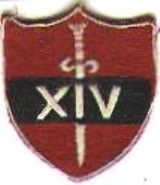
British Fourteenth Army

Encyclopedia
The British Fourteenth Army was a multinational force comprising units from Commonwealth
countries during World War II
. Many of its units were from the Indian Army
as well as British
units and there were also significant contributions from West and East Africa
n divisions within the British Army
.
It was often referred to as the "Forgotten Army" because its operations in the Burma Campaign
were overlooked by the contemporary press, and remained more obscure than those of the corresponding formations in Europe for long after the war.
For most of the Army's existence, it was commanded by Lieutenant General William Slim
.
. With the creation of South East Asia Command
in late 1943, the Eastern Army which formerly controlled operations against the Japanese Army
in Burma and also had large rear-area responsibilities, was split into two. Eastern Command (reporting to GHQ India) took over the rear areas of Bihar
, Orissa
and most of Bengal
. Fourteenth Army, part of the British 11th Army Group
, became responsible for operations against the Japanese.
The Army's commander was Lieutenant General William Slim
. Its principal subordinate formations were IV Corps in Assam
and XV Corps
in Arakan
. During the early part of 1944, the Army also had loose operational control over the American and Chinese
Northern Combat Area Command
, and the Chindits
operating behind enemy lines under Major General Orde Wingate.
The first Japanese move was a subsidiary attack in Arakan where XV Corps was advancing slowly south. After initial Allied setbacks, in which an Indian divisional HQ was overrun, the surrounded units defeated the Japanese at the Battle of the Admin Box
. A vital factor was the resupply of cut-off units by aircraft.
The main Japanese offensive was launched on the central front in Assam. While a division advanced to Kohima
to isolate IV Corps, the main body attempted to surround and destroy IV Corps at Imphal
. Since the Japanese attack in Arakan had already failed, battle hardened units were flown from Arakan to aid the besieged forces in Assam. Also, XXXIII Corps
was moved from southern India, where they had been training for amphibious operations, to relieve the garrison at Kohima and then push on to relieve Imphal.
The result of the battles was a crushing Japanese defeat. The Japanese suffered 85,000 casualties, mainly from sickness and disease after their supplies ran out. The Allies had been continually supplied from the air, in the largest operation of its type to that date.
The Japanese attempted to forestall the Allied attacks by withdrawing behind the Irrawaddy River. Fourteenth Army was nevertheless able to change its axis of advance. IV Corps, spearheaded by armoured and motorised
units, crossed the river downstream of the main Japanese forces and seized the vital logistic and communications centre of Meiktila
. As the Japanese attempted to recapture Meiktila, XXXIII Corps captured Mandalay
, the former capital which was of major significance to the majority Burman
population. The result of the Battles of Meiktila and Mandalay, known as the Battle of Central Burma, was the destruction of most of the Japanese units in Burma, which allowed the subsequent pursuit.
Fourteenth Army now advanced south. While XXXIII Corps advanced down the Irrawaddy River, IV Corps made the main effort along the Sittang River, covering 200 miles (321.9 km) in a month. It was vital to capture Rangoon
, the capital and principal port of Burma, to allow the Army to be supplied during the monsoon. In the event, IV Corps was held up 40 miles (64.4 km) north of Rangoon by sacrificial Japanese rearguards, but its advance caused the Japanese to abandon Rangoon, which was occupied after an unopposed amphibious landing (codenamed Operation Dracula
) on 2 May.
The Fourteenth Army was supported by the Women's Auxiliary Service (Burma)
who provided a canteen service for the troops of Burma Command and moved down through the country with the Army.
headquarters was formed from XXXIII Corps HQ and took over IV Corps. Fourteenth Army HQ now moved to Ceylon
to plan operations to recapture Malaya
and Singapore
. It controlled XV Corps and the newly-raised Indian XXXIV Corps
.
General Slim was promoted to command Allied Land Forces South East Asia. Lieutenant General Miles Dempsey
was appointed to command Fourteenth Army.
A seaborne landing on the west coast of Malaya, codenamed Operation Zipper
, was being prepared but was forestalled by the dropping of the atomic bombs on Hiroshima
and Nagasaki and the Japanese surrender. Zipper was nevertheless mounted unopposed as the quickest method of introducing troops to Malaya to enforce the surrender of the Japanese there and repatriate Allied prisoners of war
.
Fourteenth Army was renamed Malaya Command
on 1 November 1945.
but the majority of the army was built around the British Indian Army
, which was stated to be the largest all-volunteer army in history.
Army, with nearly a million men by late 1944.
At different periods of the Second World War it was composed of four corps:
A total of thirteen divisions served with the Army:
Some smaller fighting formations also served:
Also serving with the 14th Army were a range of army, corps and divisional units not organic
to the combat divisions.
Commonwealth of Nations
The Commonwealth of Nations, normally referred to as the Commonwealth and formerly known as the British Commonwealth, is an intergovernmental organisation of fifty-four independent member states...
countries during World War II
World War II
World War II, or the Second World War , was a global conflict lasting from 1939 to 1945, involving most of the world's nations—including all of the great powers—eventually forming two opposing military alliances: the Allies and the Axis...
. Many of its units were from the Indian Army
British Indian Army
The British Indian Army, officially simply the Indian Army, was the principal army of the British Raj in India before the partition of India in 1947...
as well as British
United Kingdom
The United Kingdom of Great Britain and Northern IrelandIn the United Kingdom and Dependencies, other languages have been officially recognised as legitimate autochthonous languages under the European Charter for Regional or Minority Languages...
units and there were also significant contributions from West and East Africa
East Africa
East Africa or Eastern Africa is the easterly region of the African continent, variably defined by geography or geopolitics. In the UN scheme of geographic regions, 19 territories constitute Eastern Africa:...
n divisions within the British Army
British Army
The British Army is the land warfare branch of Her Majesty's Armed Forces in the United Kingdom. It came into being with the unification of the Kingdom of England and Scotland into the Kingdom of Great Britain in 1707. The new British Army incorporated Regiments that had already existed in England...
.
It was often referred to as the "Forgotten Army" because its operations in the Burma Campaign
Burma Campaign
The Burma Campaign in the South-East Asian Theatre of World War II was fought primarily between British Commonwealth, Chinese and United States forces against the forces of the Empire of Japan, Thailand, and the Indian National Army. British Commonwealth land forces were drawn primarily from...
were overlooked by the contemporary press, and remained more obscure than those of the corresponding formations in Europe for long after the war.
For most of the Army's existence, it was commanded by Lieutenant General William Slim
William Slim, 1st Viscount Slim
Field Marshal William Joseph "Bill"'Slim, 1st Viscount Slim, KG, GCB, GCMG, GCVO, GBE, DSO, MC, KStJ was a British military commander and the 13th Governor-General of Australia....
.
Creation
The army was formed in 1943 in eastern IndiaIndia
India , officially the Republic of India , is a country in South Asia. It is the seventh-largest country by geographical area, the second-most populous country with over 1.2 billion people, and the most populous democracy in the world...
. With the creation of South East Asia Command
South East Asia Command
South East Asia Command was the body set up to be in overall charge of Allied operations in the South-East Asian Theatre during World War II.-Background:...
in late 1943, the Eastern Army which formerly controlled operations against the Japanese Army
Imperial Japanese Army
-Foundation:During the Meiji Restoration, the military forces loyal to the Emperor were samurai drawn primarily from the loyalist feudal domains of Satsuma and Chōshū...
in Burma and also had large rear-area responsibilities, was split into two. Eastern Command (reporting to GHQ India) took over the rear areas of Bihar
Bihar
Bihar is a state in eastern India. It is the 12th largest state in terms of geographical size at and 3rd largest by population. Almost 58% of Biharis are below the age of 25, which is the highest proportion in India....
, Orissa
Orissa
Orissa , officially Odisha since Nov 2011, is a state of India, located on the east coast of India, by the Bay of Bengal. It is the modern name of the ancient nation of Kalinga, which was invaded by the Maurya Emperor Ashoka in 261 BC. The modern state of Orissa was established on 1 April...
and most of Bengal
Bengal
Bengal is a historical and geographical region in the northeast region of the Indian Subcontinent at the apex of the Bay of Bengal. Today, it is mainly divided between the sovereign land of People's Republic of Bangladesh and the Indian state of West Bengal, although some regions of the previous...
. Fourteenth Army, part of the British 11th Army Group
British 11th Army Group
The 11th Army Group was the main British Army force in Southeast Asia during the Second World War. Although a nominally British formation, it also included large numbers of troops and formations from the British Indian Army and from British African colonies, and also Nationalist Chinese and United...
, became responsible for operations against the Japanese.
The Army's commander was Lieutenant General William Slim
William Slim, 1st Viscount Slim
Field Marshal William Joseph "Bill"'Slim, 1st Viscount Slim, KG, GCB, GCMG, GCVO, GBE, DSO, MC, KStJ was a British military commander and the 13th Governor-General of Australia....
. Its principal subordinate formations were IV Corps in Assam
Assam
Assam , also, rarely, Assam Valley and formerly the Assam Province , is a northeastern state of India and is one of the most culturally and geographically distinct regions of the country...
and XV Corps
XV Corps (British India)
The XV Corps was a formation of the British Indian Army, which was formed in India during World War II. It took part in the Burma Campaign and was disbanded after the end of the war.-World War II:...
in Arakan
Rakhine State
Rakhine State is a Burmese state. Situated on the western coast, it is bordered by Chin State in the north, Magway Region, Bago Region and Ayeyarwady Region in the east, the Bay of Bengal to the west, and the Chittagong Division of Bangladesh to the northwest. It is located approximately between...
. During the early part of 1944, the Army also had loose operational control over the American and Chinese
China
Chinese civilization may refer to:* China for more general discussion of the country.* Chinese culture* Greater China, the transnational community of ethnic Chinese.* History of China* Sinosphere, the area historically affected by Chinese culture...
Northern Combat Area Command
Northern Combat Area Command
The Northern Combat Area Command or NCAC was a mainly Sino-American formation that held the northern end of the Allied front in Burma during World War II. For much of its existence it was commanded by the acerbic General Joseph "Vinegar Joe" Stilwell, and controlled by his staff...
, and the Chindits
Chindits
The Chindits were a British India "Special Force" that served in Burma and India in 1943 and 1944 during the Burma Campaign in World War II. They were formed into long range penetration groups trained to operate deep behind Japanese lines...
operating behind enemy lines under Major General Orde Wingate.
Defending India
In early 1944, the Allies began tentative advances into Burma. The Japanese responded with all-out offensives, intending to destroy the Allies in their base areas.The first Japanese move was a subsidiary attack in Arakan where XV Corps was advancing slowly south. After initial Allied setbacks, in which an Indian divisional HQ was overrun, the surrounded units defeated the Japanese at the Battle of the Admin Box
Battle of the Admin Box
The Battle of the Admin Box took place on the Southern Front of the Burma Campaign from 5 February to 23 February 1944, in the South-East Asian Theatre of World War II...
. A vital factor was the resupply of cut-off units by aircraft.
The main Japanese offensive was launched on the central front in Assam. While a division advanced to Kohima
Battle of Kohima
The Battle of Kohima was the turning point of the Japanese U Go offensive into India in 1944 in the Second World War. The battle was fought from 4 April to 22 June 1944 around the town of Kohima in northeast India. It is often referred to as the "Stalingrad of the East".The battle took place in...
to isolate IV Corps, the main body attempted to surround and destroy IV Corps at Imphal
Battle of Imphal
The Battle of Imphal took place in the region around the city of Imphal, the capital of the state of Manipur in North-East India from March until July 1944. Japanese armies attempted to destroy the Allied forces at Imphal and invade India, but were driven back into Burma with heavy losses...
. Since the Japanese attack in Arakan had already failed, battle hardened units were flown from Arakan to aid the besieged forces in Assam. Also, XXXIII Corps
XXXIII Corps (British India)
The British Indian XXXIII Corps was a formation of the British Indian Army during World War II. It was disbanded and the headquarters was recreated as an Army headquarters in 1945.-Formation:...
was moved from southern India, where they had been training for amphibious operations, to relieve the garrison at Kohima and then push on to relieve Imphal.
The result of the battles was a crushing Japanese defeat. The Japanese suffered 85,000 casualties, mainly from sickness and disease after their supplies ran out. The Allies had been continually supplied from the air, in the largest operation of its type to that date.
Retaking Burma
In 1945, amphibious operations to recapture Burma had to be cancelled once again because of shortage of resources. Instead, Fourteenth Army was to mount the main offensive. The Army was now subordinated to the headquarters of Allied Land Forces, South East Asia (ALFSEA), and consisted of IV Corps and XXXIII Corps. Since the Army's supply lines by land were long and precarious, air supply was once again to be vital.The Japanese attempted to forestall the Allied attacks by withdrawing behind the Irrawaddy River. Fourteenth Army was nevertheless able to change its axis of advance. IV Corps, spearheaded by armoured and motorised
Motorised infantry
In NATO and most other western countries, motorised infantry is infantry which is transported by trucks or other motor vehicles. It is distinguished from mechanized infantry, which is carried in armoured personnel carriers, infantry combat vehicles, or infantry fighting vehicles...
units, crossed the river downstream of the main Japanese forces and seized the vital logistic and communications centre of Meiktila
Meiktila
Meiktila is a city in central Myanmar, located on the banks of Lake Meiktila in Mandalay Division, at the junctions of the Bagan-Taunggyi, Yangon-Mandalay and Meiktila-Myingyan highways. Because of its strategic position, Meiktila is home to Myanmar Air Force's central command and Meiktila Air...
. As the Japanese attempted to recapture Meiktila, XXXIII Corps captured Mandalay
Mandalay
Mandalay is the second-largest city and the last royal capital of Burma. Located north of Yangon on the east bank of the Irrawaddy River, the city has a population of one million, and is the capital of Mandalay Region ....
, the former capital which was of major significance to the majority Burman
Bamar
The Bamar are the dominant ethnic group of Burma , constituting approximately two-thirds of the population. The Bamar live primarily in the Irrawaddy basin, and speak the Burmese language, which is also the official language of Burma. Bamar customs and identity are closely intertwined with general...
population. The result of the Battles of Meiktila and Mandalay, known as the Battle of Central Burma, was the destruction of most of the Japanese units in Burma, which allowed the subsequent pursuit.
Fourteenth Army now advanced south. While XXXIII Corps advanced down the Irrawaddy River, IV Corps made the main effort along the Sittang River, covering 200 miles (321.9 km) in a month. It was vital to capture Rangoon
Yangon
Yangon is a former capital of Burma and the capital of Yangon Region . Although the military government has officially relocated the capital to Naypyidaw since March 2006, Yangon, with a population of over four million, continues to be the country's largest city and the most important commercial...
, the capital and principal port of Burma, to allow the Army to be supplied during the monsoon. In the event, IV Corps was held up 40 miles (64.4 km) north of Rangoon by sacrificial Japanese rearguards, but its advance caused the Japanese to abandon Rangoon, which was occupied after an unopposed amphibious landing (codenamed Operation Dracula
Operation Dracula
During World War II, Operation Dracula was the name given to an airborne and amphibious attack on Rangoon by British and Indian forces, part of the Burma Campaign. When it was launched, the Imperial Japanese Army had already abandoned the city.-Background:...
) on 2 May.
The Fourteenth Army was supported by the Women's Auxiliary Service (Burma)
Women's Auxiliary Service (Burma)
The Women’s Auxiliary Service was formed on January 16, 1942 and disbanded in 1946. The WASs were a group of British and Australian women who manned Mobile Canteens for the troops of Burma Command in World War II...
who provided a canteen service for the troops of Burma Command and moved down through the country with the Army.
End of the War
Shortly after the fall of Rangoon, the Army headquarters was relieved of responsibility for operations in Burma. A new Twelfth ArmyBritish Twelfth Army
During the Second World War, two formations called the British Twelfth Army were created, the first was formed in the Middle East in early 1943 as part of the Operation Barclay deception plan, the second was created in Burma in May 1945....
headquarters was formed from XXXIII Corps HQ and took over IV Corps. Fourteenth Army HQ now moved to Ceylon
Sri Lanka
Sri Lanka, officially the Democratic Socialist Republic of Sri Lanka is a country off the southern coast of the Indian subcontinent. Known until 1972 as Ceylon , Sri Lanka is an island surrounded by the Indian Ocean, the Gulf of Mannar and the Palk Strait, and lies in the vicinity of India and the...
to plan operations to recapture Malaya
British Malaya
British Malaya loosely described a set of states on the Malay Peninsula and the Island of Singapore that were brought under British control between the 18th and the 20th centuries...
and Singapore
Singapore
Singapore , officially the Republic of Singapore, is a Southeast Asian city-state off the southern tip of the Malay Peninsula, north of the equator. An island country made up of 63 islands, it is separated from Malaysia by the Straits of Johor to its north and from Indonesia's Riau Islands by the...
. It controlled XV Corps and the newly-raised Indian XXXIV Corps
Indian XXXIV Corps
The Indian XXXIV Corps was formed in March 1945 to be part of the British Fourteenth Army for Operation Zipper, the invasion of British Malaya. Significant formations under Fourteenth Army for 'Zipper,' possibly under XXXIV Corps, included 5th Indian Division, 23rd Indian Division, 25th Indian...
.
General Slim was promoted to command Allied Land Forces South East Asia. Lieutenant General Miles Dempsey
Miles Dempsey
General Sir Miles Christopher Dempsey, GBE, KCB, DSO, MC was commander of the British Second Army during the D-Day landings in the Second World War...
was appointed to command Fourteenth Army.
A seaborne landing on the west coast of Malaya, codenamed Operation Zipper
Operation Zipper
During the Second World War, Operation Zipper was a British plan to capture either Port Swettenham or Port Dickson, Malaya as staging areas for the recapture of Singapore. However, due to the end of the war in the Pacific, it was never fully executed. Some of the proposed landings on Penang went...
, was being prepared but was forestalled by the dropping of the atomic bombs on Hiroshima
Hiroshima
is the capital of Hiroshima Prefecture, and the largest city in the Chūgoku region of western Honshu, the largest island of Japan. It became best known as the first city in history to be destroyed by a nuclear weapon when the United States Army Air Forces dropped an atomic bomb on it at 8:15 A.M...
and Nagasaki and the Japanese surrender. Zipper was nevertheless mounted unopposed as the quickest method of introducing troops to Malaya to enforce the surrender of the Japanese there and repatriate Allied prisoners of war
Prisoner of war
A prisoner of war or enemy prisoner of war is a person, whether civilian or combatant, who is held in custody by an enemy power during or immediately after an armed conflict...
.
Fourteenth Army was renamed Malaya Command
Malaya Command
The Malaya Command was a command of British Commonwealth forces formed in the 1920s for the coordination of the defences of Malaya and Singapore.-History:...
on 1 November 1945.
Commonwealth Army
The Fourteenth Army, like the Eighth Army, was made up from units that came from all corners of the Commonwealth. In 1945 not only was the Fourteenth Army the largest army in the Commonwealth, it was the largest single army in the world with about half a million men under command. Men of the 81st and 82nd West African and 11th East African Divisions served with great distinction. There were many units and formations from the British ArmyBritish Army
The British Army is the land warfare branch of Her Majesty's Armed Forces in the United Kingdom. It came into being with the unification of the Kingdom of England and Scotland into the Kingdom of Great Britain in 1707. The new British Army incorporated Regiments that had already existed in England...
but the majority of the army was built around the British Indian Army
British Indian Army
The British Indian Army, officially simply the Indian Army, was the principal army of the British Raj in India before the partition of India in 1947...
, which was stated to be the largest all-volunteer army in history.
Order of battle
The Fourteenth Army was the Second World War’s largest CommonwealthCommonwealth of Nations
The Commonwealth of Nations, normally referred to as the Commonwealth and formerly known as the British Commonwealth, is an intergovernmental organisation of fifty-four independent member states...
Army, with nearly a million men by late 1944.
At different periods of the Second World War it was composed of four corps:
- IV Corps
- XV CorpsXV Corps (British India)The XV Corps was a formation of the British Indian Army, which was formed in India during World War II. It took part in the Burma Campaign and was disbanded after the end of the war.-World War II:...
- XXXIII CorpsXXXIII Corps (British India)The British Indian XXXIII Corps was a formation of the British Indian Army during World War II. It was disbanded and the headquarters was recreated as an Army headquarters in 1945.-Formation:...
- XXXIV CorpsIndian XXXIV CorpsThe Indian XXXIV Corps was formed in March 1945 to be part of the British Fourteenth Army for Operation Zipper, the invasion of British Malaya. Significant formations under Fourteenth Army for 'Zipper,' possibly under XXXIV Corps, included 5th Indian Division, 23rd Indian Division, 25th Indian...
A total of thirteen divisions served with the Army:
- 2nd Infantry Division
- Indian 5th Infantry DivisionIndian 5th Infantry DivisionIndian 5th Infantry Division was an infantry division in the Indian Army during World War II which fought in several theatres of war and more than earned its nickname the "Ball of Fire".- History :...
- Indian 7th Infantry Division
- 11th (East African) Infantry Division11th (East Africa) DivisionThe 11th Infantry Division was a British Empire colonial unit formed in February 1943 during World War II.-Formation:In 1943, the 11th Division was formed primarily of troops from British East Africa....
- Indian 17th Infantry Division
- Indian 19th Infantry Division
- Indian 20th Infantry Division
- Indian 23rd Infantry Division23rd Infantry Division (India)The Indian 23rd Infantry Division was an infantry division of the Indian Army during World War II. It fought in the Burma Campaign.-History:The division was raised on 1 January 1942, at Jhansi in Central India. Its badge was a red fighting cock on a yellow circle...
- Indian 25th Infantry Division25th Infantry Division (India)The 25th Indian Infantry Division was a division of the Indian Army during World War II which fought in the Burma Campaign during World War II.-History:...
- Indian 26th Infantry DivisionIndian 26th Infantry DivisionThe 26th Indian Infantry Division, was part of the Indian Army during World War II. It fought in the Burma Campaign.-History:When the Japanese invaded Burma in 1942, the various units in training or stationed around Barrackpur near Calcutta in India were hastily formed into the "Calcutta" Division...
- 36th Infantry Division
- 81st (West Africa) Infantry Division81st (West Africa) DivisionThe 81st Division was formed under British control during World War II. It took part in the Burma Campaign.-History:The inspiration for the division's formation came from General George Giffard, commander of the British Army's West Africa Command, who subsequently commanded India Command's Eastern...
- 82nd (West Africa) Infantry Division82nd (West Africa) DivisionThe 82nd Division was formed under British control during World War II. It took part in the later stages of the Burma Campaign and was disbanded in Burma between May and September 1946.-Formation:...
Some smaller fighting formations also served:
- 50th Parachute Brigade (India)50th Parachute Brigade (India)The 50th Parachute Brigade is a formation of the Indian Army, first formed in 1941. The formation was initially raised as part of the Indian Army during World War II. It was formed in October 1941, as an independent parachute brigade. Later it was one of two parachute brigades in the 44th Indian...
- 268 Indian Motor Brigade
- Lushai BrigadeLushai BrigadeThe Lushai Brigade was an improvised fighting formation of the British Indian Army which was formed during World War II. It participated in the Battle of Imphal and the Burma Campaign.-History:In March 1944, the Imperial Japanese Army invaded India...
- 28 Infantry Brigade (East Africa)
Also serving with the 14th Army were a range of army, corps and divisional units not organic
Organic (military)
In military terminology, organic refers to a military unit that is a permanent part of a larger unit and provides some specialized capability to that parent unit...
to the combat divisions.
Further reading
- Brian AldissBrian AldissBrian Wilson Aldiss, OBE is an English author of both general fiction and science fiction. His byline reads either Brian W. Aldiss or simply Brian Aldiss. Greatly influenced by science fiction pioneer H. G. Wells, Aldiss is a vice-president of the international H. G. Wells Society...
, Forgotten Life (1988) - Louis Allen, Burma: The Longest War, 1941-45, London: Weidenfeld and Nicolson, 2000.
- Bernard Fergusson, Beyond the Chindwin, 1962.
- George MacDonald FraserGeorge MacDonald FraserGeorge MacDonald Fraser, OBE was an English-born author of Scottish descent, who wrote both historical novels and non-fiction books, as well as several screenplays.-Early life and military career:...
. Quartered Safe Out Here: Recollections of the War in Burma. London: Harper Collins (1995). (Fraser, author of the Flashman series of historical novels, writes vividly of his service in the Burma campaigns of 1944-45, and of the soldiers he served with.) - Michael Hickey, The Unforgettable Army: Slim's XIVth Army in Burma, Stroud: Spellmount, 1998.
- Jon LatimerJon LatimerJonathan David Latimer was an historian and writer based in Wales. His books include Operation Compass 1940 , Tobruk 1941 , Deception in War , Alamein , Burma: The Forgotten War and 1812: War with America which won a...
, Burma: The Forgotten War, London: John Murray, 2004. - Robert Lyman, Slim, Master of War, London: Constable and Robinson, 2004.
- William Slim, Defeat into Victory, London: Cassell, 1956.
- Julian Thompson, The Imperial War Museum Book of the War in Burma 1942-1945, London: Pan Macmillan, 2003.
- James Howard WilliamsJames Howard WilliamsJames Howard Williams or 'Elephant Bill' was a British soldier and elephant expert in Burma, known for his work with the Fourteenth Army during the Burma Campaign of World War II, and for his 1950 book Elephant Bill...
(Elephant Bill), was Elephant Advisor to the Fourteenth Army, see his Elephant Bill (1950) and Bandoola (1953)