

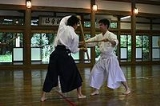
Kashima Shinden Jikishinkage-ryu

Encyclopedia
, often referred to simply as Jikishinkage-ryū or Kashima Shinden, is a traditional school (koryū
) of the Japanese martial art of swordsmanship
(kenjutsu
). The school was founded in the mid-16th century, based upon older styles of swordsmanship, and is one of the few ancient Japanese martial arts schools still existing today.
Kashima Shinden Jikishinkage-ryū
can be translated as the "divinely transmitted, honest reflection of the heart, school of Kashima
."
By repetitive practice, one maintains a constant connection with the cosmos by aspiring to jikishin (直心) unwavering intention and seimeishin (生命心) perfect clarity of mind, just like a cloudless sky on a brilliant sunny day. A practitioner who has attained heightened jikishin and seimeishin is said to have fudōshin
(不動心) immovable heart.
which overlaps the early Sengoku period
, or better dated as late 15th or early 16th century, at the Kashima Shrine
by the founder, Matsumoto Bizen-no-Kami Naokatsu (松本 備前守 尚勝, 1467–1524). The direct predecessors of the Jikishinkage-ryū style are the Shinkage-ryū
and the Kage-ryū (Aizu)
styles.
The Jikishin Kage-ryū Kenjutsu comes from a previous school, Kage-ryū Kenjutsu. A samurai
(侍) called Aizu Iko founded Kage-ryū in 1490. He perfected, and taught his style around Japan. There are evidence from 1525, that another samurai, Kamiizumi Ise no Kami Nobutsuna (1508–1548) is teaching his own style, a form of Kage-ryū kenjutsu. He called it Shinkage-ryū (the school of the new shadow). Jikishin Kage-ryū means 'the newest school of the ancient shadow'. He was denoting with the name, to the ancestors, and expressing respect to his former masters. Matsumoto Bizen no Kami Naokatsu was a famous master of this school, he also founded his own school first called Kashima Shinryū, then Kashima Shinden Jiki Shinkage-ryū. These schools can be found even today all around the world. There are more variations like Jikishin Kage-ryū, Seito Shinkage-ryū, etc.
During the 19th century, Jiki Shinkage-ryū was one of the most popular schools of combative swordsmanship (kenjutsu) in eastern Japan, especially in the Edo area. The 14th headmaster or sōke
(宗家) of Jikishin Kage-ryū Kenjutsu—Kenkichi Sakakibara—was one of the most well-known swordsmen of his time, and the personal bodyguard of the Shogun.
Sakakibara had hundreds of students during his lifetime, many of them rising to the "rank" of menkyo kaiden (免許皆伝) and shihan
(師範), thus able to pass on the full tradition. His most talented disciple was Yamada Jirōkichi (山田 次朗) from whom the Seito-ha (正統派), which means main line system or traditional school, and many branch lines were derived. (Watatani and Yamada, Bugei ryuha daijiten, 1978:155–156, list 20 menkyo kaiden successors under Sakakibara.)
A less well-known, but highly skilled, menkyo kaiden ranked student was Matsudaira Yasutoshi, who, like Yamada Jirōkichi, studied the more traditional ways of Jikishin Kage-ryū. The best apprentice of Yasutoshi was Makita Shigekats, a young man from a samurai family from Hokkaidō. His name, and Jikishin Kage-ryū became famous on the northern island in the times of the Japanese civil war in 1868. By sword fighting, he was an expert in kyūdō
(弓道), Japanese archery. He was the heir of the title of shihan of Jikishinkage-ryū, but unfortunately he was fighting a losing battle against the Emperor in the revolution. The cast of the samurai was disbanded, and he had to run. Later, he returned to Hokkaidō
, and opened his own dōjō
, called Jikishin Kan Dōjō. He was teaching various martial arts, not just kenjutsu. His dōjō was popular, in spite of the prohibition of the katana
in 1876.
After Shigekatsu's death, the village of Atsuta raised a black granite obelisk in his memory. This memorial can be seen today. The family tradition has been taken by his grandson, Kimiyoshi Suzuki. Kimiyoshi is also a master of Goju-ryu Karate
and Jikishin Kage-ryū Kenjutsu.
There were many other famous practitioners of Jiki Shinkage-ryū under Sakakibara who did not reach the highest levels of the system and consequently were not named as successors. Perhaps the most famous of these was Sokaku Takeda, founder of Daitō-ryū Aiki-jūjutsu. In contrast, some writers have claimed that other famous historical personages such as Muso Gonnosuke
were in the line of transmission of Jiki Shinkage-ryu. However, Gonnosuke was never in the direct lineage of Jiki Shinkage-ryu.
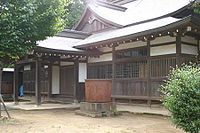 The Jikishinkage-ryū style has many differences when compared to modern kendō
. We can readily point out the different footwork and breathing.
The unpō (運法) is the footwork used in the Jikishinkage-ryū style and can be translated as law, rule or method (for) transporting, conveying or carrying ('walking'). Unlike the suriashi of modern kendo, it is stressed that both feet stay firmly planted on the ground at all times. The kiai
(気合) consists not only of the shouting, like most martial arts, but of the proper way of inhaling and state of mind as well. This is even more reflected in the synchronous deep breathing called Aum
(唵) (or a-un) with one's partner which accompanies most movements.
Every kata
(形) has two distinct roles called uchidachi
(打太刀) the striking/attacking sword and shidachi
(受太刀) the doing/receiving sword. Some parts of the kata are identical for both roles, like the kamihanen (上半円) upper semicircle
and shimohanen (下半円) lower semicrcle (also called johanen and gehanen). These are unconventional waza (技) techniques and characteristic for this style. Roughly, the swordsman draws a semicircle (upwards or downwards) with both his right
hand (holding the sword), and his left
hand (free). He finishes the movement with his arms extended, the sword pointing upwards, and the free hand's index finger pointing downwards. These movements can be considered as a greeting and a form of meditation, and are usually executed in the beginning and end of a kata or suburi
(素振り) session. They represent all the things in heaven and all the things in earth, and the practitioner in the center of everything.
Another typical technique is the morōde (両腕) both arms movement in which uchidachi raises with both arms the sword of shidachi to jōdan and receives the subsequent uchikomi with the side of the blade. This results in thrusting the left arm forwards and turning both arms outwards to allow to absorb shidachi's cut which is in kiritsuki style like performed by a kaishakunin
(介錯人).
Jikishinkage-ryū exponents train with both ōdachi
(大太刀) and kodachi
(小太刀) (but not both at once).
(keikoga) in the old times. It was needed for protection, though it was sometimes still not enough. Practices are far less dangerous nowadays, the standard clothes in kenjutsu are normal keikogi
(稽古着) and hakama
(袴). Preferably all pieces are in the same colour of dark blue or, when one seriously dedicates the practice to the kami
(神), in white. To prevent treading on the hakama when moving in a low position, the hakama is raised a bit by neatly folding the left and right outside front pleats up under the straps which are tied around the waist, before training commences. It is possible to wear tabi
(足袋) when necessary.
For outdoor practice, jika-tabi
(地下足袋) are worn. As uchidachi always faces sun, this role can be very blinding, but it is not allowed to wear sunglasses or hats. However, in extremely cold conditions one can wear a hat (without sun reflector) and other extra protective clothing. When one has not enough hair or eyebrows or in extreme hot conditions, one can wear a tenugui
(手拭い) or hachimaki
(鉢巻) to prevent sweat irritating the eyes or to keep hair out of the face. Note that tabi and jiki-tabi should preferably match the colour of the hakama.
It is prohibited to wear jewellery and the like as is custom in many martial arts. This rule is to prevent injuries to oneself and practicing partner as it is to prevent excessive display of ego and unneeded distractions.
Some practitioners wear aikidogi
(合気道着) or karategi
(空手着). In some groups beginners wear white obi
(帯), intermediates wear blue and brown obi and advanced wear black obi with hakama. Others practice in hakama without colored obi.
Over the years the trainee should begin showing competence in leading/teaching the system. Consequently usually, but not always, the student receiving kyuri-no-maki is at the level of kyoshi (assistant instructor); the student receiving goku-i is at the level of shihandai (associate instructor); and the recipient of menkyo is at the level of shihan (master instructor). However, according to Yoshida Hijime (吉田基), the current (20th) headmaster of the Seito-ha, only a shihan may teach independently of the headmaster. A restriction not necessarily followed in other lines.
For Shinbukan, the following applies:
The highest rank disciples of Kimiyoshi Suzuki sensei are 2nd dan black belts (mokuroku). The exams for belts are held once in a year, in the summer training camp. A person can take only one exam in a year.
In some groups, hakama can only be worn by those who successfully completed their 1st dan exam. This is mainly done for practical reasons. One is that the teacher can see how the student positions his or her legs and feet. Another reason is that the teacher and students can quickly see whom to call upon for assistance. In more traditional groups, everyone wears hakama.
 The Hōjō no kata (法定之形) is the first classic kata of the Jikishinkage-ryū style and can be translated as laws, rules or methods ('principals') (which are) definitive, crucial or stable ('fundamental') or fundamental principals, i.e. the basics. Both the shidachi and the uchidachi usually use wooden swords, bokken
(木剣) or bokutō (木刀), although real swords, shinken
(真剣), can be used as well.
The Hōjō no kata is composed of four stages which are named after the four seasons, namely haru (春) spring, natsu (夏) summer, aki (秋) autumn and fuyu (冬) winter in order of execution. Each season contains from six to eight waza (movement). Before each season is executed the kamihanen, and after each season, the shimohanen.
Each season has a respective pace, kōan (公案) theme, footwork, breathing, kiai, and other features reminiscent of the perceived characteristics of that season. Spring has waza which are executed in a smooth and fast manner, accompanied by loud kiai. The kōan of spring is eight-directions explosive-blast which can be translated as all directions. Summer has movements that are explosive and intense. The kōan of summer is one-sword both-cut which can be translated as cutting your ego. Autumn has a varied pace, symbolizing change. The kōan of autumn is right-turn left-turn which can be translated as times of change. Winter movements are slow, reserved but firm and efficient. This is even more accentuated on the footwork of each season. The kōan of winter is long-short one-body. The following example is an illustration of this principle. Imagine a situation where one person has a yari
(槍) or naginata
(長刀 or 薙刀), which stands for long, and the other a has sword, which stands for short, but the situation is as such that there is no more discussion, any discussion at this point would be superfluous. This metaphor tries to explain the meaning behind this kōan that in this season life and death are one.
The themes of the four seasons refer to universal principles which also express themselves in other manifestations. Some of these are listed in the table below.
Both uchidachi and shidachi take on a stance in spring and autumn which is called nio dachi. This refers to the pair of guardian deities of Buddhism
called niō
(仁王), which can be found as large statues at entrances of some of the ancient Japanese temples and shrines. The right statue is called Misshaku Kongō (密迹金剛) who has his mouth opened, this represents vocalization of "a." The left statue is called Naraen Kongō (那羅延金剛) who has his mouth closed, represents the vocalization of "um."
It is said that these two characters together symbolize the birth and death of all things, like we are born with "a" and our mouth open (inhale) and we die with "um" and our mouth closed (exhale). This is similar to "Alpha and Omega
" or "A to Z" signifying "beginning and end", "everything" or "all creation." The contraction of both is Aum
(Devanagari
ॐ), which is an important concept in Sanskrit. The stances and expressions of the statues, the sounds "a" and "um" and the symbolism behind this are very import in the Hōjō no kata.
The 15th headmaster wrote this on the meaning of the Hōjō no kata:
This kata is composed of fourteen stages, divided in six groups. Each stage has about four movements. This kata is characterized by very fast waza. Both the uchidachi and the shidachi use fukuro shinai (袋竹刀) which explains the origin on the name.
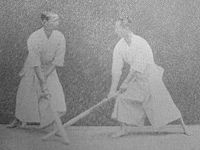
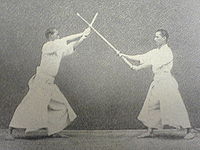
This kata used to be a secret. It is not clear when the secrecy was lifted but the kata is, like the other five, described with text and photographs in the book of Yamada Jirōkichi that was published in the early 20th century (1927).
Koryu
is a Japanese word that is used in association with the ancient Japanese martial arts. This word literally translates as "old school" or "traditional school"...
) of the Japanese martial art of swordsmanship
Swordsmanship
Swordsmanship refers to the skills of a swordsman, a person versed in the art of the sword. The term is modern, and as such was mainly used to refer to smallsword fencing, but by extension it can also be applied to any martial art involving the use of a sword...
(kenjutsu
Kenjutsu
, meaning "the method, or technique, of the sword." This is opposed to kendo, which means the way of the sword. Kenjutsu is the umbrella term for all traditional schools of Japanese swordsmanship, in particular those that predate the Meiji Restoration...
). The school was founded in the mid-16th century, based upon older styles of swordsmanship, and is one of the few ancient Japanese martial arts schools still existing today.
Kashima Shinden Jikishinkage-ryū
Ryu (school)
A Ryū , or ryūha , is a Japanese word referring to a school of thought in any discipline...
can be translated as the "divinely transmitted, honest reflection of the heart, school of Kashima
Kashima, Ibaraki
is a port city located in Ibaraki Prefecture, Japan.As of October 1, 2010, the city has an estimated population of 66,249 and a population density of 708.02 persons per km². The total area is 93.57 km². Kashima was formerly a town in Kashima District and became a city after merging with the...
."
By repetitive practice, one maintains a constant connection with the cosmos by aspiring to jikishin (直心) unwavering intention and seimeishin (生命心) perfect clarity of mind, just like a cloudless sky on a brilliant sunny day. A practitioner who has attained heightened jikishin and seimeishin is said to have fudōshin
Fudoshin
Fudōshin is a state of equanimity or imperturbability...
(不動心) immovable heart.
History
The Jikishinkage-ryū style descends from the kenjutsu styles developed in the late Muromachi periodMuromachi period
The is a division of Japanese history running from approximately 1336 to 1573. The period marks the governance of the Muromachi or Ashikaga shogunate, which was officially established in 1338 by the first Muromachi shogun, Ashikaga Takauji, two years after the brief Kemmu restoration of imperial...
which overlaps the early Sengoku period
Sengoku period
The or Warring States period in Japanese history was a time of social upheaval, political intrigue, and nearly constant military conflict that lasted roughly from the middle of the 15th century to the beginning of the 17th century. The name "Sengoku" was adopted by Japanese historians in reference...
, or better dated as late 15th or early 16th century, at the Kashima Shrine
Kashima Shrine
Kashima Shrine is a shrine dedicated to the Shinto kami Takemikazuchi-no-mikoto , one of the patron deities of martial arts. Dojo of kenjutsu and kendo sometimes display a kakejiku emblazoned with Kashima Taishin...
by the founder, Matsumoto Bizen-no-Kami Naokatsu (松本 備前守 尚勝, 1467–1524). The direct predecessors of the Jikishinkage-ryū style are the Shinkage-ryū
Shinkage-ryu
' meaning "new shadow school", is a traditional school of Japanese martial arts, founded by Kamiizumi Ise-no-Kami Nobutsuna in the mid-sixteenth century...
and the Kage-ryū (Aizu)
Kage-ryu (Aizu)
is a traditional school of swordsmanship founded by Aizu Hyūga-no-Kami Iko in c.1490. This school is also sometimes called Aizu Kage-ryū after the name of its founder...
styles.
The Jikishin Kage-ryū Kenjutsu comes from a previous school, Kage-ryū Kenjutsu. A samurai
Samurai
is the term for the military nobility of pre-industrial Japan. According to translator William Scott Wilson: "In Chinese, the character 侍 was originally a verb meaning to wait upon or accompany a person in the upper ranks of society, and this is also true of the original term in Japanese, saburau...
(侍) called Aizu Iko founded Kage-ryū in 1490. He perfected, and taught his style around Japan. There are evidence from 1525, that another samurai, Kamiizumi Ise no Kami Nobutsuna (1508–1548) is teaching his own style, a form of Kage-ryū kenjutsu. He called it Shinkage-ryū (the school of the new shadow). Jikishin Kage-ryū means 'the newest school of the ancient shadow'. He was denoting with the name, to the ancestors, and expressing respect to his former masters. Matsumoto Bizen no Kami Naokatsu was a famous master of this school, he also founded his own school first called Kashima Shinryū, then Kashima Shinden Jiki Shinkage-ryū. These schools can be found even today all around the world. There are more variations like Jikishin Kage-ryū, Seito Shinkage-ryū, etc.
During the 19th century, Jiki Shinkage-ryū was one of the most popular schools of combative swordsmanship (kenjutsu) in eastern Japan, especially in the Edo area. The 14th headmaster or sōke
Soke
The word soke has several meanings:* Soke , an early Western jurisdictional concept.* Soke or eke is a Tongan stick dance, originating from Wallis and Futuna., a Japanese title meaning "head of the family," and is usually used to denote the headmaster of a school of Japanese martial arts.* Soke of...
(宗家) of Jikishin Kage-ryū Kenjutsu—Kenkichi Sakakibara—was one of the most well-known swordsmen of his time, and the personal bodyguard of the Shogun.
Sakakibara had hundreds of students during his lifetime, many of them rising to the "rank" of menkyo kaiden (免許皆伝) and shihan
Shihan
- Title of "Master" is a Japanese Honorific Title, Expert License Certification used in Japanese martial arts for Master Level Instructors. The award of the Expert License Certification is if designated by the qualification by virtue of endorsement by the [A] Association of Chief Instructors or [B]...
(師範), thus able to pass on the full tradition. His most talented disciple was Yamada Jirōkichi (山田 次朗) from whom the Seito-ha (正統派), which means main line system or traditional school, and many branch lines were derived. (Watatani and Yamada, Bugei ryuha daijiten, 1978:155–156, list 20 menkyo kaiden successors under Sakakibara.)
A less well-known, but highly skilled, menkyo kaiden ranked student was Matsudaira Yasutoshi, who, like Yamada Jirōkichi, studied the more traditional ways of Jikishin Kage-ryū. The best apprentice of Yasutoshi was Makita Shigekats, a young man from a samurai family from Hokkaidō. His name, and Jikishin Kage-ryū became famous on the northern island in the times of the Japanese civil war in 1868. By sword fighting, he was an expert in kyūdō
Kyudo
, literally meaning "way of the bow", is the Japanese art of archery. It is a modern Japanese martial art and practitioners are known as .It is estimated that there are approximately half a million practitioners of kyudo today....
(弓道), Japanese archery. He was the heir of the title of shihan of Jikishinkage-ryū, but unfortunately he was fighting a losing battle against the Emperor in the revolution. The cast of the samurai was disbanded, and he had to run. Later, he returned to Hokkaidō
Hokkaido
, formerly known as Ezo, Yezo, Yeso, or Yesso, is Japan's second largest island; it is also the largest and northernmost of Japan's 47 prefectural-level subdivisions. The Tsugaru Strait separates Hokkaido from Honshu, although the two islands are connected by the underwater railway Seikan Tunnel...
, and opened his own dōjō
Dojo
A is a Japanese term which literally means "place of the way". Initially, dōjōs were adjunct to temples. The term can refer to a formal training place for any of the Japanese do arts but typically it is considered the formal gathering place for students of any Japanese martial arts style to...
, called Jikishin Kan Dōjō. He was teaching various martial arts, not just kenjutsu. His dōjō was popular, in spite of the prohibition of the katana
Katana
A Japanese sword, or , is one of the traditional bladed weapons of Japan. There are several types of Japanese swords, according to size, field of application and method of manufacture.-Description:...
in 1876.
After Shigekatsu's death, the village of Atsuta raised a black granite obelisk in his memory. This memorial can be seen today. The family tradition has been taken by his grandson, Kimiyoshi Suzuki. Kimiyoshi is also a master of Goju-ryu Karate
Karate
is a martial art developed in the Ryukyu Islands in what is now Okinawa, Japan. It was developed from indigenous fighting methods called and Chinese kenpō. Karate is a striking art using punching, kicking, knee and elbow strikes, and open-handed techniques such as knife-hands. Grappling, locks,...
and Jikishin Kage-ryū Kenjutsu.
There were many other famous practitioners of Jiki Shinkage-ryū under Sakakibara who did not reach the highest levels of the system and consequently were not named as successors. Perhaps the most famous of these was Sokaku Takeda, founder of Daitō-ryū Aiki-jūjutsu. In contrast, some writers have claimed that other famous historical personages such as Muso Gonnosuke
Muso Gonnosuke
Musō Gonnosuke Katsuyoshi was a samurai of the early 17th century and the traditional founder of the Koryu school of jojutsu known as Shintō Musō-ryū...
were in the line of transmission of Jiki Shinkage-ryu. However, Gonnosuke was never in the direct lineage of Jiki Shinkage-ryu.
Characteristics
Kendo
, meaning "Way of The Sword", is a modern Japanese martial art of sword-fighting based on traditional Japanese swordsmanship, or kenjutsu.Kendo is a physically and mentally challenging activity that combines strong martial arts values with sport-like physical elements.-Practitioners:Practitioners...
. We can readily point out the different footwork and breathing.
The unpō (運法) is the footwork used in the Jikishinkage-ryū style and can be translated as law, rule or method (for) transporting, conveying or carrying ('walking'). Unlike the suriashi of modern kendo, it is stressed that both feet stay firmly planted on the ground at all times. The kiai
Kiai
is a Japanese term used in martial arts. There are numerous examples of the battle cry in other cultures: kiai is perhaps primarily a development of this. In the representation of Asian martial arts in cinema and in animated cartoons, Modern Kiai are often written by westerners in Romaji as...
(気合) consists not only of the shouting, like most martial arts, but of the proper way of inhaling and state of mind as well. This is even more reflected in the synchronous deep breathing called Aum
Aum
Om or Aum Om or Aum Om or Aum (also , written in Devanāgari as and as , in Sanskrit known as (lit. "to sound out loudly"), ', or ' (also as ') (lit. "Auṃ form/syllable"), is a sacred/mystical syllable in the Dharmic or Indian religions, i.e...
(唵) (or a-un) with one's partner which accompanies most movements.
Every kata
Kata
is a Japanese word describing detailed choreographed patterns of movements practised either solo or in pairs. The term form is used for the corresponding concept in non-Japanese martial arts in general....
(形) has two distinct roles called uchidachi
Uchidachi
means "striking/attacking sword" and is one of the two roles in kata of budō and bujutsu, the other being shidachi .The senior party is normally uchidachi...
(打太刀) the striking/attacking sword and shidachi
Shidachi
means "doing/receiving sword" and is one of the two roles in kata of budō and bujutsu, the other being uchidachi . In modern Kendo this is normally written ....
(受太刀) the doing/receiving sword. Some parts of the kata are identical for both roles, like the kamihanen (上半円) upper semicircle
Semicircle
In mathematics , a semicircle is a two-dimensional geometric shape that forms half of a circle. Being half of a circle's 360°, the arc of a semicircle always measures 180° or a half turn...
and shimohanen (下半円) lower semicrcle (also called johanen and gehanen). These are unconventional waza (技) techniques and characteristic for this style. Roughly, the swordsman draws a semicircle (upwards or downwards) with both his right
Relative direction
The most common relative directions are left, right, forward, backward, up, and down. No absolute direction corresponds to any of the relative directions. This is a consequence of the translational invariance of the laws of physics: nature, loosely speaking, behaves the same no matter what...
hand (holding the sword), and his left
Relative direction
The most common relative directions are left, right, forward, backward, up, and down. No absolute direction corresponds to any of the relative directions. This is a consequence of the translational invariance of the laws of physics: nature, loosely speaking, behaves the same no matter what...
hand (free). He finishes the movement with his arms extended, the sword pointing upwards, and the free hand's index finger pointing downwards. These movements can be considered as a greeting and a form of meditation, and are usually executed in the beginning and end of a kata or suburi
Suburi
is a Japanese word which is used to describe practice swings used in sports such as baseball, tennis, golf, and in martial arts. Outside of Japan, the word is used exclusively for repetitive individual cutting exercises used in Japanese martial arts such as kendo, aikido, iaidō, and kenjutsu. Often...
(素振り) session. They represent all the things in heaven and all the things in earth, and the practitioner in the center of everything.
Another typical technique is the morōde (両腕) both arms movement in which uchidachi raises with both arms the sword of shidachi to jōdan and receives the subsequent uchikomi with the side of the blade. This results in thrusting the left arm forwards and turning both arms outwards to allow to absorb shidachi's cut which is in kiritsuki style like performed by a kaishakunin
Kaishakunin
A kaishakunin is an appointed second whose duty is to behead one who has committed seppuku, Japanese ritual suicide, at the moment of agony...
(介錯人).
Jikishinkage-ryū exponents train with both ōdachi
Odachi
An , was a type of long Japanese sword. The term nodachi, or "field sword", which refers to a different type of sword, is often mistakenly used in place of ōdachi. It is historically known as ōtachi....
(大太刀) and kodachi
Kodachi
A , literally translating into "small or short tachi ", is a Japanese sword that is too long to be considered a dagger but too short to be a long sword...
(小太刀) (but not both at once).
Clothing
Kenjutsu was practiced in a thick kimonoKimono
The is a Japanese traditional garment worn by men, women and children. The word "kimono", which literally means a "thing to wear" , has come to denote these full-length robes...
(keikoga) in the old times. It was needed for protection, though it was sometimes still not enough. Practices are far less dangerous nowadays, the standard clothes in kenjutsu are normal keikogi
Keikogi
or dōgi is a uniform for training, used in martial arts derived from Japan, or budō. . The prototype for the modern keikogi emerged in the late 19th century. The keikogi was developed by judo founder Kano Jigoro...
(稽古着) and hakama
Hakama
are a type of traditional Japanese clothing. They were originally worn only by men, but today they are worn by both sexes. Hakama are tied at the waist and fall approximately to the ankles. Hakama are worn over a kimono ....
(袴). Preferably all pieces are in the same colour of dark blue or, when one seriously dedicates the practice to the kami
Kami
is the Japanese word for the spirits, natural forces, or essence in the Shinto faith. Although the word is sometimes translated as "god" or "deity", some Shinto scholars argue that such a translation can cause a misunderstanding of the term...
(神), in white. To prevent treading on the hakama when moving in a low position, the hakama is raised a bit by neatly folding the left and right outside front pleats up under the straps which are tied around the waist, before training commences. It is possible to wear tabi
Tabi
are traditional Japanese socks. Ankle-high and with a separation between the big toe and other toes, they are worn by both men and women with zori, geta, and other traditional thonged footwear. Tabi are also essential with traditional clothing—kimono and other wafuku as well as being worn by...
(足袋) when necessary.
For outdoor practice, jika-tabi
Jika-tabi
is a type of outdoor footwear worn in Japan. It was invented in the 20th century.Also known as "tabi boots", they are modelled on tabi, traditional split-toe Japanese socks...
(地下足袋) are worn. As uchidachi always faces sun, this role can be very blinding, but it is not allowed to wear sunglasses or hats. However, in extremely cold conditions one can wear a hat (without sun reflector) and other extra protective clothing. When one has not enough hair or eyebrows or in extreme hot conditions, one can wear a tenugui
Tenugui
A Tenugui is a thin Japanese hand towel made of cotton.It is typically about 35 by 90 centimeters in size, plain weaved and is almost always printed with some pattern....
(手拭い) or hachimaki
Hachimaki
A hachimaki is a stylized headband in Japanese culture, usually made of red or white cloth, worn as a symbol of perseverance or effort by the wearer. These are worn on many occasions, for example, by sports spectators, by women giving birth, students in cram school, office workers, expert...
(鉢巻) to prevent sweat irritating the eyes or to keep hair out of the face. Note that tabi and jiki-tabi should preferably match the colour of the hakama.
It is prohibited to wear jewellery and the like as is custom in many martial arts. This rule is to prevent injuries to oneself and practicing partner as it is to prevent excessive display of ego and unneeded distractions.
Some practitioners wear aikidogi
Aikidogi
Aikidogi is the formal Japanese name for the uniform used for Aikido training. Most practitioners simply call it a gi or dogi...
(合気道着) or karategi
Karategi
Karategi is the Japanese name for the karate training uniform.A karategi is somewhat similar to a judogi as it shares a common origin, however the material and cut of the uniform is generally much lighter and looser fitting. The heaviest of Karategi are only 16 oz compared to some judogi at...
(空手着). In some groups beginners wear white obi
Obi (sash)
is a sash for traditional Japanese dress, keikogi worn for Japanese martial arts, and a part of kimono outfits.The obi for men's kimono is rather narrow, wide at most, but a woman's formal obi can be wide and more than long. Nowadays, a woman's wide and decorative obi does not keep the kimono...
(帯), intermediates wear blue and brown obi and advanced wear black obi with hakama. Others practice in hakama without colored obi.
Ranks
The following licenses exist the Seito-ha (main line recognized by Kashima Shrine).| rank | level | requirements |
|---|---|---|
| shomokuroku (初目録) | – | disciple must show competence in Hōjō no kata |
| jomokuroku (助目録) | – | disciple must show competence in Tō no kata |
| reikenden | – | disciple must show competence in Kodachi no kata |
| kyuri-no-maki | kyōshi Japanese honorifics The Japanese language has many honorifics, parts of speech which show respect, and their use is mandatory in many social situations. Honorifics in Japanese may be used to emphasize social distance or disparity in rank, or to emphasize social intimacy or similarity in rank.The system of honorifics... (教師) |
disciple must show deep understanding of the nature of Jikishinkage-ryū and show competence in Habiki no kata |
| goku-i | shihandai (師範弟) | disciple has been initiated in Marubashi no kata |
| menkyo Menkyo is a Japanese term meaning "license". It refers to the permission of education system for practitioners of various Japanese arts and ways in order to maintain traditions within the ryū... (免許) |
shihan (師範) | disciple has mastered the system |
Over the years the trainee should begin showing competence in leading/teaching the system. Consequently usually, but not always, the student receiving kyuri-no-maki is at the level of kyoshi (assistant instructor); the student receiving goku-i is at the level of shihandai (associate instructor); and the recipient of menkyo is at the level of shihan (master instructor). However, according to Yoshida Hijime (吉田基), the current (20th) headmaster of the Seito-ha, only a shihan may teach independently of the headmaster. A restriction not necessarily followed in other lines.
For Shinbukan, the following applies:
| rank | belt | color | title | type |
|---|---|---|---|---|
| 3rd kyū |  |
white | – | mudansha (無段者) |
| 2nd kyū |  |
blue | – | mudansha |
| 1st kyū |  |
brown | reiken | mudansha |
| 1st dan |  |
black | kirigami | yūdansha (有段者) |
| 2nd dan | |
black | mokuroku Mokuroku Mokuroku is a term in Japanese martial arts, used by koryu, for a "catalog", referring to a catalog of the level of ability of the instructor of the martial arts that has received a catalog as a sign of level or initiation.... (目録) |
yūdansha |
| 3rd dan | |
black | menkyo | yūdansha |
The highest rank disciples of Kimiyoshi Suzuki sensei are 2nd dan black belts (mokuroku). The exams for belts are held once in a year, in the summer training camp. A person can take only one exam in a year.
In some groups, hakama can only be worn by those who successfully completed their 1st dan exam. This is mainly done for practical reasons. One is that the teacher can see how the student positions his or her legs and feet. Another reason is that the teacher and students can quickly see whom to call upon for assistance. In more traditional groups, everyone wears hakama.
Kihon
Basic technique and movements are shown in the table below.| category | basic | other |
|---|---|---|
| te no uchi (手の内) grip | ||
| kamae Kamae is a Japanese term used in martial arts and traditional theater. It translates approximately to "posture". The Kanji of this word means "base".Kamae is to be differentiated from the word , used in Japanese martial arts to mean stance... (構) posture |
|
Irimi is a Japanese martial arts term used to describe entering straight into a technique, as opposed to the more indirect entrance into technique called tenkan. In basic training, irimi usually looks like a step forward, straight or at an angle but usually ending with the body facing the attacker,... seigan |
| ashi sabaki (足捌き) foot work | unpō |
|
| seme-waza (attack) |
Tsuki , is the Japanese word for "thrust", coming from the verb , meaning "to thrust". It sounds the same as the Japanese word for "moon"/"month" .-Kendo:... (突き) |
Atemi In Japanese martial arts, the term designates blows to the body, as opposed to twisting of joints, strangleholds, holding techniques and throws. Atemi can be delivered by any part of the body to any part of the opponents body. They can be percussive or use 'soft' power. Karate is a typical... (seiken tsuki, uraken uchi, etc.) |
| uke-waza (protect) |
|
|
| kiai |
|
Traditional kata
The following five classical or orthodox kata are the only ones practiced in Japan today and were established in this order by the time of Yamada Heizaemon Ippusai in the late 17th century. Instead of the extension 'no kata', the kata in Yamada's book have the extension 'no bu' (之部), which means section (of this book). Kimiyoshi Suzuki's students in Shinbukan also practice these classical katas and this lineage practises its own set of katas preparing for the classical ones.Hōjō
Bokken
A bokken , "wood", and ken, "sword") , is a Japanese wooden sword used for training. It is usually the size and shape of a katana, but is sometimes shaped like other swords, such as the wakizashi and tantō...
(木剣) or bokutō (木刀), although real swords, shinken
Shinken
is a Japanese term used to describe a Japanese sword that is sharp and used for real cutting or combat, as opposed to those that are blunted for other types of practice. Today, they are primarily used for high level iaido and/or tameshigiri practice. Unlike an iaito or mogito , a shinken has a...
(真剣), can be used as well.
The Hōjō no kata is composed of four stages which are named after the four seasons, namely haru (春) spring, natsu (夏) summer, aki (秋) autumn and fuyu (冬) winter in order of execution. Each season contains from six to eight waza (movement). Before each season is executed the kamihanen, and after each season, the shimohanen.
Each season has a respective pace, kōan (公案) theme, footwork, breathing, kiai, and other features reminiscent of the perceived characteristics of that season. Spring has waza which are executed in a smooth and fast manner, accompanied by loud kiai. The kōan of spring is eight-directions explosive-blast which can be translated as all directions. Summer has movements that are explosive and intense. The kōan of summer is one-sword both-cut which can be translated as cutting your ego. Autumn has a varied pace, symbolizing change. The kōan of autumn is right-turn left-turn which can be translated as times of change. Winter movements are slow, reserved but firm and efficient. This is even more accentuated on the footwork of each season. The kōan of winter is long-short one-body. The following example is an illustration of this principle. Imagine a situation where one person has a yari
Yari
is the term for one of the traditionally made Japanese blades in the form of a spear, or more specifically, the straight-headed spear...
(槍) or naginata
Naginata
The naginata is one of several varieties of traditionally made Japanese blades in the form of a pole weapon. Naginata were originally used by the samurai class in feudal Japan, and naginata were also used by ashigaru and sōhei .-Description:A naginata consists of a wooden shaft with a curved...
(長刀 or 薙刀), which stands for long, and the other a has sword, which stands for short, but the situation is as such that there is no more discussion, any discussion at this point would be superfluous. This metaphor tries to explain the meaning behind this kōan that in this season life and death are one.
The themes of the four seasons refer to universal principles which also express themselves in other manifestations. Some of these are listed in the table below.
| stage | name | kōan | tempo | stage of life | time of day | temperature |
|---|---|---|---|---|---|---|
| ipponme (一本目) 1st stage |
haru no tachi (春の太刀) spring sword |
hassō happa (八相発破) eight-directions explosive-blast |
acceleration | childhood | morning | warming |
| nihonme (ニ本目) 2nd stage |
natsu no tachi (夏の太刀) summer sword |
itto ryōdan (一刀両断) one-sword both-cut |
fast | adolescence | afternoon | heat |
| sanbonme (三本目) 3rd stage |
aki no tachi (秋の太刀) autumn sword |
uten saten (右転左転) right-turn left-turn |
deceleration | maturity | evening | cooling |
| yonhonme (四本目) 4th stage |
fuyu no tachi (冬の太刀) winter sword |
chotan ichimi (長短一身) long-short one-body |
slow | old age | night | cold |
Both uchidachi and shidachi take on a stance in spring and autumn which is called nio dachi. This refers to the pair of guardian deities of Buddhism
Buddhism
Buddhism is a religion and philosophy encompassing a variety of traditions, beliefs and practices, largely based on teachings attributed to Siddhartha Gautama, commonly known as the Buddha . The Buddha lived and taught in the northeastern Indian subcontinent some time between the 6th and 4th...
called niō
Nio
Kongōrikishi or Niō are two wrath-filled and muscular guardians of the Buddha, standing today at the entrance of many Buddhist temples in China, Japan and Korea in the form of frightening wrestler-like statues. They are manifestations of the Bodhisattva ' protector deity and are part of the...
(仁王), which can be found as large statues at entrances of some of the ancient Japanese temples and shrines. The right statue is called Misshaku Kongō (密迹金剛) who has his mouth opened, this represents vocalization of "a." The left statue is called Naraen Kongō (那羅延金剛) who has his mouth closed, represents the vocalization of "um."
It is said that these two characters together symbolize the birth and death of all things, like we are born with "a" and our mouth open (inhale) and we die with "um" and our mouth closed (exhale). This is similar to "Alpha and Omega
Alpha and Omega (Christianity)
The term Alpha and Omega comes from the phrase "I am the alpha and the omega" , an appellation of Jesus in the Book of Revelation ....
" or "A to Z" signifying "beginning and end", "everything" or "all creation." The contraction of both is Aum
Aum
Om or Aum Om or Aum Om or Aum (also , written in Devanāgari as and as , in Sanskrit known as (lit. "to sound out loudly"), ', or ' (also as ') (lit. "Auṃ form/syllable"), is a sacred/mystical syllable in the Dharmic or Indian religions, i.e...
(Devanagari
Devanagari
Devanagari |deva]]" and "nāgarī" ), also called Nagari , is an abugida alphabet of India and Nepal...
ॐ), which is an important concept in Sanskrit. The stances and expressions of the statues, the sounds "a" and "um" and the symbolism behind this are very import in the Hōjō no kata.
The 15th headmaster wrote this on the meaning of the Hōjō no kata:
Fukuro Shinai no kata (Tō no kata)
The Fukuro Shinai no kata (韜之形), or Tō no kata as it is also named, is the second kata of the Jikishinkage-ryū style. The kanji 韜 is rare and old and is able to read as "tō" but has the meaning of fukuro (袋).This kata is composed of fourteen stages, divided in six groups. Each stage has about four movements. This kata is characterized by very fast waza. Both the uchidachi and the shidachi use fukuro shinai (袋竹刀) which explains the origin on the name.
| stage | name |
|---|---|
| ipponme (一本目) 1st stage | ryubi hidari (龍尾 左) dragon tail left |
| nihonme (二本目) 2nd stage | ryubi migi (龍尾 右) dragon tail right |
| sanbonme (三本目) 3rd stage | menkage hidari (面影 左) face left |
| yonhonme (四本目) 4th stage | menkage migi (面影 右) face right |
| gohonme (五本目) 5th stage | teppa (鉄破) iron breaking |
| ropponme (六本目) 6th stage | teppa (鉄破) iron breaking |
| nanahonme (七本目) 7th stage | teppa (鉄破) iron breaking |
| hachihonme (八本目) 8th stage | teppa (鉄破) iron breaking |
| kyūhonme (九本目) 9th stage | matsukaze hidari (松風 左) (sound of) the wind through pine trees left |
| jūpponme (十本目) 10th stage | matsukaze migi (松風 右) (sound of) the wind through pine trees right |
| jūipponme (十一本目) 11th stage | hayafune hidari (早船 左) early boat left |
| jūnihonme (十二本目) 12th stage | hayafune migi (早船 右) early boat right |
| jūsanbonme (十三本目) 13th stage | kyoku-shaku (曲尺) carpenter's square (for checking angles) |
| jūyonhonme (十四本目) 14th stage | enren (圓連) circle take/bring |
Kodachi no kata
The third kata in the ryū, the Kodachi no kata (小太刀之形) has six stages. Shidachi uses a large heavy wooden kodachi (like the name of the kata), and uchidachi uses a standard kendo style bokuto or a fukuro shinai. All the three stages of this kata have shidachi running into "combat" with uchidachi. Jikishinkage-ryū is unique because the kodachi is used with two hands on the tsuka.| stage | name |
|---|---|
| ipponme (一本目) 1st stage | husei (風勢) |
| nihonme (二本目) 2nd stage | suisei (水勢) |
| sanbonme (三本目) 3rd stage | kissaki kaeshi (切先返) |
| yonhonme (四本目) 4th stage | tsuba-tori (chakin-fukusa) (鍔取 (茶巾袱紗)) |
| gohonme (五本目) 5th stage | toppi-ouhi (突非押非) |
| ropponme (六本目) 6th stage | enkai (圓快) |
Habiki no kata
The fourth kata is called Habiki no kata (刃挽之形) or Koryū (古流) kata and it is a blend of concepts from Hōjō no kata and Fukuro Shinai no kata. Both shidachi and uchidachi use habiki (a sword without a sharp edge) in this kata set. In several places both shidachi and uchidachi end up on one foot after cutting. There are four kata (the second and the third stages are is one block) in Habiki no kata, and they are the old version of Hōjō no kata.| stage | name |
|---|---|
| ipponme (一本目) 1st stage | hassō happa (八相発破) |
| nihonme (二本目) 2nd stage | itto ryōdan (一刀両断) |
| sanbonme (三本目) 3rd stage | uten saten (右転左転) |
| yonhonme (四本目) 4th stage | chotan ichimi (長短一身) |
Marubashi no kata
The Marubashi no kata (丸橋之形) is the most advanced kata, it focuses on very difficult kiai and subtle movement. To the casual observer it looks as though nothing is happening in the kata at all. Shidachi uses kodachi and uchidachi uses odachi. Like the last set of kata both use shinken.This kata used to be a secret. It is not clear when the secrecy was lifted but the kata is, like the other five, described with text and photographs in the book of Yamada Jirōkichi that was published in the early 20th century (1927).
| stage | name |
|---|---|
| ipponme (一本目) 1st stage | hassōken (八相剣) eight directions sword |
| nihonme (二本目) 2nd stage | teiken (提剣) carry sword |
| sanbonme (三本目) 3rd stage | suishaken (水車剣) water wheel sword |
| yonhonme (四本目) 4th stage | enkaiken (圓快剣) comfortable circle sword |
| gohonme (五本目) 5th stage | marubashiken (圓橋剣) circle sword |
List of representatives
The table below depicts the Kashima Shinden Jikishinkage-ryū kenjutsu lineage which spans over five centuries.l| sōke | ryū name | Seito-ha | Hyakuren-kai | Daihonzan Chozen-ji | ||
|---|---|---|---|---|---|---|
| founder | Kashima Shin(kage)ryū | Matsumoto (Sugimoto) Bizen-no-Kami (松本備前守, 1467–1524) | ||||
| 2nd | Shinkage-ryū | Kamiizumi Ise-no-Kami Nobutsuna (上泉伊勢守信綱, 1508–1577) | ||||
| 3rd | Okuyama Kyūkasai Taira no Kimishige (奥山休賀斎平公重, 1528–1602) | |||||
| 4th | Shin Shinkage-ryū | Ogasawara Genshinsai Minamoto no Nagaharu (小笠原源信斎源長冶, 1574–1644) | ||||
| 5th | Shinkage Jikishin-ryū | Kamiya Denshinsai Sadamitsu (神谷伝心斎直光, 1582–1663) | ||||
| 6th | Jikishin Seitō-ichi-ryū | Takahashi Danjōzaemon Shigeharu (高橋弾正左衛門重治, 1610–1690) | ||||
| 7th | Jikishinkage-ryū | Yamada Heizaemon Mitsunori (Ippūsai) (山田平左衛門光徳(一風斎), 1638–1718) | ||||
| 8th | Naganuma Kunisato Shirozaemon (長沼四郎左衛門国郷, 1688–1767) | |||||
| 9th | Naganuma Shirozaemon Fujiwara no Yorihito (長沼活然斎藤原綱郷, 1702–1772) | |||||
| 10th | Fujikawa Yashirō Uemon Fujiwara no Yorihito (藤川彌司郎右衛門尉藤原近義, 1726–1798) | |||||
| 11th | Akaishi Chikayoshi (赤石近義, 1749–1825) | |||||
| 12th | Dannō Gennoshin Yoshitaka (團野源之進義高, 1761–1849) | |||||
| 13th | Odani Shimosa-no-kami Nobutomo (男谷下總守信友, 1798–1864) | |||||
| 14th | Sakakibara Kenkichi (榊原鍵吉, 1830–1894) | |||||
| 15th | Yamada Jirōkichi (山田 次朗吉, 1863–1930) |
Nomi Teijiro (野見) |
Matsudaira Yasutoshi (松平, 1835–1880) |
|||
| 16th | Kawashima Takashi (川島 堯) |
– | Ōmori Sōgen Omori Sogen was a Japanese Rinzai Rōshi, a successor in the Tenryū-ji line of Rinzai Zen, a teacher of Kashima Shinden Jikishinkage-ryū swordsmanship, and a calligrapher in the Taishi school of Yamaoka Tesshū... (大森 曹玄, 1904–1994) |
Nomi Hamao | Makita Shigekatsu (牧田 重勝, 1849–1914) |
|
| 17th | Ōnishi Hidetaka (大西英隆, 1906–1966) |
Terayama Katsujo (1938–2007) |
Ishigaki Yasuzou (石垣安造) |
Suzuki Kimiyoshi (鈴木公宜, 1934) |
||
| 18th | Namiki Yasushi (並木靖, 1926–1999) |
17thheadmaster: [Hyakuren Kai 1st Leader] Hayakawa Kōichi (早川幸市) |
? | – | – | |
| 19th | Itō Masayuki (伊藤雅之, c. 1930–2001) |
18thheadmaster: [Hyakuren Kai 2nd Leader] Iwasa Masaru (岩佐勝, 1945) |
– | – | – | |
| 20th | Yoshida Hijime (吉田基, c. 1945) |
– | – | – | – | |
| headmaster | ryū name | Seito-ha | Hyakuren-kai | Daihonzan Chozen-ji | Nomi-ha | Shinbukan |
Present day practice
The table below lists places where groups currently are practicing Jikishinkage-ryū Kenjutsu can be found.| continent | country | city | kata | lineage |
|---|---|---|---|---|
| Asia |  Japan Japan |
Tōkyō Tokyo , ; officially , is one of the 47 prefectures of Japan. Tokyo is the capital of Japan, the center of the Greater Tokyo Area, and the largest metropolitan area of Japan. It is the seat of the Japanese government and the Imperial Palace, and the home of the Japanese Imperial Family... (東京) |
all classical | Yoshida Hijime |
| Asia | Japan |
Kōbe Kobe , pronounced , is the fifth-largest city in Japan and is the capital city of Hyōgo Prefecture on the southern side of the main island of Honshū, approximately west of Osaka... (神戸市) |
all classical | |
| Asia | Japan |
Yokohama Yokohama is the capital city of Kanagawa Prefecture and the second largest city in Japan by population after Tokyo and most populous municipality of Japan. It lies on Tokyo Bay, south of Tokyo, in the Kantō region of the main island of Honshu... (横浜市) |
all classical | |
| Europe |  Czech Republic Czech RepublicCzech Republic The Czech Republic is a landlocked country in Central Europe. The country is bordered by Poland to the northeast, Slovakia to the east, Austria to the south, and Germany to the west and northwest.... |
Praha | Hōjō | Namiki Yasushi via Masatomi Ikeda Masatomi Ikeda Masatomi Ikeda is a Japanese aikido teacher who holds the rank of 7th dan Aikikai.- Biography :... |
| Europe |  Germany Germany |
Berlin | classical and Shinbukan katas | Matsudaira Yasutoshi via Suzuki Kimiyoshi |
| Europe | Germany |
Halle, Saxony-Anhalt Halle, Saxony-Anhalt Halle is the largest city in the German state of Saxony-Anhalt. It is also called Halle an der Saale in order to distinguish it from the town of Halle in North Rhine-Westphalia... |
classical and Shinbukan katas | Matsudaira Yasutoshi via Suzuki Kimiyoshi |
| Europe |  Hungary Hungary |
Budapest Budapest Budapest is the capital of Hungary. As the largest city of Hungary, it is the country's principal political, cultural, commercial, industrial, and transportation centre. In 2011, Budapest had 1,733,685 inhabitants, down from its 1989 peak of 2,113,645 due to suburbanization. The Budapest Commuter... |
classical and Shinbukan katas | Matsudaira Yasutoshi via Suzuki Kimiyoshi |
| Europe | Hungary |
Gödöllő Gödöllo Gödöllő is a town situated in Pest county, Budapest metropolitan area, Hungary, about northeast from the outskirts of Budapest. Its population is about 31,000 according to the 2001 census. It can be easily reached from Budapest with the suburban railway . Gödöllő is home to the Szent István... |
classical and Shinbukan katas | Matsudaira Yasutoshi via Suzuki Kimiyoshi |
| Europe | Hungary |
Pécs Pécs Pécs is the fifth largest city of Hungary, located on the slopes of the Mecsek mountains in the south-west of the country, close to its border with Croatia. It is the administrative and economical centre of Baranya county... |
classical and Shinbukan katas | Matsudaira Yasutoshi via Suzuki Kimiyoshi |
| Europe | Hungary |
Dunakeszi Dunakeszi Dunakeszi is a city in Pest county, Budapest metropolitan area, Hungary. It is located to the north of Budapest on the left bank of the Danube.- External links :* *... |
classical and Shinbukan katas | Matsudaira Yasutoshi via Suzuki Kimiyoshi |
| Europe | Hungary |
Kecskemét Kecskemét Kecskemét is a city in the central part of Hungary. It is the 8th largest city of the country, and the county seat of Bács-Kiskun.Kecskemét lies halfway between the capital Budapest and the country's third-largest city, Szeged, 86 kilometres from both of them and almost equal distance from the two... |
classical and Shinbukan katas | Matsudaira Yasutoshi via Suzuki Kimiyoshi |
| Europe |  Italy Italy |
Turin Turin Turin is a city and major business and cultural centre in northern Italy, capital of the Piedmont region, located mainly on the left bank of the Po River and surrounded by the Alpine arch. The population of the city proper is 909,193 while the population of the urban area is estimated by Eurostat... |
Hōjō, Tō | Namiki Yasushi via Hideki Hosokawa |
| Europe | Italy |
Imperia | Hōjō | Namiki Yasushi via Hideki Hosokawa |
| Europe | Italy |
La Spezia La Spezia La Spezia , at the head of the Gulf of La Spezia in the Liguria region of northern Italy, is the capital city of the province of La Spezia. Located between Genoa and Pisa on the Ligurian Sea, it is one of the main Italian military and commercial harbours and hosts one of Italy's biggest military... |
Hōjō | Namiki Yasushi via Hideki Hosokawa |
| Europe |  Macedonia MacedoniaRepublic of Macedonia Macedonia , officially the Republic of Macedonia , is a country located in the central Balkan peninsula in Southeast Europe. It is one of the successor states of the former Yugoslavia, from which it declared independence in 1991... |
Skopje Skopje Skopje is the capital and largest city of the Republic of Macedonia with about a third of the total population. It is the country's political, cultural, economic, and academic centre... |
Hōjō | Namiki Yasushi via Masatomi Ikeda Masatomi Ikeda Masatomi Ikeda is a Japanese aikido teacher who holds the rank of 7th dan Aikikai.- Biography :... |
| Europe |  Netherlands Netherlands |
Utrecht Utrecht (city) Utrecht city and municipality is the capital and most populous city of the Dutch province of Utrecht. It is located in the eastern corner of the Randstad conurbation, and is the fourth largest city of the Netherlands with a population of 312,634 on 1 Jan 2011.Utrecht's ancient city centre features... |
Hōjō, Tō | Namiki Yasushi via Masatomi Ikeda Masatomi Ikeda Masatomi Ikeda is a Japanese aikido teacher who holds the rank of 7th dan Aikikai.- Biography :... |
| Europe | Netherlands |
Amsterdam Amsterdam Amsterdam is the largest city and the capital of the Netherlands. The current position of Amsterdam as capital city of the Kingdom of the Netherlands is governed by the constitution of August 24, 1815 and its successors. Amsterdam has a population of 783,364 within city limits, an urban population... |
Hōjō | Namiki Yasushi via Hideki Hosokawa |
| Europe |  Serbia SerbiaSerbia Serbia , officially the Republic of Serbia , is a landlocked country located at the crossroads of Central and Southeast Europe, covering the southern part of the Carpathian basin and the central part of the Balkans... |
Beograd | Hōjō | Namiki Yasushi via Masatomi Ikeda Masatomi Ikeda Masatomi Ikeda is a Japanese aikido teacher who holds the rank of 7th dan Aikikai.- Biography :... |
| Europe | Serbia Serbia Serbia , officially the Republic of Serbia , is a landlocked country located at the crossroads of Central and Southeast Europe, covering the southern part of the Carpathian basin and the central part of the Balkans... |
Novi Sad Novi Sad Novi Sad is the capital of the northern Serbian province of Vojvodina, and the administrative centre of the South Bačka District. The city is located in the southern part of Pannonian Plain on the Danube river.... |
Hōjō | Namiki Yasushi via Masatomi Ikeda Masatomi Ikeda Masatomi Ikeda is a Japanese aikido teacher who holds the rank of 7th dan Aikikai.- Biography :... |
| Europe | Serbia Serbia Serbia , officially the Republic of Serbia , is a landlocked country located at the crossroads of Central and Southeast Europe, covering the southern part of the Carpathian basin and the central part of the Balkans... |
Vršac Vršac Vršac is a town and municipality located in Serbia. In 2002 the town's total population was 36,623, while Vršac municipality had 54,369 inhabitants. Vršac is located in the Banat region, in the Vojvodina province of Serbia. It is part of the South Banat District.-Name:The name Vršac is of Serbian... |
Hōjō | Namiki Yasushi via Masatomi Ikeda Masatomi Ikeda Masatomi Ikeda is a Japanese aikido teacher who holds the rank of 7th dan Aikikai.- Biography :... |
| Europe | Serbia Serbia Serbia , officially the Republic of Serbia , is a landlocked country located at the crossroads of Central and Southeast Europe, covering the southern part of the Carpathian basin and the central part of the Balkans... |
Niš Niš Niš is the largest city of southern Serbia and third-largest city in Serbia . According to the data from 2011, the city of Niš has a population of 177,972 inhabitants, while the city municipality has a population of 257,867. The city covers an area of about 597 km2, including the urban area,... |
Hōjō | Namiki Yasushi via Masatomi Ikeda Masatomi Ikeda Masatomi Ikeda is a Japanese aikido teacher who holds the rank of 7th dan Aikikai.- Biography :... |
| Europe |  Slovakia SlovakiaSlovakia The Slovak Republic is a landlocked state in Central Europe. It has a population of over five million and an area of about . Slovakia is bordered by the Czech Republic and Austria to the west, Poland to the north, Ukraine to the east and Hungary to the south... |
Sereď Sered Sereď is a town in southern Slovak Republic near Trnava, on the right bank of the Váh River on the Danubian Lowland. It has аpproximately 17,000 inhabitants.It has a hotel, cinema, culture house, many restaurants and confectioner's shops.-Geography:... |
classical and Shinbukan katas | Matsudaira Yasutoshi via Suzuki Kimiyoshi |
| Europe | Slovakia Slovakia The Slovak Republic is a landlocked state in Central Europe. It has a population of over five million and an area of about . Slovakia is bordered by the Czech Republic and Austria to the west, Poland to the north, Ukraine to the east and Hungary to the south... |
Bratislava Bratislava Bratislava is the capital of Slovakia and, with a population of about 431,000, also the country's largest city. Bratislava is in southwestern Slovakia on both banks of the Danube River. Bordering Austria and Hungary, it is the only national capital that borders two independent countries.Bratislava... |
Hōjō | Namiki Yasush via Masatomi Ikeda Masatomi Ikeda Masatomi Ikeda is a Japanese aikido teacher who holds the rank of 7th dan Aikikai.- Biography :... |
| Europe |  Switzerland Switzerland |
Aarau Aarau Aarau is the capital of the northern Swiss canton of Aargau. The city is also the capital of the district of Aarau. It is German-speaking and predominantly Protestant. Aarau is situated on the Swiss plateau, in the valley of the Aar, on the river's right bank, and at the southern foot of the Jura... |
Hōjō | Namiki Yasushi via Masatomi Ikeda Masatomi Ikeda Masatomi Ikeda is a Japanese aikido teacher who holds the rank of 7th dan Aikikai.- Biography :... |
| Europe | Switzerland |
Basel Basel Basel or Basle In the national languages of Switzerland the city is also known as Bâle , Basilea and Basilea is Switzerland's third most populous city with about 166,000 inhabitants. Located where the Swiss, French and German borders meet, Basel also has suburbs in France and Germany... |
Hōjō | Namiki Yasushi via Masatomi Ikeda Masatomi Ikeda Masatomi Ikeda is a Japanese aikido teacher who holds the rank of 7th dan Aikikai.- Biography :... |
| Europe | Switzerland |
La Chaux-de-Fonds | Hōjō | Namiki Yasushi via Masatomi Ikeda Masatomi Ikeda Masatomi Ikeda is a Japanese aikido teacher who holds the rank of 7th dan Aikikai.- Biography :... |
| Europe | Switzerland |
Neuchâtel | Hōjō, Tō | Namiki Yasushi via Masatomi Ikeda Masatomi Ikeda Masatomi Ikeda is a Japanese aikido teacher who holds the rank of 7th dan Aikikai.- Biography :... |
| Europe | Switzerland |
Zürich Zürich Zurich is the largest city in Switzerland and the capital of the canton of Zurich. It is located in central Switzerland at the northwestern tip of Lake Zurich... |
Hōjō | Namiki Yasushi via Masatomi Ikeda Masatomi Ikeda Masatomi Ikeda is a Japanese aikido teacher who holds the rank of 7th dan Aikikai.- Biography :... |
| North America |  USA USA |
Rockville, Maryland Rockville, Maryland Rockville is the county seat of Montgomery County, Maryland, United States. It is a major incorporated city in the central part of Montgomery County and forms part of the Baltimore-Washington Metropolitan Area. The 2010 U.S... |
classical | Namiki Yasushi |
| North America | USA |
Chicago, Illinois | Hōjō | Ōmori Sōgen Omori Sogen was a Japanese Rinzai Rōshi, a successor in the Tenryū-ji line of Rinzai Zen, a teacher of Kashima Shinden Jikishinkage-ryū swordsmanship, and a calligrapher in the Taishi school of Yamaoka Tesshū... |
| North America | USA |
Honolulu, Hawaii | Hōjō | Ōmori Sōgen Omori Sogen was a Japanese Rinzai Rōshi, a successor in the Tenryū-ji line of Rinzai Zen, a teacher of Kashima Shinden Jikishinkage-ryū swordsmanship, and a calligrapher in the Taishi school of Yamaoka Tesshū... |
| continent | country | city | kata | lineage |