


Sensei

Encyclopedia
Japanese language
is a language spoken by over 130 million people in Japan and in Japanese emigrant communities. It is a member of the Japonic language family, which has a number of proposed relationships with other languages, none of which has gained wide acceptance among historical linguists .Japanese is an...
word that basically means "person born before another." In general usage, it means "master" or "teacher," and the word is used as a title
Japanese titles
The Japanese language uses a broad array of honorific suffixes for addressing or referring to people, for example -san, as in Daniel-san. These honorifics are gender-neutral , though some are more used for men or women and can be attached to first names as well as...
to refer to or address teacher
Teacher
A teacher or schoolteacher is a person who provides education for pupils and students . The role of teacher is often formal and ongoing, carried out at a school or other place of formal education. In many countries, a person who wishes to become a teacher must first obtain specified professional...
s, professor
Professor
A professor is a scholarly teacher; the precise meaning of the term varies by country. Literally, professor derives from Latin as a "person who professes" being usually an expert in arts or sciences; a teacher of high rank...
s, professionals such as lawyer
Lawyer
A lawyer, according to Black's Law Dictionary, is "a person learned in the law; as an attorney, counsel or solicitor; a person who is practicing law." Law is the system of rules of conduct established by the sovereign government of a society to correct wrongs, maintain the stability of political...
s, CPA
Certified Public Accountant
Certified Public Accountant is the statutory title of qualified accountants in the United States who have passed the Uniform Certified Public Accountant Examination and have met additional state education and experience requirements for certification as a CPA...
and doctor
Physician
A physician is a health care provider who practices the profession of medicine, which is concerned with promoting, maintaining or restoring human health through the study, diagnosis, and treatment of disease, injury and other physical and mental impairments...
s, politician
Politician
A politician, political leader, or political figure is an individual who is involved in influencing public policy and decision making...
s, clergymen, and other figures of authority. The word is also used to show respect to someone who has achieved a certain level of mastery in an art form or some other skill: accomplished novelists, musician
Musician
A musician is an artist who plays a musical instrument. It may or may not be the person's profession. Musicians can be classified by their roles in performing music and writing music.Also....* A person who makes music a profession....
s, and artist
Artist
An artist is a person engaged in one or more of any of a broad spectrum of activities related to creating art, practicing the arts and/or demonstrating an art. The common usage in both everyday speech and academic discourse is a practitioner in the visual arts only...
s for example are addressed in this way. The two characters that make up the term can be directly translated as "born before" and implies one who teaches based on wisdom from age and experience.
The word prefaced by the adjective 大, pronounced "dai" (or "ō"), which means "great" or "large," is often translated "grand master." This compound term, "dai-sensei," is sometimes used to refer to the top sensei in a particular school or tradition, particularly within the iemoto
Iemoto
Iemoto is a Japanese term used to refer to the founder or current head master of a certain school of traditional Japanese art...
system. For a more senior member of a group who has not achieved the level of sensei, the term is used – note the common use of 先 "before"; in martial arts, this is particularly used for the most senior non-sensei member.
The Japanese expression of sensei shares the same characters as the Chinese
Chinese language
The Chinese language is a language or language family consisting of varieties which are mutually intelligible to varying degrees. Originally the indigenous languages spoken by the Han Chinese in China, it forms one of the branches of Sino-Tibetan family of languages...
word, pronounced xiānshēng in Standard Chinese
Standard Chinese
Standard Chinese, or Modern Standard Chinese, also known as Mandarin or Putonghua, is the official language of the People's Republic of China and Republic of China , and is one of the four official languages of Singapore....
.
Xiansheng is a courtesy title for a man of respected stature. It can also be attached to a man's name to mean "gentleman" or, more commonly, "mister". Prior to the development of the modern vernacular
Vernacular
A vernacular is the native language or native dialect of a specific population, as opposed to a language of wider communication that is not native to the population, such as a national language or lingua franca.- Etymology :The term is not a recent one...
, xiansheng was used to address teachers of both genders; this has fallen out of usage in Standard Chinese, though it is retained in some southern Chinese dialects such as Cantonese
Cantonese
Cantonese is a dialect spoken primarily in south China.Cantonese may also refer to:* Yue Chinese, the Chinese language that includes Cantonese* Cantonese cuisine, the cuisine of Guangdong province...
, Hokkien
Hokkien
Hokkien is a Hokkien word corresponding to Standard Chinese "Fujian". It may refer to:* Hokkien dialect, a dialect of Min Nan Chinese spoken in Southern Fujian , Taiwan, South-east Asia, and elsewhere....
and Hakka where it still has the meaning "teacher" or "doctor". In Japanese, sensei is still used to address people of both genders. It is likely both the current Southern Chinese and Japanese usages are more reflective of its Middle Chinese
Middle Chinese
Middle Chinese , also called Ancient Chinese by the linguist Bernhard Karlgren, refers to the Chinese language spoken during Southern and Northern Dynasties and the Sui, Tang, and Song dynasties...
etymology
Etymology
Etymology is the study of the history of words, their origins, and how their form and meaning have changed over time.For languages with a long written history, etymologists make use of texts in these languages and texts about the languages to gather knowledge about how words were used during...
.
Use in Buddhism
In Sanbo KyodanSanbo Kyodan
Sanbo Kyodan is a Zen sect derived from both the Rinzai and Soto traditions of Japanese Zen.-History:...
related zen
Zen
Zen is a school of Mahāyāna Buddhism founded by the Buddhist monk Bodhidharma. The word Zen is from the Japanese pronunciation of the Chinese word Chán , which in turn is derived from the Sanskrit word dhyāna, which can be approximately translated as "meditation" or "meditative state."Zen...
schools, sensei is used to refer to ordained teachers below the rank of rōshi
Roshi
is a Japanese honorific title used in Zen Buddhism that literally means "old teacher" or "elder master" and sometimes denotes a person who gives spiritual guidance to a Zen sangha or congregation...
. However, other schools of Japanese Buddhism use the term for any priest regardless of seniority; for example, this title is also used for Jōdo Shinshū
Jodo Shinshu
, also known as Shin Buddhism, is a school of Pure Land Buddhism. It was founded by the former Tendai Japanese monk Shinran. Today, Shin Buddhism is considered the most widely practiced branch of Buddhism in Japan.-Shinran :...
ministers in the United States
United States
The United States of America is a federal constitutional republic comprising fifty states and a federal district...
, whether they are ethnic Japanese or not. In the Kwan Um School of Zen
Kwan Um School of Zen
The Kwan Um School of Zen is an international school of Zen centers and groups, founded in 1983 by Seung Sahn Soen Sa Nim. The school's international head temple is located at the Providence Zen Center in Cumberland, Rhode Island, which was founded in 1972 shortly after Seung Sahn first came to...
, according to Zen master
Zen master
Zen master is an umbrella title sometimes used to refer to an individual who has been recognized by an authorized Zen lineage holder and teacher as having met his or her own teacher's standards of realization or insight. These standards vary widely in different traditions, and may vary among...
Seung Sahn
Seung Sahn
Seung Sahn Haeng Won Dae Soen-sa , born Dok-In Lee, was a Korean Jogye Seon master and founder of the international Kwan Um School of Zen—the largest Zen institution present in the Western world. He was the seventy-eighth teacher in his lineage...
, the title Ji Do Poep Sa Nim is much like the Japanese title "sensei." In Nichiren Buddhism
Nichiren Buddhism
Nichiren Buddhism is a branch of Mahāyāna Buddhism based on the teachings of the 13th century Japanese monk Nichiren...
, sensei refers to the highest figure of authority in the organization, SGI.
Usage with negative connotations
Sensei can also be used with negative connotations. Sometimes enthusiastic supporters and admirers use it fawningly, as when addressing or talking about charismatic business, political, and spiritual leaders. Japanese speakers are particularly sensitive to this usage when it concerns members of an in-group who spontaneously associate or identify sensei with a particular person—many if not most Japanese speakers readily see this usage as indicative of adherents speaking of a charismaCharisma
The term charisma has two senses: 1) compelling attractiveness or charm that can inspire devotion in others, 2) a divinely conferred power or talent. For some theological usages the term is rendered charism, with a meaning the same as sense 2...
tic spiritual or cult
Cult
The word cult in current popular usage usually refers to a group whose beliefs or practices are considered abnormal or bizarre. The word originally denoted a system of ritual practices...
leader. When talking about such situations, Japanese speakers will sometimes use the term sarcastically to ridicule overblown adulation, and the Japanese media frequently invoke it to highlight the megalomania
Megalomania
Megalomania is a psycho-pathological condition characterized by delusional fantasies of power, relevance, or omnipotence. 'Megalomania is characterized by an inflated sense of self-esteem and overestimation by persons of their powers and beliefs'...
of those who allow themselves to be addressed in this manner. In speech, a sarcastic sensei is intoned for emphasis, whereas in print it is rendered in katakana
Katakana
is a Japanese syllabary, one component of the Japanese writing system along with hiragana, kanji, and in some cases the Latin alphabet . The word katakana means "fragmentary kana", as the katakana scripts are derived from components of more complex kanji. Each kana represents one mora...
, akin to scare quotes
Scare quotes
Scare quotes are quotation marks placed around a word or phrase to indicate that it does not signify its literal or conventional meaning.- History :Use of the term "scare quotes" appears to have arisen at some point during the first half of the 20th century...
or italics
Italic type
In typography, italic type is a cursive typeface based on a stylized form of calligraphic handwriting. Owing to the influence from calligraphy, such typefaces often slant slightly to the right. Different glyph shapes from roman type are also usually used—another influence from calligraphy...
in English.
Uses in English
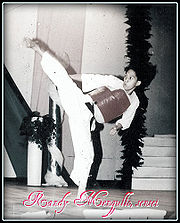
In English, the word sensei is most commonly used when referring to a martial arts instructor but it has also come to be used outside martial arts and other similarly cultural contexts. In business and industry, sensei is often used to refer to an outside, third-party expert who coaches or advises on operational and organizational excellence. In particular, James Womack's book Lean Thinking advises companies to seek out a "lean senseiLean manufacturing
Lean manufacturing, lean enterprise, or lean production, often simply, "Lean," is a production practice that considers the expenditure of resources for any goal other than the creation of value for the end customer to be wasteful, and thus a target for elimination...
" who can provide expert coaching on how to achieve organizational effectiveness. Lean sensei has since become a common term for describing an expert who can provide advice on operational and organizational strategy. A success story in American manufacturing is use of sensei by the Flex-N-Gate company as taught by Toyota.
See also
- Japanese martial arts titles
- ShishōShisho, , , and are Japanese titles used to refer to or address teachers or masters of traditional Japanese arts including, but not limited to noh, shamisen, koto, ikebana, shodo, rakugo, and Japanese martial arts....
- RoshiRoshiis a Japanese honorific title used in Zen Buddhism that literally means "old teacher" or "elder master" and sometimes denotes a person who gives spiritual guidance to a Zen sangha or congregation...
- ChineseChinese languageThe Chinese language is a language or language family consisting of varieties which are mutually intelligible to varying degrees. Originally the indigenous languages spoken by the Han Chinese in China, it forms one of the branches of Sino-Tibetan family of languages...
: sifuSifuShifu is the identical pronunciation of two Chinese terms for a master. The character 師 means “teacher”. The meaning of 傅 is “tutor”, and of 父, “father”. Both characters are read fu with the same tones in Cantonese and Mandarin, creating some ambiguity... - SanskritSanskritSanskrit , is a historical Indo-Aryan language and the primary liturgical language of Hinduism, Jainism and Buddhism.Buddhism: besides Pali, see Buddhist Hybrid Sanskrit Today, it is listed as one of the 22 scheduled languages of India and is an official language of the state of Uttarakhand...
: guruGuruA guru is one who is regarded as having great knowledge, wisdom, and authority in a certain area, and who uses it to guide others . Other forms of manifestation of this principle can include parents, school teachers, non-human objects and even one's own intellectual discipline, if the...