


Keicho

Encyclopedia
was a after Bunroku
and before Genna
. This period spanned from October 1596 to July 1615. The reigning emperors were and .


Bunroku
was a after Tenshō and before Keichō. This period spanned the years from December 1592 to October 1596. The reigning emperor was .-Change of era:* 1592 : The era name was changed...
and before Genna
Genna
was a coming after Keichō and before Kan'ei. This period spanned the years from July 1615 to February 1624. The reigning emperor was .-Change of era:...
. This period spanned from October 1596 to July 1615. The reigning emperors were and .
Change of era
- 1596 : The era name was changed to Keichō to mark the passing of various natural disasters. The preceding era ended and a new one commenced on October 27 of the 5th Bunroku.
Events of the Keichō era
- 1596 (Keichō 1): Keichō Invasion (invasion of KoreaKoreaKorea ) is an East Asian geographic region that is currently divided into two separate sovereign states — North Korea and South Korea. Located on the Korean Peninsula, Korea is bordered by the People's Republic of China to the northwest, Russia to the northeast, and is separated from Japan to the...
) - September 18, 1598 (Keichō 3, 18th day of the 8th month): Toyotomi HideyoshiToyotomi Hideyoshiwas a daimyo warrior, general and politician of the Sengoku period. He unified the political factions of Japan. He succeeded his former liege lord, Oda Nobunaga, and brought an end to the Sengoku period. The period of his rule is often called the Momoyama period, named after Hideyoshi's castle...
, the TaikoTaikomeans "drum" in Japanese . Outside Japan, the word is often used to refer to any of the various Japanese drums and to the relatively recent art-form of ensemble taiko drumming...
died in his Fushimi CastleFushimi Castle', also known as Momoyama Castle or Fushimi-Momoyama Castle, is a castle in Kyoto's Fushimi Ward. The current structure is a 1964 replica of the original built by Toyotomi Hideyoshi.-History:...
at the age of 63. - October 21, 1600 (Keichō 5, 15th day of the 9th month): Battle of SekigaharaBattle of SekigaharaThe , popularly known as the , was a decisive battle on October 21, 1600 which cleared the path to the Shogunate for Tokugawa Ieyasu...
. The Tokugawa clanTokugawa clanThe was a powerful daimyo family of Japan. They nominally descended from Emperor Seiwa and were a branch of the Minamoto clan by the Nitta clan. However, the early history of this clan remains a mystery.-History:...
and its allies decisively vanquish all opposition. - January 15, 1602 (Keichō 7, 24th day of the 11th month): A fire at the Hōkō-jiHoko-ji (Kyoto)is a temple in Kyoto, Japan, dating from the 16th century. Toyotomi Hideyoshi determined that the capital city should have a Daibutsu temple to surpass that of Nara. He is reputed to have claimed at the outset that he would complete construction in half the time it took Emperor Shōmu to complete...
temple complex in Kyoto was caused by careless workmen; and the great image of the buddha and the structure housing the statue (the Daibutsu-den) were consumed by the flames. - 1603 (Keichō 8): Tokugawa IeyasuTokugawa Ieyasuwas the founder and first shogun of the Tokugawa shogunate of Japan , which ruled from the Battle of Sekigahara in 1600 until the Meiji Restoration in 1868. Ieyasu seized power in 1600, received appointment as shogun in 1603, abdicated from office in 1605, but...
became ShogunShogunA was one of the hereditary military dictators of Japan from 1192 to 1867. In this period, the shoguns, or their shikken regents , were the de facto rulers of Japan though they were nominally appointed by the emperor...
, which effectively becomes the beginning of what will become the Edo bakufuTokugawa shogunateThe Tokugawa shogunate, also known as the and the , was a feudal regime of Japan established by Tokugawa Ieyasu and ruled by the shoguns of the Tokugawa family. This period is known as the Edo period and gets its name from the capital city, Edo, which is now called Tokyo, after the name was...
. Toyotomi HideyoriToyotomi Hideyoriwas the son and designated successor of Toyotomi Hideyoshi, the general who first united all of Japan. His mother, Yodo-dono, was the niece of Oda Nobunaga....
was elevated to Naidaijin in Miyako Daijō-kan. - 1604-1606 (Keichō 9-11): Tokugawa IeyasuTokugawa Ieyasuwas the founder and first shogun of the Tokugawa shogunate of Japan , which ruled from the Battle of Sekigahara in 1600 until the Meiji Restoration in 1868. Ieyasu seized power in 1600, received appointment as shogun in 1603, abdicated from office in 1605, but...
undertook the rebuilding of Asama ShrineAsama Shrineis a type of Shinto Shrine in Japan centered around the worship of the kami of volcanos in general, and Mount Fuji in particular.Per the Jinja Honchō, there are approximately 1300 Asama shrines in the country, centered primarily in Shizuoka Prefecture and Yamanashi Prefecture, and to a lesser...
at the base of Mount FujiMount Fujiis the highest mountain in Japan at . An active stratovolcano that last erupted in 1707–08, Mount Fuji lies about south-west of Tokyo, and can be seen from there on a clear day. Mount Fuji's exceptionally symmetrical cone is a well-known symbol of Japan and it is frequently depicted in art and...
in Suruga provinceSuruga Provincewas an old province in the area that is today the central part of Shizuoka prefecture. It was sometimes called . Suruga bordered on Izu, Kai, Sagami, Shinano, and Tōtōmi provinces; and had access to the Pacific Ocean through Suruga Bay.-History:...
in fulfillment of a vow and in gratitude for the help of the kami during the Battle of SekigaharaBattle of SekigaharaThe , popularly known as the , was a decisive battle on October 21, 1600 which cleared the path to the Shogunate for Tokugawa Ieyasu...
in 1600. - 1605 (Keichō 10): Tokugawa HidetadaTokugawa Hidetadawas the second shogun of the Tokugawa dynasty, who ruled from 1605 until his abdication in 1623. He was the third son of Tokugawa Ieyasu, the first shogun of the Tokugawa shogunate.-Early life :...
was named successor Shogun after his father "retires" from the position of Shogun. - 1605 (Keichō 10): The first official map of Japan was ordered in this year and completed in 1639 at a scale of 1:280,000.
- January 23, 1605 (Keichō 10, 15th day of the 12th month): A new volcanic island, Hachijōko-jima, arose from the sea at the side of in the which stretch south and east from the Izu Peninsula.
- 1606 (Keichō 11): Construction began on Edo CastleEdo Castle, also known as , is a flatland castle that was built in 1457 by Ōta Dōkan. It is located in Chiyoda in Tokyo, then known as Edo, Toshima District, Musashi Province. Tokugawa Ieyasu established the Tokugawa shogunate here. It was the residence of the shogun and location of the shogunate, and also...
. - 1607 (Keichō 12): Construction began on Sumpu Castle in SurugaSuruga Provincewas an old province in the area that is today the central part of Shizuoka prefecture. It was sometimes called . Suruga bordered on Izu, Kai, Sagami, Shinano, and Tōtōmi provinces; and had access to the Pacific Ocean through Suruga Bay.-History:...
; and an ambassador from China arrived with greetings for the emperor of Japan.
- 1609 (Keichō 14): Invasion of RyukyuInvasion of RyukyuThe invasion of Ryukyu by forces of the Japanese feudal domain of Satsuma took place in 1609, and marked the beginning of the Ryūkyū Kingdom's status as a vassal state under Satsuma...
by ShimazuShimazu clanThe were the daimyō of the Satsuma han, which spread over Satsuma, Ōsumi and Hyūga provinces in Japan.The Shimazu were identified as one of the tozama or outsider daimyō clans in contrast with the fudai or insider clans which were hereditary vassals or allies of the Tokugawa clan,The Shimazu were...
daimyoDaimyois a generic term referring to the powerful territorial lords in pre-modern Japan who ruled most of the country from their vast, hereditary land holdings...
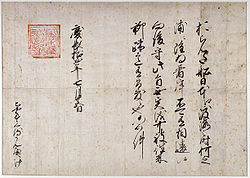
of Satsuma. - August 24, 1609 (Keichō 14, 25th day of the 6th month): Trading pass (handelpas) issued to Dutch East Indies Company in the name of Ieyasu Tokugawa.
- November 15, 1610 (Keichō 15, 30th day of the 9th month): Toyotomi HideyoriToyotomi Hideyoriwas the son and designated successor of Toyotomi Hideyoshi, the general who first united all of Japan. His mother, Yodo-dono, was the niece of Oda Nobunaga....
sponsors work which is begun to rebuild the Hōkō-ji in line with the plans which his father had supported; and this will include recreating the Daibutsu of Kyoto in bronze to replace the wooden image which had been burned. At this time, Hideyori also decides to order a great bell cast in bronze. - May 20, 1610 (Keichō 15, 27th day of the 3rd month): Hideyori came to Kyoto to visit the former-Shogun Tokugawa IeyasuTokugawa Ieyasuwas the founder and first shogun of the Tokugawa shogunate of Japan , which ruled from the Battle of Sekigahara in 1600 until the Meiji Restoration in 1868. Ieyasu seized power in 1600, received appointment as shogun in 1603, abdicated from office in 1605, but...
; and the same day, the emperor resigns in favor of his son Masahito. Emperor Go-YōzeiEmperor Go-Yozeiwas the 107th Emperor of Japan, according to the traditional order of succession.Go-Yōzei's reign spanned the years from 1586 through 1611, corresponding to the transition between the Azuchi-Momoyama period and the Edo period....
abdicates; and his son receives the succession (senso). - 1611 (Keichō 16): Emperor Go-MizunooEmperor Go-Mizunoowas the 108th Emperor of Japan, according to the traditional order of succession.Go-Mizunoo's reign spanned the years from 1611 through 1629.This 17th century sovereign was named after the 9th century Emperor Seiwa and , translates literally as "later;" and thus, he could be called the "Later...
formally accedes to the throne (sokui). - 1613 (Keichō 18): In the years 1613 through 1620, Hasekura TsunenagaHasekura TsunenagaHasekura Rokuemon Tsunenaga or was a Japanese samurai and retainer of Date Masamune, the daimyo of Sendai....
headed a diplomatic mission to the VaticanHoly SeeThe Holy See is the episcopal jurisdiction of the Catholic Church in Rome, in which its Bishop is commonly known as the Pope. It is the preeminent episcopal see of the Catholic Church, forming the central government of the Church. As such, diplomatically, and in other spheres the Holy See acts and...
in Rome, traveling through New SpainNew SpainNew Spain, formally called the Viceroyalty of New Spain , was a viceroyalty of the Spanish colonial empire, comprising primarily territories in what was known then as 'América Septentrional' or North America. Its capital was Mexico City, formerly Tenochtitlan, capital of the Aztec Empire...
(arriving in AcapulcoAcapulcoAcapulco is a city, municipality and major sea port in the state of Guerrero on the Pacific coast of Mexico, southwest from Mexico City. Acapulco is located on a deep, semi-circular bay and has been a port since the early colonial period of Mexico’s history...
and departing from VeracruzVeracruzVeracruz, formally Veracruz de Ignacio de la Llave officially Estado Libre y Soberano de Veracruz de Ignacio de la Llave , is one of the 31 states that, along with the Federal District, comprise the 32 federative entities of Mexico. It is divided in 212 municipalities and its capital city is...
) and visiting various ports-of-call in Europe. This historic mission is called the Keichō Embassy, . On the return trip, Hasekura and his companions re-traced their route across Mexico in 1619, sailing from Acapulco for Manilla, and then sailing north to Japan in 1620. This is conventionally considered the first Japanese ambassador in the AmericasAmericasThe Americas, or America , are lands in the Western hemisphere, also known as the New World. In English, the plural form the Americas is often used to refer to the landmasses of North America and South America with their associated islands and regions, while the singular form America is primarily...
and in Europe. - 1614 (Keichō 19): Siege of OsakaSiege of OsakaThe was a series of battles undertaken by the Tokugawa shogunate against the Toyotomi clan, and ending in that clan's destruction. Divided into two stages , and lasting from 1614 to 1615, the siege put an end to the last major armed opposition to the shogunate's establishment...
. The Shogun vanquished Hideyori and set fire to Osaka CastleOsaka Castleis a Japanese castle in Chūō-ku, Osaka, Japan.Originally called Ozakajō, it is one of Japan's most famous castles, and played a major role in the unification of Japan during the sixteenth century of the Azuchi-Momoyama period.-Description:...
, and then he returned for the winter to EdoEdo, also romanized as Yedo or Yeddo, is the former name of the Japanese capital Tokyo, and was the seat of power for the Tokugawa shogunate which ruled Japan from 1603 to 1868...
.
- August 24, 1614 (Keichō 19, 19th day of the 7th month): A new bronze bell for the Hōkō-ji was cast successfully -- see 19th century photo of Hōkō-ji belland see old photo of bell; but despite dedication ceremony planning, Ieyasu forbade any further actions concerning the great bell:
-
- "[T]he tablet over the Daibatsu-den and the bell bore the inscription "Kokka ankō" (meaning "the country and the house, peace and tranquility"), and at this Tokugawa Ieyasu affect to take umbrage, alleging that it was intended as a curse on him for the character 安 (an, "peace") was placed between the two characters composing his own name 家康 ("ka-kō", "house tranquility") [suggesting subtly perhaps that peace could only be attained by Ieyasu's dismemberment?] ... This incident of the inscription was, of course, a mere pretextPretextA pretext is an excuse to do something or say something. Pretexts may be based on a half-truth or developed in the context of a misleading fabrication. Pretexts have been used to conceal the true purpose or rationale behind actions and words....
, but Ieyasu realized that he could not enjoy the power he had usurped as long as Hideyori lived, and consequently, although the latter more than once dispatched his kerei Katagiri Kastumoto to Sunpu CastleSunpu Castlewas a Japanese castle in Shizuoka City, Shizuoka Prefecture in Japan. The sobriquet of this feudal fortress was the "Castle of the Floating Isle." It was also referred to as or .-History:...
with profuse apologies, Ieyasu refused to be placated."- October 18, 1614 (Keichō 19, 25th day of the 10th month): A strong earthquake shook Kyoto.
- 1615 (Keichō 20): Osaka Summer Battle begins.
- "[T]he tablet over the Daibatsu-den and the bell bore the inscription "Kokka ankō" (meaning "the country and the house, peace and tranquility"), and at this Tokugawa Ieyasu affect to take umbrage, alleging that it was intended as a curse on him for the character 安 (an, "peace") was placed between the two characters composing his own name 家康 ("ka-kō", "house tranquility") [suggesting subtly perhaps that peace could only be attained by Ieyasu's dismemberment?] ... This incident of the inscription was, of course, a mere pretext
Era developments
- Copper, silver and gold coins called Keichō-tsūhō were issued in the Keichō era; and they helped unify the currency system.
- Keichō-chokuhan, also called Keichō shinkoku-bon, were Imperial publications, produced during the Keichō era at the command of Emperor Go-YōzeiEmperor Go-Yozeiwas the 107th Emperor of Japan, according to the traditional order of succession.Go-Yōzei's reign spanned the years from 1586 through 1611, corresponding to the transition between the Azuchi-Momoyama period and the Edo period....
and printed using moveable type which had been imported from the Joseon Kingdom on the Korean peninsula. - Keichō no katsuji-ban was the general name for the first works printed with moveable typ during the Keichō era. also called the Kembun-shū was a book, a collection of tales and anecdotes compiled by Miura Jōshin (1565–1644).
External links
- National Diet LibraryNational Diet LibraryThe is the only national library in Japan. It was established in 1948 for the purpose of assisting members of the in researching matters of public policy. The library is similar in purpose and scope to the U.S...
, "The Japanese Calendar" -- historical overview plus illustrative images from library's collection
| Keichō | 1st | 2nd | 3rd | 4th | 5th | 6th | 7th | 8th | 9th | 10th | 11th | 12th | 13th | 14th | 15th | 16th | 17th | 18th | 19th | 20th |
| Gregorian Gregorian calendar The Gregorian calendar, also known as the Western calendar, or Christian calendar, is the internationally accepted civil calendar. It was introduced by Pope Gregory XIII, after whom the calendar was named, by a decree signed on 24 February 1582, a papal bull known by its opening words Inter... | 1596 | 1597 | 1598 | 1599 | 1600 | 1601 | 1602 | 1603 | 1604 | 1605 | 1606 | 1607 | 1608 | 1609 | 1610 | 1611 | 1612 | 1613 | 1614 | 1615 |
Preceded by: Bunroku Bunroku was a after Tenshō and before Keichō. This period spanned the years from December 1592 to October 1596. The reigning emperor was .-Change of era:* 1592 : The era name was changed... | Era or nengō Japanese era name The Japanese era calendar scheme is a common calendar scheme used in Japan, which identifies a year by the combination of the and the year number within the era... : Keichō | Succeeded by: Genna Genna was a coming after Keichō and before Kan'ei. This period spanned the years from July 1615 to February 1624. The reigning emperor was .-Change of era:... |