

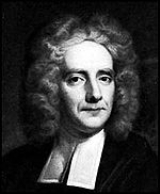
Samuel Clarke

Encyclopedia
Samuel Clarke was an English philosopher and Anglican clergyman.
was the reigning system at the university; Clarke, however, mastered the new system of Isaac Newton
, and contributed greatly to its extension by publishing a Latin
version of the Traité de physique of Jacques Rohault
(1617(?)-1672) with valuable notes, which he finished before he was twenty-two. The system of Rohault was founded entirely upon Cartesian principles, and was previously known only through the medium of a crude Latin version. Clarke's translation (1697) continued to be used as a text-book in the university till supplanted by the treatises of Newton, which it had been designed to introduce. Four editions were issued, the last and best being that of 1718. It was translated into English in 1723 by his younger brother Dr John Clarke
, dean of Salisbury
.
, he became chaplain to John Moore
, bishop of Norwich
, who became his friend and patron. In 1699 he published two treatises: Three Practical Essays on Baptism, Confirmation and Repentance and Some Reflections on that part of a book called Amyntor, or a Defence of Milton's Life, which relates to the Writings of the Primitive Fathers, and the Canon of the New Testament. In 1701 he published A Paraphrase upon the Gospel of St Matthew, which was followed, in 1702, by the Paraphrases upon the Gospels of St Mark and St Luke, and soon afterwards by a third volume upon St John. They were subsequently printed together in two volumes and have since passed through several editions. He intended to treat in the same manner the remaining books of the New Testament
, but his design was unfulfilled.
Meanwhile he had been presented by Bishop Moore to the rectory of Drayton
, near Norwich. As Boyle lecturer, he dealt in 1704 with the Being and Attributes of God, and in 1705 with the Evidences of Natural and Revealed Religion. These lectures, first printed separately, were afterwards published together under the title of A Discourse concerning the Being and Attributes of God, the Obligations of Natural Religion
, and the Truth and Certainly of the Christian Revelation, in opposition to Thomas Hobbes
, Spinoza
, the author of the Oracles of Reason, and other Deniers of Natural and Revealed Religion.
In 1706 he wrote a refutation of Dr Henry Dodwell
's views on the immortality of the soul, and this drew him into controversy with Anthony Collins
. He also translated Newton's Opticks
, for which the author presented him with £500. In the same year through the influence of Bishop Moore, he obtained the rectory of St Benet Paul's Wharf
, London. Soon afterwards Queen Anne
appointed him one of her chaplains in ordinary
, and in 1709 presented him to the rectory of St James's, Westminster. He then took the degree of doctor in divinity, defending as his thesis the two propositions: Nullum fidei Christianae dogma, in Sacris Scripturis traditum, est rectae rationi dissentaneum, and Sine actionum humanarum libertate nulla potest esse religio. During the same year, at the request of the author, he revised William Whiston
's English translation of the Apostolical Constitutions.
In 1712 he published a carefully punctuated and annotated edition of Caesar's Commentaries, with elegant engravings, dedicated to John Churchill, 1st Duke of Marlborough
. During the same year he published his celebrated treatise on The Scripture Doctrine of the Trinity. It is divided into three parts. The first contains a collection and exegesis of all the texts in the New Testament
relating to the doctrine of the Trinity; in the second the doctrine is set forth at large, and explained in particular and distinct propositions; and in the third the principal passages in the liturgy
of the Church of England
relating to the doctrine of the Trinity are considered. Whiston says that, some time before publication, a message was sent to him from Sidney Godolphin
"that the affairs of the public were with difficulty then kept in the hands of those that were for liberty; that it was therefore an unseasonable time for the publication of a book that would make a great noise and disturbance; and that therefore they desired him to forbear till a fitter opportunity should offer itself,"—a message that Clarke entirely disregarded. The ministers were right in their conjectures; the work not only provoked a great number of replies, but occasioned a formal complaint from the Lower House of Convocation
: the Blasphemy Act 1697 still made it an offence for any person, educated in or having made profession of the Christian religion, by writing, preaching, teaching or advised speaking, to deny the Holy Trinity. Clarke, in reply, drew up an apologetic preface, and afterwards gave several explanations, which satisfied the Upper House.
in 1707 and 1708 was a debate on the nature of consciousness. The principal focus of the correspondence was the possibility of a materialist theory of mind. Collins defended the materialist position that consciousness was an emergent property of the brain, while Clarke opposed such a view and argued that mind and consciousness must be distinct from matter. The correspondence also inquired into the origins of consciousness, personal identity, free will, and determinism.
relative to the principles of natural philosophy
and religion, which was at length cut short by the death of his antagonist. A collection of the papers which passed between them was published in 1717 (cf. GV Leroy, Die philos. Probleme in dem Briefwechsel Leibniz und Clarke, Giessen, 1893).
, F.R.S., occasioned by the controversy relating to the Proportion of Velocity and Force in Bodies in Motion," printed in the Philosophical Transactions. In 1729 he published the first twelve books of Homer
's Iliad
. This edition, dedicated to William Augustus, Duke of Cumberland, was highly praised by Bishop Hoadly. On Sunday, the 11th of May 1729, when going out to preach before the judges at Serjeants' Inn, he was seized with a sudden illness, which caused his death on the Saturday following.
Soon after his death his brother, Dr John Clarke
, published, from his original manuscripts, An Exposition of the Church Catechism
, and ten volumes of sermon
s. The Exposition is composed of the lectures which he read every Thursday morning, for some months in the year, at St James's church. In the latter part of his life he revised them with great care, and left them completely prepared for the press. Three years after his death appeared also the last twelve books of the Iliad, published by his son Samuel Clarke, the first three of these books and part of the fourth having, as he states, been revised and annotated by his father.
In disposition Clarke was cheerful and even playful. An intimate friend relates that he once found him swimming upon a table. At another time Clarke on looking out at the window saw a grave blockhead approaching the house; upon which he cried out, "Boys, boys, be wise; here comes a fool." Dr Warton, in his observations upon Pope's line, "Unthought-of frailties cheat us in the wise," says, "Who could imagine that Locke was fond of romances; that Newton once studied astrology; that Dr Clarke valued himself on his agility, and frequently amused himself in a private room of his house in leaping over the tables and chairs?"
, mathematics
, metaphysics
and philology
, but his chief strength lay in his logical power. The materialism
of Hobbes, the pantheism
of Spinoza, the empiricism
of Locke
, the determinism of Leibniz
, Collins
' necessitarianism, Dodwell
's denial of the natural immortality of the soul, rationalistic attacks on Christianity
, and the morality of the sensationalists
--all these he opposed with a thorough conviction of the truth of the principles which he advocated. His reputation rests to a large extent on his effort to demonstrate the existence of God and his theory of the foundation of rectitude. The former is not a purely a priori
argument, nor is it presented as such by its author. It starts from a fact and it often explicitly appeals to facts. The intelligence, for example, of the self-existence arid original cause of all things is, he says, "not easily proved a priori," but "demonstrably proved a posteriori from the variety and degrees of perfection in things, and the order of causes and effects, from the intelligence that created beings are confessedly endowed with, and from the beauty, order, and final purpose of things." The theses maintained in the argument are:
In order to establish his sixth thesis, Clarke contends that time and space, eternity and immensity, are not substances, but attributes-the attributes of a self-existent being. Edmund Law
, Dugald Stewart
, Lord Brougham
, and many other writers, have, in consequence, represented Clarke as arguing from the existence of time and space to the existence of Deity. This may be regarded as a mis-interpretation. The existence of an immutable, independent, and necessary being is supposed to be proved before any reference is made to the nature of time and space. Clarke has been generally supposed to have derived the opinion that time and space are attributes of an infinite immaterial and spiritual being from the Scholium Generale, first published in the second edition of Newton's Principia (1713). However, Clarke's work on the Being and Attributes of God appeared nine years before that Scholium. The view propounded by Clarke may have been derived from the Midrash
, the Kabbalah
, Philo
, Henry More
, or Cudworth
, or possibly from conversations with Newton.
Clarke's ethical theory of "fitness" is formulated on the analogy of mathematics. He held that in relation to the will things possess an objective fitness similar to the mutual consistency of things in the physical universe. This fitness God has given to actions, as he has given laws to Nature; and the fitness is as immutable as the laws. The theory was criticized by Jouffroy
, Amédée Jacques
, Sir James Mackintosh, Thomas Brown
and others. It is said, for example, that Clarke made virtue consist in conformity to the relations of things universally, although the whole tenor of his argument shows him to have had in view conformity to such relations only as belong to the sphere of moral agency. It is true that he might have emphasized the relation of moral fitness to the will, and in this respect Johann Friedrich Herbart
has been regarded as having improved on Clarke's statement of the case. To say, however, that Clarke simply confused mathematics and morals by justifying the moral criterion on a mathematical basis is a mistake. He compared the two subjects for the sake of the analogy.
Clarke had an influence on Enlightenment
philosophers including Lord Monboddo, who referred to Clarke's writings in at least twelve different publications. Generally Monboddo concurred with Clarke on theological topics and in regard to Newtonian ideas, but criticized Clarke for his "inadequate knowledge" of the ancients.
Clarke's work as a whole has been regarded as an attempt to present the doctrines of the Cartesian school in a form which would not shock the conscience of his time.
Attribution
Early life and studies
He was the son of Edward Clarke, an alderman who represented the city of Norwich in parliament, and brother of John Clarke. He was educated at the free school of Norwich and at Caius College, Cambridge. The philosophy of René DescartesRené Descartes
René Descartes ; was a French philosopher and writer who spent most of his adult life in the Dutch Republic. He has been dubbed the 'Father of Modern Philosophy', and much subsequent Western philosophy is a response to his writings, which are studied closely to this day...
was the reigning system at the university; Clarke, however, mastered the new system of Isaac Newton
Isaac Newton
Sir Isaac Newton PRS was an English physicist, mathematician, astronomer, natural philosopher, alchemist, and theologian, who has been "considered by many to be the greatest and most influential scientist who ever lived."...
, and contributed greatly to its extension by publishing a Latin
Latin
Latin is an Italic language originally spoken in Latium and Ancient Rome. It, along with most European languages, is a descendant of the ancient Proto-Indo-European language. Although it is considered a dead language, a number of scholars and members of the Christian clergy speak it fluently, and...
version of the Traité de physique of Jacques Rohault
Jacques Rohault
Jacques Rohault was a French philosopher, physicist and mathematician, and a follower of Cartesianism.Rohault was born in Amiens, the son of a wealthy wine merchant, and educated in Paris. Having grown up with the conventional scholastic philosophy of his day, he adopted and popularised the new...
(1617(?)-1672) with valuable notes, which he finished before he was twenty-two. The system of Rohault was founded entirely upon Cartesian principles, and was previously known only through the medium of a crude Latin version. Clarke's translation (1697) continued to be used as a text-book in the university till supplanted by the treatises of Newton, which it had been designed to introduce. Four editions were issued, the last and best being that of 1718. It was translated into English in 1723 by his younger brother Dr John Clarke
John Clarke (dean of Salisbury)
John Clarke was an English natural philosopher and Dean of Salisbury from 1728 to his death in 1757.-Life:He was a younger brother of Samuel Clarke, and was born at Norwich, his father being Edward Clarke, textile manufacturer and alderman , who married Hannah, daughter of Samuel Parmeter. After...
, dean of Salisbury
Dean of Salisbury
The Dean of Salisbury is the Head of the Chapter of Salisbury Cathedral in the Church of England. The current Dean is The Very Revd June Osborne, who was installed in 2004.-Selected office-holders:*Walter 1102*Osbert 1105*Robert 1111*Serlo 1122...
.
Religious studies
Clarke afterwards devoted himself to the study of scripture in the original, and of the primitive Christian writers. Having taken holy ordersHoly Orders
The term Holy Orders is used by many Christian churches to refer to ordination or to those individuals ordained for a special role or ministry....
, he became chaplain to John Moore
John Moore (Bishop of Ely)
John Moore was an English cleric, scholar, and book collector. He was bishop of Norwich and bishop of Ely ....
, bishop of Norwich
Bishop of Norwich
The Bishop of Norwich is the Ordinary of the Church of England Diocese of Norwich in the Province of Canterbury.The diocese covers most of the County of Norfolk and part of Suffolk. The see is in the City of Norwich where the seat is located at the Cathedral Church of the Holy and Undivided...
, who became his friend and patron. In 1699 he published two treatises: Three Practical Essays on Baptism, Confirmation and Repentance and Some Reflections on that part of a book called Amyntor, or a Defence of Milton's Life, which relates to the Writings of the Primitive Fathers, and the Canon of the New Testament. In 1701 he published A Paraphrase upon the Gospel of St Matthew, which was followed, in 1702, by the Paraphrases upon the Gospels of St Mark and St Luke, and soon afterwards by a third volume upon St John. They were subsequently printed together in two volumes and have since passed through several editions. He intended to treat in the same manner the remaining books of the New Testament
New Testament
The New Testament is the second major division of the Christian biblical canon, the first such division being the much longer Old Testament....
, but his design was unfulfilled.
Meanwhile he had been presented by Bishop Moore to the rectory of Drayton
Drayton
- In the United Kingdom :* Drayton, Hampshire* Drayton, Leicestershire* Drayton, Lincolnshire* Drayton, Norfolk* Drayton, Northamptonshire** Drayton Reservoir, Northamptonshire* Drayton, Cherwell, Oxfordshire* Drayton, Vale of White Horse, Oxfordshire...
, near Norwich. As Boyle lecturer, he dealt in 1704 with the Being and Attributes of God, and in 1705 with the Evidences of Natural and Revealed Religion. These lectures, first printed separately, were afterwards published together under the title of A Discourse concerning the Being and Attributes of God, the Obligations of Natural Religion
Natural religion
Natural religion might have the following meanings:* In the modern study of religion it is used to refer to the notion that there is a spontaneous religious apprehension of the world common to all human beings, see:**Urreligion**origin of religion...
, and the Truth and Certainly of the Christian Revelation, in opposition to Thomas Hobbes
Thomas Hobbes
Thomas Hobbes of Malmesbury , in some older texts Thomas Hobbs of Malmsbury, was an English philosopher, best known today for his work on political philosophy...
, Spinoza
Baruch Spinoza
Baruch de Spinoza and later Benedict de Spinoza was a Dutch Jewish philosopher. Revealing considerable scientific aptitude, the breadth and importance of Spinoza's work was not fully realized until years after his death...
, the author of the Oracles of Reason, and other Deniers of Natural and Revealed Religion.
In 1706 he wrote a refutation of Dr Henry Dodwell
Henry Dodwell
Henry Dodwell was an Anglo-Irish scholar, theologian and controversial writer.-Life:He was born in Dublin, Ireland. His father, William Dodwell, lost his property in Connacht during the Irish rebellion and settled at York in 1648...
's views on the immortality of the soul, and this drew him into controversy with Anthony Collins
Anthony Collins
Anthony Collins , was an English philosopher, and a proponent of deism.-Life and Writings:...
. He also translated Newton's Opticks
Opticks
Opticks is a book written by English physicist Isaac Newton that was released to the public in 1704. It is about optics and the refraction of light, and is considered one of the great works of science in history...
, for which the author presented him with £500. In the same year through the influence of Bishop Moore, he obtained the rectory of St Benet Paul's Wharf
St Benet Paul's Wharf
The Church of St Benet Paul's Wharf is the Welsh church of the City of London. Since 1555, it has also been the church of the College of Arms, and many officers of arms are buried there. The current church was designed by Sir Christopher Wren.-History:...
, London. Soon afterwards Queen Anne
Anne of Great Britain
Anne ascended the thrones of England, Scotland and Ireland on 8 March 1702. On 1 May 1707, under the Act of Union, two of her realms, England and Scotland, were united as a single sovereign state, the Kingdom of Great Britain.Anne's Catholic father, James II and VII, was deposed during the...
appointed him one of her chaplains in ordinary
Ecclesiastical Household
The Ecclesiastical Household is a part of the Royal Household of the Sovereign of the United Kingdom. Reflecting the different constitutions of the Churches of England and of Scotland, there are separate Ecclesiastical Households in each nation.-England:...
, and in 1709 presented him to the rectory of St James's, Westminster. He then took the degree of doctor in divinity, defending as his thesis the two propositions: Nullum fidei Christianae dogma, in Sacris Scripturis traditum, est rectae rationi dissentaneum, and Sine actionum humanarum libertate nulla potest esse religio. During the same year, at the request of the author, he revised William Whiston
William Whiston
William Whiston was an English theologian, historian, and mathematician. He is probably best known for his translation of the Antiquities of the Jews and other works by Josephus, his A New Theory of the Earth, and his Arianism...
's English translation of the Apostolical Constitutions.
In 1712 he published a carefully punctuated and annotated edition of Caesar's Commentaries, with elegant engravings, dedicated to John Churchill, 1st Duke of Marlborough
John Churchill, 1st Duke of Marlborough
John Churchill, 1st Duke of Marlborough, Prince of Mindelheim, KG, PC , was an English soldier and statesman whose career spanned the reigns of five monarchs through the late 17th and early 18th centuries...
. During the same year he published his celebrated treatise on The Scripture Doctrine of the Trinity. It is divided into three parts. The first contains a collection and exegesis of all the texts in the New Testament
New Testament
The New Testament is the second major division of the Christian biblical canon, the first such division being the much longer Old Testament....
relating to the doctrine of the Trinity; in the second the doctrine is set forth at large, and explained in particular and distinct propositions; and in the third the principal passages in the liturgy
Liturgy
Liturgy is either the customary public worship done by a specific religious group, according to its particular traditions or a more precise term that distinguishes between those religious groups who believe their ritual requires the "people" to do the "work" of responding to the priest, and those...
of the Church of England
Church of England
The Church of England is the officially established Christian church in England and the Mother Church of the worldwide Anglican Communion. The church considers itself within the tradition of Western Christianity and dates its formal establishment principally to the mission to England by St...
relating to the doctrine of the Trinity are considered. Whiston says that, some time before publication, a message was sent to him from Sidney Godolphin
Sidney Godolphin, 1st Earl of Godolphin
Sir Sidney Godolphin, 1st Earl of Godolphin, KG, PC was a leading English politician of the late 17th and early 18th centuries...
"that the affairs of the public were with difficulty then kept in the hands of those that were for liberty; that it was therefore an unseasonable time for the publication of a book that would make a great noise and disturbance; and that therefore they desired him to forbear till a fitter opportunity should offer itself,"—a message that Clarke entirely disregarded. The ministers were right in their conjectures; the work not only provoked a great number of replies, but occasioned a formal complaint from the Lower House of Convocation
Convocation of the English Clergy
The Convocation of the English Clergy is a synodical assembly of the Church of England consisting of bishops and clergy.- Background and introduction :...
: the Blasphemy Act 1697 still made it an offence for any person, educated in or having made profession of the Christian religion, by writing, preaching, teaching or advised speaking, to deny the Holy Trinity. Clarke, in reply, drew up an apologetic preface, and afterwards gave several explanations, which satisfied the Upper House.
Correspondence with Anthony Collins
The public correspondence of Samuel Clarke with the English freethinker Anthony CollinsAnthony Collins
Anthony Collins , was an English philosopher, and a proponent of deism.-Life and Writings:...
in 1707 and 1708 was a debate on the nature of consciousness. The principal focus of the correspondence was the possibility of a materialist theory of mind. Collins defended the materialist position that consciousness was an emergent property of the brain, while Clarke opposed such a view and argued that mind and consciousness must be distinct from matter. The correspondence also inquired into the origins of consciousness, personal identity, free will, and determinism.
Correspondence with Leibniz
In 1715 and 1716 he had a discussion with Gottfried LeibnizGottfried Leibniz
Gottfried Wilhelm Leibniz was a German philosopher and mathematician. He wrote in different languages, primarily in Latin , French and German ....
relative to the principles of natural philosophy
Natural philosophy
Natural philosophy or the philosophy of nature , is a term applied to the study of nature and the physical universe that was dominant before the development of modern science...
and religion, which was at length cut short by the death of his antagonist. A collection of the papers which passed between them was published in 1717 (cf. GV Leroy, Die philos. Probleme in dem Briefwechsel Leibniz und Clarke, Giessen, 1893).
Later life and works
In 1719 he was presented by Nicholas 1st Baron Lechmere, to the mastership of Wigston's hospital in Leicester. In 1724 he published seventeen sermons, eleven of which had not before been printed. In 1727, on the death of Sir Isaac Newton, he was offered by the court the place of master of the mint, worth on an average from £1200 to £1500 a year. This secular preferment, however, he absolutely refused. In 1728 was published "A Letter from Dr Clarke to Benjamin HoadlyBenjamin Hoadly
Benjamin Hoadly was an English clergyman, who was successively Bishop of Bangor, Hereford, Salisbury, and Winchester. He is best known as the initiator of the Bangorian Controversy.-Life:...
, F.R.S., occasioned by the controversy relating to the Proportion of Velocity and Force in Bodies in Motion," printed in the Philosophical Transactions. In 1729 he published the first twelve books of Homer
Homer
In the Western classical tradition Homer , is the author of the Iliad and the Odyssey, and is revered as the greatest ancient Greek epic poet. These epics lie at the beginning of the Western canon of literature, and have had an enormous influence on the history of literature.When he lived is...
's Iliad
Iliad
The Iliad is an epic poem in dactylic hexameters, traditionally attributed to Homer. Set during the Trojan War, the ten-year siege of the city of Troy by a coalition of Greek states, it tells of the battles and events during the weeks of a quarrel between King Agamemnon and the warrior Achilles...
. This edition, dedicated to William Augustus, Duke of Cumberland, was highly praised by Bishop Hoadly. On Sunday, the 11th of May 1729, when going out to preach before the judges at Serjeants' Inn, he was seized with a sudden illness, which caused his death on the Saturday following.
Soon after his death his brother, Dr John Clarke
John Clarke (dean of Salisbury)
John Clarke was an English natural philosopher and Dean of Salisbury from 1728 to his death in 1757.-Life:He was a younger brother of Samuel Clarke, and was born at Norwich, his father being Edward Clarke, textile manufacturer and alderman , who married Hannah, daughter of Samuel Parmeter. After...
, published, from his original manuscripts, An Exposition of the Church Catechism
Catechism
A catechism , i.e. to indoctrinate) is a summary or exposition of doctrine, traditionally used in Christian religious teaching from New Testament times to the present...
, and ten volumes of sermon
Sermon
A sermon is an oration by a prophet or member of the clergy. Sermons address a Biblical, theological, religious, or moral topic, usually expounding on a type of belief, law or behavior within both past and present contexts...
s. The Exposition is composed of the lectures which he read every Thursday morning, for some months in the year, at St James's church. In the latter part of his life he revised them with great care, and left them completely prepared for the press. Three years after his death appeared also the last twelve books of the Iliad, published by his son Samuel Clarke, the first three of these books and part of the fourth having, as he states, been revised and annotated by his father.
In disposition Clarke was cheerful and even playful. An intimate friend relates that he once found him swimming upon a table. At another time Clarke on looking out at the window saw a grave blockhead approaching the house; upon which he cried out, "Boys, boys, be wise; here comes a fool." Dr Warton, in his observations upon Pope's line, "Unthought-of frailties cheat us in the wise," says, "Who could imagine that Locke was fond of romances; that Newton once studied astrology; that Dr Clarke valued himself on his agility, and frequently amused himself in a private room of his house in leaping over the tables and chairs?"
Works
- The Scripture-Doctrine of the Trinity; London: Printed for James Knapton, at theCrown in St. Paul's Church-Yard, 1712
- notes on the Book of Common PrayerBook of Common PrayerThe Book of Common Prayer is the short title of a number of related prayer books used in the Anglican Communion, as well as by the Continuing Anglican, "Anglican realignment" and other Anglican churches. The original book, published in 1549 , in the reign of Edward VI, was a product of the English...
which became the source of Theophilus LindseyTheophilus LindseyTheophilus Lindsey was an English theologian and clergyman who founded the first avowedly Unitarian congregation in the country, at Essex Street Chapel.-Life:...
's The Book of Common Prayer Reformed According to the Plan of the Late Dr. Samuel Clarke l774
Philosophy
Clarke was eminent in theologyTheology
Theology is the systematic and rational study of religion and its influences and of the nature of religious truths, or the learned profession acquired by completing specialized training in religious studies, usually at a university or school of divinity or seminary.-Definition:Augustine of Hippo...
, mathematics
Mathematics
Mathematics is the study of quantity, space, structure, and change. Mathematicians seek out patterns and formulate new conjectures. Mathematicians resolve the truth or falsity of conjectures by mathematical proofs, which are arguments sufficient to convince other mathematicians of their validity...
, metaphysics
Metaphysics
Metaphysics is a branch of philosophy concerned with explaining the fundamental nature of being and the world, although the term is not easily defined. Traditionally, metaphysics attempts to answer two basic questions in the broadest possible terms:...
and philology
Philology
Philology is the study of language in written historical sources; it is a combination of literary studies, history and linguistics.Classical philology is the philology of Greek and Classical Latin...
, but his chief strength lay in his logical power. The materialism
Materialism
In philosophy, the theory of materialism holds that the only thing that exists is matter; that all things are composed of material and all phenomena are the result of material interactions. In other words, matter is the only substance...
of Hobbes, the pantheism
Pantheism
Pantheism is the view that the Universe and God are identical. Pantheists thus do not believe in a personal, anthropomorphic or creator god. The word derives from the Greek meaning "all" and the Greek meaning "God". As such, Pantheism denotes the idea that "God" is best seen as a process of...
of Spinoza, the empiricism
Empiricism
Empiricism is a theory of knowledge that asserts that knowledge comes only or primarily via sensory experience. One of several views of epistemology, the study of human knowledge, along with rationalism, idealism and historicism, empiricism emphasizes the role of experience and evidence,...
of Locke
John Locke
John Locke FRS , widely known as the Father of Liberalism, was an English philosopher and physician regarded as one of the most influential of Enlightenment thinkers. Considered one of the first of the British empiricists, following the tradition of Francis Bacon, he is equally important to social...
, the determinism of Leibniz
Gottfried Leibniz
Gottfried Wilhelm Leibniz was a German philosopher and mathematician. He wrote in different languages, primarily in Latin , French and German ....
, Collins
Anthony Collins
Anthony Collins , was an English philosopher, and a proponent of deism.-Life and Writings:...
' necessitarianism, Dodwell
Henry Dodwell
Henry Dodwell was an Anglo-Irish scholar, theologian and controversial writer.-Life:He was born in Dublin, Ireland. His father, William Dodwell, lost his property in Connacht during the Irish rebellion and settled at York in 1648...
's denial of the natural immortality of the soul, rationalistic attacks on Christianity
Christianity
Christianity is a monotheistic religion based on the life and teachings of Jesus as presented in canonical gospels and other New Testament writings...
, and the morality of the sensationalists
Sensationalism
Sensationalism is a type of editorial bias in mass media in which events and topics in news stories and pieces are over-hyped to increase viewership or readership numbers...
--all these he opposed with a thorough conviction of the truth of the principles which he advocated. His reputation rests to a large extent on his effort to demonstrate the existence of God and his theory of the foundation of rectitude. The former is not a purely a priori
A priori and a posteriori (philosophy)
The terms a priori and a posteriori are used in philosophy to distinguish two types of knowledge, justifications or arguments...
argument, nor is it presented as such by its author. It starts from a fact and it often explicitly appeals to facts. The intelligence, for example, of the self-existence arid original cause of all things is, he says, "not easily proved a priori," but "demonstrably proved a posteriori from the variety and degrees of perfection in things, and the order of causes and effects, from the intelligence that created beings are confessedly endowed with, and from the beauty, order, and final purpose of things." The theses maintained in the argument are:
- That something has existed from eternity
- that there has existed from eternity some one immutable and independent being
- that that immutable and independent being, which has existed from eternity, without any external cause of its existence, must be self-existent, that is, necessarily existing
- what the substance or essence of that being is, which is self-existent or necessarily existing, we have no idea, neither is it at all possible for us to comprehend it
- that though the substance or essence of the self-existent being is itself absolutely incomprehensible to us, yet many of the essential attributee of his nature are strictly demonstrable as well as his existence, and, in the first place, that he must be of necessity eternal
- that the self-existent being must of necessity be infinite and omnipresent
- must be but one
- must be an intelligent being
- must be not a necessary agent, but a being endued with liberty and choice
- must of necessity have infinite power
- must be infinitely wise, and
- must of necessity be a being of infinite goodness, justice, and truth, and all other moral perfections, such as become the supreme governor and judge of the world.
In order to establish his sixth thesis, Clarke contends that time and space, eternity and immensity, are not substances, but attributes-the attributes of a self-existent being. Edmund Law
Edmund Law
Edmund Law was a priest in the Church of England. He served as Master of Peterhouse, Cambridge, as Knightbridge Professor of Philosophy in the University of Cambridge from 1764 to 1769, and as bishop of Carlisle from 1768 to 1787....
, Dugald Stewart
Dugald Stewart
Dugald Stewart was a Scottish Enlightenment philosopher and mathematician. His father, Matthew Stewart , was professor of mathematics in the University of Edinburgh .-Life and works:...
, Lord Brougham
Henry Brougham, 1st Baron Brougham and Vaux
Henry Peter Brougham, 1st Baron Brougham and Vaux was a British statesman who became Lord Chancellor of Great Britain.As a young lawyer in Scotland Brougham helped to found the Edinburgh Review in 1802 and contributed many articles to it. He went to London, and was called to the English bar in...
, and many other writers, have, in consequence, represented Clarke as arguing from the existence of time and space to the existence of Deity. This may be regarded as a mis-interpretation. The existence of an immutable, independent, and necessary being is supposed to be proved before any reference is made to the nature of time and space. Clarke has been generally supposed to have derived the opinion that time and space are attributes of an infinite immaterial and spiritual being from the Scholium Generale, first published in the second edition of Newton's Principia (1713). However, Clarke's work on the Being and Attributes of God appeared nine years before that Scholium. The view propounded by Clarke may have been derived from the Midrash
Midrash
The Hebrew term Midrash is a homiletic method of biblical exegesis. The term also refers to the whole compilation of homiletic teachings on the Bible....
, the Kabbalah
Kabbalah
Kabbalah/Kabala is a discipline and school of thought concerned with the esoteric aspect of Rabbinic Judaism. It was systematized in 11th-13th century Hachmei Provence and Spain, and again after the Expulsion from Spain, in 16th century Ottoman Palestine...
, Philo
Philo
Philo , known also as Philo of Alexandria , Philo Judaeus, Philo Judaeus of Alexandria, Yedidia, "Philon", and Philo the Jew, was a Hellenistic Jewish Biblical philosopher born in Alexandria....
, Henry More
Henry More
Henry More FRS was an English philosopher of the Cambridge Platonist school.-Biography:Henry was born at Grantham and was schooled at The King's School, Grantham and at Eton College...
, or Cudworth
Ralph Cudworth
Ralph Cudworth was an English philosopher, the leader of the Cambridge Platonists.-Life:Born at Aller, Somerset, he was educated at Emmanuel College, Cambridge, gaining his MA and becoming a Fellow of Emmanuel in 1639. In 1645, he became master of Clare Hall and professor of Hebrew...
, or possibly from conversations with Newton.
Clarke's ethical theory of "fitness" is formulated on the analogy of mathematics. He held that in relation to the will things possess an objective fitness similar to the mutual consistency of things in the physical universe. This fitness God has given to actions, as he has given laws to Nature; and the fitness is as immutable as the laws. The theory was criticized by Jouffroy
Théodore Simon Jouffroy
Théodore Simon Jouffroy was a French philosopher.He was born at Les Pontets, Franche-Comté, département of Doubs. In his tenth year, his father, a tax-gatherer, sent him to an uncle at Pontarlier, under whom he began his classical studies...
, Amédée Jacques
Amédée Jacques
Amédée Jacques , often known as Amadeo, was a Franco-Argentine pedagogue and philosopher and one of the most prestigious educators of his time.-Biography:...
, Sir James Mackintosh, Thomas Brown
Thomas Brown (philosopher)
Thomas Brown FRSE was a Scottish metaphysician.He was born at Kirkmabreck, Kirkcudbright, where his father Rev. Samuel Brown was parish clergyman. He was a wide reader and an eager student...
and others. It is said, for example, that Clarke made virtue consist in conformity to the relations of things universally, although the whole tenor of his argument shows him to have had in view conformity to such relations only as belong to the sphere of moral agency. It is true that he might have emphasized the relation of moral fitness to the will, and in this respect Johann Friedrich Herbart
Johann Friedrich Herbart
Johann Friedrich Herbart was a German philosopher, psychologist, and founder of pedagogy as an academic discipline....
has been regarded as having improved on Clarke's statement of the case. To say, however, that Clarke simply confused mathematics and morals by justifying the moral criterion on a mathematical basis is a mistake. He compared the two subjects for the sake of the analogy.
Clarke had an influence on Enlightenment
Age of Enlightenment
The Age of Enlightenment was an elite cultural movement of intellectuals in 18th century Europe that sought to mobilize the power of reason in order to reform society and advance knowledge. It promoted intellectual interchange and opposed intolerance and abuses in church and state...
philosophers including Lord Monboddo, who referred to Clarke's writings in at least twelve different publications. Generally Monboddo concurred with Clarke on theological topics and in regard to Newtonian ideas, but criticized Clarke for his "inadequate knowledge" of the ancients.
Clarke's work as a whole has been regarded as an attempt to present the doctrines of the Cartesian school in a form which would not shock the conscience of his time.
External links
Attribution